Saturday, January 7, 2017

Two sermons from our Seminarian. . .


Sermon for the Feast of St. Thomas, Apostle, observed.  Preached by the Rev. Sem. Coleman Geraci.

Grace to you and peace from God our Father and the Lord Jesus Christ. Amen.

Although yesterday was the feast of St. Thomas, today we commemorate it today and our Gospel reading that highlights Thomas. I’d love to say that we have a stunning profile of how extraordinary a disciple St. Thomas is. But, that just isn’t the case. That really isn’t the case for any of the disciples. The Lord didn't choose a bunch of straight laced, well to do,  Concordia Seminary St. Louis educated men to be his disciples. (He would have chosen Ft. Wayne guys obviously). He chose twelve seemingly ordinary, normal men – tax collectors, fisherman –sinners, like you and me. And in fact, in today’s Gospel, St. Thomas reminds us of how ordinary all the disciples were –how normal they were.

In the Gospel reading, we get a glimpse of how normal Thomas was. Instead of painting Thomas as a great hero of faith we get a picture of a skeptical man. Maybe there is some divine humor that today we commemorate Thomas, an Apostle, who is best known for being an unbelieving or doubting disciple. No one ever uses St. Thomas in a complimentary way. No one ever says,  “Oh, that man is a Thomas because he is a Twin.” No, you get called a Thomas because you are a doubter, unbelieving. You don’t get called a Thomas for making a bold statement of faith, a bold confession –arguably the greatest confession in Scripture –no, you get called a Thomas because you won’t believe until you see.

You see, St. Thomas is very much a reminder of how normal the disciples were. But more than that, how abnormal believing is -how extraordinary, how difficult believing is for us our own. Not just how abnormal, difficult, and extraordinary, but how downright impossible believing on our own is. And we as good Lutherans should know this well. We confess it in our Small Catechism. “I cannot by my own strength or reason believe in my Lord Jesus Christ or come to him.” For Thomas, on his own strength or reason, he would not believe.

St. Thomas wouldn't believe the disciples’ message. It almost seems as if Thomas could understand that the other disciples may have seen someone resembling Jesus. Maybe someone that had an appearance of Jesus, that looked and spoke like Jesus, but certainly not the Jesus Thomas knew.

Certainly not the Jesus Thomas had seen taken away to Chief priests and then onto Pilate. Certainly not the Jesus that had been mocked, scorned, beaten, led away to Golgotha. Certainly not the Jesus who had his hands and feet nailed to cross, that after that cross was lifted up, died hanging there.  Certainly not the Jesus who had his side pierced to make sure He was dead.

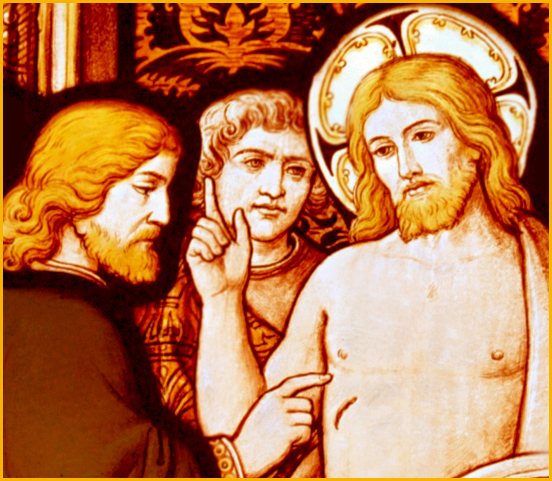
No, Thomas wouldn't believe the disciples had seen that crucified Jesus unless he placed his hands in those wounds. Without that evidence, Thomas would never believe the crucified Jesus he knew was raised from the dead. But that Jesus, the Crucified Jesus, the Resurrected Jesus, that Lord Jesus mercifully comes to Thomas.

The Lord would not leave Thomas in his unbelief. Eight days after the Resurrection, while the disciples were all gathered together in a locked room, the Lord appears in their midst and says, “Peace be with you.” As if the Lord’s extraordinary entrance into the locked room wasn’t enough, and as if His extraordinary words spoken weren’t enough, Jesus gives more. He turns to Thomas and gives Himself to him. The Lord mercifully gives Thomas His hands and side. “Place your hands here… do not disbelieve but believe.”  And Thomas replies the only way he can, making the most profound confession in Scripture, crying out “My Lord and My God!”

And Jesus, gently rebuking Thomas, questions, “Have you believed because you have seen me? Blessed are those who have not seen yet have believed.” But don't mistake our Lord’s words here. Those who have not seen are not without evidence. Those who have not seen are not without a witness. No, those who have not seen are those to whom Jesus has given the Apostles, and Prophets, and Evangelists. He has given the shepherds, the pastors, and teachers. He gave these gifts to His people, to His Church that, though not having seen His glorified and resurrected body, they would still believe. He gives those gifts for you. But Jesus always gives extraordinarily more.

We do confess in the Small Catechism that we cannot by our own strength or reason believe in our Lord Jesus Christ or come to him. This is most certainly true. But Jesus, who is merciful, will not leave us in our unbelief. And we know this from the completion of the explanation in the Small Catechism.  “But the Holy Spirit has called me by the Gospel, enlightened me with His gifts, sanctified and kept me in the true faith.” Jesus gives His Holy Spirit to us. He gives His Holy Spirit to His church. He gives His Holy Spirit to you. And this Holy Spirit calls you us through Christ’s Word, through Christ’s promises, through Christ’s Gospel.

He calls us through the waters of baptism, the place where Christ’s Word of promise seals you as His own; where your sins are washed away; where His Spirit is poured out upon you; where He brings you into His holy church.

He calls you through the words of Apostles and Prophets, and Evangelists, read here for you today. He calls you through the words of the under shepherds, the pastors, as they stand in Christ’s stead, forgiving you your sins.

But Jesus always gives extraordinarily more. As Jesus breaks into our lives and speaks His word of peace to us, He turns to each of us and gives His body and blood. Today in this meal, He gives Himself anew, afresh into your mouth. He gives to you His very body and blood for the forgiveness of your sins, for the assurance of life and salvation. He gives Himself to you that you might be strengthened and kept steadfast in the true faith to life everlasting.

He gives Himself to you this day that you would not be disbelieving, but believing. He gives Himself to you today, as He has continually given Himself to all the saints who have come before us, and all those who will come after us. He gives himself to you as He gave himself to St. Thomas. And we receive Him and His gifts that we might confess with St. Thomas, “My Lord and My God!”  Amen.

Sermon for the Holy Innocents.  Preached by the Rev. Sem. Coleman Geraci.

In the name of the Father and of the Son and of the Holy Spirit. Amen.

I had no way of introducing the Feast Day we commemorate or the text for today lightly, so I am going to be up front and blunt about it: The events recounted in the Gospel lesson today are horrific. Today’s Gospel reading, appointed for just four days after the celebration of the Incarnation of our Lord is a harrowing reminder that evil, sin, and death still exist in the world. Four days after we have sung the chorus of “Glory to God in the highest and peace to his people on earth,” we now weep with Rachel who will not be comforted. We are taken from the joy and glad tidings of this celebration thrust back into the reality of this broken creation – this place where sin, evil, and death still persist.

Today’s reading is the completion of the story of the visitation of the Magi –the part of the story we don’t want to recall. The Magi come to Herod to find the Christ child –the one born king of the Jews – and Herod, after consulting with his scribes, after reading the Prophets, points them in the right direction, but wants them to bring the child to him. The Magi complete their journey offering gifts to the Christ child, but being warned by God do not return to Herod.

Today’s reading is the rest of the story and the rest of this story is tragic. The Magi had brought the good news of the Christ child to Herod. But instead of believing the Magi, instead of going to worship this newborn king –Herod treats this news as a threat to his kingdom, to his power. His fear gives way to anger after the Magi do not return to him. His anger boils over into wrath with wicked intent to destroy the Christ child. In his wrath, he slaughters these children in Bethlehem, these defenseless babes.

We hear in horror the evil that Herod has committed. This act of horror seems to diminish the joy from the birth of the Savior; it makes us realize that, though the Savior has come, though the Word has become flesh and dwells among us, sin and evil still persist in this world.  As the sin in Herod’s heart, as the evil in his mind incite him to destroy the Christ child, so sin and evil seek to destroy our joy in what this Christ child brings to us.

Now, the good news is: Jesus Christ and His sacrifice on the Cross have conquered sin, death, and the devil once and for all. However, they still persist in our world. They still persist to thwart us from the joy we have in Jesus. They persist to tear us away from the consolation we have in Christ.

We face these realities day in and day out. Perhaps you may have faced them personally and intimately over these last several days. This may have been the first Christmas you have celebrated without a loved one or the bringing together of families has re-opened old wounds.  Perhaps, you have encountered struggles in your own life –with your own sin, with your own doubts. Or perhaps you have seen it in the lives of those around you -the sin and evil that has ravaged your neighbors. And if you have not faced them personally, certainly you have seen sin, death, and evil rear its head against the church of Christ in Iraq and Syria and North Africa. We have seen sin and death try to destroy the name of Jesus. In these times of confusion and turmoil, we wonder where can we turn to be comforted.

The Gospel writer Matthew would point us to Jeremiah.

If we return to the Old Testament text of Jeremiah for today, we begin to see the larger picture that Matthew is painting. Matthew points us to the prophecy of Jeremiah about Rachel weeping for Israel, her children, who have been displaced from Jerusalem. But, as Paul Harvey used to say, “Now, for the rest of the story.”

Jeremiah writes: The Lord says, “Keep your voice from weeping, and your eyes from tears, for there is a reward for your work,” declares the Lord, “and they shall come back from the land of the enemy. There is hope for your future, declares the Lord, and your children shall come back to their own country.”

The Lord seems heartless and cold by telling us not to weep or cry – but He tells us this so that we do not miss what He is giving –the greater thing that He is doing. We know from the history of Israel that this prophecy was fulfilled when the Israelites returned to Jerusalem. But Matthew is using Jeremiah to point to a greater fulfillment. Matthew points us to a greater hope and future that Lord speaks of in Jeremiah –not just a temporal hope and return to Jerusalem. Matthew is pointing to the greater fulfillment in Jesus Christ–Matthew points us to the rest of his story.

The rest of Matthew’s story is that Jesus will be the one rewarded for His work; that Jesus is the one who completes his work on the Cross, who goes into the land of the enemy, into death for us, and HE returns. And from His work, He gives us His Name and the Name of the Father that we might be the children who come back to their own country - to return to the Greater Promised Land. And we get a glimpse of this in the reading from the Revelation.

Jesus gives us the name of the Father that we might stand with Him, on His Holy Mountain. He gives us the name of Father that we might be the redeemed, blameless. He transforms our cries of lament, our weeping into a new song. This is the glory that awaits us when Jesus returns –when sin, death, and the devil are ultimately destroyed.

Until that point though, we live here and now in what Luther calls, “the vale of tears.” We live in the tension of the hope and promises of Christ and the brokenness and sin of the world. We live by faith in His Word against the lies and deceit of the world. We pray for His Kingdom to come and His will to be done among us to hinder every evil plan and purpose of the devil, the world, and our sinful nature.

We fight against the evil and sin that persists. We put forth our best efforts to love and serve our neighbor, especially the most defenseless, tiniest neighbors among us. And though we may still suffer the effects of evil and sin in this world, nevertheless, we continue to hold on to the hope that God has given us in Christ Jesus.

We hold onto His Word of comfort, we hold onto His Name; the Name He has given you, the Name into which you were baptized, the Name by which you are saved. We hold onto Him and His promise that meets you here today at the altar. His body and blood, that conquered sin, death, and the devil –that body and blood given for you. We take hold of these promises here and now, against the sin and evil that persists. We trust in faith that despite the circumstances, He is still our good, loving and merciful Savior who is our helper, the upholder of our lives, who has delivered us from every trouble (Psalm 54).

In the name of Jesus.  Amen.

How comfortable is Advent/Christmas supposed to be. . .

Advent begins the Christmas/Epiphany cycle with the call to repentance.  John's arrival on the scene did not come as the comforting voice to suggest that sin really is not such a big deal, that judgment is not something we need concern ourselves over, or that death is normal and natural.  No, the voice of one crying in the wilderness arises from out of nowhere to unsettle the comfortable world that has made its peace with sin and death.  Long ago and far away and as near as a month ago, Advent's voice is not sweet nor soothing but a shocking call to wake up to a reality that will not go away with wishful thinking.

Like the prophets of old, the arrival of a strange voice calling for repentance and renewal is hardly a comforting occasion.  It is the unmistakable acknowledgement that the present way we are living is at odds with God's creative will and purpose, that sin is real and has consequences, and that one cannot make peace with death -- it must be killed!  It is the acknowledgement that we have been too comfortable with sin and too cozy with death and the world itself has become too homey for a people meant for so much more.

Sometimes we go through Advent and Christmas having given into the sweet and saccharine idea that the Church exists to comfort a world and its people into believing but there is something entirely uncomfortable about talking about the forbidden subject of sin and insisting that death is still the enemy of life.  The language of Scripture and the lessons of Advent do not give us false comfort in our sins or that death is normal or natural. 

I will admit that I am tempted and I am sure every pastor is tempted to think that we can coax people into the faith --  the occasional attenders and those new to church.  If we are just nice enough or welcoming enough or sweet enough in the way we tell the story of Jesus' birth, then they will come back and they will believe.  We can save the hard talk of sin and its death until later.... much later.  But this is such a lie -- although a tempting one, it is a false and illusive dream.

The promise of Advent and its fulfillment in the Christmas story are not means to avoid the unpleasant truth of sin and its death but the only way to confront them without losing hope and giving into despair.  Repentance is not the bad news that can wait for later.  It is the shape of life for those who know sin, who feel its guilt and shame, and who desire to be set free from its curse.  It is the lens through which life is seen so that death may not have its last word over us.

If you got through Advent and Christmas without hearing the call to repent, you did not hear the whole story.  But do not fear. In Epiphany the Lord will call His disciples to drop everything and follow Him, to trust what they minds cannot comprehend and their eyes do not see, to meet the Kingdom that comes not of wishes and dreams but a God in flesh to suffer and die.  Epiphany points to the Lamb of God who comes not to make us feel better but to take away the sin of the world.  That is what the Advent prophet proclaimed, that is the reason for the Boy born of the Holy Spirit and the Virgin, and the miracles of word and deed that proclaimed Him Messiah.

But if you did hear the call to repent in Advent and to kneel before the Christ in confession and faith, then Epiphany will find you well prepared to meet the ever growing revelation of who Jesus is and what He has come to do.


Friday, January 6, 2017

Not a problem of giving but of keeping. . .

The Magi brought to the Christ child gifts of gold, frankincense, and myrrh.  For what did the Son of God need gold, frankincense, and myrrh?  He through whom all things came into being, to whom all things belong, and unto whom all things look for their completion does not need gifts or hand outs or charity from people.  The Christ received gifts from the Eastern sages not because He needed them but because their faith and worship compelled them to bring to the Lord of Life born of the Holy Spirit and the Virgin Mary those things to honor Him who is prophet, priest, and king.

I recall Harry Wendt saying one time that the financial problems of the Church were not giving problems but keeping ones.  Nothing could be more true.  Money is not the problem, faith is the problem.  Do we truly believe that all things are God's to give and that we are but managers of His resources for His glory?  Do we believe that God daily and richly supplies all things needful for this body and life.  Do we value work as our vocation by His creative act and the fruits of that work His before they are our own?  Do we esteem Him still prophet (Word made flesh), priest (who offers the one all sufficient sacrifice for our salvation) and king (from whom all things come and to whom all things belong)?

My own parish can be extremely generous and yet it is a generosity which can never be presumed.  The Lord must continue to call our hearts to worship and to the tithes and offerings of this worship or we will be worn down by our own sinful flesh and by the great temptations of the world into keeping what is not ours and squandering it for momentary glory.  Stewardship must be continually taught -- from the vocation we have by creation and as the redeemed of the Lord and to the high and holy calling of serving the Lord with labor, gifts, abilities, and money. But the worst thing we can do is turn the Church into a beggar and the cause of the Kingdom of God into a charity.

The problem is not a lack of resources; God has richly supplied us with all needful gifts for His purpose.  As the age old joke goes, the pastor got up in the pulpit to address the congregation on the eve of a major building program.  "The good news, " he said, "is that God has already given us all the money we need for this goal.  The bad news is that it is in your pockets."  The problem is not a giving one but a keeping one.

Our national church budget has remained relatively constant since the 1970s.  Sure, individual gifts (restricted funds) have increased as has personalized mission giving (or there would be no missionaries).  But giving to seminaries, to student aid for church worker vocations, and for non-essential but beneficial programs has stagnated or declined (in the case of colleges and seminaries to the point of almost insignificance).  Guess what.  At the same time the totals received at the parish level have increased exponentially.  And Districts have kept more and more of the money forwarded to them from the congregations.  We believe in missions but we do not fund them as we ought.  We believe in recruiting church workers but we lay the cost of their training largely upon them.  We look to Synod to provide many services for us but we expect them to be "free."

On the parish level our increases in budget are hard fought and giving lags even in the best of times.  We all agree in principle that these things are important but we do not give to make them possible (or at least easy to do).  Pastors must resort to being salesmen for the important works of the congregation (everything from District and Synod support to direct missionary support to fair wages for church workers).  Maintenance gets deferred.  The first things to remain unpaid in times of need are missions and the agencies we use to provide mercy service to our neighbor.  Yet when we get to Church we expect the building to appropriately cool in summer and warm in winter, the restrooms to be clean, a nursery well staffed, free coffee in the Fellowship Hall, free WiFi in the building, and the best of music, preaching, and teaching.

We have forgotten the lesson of the Magi.  We have turned the Church into a beggar and the work of God's kingdom into a charity.  We give to glamorous causes that tug at our heart strings but we don't want our money to go for the mundane of paperclips and copy machines.  When we do not agree with the decisions our church leaders make, we vote with our wallets to teach them a lesson in humility.  It is not pretty but it is real.  Those who serve the Church as pastors and church workers have to sell what they do and convince people to support it as if the money in the people's wallets and bank accounts belonged to them.  Whatever happened to ever, only, all for Thee?  What happened to our best for His glory?  What happened to the sacrificial offerings of a people always in debt to the mercy of God?

St. Paul says that God loves a cheerful giver but nowhere does St. Paul say that you can skip out on giving until you can be cheery doing it.  We do not get to choose if we will care for our spouses and families.  This is our duty and the focus of our vocation as husbands, wives, fathers, and mothers.  We do not choose if we want to pay taxes.  This is our duty and one of the primary ways in which we act as good and faithful citizens for God's greater glory.  We should not force the Church to beg or the church leaders to rally support for the things that God has given His people to do.  Gold, frankincense and myrrh.  This is our bounden duty and our delight.  Or it ought to be.

Thursday, January 5, 2017

The Romance of Revolution. . .

The death of Fidel Castro was certainly greeted in different ways.  Some openly celebrated the death of a brutal dictator.  Others lamented the loss of a beloved leader.  Still others were not sure how to respond to the death of one of the last Cold War figures.  And not a few had a bout of nostalgia for a revolutionary whose image was more palatable than his reality.  Revolution is the stuff of romance, to be sure.  The classic images of a young Fidel with cigar and military green fatigues matched with the image of Che Guevara as a true free spirit.  Unfortunately for many, if not most, Cubans, it was only the spirit that was free.  Life was decidedly constrained by Communism and by a ruling elite that will continue to control Cuba for the foreseeable future.

Why does revolution have so much romance?  I wish I knew.  Every youth has to admit some dalliance with revolution.  As it was once so well put by Edmund Burke (or whoever else is credited with it), If you are not a liberal at 25, you have no heart. If you are not a conservative at 35 you have no brain.  So I am not the first to recognize that revolution has its own cache for youth that most probably wears thin as age and experience set it.  That said, it strikes me that the most revolutionary  stance of all is not liberalism with its romantic images and free spirited ideals.  The most revolutionary perspective is that of tradition -- of truth that does not change, of morality that remains constant as times and people change, and of hope that neither flourishes with good or diminishes with bad circumstance.  It is the Gospel which is the most revolutionary word of all for it is the one word that has the power to transform the hearer forever.  It is the Church which is the most revolutionary force upon the planet for it is the place where God is incarnate in bread and wine and water and the Word to deliver the riches of His grace to the unworthy and undeserving.

Revolution has as part of its romance the casting aside of tradition, the disdain for what has been, and the idealized youthful hope and confidence in the future.  That said, trend and fad are not revolutionary but themselves predictable and routine.  Hemlines go up and then they go down just as lapels grow wider and narrower (or substitute neckties, the legs on your jeans, etc....).  There is not much that is really new.  All that is revolutionary is recycled.  It came and went and returns again (everything except, perhaps, leisure suits).  Where is the revolution in this?  How is it romantic to hitch your hopes and dreams to the new that is not new, to the revolutionary leader who hides behind authoritarian control, to the ideals that stand for little except the idea that the future must be better?

No, if you want to be really revolutionary, the word for you is the Gospel, the place for you is in the pew, and the posture of your life is daily repentance.  The longer I live and the more I know about the Christian faith, the more radical I see its call -- not as most would define radicalism but as the Word itself defines it.  Put not your trust in earthly rulers or kingdoms.  That is radical.  Take up your cross and follow Me.  That is radical.  Except a man be born again He cannot enter the Kingdom of God.  That is radical.  Unless you eat of My flesh and drink of My blood.  That is radical.  Love your enemies.  That is radical.  Forgive seventy times seven.  That is radical.  Be faithful to your husband or wife no matter what.  That is radical.  Outside of marriage, live chastely and pure.  That is radical.  Believe and obey the Word of the Lord.  That is radical.  Not you but Christ in you.  That is radical.

Why is it that Christianity seems so tame when the faith itself is so very revolutionary and radical?  Why do we find ourselves tempted by the illusion of radicalism and entranced by the romance of it all and then come to Church on Sunday and think it is ordinary to hear the voice of God speak in His Word and to feast upon the flesh of Christ and drink His blood?  Why do borrow the business models of the world and treat the faith as if it were a commodity and grace as if it were a product when it is the Spirit who gives faith and a gracious God who bestows mercy generous beyond belief? 

You want to be radical?  The most radical posture of all is on the knees before the Lord.  It has taken me far too long to realize this.  Maybe there is no other way for anyone to learn this.  Nevertheless, it is a fool's dream to think that Fidel or Che or anyone else is a radical.  Fidel is dead and he will stand before His Maker as sure as any and all of us will.  Now that is a radical thought!  Not very romantic but revolutionary, to be sure!  But there is one thing even more radical and revolutionary.  Those who live in Christ by baptism and faith do not stand there alone but covered in the Christ who died to redeem us and lives to deliver us to everlasting life.  Get your mind and heart around that radical thought!

Wednesday, January 4, 2017

The Mark of God’s People


Sermon for the Circumcision and Name of Jesus preached on Sunday, January 1, 2017, by the Rev. Daniel M. Ulrich

For in Christ Jesus you are all sons of God, through faith.  For as many of you as were baptized into Christ have put on Christ (Gal 3:26-27).

Markers identify people, places, and things.  Uniforms identify people according to their professions.  Monuments mark places where history was made.  And logos label different brands of cars, clothing, and computers.  Markers are found all around us, even on us.  You bear the mark of God’s people, you bear the mark of Baptism, the circumcision that’s made without hands, and this mark affects your whole life.

Today we celebrate the Feast of the Circumcision and Name of Jesus, the day when our Lord received the mark that identified Him as an offspring of Abraham.  Eight days after Jesus was born, Mary and Joseph took their baby boy to be circumcised in order to fulfill the law that God gave Abraham all the way back in the Genesis.

When Abraham was still a relatively young man at the age of 99 God made a covenant with him.  This was a promise to make him the father of a multitude of nations.  God would give Abraham who had no child generations upon generations of offspring.  Kings would come from his line and in his offspring all families would be blessed (Gn 12:3).

This covenant made Abraham and his children God’s people.  God claimed them as His own.  He promised to be their God.  This was a promise to take care of them, a promise to give them all good things.  This was a promise of life.  And the sign of this everlasting covenantal promise was circumcision.

Every male eight days old and up was to be circumcised.  Those who received this mark were part of God’s people and they received all the promises and blessings of the covenant.  Those who weren’t were cut off from God’s people, for they had broken the covenant.

Circumcision was a physical and permanent mark.  Every day Abraham and his offspring would see it.  Every day they’d be reminded of God’s promises.  They’d be reminded that He made them His people, and as such they were to live as God’s people, according to His will and commands.  This is what our Lord was doing as He was circumcised.  He was obeying God’s will, fulfilling God’s law, for all. 
All of the Old Testament points to Christ.  Everything in it is about Jesus, including circumcision.  The circumcision given to Abraham was a foreshadowing of Christ’s circumcision, Christ who is the true offspring of Abraham, the very One through whom all families are blessed.

Pregnant Mary in her Magnificat recounted all the wondrous things God was doing through the child she was carrying.  God was showing mercy to those who feared Him, He was showing the strength of His arm, bringing down the mighty and exalting the humble.  He was filling the hungry with good things and helping His servant Israel, just as He spoke to Abraham and his offspring (Lk 1:45-66).  In the Christ child, God was fulfilling His covenantal promise.  God, who gave the law of circumcision, was coming down in the incarnation of His Son and submitting to circumcision in order to fulfill His promises.

Jesus is God’s Son.  He’s all of God’s people wrapped up in One, and He lived the life that Abraham and his offspring couldn’t.  He lived the life that you and I can’t.

Because of our sin, we can’t rightly live according to God’s will and commands.  We’ve broken the covenant.  We don’t live as His people.  Instead, we live like we’re our own gods, doing whatever pleases us.  We exalt ourselves to God’s place, and we live our lives gratifying our sinful flesh.  We stand in opposition to Him, and because of this, we deserve nothing less than eternal death. 
But this isn’t what you receive!  In Christ Jesus, instead of punishment and death, you receive the life of Christ.  Christ was born on Christmas to take your place, to suffer your punishment of sin.  We see this just eight days after His birth, the first time He shed His blood for you.

His blood was shed again on the cross as He was beaten with whips, pierced with a crown of thorns, nailed to a tree, and stabbed with a spear.  With the shedding of His sinless, holy, and innocent blood, the debt of your sin is paid.  No longer is blood shed needed to atone for sin.  Christ’s sacrifice was the final sacrifice for the sins of the whole world, just as His circumcision was the final circumcision. 
No longer does God mark His people with a circumcision made with hands.  Now He marks them with the circumcision made without hands, made with water and the Spirit.

The mark of God’s people is Baptism.  In this holy Sacrament God washes away your sins.  The sinful man in you is drowned and your sinful flesh is cut off.  St. Paul says, “In Christ, you were circumcised with a circumcision made without hands, by putting off the body of the flesh, by the circumcision of Christ, having been buried with him in baptism, in which you were also raised with him through faith in the powerful working of God.” (Col 2:11-12).

In your baptism, you’ve put on Christ.  God has adopted you and made you one of His children.  No longer is there Jew and Greek, no longer is there the circumcised and uncircumcised.  Baptized in Christ you are joined with all God’s faithful children, you’re one in Christ.  Baptized in your Savior, you bear the mark of God’s people.

When you were baptized, the pastor traced the sign of the cross on your forehead and on your heart, marking you as one redeemed by Christ.  This mark is permanent, and we retrace it every day, reminding us that we’ve been redeemed by the blood of Christ, reminding us that we’re part of God’s people, offspring of Abraham and therefore heirs according to promise.

This promise is the inheritance of everlasting life.  Remember what God promised Abraham?  That He’d be His God and the God of his children.  This is a promise of all good things, a promise of life.  
Having received the mark of baptism you too receive this promise of God.  He’s your God, and in Christ He’s given you all good things.  Instead of the punishment of death for your trespasses, your sins are forgiven and you receive the reward of life won by Christ on the cross.  This life is an everlasting life, a life that continues even though you die.

There’s no way that Abraham and his offspring could hide the mark of circumcision.  It was a physical and permanent mark that they carried on their bodies, and their lives were to show forth this mark as they lived as God’s people.  So too do we carry the mark of Baptism and as faithful offspring we show forth this mark as we live as God’s people.

We shouldn’t try to hide from our baptismal identity.  We’re called to embrace it.  We do this by daily repenting of our sins, by always looking toward Christ our Savior who shed His blood to save us from our sin.  We live out the new life we were given in baptism in acts of love to our neighbor, serving them in their needs instead of fulfilling the desires of our sinful flesh.  And we show forth our love to God, by singing His praises, by receiving His gifts, by giving back a portion of those gifts, and thanking Him for being our God.

As redeemed children of God, we live with the mark of Baptism.  Washed in those holy waters, we’re joined to our Savior, both in His death and resurrection.  We bear the mark of a circumcision made without hands.  Our sinful nature is cut away.  Freed from sin and death by the shedding of Christ’s blood, we became God’s people, and in faith we receive His blessings and promises.  In Jesus’ name...Amen. 

When does suffering become worse than death?

A doctor in the Netherlands has performed the euthanasia of an alcoholic who claimed his addiction had turned his life into a “cocktail” of misery.  In possibly the first documented case of euthanasia for alcoholism, Mark Langedijk, a 41-year-old father of two children, was given a lethal injection by his GP.  Langedijk had spent the previous eight years battling against his addiction and had been in hospital and rehabilitation centres 21 times in that period.  His alcoholism had also caused the breakdown of his marriage, making him feel that his life had become “a hopeless cocktail of pain, drink, loneliness and suffering”.  Following an altercation with a fellow alcoholic, he decided that he wanted to die and his GP gave him a lethal injection on July 14.  Read it all here. . .

Recently a discussion about death prompted the comment "Pastor, there are a lot of things worse than death..."   I will admit to being taken aback by that estimation.  Death has always been the worst of human enemies and, indeed, of the whole creation.  Yet, in those societies in which assisted suicide and euthanasia are legal, death is at least the second worst enemy of man -- the worst quite possibly being suffering.

Even those who are against physician assisted suicide and euthanasia are under no illusions about the sufferings of this mortal life -- of illness without treatment or remedy, of emotional pain that makes living itself most difficult, of frailty of mind and body that renders the sufferer entirely dependent upon the care of others.  No, we are not immune from the reality that life is filled with suffering nor do we discount the pain of those who suffer.  What we do not believe is that this suffering is worse than death.

There are those who suggest that carrying a child to term is a fate worse than death and so we have abortion rights.  There are those who suggest that having a disability is a fate worse than death.  There are those who suggest that being born into a world that does not want you is a fate worse than death.  There are those who suggest that being disowned, homeless and have a genetic susceptibility to disease are all fates worse than death.  The list could go on.  Yes, death is bad but suffering is definitely worse.  Or so it is claimed. . .

Suffering is not good and there is no blessedness in the suffering itself or in the pain alone but that does not mean that suffering is worse than death.  We have monuments to the suffering of those who bore the cost of freedom and justice.  We look to a cross where suffering bore the fruit of our own redemption.  We have the promise of suffering that accompanies Christians -- no less than from our Lord Himself who insists it is when and not if we will be persecuted, suffer slander, are offered up to our enemies and persecutors, or even die a martyr's death for the sake of the Lord's name and His kingdom.  We say over and over again "the blood of the martyrs is the seed of the church."  We remember the saints not on the day of their earthly triumph but on the day of their death.  Christians are no oblivious to the issue of suffering and pain but we do not believe that suffering is worse than death. 

According to St. Paul, these sufferings are not shackles to be cast off in favor of death but the very means by which we acknowledge the suffering that bore our own redemption and by faith we participate in this redemptive suffering of Jesus by our own suffering and pain.  Now I rejoice in my sufferings for your sake, and in my flesh I complete what is lacking in Christ's afflictions for the sake of his body, that is, the church...  -- Colossians 1:24  Paul is not suggesting that suffering is not bad or painful but that this suffering is not without purpose, not without fruit, and not without its own noble glory.

No one looks for suffering (except a fool) and no one glories in suffering apart from the lens of Jesus Christ and His redemptive suffering.  But in that context we see what the immediacy of pain may obscure.  Suffering is not worse than death.  Truly suffering is part and parcel of all our lives since the Fall.  None of us lives to see the desires of our heart fully satisfied and everyone of us chafes over the unfairness of life and the fact that there is innocent suffering not born of poor choice and individual guilt.  But the guilt we all share in original sin means that suffering has passed to all and none may escape.  Not even the Son of God whose righteousness was pure and holy and without guilt or defect.  Yet the sufferings that come to us are not isolated from Christ's own suffering on the cross and faith sees what we bear and endure within this context. 

We enter this world through the suffering of our mothers.  We are cared for by our parents whose sacrifice and suffering is greater than we care admit.  We grow up to disappoint those who give themselves wholly and completely to our wants and needs.  At the end of our lives we find ourselves often receiving the care of those whom we raised.  We find out that our parents are not perfect and that their own flaws and failings come full circle into our own lives.  All of this is suffering but it is suffering in love and for love's sake.  We bear the sufferings of others, even strangers, for the sake of this love as Christ bore all things for us and our salvation.  How childish it is for us to insist that life hurts too much to keep on living and to choose the emptiness of death over what Christ by His life and death has won!

As a pastor I see many people in their sufferings -- from first diagnosis until death comes, from the painful reality of their terrible choices to their repentance, from the peril of labor that delivers up a child's first cry. . . You name it.  Part of my calling is to remind the sufferers that God is still there.  He is there in their pain and with them.  He who bore all things for us and our salvation will not now abandon His people in their suffering and pain!  Perhaps for the world suffering may be worse than death (God help us!) but no Christian can embrace such surrender to despair!

Tuesday, January 3, 2017

Ready for whenever. . .

Sermon for New Year's Eve preached on December 31, 2016, by the Rev. Daniel M. Ulrich.

[Jesus said] “You also must be ready, for the Son of Man is coming at an hour you do not expect” (Lk 12:40). 

Every New Year brings with it the expectation of more time: time to change; time to try out new things; time to quit bad habits.  We look forward to the stroke of midnight when we get to say goodbye to time gone and hello to time to come. 

We consider the New Year a clean slate, a fresh start, a chance to begin again.  With good intentions we make promises to ourselves, resolutions to do things we should’ve done last year.  We make grand plans to get healthy, to eat right and exercise.  We’re going to save more money and spend more time with our families.  We’re going to stop sinning that pet sin we always give into.  

We expect to have more time to do these things.  We always expect to have more time.  We assume the sun will always come out tomorrow, and we live as if there’ll always be a tomorrow.  Why do today what can be done tomorrow?  Why clean the garage on Saturday afternoon when it can wait till Sunday morning?  Why finish homework on Friday night when there’s all weekend to get it done?  We’re very good at putting things off because we think there’s a guarantee of more time to do them.  We even do this when it comes to getting ready for Christ’s return.

We expect to have more time before Jesus comes.  We know He’ll return, coming again to judge the living and the dead.  He promised this.  But we don’t really think He’ll come back in our lifetime.  So… we put off getting ready for Him. 

I’ll try harder to fight that sinful temptation next time.  I’ll stop lusting, gossiping, lying, and coveting tomorrow. I’ll start reading God’s Word first thing in the morning.  I’ll pray later tonight before I go to bed.  I’ll go to church and Bible Study next week.  There’s more important things, more urgent things that need to be done today, like cleaning the garage and finishing that school project.

We put off living the Christian life, doing those things God calls us to do, doing those things that are good for us, that nurture and strengthen our faith because we expect to have more time to do them.  If we knew for certain that Jesus was coming tomorrow, you bet we’d be in church today.  But we don’t know when He’ll return, and we don’t expect Him to be back soon, so...why bother getting ready for Him today? 

This expectation of more time is a false expectation.  There’s no guarantee of tomorrow.  There’s no guarantee that the sun will come out.  No one knows how much time there’ll be before Christ returns.  Jesus doesn’t even know.  He told His disciples, “concerning that day and hour no one knows, not even the angels of heaven, nor the Son, but the Father only” (Mt 24:36).  Only God the Father knows when God the Son will return, only God the Father knows when the Last Day will be...therefore we must be ready for it now! 

We can’t put off being ready for our Savior’s return till tomorrow because there may not be a tomorrow.  Jesus tells us to stay dressed for action and keep our lamps burning, looking forward to His coming (Lk 12:35).  He tells us to be ready like servants who await the return of their master from a wedding feast.  These servants are ready to open the doors whenever their master comes home, whether it be at 10pm, 2am, or 6 in the morning.  The servants that are awake and ready to serve their lord are blessed because their lord will serve them (Lk 12:36-38).

Did you catch this reversal?  The servants will be served by their master...and this is the same for you.  When you’re awake and ready for your Lord’s return, when He comes back, He’ll serve you.  He’ll serve you by giving you the everlasting life that He won with His death on the cross and resurrection from the dead.  He’ll serve you by giving you a seat at the marriage feast of the Lamb that has no end.  Blessed are you, God’s faithful servants, when your master returns. 

But for those not ready, for those asleep, for those who are unrepentant and who live firmly in their sin, they’ll be like a man whose house was broken into by a thief (Lk 12:39).  All the good stuff is taken away.  They won’t be served by the Lord.  Instead of receiving the blessings of Christ’s cross, they’ll receive the punishment of sin: eternal death and hell. 

No one wants to be that person whose house gets broken into.  No one wants to be that person who’s caught off guard.  Therefore, we need to be prepared and ready for Jesus to come back today.  We have to get our house in order before our Master returns, but this isn’t something we do on our own.  We can’t make ourselves ready for Jesus’ return.  Instead, we’re made ready by Him through the work Holy Spirit. 

It’s the Holy Spirit working through God’s Word who makes you ready for Christ’s return.  He brings you to repentance and faith.  He shows you your sin and He shows you your Savior. 

Being ready for your Master’s return means having faith in Him, trusting in His gifts of forgiveness, life, and salvation.  Being ready isn’t about first cleaning up your act, overcoming all those sinful bad habits on your own.  It’s not about making yourself holy through pious exercises.  It’s about being made holy through Christ’s forgiveness.  It’s about bearing the good fruit of repentance, living out the new life you’ve been given in your baptism.  It’s about continually eating the good and right food of your Savior’s body and blood.  In these things Christ makes you ready for His return and in these things He’ll keep you ready. 

Nothing can separate you from the love of God in Christ Jesus our Lord (Rm 8:39).  Nothing in creation can pull you away from your Savior.  Your Lord has come to you to save you from sin and death.  He’s done everything to make you ready for His return.  He was born of the Virgin Mary on Christmas day.  He died your death for your sins on the cross on Good Friday.  And He rose from the dead on Easter Sunday winning life for you.  This life is a life without time.  It’s an everlasting life.  It’ll continue forever. 

When the clock strikes midnight tonight, if our Lord doesn’t come before then, we’ll say goodbye to 2016 and hello to 2017.  In this New Year, we thank the Lord for the time His given us on this earth and we thank Him for the everlasting life He’s given us in His death and resurrection.  And we pray every day that the Holy Spirit will make us ready for Jesus’ return.  Let’s not take time for granted, let’s not falsely presume that there’ll be a tomorrow.  But in faith, let’s be ready for the Son of Man, let’s be prepared and always praying “Come Lord Jesus.”  In His name...Amen. 

The temptation of prayer. . .

I grew up amid the catch phrases about prayer that today make me uneasy.  Prayer changes things. . . Don't underestimate the power of prayer. . . Time spent in prayer is never wasted. . . Prayer connects us to God. . . Don't pray for that for which you are not also willing to work. . . God does nothing except respond to the prayer of the believer. . . 7 days without prayer makes one weak. . .etc. . .  Various authors, similar sentiments!

What seemed at first to encourage earnest prayer I now believe distorts what prayer is.  As I have written before, a church without sacraments (can there really be one?!) must turn prayer into a sacrament -- a means by which they know God's presence and direct Him to do what they desire.  

There are many Lutheran books on the Word of God, on the Sacraments (though fewer), but very few indeed on prayer.  Perhaps the standard work is by Ole Hallesby (1879-1961) entitled simply "Prayer."  Many of them are from the pietistic side of Lutheranism (which does not mean to diminish them but does direct us to their context nonetheless). 

Hallesby is still available on reprint and worth the price.  He does well to remind us that prayer is not sacramental -- it is not a pipeline to God such to direct the Lord to do what we purpose Him.  Instead, he does well to remind us that the purpose of prayer is not to command "God to do our bidding but for us to do God's bidding."  Prayer may not change things at all but it changes us before such things for which we pray.  The act prayer is an act of faith, confidence in the good and gracious will of God which is not our recourse after all other options have been pursued but our first and constant refuge. 

I had a member once who complained about the public intercessions.  He said he was no longer going to supply names for the prayer list because when I prayed for them I hedged my bets by praying either according to Thy will  or not our will but Thy will be done.  His complaint was that this gave God an out to ignore the purposeful will of His people and do whatever He pleased and that this rendered prayer impotent.  My response was that prayers to direct the Lord to do our will were the most impotent prayers of all and that the most powerful prayer we can pray is what we learned of Jesus in the Garden (Thy will be done) and what He indeed has bidden us to pray in the Our Father.

Absent sacramental presence, the absence of God must be filled.  Since many Christians see the Scriptures themselves as a book of facts designed for the intellect instead of a living voice of God through which the Spirit does His bidding, a word must be invented which does connect one to God.  Without the means of grace that Christ has given us, we must take something and redirect it to become a means of grace.  Thus we have come to understand prayer as the manipulation of the Divine will and purpose as if grace were in short supply and God must dispense it sparingly or as if God could not be trusted to have our best interest at heart.  The wrangling with the will of God has become the conversation of prayer, convincing God against His own instinct to grant us what we know to be best for us and for those for whom we pray.  So conditions are arranged to provide a checklist to make sure the prayer of a righteous man will avail much -- since it won't without hitting all cylinders of trust, confidence, obedience, and a clear conscience!

Hallesby got it exactly right.  We do NOT pray to get God to do our bidding but for us to do His bidding.  Even more, for us to be at peace with His good and gracious will to hinder all things against us and our salvation and to prosper all that will sustain us in His grace to everlasting life.  So it is good for us not simply to pray our needs but to pray what God has promised (at least so that we remember this in our time of doubt, fear, or terror and that these promises may comfort us as we open our hearts to the Lord). 

Honestly, we often operate as if God were an ogre who was working against us and would only reluctantly give to us what He Himself has promised.  It is as if we neither believe His grace is sufficient or in sufficient quantity for us to depend upon that grace entirely.  So we depend upon our works, upon the right formula for praying, upon the agreement of many praying the same thing, or upon our ability to negotiate from God the very thing He does not want to give (grace).  How sad it is that prayer in this way becomes a false comfort to us and no comfort at all at the same time!  How great are the gifts of God that He has well supplied us with the Gospel and the Sacraments to comfort us in our need, assure us of His gracious favor, and sustain us in the hour of trial.  For these bid our hearts release and our voices to ascend with the wants and desires of our hearts, most chiefly from baptism and faith, to trust in His good and gracious will.  Amen.

Monday, January 2, 2017

Questioning the Holy Spirit?

Archbishop Pio Vito Pinto, Dean of the Roman Rota, told a conference in Spain that Cardinal Burke and the three cardinals who submitted the dubia (questions to be answered simply with a yes or no) to Pope Francis "could lose their Cardinalate" for causing "grave scandal" by making the dubia public. The Dean of the Roman Rota went on to accuse Cardinals Raymond Burke, Carlo Caffarra, Walter Brandmüller and Joachim Meisner of questioning the Holy Spirit. 

Perhaps this is a wake up call for Lutherans who feel the warm embrace of a Pope who says he likes Lutherans, that maybe Luther was not such a bad guy after all, and that perhaps if Lutherans and Roman Catholics ignore enough doctrine and play together nicely, they will find the unity so prized above all.

Archbishop Pinto is not the first to react with outrage that some cardinals might question the Pope.  He probably will not be the last.  But how this all plays out is not without its own lesson for those outside the sphere of Rome.  The Pope has had his critics over questions of what his Synod and its documents mean with respect to the communion of the divorced and remarried.  In Amoris Laetitia  Francis seemingly opened doors, on a case-by-case basis, for divorced and civilly remarried Catholics to receive the sacraments.  For many within the Roman Catholic Church this represents a break with tradition and a breach from the doctrine of the Church.  The problem is that the language of Amoris Laetitia is sufficiently vague to allow different interpretations.  The questions, according to the Cardinals, were designed to bring confusion into clarity. The Pope claims those who question see things in “black and white, even if in the flux of life you must discern.”  He has labeled them legalists as well.  On their part, the four have suggested that, if necessary, the Cardinals and bishops must correct the error of the Pope.

Funny how the Pope, who claims not to be a legalist but one who wishes to paint these thorny questions in many colors, not just black and white, is taking a rather legalist stance against those who would dare to question him.  Whether the Archbishop is speaking only for himself in suggesting the Cardinals be stripped of their office and were guilty of questioning the Spirit or as an arm of the papal office, it is clearly the kind of language Lutherans have reserved not for people but for the Scriptures alone.  Interesting to an outsider.  Probably fairly troubling to those inside the Vatican!

Sunday, January 1, 2017

How desperate are we. . .

From Issues, Etc., in March of last year. . .  I did not get to listen to it when it was aired and got some time to pay attention to the prescient words of Pastor David Peterson:
“The spirit of Ahaz is sort of what drives the church growth movement, at its worst— that is, there is this kind of sense that we’ve got to do something. Ahaz thinks he’s got to hatch a plan, he’s got to bring the best minds, the best technology, the best strategies of the world to bear in order to win the kingdom for God, and he doesn’t want to trust in God’s Word. God’s Word seems weak and doesn’t seem like it’ll work. He’d rather have the steel of Assyrian swords, or Egyptian swords.

“So the illustration I always give on this is this: so often what we get is this desperation— you know: ‘We gotta save the lost, the lost are perishing, it’s all up to us to save them’— and that is un-Christian! It’s right that we have a mission, and we should be compelled to go out, and we should feel a desire to help these people, but desperation is not Christian. God will provide.

“So imagine a man who is profoundly moved to pity for the starving hordes in war-torn Africa who comes upon a warehouse full of cornmeal that’s 98% pure. ‘I mean, why wait any longer?’ he says. ‘Why not send this cornmeal now because they need food, and we can’t wait for perfect food. Men are starving. This’ll have to be good enough.’ But of course rat poison is 98% cornmeal, and it’s no good at all to starving people. It kills them despite the good intentions and pity of people who want to feed them. That 2% might seem completely insignificant, of course, until it sits on the plate in front of your daughter, right? You don’t want her to have 98% pure corn meal; it’s not good enough for her, because she needs real food, healthy food.

“So the analogy here is of doctrine: what men need is the truth of God’s word, and it is the false pretend piety of Ahaz which would make us think that we must save the lost and that their fate rests upon our actions or our love. If that’s the case, they’re doomed anyway. Thank God it isn’t, right? God will keep His promises. He will defend, and He will protect us, and God will also bring all of the elect to the crown of righteousness for the sake of His grace— not our efforts. So Jesus Christ did not die in vain. None of the elect will go to hell. Jesus Christ does not turn His back upon His children just because their fathers are inadequate to the task or we are lousy missionaries. Now, again, the mission is urgent— absolutely. The Harvest is ready. But it’s not desperate. That’s the point. The Lord will provide the workers for the Harvest, and He will bring them home. We cannot compromise the message. We have no right to try to make it more palatable or more attractive or the way that we think it would work. There’s no place for hand-wringing in the Church of the Resurrection.”
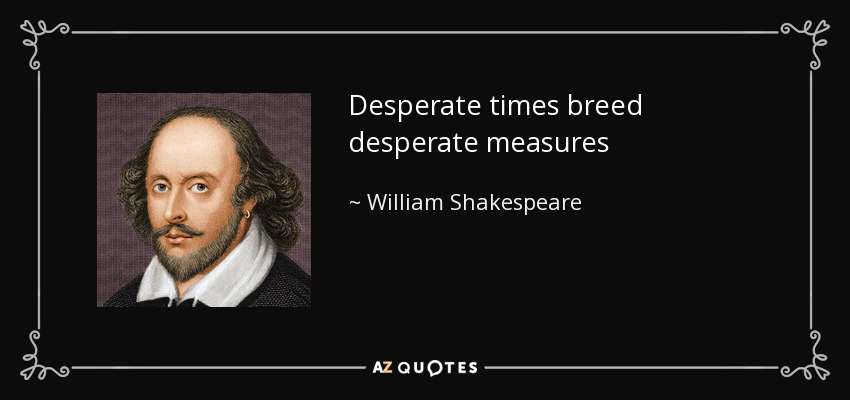
Something must be done!  The cause is urgent!  Desperate times require desperate measures.   We have heard it all before.  What kinds of terrible messes have been created by such pious sounding cries that are all too often motivated more by need than by confidence in the Word and Sacraments of God!

The world lies in desperate need but it requires something from the Church more than desperate measures.  It requires of us that we be faithful in preaching, faithful in catechesis (teaching), and faithful in action.  Nothing less can suffice.  We cannot enhance the work of God with gimmicks or tricks or it will despoil the Gospel and actually hinder the work of God to seek and save the lost.  We cannot decide to do in desperation what God seems not to do in mercy by the means He has already appointed.  Yet this is indeed our great temptation!

The world will not be helped by a Gospel that is not pure, will not be saved by work other than the work of the Spirit working through the means of grace, and will not flourish using the marketing tools of business.  The world will be saved through Jesus Christ alone and the faithful who rejoice in this gracious act of God do their best not out of desperation but from confidence in God's good will and favor in Christ our Lord.

How true it is that in desperation we cast off the things we know best to pursue kooky things that might work instead of patiently preaching the Gospel and administering the Sacraments and teaching the faith (catechesis) through which any and all who shall be saved will be saved!  We are not in such desperate times that it will be good enough to offer the world less than God's best and to be anything less than the true and faithful catholic and apostolic church established by Christ. 

Saturday, December 31, 2016

Thoughts at the end of a year. . .

This has been some year.  2016 will be put to rest with some relief by those who could not have predicted how this political season would end and yet 2017 will not begin without the same anxiety over things we could not only control, we could not predict.  Therein lies the rub.  Since the Fall, man has sought to control events and predict history and has done a pitiful job at both, all the while succeeding in distorting the Divine Image placed in man in creation, losing life to death, and living within the captivity of sin.  All because we were not content to be creatures, leaving control and future to God, and insisted upon usurping from Him what we could never possess.

While all of this might be clear enough to good Lutherans who hear solid Law/Gospel sermons on Sunday mornings, they are not at all obvious to the world around us, devoid of the guidance of the Spirit to bring wisdom to fools.  Yet even the secular world is not without its own evidence of our desire to control and predict history and our dismal track record at doing both.  Lacking any clear and universally accepted system of ethics and moral truths to bind us together, our culture has increasingly sought out authority, certainty, and power in the ability to predict and control the future.  For a long time we have rejected history and tradition as a quaint enterprise but one not thoroughly relevant to our present wants or desires (history is bunk).  So without moral compass to guide us or an appreciation of the past to warn us, we have more and more found confidence and comfort in polling that predicts what we want to know and allows us the illusion of using the present to shape and control that future.  Certainly this was the case with the election surprise and the polls and pundits who insisted it could not possibly happen.

Without an objective truth that survives the changes and chances of this mortal age, we seek our certainty in the objectivity of what people think and what they say they will do.  A whole industry has been born of our desire to know what we want to know and absent solid facts, we have increasingly turned to statistics to measure what is both reasonable and right.  I grew up when commercials on TV insisted that doctors recommend L&M cigarettes while Camels insisted more doctors smoked Camels than any other brand.  Under the guise of a “scientific inquiry,” statistics have been used to give credibility to what is not credible at all.  The final effect is to give to statistics the character of truth, unassailable truth, and the legitimacy of reason to which only fools might argue.


The use of polls is merely another use of statistics. Just as our fascination with statistics has invented a whole new industry to feed our appetite for numbers, so have we created a polling industry to survey people and come up with objective and unassailable truths grounded upon "public opinion.”  Now to be sure, I am not at all suggesting that there is merely a problem of reliability.  I presume that those who do these polls are reliable and their results reliable.  The real question here is not reliability but usefulness.  Polls may have proven to be reliable in producing certain results but the questions after the last election have more to do with who was polled, whether the people polled were honest, and whether the results were at all useful when extrapolated to the nation heading to the ballot box.  But even having failed so miserable in allowing us to predict or control the outcome of an election, I do not mean to suggest that we will ever give up on polling (another form of statistics).  We will try to figure out why they did not work and we will continue to pursue these because, quite honestly, the secular world does not have many other options left.

Even while America had no theological unity to bind our national union, we remained united in other doctrinal tenets that sufficed.  We shared an appreciation for freedom and our duty to preserve it -- even when this freedom allowed some to do what we despised.  We shared a sense of personal responsibility that bore real fruit in terms of productivity and the rising tide that floated American households to a wider level of consumerism never before known.  We shared a commitment to invention and to the work ethic to bring to market these products we produced.   Now we face a time in which the boundaries of freedom are being tested like never before, when personal responsibility has been replaced with victimhood, when we cannot find jobs for or products for people to produce in the US, and when we have transformed schools into therapeutic centers for social engineering rather than centers for learning.  Our lack of theological unity and the tearing of the fabric of our social and cultural unity leave us only statistics and polls (what people think and how many people think it) as the basis for our common identity.

It might be an opportune time for the Church to enter again and bring us together around the revealed truths of Christianity -- except that religion itself is increasingly banished not only from the public square but as a force for anything we seem to call good.  Technology is wonderful but it cannot fill our need for God.  Statistics are wonderful but they cannot produce a clear conscience.  Polls are wonderful but they cannot end the reign of death.  At the very time when bold Christian faith and witness is most needed, we are under duress to merely survive.  It is easy to develop a shrinking attitude and leave the job of truth to statistics and polling, to a morality of minimums, and to an ethical identity born of whim, desire, and self-centeredness.  Now is not the time for us to shrink from our convictions or our confessions.  The times call for nothing less that the most vigorous defense of Christian faith and its most vibrant expression in worship, witness, and service. 

What is wrong is our desire to predict and control things to erase all risk and make life safe.  But life is not safe.  Sin has corrupted desire and death has cast its long, dark shadow over all things living.  We need to know our Creator now more than ever and we can only know Him through the Savior whom He has sent and by the Spirit to breaks through the barriers of a sinful and skeptical heart.  Statistics may not be wrong but they cannot heal.  Polls may attempt to predict on the basis of what people whisper anonymously to those who listen but they cannot rescue us from ourselves.  In 2016 and in 2017 we share a common need to be reconnected to the source of our lives, to the Divine Word that has rescued us from our ill-conceived efforts to predict and control history, and to the Spirit who can give us identity, purpose, and hope.

As you close your eyes in 2016 and awaken a year later in 2017, know this.  Despite what statistics say and polls reveal, God so loved the world that He gave His only-begotten Son that whosoever believeth in Him should not perish but have everlasting life.