Wednesday, September 17, 2014

Not something to be admired or protected but lived. . .

Sermon for Holy Cross Day, preached on Sunday, September 14, 2014.

    Like other women of her age, my mom picked out a pattern of fine china when she married my father.  It is very thin and fragile.  While growing up we were cautioned about horsing around in the dining room – you know, the museum room of many homes where you look at the fine china you never eat on.  At some point in time, my mom decided her fine china was too precious NOT to use.  I could not tell you when but it began showing up on the table and the dining room was used.
    As Christians we are gravely tempted to think of the faith and the Gospel as a treasure like precious china – too precious to be used and so they end up being guarded or admired.  Indeed the origin of Holy Cross Day was when Constantine's mother thought she had found part of Jesus’ cross and it became a relic to be admired and preserved.  But we are not protectors of the faith or the cross.  God does not need us to protect Him.  God called us to proclaim the cross and to boldly speak His gospel before the world.
    Ours is not the charge to guard the faith as if it were some inaccessible treasure but to use it, to raise up the cross before the world, to proclaim the message of the cross for the saving of many, and to live out this faith by taking up our cross and carrying it out in the high and holy calling of daily life.  We are not curators of some museum or the security guards of some treasure.   No, the cross is too precious to be hidden away.  It is given to us to believe, to live, and to proclaim.
    Once the cross lifted Christ.  Were it not for the cross, Jesus would be indistinguishable from the hoards of rabbis and teachers who said this is I think the Scripture means.  But the whole focus of Jesus' ministry was the cross.  The hour had come – Jesus did not run from, attempt to escape from, or deny the cross.  It is for this reason He was born.  So in the Gospel for today we saw Him embrace the cross and His saving destiny as Redeemer of you, me and the world.
    The cross is not where we admire Jesus but where we meet the judgment of God.  The judgment of God on the world is not what we expect – not condemnation but mercy.  The cross is what reveals this.  In the face of God's Son in suffering and in His outstretched arms on the cross is written mercy, forgiveness, and hope.  This cross is then the very means through which the Lord draws all people unto Himself.  It is through the cross He reveals Himself as the Savior who has come for sinners, the sacrificial victim who pays for their sin, and the One whose death gives birth to life.
    The cross lifted Christ for the world to see the judgment of God in mercy upon the sinner.  Now the Church lifts the cross before the world so that Christ may continue to draw sinners to Himself and make know the glory of His mercy.  This is our hour.  We cannot shrink from the call to raise up the cross and boldly speak this Gospel.  This is our hour, not to hide away the cross as a relic but to confront the world with the preaching of Christ crucified where forgiveness, life and salvation are to be found.
    The world has already been judged in Christ, the sins of all the world have been paid in full by the blood of Christ.  But who will know God’s rescue or the verdict against sin born of Christ’s blood?  The cross must be lifted up, carried in faith, for us who are being saved and for those who do not yet know and rejoice in what Christ has done.  The only way the world will be rescued, the sinner redeemed, the dead find life, and despairing find hope is through the proclamation of the cross.  There is no other way that any will be saved except through Jesus Christ and Him crucified. 
    Churches and Christians are known for many things by the world around us.  Are we known as the people who speak Christ crucified and as the Church where the Gospel is proclaimed in all its truth and purity?  We do not have the luxury of pursuing other agendas or talking about things other than sin and redemption.  The Church is the means through which Christ will be proclaimed and His Gospel raised up.  God has determined to work through the Church.
    The world does not know what it wants or needs.  The world would never come to know that it needs the cross, grace, and mercy except God tell them.  So then it is by preaching God's Word, proclaiming the Law and the Gospel, that sinners are awakened to their hopeless condition and directed to the one place where hope is found.  We are in possession of the greatest treasure on earth – one that does what it says and delivers what it promises – grace and mercy!
    The world does not know what it needs or wants but every thing the world needs is found in Christ.  This Jesus whom we proclaim is the Christ of the cross.  This is not legend or myth or even pious hope.  It is, as St. Paul insists, the power of God to salvation for all who believe.
    We Christians sometimes think of the Gospel as fine china - for special occasions, too precious to be used, a treasure to be guarded.  But God has given us this treasure precisely so that we may use it, lift the cross high, and speak the living voice of His Word in our daily vocations of husband to wife, wife to husband, parent to child, child to parent, neighbor, co-worker, and even to the stranger on the corner.
    Holy Cross Day began when St. Helena, mother of Constantine, raised a pagan temple so that the Church of the Holy Sepulcher might be built.   They thought they found Jesus' cross on and this was treated as a relic to be guarded.  The true meaning of the Holy Cross is not found in a relic to be guarded.  The true meaning of the Holy Cross lies in the Gospel proclaimed, the Sacraments administered, and people who by the Holy Spirit believe it’s promise.  God has planted this cross in the water that cleans us and clothes us with Christ’s righteousness, in the living voice of absolution that reclaims us from temptation and sin, in the bread and wine that feeds the dying with the bread of life.  We are those who know the glorious gift that the preaching of this cross has given.  But there are many more who have not heard.  So we believe for ourselves and proclaim and live this Gospel for the sake of those for whom Christ also died.  In this way the cross is exalted just as God intended.  May the cross be lifted high and may it be raised in word and action by us, the baptized who have been born anew by its power and gift.  Amen.

More alike than we knew. . .

Contrary to Protestant imagination, the usual mass familiar to most Roman Catholics prior to Vatican II was not the high mass with deacon, sub-deacon, and choir but the low mass with spoken liturgy and a priest assisted by a single boy server.  It would take about 45 minutes (not counting the sermon) and the congregation might have knelt for most of the liturgy.  The homily may have been the only part in the vernacular.  The congregation's participation was mainly through interior prayer and the actual reception of communion.  In some places organ music and a few popular hymns might have been included.

The ritual of the low mass was largely limited to the part of the priest.  The low mass was mostly restrained in character and the expression of the people focused more upon the rituals apart from the actual mass itself -- namely upon the Rosary.  Extra services such as the Benediction of the Blessed Sacrament or the Stations of the Cross were often a strong focus of their piety.  The character of the low mass was more penitential than celebratory -- much more than is usual today.  The priest spoke into the silence in generally muted and deliberate tones.  This is certainly a far cry from the more folksy style of many masses after the reforms that came in the wake of Vatican II.

In other words, the liturgical setting of a typical Roman Catholic parish prior to Vatican II did not look all that much different from a typical Lutheran parish of the same era (if you closed your ears to the obvious difference in language).  The mood among Lutherans was similarly somber, the focus penitential, and the attitude of the Divine Service reverential.  There was little ad lib insertion of commentary or even the pastor's personality into the service.  The pastor, for his part, led the worship without revealing much of himself (except perhaps during the sermon).  So there was much that Roman Catholics and Lutherans had in common on Sunday morning.

In the same way, in the post-Vatican II reform of the mass and Lutheran liturgical experimentation and change of the Divine Service, we moved in parallel fashion.  For both of us the service was shifted in tone from the reverential and penitential character that once dominated it to the more folksy, personal, and casual style of the present age -- so much so that for Roman Catholics and Lutherans alike the parishes that mirror the earlier setting of the mass or Divine Service stick out as being exceptions rather than the norm.

Nowhere is this more true than the stereotypes.  Lutheran people complain about chanting as being too Catholic when Roman Catholics have for generation after generation seen chanting as exceptional rather than ordinary.  Lutheran folks assume that Rome is still the same stalwart home of highly stylized ritual in which the distance between priest and people predominates when Roman Catholics have been subjected to every kind of pastoral hijacking of the liturgy that Lutherans also have suffered since the early 1970s.  The strange reality is that the Lutherans who complain about liturgy being taken too seriously and who desire a more folksy kind of Divine Service are more in step with the typical Roman parish today than those who are generally accused of being pseudo-Catholics!!  Even incense has largely disappeared from the ordinary church life of a Roman Catholic so that they find it just as strange as Lutherans!!  The more we try to be different, the more like Rome we became -- and not in a good way!!

Tuesday, September 16, 2014

More than liturgy. . .

The strange modern phenomenon of Evangelicals embracing liturgical worship in an effort to reach out to those Gen Xers and such who seemed to be attracted by it stands in stark contrast to the Lutherans who have chosen to abandon the liturgy for the very same reason -- appeal to younger people.  "No so fast..." insists liturgical Christians to their Evangelical copycats.  You can read the well reasoned and thorough response of one liturgical Christian to the borrowings of Evangelicals here.  There is too much for me to cut and paste the article in snippets here so I urge you to read it.  My take is slightly different.  It is the reverse.  Just as this article notes how liturgical worship is the rage among many Evangelicals but suggests toying with forms is not enough to pass muster, so do I content that it is equally ineffective and quite deceitful to toy with Evangelical forms and attempt to retain a Lutheran theology.

The liturgical author is saying that it is not a "style" or a "form" that attracts the folks and therefore one cannot merely keep the same content and borrow an inauthentic "style" to reach out to those who find the liturgy welcoming and not offensive.  What I am saying is that it is equally not a matter of "style" or "form" when Lutherans (liturgical Christians) ditch the appearance in order to mimic Evangelicals and insist that they are still authentic Lutherans and that their faith has not changed.  When you worship like an Evangelical, you will believe like one.  When you believe like a liturgical, sacramental Christian, you cannot worship like an Evangelical.  The doctrinal content and practical face of Sunday morning cannot be at war with each other. 

Those who seem to be attracted the liturgy are smart enough to sniff out preaching and faith that does not flow from and back to the altar, font, and pulpit in a way that is authentic and true.  In the same way, those who seem to be attracted to praise bands, spectator services, entertainment style worship, and preaching that focuses on the immediate more than the eternal can sniff out a lie equally as well.  They will find the discrepancy between their evangelicalism and Lutheran confessional theology and liturgical practice equally disconcerting.

Honestly, sometimes I think we Lutherans are idiots.  We think that borrowing from the Evangelicals who are borrowing from us will somehow not be noticed as antithetical to what we believe, confess, and teach.  Of course we are assured all the time that the people leaning toward evangelicalism have not at all surrendered their doctrine to the altar of expediency -- only their Sunday morning practice.  Again, who are we fooling?  I would suggest we are fooling no one at all.

The folks we are trying attract will not be attracted by evangelical wannabes when they have the real thing available just down the block.  What may be the real problem is that these Lutherans are no longer evangelical wannabes.  They have sold their souls to their worship "style" and have, for all practical purposes, begun to believe like the evangelicals they want to look like. 

We celebrated St. Bart's day only a month ago.  In the Gospel for that day our Lord saw into the heart of this man and found him without deceit.  He was even honest enough to diss the hometown of the Lord.  Would that we had such honesty today.  If there are those Lutherans who do not want to be Lutheran in practice as well as in doctrine, let us be honest and admit it.  If there are Evangelicals who do not want to be Evangelical in practice as well as in doctrine, let them be honest and admit it.  Perhaps we could make a few trades along the way and everyone will be happier.

I once had a family visit our parish after being catechized and a member of one of our LCMS big box evangelical style congregations for a decade or so.  This family found our congregation a great disappointment.  They just did not get how Lutherans could use a liturgy, sing hymns, have a weekly Eucharist, chant the liturgy, baptize infants, etc....  I politely informed them that their issue was not with us but with Lutheranism for they had been sold a bill of goods about what Lutherans are and what they believe.  They promptly ditched us for a big box evangelical place down the road.  But the problem remained, what were they told about Lutheranism in their catechesis and life within the church and did what they were told have a shred of integrity with what our Confessions.  This is my problem.  If Evangelicals want to be Lutherans, I would be happy to catechize them.  But if Lutherans want to be Evangelicals, I would be sad but know we would all be happier if parted company in honesty.

Monday, September 15, 2014

The Postures of Praise and Prayer. . .

It should be fairly obvious that standing and kneeling form the two most prominent postures of praise and prayer.  Until the 1400s pews or seats were uncommon in churches so sitting was not a routine posture in worship.  The presence of pews, chairs, and fixed seating is due in large measure to the renewal of preaching that began even prior to the Reformation.  But sitting became the central posture of worship when the focus of worship among most Protestants after the Reformation was the preached Word.

As Aidan Kavanaugh noted, the shift to fixed seating defined worship away from liturgy and ritual to "a preachment perpetrated upon the seated."  The other major effect of fixed seating was to limit the ritual of the liturgy to the clergy who were less bound by furniture and then to further liimit the people's participation to one spot.  Eventually their participation ended up being mostly kneeling (which became more prominent than either standing or sitting for Western medieval Christianity). Obviously standing as the ordinary posture of worship had implications for the length of sermons that a seated congregation would not find so burdensome.

Today the seating is also governed by additional desires.  In our age of personal space, individual seats tend to predominate in new construction.  In the non-sacramental churches, these seats take on the character of movie seating, designed for comfort more than anything else.  It is the expectation of most Protestants that they will enter the church to be seated for the duration of the worship service and that the bulk of that worship service will find them hears or spectators to actions done mostly by others for their benefit (or entertainment).  With the usual adornment of large video screens, the comfortable seating of the theater is even more appropriate to the setting than ever before.

In contrast to the verbs of Scripture that describe the nature of worship in active terms, worship has become for many Christians a purely passive endeavor.  The exuberance of the Psalms stands in start contrast to the setting of worship and the way we read and even sing the very texts of those Psalms.  The same Psalms that command nature and inanimate parts of creation to praise the Lord are somehow rendered impotent when it comes to a people who come to sit, watch, and listen.  Our muted expressions of gratitude to the Lord, spoken in almost a frighteningly casual and conversational manner illustrate how little the typical worshiper expects to do on Sunday morning.

Absent the ordinary means of ritual, posture, and ceremony, the liturgy has become the domain of words only.  The way we treat the Word of the Lord (without seriously expecting or anticipating its efficacious character) leaves us with only a manufactured and artificial sentimentality as a definition of faith and piety.


Sunday, September 14, 2014

Close(d) Communion

Augustana XXV...  In defense of what has come to be called either closed or close communion, the Lutheran Reformers insisted in the Augustana that they retained the apostolic "custom" of examination and confession [and absolution] before the communicant is given the body and blood of the Lord.  As solemnly as this Confessions insist that the Lutherans teach this "with the greatest assiduity," Lutherans today largely ignore their own Concordia.

A million years ago when I went off to college 450 miles away from home, my pastor gave me a communion card for my wallet -- to be presented wherever I might go to commune to show that I was indeed a member in good standing at an LCMS congregation.  Never mind the obvious incongruity of sending a college student out to an 18 age drinking state for college and still remaining in "good standing," the intent was pious and salutary.  I used the card often (though the norm then was no more than a monthly celebration of the Sacrament of the Altar so it was not used as often as one might think).  Nearly all our LCMS parishes (and many other Lutherans as well) practiced the discipline of the Lord's table.

The inherent weakness of the communion card was the fact that closed communion never was predicated upon membership but on faith and confession.  In other words, closed communion was never about a membership card but about examination and confession and absolution.  We still struggle with this disconnect from the practice assumed by our Confessions.  We speak of closed communion in terms of which church bodies we are in fellowship with (not that this is, in and of itself, bad) but not in terms of the communicant being examined, his confession heard, and absolution rendered.  We commune those from congregations with whom we are in formal altar and public fellowship and not communing those from heterodox churches -- and so we should -- but this is not what the Confessions have in mind.  This is not the same as examining and absolving those who desire to receive the Lord's body and blood. A side benefit of this was that the Pastor knew how many hosts to put out because he knew how many he had examined and absolved before the mass. 

I honestly grow weary of the way close(d) communion is debated today.  It is a fools errand on both sides to move the fence in or out (or as the ELCA is doing, remove it all together).  It ought to focus upon the communicant, upon examination of the communicant, the confession of the communicant, and absolution of the communicant.  Until this happens the whole darn debate will sound like the rudeness of some to exclude and the lack of love on others to include those who cannot receive it to their benefit (no baptism or faith).  It trivializes what St. Paul speaks so solemnly of in discerning and recognizing the body of Christ.  I honestly wish that the whole focus of this debate were framed back where our Confessions insist it ought to be -- on the examination and confession [and absolution] before the communicant is given the body and blood of the Lord.  Apart from this context, the whole thing is just plain obtuse to most of us.

Saturday, September 13, 2014

Making sin respectable. . .

Peggy Noonan, always a great read, had a touching and well written tribute to Joan Rivers.  You should read it.  It does not matter what you thought of Joan Rivers, Noonan's comments will surprise you and give you a typically different picture of the woman, her success, and her legacy.

What struck me most was this paragraph about how Las Vegas had been cleaned up and was no longer the Godfather picture of sin city:  Twenty years ago, when everyone was talking about how wonderful it was that Vegas had been cleaned up and the mob had been thrown out, Joan said no, no, no, they are ruining the mystique. First of all, she said, those mobsters knew how to care for a lady, those guys with bent noses were respectful and gentlemen, except when they were killing you. Second, she said, organized crime is better than disorganized crime, which will replace it. Third, the mobsters had a patina of class, they dressed well and saw that everyone else did, so Vegas wasn’t a slobocracy, which is what it is becoming with men in shorts playing the slots in the lobby of the hotel. The old Vegas had dignity. She hated the bluenoses who’d clean up what wasn’t mean to be clean. No one wanted Sin City cleaned up, she said, they wanted to go there and visit sin and then go home.

Wow.  Cleaning up what was not meant to be clean.  Now there is a line of prose pregnant with meaning.  Boy did Noonan hit the nail on the head.  That is exactly what we do.  We clean up what was not meant to be clean.  Vegas with a family appeal, state lotteries that dress up gambling, vulgarity that parades as comedy, etc... we do this in an effort to take away the stink and ugliness of evil but it does no such thing.  Cohabitation may be rampant but it is not right.  Promiscuity may be routine but it is not righteous.  Lies may be pleasant but they are not good.  Pornography is benign and victimless but it screws up our sense of love, intimacy, and sex.  Cheating may be expected but it is not moral.  Killing may be normal but it is not holy.  Gay may be politically correct but it is not morally correct.  You finish the sentence.  Every time we clean up sin we end up only making evil respectable and multiplying its stain over us all. 

We have had a history of trying to clean up things with terrible results.  From the temperance movement to the diversity and political correctness movement, we have painted a new face on old wrongs but what we hoped for was not the result.  Legislating morality for whatever purpose hardly ever makes things better.  Taking the dirty edge off of sin does not make it noble, virtuous, or good.  It is no wonder our children are confused.  We have made right and wrong look alike so that no one knows the difference (except by ignoring the thin veneer of respectability we have applied over the images of sin).

Joan and Peggy hit on something profound here.  Cleaning up what was not meant to be clean is doing no favor to anyone and harming both our sense of right and wrong and our ability to discern between the two.  We have far too many "victimless crimes" in which the wrong is either not so wrong or the right not so right.  We have too many things that we justify by the hopes of good (like state lottery profits going to education).  We have too many people who say that people are going to do it anyway why not have them do it cleanly and openly.  Worse, we have believed our own lies so much so that Christian no longer look much different from the non-Christians around them. 

That is where the Church comes in.  We have to unclean what society has rendered clean -- sort of the reverse of what Peter found out about a ham sandwich and Gentiles.  Except this time the impediments are not distinctions imposed but distinctions removed to render evil and good dull, bland, and vanilla.  This is preaching the Law to expose and lay bare the painful truth without which the Gospel means nothing at all.


Friday, September 12, 2014

1000 years of European Borders Changing

Not without consequence for or a reflection of the religious history of Europe. . . Fascinating!


The march of time. . .

The liturgy long ago marked not only the seasons of piety but of life.  Through the rhythms of the church year, God's time was not simply a calendar of salvation history played out over the secular calendar and recreated in the festival half of the church year, it was the pivotal reality that shaped all of time.  God's time stamped the realm of the largely agricultural economy as well.

Just as the church bell's call to prayer ordered the day and night (absent the constant reality of clock and watch), so did the season fo the church year mark and order the livelihoods of a rural economy.  At Candlemas the farmer's tools and beasts of burden were readied and blessed as winter was nearing its end.  On or about St,. John's Day, the winter crop was harvested.  St. Michael's Day the fields were burned and animals that could not afford to be bed through the winter were slaughtered and their meat laid up for winter by smoking and salting.  Winter was a quiet season with most of life's attention focused upon keeping warm and fed until the whole cycle of life started all over again.

In contrast, we are most aware of and comfortable within the framework of a secular calendar with the seasons and rhythm of life dictated by shopping seasons, holidays (in contrast to holy days), work schedules, and school calendars.  It seems too much for us to also keep up with a calendar so arcane and irrelevant to our daily lives as the church year.  So Advent means nothing to us except Christmas is about here.  Christmas finds us tired of the whole darn thing and ready to get over it as quickly as possible.  Epiphany lives in the shadow of the New Year celebrations, MLK day, the Superbowl, and winter sports.  Lent always seems to come too quickly and we are unprepared to give up anything -- not even the extra time for worship, devotion, and almsgiving that once marked the season.  Easter has long ago been transcended by Spring Break which, unlike Easter, is a designated time on the calendar and does not float to some obscure dating system nobody in the world cares about.  Pentecost comes too often near Memorial Day for it to have any real identity and it suffers from a moving date conditional upon Easter.  By that time summer is upon us and the Church is the last thing on our minds and lists of things to do.  The Fall is taken up with the start of school and the end of summer, with Labor Day and Columbus Day, with Halloween and Thanksgiving.

So there we are.  The advance of the industrial age and the mass move into urban areas (and their suburban sprawl) has left the Church and its timing as confusing, confounding, and crazy as new math to our old lives.  The truth is that many churches have given up and now order their calendar by the secular seasons and holidays except for an obvious nod to Christmas and Easter.  Other churches seem intent to impose an antiquated and in cohesive calendar upon people just because they can.  What is lost in all of this is the whole idea of God's time -- not the pulsing chronos of the ticking clock or the seasons of our mood but the fullness of time, the moment pregnant with God's activity and grace in which He discloses Himself, His kingdom, and the grace of redemption.  We do not insist upon the church year because we are curmudgeons who stubbornly refuse to concede.  We insist upon the church year because there is where we encounter in larger form the rhythm of God to us and back to Him that is in smaller shape in the Divine Service. 

God's time is our time -- not as the imposition of a law or commandment but as the gift of grace.  Hidden in time and late in time by all our measures of urgency, God is here in flesh and blood to live, to suffer, to die, and to rise again.  This is the pulse that beats through the church year.  We do not march to the beat of a different drum because we independent people.  We march to the beat of life that his here in this present moment with the fullness of time and grace.  This is what we call our people to know and what we pray shapes our daily lives.  We are a people already in the presence of the God of our salvation and yet we are moving to the outcome which we already know but for now but anticipate in worship and calendar.

Thursday, September 11, 2014

Wishing away evil. . .

On the eve of the 13th anniversary of 9-11, we heard our President rally us to the cause of degrading and destroying one more incarnation of the Islamic terrorist threat that stained the national heart and soul when the airliners became tools of evil on that fateful day.  I pray that this renewed effort to confront terrorist threats against Americans and, indeed, the entire world, will be successful but I fear that this same President mirrors the weariness and wariness of a people who thought a war against evil could be fought like we did the Nazis and our enemies turned into partners and friends like the German nation became in the aftermath of the fighting.  Though this may be our hope, it is not real.  There is little basis in reality to hope for such an end to the vigilance or to the prospect that we might wake up one morning and find our enemies now love us and want to work with us.  The evils we face among those who are determined to destroy us no matter what the personal cost to them or their families or their national identities is a radically different kind of evil.  So I urge us to pray not only for an end to this evil, for an end to the violence, and for an end to terrorism, but to pray for the will to continue to fight in whatever form it takes -- not merely to contain this evil but to destroy it as much as evil can be destroyed.  For without this vigilance and unwavering commitment to justice, freedom, and security, those who died on 9-11 and all those died in the years since waging war against those forces of evil, will have died in vain.  Perhaps it is our fondest wish to turn back the clock to the day when we seemed to live a more carefree life, without the constant stories of death and destruction in the news cycle.  But we find ourselves more than ever locking in the battle for good and evil, for right and wrong.  There is no neutrality in such a conflict and their can be no lag of zeal or courage or the enemies outside of us will be undone by the fears inside of us.

Worship as Repentance. . .

The modern penchant for tolerance was not always seen as the virtue it is accorded today.  Lets fact it.  Most churches, even Lutheran, have become a permissive community where little attention is given to confession and where there is a great divide between even basic beliefs and conduct.  The language of sin is as far removed from liturgical text and preaching as it is the common conversation of the members.  As such, most modern forms of Protestantism bear only a passing resemblance to their Reformation forebears.

Lutherans also struggle mightily in this area.  Comfort is the byword of the day -- comfort pervades the people and the witness.  Who wants to go to church to be convicted?  Who wants a pastor who holds you accountable?  No, we seek affirmation and the cheap grace of an affordable Gospel.  Indeed, there is not much that would compel a person to join, or after joining, to attend church.  Statistics seem to support this.

In March of 1525, Pastor Nicholas Hausmann, rector of St. Mary's of Zwickau, sought an orderly reform of the mass and the approval of Luther for his draft of such an evangelical reform.  In his reply, Luther suggested ditching the preface for an "Exhortation to Communicants" (LW 51, p. 104).  It was not without precedent.  The year before Osiander had already inserted one prior to communion.  Luther's exhortation was nothing if not blunt and showed a flair for the dramatic.  It warns against taking consolation from the Sacrament for those who are unrepentant or who refuse to attempt amendment of their sinful lives.

Later church orders (especially the two most influential -- the Bugenhagen and Brandenburg/Nuremberg) took this innovation to heart and influenced a whole history of Lutheran liturgies.  Although I am in no way in favor of Luther's drastic innovation of ditching the preface and substituting such an exhortation, I will admit it is thoroughly consistent with the time and the ordinary approach to confession and communion.

What strikes me, however, is that if and when we might repeat Luther's words today, they would be seen as completely unevangelical and at odds with the very nature of the Eucharist as welcoming meal (as presently understood).  In fact, the Pastor who would read Luther's exhortation might very well stir up a list of enemies both within the parish and in the District Office.  Such blunt language about sin and repentance and unworthy communion is hardly commonplace among us anymore -- to our loss.  I am not so sure that the discomfort with the exhortation would be due to the liturgical abruptness of its insertion to the canon of the mass but because we no longer see the center of the Eucharist within the framework of sin and forgiveness.  Grace has come to mean silencing all mention of the Law and sin.  The only kind of repentance typically addressed today is our failure to be truly human, to deal honestly with our desire, to advocate for the oppressed, and to live with the smallest imprint upon creation.  This is not the lament of guilt which the commandments occasion as the mirror of our sinfulness.

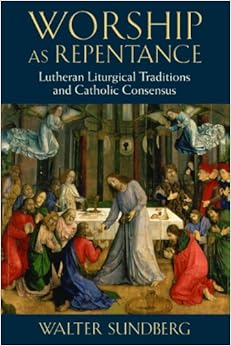
Inspired by Walter Sundberg's book... Worship as Repentance.  Good Stuff!  Read more of this kind of theology in his book available from Amazon!

Wednesday, September 10, 2014

Not just a song book or prayer book

You have set our iniquities before you,
    our secret sins in the light of your presence.  Psalm 90:8

I continue to recommend the Psalms to people looking for a devotional order or text.  For generations the Psalms served as the bulk of the daily prayer of the Church both in the prayer offices and in the practical devotional life of a people without access to many texts.  Though we think of the Psalms as texts of praise and thanksgiving, even liturgical in shape and form, they are also doctrinal.  The Psalms teach us both Law and Gospel.

Consider these words from Luther on one verse of Psalm 90, a well known and beloved text:

This is the climax of the drama which God enacts with us. His intention is that we play our part in full awareness of our sins and of death.  Yet it is not an evil thing. . . to have this awareness, to complain about our miseries, and to conclude that there is nothing at work in us but damnation.  Indeed, one should complain and sigh this way.  One should try to arrange and govern one's life in accordance with such sighing.  Then it will happen that one becomes aware of salvation....  LW 13, p. 116

Though we instinctively run from admitting our sin and guilt, God calls us to the painful awareness of those sins and to the consequences of those sin for our lives.  The secret sins we do not even speak to ourselves, much less to any one else, must be spoken or their hold over us remain.  But once spoken, once confessed, we are set free in Christ.  The shame of our sin and its guilt is transcended with the greater power of mercy and grace, with the force of the cross and our Savior's death.  Then we discover what salvation is, what was required to procure it for us, and what benefit and blessing has come to us, unworthy and undeserving though we be.

Tragically, we live in an age and time in which sins that should be secret are public and proud.  Far from the shame of those sins and the strong arm of guilt, we treat evil as if it were neutral or sometimes good.  The lack of wrestling over these sins only means that our conscience is silenced and our hearts closed to this voice of God who tells us what we do not want to hear so that we may behold that which is beyond our expectation and imagination -- the blessed salvation of sinners through our Lord Jesus Christ.

No, you could do far worse than to read one Psalm a day and call it good.  Would that we were as familiar with the Psalms as were the children of Israel!  If you notice, Matins (and Morning Prayer) as well as Vespers (and Evening Prayer) -- indeed all the prayer offices -- are nothing more than frameworks for the Psalms to be heard, prayed, and upon which we meditate in the name of Christ.

Tuesday, September 9, 2014

The scandal of grace. . .

Sermon preached for Pentecost 13, Proper 18A, on Sunday, September 7, 2014.

    A bird in the hand is worth two in the bush, right?  That is what reason says.  You look at what you have, what you can count on, and this is always weighted more than the prospect of something more.  If you don't believe me, ask those Let’s Make a Deal contestants who gave up a sure thing for a chance at something better than never came through.
    All of this is true except where God is concerned.  First of all, God’s promise is worth more than the sure thing in your hand.  This is not simply theory with God.  Such is the scandal, the offense, and the confusion of grace to the mind and heart of the sinner.  Today, amid the many riches of the Gospel lesson, we heard Jesus tell a parable about the scandal of grace.
    If a man has 100 sheep and loses one, what should he do?  What would you do?  Jesus acts as if any reasonable man would agree with him and leave the 99 to find the one lost.  But no would do that.  In our world, a 1% loss is acceptable and barely noticeable on a financial worksheet.  How many of us would have been content with a 1% loss in our IRAs after the 2008 downturn in the economy?  No, we would sigh with relief that we lost only 1%.  Life is hard.  You have to expect that you will lose 1% here and there.  It is reasonable, rational, and understandable.  But not to God.
    We would worry less about the one that got away than about keeping the 99 who remained.  We would double down our efforts to guard what we had instead of running out on the fool's errand of trying to retrieve the one lost.  That is how things work in this world.  But that is not how God works.  And this is the scandal of grace.
    God's math is radically different from our own.  God has no acceptable losses.  God does not content Himself with a reasonable loss.  God does not guard the 99 even more; He risks all in order to find the one who got away.  It is shockingly extravagant and seems utterly foolish to our minds and even to our hearts.  But such is the way of the Kingdom of God.
    One lost sheep is the deliberate and constant focus of the Lord's relentless heart of grace.  He allows us the privilege of rejecting Him but He continues to seek us out and to win over our stubborn hearts by His relentless and consuming grace.  That is the love that sought YOU out when you were dead in trespasses and sin, that refused to leave you lying in the dung heap of death that was your lost life, and that willingly sent His one and only Son to bear your sin and die your death and redeem your soul.
    God could have rightfully written us off and justly left us to the consequences of our chosen sin and rebellion and He.  But not the Lord.  He cannot forget us and He cannot console Himself to losing even one.  He continues to seek us out with the voice of His Word, with the invitation of His grace, and with the promise of His mercy.  If we are not saved, it is not the fault of the Lord.  It is ours and ours alone.  But we who are saved owe the credit to the Lord alone.
     Who would expect such relentless pursuit of one lost sheep?  Such is the scandal of grace.  But what about us?  How sad it is that we treat the unyielding pursuit of God’s mercy as something common and ordinary!  How sad it is our response to His relentless mercy and grace is the shrug of our shoulders as we continue to go on our merry way of sin that leads to death!
    We think: you some and you lose some.  That is what consoles us in our losses but not the Lord.  Grace is radically unreasonable, its values hopelessly out of sync with the world.  So radical is His grace that the unborn are valued the same as adults.  So radical is His grace that no sin and no sinner can be allowed to stand outside the realm of His mercy.  So radical is His grace that the child who trusts in Him is the model of great faith.  So radical is His grace that He values the sinner more than those who presume righteousness. 
    Just as only one sin makes you a sinner, steals your life away and leaves you with eternal death, so even one sinner moves the Lord to action, to seek out, to address with the grace of forgiveness, and to restore to everlasting life and communion with God the creator.
    This is why it is such a damning lie to shrug our shoulders at sin.  When we do this the sinner remains lost, left beyond the sound of God's voice in His Word, and left to the death that is his now and forever.  This is why we cannot be silent about sin, about evil, and about wrong.   This is why those whom sin has wounded will seek out the sinner to restore him through forgiveness.  This is why those who refuse the admonition of God’s people and His Church are treated as Gentiles and tax collectors to be won all over again for the Lord.  
    We cannot reduce the Gospel to mere sentiment and feeling.  It is always about sin and forgiveness, life and death.  God was in Christ reconciling the world to Himself so that those who dead in trespasses and sin might be redeemed to new and everlasting life.  Grace means nothing when sin is no longer counted.  God does not shrug sin away but confronts it in Christ, on the cross, by suffering and death. 
    Here is grace at work.  The water of that font kills the already dead so that God can make us alive in Christ with a life stronger than death.  Here is grace at work.  God cannot sit idly by while we stew in our own sin and death and so confession and absolution releases us from the torment of our sin and guilty consciences.  Here is grace at work.  The voice of the Word of God calls us back here week after week to restore us from our sin and weakness before temptation and equips us to call those not yet of His kingdom with the same voice of grace.  Here is grace at work.  Those who have no right or place are given the privileged place at this Table where the flesh and blood of Christ feed us forgiveness and eternal life. 
    He sent forth His Son to save us.  He continues to speak His Word to a world lost and condemned.  He washes the sinner with the water of forgiveness and drowns the dead to raise them up to eternal life.  The one lost will not be written off.  Look around you at the lost ones whom the Lord has reclaimed by His mercy.  Now look into a mirror and see the face of the lost one whom the Lord has redeemed by grace.  That lost one is YOU!  Now, do not squander what God purchased and won but live your life nobly for His kingdom and doing the good works of Him who has called you from darkness into His everlasting Light.  Amen.

The final battleground. . .

In his book The Nature and Destiny of Man (Vol. 1, p. 200) Reinhold Niebuhr wrote:  Religion is not simply, as is generally supposed, an inherently virtuous human quest for God.  It is instead the final battleground between and the self-esteem of man.

For generation after generation religion has been dismissed as a superstitious arena of mankind's quest to understand where things came from and where things are going.  We have been told over and over again that faith is a crutch for the weak and a prop for the dull.  We have suffered the fools who spoke of religion without distinguishing from the religions as if all were equal and all equally effective in the pursuit of an answer to the question of who, what, and why.  Niebuhr got it exactly right.  Religion is not some virtuous pursuit but ultimately the ring in which mankind continues the fight of Eden.  Here mankind seeks to impose self-esteem against the fabric of creation and the power of the Creator, against the morbid reality of sin and its decay against the holiness and life of God, against the ego of a creature attempting to equal the divine make and redeemer of all things.

The truth of this quote may have been hidden behind a more virtuous veneer of the past but we no longer feel need to hide our selfishness nor our preoccupation with the most minute detail of our desire, preference, and judgment.  Peruse the pages of social media or sift through the tweets of this narcissistic generation and you find a bold and bald ego that drives and runs all things.  We consume more than produce.  We seek happiness at all costs.  We no longer know the meaning of shame or guilt.  We are who we are and figure God can take us or leave us -- because in the end He exists only for our benefit anyway.

No, I am not saying that this generation is worse than others.  No, I am not saying that we are beyond redemption.  What I am saying is that we have drunk deeply of the mirror of our own desires and find it harder than ever before to know objective truth, to judge right and wrong, evil and good, and to see a good or a goal worth denying self or the moment.

Much of modern Christianity now reflects our preoccupation with ourselves so fully that there is no longer a shred of orthodoxy left.  Even when we appeal to the sacred words of the past, we do so not because we invest them with any real value or truth.  We use them nostalgically but their words do not mean what they say and we will surrender to them no measure of our own self or the pleasure we seek.

The faithful preaching of the Word of God is no more urgently needed than this present moment in which self, sin, and ego have become the shadow deity behind everything named God.  Change and decay, all around we see... O Thou who changest not, Abide with me...  There is no possibility of anything less than doctrine and practice at full strength.  The god of self-esteem is fighting to the death with the God of heaven and earth and the consequences of this battle are nothing less than our own salvation and existence.

Monday, September 8, 2014

International Buy a Priest a Beer Day

International Buy a Pastor a Beer Day!  Did you know that this coming Tuesday, September 9, is International Buy a Pastor a Beer Day? On this festive day, the faithful all over the world take their priests or pastors out for a beer and get to know them better. It’s a beautiful tradition that goes back to the time of St. Hopswald of Aleyard, the first man to take his priest out for a beer.

Okay, if you’re getting suspicious by now, International Buy a Pastor/Priest a Beer Day is not a real holiday. But the Church of Luther, beer and brats perhaps should make it real. Believe it or not, pastors and priests are real people who enjoy a beer (except for Baptists and others) as much as anyone. So, if you appreciate your pastor or priest, buy him a beer (since it might be unseemly for him to drink them all on one day, a gift certificate or a six pack of some finely brewed craft beer.  Just sayin. . .

Not my preference. . . nor yours. . .

It is so often assumed that how the liturgy is conducted is an expression of a pastor's personal style and preference that it has become accepted truth, namely, that style and substance are not only distinct but different and seemingly unrelated.  Such is the fallacy of the modern era that has heaped upon us much in the way of terrible liturgical experimentation and the adoption of texts, rites, and ceremonies alien to our confession.

In a conversation recently I was asked about a comment made that our congregation has a rather "pompous" or elaborate ritual and form.  It must be true, I was told, because this person had been to a variety of other Lutheran congregations in which the liturgy was "simpler" or "plainer."  In other words, we are the odd duck and a more basic form and ceremony is the norm for Lutheranism.  Well, that depends.  It may be true that we have a more elaborate form and practice of the Divine Service than some Lutherans but the real question here is not what is normal in practice as measured by statistics but what is normal in practice as defined by our Confessions.

Lutherans are not Amish catholics.  We are not plain people on Sunday morning.  Just the opposite.  The Lutheran Confessions were written from the perspective of a rich and elaborate ceremonial, musical, and liturgical shape of the Divine Service.  The foolish and quite juvenile debate over where this perspective prescribes what must be done or describes what was done has often overshadowed the reality of what Lutherans looked like on Sunday morning for the first few centuries after the Reformation.  The same idea could be used of all the doctrines contained in the Book of Concord -- these do not prescribe what must be believed by those who would call themselves Lutheran but merely described what the Lutherans then believed, taught, and practiced.

We are pompous or showy or elaborate because we do what?  Chant?  Bow?  Wear Eucharistic vestments? Have a weekly Eucharist? Use the Chalice? Have liturgical art?  Have a rich musical and choral tradition?  Talk about private confession?  The list could go on.  My point is this.  When the Lutheran documents that became our Concordia or Confessions were written, they did not in any way, shape, or form imagine that the liturgy would not be sung by both pastor and people, that the Sacrament of the Altar would not be celebrated at least on Sundays, that the pastors would be vested, that the ritual of the mass kept, that good and faithful music would serve the cause of the Word, and that the people assembled would gone to confession before communing...  That these are not now "normal" in the sense of universally practiced was not only not envisioned within our Confessions but marks a significant departure from the orthopraxis that is and always accompanies orthodoxy.  Theology is not theoretical.  Doctrine is not theoretical.  Theology must sing (said Martin Franzmann) and doctrine is lived out from the altar, font, and pulpit.

This is not about high or low culture.  This is not about pastoral preference or the people's preference.  This is not about style divorced from substance.  The practice of this parish is not elaborate at all.  We use incense only rarely.  We do not enforce rubrics like liturgical gestapo.  We do not make people genuflect or cross themselves.  We do not sing in Latin.  We do not repristinate a moment in time from some golden age of liturgical life.  Maybe it should be MORE elaborate.  The point is that what we do is not at all on the high side of what Luther did or Bach knew.  In the end, if we are out of step with the Great Reformer himself and if we are on the fringe of the greatest Lutheran musical genius, who is the odd duck?  I would say it would be those who attempt to be moderately liturgical while at the same time trying to be moderately evangelical and Protestant.

My liturgical preference counts as little as the liturgical preferences of those in the pew.  What counts is whether or not what we do on Sunday morning looks, acts, and sounds like what we believe, confess, and teach in our Book of Concord.  I challenge anyone who thinks we are "high" to read the Book of Concord and then tell me where we exceed the liturgical shape of this confession.  In fact, I would say that we are normal -- the normal that counts in terms of faithfulness to our Confessions.  Any other normal (statistical, for example) does not matter in a church body which claims it is all about theology and doxology.

Now some of you are probably thinking, "My God, that guy is arrogant."  You may be correct.  I am a sinner and humility is not something I have in abundance.  But perceptions are not the issue here.  What we believe, confess, and teach -- these are the issues.  So, condemn me as arrogant, a cultural snob, "high" as a kite, or a liturgical showman...whatever.  Just read the Confessions and tell me where our practice deviates from the expected, anticipated, and assumed normative liturgical and devotional life of the Church of the Augsburg Confession.

Sunday, September 7, 2014

Liturgical Experimention in Greece. . .

It might seem odd but the liturgical experimentation in Greece is not all that different from the West.  In fact, it seems it might be quite similar.

Read the story of such liturgical experimentation here. . . or read on below and follow the link for pictures...

The Divine Liturgy of Serapion Celebrated For the First Time


On Sunday, June 16, 2013 all those who attended the Liturgy in the Sacred Church of Panagia Myrtidiotissa lived a moment of devoutness, on the occasion of the celebration of the, until then unknown to many, ancient Divine Liturgy of one of the Holy Fathers of the holy and sacred Synods, Bishop Serapion of Thmuis.

The Divine Liturgy of Serapion (4th century Egyptian bishop), in a revival of an historical rite, was celebrated for the first time officially and with the license and blessing of His Eminence Metropolitan Seraphim of Piraeus in the Holy Church of Panagia Myrtioditissa in Piraeus, according to ancient Alexandrian ecclesiastical order and decorum.

The Divine Liturgy was officiated by the Chancellor of the Holy Metropolis of Piraeus, Archimandrite Nephon Kapogiannis, who solemnly celebrated the Divine Liturgy surrounded by priests of the Metropolis.

Attending the Divine Liturgy was also the Professor of Liturgical Theology at the University of Athens, Mr. George Filias.

Mr. Filias reported on the Euchologion and the Divine Liturgy of Serapion, even interpreting different parts of the Liturgy for the faithful to better understand it, and praised the importance and richness of our liturgical tradition.

__________________________________________

Speaking from my own perspective only, I found the place -- outside the iconostasis -- as shocking as the ad orientem posture.  Yes, the liturgy is old.  Yes, it was sanctioned by the Bishop.  Yes, it seems odd.  But... it was odd not in the sense of novelty created for the moment than the rekindling of an older tradition.  For that reason, I will give it a pass from my acerbic wit and complain that it is an historic thing treated as if it were spontaneous and new.  This is the one big problem here.  At least for me....


Saturday, September 6, 2014

A calling higher than desire. . .

Although it is not a perfect response to be sure, the movie called Desire of Everlasting Hills addresses those who are self-described as gay and their journey back into the church.  I noted the distinct idea that there is a calling higher than desire and that this is the realization that led these self-described gay and lesbian individuals to live a chaste and sexually pure life.  After a lifetime of discovery, they harkened to another discovery -- that satisfying desire is not the more fruitful path to peace.  Sort of like Augustine's conclusion that his soul would not rest until it rested in Thee, these three individuals recounted their own awareness of being gay, their individual pursuits of happiness as gay men and a lesbian woman, and their conclusion that there was a higher, more noble calling, than desire.

You watch it and see. .  I think there is something here to explore to respond to those who feel the tension between their desire and their faith.


Friday, September 5, 2014

From British TV. . .

An undercover look into some of the Mosques of England. . .  you be the judge. . .

  Dispatches - Undercover Mosque: The Return from Emil Kirkegaard on Vimeo.

http://vimeo.com/85362804

We are all sick. . . The dying are not just sick. . .

The shift from Extreme Unction to Unction, from Last Rites to the Anointing of the Sick, represented more than a mere change in emphasis.  It is as if there were two different sacraments being suggested under the one premise of unction or anointing.  A recent article on the First Things web site laments the loss of Extreme Unction with its solemn focus on death for the happier version of Anointing of the Sick.  I would not be surprised to find many Roman Catholics echoing the sentiments of the author. I would also think that this shift is thoroughly at home with the whole move toward a medical model of our ills, with the nearly universal expectation of life as pain free and happy, and with the ideal of a fix for what ails us (either pharmaceutical or spiritual).  It is certainly consistent with the transition of pastoral care into spiritual and the focus away from God and onto self.

But the dying are not just sick.  They are dying.  That seems to be the thing that we have trouble admitting most of all.  I have known many doctors who refused to give up on their patients long after the patients and their families were resigned to death.  It is a common malady among health care professionals -- oncologists never lose patients to cancer but to cardiac or respiratory arrest or whatever.  Cardiologists likewise hide their defeats as do the many specialists -- all in an attempt to mask the face of death.  Extreme Unction (Last Rites) is unusual because it confronts what most want to hide -- death is near.  This is not some happy death we manufacture to distract us but the real death of pain, sorrow, loss, and lament from which there is no real distraction.  The solemn confrontation of sin, the prayers and their rehearsal of what is surely coming, and the anointing in the last hours of life all combine to comfort in a way that all our happy talk cannot.

Lutherans are not without our own Last Rites.  We have a rite entitled the Commendation of the Dying.  The title says it all.  With the Psalms, prayers, and Scriptures, come the canticles (especially the Nunc Dimittis but also the Kyrie and Agnus Dei).  I love the inclusion of Martin Schalling's hymn Lord, Thee I Love with All My Heart, the final stanza:

Lord, let at last Thine angels come,
To Abram's bosom bear me home,
That I may die unfearing;
And in its narrow chamber keep
My body safe in peaceful sleep
Until Thy reappearing.
And then from death awaken me
That these mine eyes with joy may see,
O Son of God, Thy glorious face,
My Savior and my Fount of grace,
Lord Jesus Christ,
My prayer attend, my prayer attend,
And I will praise Thee without end.

I would not suggest that we lose the Anointing of the Sick but neither can we omit the solemn duty to be honest with the dying.  They are, almost, two different rites (sacraments for Rome).  In our case, the anointing of the sick is used not simply for the hospital room but also for those who face chronic ills and who will not improve but will continue to decline.  I think of those with degenerative arthritis that is slowly stealing their mobility or those with diseases like MS, ALS, or one of the many other nerve disorders whose progress may be slowed a bit but which will eventually steal their lives.  I think of those with cognitive and memory disorders (from dementia to Alzheimer's) that may not now affect the body but who will eventually turn their dearest loved ones into remote strangers.  The grace of God is surely for these as well.  But it is a very different focus.  As long as we do not trivialize this anointing, there should be room for its use for those who daily wrestle with ongoing ills such as I have mentioned.  It is not for healing only that we anoint but for the ultimate healing of salvation and for the acknowledgement of God's presence even in their weakness.

Yet to anoint the dying is to get straight to the point.  They are not just sick.  They are dying.  In contrast to the palliative care of hospice designed to relieve pain (in my opinion  a little too aggressive with the pain relievers), we do not want to mask the reality of death but prepare the dying to meet the end of this life in Christ.  So were I a Roman Catholic, I would also lament the loss of Extreme Unction.  As a Lutheran Pastor, the pastoral care provided the dying does not ignore death but confronts the subject honestly yet with the the hope into which we were baptized.  Far from being casual or chatty, the whole character of this rite is serious.

Thursday, September 4, 2014

Aborting in the Name of Jesus. . .

From Russell Moore. . . 

It is one of the most disturbing articles I’ve ever read. The current issue of Esquire magazine profiles the “abortion ministry” of Willie Parker, a doctor who flies in and out of my home state of Mississippi to perform abortions at the state’s only abortion clinic. The word “ministry” isn’t incidental. Dr. Parker says he aborts unborn children because Jesus wants him to.

Parker, the article says, preached in Baptist churches as a young man, before going into medicine. He had, he says, a “come to Jesus” moment where he became convinced that he ought to do abortions. “The protesters say they’re opposed to abortion because they’re Christian,” he says. “It’s hard for them to accept that I do abortions because I’m a Christian.”

The profile portrays Dr. Parker as he prepares women for the abortions he is selling them. He tells them to ignore everything but their own consciences, and then, of course, he informs their consciences that abortion is morally acceptable. “If you are comfortable with your decision, ignore everything from everybody else.”  Apparently, he knows how to ignore everything else, including the conscience. The article quotes him talking a woman through an abortion by telling her that her unborn child is “very small.”

In the most chilling passage of the article, Parker has just aborted triplets, and is sorting through the aftermath. He then points out the body parts of a nine-week unborn child he has just aborted. “There’s the skull, what is going to be the fetal skull,” he says. “And there are the eye sockets.” Parker points out, “That’s an eye.”

The article states: “Floating near the top of the dish are two tiny arms with two tiny hands.”
Parker says that he is not disturbed by these body parts because he is “not deluded about what this whole process is.” It doesn’t disturb him, he says, it just tells him the woman’s uterus is empty, and she’s no longer pregnant. He doesn’t consider the “fetus” a person because the child is totally dependent on the mother, and “that dependence puts it in the domain of her choice.”
 __________________________________

Surely the greatest sign of our fallen state is when we commend evil as good and condemn good as evil -- all to justify to our conscience and convince us that by doing sin we are doing the Lord's work.  Honestly folks, I have little to say.  Listen to the sound of his own words.  Ultimately it is not God who condemns us but our own words and works.  Stripped from the cover of the lies we tell ourselves, our sins are left exposed to the light.  Unless Christ is there to carry them for us, we are left to bear their burden alone.  Pray for the repentance of this man and for all who value choice over life.

Wednesday, September 3, 2014

Repaid for what we have done. . .

Sermon preached for Pentecost 12, Proper 17A, on Sunday, August 31, 2014.

    I once had a discussion with a 97 yr old who complained about his small Social Security check.  His goal was to live long enough to get back everything he had paid into Social Security.  My mistake was suggesting he had already gotten back all he paid in and more.  The balance came from the kindness of strangers, as Tennessee Williams wrote for Blanche Dubois to say.
    We are tempted to think similarly of salvation.  If we live a good and decent life, we earn something – maybe not quite enough but something.  God owes us the payback of eternal life.  What we forget is that we are saved by the kindness of a stranger – Jesus Christ – who paid not the difference between what we earned and what was required but the full debt of sin which none of us had ever the possibility of doing.
    In the Gospel today we heard Jesus speak of each of us being repaid according to what we have done.  This has nothing whatsoever to do with earning or meriting or paying for our own sins and salvation.  This is not the suggestion that any of us could possible earn our salvation or that we even contribute anything in part.  Instead, what Jesus is giving is an appeal to live by faith.  "What profit is there in gaining the whole world and losing your life?"  This is an appeal to live out the fullness of faith in the high and noble calling of our daily lives.  When this happens our lives take on the shape of the faith our lips profess; they take on the shape of the grace that has reached into our helpless situation and redeemed us.  And that is what the Lord is urging upon us.  Faith is not theory; faith is practical.  It shapes us and our lives.
    A religion that is built upon what we do is a religion shaped like a business transaction.  There is a cost we pay – something we give up – but there is a benefit received in return for what we pay.  This is not Christian faith.  Christian faith is the admission that we can nothing to earn forgiveness or to merit salvation.  Our forgiveness and our salvation are God's free gifts to us because of Christ alone.  We paid nothing into our salvation except sin, guilt, and punishment.
    So what does it mean then when Jesus says "The Lord will repay each of us by what we have done."  It means that though good works save no one, only the saved can do them.  It means that if we profess with our lips this faith in Christ, then our lives will reflect the shape of Christ and His righteousness lived out in our daily lives, in the various places or stations where we are: husband to wife, wife to husband, parent to child, child to parent, neighbor co-worker, friends.
    The key here is doing what we do in faith, because of faith, and as a fruit of faith – Christ living in us.  These are the good works that display in outward life what we believe in our hearts and what we confess with our lips.  These good works do not and were never meant to earn our salvation but are certainly born of our salvation, show forth Christ living in us, and give glory to God.
    What is operative here is faith.  Only believers can do good works and the good works of believers do not replace the good work of Christ who died for us.  They don't replace or compete with Christ's saving work, instead they show forth Christ in us.  This is shaky ground for us Lutherans because we typically hear less about good works than the Scriptures have to say about them.  We are more content being told over and over again what Christ has done for us that we could not do rather than what this grace looks like in lives of faith lived out every day.
    Your good works are not worthless because they do not earn you salvation.  They are worth something precisely because you have already been saved in Christ Jesus.  Let me put it this way.  We do good works, we have confidence that our works are not worthless, precisely because we know God by faith through Jesus Christ.  We know that God sees us as His own through the blood of Christ and our baptism into Christ.  We know that God is pleased when in faith we do the good He has called us to do and we do not do the evil His Word forbids.
    You are repaid in kind.  If you works flow from faith in Christ, you receive the reward Christ has prepared for you.  If your works flow from the false idea that you can please God apart from Christ, then you stand alone before the Lord with only your works to show under the careful scrutiny of His judgment.  Where do you want to be?  Do you want to face God in Christ and the cover of His righteousness or do you want to face Christ alone?  The answer should be obvious.
    The problem is that we operate under the mistake idea that since our good works do not earn us salvation, they are not important, optional, and maybe even worthless.  How foolish! The appeal here is to faith.  Live your faith and good works will follow.  Live your faith and your good works will glorify God and God will not fail to return to you a reward beyond imagination.
    On this Labor Day weekend, we hear a call to labor, to good works, not because they earn us salvation, but because we have been saved and it is our new born desire in baptism to do good, to glorify God, and delight in His good will all our days.
    This is what theologians call the third use of the Law.  Yes, the curb of the Law protects us by punishing evil doers and promoting virtue.  Yes, the mirror of the Law always accuses us and shows us our sins and our need for the Savior whom God has sent.  But this is not all the Law does.  The Law as guide also points the way for a life pleasing to our God, a life lived by grace in faith, and a life of integrity in which we show forth in words and works what we believe in our hearts.
    If you want to know what this looks like, look at the Epistle from Romans – the same place where St. Paul insists that our good works do not earn our salvation is where St. Paul shows us what those good works actually do.  So take to the words of Paul we heard in the Epistle for today.

9Let love be genuine. Abhor what is evil; hold fast to what is good. 10Love one another with brotherly affection. Outdo one another in showing honor. 11Do not be slothful in zeal, be fervent in spirit, serve the Lord. 12Rejoice in hope, be patient in tribulation, be constant in prayer. 13Contribute to the needs of the saints and seek to show hospitality.

14Bless those who persecute you; bless and do not curse them. 15Rejoice with those who rejoice, weep with those who weep. 16Live in harmony with one another. Do not be haughty, but associate with the lowly. Never be conceited. 17Repay no one evil for evil, but give thought to do what is honorable in the sight of all. 18If possible, so far as it depends on you, live peaceably with all. 19Beloved, never avenge yourselves, but leave it to the wrath of God, for it is written, “Vengeance is mine, I will repay, says the Lord.” 20To the contrary, “if your enemy is hungry, feed him; if he is thirsty, give him something to drink; for by so doing you will heap burning coals on his head.” 21Do not be overcome by evil, but overcome evil with good.  Romans 12:9-21

The prison of self-esteem. . .

The panacea of our age is self-esteem.  It is the Trojan Horse of all things wonderful but it is literally poison to the soul and to any real sense of happiness or contentment.  We are addicted to ourselves and to our feelings but we are so intertwined in them that we see nothing objectively -- least of all our selves.

We have taken over the social media as a prime purveyor of such self-esteem.  We confuse our social media friends for the kind our parents and grandparents had -- the face to face kind of friendships and lasted a whole life and provided the objectivity so often missing from our daily lives.  We tweet out our thoughts and opinions presuming the everyone else in the world is waiting with baited breath to find out how we are feeling, what we are doing, what we are thinking, or what we like or dislike at this moment.  Perhaps the saddest example of this is when we let the world know we are going to bed -- as if somehow the population of the universe will be saddened by the end of our Facebook threads or musings of life in 140 characters.

Worse than this is that we have transformed worship into a bond slave of our pursuit of self-esteem.  Delivering self-esteem has now become the goal of reading Scripture, hearing a sermon, singing a hymn or song (or listening to someone else sing), prayer, and everything else done on Sunday morning.  If our unhappiness is our modern day version of hell then heaven is when we get to do what we want and when we have others (God) affirm those wants and desires as good, true, and noble.

The voice of conscience has been silenced from its divinely intended purpose of guilt and guidance so that it is left with but one goal -- to tell me I was right all along.  In the end we have used this pursuit of self-esteem and our hijacking of the role of conscience so that we are even further insulated from God and from reality than ever before.

The truth that hurts is that we have no self-esteem.  We are poor, miserable sinners.  We have done the evil God forbids and have not done the good He desires and it has created a prison for us from which we cannot free ourselves.  There is no good in us for God to affirm.  Unless we are content to live under the mask of the lies we tell ourselves, there is only one path to freedom -- repentance.  The Spirit of God is given to us to make such repentance possible and to coax us from the shadows and darkness of our lies into the arena where truth can redeem, restore, and renew us. 

The self-esteem that matters is not what we think of ourselves but what God thinks of us.  In the miracle of the wounds that heal, the holiness that atones for sin, and the death that gives life we discover the miracle of love that will not let us go.  There is self-esteem.  Not what we think of ourselves but what God thinks of us.  He has considered us poor, miserable sinners, worth not silver or gold but the holy and precious body and blood of His incarnate Son.  There we find redemption and hope.  There and in no other.

We constantly must remind ourselves of this.  Indeed, we do so by remembering our baptism.  I am baptized.  I am baptized.  I am baptized.  The constant repetition of this is part of that daily repentance that is the shape of the new life imparted to us in the living waters.  We repeat what God has said and done and in those words we find what it means for Him to love us.  This love builds within us the only self-esteem that matters.  I am His.  I was bought with a price.  I am not my own and neither am I sin's victim and the devil's pawn.  I have redemption from my past and the gift of a whole new future beyond imagination.  This is what shapes who I am, how I see myself, and defines the outcome of my life.

When we transform worship from the domain of God, from His Word and Spirit, we may find momentary joy in being told that we are good, that our lives are fine, that our desires pure, and our future unlimited except by our own choice, but eventually these will ring hollow in our ears and we will search for more.  Self-esteem, just like pleasure, is not an end but a pursuit, an addiction more than an ending place.  God must break the cycle or we repeat the past forgetting that the outcome cannot change.  So God enters with the solemn warning of the Law to stop the cycle of our deception and death.  In His light, we stand naked and exposed.  But the result of this is not what we fear.  It is instead the surprise of grace.  He does not condemn but redeems.  He does not judge for His judgment has been meted out on Christ.  He makes us new again and in our deference to His gracious interference in our lives we find liberty, genuine self-esteem, and most of all joy.

Tuesday, September 2, 2014

Liberty and Freedom in Worship. . .

There are always those Lutherans who complain about the liturgy, lectionary, and liturgical year as stifling the spontaneity of the moment, the power of the Spirit to do something new.  So the goal of worship, for those so inclined, is freedom from the rule of the form and its texts, a romantic idyllic freedom in which the spirit of the self and the Spirit of God intertwine in perfect unity and harmony on some spiritual plane far above word or gesture.

The problem is that this elusive freedom is itself its own bondage.  Liberty in worship is achieved less by freedom from text and form or even by the endless freedom of many texts, options, and forms, than it is by the submission and embrace of the rule and text of the liturgy.  The ultimate spontaneity of the moment is the tyranny of self, of moment, of preference, and of the nebulous idea of what is found meaningful.  I would suggest that the freedom so often sought it found not in the escape from the liturgical shape, text, and ritual of the Mass than it is by knowing and being so thoroughly shaped by these that we find God where He has pledged to be in the means of grace.

Spontaneity is less open to the Spirit than it is to the self.  The goal of spontaneity is claimed to be following the leading of God when in reality it ends up less following God than following self -- what feels right to us and to those around us at this particular juncture of space and time.  Instead of the consensus of the fathers and the legacy of the faithful we are held in awkward captivity to the moment itself and to the feelings we either have or do not have in that moment.  This is its own tyranny and bondage.

Original sin means that spontaneity and the moment are no longer the domains of God in our lives but the ordinary arenas of sin and the sinful self.  Our bondage is not simply to the actual sins themselves but to the perspective of self which judges all things.  Its judgment is faulty and its voice is deceptive.  Searching for the liberty of a truly spontaneous encounter with God is original sin left to its own devices.  It is only within the Word and the Sacraments that we are led from the wilderness to the promised land of God's grace and favor.

We are bound to the liturgy because the liturgy is literally the Word and Sacraments, the means of grace.  We are bound to them because in them alone is freedom -- freedom through the forgiveness of sins, through the imputation of a righteousness impossible to us apart from Christ's gift, and through the bestowal of the life that death cannot steal nor overcome.  Sitting around in a circle waiting for God may be cool in a stranger sort of way but there is no guarantee of God's presence and even less that He will be accessible to us there.  It is only where we are gathered in His name -- His name being in His Word, His Water, His Voice (absolution) and His Meal.  That is liturgy.  That is freedom.  That is Spirit.  That is Truth.

Monday, September 1, 2014

Is it substantially different from entrepreneurial Christianity among American evangelicals?

Now this from Lucinda Borkett-Jones, China’s plan to nationalise Christian theology | Christian News on Christian Today:
The Chinese government is planning to introduce its own brand of Christian theology, the state-backed China Daily website reported last week.  “The construction of Chinese Christian theology should adapt to China’s national condition and integrate with Chinese culture,” Wang Zuoan, director of the State Administration for Religious Affairs.
The comments were made at a seminar on the sinicization of Christianity in Shanghai, part of an event to celebrate the 60th anniversary of the founding of the National Committee of the Three-Self Patriotic Movement (TSPM), China’s state-run protestant church.
The article announcing the move included information about a five-year campaign to promote Christian theology in China that began in 2013. The campaign “will provide theological guidance for church rostrums in China and will promote the positive and correct theological thinking with a range of publications, exchanges, discussions and evangelism,” the China Daily article said.
“This will encourage more believers to make contributions to the country’s harmonious social progress, cultural prosperity and economic development,” said Gu Mengfei, deputy secretary-general of the National Committee of the TSPM in the same article.  A spokesman from Christian Solidarity Worldwide (CSW) said: “The emphasis on believers’ contribution to ‘harmonious social progress’ and the need for Christianity to ‘adapt to China’s national condition’ echo past remarks on the role of religion in promoting social harmony and national unity.
“Although Wang did talk in more specific terms about the construction of Chinese Christian theology, it is difficult to predict what this will look like in practice. The main purpose, however, may be to remind Christians that their allegiance is to the country, and the Party, first.”
Now, before you get all up in arms about this, I ask a simple question.  Is this substantially different from the entrepreneurial Christianity practiced among American Evangelicals in which the church is operated like a business, the "gospel" or theology marketed like a product, and the chief evaluator the sales volume or customer base of the church?

Of course, I am NOT suggesting that China's move is good or that it will render a faithful Christianity but I am admitting that this is the path (albeit non-governmental in our case) that a significant segment of American Christianity has chosen.  Even those not included under the category of market driven evangelicalism are not immune from the pressure to look, act, and sound like this force.  Perhaps China has seen that the best way to derail Christianity is to co-opt Christian theology, doctrine, faith, and practice.  Liberal mainline Protestantism and the mega church movement among evangelicals have done a pretty effective job of this so far (apart from governmental interference).  I will not go further that the American penchant to define religious freedom purely as the freedom of worship is not far off from an attempt to do in a democracy what China is doing in a communist oligarchy.  Just something for you to think about. . .

Good Advice. . .

Simplicity in the pulpit, charity in the confessional, and reverence at the altar. . .  Borrowed and amended from St. St Alphonsus de’ Liguori when he was appointed bishop of the small town of St Agata dei Goti in 1762. . .

Good advice, I think.  Simplicity in the pulpit; the pulpit gives no prizes for oratory.  We do not orate.  We preach.  Perhaps that is the problem.  Too many occupants of the pulpit orate, that is, they speak upon their own merits and by their own passion as if by their words they will convince.  Instead preaching acknowledges that we do not speak on our own or on our own authority.  Like Jesus, we are joyfully humble in admitting that the words that I speak are not my own but the Word of God.  We preach not as those whose passion convinces but as those who know the Word of the Lord will not return to Him empty handed but will accomplish the purpose for His sending.  I am not saying to preach simplistically (not children's sermons) but to preach with the simplicity of the Divine Word before, after, and thoroughly intermixed with all that is proclaimed.  I also think that I and most preachers attempt to do too much -- implying that the sermon is the only means of grace and that everything hangs upon the preacher.  Simplicity means not overburdening the sermon with too many points and taking people so many different directions they do not hear Christ and Him crucified.

Charity in the confessional; you are not judge and jury.  We hear the confession of those who come.  It is the very nature of confession that we own our sins with our own voices when we confess them -- out loud.  But we speak them not to invite the judgement of the Pastor.  Rather, we speak them out loud as the penitent who own our sins, who lament them before the Lord, and who believe that He forgives them because of the merits and mercy of Christ.  We speak them out loud and personally admit them so that what may also be spoken out loud and personally to us sinners is the absolution.  I forgive you.  Not some kooky psychology to diagnose and improve me therapeutically but Christ who is the Word who answers my sin with His cross, my shame with His suffering, my guilt with His blood, and my death with His life.  Neither is it some kind of dismissal of my sin as if they were not so bad.  No, the Lord did not suffer so and spill His blood because He could or He should but because my sin demanded it or I would not be free.

Reverence at the altar; we have become the Three Stooges and Laurel and Hardy while standing upon the holy ground of His presence.  In our effort to throw off the artificial formality of a bygone age, we have become folksy and casual with the House of God and the things of God.  How foolish we are!  Even bidden, we acknowledge this is holy ground on which we have no right to stand except we stand in Christ by baptism and faith.  We are made to feel at home not by making God's House homey.  Rather it is the confidence of why we are standing here and in whose name we stand that we are confident.  Reverence is not stiff or artificial formality but it is the awesome realization of who God is, what Christ has done, and how His Spirit has bidden us come... come and hear.... come and eat... come and rejoice... come and give thanks.  I find it impossible to reconcile the formality and divinely instituted worship of the Temple with the faux informality of the modern worship space with its casual clothes, casual humor, and casual attitude toward the things of God.  Reverence is not a command but the faithful response of those who know what God has done.  “The priest at the altar”, says St Cyprian, “represents the person of Jesus Christ.”  Indeed, it is even more than this.  Christ works through the voice and hands of the Pastor to give His gifts to His people through the means of grace.  Casual???  I don't think so!