Wednesday, September 7, 2016

The cost of being Jesus' disciple...

Sermon for Pentecost 16, Proper 18C, preached on Sunday, September 4, 2016, by the Rev. Daniel Ulrich at Grace Lutheran Church, Clarksville, TN.


          Something that our modern Bibles have that isn’t in the original manuscripts of Scripture are headings.  When you open your Bible you see God’s Word divided into sections with headings or titles.  These headings can be very useful.  They can give us a quick summary of what that section is about and they can be helpful in finding certain verses we’re looking for.  But these headings can also influence us as we read God’s Word, they can color our understanding of it.

When you open your Bibles to Luke 14:25-35, our Gospel for today, you’re likely to see the heading “The Cost of Discipleship” or “The Cost of Being a Disciple.”  When we read this we automatically begin to think in terms of the market place.  When you go to the store, everything has a cost and you must pay that cost before you can take the merchandise home.  So we think similarly that there is a cost we must pay first in order to become Jesus’ disciple.  It’s with this imagery, with this thinking that we hear Jesus say, “If anyone comes to me and does not hate his own father and mother and wife and children and brothers and sisters, yes, and even his own life, he cannot be my disciple.  Whoever does not bear his own cross and comes after me cannot be my disciple” (Lk 14:26-27). 

There’s no denying it, Jesus’ words are hard.  We have a hard time understanding them; they’re difficult for us.  We want to be disciples of our Savior, we want to follow after Him, but we can’t imagine hating our family, we can’t imagine giving up everything, including our lives.   So, we ask ourselves, “Can we pay the cost of discipleship?” 

            No, we can’t.  We can’t hate our families.  This goes against everything we’re taught and we believe in.  Family comes first, blood is thicker than water.  We love our families and we can’t imagine hating them.  Sure, at times we dislike one another.  Husbands and wives argue, parents get tired of their children and children get tired of their parents.  Siblings get on each others nerves, sometimes on purpose.  There are even times when in the heat of an argument we’ll say “I hate you,” but to think about actually hating our family, disdaining them so much that we don’t care if they live or die...well we can’t do that, and we can’t understand why Jesus would say we have to. 

            On our own, we can’t carry our cross.  Our cross is our struggle against anything and everything that would lead us away from Jesus, and I do mean anything.  Our cross could be physical ailment; cancer, heart issues, deafness or blindness.  The list could go on, and Satan is skilled at using these things to get us to question God, to question His goodness and mercy.  Our cross could be persecution for the faith.  Everyday there’s pressure from the world around us to hide our faith, to not live by it.  It’s a daily struggle to stay firm in our faith when we’re attacked for it. 

            And we certainly can’t leave our possessions behind either.  We can’t imagine a life without stuff, especially the stuff we actually need to survive; houses, clothing, food, money for bills.  Giving up that stuff would mean giving up our lives, and we can’t do that. 

            We can’t pay the cost...and that’s the point.  Jesus’ words here aren’t calling us to make some “commitment,” “surrender,” or a “decision” for Him.  He’s not talking about what we, in our own strength, can do, but what we can’t do.  We can’t pay the cost, that is, we can’t make ourselves Jesus’ disciples.  That’s the work of God.  Christ paid that price. 

            Jesus paid the cost.  God makes us disciples of our Savior.  He makes us part of His family.  As a disciple, you’re not just a follower, you’re part of God’s family, an adopted son or daughter through the waters of baptism.  As a child of God, your desire is to live according to your Father’s will, to trust in His only begotten Son; and Jesus said that those who do “the will of God, he is my brother and sister and mother”  (Mk 3:35).  We’re brothers and sisters of Christ Jesus, and we’re brothers and sisters in Christ, and in this family of God love and forgiveness prevail.  We show forth our Father’s love to one another, we forgive each other, and this extends outward, to our individual families, and to those not part of God’s family. 

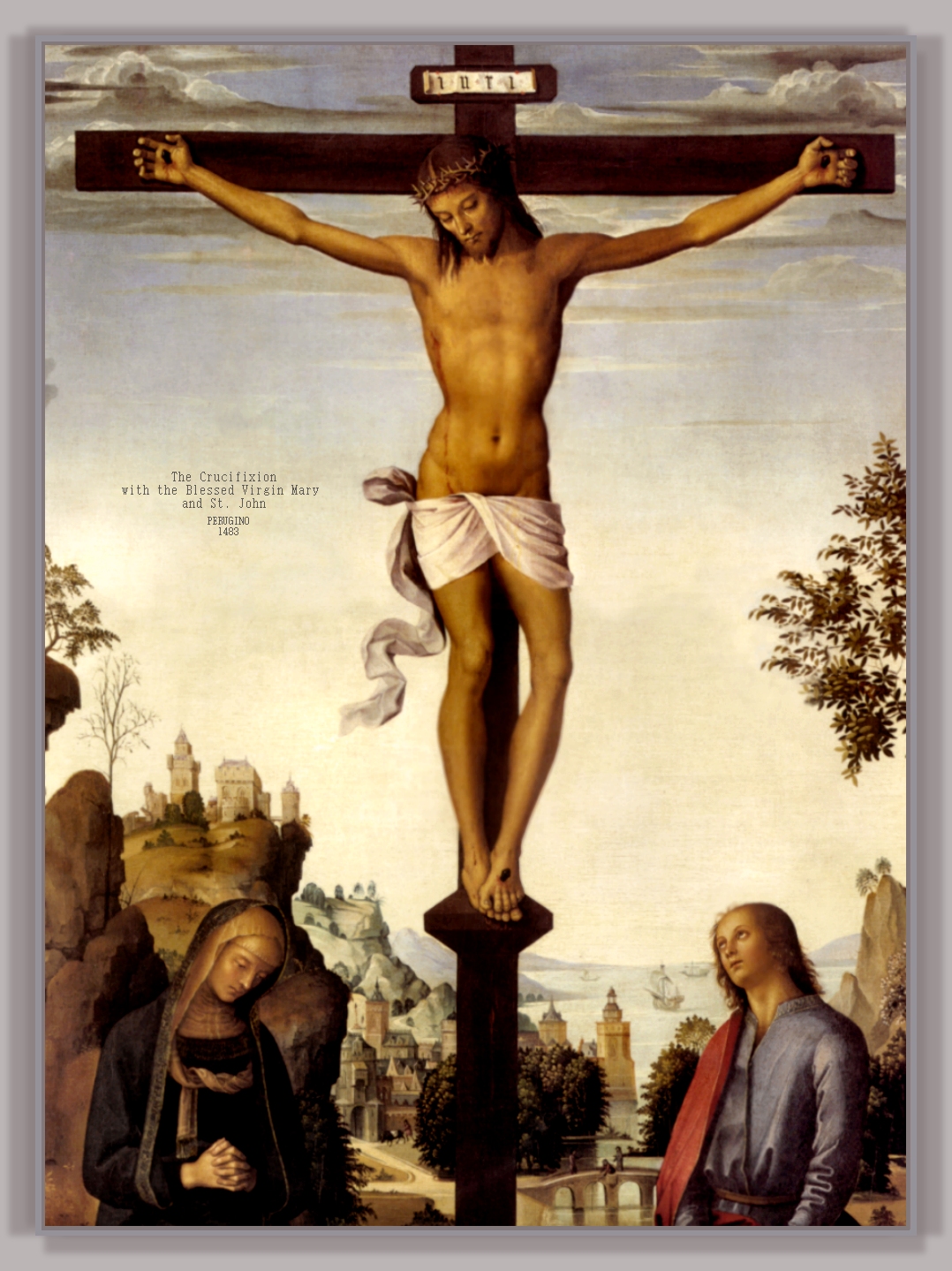
            Jesus paid the cost.  He carried His cross to overcome ours.  With His cross, with Jesus innocent suffering and death, He overcame our sin and death.  Jesus’ blood was the sacrifice that paid the price, the cost of our sin.  He suffered what we owe, and because of that, your Heavenly Father forgives you.  He cancels your debt.  Now when He looks at you, He sees the righteousness of His only-begotten Son, and He credits this righteousness to you, promising you the full inheritance of everlasting life in heaven.  And with this promise, with the help of the Holy Spirit, God strengthens us to carry our cross as we look forward to the life to come, the life that isn’t tainted with physical ailments, persecution, disaster, and death, that life that isn’t filled struggles that try to pull us away from our Savior. 

            Jesus isn’t telling us what we must do first before we can be His disciple.  He’s not telling us what we must pay in order to be considered worthy to follow after Him.  There’s absolutely no cost we can pay in order to earn discipleship, but there is a cost that comes with being a disciple of our Savior, and we need to be aware of this.

This cost is clinging to Jesus alone, with the help of the Holy Spirit.  The cost of being a disciple of our Savior is to hold fast to Him, putting Him first, above everything else, and that’s what Jesus is telling us here.  That’s the purpose of Jesus’ hard words.  He’s telling us that we must be prepared to give up ourselves, to renounce all that we have (Lk 14:33).  Being a disciple of Jesus has it’s cost, and Jesus is calling us to consider this cost, just as the builder considers the cost of the tower and the king considers the cost of the war (Lk 14:28-32).  Being a disciple of our Savior means that we cling to Him above all else.  With the help of the Holy Spirit we do this.  But this means, that we must let go of other things, things that would get in the way of our faith, things that would shift our attention and worship away from Christ. 

These things include our families.  We can turn our families into gods, putting them above God our Father, above Jesus our Savior, and this is what Jesus is talking about when He says we must hate our families.  He’s not saying that we must have disdain for them, for this goes against His command to love.  But what He is saying is that we must abandon them as far as our spiritual resources are concerned.  We must give them up when they get in the way of our faith in Christ.  This is a difficult thing to do.  This is a hard cross to bear, and that’s why God sends His Spirit to us, to help us with this, to help us carry this cross. 

Jesus’ words in Luke 14:25-35 aren’t telling us what we can and must first do to become His disciples.  Instead He’s telling us what we can’t do.  He’s telling us that we need to consider this and all realize that we fall short on our own.  Therefore we hear Jesus’ words and we come to Him.  We come to Him and cling to Him alone in faith, because He’s the one who paid the cost of discipleship for us.  He made us part of God’s family, He carried His cross and died on it for our forgiveness and life, and He’s won for us the inheritance of salvation.  In Jesus name...Amen.

High Church or not?

When we built our new addition, the question of installing kneelers came up.  Some were adamant.  No, we must not install kneelers.  They will not kneel (or cannot) and it would unnecessarily divide up the congregation into those on bended knee and those not.  It was an interesting debate.  What finally won the day was the reminder that no one was being required to kneel but by refusing to install kneelers everyone was being kept from kneeling (save the few who might go down all the way to the tile floor on their knees).

It is a good principle.  By refusing to allow something, we are doing what we deplore -- mandating that everyone do what we do.  This is a principle in conflict with Lutheran liturgical theology and practice from the get go.  We refuse to bind men's conscience in what must be done or what cannot be done (except where such practice conflicts with Scripture).  Kneeling, clearly does not.  Whether on one knee or both knees, kneeling is all over the Bible and, if you look, all over Lutheran practice.

It has become fashionable in Lutheran circles to label extra things "high church".  Lutherans are, as Garrison Keillor famously noted, instinctive minimalists -- at least in culture.  So we would rather do less than more.  What he noted as a joke, has become dictum for many in our church body and this has given birth to a new intolerance for things one step beyond the minimum.  That means everything from vestments to chanting to kneeling (one knee or two) to choirs to pipe organs and a host of other things.  If they are not usual, they are "high church" and "high church" is always bad.  Hence a complaint from a District President about the worship of the LCMS Convention:

WHAT’S THIS?  GENUFLECTING IN WORSHIP?

Finally, a word about my worship experience at the convention.  Worship was definitely of high church style, complete with liturgies “out of the book” and chanting throughout on top of full liturgical garb, chasubles and the like.  This is my second convention which was run and organized by our current administration.  The same style at this convention held true at our last convention, which is also true when I attend chapel at the International Center in St. Louis.  The message to me is plain.  High church is the preferred worship style given to the churches of the LC--MS.  I get it, I can even do high church liturgy if I wish but which I don’t.  But what is completely foreign to me and a bit unsettling, being a life-long LC—MS Lutheran, is what appears to be genuflecting going on in the chancel.  This is something I hope will not continue (if genuflecting is what indeed is taking place)which in some strange way is reverencing the host as if the pastor, because he is a pastor, has some magical power and has instantly before our eyes magically changed the substance of the bread into the body of Christ.  Really?


So it has become usual to complain about the the convention worship of the last few years that it is not mainstream or minimal or even diverse but "high church" and therefore unusual.  What is so strange in all of this is that nearly everything came right from the hymnal!  Since when did the hymnal become "high church?"  If that is the case, then Lutheranism is in more trouble than any of us care to admit.  When the worship of the book becomes the strange or unusual ("high church"), then we no longer have a common language or identity when it comes to people at worship around the Word and Table of the Lord.

What is also interesting is that the complaint against "high church" worship is not ordinarily matched by a complaint against "minimalistic" worship from the other side (whoever they are but I am sure most would include me in "them").  If no vestments had been worn, no recognizable order of service used, no ritual gestures included, would there have been an outcry?  Probably not.  A few folks might have complained but most folks have learned well that minimalism is just as good, perhaps even better, than anything more ("high church").  How far we have come since our Confessions once insisted. . .

Augsburg Confession Article XV: Of Ecclesiastical Usages.

1] Of Usages in the Church they teach that those ought to be observed which may be observed without sin, and which are profitable unto tranquillity and good order in the Church, as particular holy days, festivals, and the like.
2] Nevertheless, concerning such things men are admonished that consciences are not to be burdened, as though such observance was necessary to salvation.
3] They are admonished also that human traditions instituted to propitiate God, to merit grace, and to make satisfaction for sins, are opposed to the Gospel and the doctrine of faith. Wherefore vows and traditions concerning meats and 4] days, etc., instituted to merit grace and to make satisfaction for sins, are useless and contrary to the Gospel.

Article XXIV: Of the Mass.

1] Falsely are our churches accused of abolishing the Mass; for the Mass is retained among 2] us, and celebrated with the highest reverence. Nearly all the usual ceremonies are also preserved, save that the parts sung in Latin are interspersed here and there with German hymns, which have been added 3] to teach the people. For ceremonies are needed to this end alone that the unlearned 4] be taught [what they need to know of Christ]. And not only has Paul commanded to use in the church a language understood by the people 1 Cor. 14:2-9, but it has also been so ordained by man's law. 5] The people are accustomed to partake of the Sacrament together, if any be fit for it, and this also increases the reverence and devotion of public 6] worship. For none are admitted 7] except they be first examined. The people are also advised concerning the dignity and use of the Sacrament, how great consolation it brings anxious consciences, that they may learn to believe God, and to expect and ask of Him all that is good. 8] [In this connection they are also instructed regarding other and false teachings on the Sacrament.] This worship pleases God; such use of the Sacrament nourishes true devotion 9] toward God. It does not, therefore, appear that the Mass is more devoutly celebrated among our adversaries than among us.

Conclusion to the Augsburg Confession.

Only those things have been recounted whereof we thought that it was necessary to speak, in order that it might be understood that in doctrine and ceremonies nothing has been received on our part against Scripture or the Church Catholic. For it is manifest that we have taken most diligent care that no new and ungodly doctrine should creep into our churches. 


Tuesday, September 6, 2016

The masks of the eternal in the temporal. . .

Sermon preached for Pentecost 16, Proper 18C,on Sunday, September 4, 2016, at Golgotha Lutheran Church, Wausa, NE, by the Rev. Larry A. Peters.

We like to think that the Scriptures comfort us and this they surely do.  But it is not hard to find shocking things in the Bible and to be repulsed by the very words of Jesus Himself.  If you came to church today expecting to hear something warm and sweet, you hit the wrong Sunday.  Instead, you heard:  If anyone comes to me and does not hate his own father and mother and wife and children and brothers and sisters, yes, and even his own life, he cannot be my disciple.

It is hard to find a more shocking statement than this.  There are few things more sacred than family.  Blood flows thicker than water.  I can criticize my family but no stranger is allowed that privilege.  Family is the shape of human life and family defines us.  Family first.  We expect that this is what God thinks, too; that these priorities come from Him.

Scripture offers us a host of images that our God uses to describe our relation to Him.  He is our King, our Master, our Creator, our Redeemer, our Holiness, our Bridegroom, and our Shepherd – just to name a few.  Yet the most profound description of God’s relationship to us is that of family.  He is our Father who art in heaven. . . Christ our Brother in flesh. . . the Spirit our Lord and who teaches us faith and keeps us in holiness and righteousness. 

The Trinity is itself a description of family.  God is Father who begets our Lord Jesus Christ and the Spirit proceeds from the Father through the Son.  This is the perfect family not simply because they are perfect but because none seeks self above the other and all are perfect in the love that defers to the other.  This is the love that we see at work in Christ, come to trust by faith by the Spirit, and learn to pray Our Father who art in heaven.  There is no greater affection and intimacy than this saving love.

The Father wills our salvation.  The Son comes to fulfill the Father’s saving will, joyfully taking the Father’s purpose as His own, and the Spirit awakens within us faith to grasp this salvation and rejoice in what love has done.  The Father’s saving will not only redeems us but transforms us, taking us into Himself so that we will become like Him, seeking the things of the Father the way the Son seeks to do His will.

It is into this context that Jesus speaks.  If anyone comes to me and does not hate his own father and mother and wife and children and brothers and sisters, yes, and even his own life, he cannot be my disciple.  We tend to assume that God has come to bless what is already ours and make it better.  The shocking truth is that God has come to transform us and our relationships.  He has not come to help us get what we want.

He has come to instill in us the desire to want what God wants.  He has come to give us all things new; to bestow upon us that which transcends and replaces what we have.  The Kingdom of God reshapes and replaces everything.  Our earthly fathers are masks and mirrors of our Heavenly Father.  Their best work in us is to reveal our true Father in heaven, just as Jesus has come to reveal the Father to us and to do the Father’s will. 

We have a new mother, the Church and the Spirit who, like a mother, gives us new birth by water and the Word.  Our earthly mothers are masks and mirrors of the mothering love of God who from the womb of baptism give us the new birth death cannot steal.  We have a new brother in Christ who took on our flesh to suffer and die in our place and to rise again on the third day.  Our earthly brothers and sisters are masks of our true brother, Jesus Christ.  God has given us a new family, those who with us confess Jesus Christ and who rejoice in the redemption He has purchased and won for us with His own blood.  All our earthly families point us to the heavenly family to which we were born anew and in which we now live by faith.

And if that were not shocking enough, we have a new self.  We are not who we were.  We were bought with a price.  We don’t belong to ourselves but to the Lord.  We were redeemed to be free – not in the sense that we can choose our own fates and futures but free to receive by faith the fate and future written for us in the blood of Jesus.  We are made new, we are given a new family, and we live new lives.  Jesus is blunt.  You cannot live with one foot in the kingdom and one foot in the world.  You cannot love Jesus but love your earthly families more.  You cannot love God but love yourself a little more.  You cannot love this life and love Jesus just a little bit more.  God’s claim is not to part of you but to all of you.  By faith, you claim Him above all other things.

The sinful heart within us fears such radical new birth, the new shape of our family, and new self we live as the children of God.  We would rather have a little bit of everything than to risk investing all our hopes in one thing. Faith has become like a visit to the smorgasbord in which we take what we want but God pays the bill.  Jesus is blunt.  Faith cannot pick and choose from the things of God and the things of this mortal life. We cannot live half on our own and half in the power of God by faith.  The radical truth of God is the radical claim of radical discipleship.

And it gets even more shocking.  The radical path of discipleship is not earthly ease,  comfort, or victory but suffering.  What does Jesus say?  Whoever does not bear his own cross and follow Me, cannot be My disciple.  Your path of faith on earth is tested by trials and tribulation, sorrows and suffering, pain and persecution, life and loss.  Your victory is by faith and not by sight.  The future that belongs to you is the future you see not with the eyes in your head but the eyes of faith opened by the Holy Spirit.  The struggles of the day are not the lens by which you see your eternal future but just the other way around.  Your eternal future and your new relationship with God your Father, Christ your brother, and the Spirit your mother is the lens through which you see the struggles of this mortal life and the troubles of this day.

So what does Jesus call us to do?  Count the cost.  Jesus does not promise a rose garden but a life wearing the cross and enduring suffering.  I know that is not what you thought you would hear today but it is the truth.  Yet despite it all, God is still our heavenly Father, Christ our brother who has saved us from our sins and death, and the Holy Spirit still the mother who bore us in faith that we may endure to the day of Christ’s coming and be found holy and blameless before His judgment seat.

Count the cost.  Know what it is that tests you and what it is that waits for you.  Know what it is that you are called to sacrifice for the Kingdom but never forget what Christ has sacrificed to give you the Kingdom.  Know that here on earth your sufferings are not in vain, your faithfulness is not without reward, and your life not without purpose.  Count the cost.  Repent.  Believe the Gospel.  Keep the faith.

Some of you undoubtedly complain about the government, about taxes, about the choice you must make at the ballot box, about the weather, about your spouse, about your children, about your parents, about life’s disappointments and its defeats.  I know I have.  But our comfort does not lie in an improving world or family or life.  We are citizens of an eternal city and our citizenship is in heaven.  We belong to Him. Everything on earth was created to point to God from the food we eat to the families into which we were born.  They are shadows of the eternal and even though sin has corrupted them, the temporal things of this life do not fail to point to the eternal.  The Spirit is given so that we can see this with eyes of faith -- seeing what our physical eyes cannot see.

Our earthly families are not substitutes nor are they competitors for the heavenly family but earthly masks or mirrors of God’s love and family.  We cannot choose one over the other for the only way our earthly relationships endure is to belong to God, to know Him as our Father, Christ who was incarnate as our brother, and the Spirit who acts as our mother to give us birth in faith.  We cannot choose our old self over the new life God has created in us.  The only way we are truly free is to be drowned in baptism and rise as the new people of God’s own creation.  Every day we recall this death through repentance and rise in faith to live as the people of God, rejoicing over this new birth, new family, and new self.

If you do not renounce all other claims but Christ, you cannot be His disciple.  The only things that are truly ours are those God has given.  Count the cost.  Repent.  Believe the Gospel.  Your life is not defined by today but by Christ and the eternal tomorrow He has prepared for You.  Let he who has ears, let him hear.  Amen.

It is not a void we battle. . .

There are those, like me, who are old, tired, and wearied by the pace of change, the constant march of technology, and the disarray of sexuality, family, and social order.  We often look upon this world around us as a world filled with nothingness, a void that needs to be filled.  The truth is that the vast majority of folks outside orthodox Christianity do not see the world as empty at all.  They see a world filled with a difference -- one that I may not like but which they have come to accept and even enjoy.

They do not abandon all meaning but have chosen to eschew the eternal for the meaning of the moment.  It may not appeal to me or to you but they see it as a legitimate and alternative reality that satisfies them -- at least for now since nothing in the moment is ever more than momentary.  It is not that they find no need for the eternal -- they are perfectly willing to let the eternal be the choice of those who reject the present but they do not reject the present.  They are satisfied with the moment -- with the dizzying pace of change as a goal as much as the actual outcome or purpose for that change.  They dread boredom as much as death -- could death be the ultimate boredom?  So they delight in choice, in the supremacy of personal preference, and in a life which is defined by the moment.

In addition, they have come to terms with individualism.  They see themselves as solitary organisms who define their own lives and who live to fulfill their own pursuit of happiness and pleasure.  These may or may not include family and community in the real sense of neighborhoods and personal relationships or they may be satisfied with the virtual friendships and community of social media, of gaming partnerships, and of screens.  It may not be my cup of tea but it is clearly theirs.

The church is not doing battle with meaninglessness but combating an alternative meaning of happiness, pleasure, and life. This is somewhat true of young women but perhaps more true of young men.  Yet it is true.  The church does not wrestle with despair or hopelessness as much as she does battle with an individualism captive to a moment -- and one which is, for the present, satisfying to those of a certain age.

We cannot engage those people by adapting or adopting something that is similar to their own world of individualism and the moment.  We cannot distract them by offering competing entertainment to the vast video world they already know.  But neither can we win them over by complaining about them or dismissing their choice of self and the moment.  We have to do much more.  We need to re-engage them on another playing field.  They may not come to us but we dare not masquerade as one of them in some attempt to bait and switch them into orthodox Christianity.  We must be true to the Gospel and authentic in every way (doctrine and life).

The moment works best for those who have no real expectation of or experience with suffering, with grief, or with death.  It is easier to be satisfied with the moment when you do not look into the mirror and see that life has brought you to its final chapter.  It is easier to accept a solitary life yoked to others through technology and media when you are a master of that technology.  But that does not mean that this generation is already immune to questions of hope and community.  We need to recognize those questions in the forms they take and address them with the one hope of Christ crucified and risen and the real community of life together as the baptized.  We cannot escape from their world and we cannot allow them to think they can escape from the world of need that has found answer in the Incarnate Son of God who redeems us from captivity to a moment so He might make us eternal in Him.

Europe may have chosen a secular identity over its Christian past but those Christians who mirror the culture of the moment and glory in the individual have surrendered Christian identity on another altar.  Neither should go unchallenged by the real alternative of hope, redemption, a clear conscience, life now, and eternity.  One last thing.  Even old curmudgeons like me have to wake up and realize that we are not entirely aloof from the age we abhor but are also embedded within this fabric and shaped by its ideals.

Monday, September 5, 2016

The dignity of work. . .

On the one hand we face this Labor Day acknowledging that a certain segment of young males would rather spend their time playing video games and watching porn than living maturely the life of vocation as worker, husband, father, and citizen.  I am not at all sure what to make of all of this but do not doubt the challenges.

On the other hand, we enter this Labor Day with a military in which men and women now fight along side each other, in which women tend to see career as a greater and more productive role than mother, and in which many if not most our children have no significant male role model in the home (father or step-father).  Again, you will read my words in vain to find a solution to all of this.

But on Labor Day the Christian should spend a moment or two on the idea of work as a gift and the blessing of vocation (both inside and outside the home).  Ask the un- or under-employed and they will tell you that for those who desire it, work is a gift and blessing and to face life without a good, stable job is a difficult and taxing burden.  But it is not simply a gift when we miss it.  It is a gift and purpose that goes right to the heart of who we are and why we are here.  It is first article stuff.  I believe in God the Father almighty, maker of heaven and earth.  And Luther leads us here to finish that thought by making it very personal. 
I believe that God has made me and all creatures; that He has given me my body and soul, eyes, ears, and all my members, my reason and all my senses, and still takes care of them. He also gives me clothing and shoes, food and drink, house and home, wife and children, land, animals, and all I have. He richly and daily provides me with all that I need to support this body and life. He defends me against all danger and guards and protects me from all evil. All this He does only out of fatherly, divine goodness and mercy, without any merit or worthiness in me. For all this it is my duty to thank and praise, serve and obey Him. This is most certainly true.
Secondly we would do well to remember that we have a vocation not of our choice but by virtue of God's creation.  We are given the earth not as possession but as God's resource to use for His glory.  We are born into a family and have a vocation as son or daughter to our parents for as long as they live.  We live in community and have a vocation to our neighbor and as citizen in the state whether we like our neighbor or approve of our government.  We enter into marriage not simply for what it offers us but to fulfill the godly vocation of husband to wife, wife to husband, and parent to children.  Vocation is what does not change (at least until death).  This is our vocation -- our godly venue in which we work and for which our labors go forth every bit as to the Lord.  Even the Sabbath is not a rest in which we do nothing but undertake the work of worship, honoring God as our Creator, Redeemer, and Sanctifier by trusting in the one God in the Three Persons of Father, Son, and Holy Spirit.

So as you bite into your burgers and hot dogs and corn on the cob and pop open a beer, remember that labor is a burden only because of sin and in spite of sin it is still a gift, a blessing, and privilege -- whether the venue is in the home, in the neighborhood, at the workplace, or in worship.  Labor is a gift and the reward is not the paycheck but understanding who we are and why we were made.  When that happens, the holiday becomes a lifetime!

Sunday, September 4, 2016

A Swede for Latvia!


The Evangelical Lutheran Church of Latvia (ELCL) consecrated a priest barred from ordination in Sweden to be bishop.  The Reverend Hans Jönsson, 48, was consecrated Saturday (August 6) at the cathedral in Riga to serve as bishop of Liepaja Diocese in southwestern Latvia. Bishop Jönsson graduated from Lund University in Sweden but was denied ordination in the Church of Sweden. He was, however, certified as qualified for ordination by the Church Coalition for The Bible and Confessions, an umbrella organization encompassing several Swedish Confessional Lutheran movements that was founded in 1958 at the initiative of Bishop Bo Giertz to defend traditional Lutheran faith in the Church of Sweden. The Coalition was originally formed by those who rejected women’s ordination as contradicting Scripture and tradition.
Since the founding of the Swedish Mission Province in 2003, approximately 40 men have been ordained in Sweden and in the Mission Dioceses in Finland and Norway who would otherwise have been excluded because they believe the Holy Scriptures limit the pastoral office to men.  The ELCL has a close historical relationship to the Church of Sweden. Unlike the Church of Sweden, however, the Latvian church has remained faithful to Confessional Lutheran theology.  Rev. Jönsson was elected June 3 to replace the retiring Bishop of Liepaja. The diocese consists of 124 congregations served by 40 pastors.

Archbishop Janis Vanags conducted the consecration, which was broadcast in its entirety by Latvian national television. Abp Vanags was assisted by Latvia’s bishops as well as Bishop Tiits Salumäe of the Estonian Evangelical Lutheran Church and Bishop Hans-Jörg Voigt of Germany’s Independent Evangelical Lutheran Church (SELK), who is Chairman of the International Lutheran Council. The Lutheran Church-Missouri Synod was represented by Dr. Albert Collver, Director of Church Relations and Assistant to the President. Provisional Bishop Torkild Masvie of The Lutheran Church in Norway also participated in the service. Representatives also attended from the Nordic Mission Dioceses, as well as the Swedish Luther Foundation and other Confessional Lutheran movements.

With nearly 300 congregations, the ELCL is the nation’s largest church. It is in fellowship with the LCMS and also has close ties to the Independent Evangelical Lutheran Church (SELK) of Germany. In June, the ELCL amended its constitution to reverse a policy imposed during the Soviet domination that opened ordained ministry to women (although no women had been ordained since shortly after Latvia’s liberation).

My Comments:

Missouri has enjoyed a very close relationship with the Lutheran Church in Latvia and it has been a catalyst for the confessional Lutherans in the entire region who seek to be faithful to Scripture and the Confessions in the face of changing culture and churches that merely reflect back wherever culture goes and whatever it values.  We should commend all involved and in particular rejoice with them at this consecration.  Further, it proves again that the key to confessional identity lies not in some democratized church structure nor in an episcopal structure alone but where the faithful remain steadfast and immovable in their confession.  I am hopeful, however, that occasions such as this will wear down Missouri's instinctive resistance to anything episcopal -- be it office or function -- and remember that Lutherans were not always so opposed to bishops as they have been in Missouri's history.  The stand of the Lutherans in Latvia was certainly enhanced by the ability of the episcopal structure there and a good man in the form of Archbishop Vanags.

Saturday, September 3, 2016

What exegesis is NOT. . .

On another forum there was this comment made:  Exegesis is seeking to get into the mind of the original author and the meaning he originally meant.  It matters not who said it.  It is perhaps the typical way that those who view the Scriptures as pretty much just like another book view the exegetical task.  It may even sound attractive -- after all, who would not want to get into the mind of a St. Paul or St. Peter or an Isaiah or Jeremiah or Ezekiel?  But as interesting as this might sound, it is not exegesis.  It is some kind of channeling idea that produces no good fruit and undermines the very character of the book we call the Word of God.

This is exactly what happens when exegesis is taken outside the faithful and placed into the hands of the skeptic or academic whose purposes and goals have little to do with the Word of the Lord that endures forever.  The concern here is not the the meaning of Scripture -- which Jesus says is to testify of Him -- but the pursuit of an illusive and impossible goal.  Namely, to separate Scripture from the God of the Scriptures and to presume that the words are merely the words of man (although they might contain some words of God -- especially when they speak of morality, the goal of justice, and spiritual enlightenment of the individual.

Over the course of time much of Bible study has devolved into "what do you think it means" or "how does this make you feel."  Even printed studies published by church publishing houses waste the student's time by focusing not on the Word that endures forever but simply what you think, feel, or guess about the text.  While this is a problem in the parish, it is an even bigger problem when it is taught to the pastors who will teach the folks in their parish.  It suggests that the meaning of the text is largely unknowable, that it does not matter, and that the best guess of the scholar is slightly more important than the best guess of the folks in the pew.

The Church does not need pastors speculating about what God meant or what He said.  The people in the pew deserve better.  They deserve a pastor who can tell them what the Word of the Lord says and point them to the Christ who is both key and subject of the Word -- the words about the Word made flesh!

At some point in time we lost track of the idea that the written Word and incarnate Word speak the same thing and that Christ is both author and content of that written Word.  I cannot tell you how much damage has been done to the faith of people by the promotion of this idea that Scripture means something different than what it says, that the Christ of God is largely unknowable from the Scriptures, and that the Word of God is mostly human words, speculation, about the unknowable God.

One of the worst outcomes of this mess is that our people are no longer sure that they know what the true doctrine is.  Church membership is thus separated from what is confessed and taught and left to the realm of speculative ideas which have the same relative value (except when they are in service to a progressive social agenda when they suddenly become authoritative!).  Reduced to mere preference or opinion, the Church is powerless to call out error and impotent in the face of heresy and apostasy.  That is where most mainline denominations are at today.  You do not need to believe in much of a God to belong and the primary requirement is that you refuse to label any doctrine any more that speculation and every truth equally correct and equally error.  It is wonder that liberal Christianity is bleeding off members.  Train up a child in the way he should go and he will not depart from it.  What that means today is that we have done such a good job teaching our children that doctrine is a best guess, that everyone's guess is equally valid and authoritative, and that the Bible is one source but not the norm of what is believed, taught, and confessed that they have trouble believing in anyone or anything.

Friday, September 2, 2016

Faith of our Fathers Living Still. . .

My father-in-law slowly lost much of his memory.  First words escaped him and then names and then whole sections of his memory were lost to him until he was most comfortable with the earliest memories of life as a child in the home of his parents.  He went the same path of his brothers who all suffered some kind of memory loss -- some earlier and some later in life.  It was as if each of them were robbed of their identities by the memories stolen by Alzheimer's.  Death was merciful and his suffering ended and in death was surrounded by his family who insisted upon remembering him as he was before the disease had taken the vigor from his muscles and made his mind so fragile.  My wife misses him terribly and I with her.  We refuse to forget and insist upon remembering especially in the face of an affliction that clouded memory and made him forget what was nearest and dearest to him.  He had no choice.  We do.

It is as if the Church is suffering its own disease of fragile memory.  We are in the midst of an identity crisis.  We have forgotten who we are and what does not change and so we reinvent ourselves and change ourselves to match, as much as possible, the rapid changes we experience around us in technology and culture.  The Church is, after all, is a living body, filled with the distinct life and identity of Christ. We are in but not of the world, not our own but bought with a price, and we belong to Him who made us first and recreated us in the living waters of baptism.  We are His baptismal people, endowed with the new hearts and lives of His own creation.

Without tradition, without the corporate and individual memory of who we are, we are left to reinvent and redefine ourselves as often and according to the whims of our desires.  Thus the Church has suffered her own memory crisis so that what we once believed is now under suspicion, what we once confessed regarded as outdated or irrelevant, and what we once did in worship no longer meaningful or relevant to this moment.  The Church, the Body of Christ, has been left without a context, without a beginning, without an ending, and without certainty of what to be and what to do in the meantime.  So the tradition of our fathers and the apostolic foundation has been cast aside willingly or swept away by passing fads, prevailing moods, and personal preference.  In many ways, the Church has become like an Alzheimer's patient with no memory and is being led helplessly along a pathway created not by God but by ourselves (or perhaps even our enemies).

Faith does not come naturally but is a gift handed down by those who went before and enlivened by the Spirit. We do not create faith or define it to suit our preferences. We are incorporated into the faith which existed before us and, if we are faithful and God keeps His promise, will exist after us.  When we are baptized into this faith, we are born anew, from above, into a kingdom and creed that was before us and is not of our own making. The Spirit works through the means of grace to incorporate us into a reality that was before us -- what we call the Church.  We receive this faith by the Holy Spirit, as Luther taught in the explanation to the 3rd Article of the Creed.  This faith was watered by the blood of the martyrs, preserved and passed on by the faithful who went before us, and we are not given to make it ours but to add our "Amen" to it all.

Faith is under all things surrender.  It is the surrender of the intellect to the mind of Christ and surrender of the will to the will of Christ.  The Spirit works this and it is not simply a choice we make.  Faith cannot co-exist with the refusal to surrender thus.  We are captive to the Word of God and the will of Christ.  Faith always involves this element of surrender—surrender of personal preferences, of whims and desires, and of reason and idea to the higher wisdom of Christ. We believe, teach, and confess an unchanging truth in an age of relativism and do-it-yourself religion -- the most radical and countercultural truth.

We confess a catholic faith and a catholic and apostolic church.  God does not speak one thing to one people or one thing to one age and then speak to others or other ages different truth.  The Word of the Lord endures forever.  We cannot afford to forget our fathers in the faith and we cannot allow the Church and the Gospel to become captive to the moment.  “So then, brethren, stand firm and hold to the traditions which you were taught by us, either by word of mouth or by letter,” says St. Paul.  (2 Thess. 2:15).  "Therefore, as you received Christ Jesus the Lord, so walk in him, rooted and built up in him and established in the faith, just as you were taught, abounding in thanksgiving." (Col. 2:6-7)

The loss of his memory left my father-in-law a shell of his former self and utterly dependent upon others.  The loss of the Church's memory, her tradition, the living faith of the dead, leave us a shell of what God intends us to be, utterly captive to and dependent upon the moment.  If we have anything to offer a world in pain, sinners in shame, those who live in the shadow of death, then we cannot afford to forget but must work always to remember and remembering renew within us the faith yesterday, today, and forever the same.


Thursday, September 1, 2016

Not merely dancing with the devil but leading. . .

I was shocked to find out that VP Joe Biden had asked for and received government approval to preside at the wedding of a same sex couple.  VPs do not normally do such things.  Biden presided over the union of Joe Mahshie and Brian Mosteller, both longtime White House aides, at their requires and got a special temporary certification from the District of Columbia to make it legal.  Of course Biden has long proposed gay marriage (going back to 2012 and before) but Biden is Roman Catholic and claims to be very devout.

A very long time ago (1984) Mario Cuomo famously argued that he was “personally opposed but won’t impose” his views upon his public policy with regard to abortion.  It was a “watershed moment” for pro-choice sympathizers and especially for Roman Catholics (for whatever reason well represented on the left side of Democratic politics). The University of Notre Dame gave Cuomo a highly visible platform in which to make his argument and also, it could be said, provided an official “nihil obstat” stamp upon his logic and his argument.

Notre Dame has a history of slighting its local Bishop and giving prominent place and exposure to Roman Catholics who violate Roman Catholic teaching.  Senator Tim Kaine, Hillary Clinton's running mate, is, like Biden, resolutely pro-choice.  Like Biden, Kaine supports same-sex marriage. Like Biden, who has endorsed the Obamacare contraception mandate’s incursion on religious liberty, Kaine co-sponsored a bill aimed at crushing with heavy fines the consciences of pharmacists who don’t want to sell contraceptives -- eliminating any conscience for those who disagree with the Obamacare mandates.

Note that Biden cannot claim as some do that their elected duties require them to go against their conscience.  No, in this respect, Biden choose to violate church teachings by securing permission to do what was not his to do in the first place. Biden went out of his way to show his contempt for church teaching, his own church teaching, and therefore begs the church to do something -- anything -- about it.  If the church does nothing, then the church is complicit in the actions of its very public members.  Because this is public, it cannot simply be handled in private.  The world is watching.  How is it possible for a person who claims to be a pious Roman Catholic to violate church teaching in such an overt and public manner and the church to say nothing officially about it?

Roman Catholic, Lutheran (Missouri Synod), and other politicians who disregard the teaching of their churches and separate personal from public beliefs with regard to same sex marriage, abortion, and reproductive rights are not merely dancing with the devil.  They are leading the dance for they are making it harder and harder to stand upon conscience and the Word of God in the face of public policy that violates the Scriptures, conflicts with the Judeo-Christian teaching on these subjects, and mandates that require the subjection of faith to the prevailing political mood.  They are by example denying the truth of their privately held beliefs and proving that doctrine and practice are satisfied by a smorgasbord approach to truth and life.

Notre Dame is not only sanctioning these individuals but undermining the whole structure of the pro-life movement that is the true and real justice cause in America today -- indeed there can be no justice for any other group as long as the unborn are not considered persons, as long as the destruction of their lives in abortion or various means of reproductive technology is considered moral as well as legal, and as long as somebody gets to choose which lives matter.

It is a scandal.  I feel for Rome and its difficult position but until the bishops and cardinals stand up for the positions they have taken in the face of highly visible and prominent Roman Catholic politicians, the integrity of their pro-life stance has been compromised by these individuals.  It makes it appear that the pro-life movement is but a thin veneer upon a rotten core of expediency and political reality.  I hope that I am proven wrong.