Sunday, April 17, 2011

Your King Is Coming

Advent tells us Christ is near;
Christmas tells us Christ is here!
In Epiphany we trace
all the glory of his grace.

Those three Sundays before Lent
will prepare us to repent;
that in Lent we may begin
earnestly to mourn for sin.

Holy Week and Easter, then,
tell who died and rose agin;
O that happy Easter Day!
"Christ is risen indeed," we say.

Yes, and Christ ascended, too,
to prepare a place for you;
so, we give him special praise,
after those great Forty Days.

Then, he sent the Holy Ghost,
on the Day of Pentecost,
with us ever to abide;
well may we keep Whitsuntide!

Last of all, we humbly sing
glory to our God and King,
glory to the One in Three,
on the Feast of Trinity. 


Written in 1888 by Kath­er­ine Hank­ey (1834-1911) for the Sun­day School of St. Pe­ter’s, Ea­ton Square, Lon­don, these words have probably been sung by countless children and adults.  I am struck by the connection between Advent and Palm Sunday.  We heard the Palm Sunday processional Gospel on the First Sunday in Advent.  It probably seemed terribly out of place to us in Advent but now we see how the two readings tie together.  Advent, Christmas, Epiphany, and Lent all point us in the same direction.  Unlike a child's understanding of bits and pieces, the Church Year points us through and not simply to each section.  We are heading toward the cross and that is unmistakable on Palm Sunday.  Palms and Hosannas are not some joyous welcome home to a favorite son but the welcome of the Savior to His appointed destiny -- the one He willingly takes upon Himself for us and our salvation.


As we wave the palms and shout our hosannas today, my mind will still be back on the First Sunday in Advent when the lessons reminded us what was awaiting us today.  I truly love that tie between the most unlikely of Sundays and seemingly disparate seasons.  The cross lay hidden along the way from announcement to birth, from epiphanied glory to Transfiguration light, from ashes and repentance to palms a waving...  Yes, blessed is He who comes in the name of the Lord!  

Saturday, April 16, 2011

The Cross Is Not Pretty

The old adage is that beauty is in the eye of the beholder.  I am not so sure.  True that we all have our own taste and we like what we like but I am not sure that this is a good or fitting definition of beauty.  I had a shut in whose prize possession was a velour painting of a tiger.  It was something.  He thought it was beautiful.  It was his house and so he can hang what he wants and call it what he wants but it is not beautiful.  I have seen modern art that looked like paint was tossed on to the canvas and, without a hanger on the back, who would know what side was up.  I have stood there as people oohed and aaahhhed over its beautify.  Where?

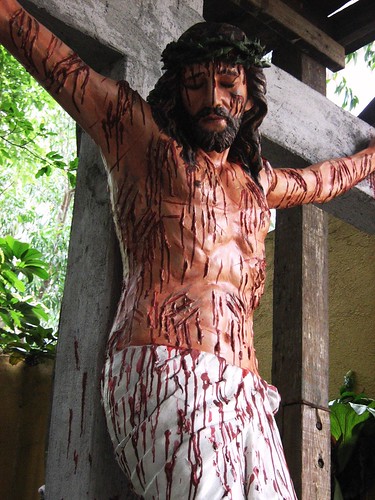
We have a great tendency to clean up the cross and turn it from an instrument of death into a work of art -- a thing of beauty.  It is not a good thing to do.  The cross was never meant to be a thing of beauty.  It was created to be an instrument of death and God chose to use it as the place where His only Son would meet His death -- with the surprise that this death would end death's reign and have the power to give us life!  That surely transforms the cross but it does not make it beautiful.  There is no beauty in such deep suffering that the voice cries out "Eloi, Eloi, lama sabachthani!"  The cross is not pretty but we continue to behold it and even raise it up because on it the salvation of the world was accomplished -- freely, without input or cost from us, and graciously imparted to unworthy and undeserving sinners.

Tomorrow it all begins.  Holy Week.  The palms and hosannas turn into the cross and cries of "crucify."  The events take up perhaps a third of all the Gospels and there is nothing pretty about what takes place.  Unlike the comforting and consoling images of Jesus carrying the lamb in His arms, we meet bloody sweat and betrayal, mocking homage and a kangaroo court, pressing crowds and a weak Roman governor, conspiring priests and an expedient death, a crown of thorns and a blood stained robe, sour drugged wine and heaving breaths, gracious words and whispered end, blood and water, a centurion's unlikely confession and a mother's grieving loss, a death like any other death and yet a death like none other...  It is a week of images not pretty but profound.

We have an urge to clean it up, explain it away, and then put it away so that we can enjoy Easter without remembering Good Friday.  But it will not be... As often as you eat of this bread and drink of this cup, you proclaim the Lord's death until He comes....  It is death that we have come to remember, death we have come to honor, and death that we proclaim.  Easter does not erase this terrible death or turn it into something beautiful but it points us to what was accomplished by this death that transfers forgiveness, life, and salvation to us -- teaching us to sing again the "Alleluia" for a time put aside that we might sing it again.

Beauty is not the purpose of the cross but redemption.  Dirty, messy, wounded, and dying sinners required a God who got dirty with them, who entered their mess, who was wounded for their transgressions, and suffered all -- even death -- for their sins and to purchase their redemption.  The cross is many things but pretty is not one of them.  As we prepare to walk the final footsteps of our Lenten journey, let us not try to whitewash where the journey goes or recast the cross into a piece of art.  It's beauty lies not in what it is, but in who was crucified there and what His suffering and death has won for us and for our salvation.

Soli Deo Gloria

Friday, April 15, 2011

Mystery or Majesty

Somewhere I read something to the effect that God is not a mystery to be solved but a majesty to be worshiped.  Now I would suggest that this does not and we should not put majesty and mystery against each other.  Rather this challenges the idea that it is our job or even our goal to unpack the mystery of God before His majesty can be worshiped.  It occurs to me that there is much truth to this idea.  The sad thing is that we view the mystery of God as a challenge and the job of the theologian to be a myth buster -- sorting out what is real from what is not.  Yet by its very perspective, this places the theologian above the God who is mystery and makes God's majesty into something rather ordinary and mundane.

It occurs to me also that most of what the Church has said about God has begun from the negative -- God is NOT...  Instead of saying who or what God is (beyond Scripture anyway) the Church has been forced by heretics and apostasy to say who or what God is NOT.  The point of this has not been to unpack God's mystery but to protect that mystery -- to ensure that what we say about God is what God has said about Himself  -- no more and no less.

One time when the Church did make a radical departure from this was the introduction of the word homoousias into the creed (of one substance with the Father).  This was not without its own controversy and yet it was a word coined to express the mystery of what God has revealed about Himself.

Most of what God has told us of Himself falls within the range of apparent or even seemingly obvious contradictions.  What of Jesus who says in John's Gospel on one hand that "I and the Father are one" and on the other hand says "the Father is greater than I?"  Yet this is part of God's revelation of Himself and part of His testament which creed and confession must affirm to be orthodox.  It is our great temptation to try to unpack this and dissect this aspect of the mystery but I think we do this at some peril.  On one hand, the great fallacy is that we can ever fully understand or express in human language the fullness of the Divine mystery and majesty (except to affirm what Scripture says).  On the other hand, the fallacy is that God gives us enough words about Himself so that there are cracks in His mystery and therefore invitations for our speculation.

Yet the point of God's revelation is not to explain Himself or make Himself predictable or even understandable to us.  Rather God tells us of Himself that we might worship Him.  He shows us Himself in glimpses that neither explain nor completely reveal.  He shows enough of Himself to save us -- to address us with the grace that imparts new life to us lost creatures, forgiveness for all our sin and guilt, and righteousness to cover up all our flaws and failings.

You do not need to be a theologian to be tempted to define God in such way that God is understandable or predictable to us.  The great bulk of Christian books at the local bookstore attempt to do that in some way and yet these books are not meant for the theologian but to inform the daily life of prayer and worship of the ordinary Christian.  We must be wary of such attempts and we must challenge those who would go far beyond what God has made known to us of Himself.  Instead, we live within the constant tension of "Lord, I believe -- Lord, help my unbelief."  And in the midst of that tension is the attitude and perspective of worship and prayer.

And the Catholic Faith is this: That we worship one God in Trinity, and Trinity in Unity; Neither confounding the Persons; nor dividing the Essence....Fides autem catholica haec est: ut unum Deum in Trinitate, et Trinitatem in unitate veneremur.  If we forget this, God will neither be more accessible to us nor will He deign to be limited to our definition of who He is or what He has done.  Worse, we will be left with pure and raw speculation instead of fact and worship a God who is more idol (make that mere idol) than real deity.

Thursday, April 14, 2011

Time to Panic

Although you may not be thinking this way, most Pastors are approaching panic mode by now.  Palm/Passion Sunday is but a few days away and then the fun begins.  I cannot say that I do not enjoy it but the schedule for Holy Week and Easter can be unnerving -- even after more than 30 years of it.  It is one of those things that you do not fully appreciate until you go through it all. 

I am convinced that Easter does not make a lot of sense to most folks (well, at least to those who miss the unfolding drama of Palms to Upper Room to Cross to Grave to the Vigil and the Easter liturgies that follow.  I have always urged folks to make one complete journey through Holy Week and all the services -- even if they cannot do it every year, there is great value in walking the path at least once every several years or so.  Most of the time people find that their sense of Easter is radically changed by the walk of Holy Week.  Sadly, most Lutherans do not follow the entire path and for too many the whole thing seems kind of disjointed and even jerky.  Palms to Passion, Upper Room to courtroom, Cross to Tomb, waiting to water.... if you miss the flow of it all, the whole thing loses a bit, I am afraid.

Without a sense of the whole story as it unfolds by God's design, we end up with Easter as more of "a pie in the sky when you die" kind of hope.  Some who attend must surely wonder why all the fuss since Monday morning they return to the ordinary routines of mortal life.  Yet that is exactly the point.  Monday is not the return of ordinary life for ordinary people.  It is, instead, the arena in which we live out now the new and eternal life given to us in baptism, when the cross and empty tomb became "personal."  To go back to life as if nothing had changed by the last word is to miss what God has done in Christ and what blessing He affords to us (who cannot afford it at all).

I would urge all Christians to make their way through it all.  We begin with palms, outside (weather permitting).  We read the processional Gospel and set apart the palms with prayer and thanksgiving.  The children in the crowd pass out the palms to the standing people.  Then we speak responsively "Blessed is He who comes in the name of the Lord/Hosanna in the highest" over and over again as we slowly make our way into the Narthex.  There the strains of the organ introduce the traditional entrance hymn: "All Glory, Laud, and Honor."  There the palms give way to the story of the Passion.  We read the whole, long Passion.  I do not like to trivialize the story by assigning parts (especially by having the people read the "part of the crowd."  I did that a few times and felt like it imposed something on the text that was less than salutary.  Then we commune as the Passion hymns retell the story.

Through the smaller services of Holy Week we come to Maundy or Holy Thursday.  Many find the individual absolution to be one of the most deeply moving aspects of the whole service.  Others find the ending the clincher -- seeing the chancel emptied of all its appointments is like watching our Lord's things being taken  from Him.  And then it ends in quietness and solitude.  From there to the noonday office in which we read the Passion, interspersed with hymn stanzas, and end with the bidding prayer.  In the evening we have used several different formats.  This year we shape the service around the text of the Litany (our prayer for Lent at the behest of Pres. Harrison).  Again, the focus is on the Passion (according to St. John) and it ends with the adoration of the cross and the Our Father.  The empty chancel and the starkness of the setting emphasize the Passion story.  Quiet and solemnity affords us no distraction from the words of the Gospel.

The Vigil will see two baptisms and perhaps the smallest of the crowds for the Holy Week and Easter services.  The smaller attendance seems to better fit the character of the Vigil and allows us a more casual atmosphere (with respect to coming and going and nearness to the action of it all).  The people there then decorate the chancel for Easter and restore the Alleluia to the song of praise for the first time since the Transfiguration.

Three Easter liturgies -- all Divine Service -- but somewhat different in character.  The first is more simple without either choir or brass.  It begins with a nod to the Easter vigil of the evening before as the Light of Christ is carried again into the darkened Sanctuary.  Then the larger (9 am) Divine Service with full choir, brass, and sung liturgy.  It is usually packed.  The final Divine Service (10:45) brings the Resurrection schedule to its end.  Then Easter Monday and a much smaller crowd extend the dawn of the eighth day and its new week of life, hope, and resurrection.  From there we transition to a season and not a week or specific days...

The point is that the whole thing makes most sense when you are part of it all -- from Palms to the Empty Tomb.  So if you have not followed the entire path before, why not put it in your schedule THIS year!

Wednesday, April 13, 2011

Salvation has come to your house...

Remember when Jesus came to Zacchaeus' house?  "Salvation has come to your house," said Jesus.   Salvation is where the flesh and blood of Jesus are.  Salvation is not some gift Jesus pulled from His pocket and handed out but the intrinsic gift of His presence.  Where He is, there are His gifts of forgiveness, life, and salvation.  We so often forget that salvation still comes to the people of God's house, where the flesh and blood of Jesus come to us still -- in the Sacrament of the Altar.

I grew up in a time when the Lord's Supper was customarily offered quarterly (that is, once every three months).  It was a solemn and somber occasion.  By the time I was confirmed the frequency has increased dramatically to monthly.  But whether monthly or quarterly, there were those in the pews who ducked out before the Sacrament or who sat in the pews and did not commune.  I was told that some folks had not fully prepared or perhaps did not feel the need to commune on that day (and would therefore wait another three months for the opportunity).  When I returned home from college with a distinctly different view of the Sacrament, I thought it would be good to have Holy Communion on Easter Sunday.  My father's aunt, who rode with us to church each Sunday, exclaimed "how depressing."  Apparently nothing can diminish Easter joy as quick as feasting upon the body and blood of our Lord Jesus Christ!

Thankfully even my home congregation has increased the frequency of the Sacrament more and some of that old piety has greatly diminished.  Yet it is still true that we do not realize what great gift and blessing there is to us in this Sacrament.  For too many Lutherans, the Sacrament is an add-on to the service and not an essential part of who we are and what happens among us on Sunday morning.  For too many others, the Sacrament is received more frequently but with less thoughtful preparation and less realization of what exactly it is that we are receiving.

Salvation has come to our house.... those words once spoken to Zacchaeus are literally fulfilled among us everytime we gather in around the Table of the Lord.  Where the flesh and blood of Christ are, there is forgiveness, there is life, and there is salvation.  We do not offer the Sacrament weekly for any other reason than by this blessed communion "Salvation comes to us..."  When speaking of the movement to a weekly Eucharist (a restoration and not something that should be new to Lutherans), I recall how one retired Lutheran Pastor suggested that my people might be more sinful than the people of his last parish and therefore more in need.  Ahhhh, what foolishness.

We do not come to the table of the Lord because guilt drives us there but because Christ is there.  It is not a dreadful call that beckons us but the call of grace, of unmeritted favor, and of mercy lavish and generous beyond imagination.  We are called and beckoned to the Table because Christ is there and where He is, there are the gifts won by His suffering and death.  We come because "Salvation comes to us there.."

Would that we know this and respond to this with such holy joy as once Zacchaeus knew so long ago. 

Tuesday, April 12, 2011

A Lil Dab'll Do Ya

I know I am dating myself when I admit to having heard, sung, and been a customer of Brylcreem -- the storied hair cream of the ancients.  Though some used enough to make their hair positively leak of oil, the product slogan always reminded you, "A Little Dab'll Do Ya."  Just a little dab.  That's all you need.  No more.

For so many of us as Christians, that slogan might apply to the way we view faith, the Church, prayer, Bible reading, etc.  A little dab will do you.  Our Lutheran fascination with "moderation in all things" has become a justification for not overdoing the business of Church, faith, prayer, Bible study, or good works.  We are not extreme -- moderates and even there, moderates on the light side of things.

So when our identity as people should be shaped by the baptismal gift, instead we honor the event of baptism -- when someone is baptized -- only to moderate our view of baptism thereafter.  So when we think of the Lord's Supper, instead of being overwhelmed by the gift and blessing of that table, instead we caution against having too much of a good thing or going to the Lord's Supper without undergoing a thorough preparation (and then we do not commune or feel the need to commune as often).  So when we talk about devotional reading or Bible study, we think it is a good thing in principle but does not need to be overdone.  So when we talk prayer, a few words regularly prayed (usually at meal times) ends up being enough for us.

The down side of our notorious sense of moderation is that we are deprived of the full benefit and blessing of grace which is extremely immoderate -- even lavish.  So our self-esteem bounces from our works ro our popularity to our accomplishments when it should be fully grounded on the solid foundation of God's abundant love and His rich grace.  It should be fixed on what God has declared about us more so than on what we think about ourselves.  In the end the result is that our sense of self-worth is like the ball in a pinball machine -- moving all over the map depending what paddle hits us or what reward comes back at us.

The down side of a little dab of religion, faith, Church, and piety is that get just enough to feel guilty about not doing more and yet not enough to make a real impact upon our daily lives.  Like the politicians who label their opponents "extreme," we find comfort in being "moderate" even about the things God is lavish and the abundance that God bestows upon us in mercy.

Once as a child I was convinced that the Lutherans would be the first to rise on judgment day -- since Scripture teaches that the dead in Christ would be the first to rise and I could think of no Christians more dead than my home congregation.  It was not that I wished to be so -- I did not -- but it was the inevitable consequence of a false and foolish idea against going head first into anything -- especially religion.

Our faith and piety should be extreme -- not in the sense of us going overboard on what we are doing but in the wonderful sense of Him who has bestowed upon us great and lavish gifts of grace.  In the case of God's rich gifts of grace, we should not settle for little.  God has determined to give us much and it is much we should desire.  Instead we through a big party on the day of a baptism and forget that we are the baptized as we journey through our lives.  Or, we require a great deal of preparation before young may commune and then do little to reclaim them when they fall away from the Lord's Table.  Or, we settle for the general confession on Sunday morning when our hearts continue to be shackled to guilt and shame over things of which we cannot let go.

In the old days I was reminded that the perfect Pastor is the one who could get the people in and out in 59 1/2 minutes.  We don't want to overdo it, you know.  What happened to the idea that God's House was a place we did not want to leave or we lamented how quickly the supper was over and the vessels disappeared or that time itself seemed suspended during the time we were together with the Lord and in His house?  We are not talking about a dogmatic statement that this is not enough but a heart not content to receive in small doses what God is determined to give us in copious amounts.  Instead, we take a minimum like Luther's four times a year commune and turn it into the ordinary expectation.  No, our sense of who we are is all wrapped up in what God declares and bestows.  And what our life is or will be can only flow from the abundant and lavish grace that God insists upon supplying to us in many ways and often.  I wonder if it might make a great difference upon us, upon the way we faced life's trials and troubles, and our ability to weather life's storms -- if we were as hungry at receiving as God is in bestowing His rich treasure of grace in Christ Jesus.  Instead, we echo the sentiment of the Publican that we are not worthy but really mean, "That's okay, God.  Not today. We are good for now.  Maybe next time...."

Monday, April 11, 2011

Love Is Not A Many Splendored Thing

Love is not some fairy tale, happily ever after, thing.  Love is messy.  Love is costly.  Love hurts.  The very word "love" has come to mean something rather cheap and something easily discarded but this is not love that comes from God.  The love that comes from God is neither naive nor aloof to the cost of loving, the pain of loving, and the mess that loving causes.

It seems that we are doing a grave disservice to our youth by the way our culture deals with this thing called "love."  From the media to the culture, we have chipped away at what love is in order to turn it into something it is not -- something alien and unfamiliar to the God of love.  This has served only to confuse and confound us about who we are and who God is.  In the end our love has come to have less and less in common with what Scripture says and God does.  The consequence of all of this is that we have tried to define God's love by the way we love one another -- instead of trying to love one another as God has loved us.

For us, perhaps, no where is this more true than when it comes to the love a parent has for a child.  Such love is never easy or neat or tidy or cheap.  It is always costly and it always leaves us with some pain.  Part of that pain may be that we cannot keep our children from the hurt and pain and danger of the world.  But a goodly share of that pain is simply the cost of loving.  Love is by nature sacrificial and sacrificial love is both contrary to our sinful nature and foreign to hearts laid cold and bare by sin and its terrible companion, death.

Love caused God to create mankind -- and God knew from before that creation the pain of the loss that awaited the noble creatures He had made in His image and likeness.  The fall was no surprise to the Creator and it would have been perfectly understandable for Him to foreknow and decide to forego the loving act of creation.  But love won out over the painful knowledge of exactly what awaited His creation.  The banishment from Eden was both punishment and love -- the painful love of God still loving a rebellious creation that thought and chose self over Him, independence over submission.

It was love that spoken of the promise to come.  Genesis 3:15 is both the promise of what the ages will unfold but it is also testament to all that love will do and everything that love will bear up for His lost creatures.  The history of Israel is the story of love given -- but it is too often unrequited.  Covenant and promise, deliverance and the land of promise, priestly presence and prophetic speech... they are all gift and love.  And what response did love receive?  Broken covenant and promise, complaint and exploitation of the gift, and corruption and rejection of temple and Word of God.

When love was incarnate it was the ultimate gift and still those who were His own, knew Him not.  Love was rejected and love was put on trial, crucified, killed, and buried.  Yet this was not some wild out of control event to which God could merely watch in horror -- the miracle of it all is that love was at work in this cruel and brutal story to forgive those who did not know what they had done, to redeem those who saw no need of such a Savior, and to restore those outside the family boundary.

Love is not a many splendored thing.  It is as hard as temptation, messy as sinners welcomed and righteous  turned away, and as clostly as the only innocent body broken and holy blood outpoured.  We Christians do a terrible disservice to the Passion of our Lord by forgetting or minimizing the cost and pain of love, the cost and pain love was willing to bear, and the freedom born of submission and servanthood.  No one is won over to Christ by hiding the pain and cost of God's love but many are surely lost because this love is discounted and made easy and cheap.

I do not mean to say that love is only pain -- for it is not.  But in order to make to promise and blessing, the path led through pain.  For Jesus.  For those who follow Him.  We do not believe in easy love or happily ever afters.  We beleive in love tested and tried upon the cross and even in death -- and found worthy.  This is the first love that loved us and this is the love that teaches our hearts and burns like a fire within us (by the power of the Spirit).  It is one of my favorite hymns and yet one of the hardest to sing -- the words insist that the singer remember what we seem quick to forget -- never was love, never was grief like Thine!

My song is love unknown,
My Saviour’s love to me;
Love to the loveless shown,
That they might lovely be.
O who am I, that for my sake
My Lord should take frail flesh and die?

He came from His blest throne
Salvation to bestow;
But men made strange, and none
The longed-for Christ would know:
But O! my Friend, my Friend indeed,
Who at my need His life did spend.

Sometimes they strew His way,
And His sweet praises sing;
Resounding all the day
Hosannas to their King:
Then “Crucify!” is all their breath,
And for His death they thirst and cry.

Why, what hath my Lord done?
What makes this rage and spite?
He made the lame to run,
He gave the blind their sight,
Sweet injuries! Yet they at these
Themselves displease, and ’gainst Him rise.

They rise and needs will have
My dear Lord made away;
A murderer they save,
The Prince of life they slay,
Yet cheerful He to suffering goes,
That He His foes from thence might free.

In life, no house, no home
My Lord on earth might have;
In death no friendly tomb
But what a stranger gave.
What may I say? Heav’n was His home;

But mine the tomb wherein He lay.

Here might I stay and sing,
No story so divine;
Never was love, dear King!
Never was grief like Thine.
This is my Friend, in Whose sweet praise
I all my days could gladly spend.

Sunday, April 10, 2011

Proud to be Lutheran

I was reading on another blog.  The author was describing an outdoor procession of Roman Catholics (a Corpus Christi procession with monstrance, many altar servers, clergy, and choir).  The author described how foreign this was to the culture of the day and how strange it was to see such a procession wind its way through the streets toward the church building.  And it was -- almost culture shock.  A canopy over the host in its luna holder and the monstrance held high, so many in vestments, chanting, etc. -- not the kind of thing usually seen in the neighborhood today.  There may have been a time when this was more common but today it is an unusual occurrence, to say the least.  The blogger reported how people came out and proudly announced that they were "Catholic" (big "C" meaning Roman) and how they positively glowed at this somewhat antiquated ritual intruding into modern day life.

My point is not to comment on the procession or the theology behind carrying around the consecrated host (instead of receiving it as Christ clearly intended by His own words).  That is something for another post.  What struck me is how he noted that people came out of restaurants, stores, apartments, etc. -- all to identity with the procession and, specifically, to identify with the Roman Catholic Church.  I think it safe to say that not all of those who so identified were active; some were occasional attendees at Mass and some just plain lapsed Roman Catholics.  In spite of the scandals of the priests, even though there is serious discord within the Roman Catholic Church on serious issues (ordination of women, abortion, etc.), and even in view of the antiquated character of what was happening, they came and proudly bore witness to their church.

I wish it were so among us as Lutherans.  I fear that we are far more hesitant to announce that we are Lutheran or to identify publicly with our church than were these Roman Catholics.  I wonder why?  I suppose I could credit it to Garrison Kiellor's humorous take on Lutheran humility and our shyness in the limelight.  There may be something to it, or maybe not.  But why do we so easily live within the shadows of who we are, what we stand for, and where we exist?  Why do Lutherans make such good wallflowers?  Why do we feel so comfortable not speaking with pride about our heritage, our identity, and the work that God is doing in and through us?

I have personally heard people lower expectations of visitors who come to a Lutheran congregation for the first time.  I have had new people who moved into the area come up to me and tell me how their home Pastor told them not to expect much of Lutherans in the South.  I have seen families bring folks with them on Sunday morning and then act almost embarrassed by their congregation, Pastor, and facility.  Why would we want to lower people's expectation of us?  Why would want folks to believe that Lutherans are a shadow church in any neighborhood or region of our country?  Why would we diminish what God is doing in, among, and through us to those whom we bring with us on Sunday morning (family or friends)?

The only possible conclusion I can find is that we ourselves are not fully comfortable with who we are.  Could it be that we not only are looking for a greener side of the fence but our hearts are more fully at home in and our minds more fully conversant with another theological identity -- besides our own?  Could it be that we do not have much confidence in the Word and Sacraments, the means of grace, and therefore have neither great expectations for ourselves nor a positive perception of what happens in the Divine Service?  Could it be that the Lutheran identity is muddled enough by the extremes of liturgical and theological identity that are really not sure who we are?

One of the things I long for (and I would guess most Lutheran Pastors share in this) is that we learn a healthy sense of pride and confidence in who we are as Lutheran Christians.  This rests on a heritage and lively legacy of faith from Luther as an obedient rebel.  He did not seek rebellion until it was clear that the church of his day was more comfortable in hiding the Gospel than proclaiming it clearly and even then was a conservative reformer -- quite unlike the Radical Reformation folks who fathered the rest of Protestantism.  This rests upon recent identity and heritage for an immigrant church that blossomed into one of the largest of American religious identities largely through efforts on the ground and grass roots level.  This rests upon an identity in education that sought (and largely still seeks) to teach young people within the context of their faith and baptismal identity to fulfill their baptismal vocation as Christian people (from preschool to university).  This rests upon the modern day reality of a church fully invested in the work of mercy and service -- where disaster strikes and amid the ordinary structures of poverty, inadequate medical care, and basic need.  We have a wonderful heritage (going way back and going back only 4-5 generations).

I believe we have a wonderful identity.  We are confessional, sacramental, liturgical, and Biblical.  We have been the birthplace and nurturing center for a highly disproportionate number of the greatest musicians.  We have a vibrant sense of God's presence -- not as an idea for the mind or feeling for the heart or discipline for the life but as the gracious God whose Word speaks and acts, whose water cleanses, kills and makes alive, and whose table feeds us upon the very Body and Blood of Christ.  We should know who we are and we should know what we do (not simply in the sense of Sunday morning but as a people engaged in the work of the kingdom both near and far).  We should have a sense of pride -- not the false pride in ourselves but the pride that flows from the work of God among and through us and the wonderful fruit borne of the Spirit within Lutheranism.

If we processed down the street, say on Palm Sunday, would our people come out to say, "Hey, that is MY Church..."  Although I believe they should have ever reason to do so and I wish that they would, I fear that such a swelling of pride might not be their first response.... Just something to think about...

Saturday, April 9, 2011

Moral Equivalence

From the Episcopal Church:

“This year Earth Day falls within Holy Week, specifically on Good Friday, a profound coincidence,” said Mike Schut, a church spokesman. “To fully honor Earth Day, we need to reclaim the theology that knows Earth is ‘very good,’ is holy. When we fully recognize that, our actions just may begin to create a more sustainable, compassionate economy and way of life.”
Christians observe Good Friday, the day reserved to remember the crucifixion of Jesus Christ, on the Friday before Easter, which is not celebrated on a fixed date. First observed on April 22, 1970, Earth Day is celebrated to raise awareness about efforts to protect the environment.
Schut continued: “On Good Friday, the day we mark the crucifixion of Christ, God in the flesh, might we suggest that when Earth is degraded, when species go extinct, that another part of God’s body experiences yet another sort of crucifixion — that another way of seeing and experiencing God is diminished?”
From a Roman Maryknoll Priest:

  • For the past 20 years I have been speaking out and organizing against the injustice of the School of the Americas and U.S. foreign policy in Latin America. Over these years I discovered an injustice much closer to home – an injustice in my Church. Devout women in our Church believe God is calling them to be priests, but they are rejected because the Church teaches that only baptized men can become priests. As a Catholic priest for 38 years, I believe our Church’s teaching that excludes women from the priesthood defies both faith and reason and cannot stand up to scrutiny...

What do these two things have in common -- their fatal flaw or, should I say, the whole ground of their argument?  Moral equivalence!  Now I could have posted any number of similar things but wanted to show how one of the prime ways that we argue (when we have nothing else to stand on) is to falsely raise up a weak issue so that it stands shoulder to shoulder with a strong one.  We make them morally equal.  Usually one is fairly obvious or well accepted.  The other, the one that is being argued, less so.

Notice how in the first the crucifixion of our Lord on behalf of a fallen, sinful, and death marked humanity is equated with the loss of species or the "abuse" of the environment.  Now this actually came from the office of the Episcopal Church and not some individual crack pot.  My point here is how agendas skew thinking and distort the playing field of ideas when we debate.  There is no moral equivalence to the death of the Son of God for the sake of the fallen world and the loss of species due to the actions of man (either directly or indirectly).  The end result is not that the environmental cause is raised up but the death of Christ is diminished and even trivialized.

In the second a Roman Catholic Priest was asked to own up to the official Roman teaching on women and the priesthood -- something you would expect from any Roman priest as a matter of form.  But this priest rejects his church's teaching and in doing so justifies his "disobedience" by equating national injustice he supposes from the US foreign policy with the fact that ordination is not open to women.  Injustice is injustice and so he takes a "courageous" stand for the priesthood being opened to women just as he did when speaking against (presumedly) the rule of dictators and the oppression of people by repressive governments.  The only problem is that one is dealing with what the world recognizes as "human rights" and the other a privilege distinct to very few within the Roman Catholic Church.

We see a lot of this kind of argumentation and it is ridiculous.  It is stupid when it happens in political discourse, childish when it happens in the civil realm, and downright shameful when it detracts from Good Friday or the doctrinal teaching of a Church (and, I might add, the unbroken practice of the Church -- nearly universal -- since the time of Christ).

People might think this a clever argumentative tool but it is a ploy designed to mask the weakness and foolishness of the debater and the lack of strong points to use in defense of his or her position.  I just had to say it....

Friday, April 8, 2011

No Baptist Rituals?

A friend gave me the heads up on a Baptist preacher's take on "why we don't observe Ash Wednesday and Lent."  It is a short but interesting perspective on the ancient and nearly universal practice of the Church Year, especially with respect to the Queen of Feasts and the days leading up to it.

A couple of things... One is the accusation that the fickle crowd one day cried "crown Him" only to change their tune to "crucify Him."  While it is a common belief that these were the same voices, the Palm Sunday crowd and the Good Friday crowd are often seen as two different groups by many commentators.  Besides this, what does the fickleness of one crowd have to do with us today?  Oh, yes, those who observe Ash Wednesday and Lent are also fickle.  Aren't we all?!

Second is the equation of the excess of Mardi Gras or "fat Tuesday" with the people who observe Ash Wednesday and Lent.  I have lived in the heart of the South for going on 19 years and nearly everyone here knows something of Mardi Gras but hardly any know of Ash Wednesday or Lent.  In fact, I would suggest that those whose piety follows the Church Year are hardly those whose "moral abandonment, gluttony, and drunkenness" have so painted the picture of the day before Ash Wednesday.  Just the opposite -- those who love a party will use nearly any pretense for holding one -- like the end of Baptist softball season!

He makes a point.  "True repentance and true humiliation is not just a forty day fast but a lifestyle change..."  True enough.  But there is nothing to preclude a lifestyle change from springing from the Spirit of God at work during such a time of self-denial, additional prayer and church services, alms giving, fasting, and Scripture reading -- all the stuff of which Ash Wednesday and Lent are about (supposed to, anyway).

A minor correction -- many people give up things in Lent without marking their foreheads with ashes and many people mark their foreheads without giving up things -- they can go together and often do but not always.

But the damning charge is that there is nothing in Scripture -- not one word -- that suggests or supports Ash Wednesday or Lent.  Hmmm.  There is not one word in Scripture that suggests or supports the use of a PA system, Powerpoint slides on large screens, soloists with wireless mics, red carnations on Mother's Day, a big floppy Bible in the hand of a preacher, an altar call, the sinner's prayer, a heated walk in baptismal font, pastoral waders for baptisms, or a thousand and one other things commonplace in Baptists and most other churches not in favor of Ash Wednesday or Lent.  So what?

In the end there is one part the author got right -- "this is not a bad thing."  Not required, no one says that, but not only not bad.  It is good.  The Lenten discipline is a good thing.  And beginning it with a remembrance that we are dust and return to dust is a good thing.  And ending it at the foot of the cross is a good thing.  If the author would have kept his commentary to those six words I would have had nothing to say.... but then where would have been all the fun....

Thursday, April 7, 2011

Who Cares for the Pastor?

It is not uncommon for folks in the parish to complain that the Pastor was not "there for them" during this or that.  In fact, it seems a weekly occurrence that someone will sigh that this or that happened to them or within their family and the Pastor did not call or console them.  Once I had a family attack me because I did not know that their son had been in the hospital overnight -- they were sure that hospitals routinely informed the clergy of this and therefore I knew and deliberately did not come to visit.  They were shocked to find out it has been a couple of lifetimes since hospitals informed churches when their members entered.  With the HIPPA laws in effect today and the lack of priority given to religious identification of the patients, I have been at the hospital, knew that someone was in there, but could not find a room number. Oh, well, such is the life of the Pastor.

Several times in classes where new people join our congregation and as often as I can remember, I remind people that Pastors provide pastoral care but not the only care.  If somebody from the parish drops by a tuna casserole, calls on the phone to see how they are doing, and prays for them, they have not been without the care of the Church.  Pastors are not the exclusive agents through which this care is provided although they are uniquely situated to provide the pastoral care of the Word and Sacrament. Some congregations have made use of programs such as the Stephen Ministry to provide somewhat trained care givers to formally extend the care and concern of their fellow members of the Church.  Some congregations use their elders to do much the same thing in a less formal way.  It is not all a bad thing.  As long as the distinction between the Pastoral Care of the Word and Sacrament remains the domain of the Pastor we may expand the definition of care to include what Christians provide to their fellow Christians.

But who pastors the Pastor?  Or his family?  I well recall the loving care and kindness provided to us when the Episcopal priest where I was serving came to the hospital and did the "Churching of Women" when our first child was born.  It is not that my fellow Lutheran clergy were unkind or uncaring but they did not attend us in moments of great need.  This was compounded by the fact that I was nearly an hour away from my closest LCMS brother and served as Circuit Counselor during several of those urgent times of need.

I visited a Lutheran Pastor and his family once some years ago and found that they were facing very serious medical treatment but fairly far from home and were, indeed, alone.  I came though I barely knew them and yet they were ever so grateful for my presence as a Pastor in their hour of need.  I visited another retired Lutheran Pastor who admitted that even though he had faced several serious health issues during his active career, he could count on one hand the number of Lutheran Pastors who were there to sit, pray, and encourage him and his family in their need.  I visited another retired Lutheran Pastor who admitted that he had gone through the death of two spouses and personal health issues with nary a word or phone call from other Lutheran clergy to inquire, support, and console him with the Word of God.  When I gave him Holy Communion he broke down in tears because it was the first time ever a Lutheran Pastor had brought him the Sacrament.

There is not a little loneliness for those who serve as Lutheran Pastors.  Some of it is self-imposed, some due to geographic isolation, but much of it is due to the fact that Lutheran Pastors and their families often are on their own in time of trouble.  Sometimes they cannot share the circumstances of their need with the people of the parish and sometimes they choose not to -- but the net effect is that this isolation is felt on an even deeper level when the wound is there and not one comes to bring the counsel and comfort of God's Word or to bring to them the Sacrament of the Altar.  There are times when Pastors can address their own families with God's Word and care but for the most part it is impossible for Pastors to provide pastoral care to their own family members.  Ask almost any Lutheran Pastor's family and they will tell you that generally they are the only ones in the congregation without a Pastor.

It can be helpful when the parish leaders and elders are supportive, caring, and concerned and in most parishes this is indeed the case.  Yet this is not the care I am talking about.  Who brings the sacrament to the Pastor and his family when they need its comfort?  Who speaks to them the consoling Word of absolution and addresses them with the encouragement of God's Word?  Who is able to speak to them a word of warning when they wander from the path of faith?  While I do not diminish the care and concern of a good board of elders and other parish leaders, this is not the same as having a Pastor.  While it might be nice if the District President carried out this episcopal responsibility, the sad truth is that many DPs are geographically far removed and administratively unprepared for this pastoral role -- one that may require removing the typical district "CEO" hat in favor of the vestments of a Pastor.  I am not disparaging them or circuit counselors and yet I am not sure that these structures were even meant to function in the way that Pastors need or require when troubles, trials, sickness, and struggle overcome him and his family.  In one sense, it is often left to "Physician, heal thyself."

While this need may be exacerbated by distance where Lutherans are few or far between, I have heard from many who live in Lutherland that they often face the same loneliness and isolation.  Just a thought that perhaps we assume too much in this regard and as Lutheran Pastors need to be more deliberate in making sure that those who bear the responsibility for the Pastoral Office are not left to tend their wounds or the wounds of their families all by themselves... Who pastors the Pastor and his family is a question worthy of an ongoing discussion.

Wednesday, April 6, 2011

Some Thoughts About Keeping God Small

In doing some reading both in paper form and on the internet, I came across a wonderful phrase.  The idea is that for those whose relationship with God is essential a work of their own creation, and whose righteousness is a righteousness of their own creation, it is very important to make and keep God small and controllable.  I had not really thought about this phrase but I remember reading in a freshman religion class the J. B. Phillips classic Your God Is Too SmallPhillips proposed that we have not found a God big enough for our modern needs. Instead we have reduced God and limited our idea of God. Among others, he describes the flawed conceptions of God as "Resident Policeman," "Grand Old Man," "Meek-and-Mild," and "Managing Director." Instead of this small and rather predictable God, He would point us to the God who large enough to address the reality of our modern day lives.

In addition to keeping God manageable, it is also our great temptation to keep God distant.  If God is distant, then we are the ones who move closer or further away from Him through our faith, piety, and good works.  Lutherans are often the ones accused of image worship with our vibrant sacramentality and yet the places where God has attached Himself are not images at all but the means and vehicles of His own appointing, the places where He makes Himself known to us (in the breaking of the bread, for example).  Yet by keeping God distant, idolatry is precisely the problem for those who use faith, piety and works to grow near to Him.  Without the appointed means of grace by which God is near, the very works and actions of the faithful become the images and idols of those for whom self-justification is the path to God.

In the same way the religious leaders of Israel could not conceive of a God who looked and acted and spoke like Jesus.  He ate and drank with sinners.  He broke the Sabbath in order to bestow grace.  He insisted the Kingdom of God was near, present, and immanent.  So they could not abide Jesus claiming to be God and being and acting and speaking as Jesus did.  This is the generous and gracious God who gives every laborer the generous wage despite the hour they entered His vineyard.  This is the God who spread around His favor to those clearly unworthy of Him (a Samaritan woman, a centurian's child, a man blind from birth, etc.).  This is the God who sends out those to gather a new crowd for the wedding feast when the invited ones chose themselves over Him.  This is the God who clothes the guests and raises the lower to places of honor at His table.  He confounds us because He bridges the distance and insists that God is not where He was expected (or rather relegated) but near and accessible.

Lutheran sacramentality, rooted in Luther himself, continues this radical and shocking understanding of God's nearness and accessibility.  We are not just sacramental but "hyper-sacramental."  It is not that we put God into images but we see where God has placed Himself -- the presence that sin's blindness and darkness has kept us from.  Because we could not see God where He is, we have continued to construct images and places to place Him (or confine Him) in order to keep Him manageable, controllable, and predictable.  The scandal of grace is not that we have locked God up in water, bread, wine, and His Word but that by knowing God here, we see Him everywhere.  And this is something scary to a people whose natures bare the corruption of sin and the mark of its death.

Islam only magnifies this distant image of God so that God respects the privacy of the bedroom or bathroom.  In contrast Christians speak of God who sees and knows all, who will not abide any locked door to keep Him from where He desires to be -- not even death!  The God who comes to us in Jesus Christ is radical, shocking, and unsettling to us.  When we meet Him in the places where He has attached His promise and, indeed, Himself, our eyes are open to see Him everywhere.  Jesus does not bring the distant God near to us but opens our eyes to see Him where He is.  This does not mean that all things are sacramental or that the fruits of His presence are the same everywhere -- they are not.  But what it does mean is that when the scales of our eyes fall away, we see what we could not and cannot see apart from His revelation and Spirit.

Think of how this ties in with the reading from John we just heard -- the healing of the man born blind.  Our eyes are not opened that we might imitate Jesus but rather that He might heal us so that we see Him clearly with eyes of faith and know Him as the gracious Redeemer who suffers for our sins, dies our death, and rises to bestow upon His life -- in all its fullness.  Ahhh, so much there to think about... 

Tuesday, April 5, 2011

The Borgias and The Way We See the Church

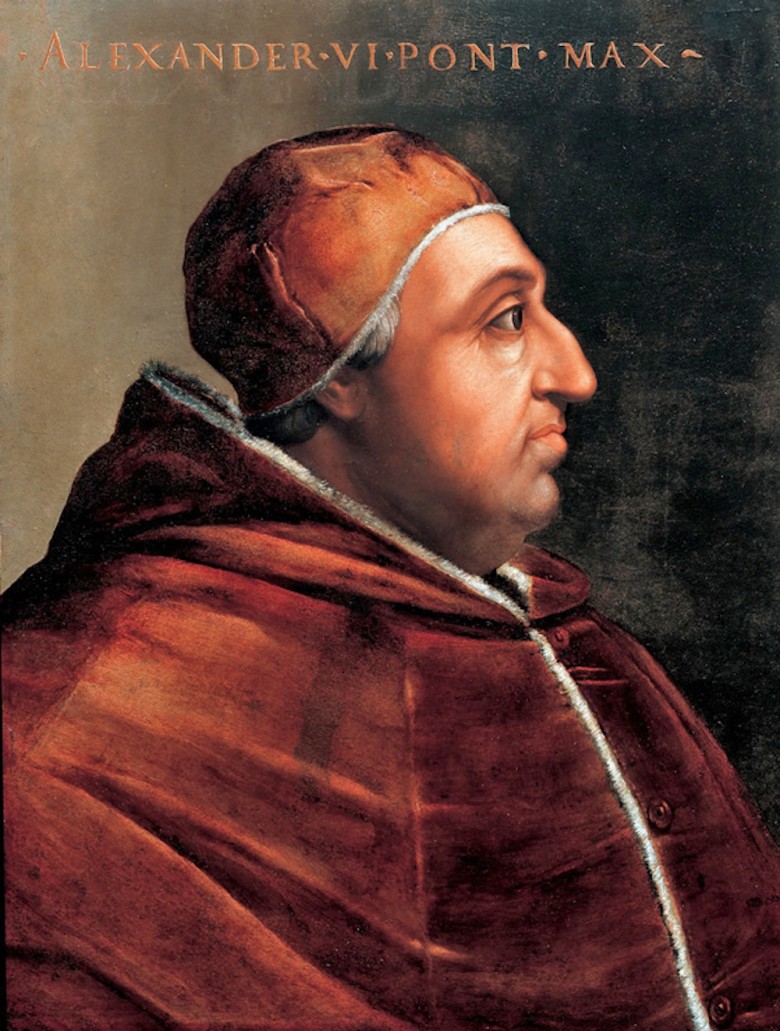
I love history and mostly enjoyed the Tudors while it played on Showtime.  The next incarnation of a gripping story of power, sex, and deception is the chronicle of the Borgias.  They are remembered for their corrupt rule when one of them was Pope. They have been accused of many different crimes, including adultery, simony, theft, rape, bribery, incest, and murder (especially murder by arsenic poisoning). Due to their search for power, they made enemies of other powerful families such as the Medici and the Sforza, as well as the influential Dominican friar Savonarola.  Alfons became Pope Callixtus III in 1455 and Rodrigo became Pope Alexander VI in 1492.  It is a wicked story that reached its culmination in bribery used to obtain the Papal Office and the children of the Pope running the Church with their Papa.  Alexander VI is often regarded as the worst of the popes.  I love the history.  I do not love the way so many view this history.

One of the ways that Protestants in America have viewed the Church of Jesus Christ is as a showplace for the holy and the humble.  From the Puritans down through the holiness churches even to the present day, Christian faith is seen most clearly and deeply in the realm of behavior.  Back in the day when Baptists actually eschewed liquor stores, dances, tobacco, card playing, and the like, piety was worn on the sleeve.  The method of the Methodists was written down in a regularly updated Book of Discipline.  Lutherans had their own dalliance with behavioral Christianity in the form of Pietism.  I have but skipped over the surface except to say that piety has typically been seen in terms of outward behavior and that those outside Rome seem to glory in stories like that of the Borgia family.  Nothing makes us feel so good about the minor sins in our own eyes as the huge failings of the most visible of church leaders.

We seem transfixed by the idea that the work of God can be done only by the most holy and pious of folk.  But where did we get such an idea?  It seems that many of the folks of the Old Testament were rather like scoundrels than saints and yet it seems God's work was not prevented by their lack of piety.  Moses was flawed enough so that the Promised Land was but glimpse in the distance.  Abraham was first class brute and was lucky that Sarah stuck with him.  The sons of Isaac were full of deception and trickery -- not in the least his own wife.  David was an adulterer and murderer.  Solomon was wise but not pure.  Well, the list could go on but I will spare the gory details.

The work of God and the Church of Jesus Christ does not rest upon the inherent holiness or pious heart of His people or those who lead His Church.  The testament to God's grace and favor is not that He seeks out and raises up the perfect (or pretty close) to do His bidding but that He works in, among, and through sinners.  Nowhere is that more true than His Church.  A strong moral compass is a good thing and we would wish it upon all those who lead God's people on every level of His Church, but it is not a requirement before God can and will do what His grace determines.

The world loves a scandal and a story with a lot of juicy details.  Rome has not failed to serve up many of them and some of them were absolutely saintly in their unholiness.  Evangelicalism has not failed to parade its fallen leaders and the shadow of disgrace is certainly not confined to a few.  Yet none of this has all that much to do with whether or not God is at work in His Church accomplishing His purpose and fulfilling His intention.

The Donatists were especially rigorous in this, holding that the true church must be a church of saints, not sinners, and that sacraments, such as baptism, administered by unholy or apostate clerics lacked validity and efficacy.  About a hundred years later (409 AD) the Church officially dispatched this view as heresy.  Apparently some in Protestantism have not gotten the message.  Too many non-Roman Christians snicker in the flaws and failings of those called the Vicar of Christ and take far too much delight in their sordid stories.  No one spoils a prideful moment more than the God whose grace redeems the sinner and then does His work through them -- in spite of their flaws and failings.  Such is the confidence that we have not in flesh and blood  but in the Word and Sacraments, the means of grace through which God works and in which God's effective and efficacious saving will does its bidding.  Even without help from the soiled and stained who administer it and who are its first beneficiaries.

Monday, April 4, 2011

Church Leadership

Those who serve as church leaders are generally decent folk who genuinely seek what is good and right.  The problem is that we hold them accountable for nearly everything except faithfulness.  We judge them on the basis of their ability to raise money, on the basis of their good numbers (baptisms, confirmations, new members, etc.), on their ability to inspire, on their outgoing personality, and on their effectiveness at getting things done.  Now, I am not suggesting that none of these are important -- just that they may not be the most important criteria.

We elect our leaders -- so those who say or do what we do not like, we do not re-elect.  This means that the folks who are being led are those who not only determine their leaders but hold them accountable every time they run for re-election.  The people who elect determine the criteria upon which those elected (or not) will be judged.  Those who are elected to positions of leadership know that they will face review from those who elected them.  I am not suggesting that our elected church leaders are people pleasers -- perhaps some are but most of them are certainly not.  Yet, in order for them to continue in office, they do need to keep their fences mended.

My point here is that we ask of our church leaders more than they are capable of giving -- we want them to be all things to all people and we require of them that they submit to our approval every 2 or 3 or 4 years.  If we are unsatisfied by their performance, it may be that we have ourselves to blame.  When St. Paul used that phrase, he did not submit to an election every couple of years nor did he mean he would say or do whatever was desired by those whom he served.

Let me focus on one office -- that of District President (what Missouri fears calling "Bishop").  We ask them to fix what is wrong both within congregations and with the clergy.  So they function like firemen who run from place to place trying to cool down the blazing inferno of conflict and to spread calm on the troubled waters of both parsonage and parish.  I know several DPs fairly well and I know that they spend an inordinate amount of time trying to manage conflict within the congregations of their Districts and resolve conflicts between these parishes and their Pastors.  While this is a noble endeavor and a reality of the time in which we live, I do not see much about this duty or responsibility in the Scriptures.  Now it might be a different thing if the DP called the parish or the erring Pastor to repentance, confession, and forgiveness.  Those who have traversed the various models and processes used for conflict resolution or reconciliation know that it generally bears little resemblance to confession and absolution.

We require of them that they advise and counsel yet we give them limited means to enforce their advice and counsel when it needs to be done.  Because of the way congregations understand their independence and their authority, they can easily refuse the most salutary and wise counsel a District President may give and there is not a whole lot he can do about it.  In the same way, clergy can often hide behind the same kind of independence.  As long as their parishes are mostly happy with them, they can and often do outrageous things and foment great discontent outside the domain of their own congregations.  Again, the District President has little real authority and when he does exercise it, he often plays right into the hands of the victims who justify their stand by their martyrdom.

Scripture speaks of church leaders as teachers of doctrine and supervisors of faithful practice yet we saddle them with fund raising duties, with responsibility for bringing calm to troubled places and people, and with achieving measurable success in areas that they have little direct responsibility or influence over.  Where is the time or energy left for the episcopal role as chief Pastor and teacher?  When they are so busy dealing with the conflicts and troubles in the minority, they are absent and invisible to the majority.  How well can they know all the parishes and Pastors in their care when this happens?

Meeting after meeting consumes too much of the DP schedule.  Some are national meetings with the COP and the larger boards, committees, and commissions on which they sit.  Others are local.  Honestly, how could a Pastor function with such a busy schedule of meetings imposed upon him?  Then why do we assume that the DPs are more adept at dealing with an endless schedule of meetings?

In order for things to change in the Church, we need to start electing people who have the courage to tell us when the roles and responsibilities that we assign to them are not what they are supposed to do.  We need to hear and heed their words and actions -- even when it is unpleasant to us.  We need to cultivate faithfulness as not only the goal but the very criteria of service to the larger church.  Instead of electing every few years, we might be called upon to reaffirm this "call" to such service but without opposing candidates standing at the same time.  Or we might have fewer but longer terms so that a DP can actually cultivate the deep and abiding relationships with parishes and Pastors in which faithful and fruitful oversight, leadership, supervision, and direction can be given.

There is a great deal of disdain and blame laid at the doorstep of our District Presidents -- all I am saying is that it is often more the result of the nature of the office we have defined and the roles and responsibilities we have foisted upon them than it is simply the failings of mortal men.  This is not only true of the DPs but also of all the elected leaders of our church body.  I think it is time that we look into the mirror and see what part of the problem lies in us and what we can do to correct it.  Perhaps we might end up with a different result if we began at a different place....

Just some thoughts...

Sunday, April 3, 2011

How Hard It Is...

Of all the things we do in worship, the hardest is that which is not printed out in a hymnal or a rubric directed by red print or a sermon preached at or to us... no, the hardest thing we do in worship is that which underlies all else, namely, focus our attention off ourselves if for one brief hour.

We have been taught by culture and advertising to be fully aware of everything about us. We are consumed with how we feel (walk down any aisle in a drug store and see the myriad of concoctions sold to help us feel better).  We cannot go ten feet without a water bottle or soda in our hand -- Lord knows, we may get thirsty.  We tweet, text, email, and call people out of an incessant need to communicate how we feel at any given moment (or where we are or what we are doing or what we just saw, etc.).  We are enormously self-important in the sense that we know and think about our feelings, our health, our desires, and our needs nearly every moment of every day.  Add to that, we think about others in relationship to ourselves.  We cannot forget the guy who cut us off in traffic or the woman who slipped in front of us in line at Kroger or shopper who grabbed the very thing we were going to buy.  Of course, we are most consumed by what others have said or done to us.  Facebook pulses with what others said about us and how we think about it all.  We are tired, we are busy, we are hurting, we are bored -- oh, are we bored!

You may think that hymn was difficult to sing or that lesson difficult to follow or that sermon difficult to stay awaken through it all, but underneath it the most difficult thing we face on Sunday morning is keeping the focus, the attention, and the mind/heart off ourselves.  We fidget and yawn and gaze off into space and close our eyes and have imaginary conversations or write imaginary to do lists in our minds because it is nearly impossible for us not to think of ourselves -- if only for the worship hour.

I often remind certain acolytes that I do not care how tired or bored or whatever they are, the people in the conversation are watching them and they need to pay attention to what is going on and at least look interested.  They look back at me with questioning eyes and stutter "bbbbbbbut" to justify or excuse why they should be afforded a little leeway that Sunday.  Sometimes I wish I had the nerve to say this to the people in the pews.  There are some of us on Sunday morning who cannot resist the impulse to comment on everything that is going on around us -- and most are not as subtle as they think.  There are some of us who squirm in the pews as if we were being tortured instead of fed and nourished by the hand of God.  There are some of us who look around us as if the rest of the folks in the room were the object of Sunday morning.  And then we wonder why we did not get anything out of it. 

No, clearly the most difficult task for the Holy Spirit is to turn our attention away from ourselves for just a while each Sunday morning so that we may focus our hearts and minds upon the Word and Table of the Lord.  When the Spirit accomplishes this feat, He deserves His Sunday afternoon nap.  I rather think He is like the proverbial plate spinner who puts a porcelain piece of dinnerware on a stick and gets it spinning only to do it over and over again, running back and forth to restart a tottering plate waiting to crash.  Yet that is His work every Sunday morning, wherever God's people gather in His name.   Another Sunday morning will soon begin and we bring to the worship service our wounds, our worries, our whining... etc.  But somewhere in the midst of all the things we think and say, the Spirit will also be there pushing our eyes to see Jesus, opening our hearts to His grace, and focusing our minds upon Word and the Sacrament -- not for God's benefit, though that would surely be enough cause for His mighty labor, but for ours.

Saturday, April 2, 2011

In the Mail

I have taken a couple of days off (mow, fertilize, mulch, etc.) and I picked up the Church's mail to see if there was anything urgent.  It amazes me how little of the mail that is addressed either to me as Pastor or to the congregation in general has to do with who we are as the Church.  I see we have about nine copies of various catalogs from Oriental Trading (the web version of the five and dime).  Lord knows that the Church of Jesus Christ must have cheap plastic crap or else we will certainly fail in the purpose for which Christ has established us!  A couple of dozen invitations to things that have nothing to do with us the Church (various goings on at the local university, some things from the Chamber of Commerce, some business stuff sent to us because we belong to the Chamber).  There were any number of office supply catalogs and post cards wondering why we had not been ordering more.  There were offers from various journals and magazines whose viewpoints are absolutely essential for any effective church and Pastor.  There were a host of church supply catalogs (mostly offering stuff we never use and never would use).  There were a number of charities soliciting support from our congregation and from me personally.  There was even a letter from a prom committee in town asking for money to cover the post prom party for one of the local high schools.

I must have had a hundred emails that I had not read.  While about 20 of them were urgently related to me as Pastor and to the congregation, many of them were solicitations, some "junk" emails that missed the spam filter, and some from various mailing lists to which I subscribe (some news services for my Synod and some other church bodies).  Most of it ended up in the delete file and some never even got opened  before they ended up there.  I am sure that I must have deleted that one all important email that would have made me more efficient and more effective and that this is the reason I often am "under the gun" -- or not.

There was one thing that was personal.  It was a note from a member of the congregation who felt I was looking kind of tired and was concerned for me.  It was heart felt and greatly appreciated.  The individual expressed appreciation for all that I do and wondered how I had time for everything and hoped that it did not come at the expense of my family or myself.  Ahhhh, I knew there was a reason I looked forward to the mail... (snail or email varieties)... There is always at least one thing in the stack that makes it worth while...

Friday, April 1, 2011

Ritual without the Religion.... Religion without the Ritual

It seems we have trouble with the two "Rs" together -- ritual and religion.  On the one hand we have some who want the ritual but not the religion.  This would explain some Jews who maintain a kosher kitchen and follow the rigorous dietary rules yet do not believe in Messiah to come or really in God at all.  They are in their belief largely secular but in their practice they are pious.  I well recall a conversation very long ago with a daughter of a member who had decided to become a Jew, her husband being Jewish and she wanted to resolve many years of conflict (at least in practice).  "What changed when you (a Lutheran) became Jewish?" I asked.  The simple reply.  "I began keeping a kosher kitchen and observing the dietary laws of Judaism."  Later she admitted that she still kind of believes in Jesus but does not see the conflict.  She (like her husband) became an observant Jew in practice and not belief.

Add to that the many Anglicans across the world who can hardly be bested when it comes to vestments, liturgical appointments, and the finest ritual of the BCP Mass and yet they hardly believe a word of Scripture.  They have adopted every liberal social cause as their mission and they seldom speak of forgiveness, life, and salvation.  I think of folks like John Shelby Spong, Episcopal apostate Bishop, who seems comfortable within the liturgical ritual of his church but extremely uncomfortable with the tenets of the faith (traditional or orthodox).  His cause is accompanied by many of the "high church" Protestants whose practice involves ritual and gesture that would seem to betray belief and yet it does not -- at least not any belief that Athanasius might recognize.

On the other hand are those who want religion without any ritual.  This would represent most of fundamentalism and much of evangelicalism (although there are new rituals associated with the emergent church that might pass for ritual -- like the coffee and the waved arms).  This group believes that religion is almost tarnished by any outward ritual, as if it were offensive to the true worship of spirit and truth.  They take religion very seriously but do not take ritual all that seriously.  Some are confused by the desire or need for ritual and others see it as formalism.  Strangely enough, these folks seem to love the rituals associated with patriotism, sports, the lodge, etc...

Lutherans seem to be well poised to marry both the seriousness of a faith grounded in an authoritative and efficacious Scripture and the ritual that accompanies and even illustrates what is believed with the heart and confessed with the lips.  We do not have many who are in it for the ritual but who prefer their religion lite -- though it may be said that liberal Lutheranism is indeed heading toward this.  We do seem to have a number of folks who are at the least uncomfortable with ritual.  They follow the liturgy of the hymnal and wear the vestments (as few as possible) but they do not feel as comfortable at the altar as they do at the pulpit.  These are the folks who are as conservative as can be with it comes to Scripture and the Confessions but would almost prefer the old black academic or Geneva gown of Lutherans at the beginning of the last century.  Lest we forget, we also have a new wave of "Lutherans" (I am not so sure how deep their Lutheranism runs) who eschew ritual with the best of the evangelicals and who have firmly embraced the idea that they can have an evangelical style with a Lutheran substance and get by with liturgy lite and with abandoning ritual.

It would seem that with the well established liturgical movement as our recent history and the more catholic bent of nearly all newer Lutheran hymnals, Lutherans would be on the cusp of a new and strong marriage of religion and ritual.  It would seem that Lutherans would be well situated to combine a robust confessional identity, confident Law/Gospel preaching, strong Eucharistic piety, and a well ornamented liturgy.  And for many it would be true.  But the facts tell us that we Lutherans are still beset by problems marrying the seriousness of the Christian religion with a ritual that both flows from and identifies with this faith.  Whether ELCA or Missouri, WELS or ELS, or one of the newer or smaller derivations of Lutheranism in America, we still struggle with the union of religion and ritual.  Though, to be sure, we are not so diverse or extremely divided as others in the spectrum of Christian denominations.  There is some comfort in that but I hope we do not take too much of it and instead push toward the strong tie and connection between faith's confession and its practice liturgically.

Thursday, March 31, 2011

After the Benediction, We Are the Same

There is that great line in the Godfather movie (I cannot remember which one) in which Michael (Don) Corleone responds to Senator Pat Geary by saying they are the same, part of the same hypocrisy.  It is a powerful moment in which the illicit Mafia family stands at the same level as the level of an outwardly respectable public official.  We are the same -- a powerful indictment against the artificial divisions of respectability.

There are many in Lutheranism who would insist that those Lutherans who experiment with evangelicalism and those who worship from the book are the same -- a difference only in style but not in substance.  For too long we have allowed this artificial distinction to stand, something foisted upon us by those intent upon making us different and making sure that some Lutherans, at least, were going to be different, very different.  So the worship wars have spent countless words and ink fighting over issues of taste and culture and musical preference -- to the point where many, even passionate voices, have grown weary and tired of the whole darn debate.  But that is because we have assumed that we are the same -- at least after the benediction.  What we do before the benediction does not really matter because after the "Amen" and on our way out the door we are all the same.

But are we the same?  Can we be different before the benediction but the same afterward?  Or is piety inherent in what we do before the benediction as well as expressed in what follows the Divine Service?  Is it possible for us to have a split personality of American evangelical style worship and retain a Lutheran faith and live out a Lutheran piety after Sunday morning is over and done with?  [A caveat here, there are many, including people on both sides of the worship wars, who would argue that there is no such thing as a "Lutheran" piety.]

How we see the world, how we see ourselves, how we understand our purpose, what we value, what priorities we attach to the various aspects of our lives -- all of these are issues of piety but this piety is not indifferent to what happens on Sunday morning -- rather it flows exactly from what happens on Sunday morning.  Sunday morning shapes and defines and directs what happens after the benediction.  Part of the great problem with the worship wars is that we are ONLY arguing about what happens before the benediction and should be also talking about what happens following the "Amen" on Sunday morning.  Worship is not about aesthetics and therefore subject to taste or personal preference and neither should our piety be something indifferent to our confession.

My fear for Lutheranism is not about today or even ten years from now but decades down the pike.  What will our Lutheranism look like if our piety is at odds with our confession and Sunday morning is given wholesale over to a mainline Protestant agenda (ELCA) or an evangelical (perhaps fundamentalist) agenda (Missouri)?  What will our Pastors look like -- when, for example, the Divine Service that has been our Lutheran identity for nearly 500 years is unfamiliar to those who will preach, teach, and preside in our circles?    What happens to a Lutheran church body when the hearts and minds of its clergy are more at home in a piety, vocabulary, and song track that comes from and is shaped by something outside Lutheran confessional identity?

Historically, Lutherans have said that their clergy need to be resident at a Lutheran seminary in order to become Lutheran Pastors.  Until rather recently, and then mostly in the ELCA, you cannot go to Harvard Divinity School or Vanderbilt or Duke or anyone of the generic or nominally affiliated seminaries and then be ordained a Lutheran Pastor.  Why?  Truth to be told, there are some very fine teachers at these institutions and not a few of them are Lutheran.  Well, we have said that Lutheranism is not just intellectual property but piety as well.  Formation involves not merely head knowledge but being shaped by the daily office, the Eucharist, koinonia (life together)...  We not only expected this but required this of those who would bear the Pastoral Office in the Lutheran Church.

This was also part of the rationale for youth and adult catechesis.  Becoming Lutheran is not giving intellectual assent to a series of dogmatic or doctrinal formulations.  It involves an altar, a pulpit, a people gathered with you around these -- and not in the least of this is both script of the faith and soundtrack of the faith (hymnody).  This was the rationale for the RCIA in Rome when they began to realize that becoming a Roman Catholic was not merely a change of truths for the mind but the home of the heart.  We Lutherans may not have called it RCIA (Rite of Christian Initiation for Adults) but we had an idea of it when we brought people in through adult confirmation, connected them to Bible study groups, put the under the nurture of those already well established in the faith and congregation, and received them publicly through a rite of reception.

Now, it seems, that we have forgotten much of this and have come to the mistake conclusion that we are only discussing what happens before the benediction and that after the benediction we are the same.  We are not.  When our piety is shaped by American evangelicalism instead of the Church Year, the Divine Service, the Catechism, baptismal vocation, and an efficacious Scripture, we cease being Lutheran even though we may, intellectually anyway, hold to the doctrinal content of the Confessions.  Piety flows from liturgical identity.  But liturgical identity is also shaped by piety when that piety is different from or in conflict with that liturgical identity.  Is this not what lex credendi, lex orandi means?  Worship AND piety either head the same direction or a train wreck will occur and this is the looming cost of adopting the idea that you can have evangelical style and maintain Lutheran substance, or, to put it another way, to believe that after the benediction, we Lutherans are still the same.... no matter what happens before the "Amen."

Wednesday, March 30, 2011

The Perfect Love that Loves Imperfect People

Sermon for Lent 3A, preaching on Sunday, March 27, 2011.

   I well recall when my parents gave me the gift of the record album called the Goldberg Variations by pianist Glen Gould.  Gould is regarded as one of the greatest pianists of all times and gave fresh interpretation to one of the grandest of Bach’s compositions – yet one that remained unfinished.  As good as Gould was, he abandoned his concert career at age 31 and never performed in public again.  The pressure of performance nearly crippled him.  Geoffrey Rush played David Helfgott in the great movie “Shine” about another pianist left wounded by both his early success and a relentless demand for perfection placed upon him.
    We might think that the pursuit of perfection is, after all, the very goal of religion.  We might expect that God demands the price of perfection before He will receive us as His own and love us.  Some see this as our quest in life – waiting for a perfect mate, perfect job, perfect happiness, a perfect life.  Now I am surely not one to discourage the quest for excellence and yet this demand for perfection is a hopeless end, leading only to despair.  God did not come to sift through humanity in pursuit of the perfect, holy, or good, but was determined to love sinners, to come for sinners, and to redeem sinners  – a perfect love for imperfect people.
    Christianity is not about the pursuit of perfection or our ascent to God but about the God who loved us while we were yet sinners and enemies and who descended to us.  This God loved a quarrelsome people called Israel who complained to Him relentlessly and disobeyed Him regularly. This God loved a Samaritan woman at a well who never married yet had many husbands and offered her the water of life.  This God loves sinners like you and me, who can never, ever measure up to His holiness and perfection.  It is the surprise of His perfect love that it flows for imperfect, flawed, failed, and sinful people.
    What we are talking about is the triumph of grace, the God who loves those unworthy of His affection.  God meets us on the ground of our own weakness, infirmity, and sin.  His love ought to be repelled by what He finds and yet His love moved Him to bear up our sin on His own shoulders and bestow upon us the grace of forgiveness, life and salvation.  He loves us where we are but He does not leave us there.  He declares us forgiven grants us the new birth of Holy Baptism.  He plants His Spirit in our hearts that our fears may give way to faith.  He directs our mind and hearts to that which is good, right, and holy, that this may become the desire we seek after with all our heart, mind, body and strength.
    When we meet this perfect love for us imperfect sinners, how do we respond?  The first mark of God’s perfect love at work in imperfect sinners is repentance.  Repentance is not our effort to impress God but His grace working in us to acknowledge our sin, own it by confession, and grasp hold of the forgiveness Christ gives.  The first fruit of His perfect love for imperfect sinners is always repentance.  We come empty to this love, bidden by the Spirit, and there God claims us, just as this morning we saw that perfect love reach out through the baptismal water to name Matthew and Natalie as His own children.  The living waters still flow to those who least deserve them and who know not where to find them until He directs us.
    The second mark of God’s perfect love at work in us imperfect sinners is that we are sustained in hope no matter what comes our way.  Through suffering and sorrow, in the midst of troubles and trials, beset by danger and death, we do not lose heart.  We do not despair.  The focus of our lives is not on the circumstances of the moment – be they good or bad – but upon the future God has bestowed upon us in this baptism.  The holy joy that sustains our journey in faith is not getting what we want now but possessing eternity in Christ even in the midst of life’s greatest wounds and disappointments.
    The third mark of God’s perfect love at work in us imperfect sinners is that we learn to love others as He has loved us.  As God did not wait for us to become perfect before He loved us with the everlasting love of the cross, neither do we wait for the folks around us to be perfect before loving them as He has loved us.  It is not that we are content with wrong, overlook evil, or accept sin.  We love people as they are but we do not leave them where they are.  We do not love the good or those who are nice or those who think like us or those who can do something for us.  We love the imperfect, flawed and failed as God has loved us and we love them by telling them of the place where living water flows, where grace forgives, and where life is bestowed.  We love them by sharing with them the good news of the cross and empty tomb.
    Jesus met a woman at a well.  According to the rules of holiness, He should have had nothing to do with her.  Instead He engages her in conversation.  He offers her to drink of the living water that gives eternal life. He exposes her sinful life but not to condemn her or push her away.  He speaks of the grace that transcends right and merit and takes flesh for the sake of such sinners.  This is the perfect love for fallen people, perfect flesh for sinful creatures, a holy Savior for unrighteous folks. This Messiah does not tell us what we must do but does for us what none of us deserve.  He grants us the living water that fully refreshes, completely cleanses, quenches thirst, and becomes a well springing forth eternal life in all who receive it.
    God’s love is perfect – He does not love us for who we are or what we could be but as we are  – sinners.  This is the love we meet in Christ.  This is what melts our stone cold hearts, so quick to judge and so slow to love.  Love does not wait for perfection but neither does love leave the sinner where it finds him.  Today we celebrate that love met in the holy waters that give life and in the holy meal where the undeserving sit in honored place.  Tomorrow we have the opportunity to show forth that love in the way we deal with one another.  We will surely fail in love’s work, but let it not be for lack of desire or effort from us.  And when we do fail, God meets us again with the perfect love that forgives and restores us to love one another again.  Amen