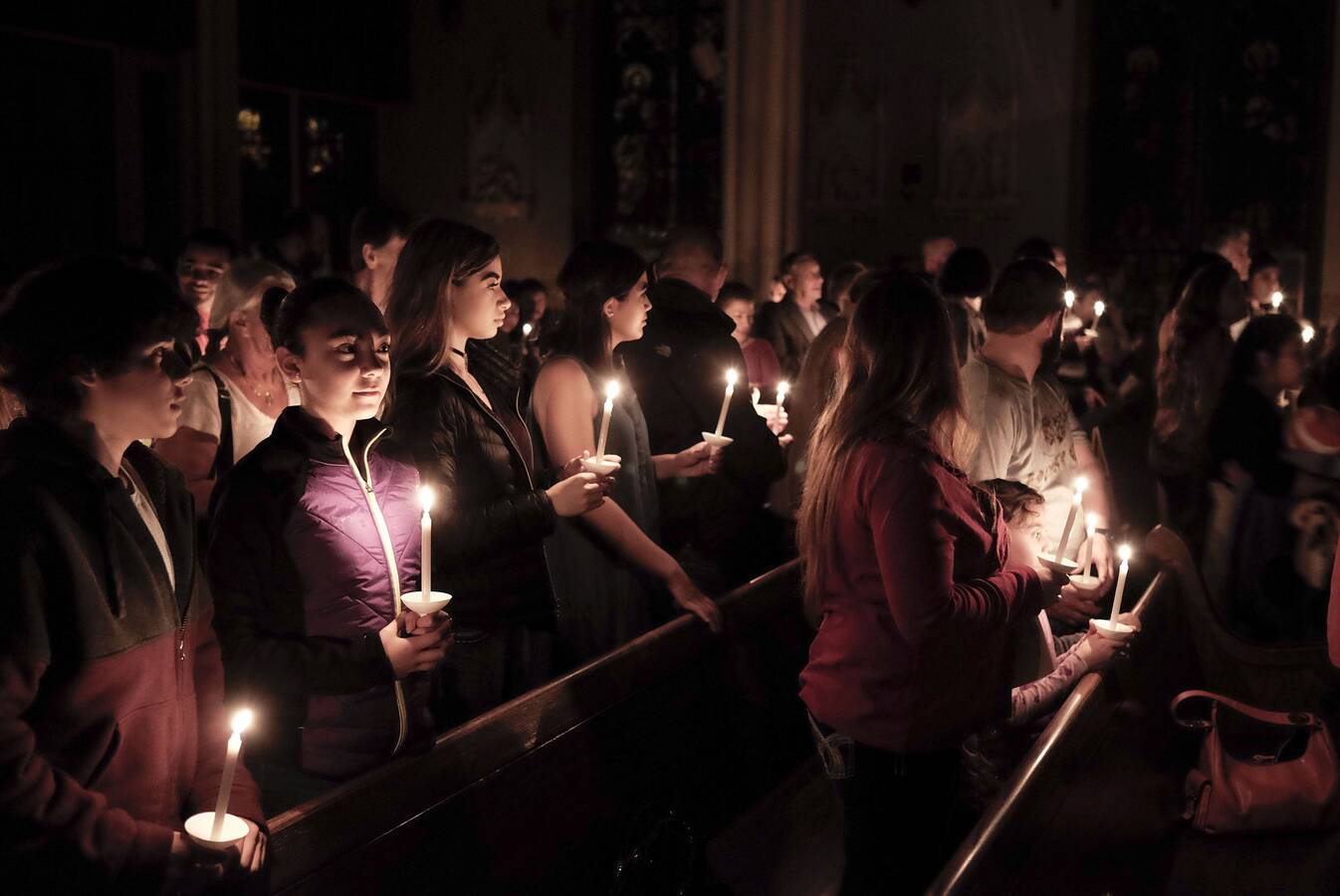
One of the things I love most about the Easter Vigil is the procession with the new light of Easter. We begin with Paschal Candle alone and then stop three times on our way into the nave, each time singing Light of Christ and passing the light to a third of the hand candles until when we have entered the nave and all are lit. This year we did it in the Chapel. Our smaller numbers (50) fit well into a chapel seating 70-80. The light from the hand candles was brighter than in the larger nave of the main sanctuary (seating 400). It was, however, not a big light but a collection of small lights. At a point later in the liturgy, the lights of the chapel were lit and the entire space was bathed in light.
It strikes me that this contrasts well how we see the Church -- or at least how we would like to see her. On the one hand, the Church in the world is not the bright and dominant light of the sun but a collection of smaller lights. Christ is that light, to be sure, but how that light shines is the issue. What we want is a bright light that dominates and cannot be missed or ignored. We want a sun to obliterate the light so that there is no darkness. That is what we want but that is not how it is. For now, the light of Christ does not exist without challenge. The Light, the Word, became flesh and dwelt among us but the people chose the darkness. We would rather be the bright beams of a floodlight that leaves no hint of darkness left but until Christ comes in His unmistakable glory, the Church is more like a collection of those lights from the hand candles in the Easter Vigil.
The miracle about that light is that the light from even one is not lost in the darkness and that light of many together becomes a strong and profound light, even with the shadows of darkness around the edges. Though the Church become few among the many who reject the light of Christ and choose to live in darkness and death, the light of Christ is not lost. Even the light of one of the baptized stands out in the darkness. But even though the Church is few and not a majority, the collected and gathered lights of the baptized faithful grow into an even stronger light. In fact, is this not one of the reasons why we gather? We come together to be in the Light of Christ's Word and Sacraments, the places of His presence where He bestows His gifts, but we also come together to strengthen one another and to stand together as Christ's own in a world for which He died but which has rejected Him. Just a little thought for this morning...
I have written before of King Charles idea of expanding his role from the Supreme Governor of the Church of England and Defender of the Faith to being the, well, defender of all faiths and head of no exclusive faith. Curious, isn't it, that this man who claims to have found interest and perhaps fascination with his father's Orthodox roots now seems intent upon becoming the first monarch of coexist -- in England anyway.
What would be said about prayers prayed in a place set apart to belong to the Lord but addressed to a different deity? Would Charles be asking Jesus to bless those religions, their competing claims to be God, and their different holy books rather than the Scripture which He says is all about Him? Why would he do this?
The answer, of course, is to make people feel included -- inclusivity is one of the cardinal virtues of modern life, after all. So to mention Allah or Buddha or Bhagavati or even, for the Atheists, None, will assuage the consciences of those who feel they might be left out of a prayer to Jesus. In other words, it is okay to offer up Jesus on the altar of expediency in order to make others feel better about believing in the wrong God. After all, Jesus is accustomed to being sacrificed for many so why not offer Him up for the sake of diversity and good will? On the other hand, how shallow are these people whose bruised egos are nursed by prayers and mentions that mean nothing but a polite nod to diversity.
The scandal of particularity is worse than just about any other sin. So even if Jesus is exclusive for the sake of including all (every sinner marked for death since the Fall in Eden), it is still too exclusive for Charles and for most Christians. In the Christian truth, God's peculiar way of saving the masses is an offense only to those who insist that they either need no redemption or are comfortable enough in their own truth (including sin and death). Strange, when you think about it. Abraham was sent into a foreign nation to be told he would become the father of many nations. It is fulfilled only in small part by the miracle son God gave Him and is, instead, come to perfect consummation in the son of Abraham who dies on behalf of all the nations and not just the chosen.
Charles does what Charles wants and he seems to be happy to dismantle the foundations of all that came before him as he ascends the throne (not quite his but only his for a time). When Christ becomes a way instead of the way, there is nothing left of Christianity at all. Jesus Himself insists no one comes to the Father except through Him. We are severely tempted in our time to do exactly what Charles is doing -- to make Jesus stand merely as one of many instead of the exclusive One. Whether we stand on a dais at an ecumenical gathering in which other gods and other names will receive prayers or we sit upon the Edward's chair, to make Christ one of many is to strip Him of every title He was incarnate, lived in righteousness, died in obedience, and rose in triumph to earn. As we heard weeks ago in Holy Week, Jesus says He was born for this -- to be the King of All and not one of many pretenders to the throne. Charles seems intent upon presiding over the last nail pounded into the coffin of what was the Church of England but we ought to make sure we do not follow his arrogant denial of all that is the Christian faith.
One of the inherent weaknesses of a state church is that it is caught between two masters -- on the one hand it is supposed to serve the God who is confessed but on the other it ends up being an agency of that state. One need only look to the Church of England to see the dilemma. The CofE is caught between being an agency of the government and a supporter of its causes and the Christian faith that must oppose such causes which are opposed to the Scriptures. The Anglicans have made their choice and seem determined to leave behind as excess baggage the historic faith they once confessed. Perhaps it was inevitable but it is a choice nonetheless.
If an established national church cannot ultimately oppose the culture of her nation or defy the government of which it is by essence a part, is it possible for their to be an established national church at all or is this an oxymoron? In every partnership there is a dominant partner and for the established national church, the politics, culture, and government will always be those dominant partners -- influencing the Gospel more than the Gospel influences them over time. It was for this reason, in part, that the United States chose to forego the example of a national church. Surely it is difficult enough to forego the Zeitgeist as an independent institution without being encumbered with political and cultural ties that make resisting that Zeitgeist almost impossible. While some may think that by skipping an establishment church we have also bypassed the conundrum, it does not quite appear to be so.
Even disestablished churches and those never established find themselves under duress when the values of the times and the opinions of the people grow increasingly apart from the Scriptures. In America, it can easily be shown that the mainline churches as well as many other groups have found it impossible or tiring to resist the views of the dominant class and culture. For us, as in England, this is the same group -- urban progressives. Even evangelicals in America have capitulated along side their mainline cousins and have surrendered many of their positions to those in favor in the moment. It is not just in the arena of sex and gender but in a hose of other positions, including climate change, racism, equity, and diversity, that the churches here tend to step in line with the established Church of England in promoting the opinion du jour on these issues.
In this respect, it makes it harder than ever to be a national church, established or not. Look at the disparities between governments and politics and culture in the various regions and states of the US. What you can do in Tennessee or Texas you cannot do in New York or Illinois or California. It is not rocket science but simple pragmatic common sense. So what does that mean? How do we function as a national church body in a nation in which regions or states have different rules and environments for how we live and confess and serve? The days of a strong national identity may be waning for a variety of reasons but for the Missouri Synod it has never been quite about jurisdiction than about confession. We may not be a national established church but we have enjoyed a history of clear and courageous confessional witness. Though, to be sure, even events like the Civil War and slavery created a hint of the conflict we have now in trying to decide which positions of culture and government we can live with and which we cannot. Could it be that we will end up functioning almost exclusively as a congregational church and the national identity will continue to weaken? Will we find the cost of standing apart too great to retain this confessional witness? Will end up a confederation of diverse and distinct regional identities? These are some of the questions on my mind and I hope we are all thinking about them. The decision by one of our universities to go it alone could very well be accompanied by a district deciding to become its own identity. Would we, could we, or should we oppose the disintegration of the Missouri franchise? What do you think?
It is no secret that much of Christianity has become a tame and boring imitation of either the world around us as this present moment or some imagined future utopia. Because liberal Christianity has devolved into a mere echo of whatever it is that people are thinking or doing today, it is always a day late and a dollar short and so struggles to be relevant. Because progressive Christianity has become an ideology that purports to make the world into a better place (largely through ideas that have nothing whatsoever to do with the Gospel, it is no longer a faith but a political movement for justice, diversity, equity, inclusion, and liberation (especially sexual). As such it must compete not against other religions but with politics and political parties for the attention of people.
I wish I could say that conservative and orthodox Christian bodies are better off but most of them are not. Rome is trying to hold together views and ideas that inherently conflict with each other -- sort of like the handle of the umbrella that holds together the ribs stretched almost to the breaking point. If there were a strong pope, it might be manageable but with Francis the ribs are buckling and the whole thing is in danger of folding up into ruins. The Anglicans have tried, especially those in the developing nations, but there is no mechanism except the bishop to enforce the boundaries and that has brought less than a glowing success. Besides, the Anglicans seem to draw the line at homosexuality but have thoroughly embraced the ordination of women and have been reluctant to say much against abortion. For Lutherans the mantle has fallen largely upon Missouri and its fellowship partners. I wish I could give a glowing report about our success but the results are mixed at best. Missouri often finds itself between those who are fixated on the things that divide rather than unite and those who really do not care -- both those who do not look beyond their own parish and those who have transcended such sectarian things for the pursuit of an evangelical style identity.
We have lost our edge. We either argue too much about little things because it is easier to fight about them -- easier than addressing the elephant in the room. Sadly, many of our people have quietly decided that children may not be such a good thing, that birth control is the only adult and responsible path for married as well as unmarried, and that marriages can easily be broken when they become difficult. Sure, we are against abortion but the decline in the birth rate among the numbers of those in child-bearing years says a great deal about what else we believe. We are against injustice but hesitant to speak out and when we do we often sound like those in the liberal corner or else a we come too late to the party and are ignored. We espouse a morality that is different by degree from the world but not in essence. We quietly confess things that we know the world rejects but we do not confess them too loudly or too clearly.
We have lost our edge. We think it normal that half or more of our people claiming to be members are nowhere to be found on Sunday morning. We have normalized divorce and cohabitation to the point where a pastor who has the nerve to bring it up is often roundly condemned as either a hypocrite in pointing out the specks in the eyes of others while failing to own up to the log in his own eye or we blame the prophet for speaking what God has said (sort of like the Old Testament). We raise our children to believe different than the world on Sunday morning but to fit in at school and in the rest of the shape of modern day life the rest of the week -- especially with their use of the screens and the internet and social media. We say that Church is important but our stewardship is pathetic -- giving less than a quarter of the percentage of our incomes that the Old Testament people did by demand and so the Church is forced to beg for money and pastors, teachers, and other church staff are told that they should be paid more but cannot. We say that service is important but congregations go begging for folks to serve in key leadership positions and then to give those positions the fair commitment of time and energy they deserve.
We have lost our edge. Our worship services reflect our low commitment to the things of God and so we settle for canned music instead of raising up qualified and faithful parish musicians and organists and we seldom have a choir anymore -- this from the Church of Bach, Brahms, Walter, Pachelbel, Schein, etc... Our buildings content themselves with delayed maintenance that is revealed in water leaks in roofs and antiquated systems. In addition to that, we have surrendered art to the connoisseur at the museum and so our walls are filled with the pictures of memes instead of crucifixes and paintings that honor the Lord with beauty. Our educational programs are more concerned with making kids happy than teaching them the faith and so we judge by statistics of attendance more than by the content we deliver to those young in the faith. Our support of missions is from the leftovers of what we think we need at home and so there are few dollars left to support the mission of speaking the Gospel to anyone but our own ears. Our surrender to preference is so deep and so profound that we cannot constrain ourselves from eating and drinking during worship, gabbing through the Divine Service, running in and out of the Nave to satisfy every desire, and walking away when we make a mess with our spilled coffee or breakfast bars.
We have lost our edge. Our faith has become a tame and timid thing and so the Church looks more like us than it does the wild and shocking creation of Christ. Who would be offended by what we say and do today? Would there even be a reason for our enemies to persecute or lock us up or bring us before a magistrate? If charged, would there be enough evidence in our words and deeds to convict us of even being a Christian?
I know I am part of the problem. We all are. That does not excuse me or any of us nor does it mean that it is too late to be the people and Church God has called us to be. Christianity was once edgy and shocking and offensive to the world. Maybe it is time we learned how to be just that for the sake of the Gospel.
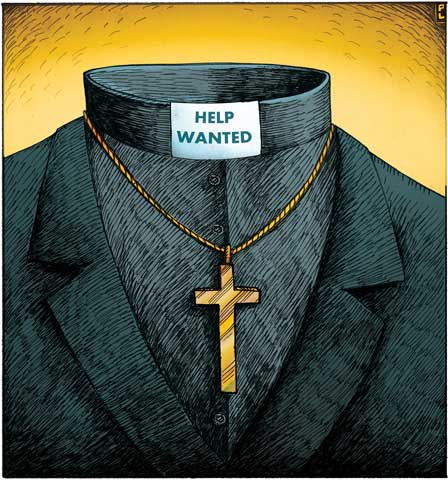
According to a source, the largest diocese in Europe has reported a catastrophic decline in seminary vocations. So, for 2013-14, the diocese reported 150 seminarians, dropping slightly to 139 in 2017-18 and then dropping precipitously to just 78 in 2022-23. Then there is this -- only 6
seminarians were admitted in 2022. Of course, there are any number of reasons for this decline but chief among them has got to be the direction of the Roman Catholic Church, the news from the Vatican, and the witness of the current Pope for nearly all of that same period. What is true, however, is that this decline cannot continue.
Before we Lutherans snicker, we need to admit the decline of seminary vocations in our own back yard. Plus, we are in a position to see upwards of 25-40% of actively serving pastors retire within the next 5-10 years. We are not in any enviable position either. We have tried inventing alternate routes, tried substituting an online option, and offered financial scholarships to cover all the seminary tuition and still we have not made progress in the recruitment of young men as first career pastors and rely on second career seminarians as the primary seedbed of new pastors. While there is certainly nothing wrong and entirely laudable about those second career men, the truth is that many of them will only serve half as long as first career pastors and many less than that. This means that second career men cannot be the primary source of pastors for our churches though they should and must always be a strong secondary source.
This decline cannot continue. We are no better position to sustain our congregations with the diminishing numbers of men coming out of our seminaries. We must take this seriously. Sure, we have a Synod-wide program to highlight pastoral vocations and other church work careers but it is not the Synod's job to find recruits. It is the job of those in the pews and the pastors in the congregations. We better start taking it seriously.
Barriers to recruitment of young men for the pastoral vocation include:
Lack of support from their family and friends
Low esteem many of our people hold their pastors
Low numbers of those families who attend weekly
Low salaries and high educational debts
Lack of support and encouragement from congregational leaders
Abundance of alternative careers
High cost of our church colleges and seminaries (not just tuition, folks)
Naysayers who suggest that the church is in decline and not many pastors are needed
Terrible portrayals of clergy in the media
Thinking it is somebody else's job to encourage pastoral vocations
All of these are true and real but one of the biggest reasons never cited is prayer. Are we really praying the Lord to send out laborers and shepherds into His vineyard and flock? If we prayed more about this, perhaps the prayer would find a greater willingness in us to work for what we pray. If we prayed more about this and more in earshot of young men in the congregation, they might hear the greater need and hear the Lord calling them to consider more seriously this vocation. I have been actively serving as a pastor for 43 years. Many of my peers are already retired and my family is encouraging me to do that also. If you love your pastor and appreciate what he does, look around your parish for smart and dedicated young men and encourage them to follow in his footsteps. Pray for them. Pay for them to make their education easier. Support them by honoring the calling and the office. Rome is certainly in worse shape than we are but we could be right behind them. And it is our own fault. We have contributed to the decline at least in part by not esteeming the office highly and by presuming it is somebody else's job to identify and recruit young men to serve the church as pastors.
Curiously, there seem to be more people interested in finding a painless way out of this life than into an afterlife. It is surprising to me but not quite shocking that the whole notion of eternal life is seen as pointless or strange to a great many people. Add into that the idea of the resurrection and a new and glorious flesh and blood and you have turned the cardinal Christian doctrine into something crazy and unthinkable. That is how deep and broad our acceptance of death and its normality have become. Even Christians who are wedded to many tenets of the orthodox faith are not quite sure that the resurrection and eternal life are all that necessary or even desirable -- especially to the proclamation and witness of the faith. My, how far we have come since St. Paul insisted that without the resurrection and eternal life we have a pitiful faith and are pitiful people.
It should come as no surprise to those who have been to funerals of late. If there is one thing missing from many (dare I say most) funerals today, it is the resurrection of the body and the life everlasting. We all know how quickly Christians warmed up to the idea of a celebration of the life of the deceased instead of a funeral and how easily the eulogy replaced the resurrection and eternal life as the core purpose and comfort of the sermon. It was not simply because we love sentiment more than truth but because we have become so comfortable with the notion of death to help us define life that we cannot define it at all without death. In fact, many folks are relieved at the prospect of death and happily ready to cede all existence away than to hang their future on an eternity filled with uncertainty and devoid of the pursuits that fill us with happiness now. At best, we would consent to the idea of a virtual life that continues after the body lay in the grave or the ashes in an urn but even then we seem to want assurances that this virtual life will not be all that different than our present life (and will also have an ending point when we tire of it all).
Our culture loves the idea of limited do overs -- the opportunity to start again with all that we know now if only to avoid making the same mistakes. But that is hardly what the Christian hope promises. Our culture loves the idea of the perfect happiness of a life of amusement and entertainment without having to deal with those who reject us or our chosen leisure activity. That is also hardly what the Christian hope promises. There are some who not so jokingly confess that the idea of an eternity of choir singing or praying or praising God sounds entirely boring and might be cause to choose hell over heaven any day of the week. As the joke goes, at least I will know more people down there. That is also hardly what the Christian hope promises.
The promise that accompanies the resurrection of the body to a new and glorious state and the gift of eternity come with the rehabilitation of the heart so that the things we do on a limited basis today might be desired and done forever. It is not that we will be the same people in a new flesh and at a new address but that what was begun in us and is now complete will be brought to perfect consummation. Translated into English that means that our hearts will change, our desires will change, and the objects of our joy will change. Perhaps that is the problem -- we do not want to be changed. In other words, it is not simply that we find the idea of the resurrection untenable or the idea of heaven unthinkable but that we reject these ideas point blank because we prefer to be who we are even if that would mean suffering something for it. Such is the state of affairs to be pondered by those who preach and teach the Christian faith today. We are more and more wedded to our worldly view of everything, including ourselves, and less inclined toward any version of the future that would require us to surrender that view of ourselves and what we fancy.
Sermon for the Holy Trinity, preached on Sunday, June 4, 2023.
I am ashamed to tell you that over the last century or so we have spilled more ink on Matthew 28:18-20 than just about any other text. We have given it not just a name but a compelling one. It is the Great Commission. Yet for all the words written about these words and for all the commands laid out in the Lord’s name to make the Church grow, Christianity here in America is in the midst of a great decline. It is because in no small part we have not heard Jesus’ words at all but have presumed to have heard them and acted on them in ways that make sense to us.
We see Jesus urging us to put a franchise of the Church on every corner of America and, while we have the buildings there, most of them are empty. We see Jesus urging us to do something and so we have created programs and schemes to satisfy Jesus only to have the world ignore them all. We see Jesus telling us to market the Gospel so that it will have many buyers, many great reviews on Amazon or Google, and become a force in our culture – except that Jesus was not urging on a committee or a task force to do any such thing. We see Jesus telling us to gain followers for Him except that Jesus is in reality calling us to follow Him.
The truth is that I despise numbers. I hate counting people in the pews and reporting to District and Synod or counting offerings and reporting to District and Synod or reporting success to District and Synod. What does Jesus know of statistical reports or spreadsheets? What does He care? Our Lord did not set apart people to be His Church so that we might have a nice little entrepreneurial little enterprise. No, He gave the name that is above all names, the name of our salvation, so that we might do with that name what He has commanded: baptize and teach. The Church is not a business nor is it a franchise. The Church is not a social club nor is it a voluntary institution. The Church is His body and the Church exists to preach and teach His Gospel and to baptize the lost into Christ our Savior.
We do not do this because we like to or because we have been ordered to. Indeed, we have translated it all wrong. Jesus never commands us to go but instead tells us that as we are going, baptize people into the name of the Father and of the Son and of the Holy Spirit and teach them all the things He commanded to be taught, and He would be with us always. Instead we forsook the gift of the Name of God, turning Jesus’ words into license to build the Church on our own terms and way.
What a terrible task we have assigned to ourselves. We think that we are God’s press secretaries, sent to make sense of His gobbly gook of words. We think that we are God’s builders who have been charged with the construction of His kingdom. We think that God has given us the Triune name so that we can make sense of it to a skeptical world. How foolish we are. The Lord does not need us to explain Him or defend Him or do His work. What He needs us to do is the speak the Name of the Father and of the Son and of the Holy Spirit over the water that gives life and to instruct those baptized in the Gospel of Christ crucified and risen. His promise is that where we confess this Triune Name in water and catechize those baptized, Christ says He will do the rest. His is the heaviest of heavy lifting.
The Triune Name of God has become a burden to Christianity when it should be blessing. It has become a command and a duty laid upon us that we must do and upon which we will be judged instead of the joyful activity of God’s people led by the Holy Spirit. How sad it is that the growth of the Church has been reduced to statistics and numbers! In Matthew 28, our Lord insists nothing of the kind and just the opposite, as a matter of fact. He insists that the giving of the Name of the Father and of the Son and of the Holy Spirit is manifest grace and blessing. God has given us the privilege of His name and not enlisted us into an unpleasant duty and responsibility.
By taking what God gave as gift and turning into a law or commend laid upon us as a heavy yoke, we have conveniently made us into the managers of God’s local franchises, the leaders who will decide for God what should be done to grow His Church, and the judges who will decide when that Church has grown. It is nothing less than the arrogance of sin that took the Name of the Father, Son, and Holy Spirit and turned it into justification for making a name for ourselves by being able to crack the mystery of the Trinity or fill the pews with people.
Dear brothers and sisters in Christ, when Jesus gave us the Triune Name and attached that name to water and endowed us with the Gospel to be taught and instructed into the minds of those baptized, our Lord was showing us how the Church is to grow and promising that He will make it grow. If only we could hear it in this way, we could enjoy the freedom and grace that this name bestows – first upon those so baptized and then upon the world as the baptized proclaim Christ crucified and risen to the world. Our work is not the beating heart of the Church but the work of Him who saved us, who placed on us the name of the Triune God.
Honestly, I wish I had known as a young pastor starting out what I have learned over the years. Chief among those lessons is that leadership is not getting out in front and ahead of God but making sure we do not get in the way. That leadership does not mean fixing what God has given to us but keep it faithful to Christ crucified and risen. That the mystery of the Trinity is not something to be explained but the Name to be confessed in the water of baptism and in absolution of God’s people. That our job is not to make the Church grow but to be faithful to the Word of God and to faithfully administer the Sacraments of Christ so that God can do the rest.
The Name of the Triune God is given to us in our baptism because by that baptism into Christ we are no longer our own. We belong to Him into whose name we were baptized. The Name of the Triune God is given to us so that we might know it is the will of the Father that we should be saved and the work of the Son to save us and the work of the Holy Spirit to believe this. The Name of the Triune God is given to us so that we might confess it before the world as we tell of what this God has accomplished for us and for our salvation by the cross.
As we confess the name of the Trinity in the Athanasian Creed, we are saying as much about what the Trinity is not as we are explaining who God is. Even more, we are placing that name in a context, in the context of worship, where we confess with “Amen” of faith all that God has done for us and insist that this is what we believe, teach, and confess and nothing else.
Quite a while ago, our neighbors said that they were going to drop into the parish I served to see what it was like. We had known and come to love these neighbors as dear friends but it was a very different context than in worship. Furthermore, they were already Christians and attended church regularly. So it was a surprise when they did just what they said they would. They showed up in my parish all cleaned up and wearing their Sunday best. After the service I greeted them and got an odd question. Who are you and what have you done with my neighbor?
We were neighbors. We joked around and laughed a lot. But on Sunday morning she did not see even a hint of this Larry Peters and saw someone very different. The difference was the context. In our back yards there could be and should be laughter and fun but in God's House it is serious business. The pulpit is a place of serious business. The altar is a place of serious business. The rail is a place of serious business. We do not make light of nor do we joke about the things of God. This is an affront to God but even more so it is an arrogant presumption on our part.
Increasingly, pastors are being pushed into the roles of entertainer and MC and the things of God are rendered into amusements. It is a sad state of affairs but it is getting worse. Even when some wear vestments, they cannot resist deviating from the script to make a joke about something. I was at a Eucharist for a District Convention once and the people instinctively stood for the Gospel but the pastor presiding at the service turned it into an occasion to laugh. "Did I tell you to stand?" he asked. So we sat down. Then he motioned us to rise and we all did. Then he motioned us to sit and we all did. Then he had us stand and sit as if it were a joke all the way around. At that my lay delegate sitting next to me asked if we could just leave. He was embarrassed. He was also correct. Nobody gains anything by making the things of God a joke or taking worship to be anything less than serious. That is the root problem also of closed communion -- we do not take it seriously so it does not matter who communes. Think about the serious promises made by parents when bringing their sons and daughters to baptism. This is not a joke but serious business.
Because we are uncomfortable with the serious business of God's House, we nervously try to turn it into a joke that excuses our awkwardness and justifies our failing to stick to the script. When we do this, we are telling people a lie -- that none of this is important, that none of this matters all that much, and that none of this is serious. Could you imagine the mighty prophets of old trying to gain an audience with people and to win over their ears by turning This saith the Lord into a punch line? Stop it. Don't do it. Save it for the Fellowship Hall. Don't ruin the Divine Service. Say the black and do the red. Really.
Why is it that when faced with the mysteries of God which we are to know and believe by faith, we are determined to use flawed analogies to define the being of God, the Father, Son, and Holy Spirit? It is no wonder that our people do not know if they believe in one God or three or one God with a split personality or one God who shows Himself with three faces. Let the creed speak and inform, let us speak the creed and confess, and let us leave our witness there. It is enough. . .
Athanasian Creed
Whoever desires to be saved must, above all, hold the catholic faith. Whoever does not keep it whole and undefiled will without doubt perish eternally. And the catholic faith is this, that we worship one God in Trinity and Trinity in Unity, neither confusing the persons nor dividing the substance. For the Father is one person, the Son is another, and the Holy Spirit is another. But the Godhead of the Father and of the Son and of the Holy Spirit is one: the glory equal, the majesty coeternal. Such as the Father is, such is the Son, and such is the Holy Spirit: the Father uncreated, the Son uncreated, the Holy Spirit uncreated; the Father infinite, the Son infinite, the Holy Spirit infinite; the Father eternal, the Son eternal, the Holy Spirit eternal. And yet there are not three Eternals, but one Eternal, just as there are not three Uncreated or three Infinites, but one Uncreated and one Infinite. In the same way, the Father is almighty, the Son almighty, the Holy Spirit almighty; and yet there are not three Almighties, but one Almighty. So the Father is God, the Son is God, the Holy Spirit is God; and yet there are not three Gods, but one God. So the Father is Lord, the Son is Lord, the Holy Spirit is Lord; and yet there are not three Lords, but one Lord. Just as we are compelled by the Christian truth to acknowledge each distinct person as God and Lord, so also are we prohibited by the catholic religion to say that there are three Gods or Lords. The Father is not made nor created nor begotten by anyone. The Son is neither made nor created, but begotten of the Father alone. The Holy Spirit is of the Father and of the Son, neither made nor created nor begotten, but proceeding. Thus, there is one Father, not three Fathers; one Son, not three Sons; one Holy Spirit, not three Holy Spirits. And in this Trinity none is before or after another; none is greater or less than another; but the whole three persons are coeternal with each other and coequal, so that in all things, as has been stated above, the Trinity in Unity and Unity in Trinity is to be worshiped. Therefore, whoever desires to be saved must think thus about the Trinity. But it is also necessary for everlasting salvation that one faithfully believe the incarnation of our Lord Jesus Christ. Therefore, it is the right faith that we believe and confess that our Lord Jesus Christ, the Son of God, is at the same time both God and man. He is God, begotten from the substance of the Father before all ages; and He is man, born from the substance of His mother in this age: perfect God and perfect man, composed of a rational soul and human flesh; equal to the Father with respect to His divinity, less than the Father with respect to His humanity. Although He is God and man, He is not two, but one Christ: one, however, not by the conversion of the divinity into flesh, but by the assumption of the humanity into God; one altogether, not by confusion of substance, but by unity of person. For as the rational soul and flesh is one man, so God and man is one Christ, who suffered for our salvation, descended into hell, rose again the third day from the dead, ascended into heaven, and is seated at the right hand of the Father, God Almighty, from whence He will come to judge the living and the dead. At His coming all people will rise again with their bodies and give an account concerning their own deeds. And those who have done good will enter into eternal life, and those who have done evil into eternal fire. This is the catholic faith; whoever does not believe it faithfully and firmly cannot be saved. Amen.
It would seem that the leader is always the problem -- at least he gets the blame for the problems. The reality is far more complex and hard to fit into a sound byte or capture in the momentary attention span of a nation that thinks a meme is a weighty discourse.
It might not fit the political image but I doubt that much would change if Biden were to step aside in favor of a conservative President. That is not because the leader does not count. It is because the leader does not have the magical resources to fix all the things for which he is blamed. Much of what was wrong on the political scene was wrong before Biden was inaugurated. Even before Trump. Yes, and even before Obama and Bush. We invest a great deal of mythology in the idea of leadership and one of them is that a leader can turn the great ship of America around on a dime. He can't. We are pretty much set up to be disappointed because we think a leader will fix everything that is wrong when most of the things that are wrong are closer to us than to the White House. Of course, a good leader helps and a bad leader hurts but to fix what ails America requires many people working together from the ground floor on up the food chain, so to speak. It does not help to fix the problems by bouncing back and forth from one party to another. It literally means we are treading where we have already trod.
The same is true of a church body. Pope Francis could die or retire and someone else very different be elected and most of the problems in Rome would remain. They are institutional problems. Does anyone really think that a different pope will stop the closing of churches or their consolidation or prop up mass attendance or fill the seminaries? A good pope can help make some progress and a bad one can stall the improvement a bit but the trajectory of Rome was set along time ago and it would be a miracle if anyone could fix it now. But a bunch of folks from the pews on up the hierarchy could. That is the problem. They are not all on the same page.
This is Missouri's silly season and now a group of folks has sent out a letter thinking it is time for a change (does that line sound familiar?) and are offering up their support to another candidate to oppose the incumbent. If you read the letter (written largely by the gray haired retirees from leadership in Missouri) you get the idea that if the new guy where elected, all our problems would fade away. We would no longer have conflict, be contentious, have an older membership, have problems with our universities, etc... We would be instantly happy, healthy, hopeful, and healed. Gosh, it sounds wonderful, doesn't it? But that is the problem. All of our problems will not magically disappoint because we elected the incumbent or his opponent. That is because we are some of our own problems. It would take a movement from the pews on up through the hierarchy to fix Missouri's problems and it would take a generation before a sign of that improvement showed up on the statistics we love to worship. A new guy is not going to make us respect or appreciate one another. The leader is always the problem but hardly ever the real solution. Every new Synodical President has been a savior of our Synod until they too became the problem. People, look in the mirror. There is the problem. We are our own worst enemies. Another talking head will not fix what ails us. We need repentance, radical faith, and faithful devotion to the things of God. The turnaround, if it comes, will start not at the so-called Purple Palace but in the pews where you and I live every week.
Rome seems to enjoy lining up the usual suspects to complain about. On the one hand are those who advocate a thoroughgoing embrace of culture and society, including radical visions of individual autonomy and freedom, in the name of Vatican II. They find the convenient target of the Latin Mass folk as the real problem with Rome. If only the windows of Rome could be opened to the fresh air of music with a beat, conversational words, feelings, and fun, it would all be better. On the other hand are those who hold their nose every time Vatican II is mentioned -- presuming that the good pope John and the bishops assembled were the ruination of Rome.
Of course, the problem here is that both are wrong. While Paul VI might have more blame in the aftermath of things, there was much that was commendable in the writings of Vatican II. While no Lutheran can heartily agree to everything, there is much any thinking Lutheran would find good and salutary -- including much of what the Council actually said about Scripture. The problem is that the lefties in Rome really have not read or paid all that much attention to what they did read of Vatican II and the righties are in the same boat. They blame things on Vatican II that might rightfully be laid at the feet of Paul VI and those who either did his bidding or conned him into theirs (depending upon your opinion). There is little of the modern day conundrum of worship wars in Rome which the Council addressed in detail. Neither are the troubles of Rome in general the direct result of Vatican II.
All of that is easy for me to say. I am not Roman Catholic. But there is an application for Lutherans as well. Some Lutherans love to lay our problems at the feet of the liturgical movement and the liturgical renewal that resulted in LBW/LW. There are plenty of folks who say that if we had not deviated from p. 15 in TLH or the one year lectionary, Missouri would have continued its spectacular growth from the 1940s through the 1960s. Balderdash. Missouri's problems are deeper and were there long before the late 1960s and early 1970s. Before anyone rushes to blame liturgical renewal for the confusion on Sunday mornings in Missouri, one might consider the advent of the photocopier, personal computer, desktop publishing, and a host of cultural changes that entered the fray at the same time. Furthermore, Missouri had its own theological, cultural, and worship wars before 1960 -- due in part to a rural church becoming urban and suburban, the growth in numbers, encouragement to study outside of our own universities and seminaries, and the difficulty in maintaining any kind of unity as other aspects of our life together became more diverse.
Others lay the blame at the liturgical movement and liturgical renewal for another reason. It did not go far enough. These anti-liturgical types were not looking for different vestments but for none, not for a different liturgy but for none, not for new hymnody but for radically new music, and not for unity but for radical diversity and the focus on the local. They claim that if Missouri had ditched every hymnal we might have kept our numbers and even increased as we became a church more in tune with its people and the tenor of the times. Of course, the problem with that is there are plenty of churches who did just that and they are no better off than we are and more likely worse off that we will ever be. Worship and music are convenient targets for problems that have many causes converging on the same period in time.
I wonder if our problems (perhaps even Rome's problems) were elsewhere. We ended up not having babies but that did not happen overnight. Family size began to diminish slowly and without notice until we looked around and saw all the gray hair. We did not formally address such things as birth control but it became the norm for our folks like the rest of society along with the legalization of abortion. We began to treat divorce as something normal or routine and so it became such. Marriage became as optional to our youth as it was becoming for the rest of society. The educational ministries of the church declined along with the teaching of the faith in the home until our kids did not know the difference between what others believed and we Lutherans confess. A mobile society took kids away from where they grew up and their support systems of home and church. Choices multiplied and church became one of many things competing for our time and attention. Our world had its own agenda with everything from the liberation of women, gays, trans, etc., to a consuming passion for pleasure and entertainment. We watched the new theology of media intent upon promoting causes as well as getting our money and we bought into things before we realized the media had cause. A bunch of things happened to cause the decline in churches which we all lament. Convenient targets, like the usual suspects, give us quick but generally unrealistic and unreliable reasons and prevent us from doing what needs to be done to stop the decline. Worship got wrapped up in it all but it was hardly the agent causing the decline. I wish we would awaken to this reality and address the real problems. Sure, there are worship problems that need to be addressed but even if we fixed them all we would still have much left to repair.
We live in an age when people talk about simplifying their lives, decluttering the place where you live as well as how you live. Around us we see that the up and coming generations seem less interested in home ownership and are more content to rent. They are also less likely to drive or own a car than those who went before them. It seems like some idyllic view of life that may be clothed in perhaps a little contempt for the sins of their parents and grandparents. No one would dispute the fact that they have little interest in the things of their parents and grandparents except to haul them off to the thrift stores. This generation seems to be less overtly patriotic, less devoted to religion, less committed to hard work, and be less interested in marriage and children.
The same generation, however, does not appear to be living more economically because of these choices. The things they do purchase tend to be higher cost -- from the latest greatest techno toys with all their screens to the pricey coffees to the craft labels on their brews to the designer labels to the Uber trips and deliveries to the cloud based apps and subscriptions they cost. They may have less stuff but the stuff they have costs a premium price. In other words, money is even more important to this generation because of the champagne tastes they have on their beer money. They get their incomes from jobs that demand less and parents who have saved more and half spend more than they earn. As consumers the younger generations are more likely to buy sustainable, high-quality, products and are willing to pay the premium for those products -- on average `0-`5% more. They
value personalised products and are often drawn to brands that share
their point of view on political issues. They prefer not to shop at the big box retailers but prefer boutique shops (both online and brick and mortar). They do not carry cash and use cards and, on average, carry a hefty credit card balance. They have side hustles to add to their incomes to help finance these choices.
They have pictures but they are digital and not printed. They have playlists but no CDs. They have streaming movies but no DVDs. Their world is largely virtual and this is both a result of things around them as they were raised and of their choice to be content with this digital life. They think they are adept at multitasking — eating (59%), listening to music (59%),
talking on the phone (45%), or even dancing (28%) while scrolling
screens. Overall, people surveyed said their online time happens while they're watching TV (59%), in bed (65%), on the toilet (43%), and at work. They imagine a world in which everything is virtual and look forward to that evolution and do not seem to be bothered by privacy concerns or the safety of such a digital world. They prioritize the digital life over the real life.
It is no wonder, then, that in person worship is not as important to them or why they fail to find a difference between what happens online and in person. Their realities are blurred in the sense that they do not feel a personal need nor do they desire what happens face to face -- especially in Church. That said, I am not at all advocating a strategy for the Church which surrenders the real to the virtual or the in person to the digital. In fact, I am saying the opposite. This is not a good trend and the attention given to AI seems even more inclined to keep the younger generation within the prison of their screens, online every minute of the day -- a prison from which they need to be set free. If stuff was the illusion of real life to the generations before, the virtual world is the illusion of real life to the generations now and to come. They have never lived without constant access to their digital world and so they do not even know they are being held captive. The gospel is for them as for all but it may have to speak differently to these people. They may just think that they have not become captive to the world simply because their world is virtual. Are virtual sins as bad as real? Do they even count?
As I began, the replacement of the real with the virtual brings with it a new set of challenges to those who proclaim the Gospel but in many respects the need is the same. One thing to remember, however, is that living the virtual world is not cheap and it costs not only in money but in the demands placed upon those who live it.
While cleaning out some bookshelves, a couple of paper back song books produced by the Youth Ministry arm of the LCMS fell on the flood. They were brown with age and were never printed on good paper to begin with. It was that time in the life of the Church when things were a changin, The songs were folk music set to guitar and it took the world by storm. For Rome on the cusp of change through the Second Vatican Council, this music was in start contrast to the Latin and chant that had dominated the Latin Mass. For a Missouri Synod Lutheran, this was very different than the setting from the then 25-30 year old hymnal.
The man whose name were attached to some of the more popular melodies was Ray Repp, a Roman Catholic musician whose music was so shocking to some dioceses that the music was banned. I can understand and many in the LCMS were not too fond of it either. Allelu, I Am the Resurrection, and many others were the first experiments of what would later flourish into an industry. Repp died in 2020 after being lauded and condemned for his work. Repp’s Mass for Young Americans, published by FEL (Friends of the English Liturgy) in 1966, became a best seller, literally. Repp was certainly the father of the guitar mass and one of the first voices for the folk style that affected many in my Boomer Generation.
When I came to the parish I have now served for over 30 years, some asked when we were going to sing "Sons of God." I wondered where they got this piece of music then already a generation old and it turned out that it had been pasted inside the front cover (but not mine since I brought my hymnal with me!). It left with the last of the LWs in 2006. In the end it was a good thing that these little song books were printed so quickly and cheaply because they did no good service to the Church except create the expectation that the songs heard on the radio must dictate what is heard and sung on Sunday morning. The big hits of this era are now considered quaint and just as out of style with the modern ear as chant. That was the other things this genre of music introduced -- an expiration date. There was a reason why these worship songs were printed on cheap paper in booklets designed to be thrown away -- what was in them had a shelf life of several years (except in the minds and hearts of boomers). This was also the day when new and different were the prime criteria for what happened in worship at least when it involved youth. The lesson was not lost on the boomers -- they remembered and it has been the bane of music in the Church ever since.
Sermon for the Day of Pentecost, preached on Sunday, May 28, 2023.
The Feast of Tabernacles was one of the pilgrim festivals that could only be celebrated in Jerusalem. It was a feast of thanksgiving which concluded the time of harvest. It was observed over a week – the first day with a holy convocation on which no work was done, like the Sabbath. On the last day, called the Great Day, another holy convocation took place without work but with an offering by fire. It is characterized by booths or tents in which the pilgrims lived throughout the feast, commemorating their sojourn in the wilderness as nomads heading from slavery to the land of God’s promise.
Solomon’s temple was built during the Feast of Tabernacles. It was the destination to which the tents or booths had looked as they journeyed toward their home. The activities were dependent upon rain – without it there was no planting or harvest. Solomon explained that the absence of rain was God’s judgment against sin. The gift of rain the sign of God’s favor and forgiveness. So a major feature of this feast was the drawing of water – an act associated with great joy for the favor of God was upon His people and their future in His hands.
Isaiah captured this thought. With joy you shall draw water from the wells of salvation (Is 12:3). But Jesus brings all of these motifs together in the Gospel for today. The Spirit that hovered over the waters of creation, the water that flowed from the rock when Moses struck it, and the rain signifying God’s favor. Jesus pulls these all together in Himself. He, the crucified and risen One, is the source of the living waters. He is the One from whose side flow blood and water. It is the unmistakable sign of baptism and of the the Eucharist now united with the Spirit whom the Father sends in Jesus’ name.
Though we associate the Spirit with the wind that blows when and where it wills, our Lord has tied the work of the Spirit not to your mind or to your heart but to the means of grace. The water that turns the desert heart of unbelief into the wellspring of living water is the Spirit working in the baptismal miracle. He turns the font into a womb in which the dead go down into the water and are brought forth alive – with the life of Christ stronger than death. He turns the font into a bath that washes once forever the dirt of sin away and bestows forgiveness bigger than every sin. He brings forth the sinner from the prison of guilt and shame with the cover of His righteousness. Now He promises the Spirit to believe this grace. Jesus was speaking on the Great Day, the holy convocation of God’s pilgrim people now rooted and planted around the temple where God forgave sin, where He heard their prayers, and where He brought to their remembrance the mighty acts by which they have been saved. When Jesus was speaking it was prophecy. He had not yet been betrayed into the hands of sinners, marked by Pilate for death, punished by the whip, nailed to the cross, shed His blood, or breathed His last. The cross was the key to the promise becoming reality. The gift of the Spirit could come only when the Lamb of God had been sacrificed once for all. But what we see here in unmistakable terms is the unity between the cross and the Spirit, between the cross to which we have been joined in baptism and the Spirit that raises us to new life by faith, and between the cross and the fruits of His redeeming work which we now eat and drink in His flesh in bread and His blood in wine.
Where the cross is, there is the Spirit. Where the means of grace are, there is the Spirit. Where the Spirit is, there the dead are raised, the sinners forgiven, and the mortal given immortality. Where the Spirit is, there is faith to behold, believe, and rejoice in this unimaginable gift of grace. On the Great Day of the Feast of Tabernacles, Jesus sees the future that none of us can see until He fulfills it, until He is crucified for us, until He is raised to life stronger than death, until He commands baptism in the name of the Triune God, and until He sets His table among us and calls us to do this as His remembrance, the holy participation in that Passover fulfilled and the promise of the Marriage Feast of the Lamb to come.
If anyone thirsts, let him come to Me and drink. That is His invitation. He is standing here among us just as He promised. He has fulfilled all things for us and our salvation. He has bestowed upon us His Spirit that we might believe and believing might see, and seeing might live forevermore. This is that Great Day – not the day of promise but of promise fulfilled, not the prophecy of what will come but the declaration of what has come. This is your feast and mine. We have been bidden by the voice of God to come, to eat, and to drink. We have been assured that in this hearing, washing, eating and drinking the Spirit is at work in us the harvest of souls to everlasting life. We have been pledged that Spirit to bring forth in us a wellspring of living water so that we might give witness to all that our Lord has accomplished for our salvation and for the salvation of the whole world.
Are you thirsty? Sure, we are thirsty – we live in an age of incessant water bottles and drink cups and designer coffees. We are always thirsty. But for what? It is a sad and painful truth that many of us desire the things of this life more than eternal life, that we yearn more for the fulfillment of our wants than God’s saving will, and that we are more interested in holding God accountable than in being held accountable. Look around you. Empty pews. Easter they were full. Christmas too. Like Israel of old, we grumble that the Lord expects too much of us. We have lost the joy of remembering all that God has done for us and too many of us remain in the prison of our self-centered hearts. Instead of a wellspring of living water, what proceeds from our hearts is a litany of complaints and an endless list of wants directed to God.
The promise to you is Christ, the crucified, who alone delivers to you the water of life, the bread of hope, and the cup of salvation. The promise to you is the Spirit who is always where Christ has said He would be, doing what Christ has promised He would do, and bestowing all that Christ said He would give. Are you thirsty? Are you thirsty for the things of God that are His joy to give and our joy to receive? Are you thirsty for the holy life of God’s own, delighting in His Word and the gift of a clear conscience? Are you thirsty for the eternal life which this world cannot even imagine? Our Lord is more anxious to bestow than you are to want. That is the dilemma of Pentecost. The traveler has found a home, the sojourner not a tent but a mansion with many rooms, the guilty a pardon, the lost a place where we belong, and the dead have been given eternal life. Come. Drink. And out of you will flow rivers of living water. In the Holy Name of Jesus. Amen
*with special debt to Dr. Bill Weinrich and the recent second volume of his commentary on John published by Concordia Publishing House.
The Lutheran gave way to the Living Lutheran and now this. Like many periodicals, those changes have affected the ELCA’s magazine.
Rising print costs—for paper, ink and postage—have resulted in changes
in paper quality and distribution frequency. We started with 18 issues
in 1988—in 2023 we will have six, though we continue to have a robust
online presence here at livinglutheran.org. Technology also has changed, and we are moving along with the way people want to receive information. In other words, the last issue will be November/December 2023. The denomination will pull the plug on their flagship journal. Maybe I should send a sympathy card.
I am not at all sure that whatever remains after December of 2023 will be robust in any way shape or form. The magazine has been on life support for a while. Though part of its troubles can be laid at print costs and the way people get information, the real problem is the content. It has seem to focus more on the living part than the Lutheran one. In fact, the articles have grown away from the official faith and confessions of the ELCA and into a journal that celebrates the unholy trinity of diversity, equity, and inclusion. In the strange new reality of this church, the presiding bishop apologized for offending a community but cannot seem to even acknowledge that they tolerate churches and pastors who blaspheme the Scriptural name of God. Apparently not even the potty-mouthed, tattooed, edgy clergy celebrated in social media can get the moribund ELCA excited, much less God.
The ELCA has been bleeding off members for a very long time. Everyone knows that. It has done everything right according to the polls. It keeps a semblance of liturgy though empties it of any substantive Christian content and seems happy to be a faint echo of culture rather than a bold voice for the God Scripture reveals. Not even a good show and wide open arms for any faith and every faith (except of course a traditional one) has slowed the long slow death of this denomination. Sadly, the numbers missing from the count since it began in 1988 have not headed to either of the break off denominations nor have they joined other churches. They have just left.
As odd as this is, the greater absurdity is that there are sill folk in this denomination who say their faith has not changed. Either they were radically ahead of the atheism curve or they are blind or they are old enough that they just keep driving to the same address every Sunday morning. I cannot figure it out at all. Some of them are my family members. The seminaries have been selling off property as fast as they can find a buyer. What happened to the ELCA has become a sad joke. The joke was chronicled on the pages of their monthly journal. But nobody is laughing.
One of the most poignant patriotic moments I have ever observed happened at my father-in-law's funeral. As the casket lay in the front of the church, a slow line of aged veterans came down the aisle. Each one stopped before the casket, gave the salute, and solemnly made the way out. It was a very slow procession as many had trouble walking. This was about duty and respect and they took is so very seriously that is was impossible not to watch them without being humbled by their devotion.
We as a nation stand in debt to those who gave their lives in service to the cause of liberty. I am not sure there is a family in American that cannot look back on a relative who never came home from the battlefront or who came home in a casket. Living so near Ft. Campbell, this is still a point of awe as I look out on many active duty men and women on Sunday morning. Having served here for more than 30 years, I have known many who paid the highest price for their devotion to God and country. How can we sit unmoved by this witness as we sit down to our hamburgers and hotdogs this Memorial Day?
The sad truth is that today we expect more from our service men and women than ever before. They must be ready at a moment's notice to go wherever they are sent. They do not serve for the money but out of devotion to their nation and to protect the precious liberties so many have died to obtain and preserve. We have treated the military as an experimental focus group for social engineering fad and trend. We have brought them back from deployments broken and then discharged them when they were no longer useful to us. We have put more of our funding into weapons than into the support of these noble men and women. As we look at the rows of white tombstones and crosses that dot the landscape at home and throughout the world, it might be a good time for us to reflect upon those currently serving and how we treat those who are put in harm's way on our behalf. It would be a good time for us to consider how we use this precious gift of liberty and to challenge both the self-centered nature of our exercise of freedom and our willingness to surrender that freedom without a fight to government or culture. It would be a proper time for us to remember those who made the ultimate sacrifice and how our lives reflect an honest appreciation both for the freedoms we enjoy and those who daily stand guard to protect them.
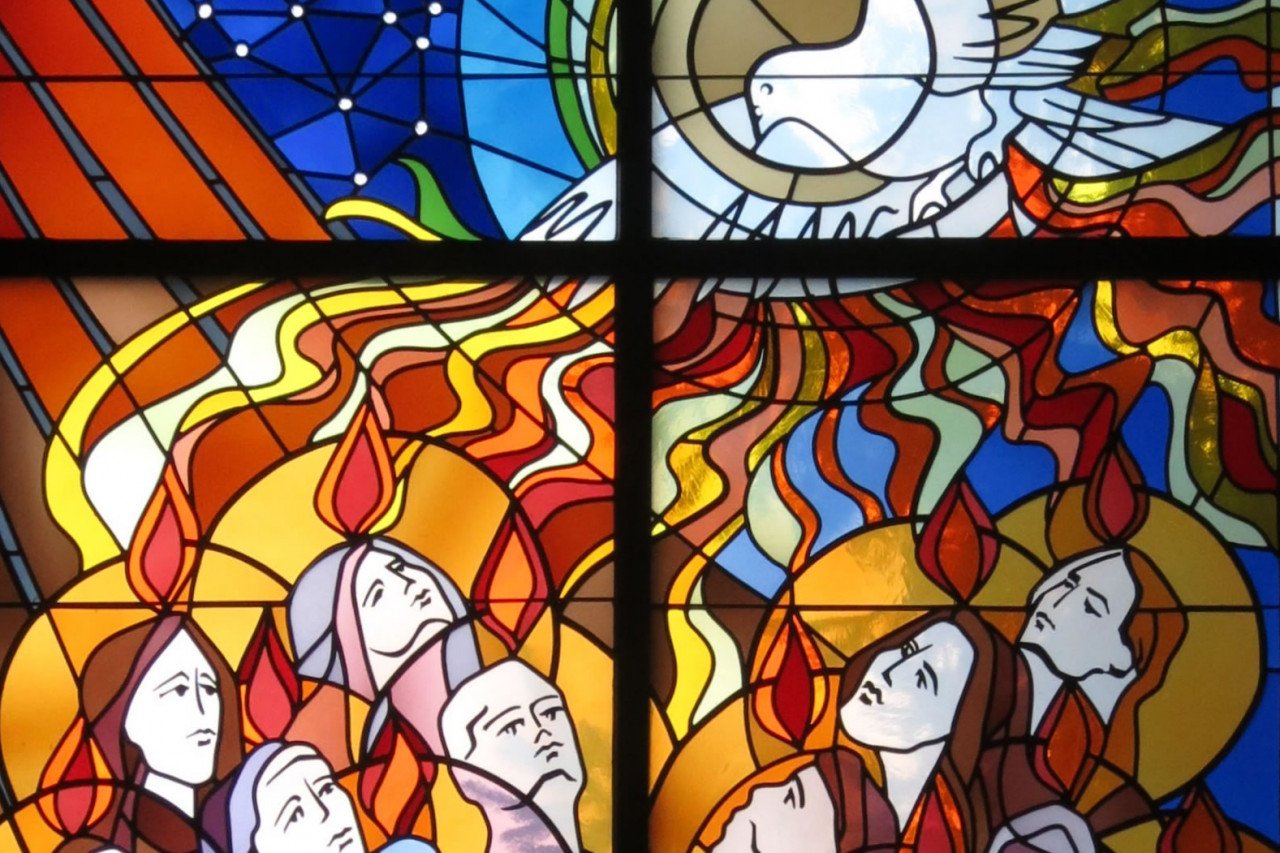
As we celebrate another Pentecost, it certainly seems true that we have thoroughly underestimated the grace of God, the promises of God, and the Spirit of God. It is true on all fronts. When it comes to doctrine, we think the Scriptures too hard to be believed and so underestimate the power of the Spirit to bring us to faith and confidence in that Word of God. When it comes to piety, we think the liturgy too hard to understand or follow or judge it irrelevant and so underestimate the
power of the Spirit to work through the liturgy (really nothing less than Scripture said and sung) to bring us to faith and confidence in the prayers we pray and the praises we sing. When it comes to sacraments, we think the baptism, the Holy Eucharist, and absolution too hard to be believed and too ordinary to convey what they sign so underestimate the
power of the Spirit to bring us to faith and confidence that the water with the Word does what the Lord says, that the bread and wine is what He says it is, and that the voice of the absolution through an ordinary pastor effects anything. When it comes to sexuality and gender, we think the God given order in creation too hard on desire and too distant from what we feel to be true and so underestimate the
power of the Spirit to bring our lives into God's order through repentance and faith. I could go on but you get my drift.
We have tried to gimmick people into faith and going to Church and giving because we are either too impatient to wait upon God's time and power or because we have completely lost confidence in that power to effect in time what He desires. We guilt people into the good works of love that are supposed to be the fruit of the Spirit. We cater to the whims of those who are more sure than creed and confession that they know what God wants us to know and believe about Him. We surrender the objective truth built upon the concrete of fact and history to the imagined truth of feeling or whim. It is because we think God's way too hard, too slow, too weak, and too out of step with the times -- we have and continue to underestimate the
power of the Spirit -- even in the light of what happened on Pentecost to bring courage, boldness, and power to a group of disciples who weeks before hid behind locked doors afraid of their own shadows.
If we underestimate the Spirit, we overestimate everything else but especially science, observation, experience, feelings, desire, and reason. All of these are good and salutary gifts of God but in the wrong hands, they become instruments of tyranny imposing upon us a prison in life that will become our prison in death. We create our own dead end by elevating these above the Scriptures and by devaluing the power and work of the Spirit working in those Scriptures to work faith in our reluctant hearts. We do not allow God to transform anything in us -- not our mind to appreciate and celebrate what He has accomplished for our salvation and not our desires that we refuse to see as sinful and insist are the most trustworthy things this side of glory. We overestimate what we do or think we can do or think we should be able to do to knock God down to size so that He is no bigger than our imagination and almost our equal in every way.
As we celebrate Pentecost this year, let us remember to trust more the work and power of the Spirit and trust less our works and powers. The Church will certainly be better off trying to be faithful than to be successful and each of us will have cause to rejoice as well.
Garrison Keillor famously told the story of 25 Lutheran pastors who were guests on a pontoon boat. If you have not heard it, take a few moments to click on the video. There is a rather important principle in this story, though hardly one Keillor intended. In the story there is a problem that happens when all the Lutheran pastors head for the same side.
We have all heard the stories of population shifts taking place right now. There seems to be an exodus from saltwater states (blue ones) into such places as Florida, Texas, Tennessee -- among others. New York and California seem to be those losing the most. During the pandemic, South Carolina was one of the
fastest-growing states in the nation enjoying those leaving closed down states for one more open. That was entirely due to people
moving in from other places, new census estimates show. The sad reality is that South Carolina was at the same time having a negative birth rate. That remains the big problem. We are seeing people move around but many states are in the same predicament as South Carolina -- they have a negative birth rate. The shocking reality is that every state would be in this same pontoon boat is immigrants and the birth rate of the immigrants were removed from the equation.
We are moving people around but not growing. Sort of like the growth in evangelical churches that was supposed to be from the unchurched but looks pretty much like Christians moving from one non-denominational church to another -- rearranging people but not really growing. If you will, the birth rate did not grow but some congregations showed increases while others showed decreases. It will not work for America any better than it did for churches. Rearranging people is not the same as growing. But that is the bill of goods we have been sold. We do not need babies because we have too many people already. That does not help the nation and it will not help churches either.
The other side of the coin is that the population is aging. Moving people around may help some states but it is not going to help the nation. We will have to confront the negative birth rate both as a nation and as churches.
“Americans are the nicest, most generous, and sentimental people on
earth,” Walker Percy once observed. He is correct. If there is a disaster some where or a crying need, Americans send their money to relief agencies and go fund me pages more than any other people. Americans are sentimental -- we are the only ones in the world to keep so many greeting card companies busy with invented holidays and saccharine sayings to fit them all. Americans are nice and smile their way through many things that would deserve at least a frown.
“Yet Americans have killed more unborn
children than any nation in history, so observed the same Walker Percy.” While that was written at a time when abortion was barely a generation old as a right protected by the constitution (so said the Supreme Court), it is still true. Abortion is no longer a federally guaranteed right found in the constitution but it is still legal in more states than not and it still offends many that it is restricted anywhere.
How to figure out the contrast? I wish I knew. I have found the same thing related to other issues. In the Midwest of my youth, there are plenty of nice Germans, Swedes, and Norwegians who are conservative in values but too nice to argue with those who are not. Many of those are Lutherans who remain with a Lutheran body that long ago departed from Lutheran values. They are too nice. I know that is hardly possible but it is true. They are too nice. Sometimes we just do not know when to stand up and say "no" to the things that are just plain wrong.
Yes, we risk offending people and alienating friends but it is not nice to confuse our children with invented genders. Yes, we risk offending people and alienating friends but it is not nice to confuse our children with overt sexuality and put them in adult positions, making adult decisions, when they are only kids. Yes, we risk offending people and alienating friends but it is not nice to confuse our children with invented virtues while we trash the old ones all in the name of new gods of modernity. Yes, we risk offending people and alienating friends but it is not nice to confuse our children with the idea that God's Word is only partly His Word and we get to decide which is and which is not. Yes, we risk offending people and alienating friends but it is not nice to confuse our children by saying God is good with whatever makes us happy -- in life and in worship. By the way, it is not just the children that end up being confused. The nice folks do as well and in that confusion they end up surrendering that which they once held sacred because it certainly is not nice to offend.
We went fifty years flushing away the children in the womb in the name of what seemed right in the moment. We are just beginning the accelerated conflict over marriage, gender, and sexuality that will certainly be as divisive as abortion was and is. Nice should not be cover for doing what we all know is wrong. When you are that nice, you are too nice.
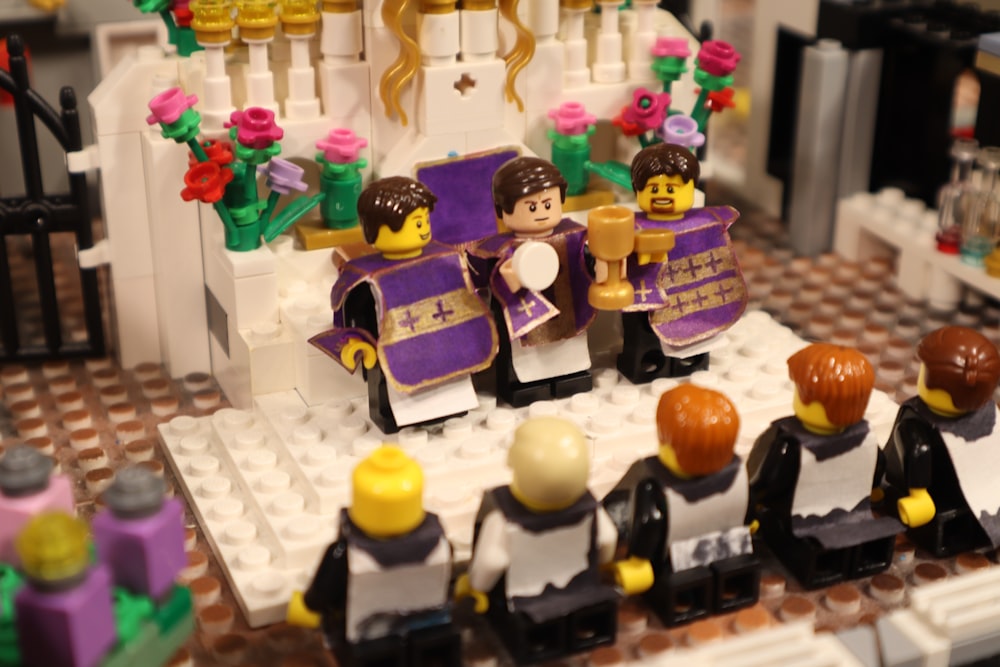
It is a well-known phenomenon that Evangelicals are attracted to liturgy and the traditional liturgical ceremonies as a means of attracting younger folks who seem to like things liturgical and traditional -- in worship anyway. The problem with this is that the liturgy is not simply a set of clothes you can wear or a role you can play or a way of decorating. The liturgy is not a tool. It is the form that mirrors in worship what is catholic in doctrine.
The liturgy is not a toy. Sadly, the liberals who like to play church but who refuse to believe the doctrine of the faith have turned it into just that -- a plaything. It is the saddest thing of all for these folks to be so solemn and serious about liturgical things but who refuse to let the words define what is believed and confessed. The liturgy is literally just Scripture said and sung and when it is done by people who refuse or refute what Scripture says it is the highest form of hypocrisy.
The other side of this is on the side of those who say they believe what Scripture says and then treat how they worship as if it were merely a preference. Evangelicals and Protestants who originally cast aside everything from Lent to liturgy are now adopting the Church Year and things liturgical and using these as gimmicks to attract folks no longer won over by a worship diva, a professional praise band, and repackaged secular entertainment.
The preaching and teaching is a sure place to see the conflict between what is proclaimed and what is practiced in worship. You resurrect ancient forms and practices only to reject what they confess. In this respect, those who seem to be more conservative on the Evangelical side of the equation end up using the liturgy without the integrity of what is believed and taught just like those on the liberal side of things. It is a trend or fad that will just as soon be dropped in favor of something else that seems to work better. Unfortunately, the progressives seem intent upon holding on to the forms while emptying it of anything close to what it confesses -- both in words and in deeds. Even worse, they eat away at the historic words and ceremonies by inserting within the liturgy little bits and pieces of modernity. One example is the name of God and how the Son of God is addressed liturgically but that is not the only one.
It ought to be a selling point for us that we combine both the confession and the liturgy as one seamless reality of doctrine and practice. They are consistent and faithful at the same time. Even Rome cannot claim this unequivocally since Rome seems to accept most of modern higher criticism that begins with skepticism over what Scriptures say and who wrote them. If the younger generation is looking for authenticity of form and content, then conservative Lutherans fill the bill. Episcopalians may have more expensive accoutrements and are better rehearsed but they are empty doctrinally. Rome is all over the page with some masses worse than Protestant excesses and others as close to Trent as possible -- with differing levels of success. Missouri Lutherans need to step up and claim the ground. We have the form but we also have the content. We have the historic ceremonial (if we are willing to do it) and we trust the words to mean what they say. Our Achilles' heel is that we seem reluctant to practice as we believe.