Friday, March 18, 2011

Restoring Beauty to the Sanctuary

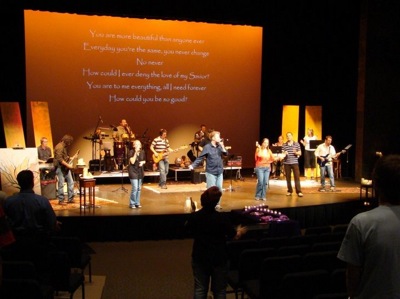
I have noticed a real buzz going on among Roman Catholics who are restoring a sense of beauty and reverence to older church buildings who were "modernized" in the wake of Vatican II and newer church buildings that took their cues from a religious style sheet that emphasized Soovik's idea of gathering space, functional design, and minimalism with respect to art and adornment.  I spent an evening following link after link in which the rather inconsistent Vatican II alterations of historic buildings were undone and, instead of restoration to what was, a restoration of beauty and liturgical function left it both fresh and timeless.  Then I happened upon a trail of links of modern buildings whose often stark and blank canvas was redone with attention to the liturgical legacy of Roman design and the mass yet was not a repristination of any one past architectural style or form.  Most of them were surprisingly well done.  Check out this example from Texas.

It seems that a number of "rules" were common to the work of such restoration.  I believe that they are equally worthy of Lutheran church buildings (whether old buildings "modernized" or new buildings without much soul for worship). 
  1. Get rid of the carpeting.  Ceramic tile, stained/polished concrete, stone, or hardwood is the floor of preference that both accommodates usage, restores acoustics dulled by think and abundant use of carpeting, and removes the often dated and ugly colors chosen for carpeting.
  2. Get rid of the pew cushions.  Not only do pew cushions suck up the sound and work against the singing of the people and the sound of the spoken word, they are often stained and downright ugly.  A good pew will sit better without cushion than a poorly designed pew in which the cushion is used to make up for a lack of good design.  If you cannot get rid of them, re-cover them with a denser foam and with a deeper and more earthly tone (personally, I would avoid gold, orange, red, or blue or primary colors).
  3. Re-stain the blond wood and make it warmer with a darker stain.  There are companies that will come in and refinish the pews and chancel furniture on site for reasonable cost and the difference in tone will make a deep difference in the warmth of the space.
  4. Install stained glass -- if not throughout the building, look at the windows in and around the chancel.  The color adds warmth and character and the symbols and pictures of faith reinforce what takes place within that space.  Check out eBay for used windows and new ones that fit inside the current windows may be much less than you think.  A few years ago we installed 14 custom clerestory, three windows for the Trinity, and the round means of grace window that is on this blog -- all at a cost of about $30K.
  5. Install a crucifix (or, if that is too much for your Lutherans to accept in one bite, try a Christus Rex).  It is amazing how much the figure of Christ on the cross makes a strong statement to all who enter, what is our focus, our source, and our goal in what takes place here.  Again, there are supply houses that reclaim such things from churches closed down or remodeled and they can offer a break in cost.
  6. Move things around so that the altar is central and so that the pulpit speaks well into the building.  Move the baptismal font to the entrance so that people have to pass it on the way into the building.  Sometimes moving things around can radically reshape our sense of the whole space.
  7. Expand the chancel -- either by moving the music to the back, taking out a row or two of pews (who sits up front anyway), or extending the rail.  The chancel should be 20-30% as big as the nave and so often we sacrifice chancel space to add in seating.  What we are left with is often a busy and cluttered area that is the visual focus of those who sit in the pews.  In addition, it is hard to function in crowded space with acolytes, assisting ministers, etc...
  8. If there is an abundance of wood (or fake wood) paneling, paint it (start with a good quality primer) and avoid stark white -- neutrals in the cream family if you must but several tones may work much better than one solid color spread over the entire space.
  9. Religious art -- not the burlap banners of the 1970s but well done liturgical hangings (from quality seasonal banners to a dossal curtain to paintings to icons) can make a huge impact in the character of the worship space.  There are stencils available to make it more accessible if you do not have artists available to you.  Talk to the congregations who have these kinds of adornments and see where they found the artists and artisans to provide them.  They will serve you for many generations.
  10. Paraments -- I am struck over and over again by old, ugly, and minimal hangings on the altar, lectern, and pulpits of our churches.  This is an area that makes a big impact and is very reasonable in cost.  Instead of buying stock items, talk to some sources of supply about the custom paraments that allow you some design flexibility.  The transformation of the chancel through the use of liturgical antipendium is profound.  We have full Jacobean frontals that cover all four sides of our altar and ground the whole space with color that points to the season, feast, and festival for each Sunday.
  11. Lighting -- did you know that incandescent bulbs are on the way out.  Now is a great time to reconsider the lighting in the church -- general lighting over the pews and specific lighting for the chancel (flood and spot lights).  Sometimes a mere change of bulbs or fixtures transform the space in ways that you would never guess.  Check with some of the lighting consultants who often work for cheap because they also gain commission on the fixtures they sell or from the manufacturers they represent.  You are not obligated to take their advice but they can be very helpful.
  12. Forget the modern idea of gathering space, and take a look at your chancel from the perspective of sacred space.  What is being said by the design, the arrangement of furniture, and the art (or its lack).  Remember it does not have to Gothic or baroque or Romanesque -- it can be modern.  But it should not be jarring, stark, or cold.  We cannot afford to be forgetful of who we are -- especially in worship.
If there are those who think that the money for refurbishing the worship space might be better spent elsewhere, just remember how much is spent on creature comforts in our buildings (heat, A/C, etc.) and think of this as an investment that strengthens identity, purpose, and consequence of who we are as the church of God.

Thursday, March 17, 2011

The Way You Carry the Book

A few words about the setting of a comment.  Where I serve, the first two lessons are read from the lectionary at the lectern.  Between the lessons is the Psalmody or a choir anthem reflective of the pericope.  After the second lesson is either the Alleluia or Lenten Verse (occasionally the proper verse but mostly the general one).  While this verse is being sung, I carry the lectionary book to the pulpit to read the Gospel.  I carry it with both hands on the bottom of the book, held upright and high, until in the pulpit I lay it down on the lectern of the pulpit and open it to the proper page.  After the Gospel, I hold up the book in the same way and say, "The Gospel of the Lord."

Now to the comment.  A parishioner noted the way the book was carried and lifted up after the reading of the Gospel.  This person watched for weeks on end after first noticing my practice.  Finally, the person spoke to me about the practice.  "The way you carry the book tells me what it is and how we relate to it..." He did not ask how or why but observed that my several comments in Bible study and sermons talking about the way we as Lutherans view the Scriptures were borne out in this practice.  God's Word is not to us a history textbook or an encyclopedia of knowledge or a disciplinary book of rules but the life-giving Word of God, living and active, infallible and efficacious.  This parishioner told me how this ritual of carrying the lectionary book with attention to what it is (God's Word) has become something to watch for -- week after week.  This simple gesture is a visual affirmation of what we believe, teach, and confess.  And that is the salutary purpose of ritual, ceremony, and religious gesture within the Divine Service.  They give form to what we believe, teach, and confess.

Now to the result.  This person has been talking to others in the pew about this.  Now I notice that there are many eyes on me as I make my weekly walk from the lectern to the pulpit, carrying the lectionary book (BTW, if any of you know of a source of supply for a suitable Gospel book with grand metal cover that works with the LSB three year calendar and will not force me to take out a second mortgage, please let me know as I would love to carry this).  Others have come to see that the truth we believe, teach, and confess takes visual form in the ceremonial of the mass or Divine Service.

I could speak of other ritual gestures that also give form to what we believe, teach, and confess.  For now, this is enough to illustrate my point.  It is not a matter of whether we like or dislike ritual.  We confess something by its absence just as we confess something by its presence.  The point is not to spiritualize what we do but to make sure what we do reflects what we believe. They flow together as parallel streams from the same source -- what we believe with out hearts, confess with our lips, and show forth in the church usages, rituals, and ceremonial gestures of the mass or Divine Service.

Polo shirt vestments, with none of the ordinary furniture of the chancel, without the pattern of the Divine Service (mass), absent the ritual and ceremonial that accompanies the form and text, speaks just as loudly against what it is that we believe, teach, and confess about the mass (Divine Service) as the faithful practices speak.  But what do they say?  Could it be that what they speak agitates against the confession that the Word of God is authoritative, infallible, and efficaciouis?  That Christ is truly present, distributed, and received in the bread which this Word calls His body and the cup which this Word identifies as His blood?  That the Pastor is acting not for himself but in persona Christi?  That what happens in the Divine Service (mass) is the entrance of heavenly glory into this earthly domain as Christ comes as He has promised and bestows what He has to give?

The point is not necessarily "could" we do without all of this.... but "should" we?  If how you do it speaks as clearly as what you say, then we need to pay attention not only to the text or content but to the context and practice...  Something to think about...

BTW I looked but could not find a handy photo of a Lutheran carrying the Gospel book so I have made do with B16 doing the same thing...

Wednesday, March 16, 2011

Funerals Are Dead -- Long Live the Celebrations of Life

I see that the obituaries in my city have universally abandoned the term funeral in favor of the much more positive "Celebration of Life."  This is not only for those who have no Christian affiliation but for Christians of all stripes, as well.  I have argued with them that Lutherans do not celebrate life but we do bury the dead through the Christian funeral.  Yet it seems to no avail. 

Some Christian (and Lutheran) conservatives are worried about cremation as a pagan practice.  Good God, nearly every burial practice today is so pagan that it is difficult to find anything consistent with Christian faith and practice.  First of all we make the dead look as much less dead as possible.  I am not sure whether this is a denial of death or simply a silly, sentimental attempt to soften the reality of death.  Personally I can think of nothing more scary than the prospect of someone being placed in a coffin who was not dead and then being buried alive.  And the banal and vacuous conversation that goes on about how "good" he or she looks in the casket is itself testament to our unwillingness to admit that death is a real enemy to be overcome.  Why I have often heard that the person in the casket looks better than they did while they were alive.  If the price of looking good is dying, then I vote for looking awful.

Then we embalm that body so that the dust to which it is meant to return is put off as long as technology is able to deny its return to the earth.  Like Lenin whose body has been kept in somewhat "normal" appearance for how many years, we find some sort of sick comfort in knowing that if we did up the dead after a decade or two, they will look a lot like they did when we planted them in the ground.

And then there is the funeral home.  Instead of sitting vigil with the dead, we turn the viewing into a living room, adorned with objects familiar to the deceased as if a dead man who once loved fishing is more easily mourned by surrounding the body with the very things that he will never do again.  I once thought that the video of pictures was a good thing but even this has become an exercise in removing seriousness from the whole thing of dealing with death.  We no longer mourn the dead or lament our loss or wail and gnash our teeth.  Instead we laugh and giggle at the mention of those funny little memories of which the pictures remind us.

When it comes time for the service, the "professionals" take over and the Pastor becomes an actor with a bit part in their production.  The screens on either side of the "chancel" at the funeral home "chapel" continue to play the happy scenes of the life now gone and the Pastor is left to merely comment upon the memories and, if possible, tell a good joke or funny story to make us happy again.  Sometimes even the coffin is left open so that the Pastor is hidden in the shadow of the open box.  Oh, and don't don't forget the music that plays a sound track for this whole production (a musical accompaniment that is less about faith than it is about what the dead would have wanted or the living enjoy hearing).  And if you set the funeral when your Pastor cannot be there, don't fret.  The funeral home/celebration of life center has people on staff who will do the service the way they and you want -- without fighting all those decisions that go against the grain of Christian faith but make us feel so much better about death (or do we call it the end of life?).

At the end of it all we have the chance to burn up the remains and receive a baggy of the deceased to carry around with us and drop off in dribs and drabs at all the places so special to his or her life.  Or, if we are old fashioned, we might put the embalmed and wonderful looking body and its finely crafted comfortable resting place into a vault in the ground -- sealed so tightly that nothing gets in and nothing gets out for as long as the lifetime guarantee allows.  Then we can put up a tombstone which has an electronic device that will replay the person's voice whenever we want to laugh again at that wonderful old story that he or she always told so well.

Celebrate Life!  I don't think so.  I long for the old days when the family washed the body and pine box accompanied its journey back to the dust of the earth.  When we carried the coffin to the Church and from the Church to the cemetery, while the great hymns of the faith and the story of the death that gives us life set the whole event into perspective.... When there were tears of loss because death was no friend but the mortal enemy for which God Himself risked human flesh and blood to live, yes, but more to die for the dying and grant them life death can no longer steal away... When time stopped long enough for the family, friends, fellow church members, and neighbors gathered in solemn and sacred duty to bury the dead... When funerals were funerals and Pastors were there as representatives of God to frame our sorrows within the context of the cross and empty tomb... When what we needed to remember was what God did to answer death's cry and rescue us from its bondage... When the images that mattered were the sacred symbols that gave visual form to what we believe, teach, and confess...  Things were not perfect back then but at least we knew that death was real and really awful and that God does not just console us but restores to us the lost lives sin stole by nothing less than Divine intervention.  So I vote "no" to celebrations of life and "yes" to funerals where the story that is central to death is Christ's life.

You may worry about cremation being rather pagan in origin but it is less the problem than the kit and caboodle of modern day burial practices...  I know I have offended funeral directors (or is it celebration of life coaches) and I apologize both for painting with a broad brush and for faulting businessmen who give the public what it wants.  But I needed to say it... and maybe you do to when you show up at the funeral home (make that celebration of life center) to make arrangements for your loved one.  BTW, don't set the time of the funeral/celebration of life without first checking with the Pastor's schedule.

Tuesday, March 15, 2011

When Faith Becomes An Event

I normally do not read the Huffington Post but a friend pointed me to an article by Tim Suttle on Why Evangelicals Need Lent.  In it an evangelical laments the "fix" focus of many evangelicals in which faith becomes more and more directed to and by "events" -- conferences, concerts, newest books, latest trends, etc.  He also laments the way many evangelicals become satiated in these events -- indulging in them to the point of excess.  Now I cannot objectively judge his conclusions but he makes a persuasive case for his points.  My concern is not to review his perspective here but to consider how we as Lutherans tend to follow the same path, only a few years behind the times.

Parish calendars have become the blank canvas on which we feel it is our job to fill every moment with some kind of church event.  We seem intent upon rallying our people to death for this cause or that and we lament it when these events do not draw the big crowd.  We do this with women's ministry, youth ministry, children's ministry, etc.  The Lutheran thing seems to be take an idea from the evangelical playbook, ruminate on it a while, and then offer a "Lutheranized" version of the same stuff -- albeit a year or two after the craze has come and gone.  So we turned Lent into Forty Days of Purpose Driven Life and we tried a version of Promise Keepers to ramp up our men's ministry and we promote Beth Moore workshops for women and we cannot get enough to Rob Bell... We are programming our parishes the way evangelicals do but evangelicals program because they have no church year, no liturgical identity, and no confessional perspective.  At the very moment they are thinking about rediscovering Lent, for example, we have all but ditched the special themes, Bible studies, devotional resources, and mid-week services that once was our forte.

We turn worship into an event and so the focus is not on the weekly rhythm of Word and Supper that draws us in and sends us forth.  We turn prayer into an event instead of the daily discipline of an ongoing conversation in which God is not only the listener but the speaker.  We turn Sunday school and catechism into event shaped venues for fun and things relational -- to all except to God.  We make it seem like the Christian life is a matter of scheduling events, of reading current authors, or of exploring the latest spiritual gimmicks instead of daily repentance, being in the Word of God, and fulfilling our baptismal vocation of witness and service in the world.

I guess if I were writing an article about Lutherans today it might ask Why Lutherans Are in Love with Things Evangelical (the movement and not the Gospel sense of that word).  We are a few years behind them but well on our way to satiating our people with events and themes and the latest this and that.  One day we might be writing articles about Why Lutherans Need Lent.  Or, we would stop the constant borrowing of spirituality resources, Bible studies, programs, music, and trends from the evangelicals and look at our own heritage of confession, creed, Scripture study, and liturgy.  In the end it might help us find out who we are in the midst of a world filled with plastic people and plastic churches who act different than they believe and are not content with who they are.  The world is not in crying, desperate need of more evangelical wannabes but it is in crying, desperate need of Word and Sacrament Christians, with a history, a heritage, and a confessional/liturgical identity --  as well as a future.  Think about it...

Abortion is the Leading Cause of Death in NYC -- BY FAR

In 2008, according to the New York City Department of Health and Mental Hygiene, there were 55,391 total deaths in New York City. Also in 2008, according to the New York State Department of Health, there were 82,475 induced abortions in New York City.
Let’s break it out with some leading causes of death in New York City in 2008:

Cause of Death Number of Deaths
Heart Disease 21,844
Cancer 13,116
Influenza/Pneumonia 2,578
Diabetes 1,708
Stroke 1,669
Deaths by All Causes (excluding abortion) 55,391
Induced Abortions 82,475

The number of people who died from abortion in 2008 in New York City is 149% of the number of people who died from all other causes. Put another way, abortion accounts for 60 percent of all deaths in New York City.

HT to the Catholic Key blog...  so disturbing that no comment can appropriately gauge the shock of these numbers...

Monday, March 14, 2011

Whose voice do you hear? Whose voice are you listening for?

Sermon Preached for the First Sunday in Lent, March 13, 2011.

    When my children were small, I could hear their every whimper.  In church I knew instinctively when it was one of my own crying.  I have found that once they grow up, they seldom cry in church.  Some folks have an issue with kids crying in church. They have often complained to me that children should be seen and not heard – especially in church.  On very rare occasions that have been small children whose cries might be better dealt with by taking them out for a few minutes, but, the rest of the time, I just plain don't hear them.  I am listening to and for other things.  What are you listening to?  Whose voice do you hear - not only on Sundays but all week?
    The story of temptation is the story of voices.  Eve first heard the voice of her own doubts and anxieties.  Then she listened to the voice of the serpent who kept amplifying those feelings.  Adam listened to the voice of his own discontent when Eve had risked the forbidden and then he listened to her voice inviting him to join her.  What happened in the Garden of Eden still happens.  We listen to the voice of our doubts, fears, and discontent and Satan amplifies that voice and adds his own voice of lies and deception.  And as soon as we focus on these voices, we are weak in the face of temptation.
    Whatever doubts Adam and Eve had of God and His rules for the garden, Satan took and amplified until they were the only voices they heard.  Their perspective shifted from the positive affirmation of all that God had given them to the negative voice that complained about the one thing forbidden to them.  So it is for us today.  Temptation starts with discontent over all that you have and soon it gives birth to resentment over what you do not have.  When our focus is on ourselves and what we lack, instead of God’s grace and what He has given us, this discontent becomes the fertile ground for temptation to succeed.  When this ground is plowed by Satan, the fruit is always weakness and defeat – we give in to our desires.
    Satan feeds on this discontent.  He manipulates our knowledge until the very thing that we know is wrong becomes the thing we think we ought to do. It was that way in the garden of Eden so long ago and it is still the path that temptation follows in our lives.  Whose voice do you hear?  Do you heed?
    Jesus heard another voice.  Jesus was flesh and blood like we are.  His perfection did not come because He was immune to temptation.  Jesus was just as vulnerable to temptation as we are.  The devil knew His weakness and appealed to it expertly – food for a hungry body, test to make God prove Himself, and finally a short cut to get what He was here to accomplish.  But Jesus did not listen to the voice inside Him crying out for the easy path.  He did not hear or heed the voice of desire.  Instead Jesus was listening to another voice – to the voice of the Father and the voice of Scripture.
    What enables us to resist temptation is not that we are better than others but a matter of whose voice we hear.  Sin speaks the voice of the moment, the voice of desire, the voice of want... The Spirit speaks to us the voice of truth, faith, and righteousness.  Jesus did not only fulfill all righteousness for us, He shows us who to listen to and how to hear the voice of the Spirit, speaking through His Word, make us strong.
    When Jesus says, "Man does not live by bread alone..." He is telling us that earthly things do not matter much.  The world insists that they are the only things that matter.  Our desires tell us that only this moment counts.  But the Word of God puts it all into perspective.  If you get the heavenly things right, the earthly things fall into place.  I read that somewhere a week or two ago.
    When Jesus says, "Do not test the Lord your God..." He is telling us that God is always there – whether we see Him or not.  He reminds us that what we see with these eyes may not be as true as what we see with the eyes of faith.  We do not gain trust by testing the Lord in small increments, we trust the Lord in the midst of all our tests, trials, and troubles and we are made strong.
    When Jesus says, "Trust in God alone..." He is telling us what part of us already knows.  Even well meaning people will let us down; only God will never fail us.  We say a friend in need is a friend indeed but how many of us have been abandoned by our friends?  God's friendship is not some vague promise but the reality of the Cross.  Greater love has no one than he who lays down His life for His friends.  Jesus shows us this love in His outstretched arms on the cross.
    No one escapes temptation – not even the Son of God.  Parents cannot isolate their children from the sinful path of the world and its allure.  But only Jesus faces the temptation in the power of the Word of God and remains true to that Word.  Better than hiding our children from the world is to raise up our children to hear the voice of God’s Word that the Spirit may make them strong in the face of evil’s glitter.  You and I walk in temptation every day of the week, every week of the year.  To whom do we listen?  For whom do we listen?
    The devil begins not with the stuff out there but with what is in here, in our hearts, with the voice of our own discontent, our own doubt, our own anger, and our own bitterness.  He reflects back to us what flows from our weak and sinful hearts until it is the only thing we hear.  And then we are done for.  But... when we listen to the voice of the Father speaking through His Word, we are made strong in Christ.  What we hear is joy, confidence, peace, and courage.  And when, striving mightily against temptation, we fall, Christ will stand us up again with forgiveness.  His forgiveness is His hand out to reach us, lift us up, and restore us to Himself.
    This is no simplistic call to think "What would Jesus do" or the command to "do what Jesus did."  This is the voice of God who does not command us to be strong but rather equips us with Christ's strength in the face of our weaknesses.  And when we do fall, as indeed we shall, this grace does not abandon us.  Rather it is this same grace that lifts us up again.  I call on you today.  Do not listen to the desires of your heart – they will lead you astray.  Rather, listen to the one voice that cannot lead you astray – the one true and solid voice of God in Christ.  Listen to His voice that you may be strong in the face of temptation.  And when are weak in the face of temptation, this same voice will call to You with forgiveness, lift you up and restore You to Himself again.  Amen

Not the UnChristian but the ExChristian

I was pointed in the direction of an article on-line at Christianity Today that deals with the issue of the those who are leaving the Church AND the faith -- the so-called "Young Doubters."  It is a fair and reasoned article that offers none of the simplistic answers so common today (put in a praise band, make church like the mall, etc.).

Others have probably read and commented on this in depth article but I was caught by the turn of a phrase.  The problem today isn't those who are unchristian, but that so many are ex-Christian. Strictly speaking, they are not an "unreached people group." They are our brothers, sisters, sons and daughters, and friends. They have dwelt among us. And now they are gone...

Some have suggested that we should not panic and that younger folks have always taken a "hiatus" from the Church until young adulthood and responsibility seems to call them back.  Others are not so sure the situation is the same.  Young adulthood is not what it used to be, marriage is delayed longer or not even sought out, and many of these are not having children -- children being sort of God's wake up call to young adults.  Still others suggest that the variety of choices or non-Christian options has snagged some (especially, apparently Wiccan).  Some point to a hardening of those who have left -- something not particularly isolated to religion and faith but that covers much of their life and thinking.  In the end, those "leavers" are not leaving for one reason but for many reasons and therefore there is not one answer to draw them back. 

Now, no one is saying Christianity is on the verge of extinction.  But there is a certain seriousness about the number of those leaving and the reasons why.  In the end, it seems that there might be more of a common thread to this than first expected.  The author's own conclusion is that "I realized that most leavers had been exposed to a superficial form of Christianity that effectively inoculated them against authentic faith."  A "seeker" style Christianity with its low commitment, high emphasis on spectator/entertainment worship, small groups, and its acceptance of the "me" at the center of things has kept many of these from knowing true Christianity.  In addition, the inability of orthodox Christianity to answer their doubts and shepherd them through those doubts has left them cut off from the Church and the faith -- at the very moment they were most in need of the Church and of the nurturing care of the faithful.

I might suggest here that many of those "leavers" went to youth groups and national youth gatherings in which cutting edge Christian music and provocative and anti-traditional Christian speakers tried to show that you don't have to belong to your grandfather's church in order to be Christian.  I might suggest that but I won't dwell on the well documented failings of our youth programs.  Maybe I will let the author speak for himself (and he sounds pretty Lutheran here):  There's nothing wrong with pizza and video games, nor with seeker-sensitive services, nor with low-commitment small groups that introduce people to the Christian faith. But these cannot replace serious programs of discipleship and catechism. 

The sad truth underlying all of this is that these "dechurched" young people are much harder to reclaim than "unchurched" and this is true for all age groups.  Unless we are willing to heed some of the warning signs and make sure that it is a Biblical faith that is being proclaimed and taught, a confessional, creedal, and catechetical perspective that is the starting point and guide through life, a liturgical setting in which the focus is on the means of grace and not the person, and a mercy driven - servant shaped life together that directs our baptismal vocation, we will have more and more of these hard nuts to crack and more and more articles lamenting the loss of those who were once one of us.

Sunday, March 13, 2011

Prayer Shaped by Our Need or God's Promises

In the now famous video of Pres. Harrison explaining the three fold emphasis of witness, mercy, and life together, he makes a small comment on prayer.  He says we know not how to pray because we know not the promises of God.  It is a very small portion of his entire presentation but a powerful one, indeed.

Most of our prayers are shaped by what we perceive to be our need.  We pray out of our troubles and trials.  We pray out of disaster and calamity.  We pray out of guilt and shame.  We pray out of fears and doubts.  We pray out of despair and death. We pray out of the same things but experienced in the lives of others.  We know those needs well because it is in this world of need in which we live.  We believe we know these needs better than anyone so it is often difficult for us to pray "as God wills."  We live with the haunting fear that God does not know our needs as we do and God will not give us what we think and what we know we need.  We often find it a betrayal of prayer to lay out all that we have determined is needed and then to end it all "in accordance with God's will."   After all, is not the whole function of prayer to make known to God our needs as we see them? 

I am sure I am not the first Pastor to be asked "why do you bother to prayer for someone on the sick list when you end that prayer 'in accordance with Your will, O Lord?'"  The person was earnest in his protest.  Surely, when we defer to God's will, we betray what it is that we have come to the Lord to ask.  In my early years as a Pastor, there were folks influenced by the charismatic movement who would urgently seek two or three others to "agree with them in prayer" so that what they asked for would be certain to be received from God.  In one tragic instance, this involved a young girl afflicted with cancer.  Her "prayer agreement" was for healing but when she died her family questioned the value of prayer and eventually fell away from the faith.

Such issues are often overcome by praying from God's promises.  When our prayers are shaped by what God has promised to bestow (as well as by our need), we stand on the firm ground of grace that is not in doubt but firmly pledged and promised.  If in worship the surest word we speak to God is the Word He has spoken to us, then this is even more true when it comes to prayer.

Someone once asked me why our petitions in the liturgy seem to pray for the same things every week (the church, her ministers, the nation, our leaders, the sick and suffering, the dying and those mourning, our worthy reception of the body and blood of our Lord, our faithful stewardship of His gifts, etc...  They suggested that it sounded as if we were praying for the same things because we never got them in the first place and so we keep harping to God for the same things, week after week after week.  But of course, we pray in the liturgy for those things which God has promised to give to us as well as the particular needs that change from day to day (the sick, for example).

I often think that how we understand prayer has been so influenced by the evangelicals and pentecostals that it bears almost no resemblance to the prayer we are bidden to pray in Scripture.  For surely the Our Father is meant not only as the prayer we pray as God's people but the prayer that shapes our own lives of prayer.  In this prayer we pray from God's promises -- what God has pledged and promised to give us in grace.  About these things we are not in doubt.  So such prayer is not the earnest but uncertain petition of a people who do not know how God will respond to their prayers but the confident request of God's people for the Lord to grant us what He has already pledged and promised to do.

It seems to me one the best things about Luther's explanation to the Our Father in the Small Catechism is that he frames out each petition within the context of this promised grace.  Truly Pres. Harrison is right -- we need to be in the Word of God in order to help our prayers and we need to learn to pray from the vantage point of those promises so that our lives of prayer might not only be earnest but rich and full.  In this respect, it might actually be an outgrowth of his own bidding to pray from God's promises if we take up the call to pray the Litany in our daily Lenten prayers.

How to pray the Litany:
(1) Set aside a time and a place for quiet meditation and prayer.
(2) Calm yourself and prepare yourself to pray in silence before you begin.
(3) If you are with others, choose one person to say the “L” parts and then all join in on the “C” parts. If you are alone say/sing each part.
(4) Kneeling is a helpful posture to assume when praying. If this is not possible, use whatever posture is most helpful to you.
(5) Use any, or all, of the concluding prayers, in the same manner as the Litany.

THE LITANY
L: O Lord,
C: have mercy.
L: O Christ,
C: have mercy.
L: O Lord,
C: have mercy.
L: O Christ,
C: hear us.
L: God the Father in heaven.
C: have mercy.
L: God the Son, Redeemer of the world,
C: have mercy.
L: God the Holy Spirit,
C: have mercy.
L: Be gracious to us.
C: Spare us, good Lord.
L: Be gracious to us.
C: Help us, good Lord.
L: From all sin, from all error, from all evil;
From the crafts and assaults of the devil; from sudden and evil death;
From pestilence and famine; from war and bloodshed; from sedition and from rebellion;
From lightning and tempest; from all calamity by fire and water, and from everlasting death:
C: Good Lord, deliver us.
L: In all time of our tribulation; in all time of our prosperity; in the hour of death; and in the day of judgment:
C: Help us, good Lord.
L: By the mystery of Your holy incarnation; by Your holy nativity; By Your baptism, fasting and temptation; by Your agony and bloody sweat; by Your cross and passion; by Your precious death and burial; By your glorious resurrection and ascension; and by the coming of the Holy Spirit, the Comforter:
C: Help us, good Lord.
L: In all time of our tribulation; in all time of our prosperity; in the hour of death; and in the day of judgment:
C: Help us, good Lord.
L: We poor sinners implore You
C: to hear us, O Lord.
L: To rule and govern Your holy Christian Church; to preserve all pastors and ministers of Your Church in the true knowledge and understanding of Your wholesome Word and to sustain them in holy living;
To put an end to all schisms and causes of offense; to bring into the way of truth all who have erred and are deceived;
To beat down Satan under our feet; to send faithful laborers into Your harvest; and to accompany Your Word with Your grace and Spirit:
C: We implore You to hear us, good Lord.
L: To raise those who fall and to strengthen those who stand; and to comfort and help the weakhearted and the distressed:
C: We implore You to hear us, good Lord.
L: To give to all peoples concord and peace; to preserve our land from discord and strife; to give our country Your protection in every time of need;
To direct and defend our president and all in authority; to bless and protect our magistrates and all our people;
To watch over and help all who are in danger, necessity, and tribulation; to protect and guide all who travel;
To grant all women with child, and all mothers with infant children, increasing happiness in their blessings; to defend all orphans and widows and provide for them;
To strengthen and keep all sick persons and young children; to free those in bondage; and to have mercy on us all;
C: We implore You to hear us, good Lord.
L: To forgive our enemies, persecutors, and slanderers and to turn their hearts; to give and preserve for our use the kindly fruits of the earth; and graciously to hear our prayers:
C: We implore You to hear us, good Lord.
L: Lord Jesus Christ, Son of God,
C: we implore You to hear us.
L: Christ, the Lamb of God, who takes away the sin of the world,
C: have mercy.
L: Christ, the Lamb of God, who takes away the sin of the world,
C: have mercy.
L: Christ, the Lamb of God, who takes away the sin of the world,
C: grant us Your peace.
L: O Christ,
C: hear us.
L: O Lord,
C: have mercy.
L: O Christ,
C: have mercy.
L: O Lord
C: have mercy. Amen.
THE OUR FATHER
C: Our Father, who art in Heaven….
One or more of the following Litany collects may be spoken or chanted. You may use as few or as many, as your devotion suggests.
L: O Lord, do not deal with us according to our sins.
C: Do not reward us according to our iniquities.
Almighty God, our heavenly Father, You desire not the death of a sinner, but rather tha we turn from our evil ways and live. Graciously spare us those punishments which we by our sins have deserved, and grant us always to serve You in holiness and pureness of living; through Jesus, Christ, Your Son, our Lord, who lives and reigns with You and the Holy Spirit, one God, now and forever.
C: Amen.
OR
L: Help us, O God of our salvation, for the glory of Your name.
C: Deliver us and pure away our sins for Your name’s sake.
Almighty and everlasting God, since you govern and sanctify the whole Christian Church by Your Holy Spirit, hear our prayers for all its members. Mercifully grant that, by Your grace, we may serve You in true faith; through Jesus Christ, Your Son, our Lord, who lives and reigns with You and the Holy Spirit, one god, now and forever.
C: Amen.
OR
L: O Lord, do not deal with us according to our sins.
C: Do not reward us according to our iniquities.
L: O God, merciful Father, You have promised to hear the prayers of all who in repentance call out to You. Graciously hear us so that all evils which beset us may be of no avail, that we, Your servants, may evermore give thanks to You in Your holy Church; through Jesus Christ, Your Son, our Lord, who lives and reigns with You and the Holy Spirit, one God, now and forever.
C: Amen.
OR
L: O Lord, enter not into judgment with Your servant.
C: For in Your sight shall no man living be justified.
L: Almighty God, You know we live in the midst of so many dangers that in our frailty we can not stand upright. Grant strength and protection to support us in all dangers ad carry us through all temptations; through Jesus Christ, Your Son, our Lord, who lives and reigns with You and the Holy Spirit, one God, now and forever.
C: Amen.
OR
L: Call on Me in the day of trouble.
C: I will deliver you, and you will glorify Me.
L: Spare us, O Lord, and mercifully forgive us our sins. Though by our continual transgressions we have merited Your chastisements, be gracious to us. Grant that all these punishments which we have deserved may not come upon us, but that all things may work to our everlasting good; through Jesus Christ, Your Son, our Lord, who lives and reigns with You and the Holy Spirit, one God, now and forever.
C: Amen.

HT to Cyberbrethen and Paul McCain

Saturday, March 12, 2011

The Seeds of Lutheranism's Death

"If each and every local congregation does not make the solemn, sacred, self-effacing worship of God its absolute pastoral priority, one by one they will go extinct, drowning in an ocean of mediocrity, relativism, irrelevance -- in a word -- in a total lack of Catholic identity..."  -- from the Last Catholic Standing blog...

Ahh, the wisdom of all of this.  There are those who would insist that Lutheranism is dying because of what is or is not happening in evangelism but the seeds of our destruction are sown not in the way we do or do not witness but rather in what happens on Sunday morning.  If this is true for a Roman Catholic with all the structures of the priesthood, episcopacy, papacy, and holy mother church to make up for local weakness, excess, or lack, then it is even more true for us as Lutherans.

I am fully convinced that our problems are less about evangelism than about worship -- the theology of worship, our worship practices, and the integrity of it all.  Listen again to what this blogger has posited:  The main reason Catholic identity is now so weak is that, forty years ago, we began experimenting and tinkering with God’s sacred mysteries, and now nothing seems holy, nothing permanent, nothing worth reverencing, nothing worth genuflecting before.  For him the issue is the new mass introduced after Vatican II.  For us it is not so simple since our problem is less a new order of mass that is being followed than no order mass and parishes and Pastors doing whatever they will on Sunday morning.  All the casual character of contemporary worship -- even that form of CoWo which follows the basic mass form which has been part of Lutheran identity since Luther and catholic identity from, well, the beginning -- has diminished the idea that anything real is happening here, that anything worth noticing is present here, and that anything worth paying attention to demands our focus.

The whole focus of worship in Lutheran congregations is on the efficacious Word that does that of which it speaks and of the Sacraments that not only bestow the gifts of Christ but make the Giver present where His promise has been attached.  The truth is that you no longer know whether this Word or the Sacrament will be the core and center of what happens on Sunday morning in a Lutheran congregation.  We are not talking about musical style or page numbers in a hymnal but our confession and the liturgical identity that flows from that confession.

The only thing we have to offer the world is the efficacious Word and Sacraments.  Apart from this, Lutheranism has little raison d'être.  We were not born of intellectual debate, evangelistic zeal, or personal piety but of the very practical issue of what people hear and receive on Sunday morning.  It was not a curious quirk of theology that gave us birth but the need to speak the saving Gospel in all its truth and purity and the need to receive the sacraments as gifts and means of grace and not the sacrificial offering of the Church.  These may have been debated and discussed on the pages of seeming academic setting and language, but their domain is decidedly liturgical and practical in nature.  What is the Word that is proclaimed on Sunday morning and what is there to be received on Sunday morning.

The distance that is created by experimentation, by association with evangelical expression and style, by congregation autonomy, by disdain for adiaphora, and by novelty and innovation, the less we are who we claim to be and the more we deceive those we serve and those to whom we witness about Lutheranism and its confession.  This is what is killing Lutheranism -- the lack of awareness and appreciation for the sacred mystery that is God's presence in Word and Sacrament AND the idea that there is nothing real on Sunday morning other than personal taste, feeling, and expression.  We are not killing Lutheranism by our failure to knock on people's doors and speak the Gospel to them.  If we are dying as a church body, it is because of what happens on Sunday morning is no longer true to the mystery, consistent with our confession, or consistent with our evangelical and catholic identity.

This is my problem with Ablaze -- the issue that deserves our primary focus is not how well or how poorly we communicate the Gospel to those outside the Church but how well or how poorly the people on Sunday morning are confronted with the efficacious Word and Sacraments.  When we bring them into the Church and we have nothing really to offer them there, then we have failed even more so than if we never spoke the Gospel to them in the first place.  Don’t we have more important, more urgent things to worry about than worship?  I don't think so....

Friday, March 11, 2011

The Range of the Liturgical Movement

This week something amazing happened.  It took place in a small Lutheran country church.  This congregation has been in the same cornfield since 1896.  Over the door it proudly proclaims the UAC - Unaltered Augsburg Confession (a reference to the adulterated version that was the subject of great controversy in American Lutheranism of the late 1800s).  A relatively few Pastors have served there and the pastorates tend to be long.  Several of the Pastors are buried in the cemetery that is just down from the back of the building.  Many of my own family members on my father's side are buried there.  When the day comes I may be buried there (so says my oldest son, anyway).

This is the congregation where I was baptized and confirmed, the parish that supported me on my path toward ordination.  When I was growing up there, there were no hymnals in the pews.  It was not until the 1970s that hymnals and book racks showed up (a memorial for one of my extended family members).  Prior to that time you brought your hymnal with you to church (a few extras were available for visitors or those who forgot -- but few people forgot).

It was a parish that was sure of its identity -- this was not a mean spirited judgment against other Lutherans but a confidence in the Lutheran Confessions and Biblical infallibility that meant they knew they were different from the Augustana Church in town as well as the scattering of Methodists and Mission Covenant folks who filled out the rest of the religious complexion of the area.  They were identified with the Missouri Synod but never formally joined the Synod until the 1960's.  When the controversies of the early 1970s hit the Synod, there were those who wondered if they had made a hasty decision -- waiting nearly 70 years to make a formal affiliation.

Anyway, to get back to my point, for the first time in its history ashes were distributed on Ash Wednesday.  I called my dad before and afterward just to make sure that the roof did not cave in, the Protestant police did not haul away their Pastor, or the second coming did not happen and I missed it.  Everything went well.  My almost 84 year old dad stood and received ashes on his forehead for the first time in his life and for the first time in the history of that Lutheran congregation.  He knew I had been placing ashes since 1980 and receiving them even earlier and it was always a question of either too catholic or outward sign that was meaningless because God was interested in a contrite heart (like the Gospel for Ash Wednesday had not addressed that).  But now it seemed, well, right.  He was ready, the parish was ready, the Pastor encountered no back lash or any real controversy.

Those who would argue about the reach of the liturgical movement within Lutheranism and within the LCMS in particular, take notice.  It has reached the prairie.  Not as a tsunami wave of destruction but as the rising tide of a liturgical identity that has become more and more intrinsic with the Confessions of the Lutheran Church.  In the early 1970s, I introduced the surplice and the stole.  In the 1980s the alb came.  Then a more frequent reception of the Sacrament of the Altar (from the quarterly observance of my early childhood to monthly, to twice monthly, and now twice monthly plus special days).  I would have never guessed that ashes would be introduced there nor would I have ever thought it would have occurred without conflict.  Such is the reach of the liturgical movement and the reach of liturgical renewal.  It has reached the prairie. 

Ashes in and other themselves are merely signs meant to make visible the tension of death and dust and the cross that brings life even to the dead and to the dust.  The point is not ashes but a growing comfort level with who we are liturgically as a reflection of who we are confessionally.  I am not heralding a practice but the reach of a liturgical movement that, at its best, sought to reconnect confession and liturgy, belief and identity in worship.  This is indeed a good thing.  We are not a church body with liturgical canon laws but we do expect that what happens in worship within our parishes flows from our Confessional identity and is not disconnected from that Confession.  So we affirm that doctrinally pure hymnals and agendas be used because what happens in worship either reinforces our confession or contradicts our confession, inhibits our identity and faith or reflects that identity and faith.

Slowly and surely the liturgical movement has moved from cities and colleges to suburbs and now to the prairie.  Not all in that liturgical movement is good, to be sure, but when it helps us connect our evangelical and catholic confession with evangelical and catholic worship, only good can come of it....

Thursday, March 10, 2011

Living in a Plastic World

NEWS UPDATE:  You can download an app to filter out all references to Charlie Sheen from your web browsing!  You will no more be subject to the rants and raves of one of the most self-indulgent stars in the plastic and self-indulgent Hollywood.  Apparently only a few of us are interested since Sheen has garnered a couple of Guinness world records for the most Twitter followers -- 1 million within 24 yours and 2 million within five days.  I might suggest that those who follow Sheen Tweets and nothing but twits -- but that would be too easy!

What is Lent about?  Honesty.  What is the nature of our world?  Plastic -- Fake.  Lent is about the terrible truth that our plastic world refuses to admit.  We are dust -- we came from dust and we return to dust.  And we might add, in between the dust from which we came and the dust to which we return, there is more dust.... more ashes.  To put it another way, it is not all about you.  You are dust.  It is all about Him who gives life even to dust (the cross that the ashes mark).

Somebody once said that all publicity is good publicity.  Charlie Sheen must have been listening.  He is on every talk show, he calls into to countless radio shows, he has been interviewed in print, and he seems intent on giving us his every opinion on every subject.  We may laugh at him or wag our heads wondering what in the world he is on, but he is the unvarnished and raw part of every one of us.  It is just that the rest of us have learned to hide or soften this selfish core and appear less plastic, less fake.

Lent is a season of self-awareness -- not the kind that happens in an office, on a couch, with a therapist but the kind that begins with ashes and dust.  Our world is plastic -- from the plastic surgery that fixes everything that we think is wrong with us (but cannot fix death) to the plastic that finances our indulgence (with the appearance of riches) to the plastic that sides our homes (trying to look like the wood it is not).  It all starts on Ash Wednesday. There the people of God come clean and admit this most distasteful truth.  We lament this truth.  We confess this truth.  We repent of all the lies and the plastic world that covers up or deceives and stand before the Lord as the dust we truly are.  And the miracle of it all is that God does not turn away from us but comes to us -- in all our weakness and mortality, in all our flaws and failings, in our sin and death.  He comes to us not with the pointy finger of an "I told you so" or the righteous indignation that rejects us sinners.  No, He comes to us with the blood of forgiveness that washes white... with the true righteousness of Christ to cover up the filthy rags of our own goodness and holiness... with the grace that visits the unworthy and the undeserving with gifts for which we dare not ask and are too good for which to hope.

Sadly, too few churches are telling the truth on Ash Wednesday or throughout Lent.  Instead, we have turned even this season of honest appraisal into another forty days about ME.  Lent is like a "ME" filter -- it strips away the plastic veneer on our lives to expose the truth.  And you know what Jesus said about the truth -- it will set you free.

Of Pancakes and Piety - Not Much Shriving Going On

A little late, to be sure, but, as they say, better late than never...  Why do we call it SHROVE Tuesday?

The word SHROVE is from the old English verb shrive.  What does it mean to shrive?  Shrove or shrived, shriv-en or shrived, shriv-ing.

— verb (used with object)
1. to impose penance on (a sinner).
2. to grant absolution to (a penitent).
3. to hear the confession of (a person).

— verb (used without object) Archaic .
4. to hear confessions.
5. to go to or make confession; confess one’s sins, as to a priest.

If you survey the landscape of American Christianity, you do not see a whole lot of shriving going on.  To be sure there are calls to repentance but much of it is a call to manifest a specific moral behavior.  When it is applied to us as a people, it too often is seen as the stuff you have to do to get what you want (such as the distorted use of II Chronicles 7:14: if my people who are called by my name humble themselves, and pray and seek my face and turn from their wicked ways, then I will hear from heaven and will forgive their sin and heal their land which becomes a way to get America back on its track by ditching immoral behavior).

Real repentance is occasioned by the work of the Spirit -- not a preliminary work which we do and to which the Spirit responds.  Real repentance is not some precondition of grace but the fruit of grace at work already in the life of the penitent.  Repentance cannot be equated with giving up outward sins but neither can it be satisfied when there is no attempt to reign in desire and shape our outward behavior. 

Repentance is the work of God teaching us to despair of our sins and not simply regret them.  It crushes all our pride and self-sufficiency and admits that sin is no character defect that can be fixed by discipline or overcome by focusing on one's strengths.  Repentance kills us in the proverbial dust and ashes of our beginning and our ending and then in the midst of it all, cries out to God for the promise of His grace.  Christians say words like “Lord have mercy on me, a sinner” not because we are uncertain how God will respond but because we know not only His hate of sin and evil but the power of His love to work forgiveness, give life to the dead, and grant the gift of salvation to the unworthy.

To live in repentance is to live with this crushed spirit -- not to get past it or to live beyond it but to live with it, and, at the very same time, to cast your only hope for salvation on the mercy of God in His Son Christ.  In one arena, this takes place when we make confession -- the private confession of our prayers, the public confession of the Divine Service, the private confession before our Pastors, and the consolation of the brethren when we confess to one another.  Lent has turned into things like the hangover after Mardi Gras self-indulgence or the ease at which we ditch certain desires or wants or habits (knowing full well that we can grab them back after forty days or so).  Let us not treat sin or Lent so lightly -- giving up only to take back the sin in our hearts, minds, mouths, and bodies.  Lent is about shriving, repenting, confessing and living in this attitude and spirit daily.

The Tension of Sinner and Saint -- resolved only by grace

Sermon for Ash Wednesday, preached on Wednesday, March 9, 2011.
 
    I tell you straight up that I have no desire to relive my life or to be a child again.  I believe that one of the most difficult times of life is the tension between youth and adulthood.  Everyone tells you to grow up and then they insist you are still a child.  You cannot live in the carefree play world of a little child but neither can you live in the adult world with all its privileges and its responsibilities.  It's the terrible in between time; I have no desire to repeat it.
    Yet we live in that same terrible tension as Christians.  We are also here caught between who we were as sinners condemned and our newly bestowed status as saints redeemed and declared righteous by God.  If anyone suggests to you that faith is the easiest path to walk, they lie.  It is much easier to live in the dark deception of sin than it is to live in the light of God.  Yet the darkness cannot hide our sin forever – it just postpones the day of reckoning.  As painful as the light is, it provides us confidence and peace for that judgement and courage for every hurdle we face in this journey of living.
    Here in the same body, lives two people.  One is the sinner condemned by God and drowned in baptism.  The other is the saint redeemed in Christ and reborn to new life in those same baptismal waters.  But until the day of Christ's return, we carry within us the tension of two radically different people – one not yet fully dead and the other not yet fully alive.
    The world recognizes this tension and treats us as hypocrites and fakes even though God has declared us the genuine children of God.  Because we have no perfect righteousness of our own, the world finds us Christians eminently forgettable and anonymous.  Yet because we wear Christ's own righteousness by baptism, we are immortal and our identities are sealed for all eternity in the baptismal river that leads us to the very presence of God.
    We carry around in our bodies the death that sin has wrought but at the very same time we carry around in those bodies the life that death cannot overcome.  At one and the same time we are sinners condemned and the saints who are alive to God in Christ, forevermore.  It is not a choice of which people we shall be today but this is who we are at all times.  When we are evil, we are the forgiven and when we are good we are still the sinner.
    We are caught between our sorrow over the sin that continues to infect our thoughts, words, and deeds and the joy that flows from God's gracious gift of forgiveness in Christ.  We are often unsure what we should be – the somber people who lament our sins or the joyful people who live in the freedom of forgiveness.  But, of course, we live in both places at the very same time.  There is sorrow for sin on Easter Sunday and joy over forgiveness on Ash Wednesday.  It is a tale of two opposite worlds and people who live in them both at the very same time.
    We are poor and humble who dare not demand or even ask of God one thing and yet we are declared rich in Christ and called the royal children of our Lord, the very brothers and sisters of the Son of God.  We are the empty who have nothing and the people who are filled with heavenly grace.  This is the reality of the tension in which we live and we cannot escape this tensions nor can we live outside the contradiction that is the forgiven sinner.
    No where is that more in evidence than on Ash Wednesday.  This is  a day all about our sin and our need of a Savior.  It is the day we recall and take personally the words spoken to Adam and Eve in the Garden: Ashes to ashes, dust... from dust you came and unto dust you shall return.  Yet even in those ashes lies our hope.  They are not simply smudges of death on our foreheads but crosses that remind us of the life that God has built in us by baptism.
    Ashes in the shape of the cross, marked on the foreheads of condemned sinners for whom Christ died....  We are walking contradictions to everyone except to God.  This tension would be a terrible burden except for faith.  The contradictions would be impossible to bear were it not for the cross.  We are simultaneously sinners condemned and saints forgiven.  One is the reality we know and cannot escape and the other the reality declared us in Christ of which we dare not let go.  We are not who we were, but neither are we yet the people we shall be in Christ.  So today is not primarily for the unbelievers who know not God’s grace but for the sinners whom He has redeemed, who know His grace and yet, like St. Paul, lament that the good we do not and the evil we do over and over.  Baptism is the lens that makes this clear and faith is what reconciles the seeming contradiction of it all.  We, the baptized, return to the Lord.  We come not because of what we fear, but because of what we know.  We come not under compulsion but as those bidden by grace.
    In the midst of it all, we cling to the cross.  Caught in between the sin we know and the forgiveness God has declared, repentance is the only thing that makes sense.  Such is the state of repentance that marks our lives until Christ comes again.  It is in this tension that we live and work and it is in this tension that worship and rejoice.  The promise of an eternal tomorrow hidden in the reality of an earthly today... Guilty sinners declared righteous... the dead made alive in Christ... So this contradiction that only makes sense in Christ is not something we run from but run to... and the whole mystery of it all is revealed in ashes in the shape of hope... Amen.

To see Jesus and Him only....

Sermon preached for the Transfiguration of Our Lord, on Sunday, March 6, 2011.

    How many times don't we blurt out to somebody, "Did you see that?" only to have they say "What?"  After listening to the Transfiguration account in the Gospel for today, it makes me wonder what was going on with Peter, James and John.  Did you see that?  What?  Moses, the great patriarch dead for thousands of years, and Elijah, the great prophet who was to usher in Messiah's reign, who was also dead for thousands of years.  As an aside, how did they know who these guys were?  Did they have pictures in their wallets to use to recognize Moses and Elijah?
    But that is the whole point of this day, the whole point of the testimony of the Law and the prophets, of Scripture and tradition, of confession and creed: That we might see Jesus and Him clearly and see Him only.  Our Lord is not one of many messages of one messenger among many but the one message of God and the one messenger of salvation.  It is our lifelong task to see Him clearly – amid troubles and trials, sorrows and struggles, doubts and death.  It is the transforming work of the Spirit that everything else falls into the background when we see Jesus.
    Too often the Mount of Transfiguration is preached as if on it Jesus changed.  But did He?  Was He different on that mountain than in the manger or in the Jordan River or walking on water or healing the sick or raising the dead or preaching the Kingdom or eating with sinners or suffering on the cross or dying for a sinful world?  Was He a different Jesus than before?
    Was the Word of God different on that mountain?  Was its message new or different?  Was it a different Law Moses used to point to Jesus on that mountain?  Was it a different prophetic promise raised up by Elijah to point to Jesus?  Did the message of God's Word change? What exactly happened on that mountain?  Who was transformed, transfigured, and changed?  Was it the Word who changed, or the Word made flesh who changed, or?
    Or.... were the disciples transformed, transfigured, and changed?  Did Jesus have more glory than He had when He spoke the creative word that brought all things into being or when He was born of the Virgin or when He turned water into wine, sick into whole, dead into the living?  Or, was His hidden glory revealed for the sake of the disciples so that they might be changed, transformed, and transfigured... prepared for the glory that the cross would reveal, for the love that would sacrifice all, and for the triumph of mercy over sin?  Could it be that this mountain was not for Jesus but for us?  Could it be that what Peter, James, and John saw, we now see by faith?
    The transfiguration, like the cross, is for us.  It exists to shape and sharpen our vision so that we might see Jesus and see Jesus only.  What was crystal clear to the disciples with Jesus on that mountain is to be crystal clear to our hearts and minds.  That Jesus is the one and only righteous man, the holy One who has alone kept the Law perfectly and satisfied its every claim upon us, so that we sinners can give up the charade of righteousness that are our failed works and cling to Christ's righteousness alone in our baptism.
    The transfiguration is for us.  It exists to shape and sharpen our vision so that we might see Jesus and Him only as the message of the Scriptures and the One the prophets point to.  There is no other Gospel, no other Word from God and no other Word of God than the Word which is Jesus Christ, the Son of God, whom the Father has sent to be our Savior and Redeemer.  He has paid every debt of our sin, unshackled our chains to death, and made us free.
    The transfiguration is for us.  It exists to shape and sharpen our vision so that we might see Jesus and Him only amid a life with too many doubts, detours, and distractions.  It is for us so that all the sorrows and struggles, trials and tears may not steal our focus away from Christ who is our Savior.
    Hey!  Did you see that?   What?  That is the dialog spoken by faith in the face of every danger, temptation, and hurdle faced in this mortal life.  We are constantly being asked if we saw the hurtful words or actions done to us... did you see the injustice toward you... did you see how unbelievable the claims of Scripture... did you see how intolerant God is... did you see how hard it is to be good and how easy it is to be bad... did you see how short life is and how much you have to pack into it to make it worth while...  But in all of this we were not fixed or focused on these things.  Rather, we are too busy looking at Jesus.
    The transfiguration was not for Jesus but for Peter, James, and John... and for you and me living nearly 2,000 years later.  We live amid the great temptation to see everything around us with perfect 20/20 vision – everything except Jesus.  But it is only when we see Jesus that we see everything else clearly.  Our vision is being clouded by all sorts of things – from the lie that we can make ourselves good enough to the lie that we are too bad to be saved... from the lie that if you don't live for yourself you won't be happy to the lie that says there is no happiness or contentment in this world... from the lie that says the Bible is full of messages to the lie that says the Word of God has nothing to say to us whatsoever...  But we are determined to see Jesus only.  And seeing Jesus, everything else that we need to see comes into clear focus.
    Think about it... those guys up on that mountain with Jesus had seen Him do amazing things, had heard Him speak of His coming suffering, death and resurrection, and then saw Moses and Elijah as living witnesses standing there pointing to Jesus...  And shortly they would see Him mount the altar of the cross and die as the innocent for the guilty, the Son of God for mortal men.  So Jesus reveals His glory and the glimpse the grace hidden in His earthly flesh and blood so that soon they might glimpse in His suffering and death the glory of forgiveness, life, and salvation for a whole world.  They were being prepared so that seeing Jesus clearly and seeing Him only, everything else in their lives might come into proper focus.
    We come today to see Jesus.  We come with the distractions of sin and guilt on our hearts, of doubt and fear in our minds, of sorrow and despair that has stolen our joy – these things have stolen our focus so that seeing them, that is all we see.  And here Jesus reveals His glory in the surprise of simple earthly elements, hidden glory only faith may see, but glory that helps us clear out the clutter, refocus our weary eyes, and see Jesus... see Him clearly... and see Him only... and then all things we need to see fade into view in their proper focus.  Amen.

Wednesday, March 9, 2011

The Romance of Piety

As I heard the first confession of a young penitent, I harkened back to my own first, hesitant, and fearful attempt at private confession -- as the sinner seeking absolution.  My mind was filled with fear.  The words on the page seemed to refuse entrance into my mouth.  My mind assured me that whatever I said, it would not be the first time someone had confessed it and, most likely, not the first time my father confessor had heard it.  But my heart seemed reluctant to let go of the burdens binding my heart if the cost of such freedom was to give voice to what lie hidden within me.  In the end I stumbled through it with halting speech, and, like a bookie making odds, decided what I would say and what I would not say out loud.  O Lord, I wondered, why did Lutherans have to get rid of those nice, anonymous confessional booths!  What I had the nerve to confess were not the things that most troubled my soul but I consoled myself by saying this was not the last or only time I would go to confession.  When I finally left the prie dieu, the torment imposed upon my guilty conscience -- which had silenced my voice -- came spilling out in uncontrolled sobs that I could not define as either sorrow or joy.

In the end I believed it was a most salutary experience and insisted to myself that I definitely would do it again.  But, like the dental appointments that we know we should make, the next appointment with my father confessor did not come very soon.  But it came and with it a bit more of the poison kept inside of me bled out into the words of my confession.  As I became more comfortable with the setting, I found it strangely easier to speak honestly with this gentle Pastor the barbs and wounds of my sins.  I had confessed them multiple times within the general vagaries of the Sunday morning preparation office but before I left the Church I had always taken them back home with me.  God may have forgiven me but I was not so sure I could forgive myself. I yearned for the touch of my father confessor's hand, outlining upon my forehead the cross as he spoke directly to me, "I forgive you..."  It was as if the hot coals of my rebellion were jumping from within me as I found the courage to speak out loud what lie hidden and buried within my soul.  Each time I went home lighter, having lost some of the weight that I had carried around with me and I had no idea how heavy this load had become until it was pealed from my shoulders, sin by sin by sin.

I will also never forget the first confession I ever heard as a Pastor.  It was cold in the chancel.  I sat on a chair reading from the Psalms as I awaited the appointment.  As is so typical, it did not begin with a desire for private confession but with the words, "Pastor, I need to talk to you about something..."  But eventually I learned that this is Lutheran speak for I need to go to confession.  The burden of a childhood sin had been with this person well into adulthood and had remained well hidden -- no one would have ever guessed.  But they could not forget and the remembrance was becoming more and more difficult to hide and more and more costly to deal with.  The person did not know how to begin so we began with Psalm 130 and by reciting together the ten commandments out of the catechism.  There was much silence and I was not sure if I should speak or not.  Not proved to be the right course and when the words came, a lifetime of guilt and pain came with it.  A few words of counsel and the assurance that the grace of these words was indeed Christ's own word (John 20:23) and the person was off.  I was as nervous about the whole thing as this person coming to confession but we made it through and this person came many times -- never for confession but to talk to me about something.  Yet we always ended up at the altar rail and made our way through page 54 in the Worship Supplement (1969) and then page 310 in Lutheran Worship (1982).

There is a certain romance about piety -- things like private confession, fasting, disciplined prayer, daily devotions, Bible reading, etc.  We are in love with the idea but seldom do we work at it long enough for it to become habit or norm in our daily lives.  I was in love with the idea of being a father confessor to my people but knew that if that was to happen I must learn first to kneel before my own father in the faith and make my confession.  I am still in love with the idea of the daily office, with disciplined prayer times, with a daily and weekly schedule of services (as once the monastery or cathedral chapel might observe), and with a thousand other things associated with the practice of prayer and the meditative life.  But the romance is like the regret over a lost love -- it offers you nothing of the blessing until you find your way to put it into practice.  As long as it remains only an idea, it can do nothing to assist your journey in faith through this mortal life.

Lent is likewise filled with romance -- of precious loves given up, of regular fasting, of almsgiving, of good works, of special services and devotion.  But the romance of it offers little to help you along the way.  What is required is that we risk the disappointment in order to just do it.  I remember well the person who went through instruction several times and yearned for the Sacrament yet found it hard to believe that there was anything there but a bit of bread and a sip of wine.  They lived with the illusion of reality instead of the taste of that which Jesus calls "real food and real drink..."  And then they resolved to know the mystery they could not own and so this person came to the rail one Sunday.  After the Sacrament, I was tempted to ask "how was it" as if this was a first taste of lobster or some other inaugural experience of an unknown delight.  Later the person came to me disappointed because the lights did not blink and the sky did not open.  "I thought there would be more..." he said with a sigh.  "Maybe you need to still your expectations and just come," I offered.

Years later and hundreds of communions after that first taste of the Lord's goodness, the person admitted to me that the experience had grown with each visit to the Lord's table.  In the end, what they had expected to come with the initial rush of it all, came instead with the gradual experience of the hidden grace in earthly form.  This person is still communing and the reality of it all has become far more than the romance of his first imagination.

We may be in love with the idea of piety, with its romance, but the reality is much more.  The reality is messy -- never as neat and tidy, predictable and perfunctory as we assume -- but that is the way of faith and its expression.  The habit of it becomes the occasion for its greatest gift...

Tuesday, March 8, 2011

Whence Lent

The immanence of our Lenten days has its source in the bishops' gathering during the great ecumenical council in the Turkish town of Nicea (now called Isnik). It was 325 AD and some of those bishops present bore the scars of the persecutions under the emperors Maximin and Licinius. Tradition tells us there were 318 bishops there, but the canons tell that they ordered a forty day time of fasting and penance that now is called Lent.  We can only presume the forty came because Moses, Elijah, and Christ had fasted 40 days.

The bishops gathered in Nicaea knew the pain of suffering.  They believed the consequences of mortification not without salutary benefit.  They had tasted both the grief of it when inflicted by others and now they saw the grace of it when borne voluntarily. The previous history of some three days of penitential devotion was extended to forty days  and the focus was expanded from pentience to catechesis.  This was the time when the catechumens were prepared for baptism and all the faithful were reminded of the chief parts of the faith.

The practice of the Lenten fasts and penances varied until, in the seventh century, the West established  Ash Wednesday, exempting the Sundays but keeping a full forty days for the season of solemn preparation.  Already at the time of the Council of Nicaea, however, the Church in Jerusalem had eight five-day weeks of Lent so the practice was an amalgamation of earlier varied traditions and not necessarily something brand new. The word "Lent" has its source in the Old English word "lencten," itself a reference to the coming of spring with its lengthening of the daylight.

So we begin by joining with our for bearers who have seen the wisdom of fasting before feasting, of somber and pentitential devotion as a prelude to the remembrance of Holy Week and the restoration of the Alleluias of Easter.  There are countless variations of the traditions associated with the season that begins tomorrow -- not all good.  The use of the fat or lard for the sumptuous cakes and breads of Shrove Tuesday (Fasching in German) has given way to a few days of extreme self-indulgence that is seldom followed with much regret or contrition.  But Mardi Gras has little real connection to the faith except the timing.

I recall not where I read it or from whom this poem comes, but it has a certain affection for me as I think about tomorrow:

Once in winter,
I stood,
White flakes brushing my face
With white fingers,
I waited with the others
We shivered on the steps--
Stuck out our tongues to catch snowflakes
So cold they would burn.
Soon the big doors would open
On smoke and candles
and a cold thumb would brush
My forehead with a cross of ashes
"Dust to Dust" he would mutter
While snowflakes melted in my hair.

Monday, March 7, 2011

Diversity and Unity in Tension

Unless you have hidden under a rock for the past generation or two, it is obvious that a new virtue has arisen to primacy in the pantheon of goodness -- Diversity!  We have nations struggling to implement a strategy for diversity that can somehow co-exist within the parameters of citizenship, civic duty, and national identity.  We have business struggling to make sure that not only is the marketplace of jobs equal and equitable but that a nod be given for a diverse work force (ethnicity, religion, race, and sexual identity).  We have schools that teach teachers diversity in the classroom (my daughter is finishing out her academic preparation for a career in education) and we have schools that have sought to make for a diverse school population.  We have seen the political arena become the enforcer of a new political correctness in which certain things are more equal than others (a bow to diversity which appeals to new minorities over old ones).  We have seen worship and religion (at least in the Christian tradition) pressed with the need to celebrate and fully live out a diversity of cultures, expressions, definitions, truths, and lifestyles under the general umbrella of Christian freedom.  But, then, I am not telling you something you do not already know...

In particular I would focus this on the relationship between unity and diversity.  Who can deny that unity and uniformity have become, if not bad words, at least a second class word to the glories and wonders of diversity.  So the once and ordinary allowance that every congregation live out our unity together as a Church striving for as much unity and even unanimity with other congregations has become the mark of the evil empire.  Instead, the tension has been directed the other way.  The Church as a whole has got to learn to live with differences, distinctions, and diversity in worship practice (and, to a certain extent, matters of faith).  So the burden is effectively not on the individual congregations to strive together for the common good of worship practice and doctrinal integrity but upon the Church to allow and even foster such freedom of expression that may even threaten or betray the ordinary unity which might be expected of those who claim the same confession.

A common hymnal and liturgy was, in the past, almost a prerequisite of Synodical identity and koinonia.  For a long time that was mostly achieved through The Lutheran Hymnal.  Now, it is true that this hymnal had some 41 years to move from being new to the only book for LCMS Lutherans.  Antiquity does have its benefits.  Since it was published we have had no less than a couple of supplements, a couple of hymnals, a Spanish language book, almost an African-American book (Missouri declined it), and almost an ecumenically Lutheran book (again, Missouri declined it).  So some "diversity" of worship practice in our Synod -- at least since the early 1960s -- has had an almost official imprimatur upon it through these different books.  In reality, the most powerful push for "diversity" has come not through the publishing arm of Synod or other official Lutheran options, but through the advent of the photocopier, desk top publishing, and the wide and easy array of source materials from all sorts of places. 

We could spend hours talk about this but the point I want to get at is this:  When did diversity become a higher value than unity?  When did difference become more important than uniformity within the boundaries of local appropriateness or ability?  Sure, in the past unity and uniformity in text and the practice of the liturgy was commanded and enforced.  We have seen this to be sure.  Luther and the other Reformers with him were understandably shy about commanding form and practice.  Yet, it is unmistakable that they valued unity and uniformity (as much as was possible), that they sought these, encouraged these, and foster a voluntary unity and uniformity in worship form and practice.  They placed a high value upon the willingness of the congregation (and its Pastor) to forgo novelty, innovation, and diverse expression in favor of those forms and practices which gave physical expression to the doctrinal confession.

When did we lose sight of this goal and when did we begin to see diversity as a higher value?  Was this a fruit of the inherent freedom within the local congregation and Pastor or did this proceed from the adoption of cultural trends and values that exploited this freedom?

There are those who would like to see a top down approach to solving the worship wars in our Synod (indeed, across Lutheranism).  I personally believe that we are ill equipped for such an approach.  If we are to recapture a more united and uniform worship form and practice among our churches, it will come when we recognize the higher value of this unity over diversity and when we voluntarily surrender our freedom for the sake of our identity and confession.  This will mean that some of us -- me included -- may have to change some things as well as those on the fringes of contemporary worship adopt a radically different approach to what happens on Sunday mornings.  When we find again the value of such unity and when uniformity (here I mean the use of our hymnal and the Divine Service(s) within that hymnal as the fundamental core) is our willingness to yield some of the freedom we believe we might possess for a higher value and calling, then and only then will the extreme diversity within the worship of our Lutheran (and specifically LCMS) churches find a common identity and expression that flows from our Confessions and our faith (and not from an imposed rule from above).

BTW if you think this is a "Protestant" problem, read some of the Roman Catholic blogs about liturgical practice and the introduction of the new text of the mass.  Therein we find the same tension in a church body in which a hierarchical structure would seem to make it easier to impose unity and to establish uniformity.

Just a few thoughts...