Thursday, February 12, 2015

Sad but true. . . for Lutherans as well

Borrowed shamelessly from Mgsr. Charles Pope:  

Consider the following Super Bowl behaviors and contrast them to Mass and the faith:

    Super Bowl – Many fans prepare for the game for weeks. They follow the playoffs, review stats, and listen to commentaries and predictions. They make sure they are “up on” the game.” At a bare minimum, they know who is playing, and usually a great deal more. They often plan parties and invite others to join them. They discuss with fellow fans their wishes and the likely outcome of the game. They often boast of their team and loudly proclaim their intent to watch the game and see their team emerge victorious! They anticipate the game and look forward to it joyfully.
    Mass – Little preparation is evident on the part of most who go to Mass. Generally, they do not review the readings or spiritually prepare by frequent confession. Fasting has disappeared from the Catholic landscape. In fact, ¾ of Catholics don’t go to Mass at all. And even of those who do, many don’t anticipate it joyfully. Many even dread going; they try to “fit it in” at the most convenient time and hope for the shortest possible Mass. This is true even on the great feasts like Christmas, Easter, and Holy Week. Most Catholics do not talk to others about going to Mass or invite them to join them.

    Super Bowl – Many fans wear special clothes for the occasion, even at regular-season football games. They wear jerseys, hats with insignias, and other “sacred” apparel. Some even paint their faces and bodies.
    Mass – Sacred apparel for Mass is all but gone. There isn’t much special attire and little care is given to display one’s faith through clothing or other marks of faith. Sunday clothes were once special. Women wore hats and veils; men wore suits and ties and would never dream of wearing a hat into Church. But all that is gone. “Come as you are” seems to be the only rule.


    Super Bowl – People who go to football games often spend hundreds of dollars for tickets. Those who are fortunate enough to go to the Super Bowl spend thousands, gladly. Those who stay home often spend a lot of time and money on parties.
    Mass – Most Catholics give on average 5-7 dollars per week in the collection plate. Many are resentful when the priest speaks of money.


    Super Bowl – Most fans arrive early for the game, and do so eagerly. At regular-season games, many have tailgate parties. Fans at home joyfully anticipate the kick off and spend time in preparatory rites such as parties and beer. Even ordinary games find the fans watching pre-game shows and gathering well before the kickoff.
    Mass – Many Catholics time their arrival for just before the Mass begins. Many—as high as 50%—arrive late. Arriving early to pray or to greet fellow worshippers is generally not something that is planned for.

    Super Bowl – People LOVE the game. They are enthusiastic; they shout, cheer, and are focused and interested in each play. They are passionate, alive, and celebratory. They also care a great deal, exhibiting joy at good plays, and sorrow at bad ones. They are alive, exhilarated, and expressive.  They care passionately about what is happening on the field.
    Mass – Many look bored at Mass. In many ways, the expressions on people’s faces remind one more of a funeral than of a resurrected Lord. Rather than a sea of joyful faces, it looks like everyone just sucked a lemon: bored believers, distracted disciples, frozen chosen. One finds exceptions in many Black parishes, at charismatic Masses, and in some Latino parishes. But overall, little joy or even interest is evident. It is true that many would not think of loud cheers as appropriate in Church, but even a little joy and interest would be a vast improvement.

    Super Bowl – Many fans sing team songs. Here in Washington we sing, “Hail to the Redskins, Hail victory! Braves on the warpath! Fight for ol’ D.C.!”
    Mass – Most Catholics don’t sing.

    Super Bowl – Even a normal football game lasts four hours including the pre- and post-game shows. Toward the end of each half, the game is often intentionally slowed down; incomplete passes stop the clock, etc. Fans gladly accept this slowdown and are even happy and excited if the game goes into overtime.
    Mass – Frustration and even anger are evident in many of the faithful  if Mass begins to extend beyond 45 minutes. Some people even begin to walk out. Many leave right after Communion even if the Mass is “on time.”

    Super Bowl – Fans understand and accept the place of rules and expect them to be followed. Often they are angry when they are broken or when penalties are not called. They respect the role of the referee and the line judges and, even if they are unhappy, accept the finality of their judgments. They seem to understand that a recognized and final authority is necessary for the existence of the game.
    Mass – Some Catholics resent rules and routinely break them or support those who do. They also resent Church authorities who might “throw a flag” or assess a penalty of any sort. Often they do not respect bishops or the authority of the Church. Many refuse to accept that recognized and final authority is necessary for the existence of the Church. Many Catholics resent pointed sermons at Mass in which the priest speaks clearly on moral topics. Praise God, many Catholics are faithful and respect Church authority. Sadly, though, others do not.

    Super Bowl – Many who go to a football game endure rather uncomfortable conditions for the privilege: hard seats, freezing cold, pouring rain. Often the game is hard to see and the sound system is full of echoes. Still the stadium is full and few fans complain.
    Mass – Many complain readily at any inconvenience or discomfort. It’s too hot; it’s too cold; the Mass times aren’t perfectly to my liking. Why aren’t the pews cushioned? (They’re harder to keep clean, that’s why.) Why wasn’t the walk to my usual door shoveled clear of snow? When will the sound system be better? Why do they ask me to move to the front in an empty Church?

Wednesday, February 11, 2015

Desolation and prayer. . .

Sermon for Epiphany 5B, preached on Sunday, February 8, 2015.

    It is funny – not humorous but surprising – how often you find that desolation and prayer together – both as the occasion for prayer and its location for the prayers.  From the ruins of our lives, many prayers are born, to be sure.  So it was in the Gospel for today.  Many came to Jesus found themselves in a desolate spot. Their desolation varied – ill with a fever, afflicted by demons, but all with no where else to turn for hope.  And Jesus was the answer to their prayers – even as He is today. 
    The Gospel lesson says much in one small sentence.  In the early morning, while it was still dark, Jesus went out to a desolate place and there He prayed.  Where did He go and why was He praying?  He was alone with His Father in heaven.  Was He praying for peace amid the stress and press of people looking to Him?  Or, perhaps, strength for the outcome awaiting Him at Calvary.  No, look at Scripture.  When Jesus prays, He prays for you and for me, for all those who would turn to Him in their needs, for the grace sufficient for our every need.
    In the midst of life's troubles we find ourselves so very alone.  Even surrounded by other people, we feel alone.  When we face the prospect of illness – whether ours or those whom we love.  When we face the demons who afflict our lives – those of our own making and those whom the devil sends to try and wrest our faith from us.  When we have everything and feel like we have nothing, alone and in the ruins of our lives, we cry out.
    We raise the lament of our troubles and we cry out with the frustration of our powerlessness to fix it all.  We survey the landscape of our lives and know there is but one place we can turn.  So, like the folks in the Gospel for today, we come looking for Jesus.
    We look for Him whose healing power binds up our wounds and ills.  He gives us healing – not merely the quick fix of this body for this life but the healing that overcomes death once and for all.  We look for Him who can silence the taunting voices of our demons – those inside of us and those from the outside.  We seek the One who can silence the demons and make us strong in the face of temptation, strong amid trials, and strong amid the tests of living as the people of Christ in the world.
    We look for Him who can lead us through the ruins of this mortal life and of our own broken lives and rebuild us with the grace of forgiveness, restoring to us the clean hearts and the joy of salvation that sin has soiled and despair has overcome. We long for the new lives of our baptism, for a past that is over and a future that is assured.  We long for the food that feeds us until we hunger and thirst no more.  Jesus is our answer.
    The miracles of Jesus confirm His claims.  The One whom the prophets foretold and who keeps the law perfectly. The One in perfect communion with the Father and who can enable us to live in perfect communion with our heavenly Father.  He bestows upon us the new vocation of life as a child of God gives us the power and Spirit from on high to live this new life to God's glory and for His purpose.  Who provides hope for our union with God and our reunion with Him who made us for His purpose and glory.
    Jesus is attracted like a magnet to all our troubles.  As much as we want to run away form them and hide, Jesus runs to us in darkness and the shadow of death.  He wears all our wounds and sins in His flesh in order to redeem us from sin and its death.  We meet Him not on the mountaintop of our greatest moments and accomplishments but in the valley of the shadow, in the nooks and crannies where guilt shames us and we hide.  Where we run to escape, He runs to find. 
    Prayer is this holy conversation.  The Spirit enables prayer by opening up our hearts to pray and giving us the confidence that the Lord hears and answers with His good and gracious will.  The conversation that arises from the desolate places of our lives.  There we lay out our laments not to inform Him but to deliver them over to Him who can answer them.  What a foolish idea that God requires us to tell Him what weighs upon our hearts or burdens our lives! He does not need us to explain to Him what we want or desire or need.  No, prayer is not to inform an unknowing God but to deliver to Him our longings, our needs, and our desires with the confidence that His good and gracious will shall be done for us. 
    When we say our “Amen” to our prayers, we are turning over all our thoughts, words, and worries to the Lord, to His wisdom, and to His grace, everything that we have prayed to Him for – only faith can say this.  Only faith leads us to let go of these things and to trust that God’s answer is not something fearful but the welcome response of grace now and grace eternally.  And there we listen.  We listen with hearts of faith to hear the sound of His voice – not in condemnation but in redemption.  "I have redeemed you..."  "I forgive you..."  "I will raise you up."  "You belong to Me..."  That is why in desolation the people of old came to Jesus.  That is why we, in our desolation, come here today and huddle before His cross.  In His lonely moments of suffering, Christ is there to hear, to answer, and to give birth to our new lives of hope and confidence.  We can still find grace, mercy, healing, strength, and hope.  We find it in Jesus.    Amen.

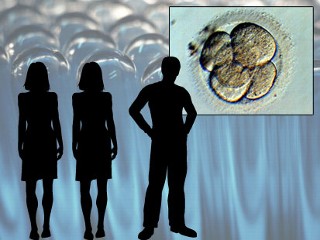
Three Parent Babies (no you did not misread this)

Members of Parliament in England are set to vote to amend the Human Fertilisation and Embryology Act of 2008 to allow for three parent babies.  If they do, England will become the first country to allow the creation of "three-parent babies". Many voices from the scientific community are urging a yes vote, but the issue is not without its detractors.  Opponents insist the technology is not ready. This is about mitochondrial replacement. Originally conceived as a means to prevent diseases caused by mutations in the mitochondria, the technique  uses donor mitochondria to replace the faulty ones. The "three-parent" short hand is from the fact that because mitochondria have their own genomes, the child ends up with genes from three people.

Proponents argue the name is not only misleading but inflammatory: mitochondria and their genomes are purely functional, limited to producing energy and exerting no influence on appearance, personality, intelligence or other human attributes that we value.  Some in the scientific community believe we may have seriously underestimated the influence that mitochondria have. New research suggests that they play a far greater role in some of the most important features of human life than first thought.  

The whole issue raises an ethically troubling prospect – that children conceived in this way will inherit vital traits from three parents.  In August 1996, at St. Barnabas Medical Center in Livingston, N.J., a 39-year-old mechanical engineer from Pittsburgh became pregnant after trying for almost seven years to conceive a child through in vitro fertilization. She agreed to a very experimental procedure in which doctors extracted her eggs, slid a needle into them, injected her husband’s sperm, and also included a small amount of cytoplasm from another woman’s egg to assist the viability of the conception.  What some have hailed as the next advance in the rapidly changing world of reproductive technology, some have deemed the root of an exciting medical advance and others say is the beginning of the end of the human species.

A year ago, US health officials began weighing the approval of limited trials of  this technique using DNA from three people in an attempt to prevent illnesses like muscular dystrophy and respiratory problems. The proposed treatment would allow a woman to have a baby without passing on diseases of the mitochondria, the "powerhouses" that drive cells. Some are warning the procedure is "not without its risks, but others insist it's treating a disease. Preventing a disease that can be passed down for generations would be ethical as long as it is safe. 

Once more we face a challenge in which the seeming benefits of such an advance in technology seem hard to deny yet there is a lingering fear among most Christians that this is not simply a treatment for disease but represents one more attempt to manipulate and control the process of conception and to treat the issue of life's beginning (middle and ending) as something best left to the experts and not something subject to the ordinary constraints of morality.  In other words, if we can do it and we promise to do it well, who can disagree?  The water over the dam of technology running ahead of our morality is well attested in modern society.  What is curiously unique is that at the same time we seem to be working to make it possible for the infertile to conceive and those prone to genetic illness to conceive without passing down the disease, we are also marching further and further ahead on the routine and ethically neutral ending the life of the unborn, physician assisted suicide of young and old, and the compassionate ending of the life of those who consume too much of our health care budget or whose lives are no longer deemed "worth living" by those who sit in judgment over us.  What a convoluted and soiled trail of logic and a perverted use of our technological ability.  God must save us from ourselves even before He must rescue us from the devil.  Kyrie eleison.

Tuesday, February 10, 2015

We don't want tradition. . .

In 1916 Henry Ford said this: “I wouldn’t give a nickel for all the history in the world. It means nothing to me. History is more or less bunk. It’s tradition. We don’t want tradition. We want to live in the present, and the only history that’s worth a tinker’s damn is the history we make today.”

I had not realized it until now but it seems Ford was not only a prophet with regard to the automobile and to modern manufacturing techniques, he was a prophet of modern Christianity.  For surely much of modern Christianity lives to oppose or ignore what the Church and those saints before the present moment believed, confessed, and taught.  The church today is more likely to listen to culture, public opinion, and the heart than to the voice of the saints.  The sacred deposit once handed down to the saints has been traded in for a flashy new model; the old has been relegated to the flea market or second hand store for those who are hopelessly out of sync with our present mindset.

We have looked at Scripture and decided it is at best a moral word encouraging us to be better people than we are.  We have looked at its story of creation and decided it is no longer credible in this scientific age.  We have looked at the relationship between male and female and decided that Scripture and tradition were wrong and feminism is right.  We have looked at life and decided there are no absolute values to life -- not to the unborn, not to those who despair of living, and not to those who are a financial or logistical burden to us.  We have looked at morality and decided that the most immoral thing is to deny yourself for any reason or cause (including to follow Jesus) and rendered every moral stand that would restrain our freedom to what whatever seems right in our own eyes and without any guilt suspect.  We have ended up with a church and a faith that is only shallowly rooted in history but it surely wide enough to encompass any and every opinion about Jesus, gender, sex, history, and science -- every opinion, that is, except that which is orthodox, Christian, and traditional.

I once sighed in frustration about a church I served that every year we had to vote on whether or not we would observe Christmas.  My point was that we eschewed tradition and seemed intent on re-inventing ourselves and everything we believed or did over and over again.  Little did I know that this would become a modern Christian epidemic.

“Tradition means giving votes to the most obscure of all classes, our ancestors. It is the democracy of the dead. Tradition refuses to submit to that arrogant oligarchy who merely happen to be walking around.”  So said G. K. Chesterton in  Orthodoxy, 1908.  It sounds positively old fashioned now.  Who would speak like this today!  Or consider the late Jaroslav Pelikan's famous quip: “Tradition is the living faith of the dead; traditionalism is the dead faith of the living.”  Could it be that Pelikan's prophecy is true?  Have we abandoned the living faith of the dead to be content with the dead faith of living?  Or what about McMillan's famous line:  "Tradition does not mean that the living are dead, it means that the dead are living."  Surely we are not ready to declare the dead dead... or are we?  Remember that by saying The God of Abraham, Isaac, and Jacob the Old Testament and the Jews were affirming their faith in the resurrection and in the ongoing life with God their ancestors enjoyed and for which they lived in blessed anticipation.

I have not even begun to quote the many famous quotes on tradition.  Perhaps there was a time when tradition gave veto to the dead but today it is more likely that we no longer give the dead even a voice.  We love nostalgia -- give us Antique Roadshow or American Pickers or Restoration shows featuring everything from soda machines to cars.  We love such things but we tend to see them more as cute and quaint than authoritative.  So when it comes to Scripture, we read a book whose wisdom must be silenced when it conflicts with our modern values and its stories read with a grain of salt when they contradict our modern scientific assumptions about life.  And when it comes to liturgy and worship, tradition is but an affectation or peccadillo -- sort of like those who enjoy watching Downton Abbey or other BBC shows (old or new).   Maybe Ford had us right all along -- we don't want tradition.  Not Americans, not Christians, and not Lutherans. . .  sad, really, but somewhat predictable.

I once knew a fellow who had an old car.  It was not a classic, just old.  It was not a collectible -- just old.  It was not vintage -- just old.  Nope, just old.  That is pretty much how many of us Christians view tradition.  So, like Ford, we will give the saints a pass and view them from a distance while ever defining anew the age old faith of Jesus Christ.  Perhaps we will not miss what we no longer know.... or maybe God will issue a wake up call...

Monday, February 9, 2015

Fighting the heart with the head. . .

Teaching the head has nothing to do with changing the emotion of the heart. . .  It was a genius statement by Pr. Harvey Mozolak.  He wrote it on a forum in reference to a person having an emotional antagonism to saying the word catholic in the creed.  It is certainly that.  Lutherans who do not like the word catholic are not stupid.  They can be taught the history, the fact that Lutherans did not originate the substitution of Christian for catholic, that they were meant to be synonyms and not to contrast one with the other, and that what we mean when we say Christian today is not really at all what the creed meant when it said catholic.  But that teaching of the head has nothing to do with the changing of the emotion of the heart.

Lutherans are not stupid.  They see in LSB that chanting notes were provided the pastor (as in LW but published separately in TLH).  They understand the history and can appreciate Luther's own words directing how portions of the service ought to be chanted.  In their hearts, however, is the god of preference and a pervasive bigotry against things presumed ROMAN and they resist the chanting like a horse resists his first bridle.  That teaching of the head has nothing to do with the changing of the emotion of the heart.

Lutherans are not stupid.  They see the difference between the great words of witness and confession in the Lutheran chorales and in the hymnody that mirrors this Gospel story telling perspective but their hearts are drawn to soft rock like bees to honey (pollen?).  It does not matter what is explained, their god of preference that lives in their hearts wants to hear what they want to hear and so they come up with reasons (evangelism, outreach, youth, etc...) to shut the hymnal, look up at the praise band, and sing the words on the screen to a song the Lord gave to some evangelical praise leader but have now been copyrighted and so they are not free to use.  That teaching of the head has nothing to do with the changing of the emotion of the heart.

Lutherans are not stupid.  They can read the Augustana and they know that Lutherans have Holy Communion every Sunday (Lord's Day) and every other day when people desire to receive it.  They know this is expectation of our Confessions but they like having shorter services, their piety is formed from and shaped by something other than the Sacrament of the Altar, and their quest for variety (the spice of life) and the god of preference intervenes to by-pass what they know with what they want.  As one person put it to me, "Pastor, I am not saying you are wrong about this being Lutheran, I am saying I really don't like it."  That teaching of the head has nothing to do with the changing of the emotion of the heart.

Lutherans are not stupid.  They understand what Jesus said about the little ones who believe in Me and they read about baptism in Paul's letters.  They know that baptismal piety is a hallmark of Lutheranism but they feel like this is overstated.  Kids ought to know, understand, and consent to the faith before they are initiated into it... baptism is like your first sex, you do it and move on... you have to feel something in your heart for it to be true...  -- just a few of things people have actually said to me about baptism.  We teach it, preach it, talk about it, return to it for hope in illness and death, etc... but that teaching of the head has nothing to do with the changing of the emotion of the heart.

I could go on... but really what I am saying is that confessional Lutheranism is not about the head.  I think we got it down there.  It is a battle for the heart -- against the god of preference, against the relativism of the modern age, against the bias toward feeling over truth for certainty, and against the longing to feel like an evangelical in a Lutheran setting...  We don't need new confessions or even more convention resolutions or more books. . . we have plenty (well, not really enough for a book lover like myself, but...).  What we lack is the will to control the heart, to rein in the god of feelings running out of control, and to cling to the objective truth over the subjective warm and fuzzy of the heart.  We are not there yet.  In the LCMS we are closer to sticking our necks out and stepping outside the mainstream of culture and cultural Christianity but we are not convinced enough by the head to overrule the heart.  Not by a long shot.

Maybe we will never win... maybe this is the meaning of lifelong repentance????  Jesus said it best.  All kinds of evil proceeds from the heart.  We don't have to learn it from TV or school or even parents.  The problems proceed from the heart and we dare not return to the heart for assurance of our forgiveness or salvation.  As tempting as it is, our hope lies with the teaching of the head.  Don't get me wrong -- we ought to feel things but the informed mind ought to tell us where to go for the source of our passion and what it is that endures forever and does not change (like the feelings of the heart).

Way to go, Harvey!  You hit on a genius statement!  God bless you.

Sunday, February 8, 2015

Whose business. . .

Everyone a minister and everyone a ministry. . . or at least that was the thought of it in the 1970s and 1980s.  Pastors were told to help people find their place (ministry) and their gifts (to minister).  So many of us in many congregations strained to discern what the unique ministry was for each of us and how we might live that out in the parish. Suddenly everyone in every congregation had a vocation -- one far more personal and specific than the baptismal vocation of worship, witness, prayer, and service. “Equipping the saints for ministry” (from Ephesians 4) became a slogan for an American Christian vision of how to structure the parish and how to get things done.  It was, after all, in the interest of the the business of the parish to be effective and efficient. But what is the business of the Church?  And whose business is it?

Every pastor has wished for a secret method to get people to step up to the plate and serve.  Whether in finance areas or teaching Sunday school or heading up a pot luck, the congregation is an engine that depends upon people sharing responsibilities and tasks. Enter the gift of the charismatic movement and neo-pentecostalism:  the spiritual gifts inventory.  Instead of recruiting people for tasks, here the appeal is to spiritual gifts -- discerned, recognized, and utilized in such a way that it promises relief from the ever present seeking of volunteers.

The idea of spiritual gifts has gone mainstream and is no longer associated with its origins in the charismatic and pentecostal movements.  It has become the promise of a Biblical alternative to the seeking of people for necessary tasks and jobs in the congregation.  But it is?

I wonder if any writing of an Apostle been more confused, abused, and misused than the contemporary treatment of spiritual gifts. From a letter to a divided, troubled, and error prone Corinthian congregation, St. Paul issued a plea for unity that would bring together factions and fragments in a cause for a higher way.  Yet this has become a blueprint for parish management, an entrance for a psychology of self-identity and self-esteem, and the cause to mirror managerial science within the work of the congregation. Gifts and talents are all the rage and surveys have replaced the task of recruiting and training lay volunteers for essential parish tasks and responsibilities. I must admit I am suspicious of it all.

Is this the "still more excellent way" that the Apostle had in mind when he wrote to the Corinthians (after an excursus on the gifts of the Spirit). I have used such tools in the past but found them no less likely to result in the rejection of the needs and call to serve.  In one such instance, a person who was a gifted teacher insisted that she could not teach in Sunday school because her "charism" was leadership, not teaching.  Worse than a mere "no" was the cloaking of this "no" in the most spiritual of language that made it seem as if God were saying "no" instead of the woman!

It seems to me that spiritual gifts inventories and programs focus more attention on the individual instead of less and that is troubling to me.  Instead of the work of the kingdom, the center of it all is the individual and his or her spiritual gifts.  Instead of the good of the body and its edification, the goal tends to be either finding a place for the person to exercise his or her gift in the parish or to find the gifted one to fit the need and give them the venue in which to shine.  Perhaps I am all wet.  I have often been accused of it.  But this is hardly a panacea to counter the ongoing and difficult problem of finding people to serve where needed in the parish.

In the end the spotlight is on our business instead of His.  While this is certainly the weakness in every recruitment tool or methodology, it is a real challenge when everything is covered with a veneer of spirituality that trumps everything else.  It would seem to me that we have lost perspective of the need for us all to be about our Father's business -- whether or not it is appealing, convenient, or comfortable.  The cause is bearing the cross and some of this cross bearing happens when we take up the work and works that must be done to ensure that the local community of faith endures.  

That is not to say that everything a congregation does is all that important.  It is not.  In fact, a hundred years ago would have found the church building dark and empty except for worship (and absent all the other rooms and space that we have come to cherish -- fellowship halls, parlors, gymnasiums, etc...).  The things of the congregation still happened but they happened in the homes of the members (LWML meetings, counseling, Bible studies, etc...).  Was this better or worse than the situation today?  I do not know.  But we are all in search of a successful methodology to fill the jobs that we have deemed necessary to the survival of a modern day congregation . . . and I am not sure we have done the Apostle good service by turning his words on spiritual gifts into just such a program.  And, in fact, I am greatly troubled by the way that these agendas have stolen the spotlight from the real work of Word and Sacrament, especially confession and absolution, in the life of the baptized and the parish.


Saturday, February 7, 2015

The most important day of my life. . .

Writing of Pope John Paul II in Witness to Hope, George Wiegel describes the day when the pope returned to his home parish in Wadowice during his monumental return to Poland as Pope in June of 1979. As he entered the church where he had served Mass, received the scapular, and prayed daily during his youth, the 264th Bishop of Rome went straight to the chapel that housed the baptismal font and venerated the place where he had been “born again” in 1920. Why? Because Karol Wojtyla knew that that day was the most important day of his life. . .

One of Lutheranism's greatest gifts to Christianity has been a vigorous and robust baptismal piety.  At least in theology, Lutherans speak most forcefully of God's action in baptism and of the consequential vocation that results from that baptismal miracle of water and the Word.  I remain constantly impressed with the vitality of Lutheran baptismal theology, piety, and devotion.  Even those outside Lutheranism have noted this.  David Schutz once observed:  In addition, modern conservative Lutheranism has developed a quite startlingly strong spirituality of baptism (almost equivalent in emphasis to the spirituality of the Eucharist in the Catholic Church). I take that as a compliment and an astute one at that.

That said, the theory is better than the practice.  I am constantly amazed at those who have no clue to the date of their baptism or the place.  In my catechism class it is one of the first assignments given to the youth -- find out when and where you were baptized and who your sponsors are.  It is not unusual for them to return without a clue because mom or dad did not recall and their certificate is buried somewhere -- ostensibly for safe keeping.  Because of this, we now give out a baptismal banner to those baptized here so that the date, at least, can be recalled from the banner that hangs upon their wall.

Though some complain Lutherans make too much of baptism, I fear it is too little.  Too little in regular practice and piety or else we just might remember the date, the place, and those who stood as our sponsors. Baptism IS the most important day of my life.  This is no slight to my wife and the day we were married or my children and the days they were born.  In fact, it is because of this that my children remain active Lutheran Christians to this present day.  A vigorous baptismal piety is one of the keys to retaining our youth in the faith and in the church.

Every time I return to my home parish, I see the font where I was baptized, where my father was baptized before me, and where two of my children were baptized.  It is the place where my faith was born, literally.  I only wish that most of my people felt the same way.  I fear that many of them consider baptism peripheral to their faith and life in Christ and this is a tragedy of great proportions.

Our quest for assurance (more Calvinistic than Lutheran, to be sure) has become a treasure hunt for the right feelings or the right attitude or the right knowledge or the moment of decision.  As good as each of these are, they offer us nothing of the security we long for.  For that we must turn to Him who changes not, whose Word endures forever, and who keeps His promises without fail.  That is what we encounter in the water of baptism.  There is Christ and His cross.  There is the embrace of the Father and the gift of the Spirit.  There is the killing of what was already dead and the new birth of that which none of us could make alive.  There is the past event whose continuing significance and blessing forever shapes our Christian identities and lives.

On the Baptism of our Lord we baptized a young man into Christ and then nearly 300 of us passed by the font to dip our fingers into the water, make the sign of the cross, and affirm this life changing event, I am baptized!  I am on a one man crusade to pull baptismal fonts from the corners and into the entrance of the nave and to fill them with water ALL THE TIME so that this annual moment might become a regular remembrance and thanksgiving of our baptisms into Christ.  Reclaim it for yourself, instill it for your children, and witness it for your neighbors -- the most important day of my life was my baptism into Christ!

Friday, February 6, 2015

With Authority. . .

Sermon for Epiphany 4B, preached on Sunday, February 1, 2015.

    In the Gospel for today we hear how Jesus preached and taught with authority.  He spoke with the authority of the Word – not as one who must learn that Word first, but as the one who wrote them.  He shows His authority over demons – not with the force of might but with His righteousness.  He ruled the wind and the wave – not as some display of raw power but as the One to whom the wind and wave must answer.  But nowhere is His authority more pronounced than when our Lord forgives sins.  Every other authority led the people around Him to marvel but the authority to forgive sins was too much for them.
    The word authority here is εχουσια.  It is an authority unlike the people of God had ever known or experienced before.  Jesus addressed matters of faith and life very differently than the teachers of old or even the prophets.  It was not that He was a good teacher or a good wordsmith or a good preacher – His authority drew from His very self – the Word of God made flesh.  This is the authority of weight, of right, of domain.
    In a worldly sense, authority is power – the ability to enforce your words with actions that compel people to pay attention to you and obey you.  Jesus appears to have little power in this sense of authority.  He comes to suffer and die.  He is the victim, the sacrificial offering.  His authority is manifested not in making people serve Him but in serving the world with His righteous life, faithful service, obedient and sacrificial death.
    Jesus refuses the sword of the world.  He insists to Pilate that His kingdom is not of this world.  He tells Peter to put away his weapon.  It will not be brought about or sustained by armies, weapons, and fear.  His sword is His Word.  He speaks and it is done.  That was the way all things came to be in creation and now He lays down the script for what is to come at Calvary and the empty tomb.  He keeps His Word; its truth is sufficient for all people and for all time.
    What is new about this authority is it is not derived.  Almost all authority on earth is derived from someone or something.  But not Jesus.  He IS the Word made flesh.  He incarnates what He is come to say and do.  He is the flesh around the words that people spoke for Him and of Him in the past.  He is still the Word that speaks even when He borrows our own voices.
    His power is not the threat that compels in fear but the promise that delivers what it says.  Here is the surprise of grace.  Where people had become accustomed to seeing God as a potentate who rules like earthly rules, Jesus shows the power of mercy.  He manifests a greater power than every earthly form in the grace that gives to the undeserving God's everlasting favor.
    Jesus does not manipulate language.  He does not lie, He does not shade the truth, rather, He is the way, the truth, and the life.  We too often presume that Jesus authority lies in His ability to inspire but He is not come to inspire us.  He is come to save us, quite apart from either our request or our desire.  He does so even though this salvation comes at the cost of His very life give up to the suffering and death of the cross.
    In the Church we tire of all of this.  We want power, raw power, earthly power.  Pastors, too.  We grow weary of the authority of love and long to exercise worldly authority.  But Jesus will have none of it.  It will not be as it is in the world where people lord it over one another for personal gain.  Jesus has given His Church a very different authority the likes of which the world has never seen before.
    This authority is cross shaped.  It speaks the new vocabulary of grace.  It is the Word that does what it says.  It is in people who confess it with words and live it in actions.  It is messy and slow and the world laughs at this authority and calls it weakness.  Heaven and earth will pass away but not the works of those who wield the Word of the Lord nor the actions of those who serve others in His name.  In the end it is about forgiveness – stealing the domain of sin and its death from a people who have lived in its shadow so long they think its natural.
    Jesus has authority.  He has placed His authority in His Word.  He has placed His Word in our hearts and minds by the power of the Holy Spirit.  His Word is efficacious – it has the Spirit in it and working through it –so that it does exactly what it says.  It delivers us from guilt.  It forgives our sins.  It calls out our demons.  It stills the storms of life.  And it does so with the force of grace.  And where we will exercise this authority, the Kingdom of God will come... He whose Word it is has promised us this, today, tomorrow, and forever.  Amen.

Singing the Psalms IS Praying the Psalms

I think you may recall my commendation of a Psalter edition published by Crossway and featuring the Psalms according to the ESV translation. . . now you can purchase a Psalter with Psalm tones and Psalm prayers and it is done in usual fine fashion by our own Concordia Publishing House.

I quote Chaplain Will Weedon's description of the book:
* The wording matches the ESV version that was used in Lutheran Service Book.
* Suggested Psalm tones are PRINTED before each Psalm (first a tone from LSB, second a newer tone but following the same three syllable pattern) and these tones "match" the thought of the words of the Psalm. Twenty-two tones are provided total, and some of the new ones are particularly fine (I think my favorite thus far is tone 8 (by Dr. Kosche).
* Longish Psalms are divided into parts for easier praying.
* Psalm prayers follow each Psalm (or part) that focus on a Christological understanding of what has just been prayed.
* Three charts for praying the Psalms are included in the front of the volume covering the Psalter either in a month or in a two-week period. 
* Two-part tones are not neglected (the book supplies six of them total), and no guessing if the two-part will come out even on a Psalm anymore: they are printed only on Psalms they actually work on!
 CPH has the book for order here. . . and a Sampler in PDF form here. . .

So whether you are looking for a Psalter for individual devotional use, for use in the pews, or for small group or family use, this is the book for you.  I am very impressed and I believe you will be also!

Thursday, February 5, 2015

No laptops, tablets. or smart phones here. . .

I do not often repost an entire column from another source.  This is one I think worth passing on.  The sad truth is that electronic media have become not only a staple of the classroom, but, some would argue, a necessity.  Balderdash.  They are not an improvement upon the old fashioned form of written notes and faces pointed in the direction of the professor.  By extension I would apply this same point of view to those who think screens, smart media, social media, etc... are the saviors of a church that seeks to reach people via Sunday morning.  I know of little benefit from the people head down and attentive to a screen and I know of little benefit from the pastor leading from it or using them on the wall.  The technology is marvelous, to be sure, but its application must be judicious and it does not work nor belong in worship (or the classroom, as this professor suggests).  Well, there I go. . . showing my age and curmudgeonliness again.

Read on. . .  by Mark Bauerlein writing in First Things:


I disallow laptops in my classroom. No screens, only books, paper, and pencil. The obvious reason is the distraction factor. Stand in the back of a classroom of fifty-plus students, survey the dozens of screens propped open, and count how many show social media, pictures, text messages . . .
That’s one reason why, when I announce the laptop ban on the first day of class, several students nod in relief. They find nothing more annoying than having their eyes drawn to the screens of the mates in front or beside them. If a movie is playing, they can’t help but glimpse the action and lose track of class content.
Here is a study that uncovers a deeper problem with laptop use. (The link is contained in the news story, but you’ll have to use your academic password to get access to the full report in Psychological Science, June 2014.) Even when students pay attention and take notes on the keyboard, their learning suffers. Or rather, they understand and retain the material less effectively than they do when they take notes by hand.

In the study, longhand and laptop note-takers performed equally well on factual-recall questions, but on “conceptual-application” questions, “laptop participants performed significantly worse than longhand participants.” This was true in spite of the fact that laptop note-takers composed many more words than longhanders did (though, within each group added volume correlated with higher scores).
The difference comes down to “the manner and quality of note-taking,” the researchers state. Typing quickly on a keyboard involves “shallower processing” than writing by hand. Handwriting is slower and more laborious than typing, and so a student has to be more selective about what to record. Because the speed of longhand is lower than the speed of presentation, the student also must condense and summarize, thereby initiating a process of comprehension in the very act of taking notes. In fact, the closer a student came to a verbatim rendition of the teacher’s presentation, the lower he scored on the test.

This is further evidence in favor of the old way of doing things, and so I encourage the teachers reading this to adopt the “no-screen” pedagogy. Yes, it’s counter-cultural, and some of the students will resent it because it means more work. But a little more pain will bring them more gain at exam time.

Wednesday, February 4, 2015

The distance between Christian and Lutheran. . .

I have had several interesting discussions (individual, small group, and even within the Circuit) in which a question came up on how much distance there is between Christian and Lutheran.  I have to admit that I had not thought much about it until that point.  After the discussions it seems that there are a couple of answers to the problem.

One would insist that Christian is foremost and first and Lutheran secondary.  In it as if Christian were the major identification and Lutheran a sub-category.  So the idea here is that Christian is the identity that counts (it saves) and Lutheran is a personal preference (one of many preferences here -- most of them being equally valid and effective).  Lutheran is a step down from Christian.

Another would say that to be Christian is to be Lutheran (even if the person does not know it yet).  This would insist that Lutheran is the only authentic shape or form of a Christian.  It is not far from saying that in order to be saved you must be Lutheran.  Lutheran is a step up from Christian.

I suppose there are also those who would say that they are mutually exclusive terms.  Those who think that one cannot be Lutheran and Christian or Christian and Lutheran -- one can and should only be Christian.  There were none of these folks in my conversations.

Before these conversations,I had never conceived of any distance between the two.  A Lutheran is a Christian and, if I am honest, I would admit that Lutheran is the best form of Christianity.  I am not a Lutheran first and a Christian second -- I am a Christian by being a Lutheran, being the best Lutheran I can be.  There is no distance between Christian and Lutheran.  If there is, we are in big trouble.

When I identify myself as a Lutheran, I am identifying myself as a Christian, as a Christian who believes the Scriptures are the Word of God and His living voice that spoke and all things came to be, that spoke to keep hope alive over generation after generation, and who became flesh so that my sins are forgiven and I am reconciled to my Heavenly Father.  When I identify myself as a Lutheran, I am identifying myself as a baptized child of God who was raised up out of that water filled with the Spirit, with forgiveness, with new life, and marked as God's own being readied for the place He has prepared for me in eternity.  When I identify myself as a Lutheran, I am identifying myself as one whose new life is nurtured and nourished upon nothing less than the flesh of Christ for the life of the world and the cup of His blood which cleanses us from all sin.

Frankly, I do not think it is enough to say "Christian" in an age when that word has come to mean something so broad and vague.  To say "Lutheran Christian" is both to connect faith to a written expression (the Confessions) and to a community of people gathered around the Word and Sacraments.  Ultimately this is the issue.  Can one become Christian and remain Christian apart from life within the community where the Word and Table of the Lord are source and summit?  Yes, I suppose it is theoretically possible but it is surely not what God intended nor is it a benefit to the individual to live outside the means of grace.   Quite the opposite, it is nearly a major uphill battle to remain in faith while living apart from the Word and Table of our Lord.  Ask anyone who has been forced to do this and they will admit the struggle.

Are we doing the Lord or the person any favors by bringing them to Christ (or bringing Christ to them) without connecting them to an altar, pulpit, and font?  I don't think so.  The Christian marketplace is ripe with seductive, emotive, and false forms of the Gospel that will only destroy faith.  That is why Lutheran missions are about Lutheran congregations where those who hear the Gospel and believe may be fed and nourished upon the Word of God and the Table of the Lord.  That is why the Lutheran witness is not merely to the faith but to faith and life where the Eucharist is source and summit of living out of the baptismal life.  To do any less is not merely institutional folly but the failure to be the witnesses we were called to be.  

Tuesday, February 3, 2015

I must admit I have never met a liturgical dance I liked. . .

Sent to me recently, via Fr. Z, I think.  Anyway it is a classic example of many things.  First, it is really bad liturgical design in the chancel.  The back walls appear to be poured concrete, the floor bare concrete, the altar a strange shaped lump of concrete with a couple of holes in it, and the ambo made out of some sort of stone (or poured concrete to look like stone), with an overgrown and distracting planting off to the left (facing the altar), a crucifix hidden in the shadows, and a banner that seems an odd contrast to its surroundings. . . Then there are the dancers and their costumes. . . 'nough said there, don't want to get into too much trouble.  Finally there is the dance.  Why is it that David's impromptu dance before the Lord has become the script for modern liturgical ideas when an unbroken history of reverence is quickly discarded in favor of a circus atmosphere?  Oh, well. . . at least it did not happen in a Lutheran church. . . as if this were any real consolation. . .

Nope, I must admit that I have never met a liturgical dance I liked.  And still counting. . .


Monday, February 2, 2015

Morality defined by consent. . .

In the wake of Rolling Stone's creative story of gang rape at the University of Virginia, there have been any number of comments and commentators.  Sadly, there are those who truly wanted the story to be true, indeed, they have built their whole existence upon the premise of a rape epidemic.  Sadly, there are also those who insist that it is all women's fault for saying some nos that mean yes and some yeses that mean no.  Worst among the ideas is that unlikely consensus that what makes something moral is merely informed consent.  That is the tip of the iceberg that is waiting to sink the good ship of modern society.

Robert Reno put it this way in the February First Things, "by this way of thinking, it's okay for a guy to go to a party, meet a girl for the first time, and an hour later to have sexual intercourse with her -- as long as they both consent...."  Ah, that is indeed the issue.  Consent does not make a thing moral and lack of consent does not make it immoral.  But that is where our valueless society has left us -- the one remaining shred of decency left to us is the idea that as long as we do it knowingly and agreeably, that is all that matters.

When I was but a youth, I succumbed to one of those enticing ads for a record club (yeah, I know, nobody knows what a record or a record club is today).  Anyway, I got fourteen record albums of my choice free -- the hitch being I had to purchase so many per year at regular price until the obligation was fulfilled.  That was the part I had trouble with.  I could afford free but I could not afford $7 or $8 per album.  After the enrollment period matured I received a nice letter telling me how many albums I had to purchase and that I was already behind in my contractual agreement.  I tried to get them to cancel by saying I was underage.  Then my mom wised up, opened some of the correspondence before I got to the mail and paid my debt (taking the cost of it out of my hide).  My mom insisted the morality was not defined by age.  Somebody needs to wake up today and scream out that morality is also not defined by consent.

What danger await us by assigning all moral weight upon simple informed consent?  You name it.  Every kind of perverse, sadistic, masochistic, sinful, and deviant desire is suddenly legitimized by informed consent.  Pretty soon we will all wear body recorders so that we can get on record that he, she, or said "yes" no matter what kind of buyer's remorse erupted after the fact.  This is not much different than the idea to answer the problems of policing with a body camera!  Yet this is exactly where we are beginning to find ourselves.

Promiscuity is not rendered moral because there was no pregnancy or transmission of disease.  Sex is not made moral simply because everyone involved knew what they were doing and wanted to do it.  Right is not what we all agree it is nor is wrong when we all condemn.  Such a morality is too weak to stitch together the fabric of our society or repair the growing rips and tears of a broken community or nation.  We need more.  We need more than information or agreement.  We need something noble enough for us to aspire to and not something quick and easy enough for us to condescend to -- but where will this come from?

That which once united the diversity of America and Americans was a commonly held sense of right and wrong - one that was Judea-Christian, to be sure, but which also transcended the narrow boundaries of religion or ethnicity.  Without such commonly held values, we find ourselves desperately searching for some, any, rationale that will make sense of right and wrong.

This is why Christianity has a duty to remain in the public square.  Even if we will not win over any converts to the faith, faithfulness requires us to speak to what is right and wrong, to issue a call to clear moral thinking in our muddled world in which knowledge and consent are all that is required, and to help us rebuild a consensus and repair the divisions that threaten us at every turn.

This is why it is so urgent for Christians who are elected to lead on all levels do not leave either their brains or their faith at the door when they enter the halls of legislatures or justice.  Things will not be improved by ignoring what we believe, confess, and teach nor will they be rectified by reducing the whole idea of morality to a yes that is informed and a yes that means yes (at least for now). 

The consent that ends up in regret cannot be repaired with rules.  Christians have a means to deal with this.  It is confession and absolution.  This, too, is part of our public witness.  What some boy or boys should have known or some girl or girls should have made clearer is a fairy tale world in a world in which sex means everything, love means little, marriage is optional and non-essential, and children are valuable only if you can afford them or they can return something to you that you want.  There will always be regrets and most of them happen once the haze of booze or drugs or euphoria has left and we have only the horror of a memory. 

No, consent, no matter how informed, is hardly strong enough to carry the weight of our new morality.  It will leave us more broken, confused, and isolated than ever before.

Sunday, February 1, 2015

The presumption of life

From conception. . . in the womb. . . at birth. . .the same child. . . the same life. . . the same treasure. . . the same responsibility. . . the same gift. . . the same promise. . .


It's just not me. . .

So began a conversation with someone who is unhappy with the liturgical life of the parish I serve.  It's just not me. . .  Well, of course not.  It is not ME, either.  In fact, it is not about me -- any of us who think that worship ought to reflect our likes, preferences, personality, wants, or desires.  I honestly grow weary of addressing this topic but it seems like it is a never ending task.  So we had better bone up on the rationale given us by those who object to the liturgy, ceremonial, and music of worship that is the practical face of our Confessions on Sunday morning.

Once again we have the fallacy that the worship style of Lutheran congregation mirrors either the preferences and likes of the pastor or of the people in the pew.  I know that in my own parish there are those who would be more than happy if another pastor were to come along and ditch nearly every ceremony, ritual, or, what our Confessions call church usages that define us on Sunday morning.  These are foreign to them and alien to their personality and do not reflect their own likes or wants.  I understand.  It is a constant struggle against the curved in shape of self since the fall in which nearly everything is defined by likes, preferences, wants, and desires.  The worship of the congregation is just one of many things that gets tied up in this mess.

The people of past generations were in not less affected by the press of desire but lacked the opportunity.  In Europe, Lutheran worship was strictly regulated by the jurisdiction (what we might call district or diocese).  The people might have wanted to ditch Bach and the kirchenordnung of their church but they had no mechanism to do so.  Pastors and people were constrained in their freedom to follow the regulated order.  The unding in all of this was the freedom of a place where jurisdiction and regulation were absent.  Hence, America provided the place where the desire for worship to mirror personal preference would prosper.

Yet even in America this freedom was constrained.  Across America Lutherans were united in a common liturgy that reigned in much of that freedom and dampened the power of personal preference.  It is epitomized in the Common Service of 1888 that reigned supreme for more than four generations.  This constraint that kept Lutherans on the page was unraveled not so much by organized opposition to the liturgical form but by several things.  Lutherans looked over the fence to see what others were doing.  Technology afforded them the possibility of publishing their own liturgy locally.  Add this to the plate of the Boomer preoccupation with self and we unleashed the genie from the bottle that has left Lutheran worship a  what if more than a we believe, confess, and teach.

All of us instinctively react negatively to rules (sin's wonderful legacy) and this is surely a part of our refusal to abide by any rules or covenants of love (as some would describe our Synodical unity and surrender of some of our freedom).  So the pastor who comes along with the idea that our worship ought to mirror our Confessions is seen as a rule man of the law while the pastor who ditches hymnals, liturgies, and all boundaries is identified as a man of the gospel and of the spirit.  False identifications, to be sure, but effective and hard to shake.  Worse, however, is the commonly accepted idea that pastors pushing for liturgy and ceremony inherent to our Confessions are merely agitating for a personal preference -- in essence no different than the folks who don't want to worship to look like that.

Speaking personally, many people do not get me at all.  They think what I am doing is advancing my own personal preference when the reality is that my nature tells me to make worship about me, to lead worship like Jay Leno doing his monologue, and to use my leadership of worship to impress my people with my wit, personality, and wisdom.  In reality, the liturgy is their savior as well as mine.  The ceremonies of the liturgy draw attention not to me and my wants but to the truth confessed every Sunday morning.  The order of lectionary and church year require me to surrender my preferences for the larger counsel of God's Word and the time perspective of the kingdom rather than Larry Peters.

The folks who complain if I genuflect or chant or bow or kneel or whatever are the folks who would probably not be bothered at all if I showed up with a polo and khakis, sat on a bar stool, and regaled them with my wisdom, wit, and wonderful stories.  They mistakenly think that genuflecting or chanting or bowing or kneeling or vestments or whatever draws attention to ME when it does just the opposite.  They mistakenly think that me sans vestments and liturgy would make it more spiritual and less formal when all it would do is make it more about ME than about THEE.

It is just not me. . .  You bet it ain't.  And it better not be, either.  For as soon as finding a church becomes finding a good fit for me instead of where the Word of God is faithfully proclaimed, the creed faithfully confessed, and the liturgy faithfully prayed, we are in big trouble.  The only good fit that matters in church shopping is finding a place where the evangelical and catholic (always in every place at every time) faith is what defines who we are and what we do on Sunday morning.  The rest of it is as deep and significant as finding a restaurant.  But we are not searching for a place that feeds us what we like, we are searching for the place where God's food of Word and Sacrament are faithfully delivered for the present moment and as the foretaste of the Eternal Feast to come.  This is the Spirit's work; everything else is man's.  The Spirit leads us to a real destination.  Man's way is a dead end.

It is just not me. . .  And it is not ME either.  Don't forget it.

Saturday, January 31, 2015

Before fishers, fish. . .

Sermon for Epiphany 3B, preached on Sunday, January 25, 2015.

    How easy it is to jump to the call to be fishers of men – too easy – to begin with the fishing and forget that we were fish before we were fishers of men.  Before we were set apart for the work of the kingdom, we were the work of the kingdom.  We often assume that fishing for men is a matter of strategy, planning, and expertise.  We forget we were caught up on the net of Christ's Word and Sacraments.  We were the sought out of the Lord who made us His own before we were ever called to seek others out with His Word.  To forget this is to lose sight of who is at work in the fishing and how it works that God catches us up in the net of His grace.  More than this, it calms the fears of those who know not what to say to those who have not heard of Christ and what to do for those not yet of the Kingdom.
    Where are the fish?  Who of us does not know those without faith? Who do not get up and dress for church? Who are not found in worship on Sunday morning?  More than this, they are among our own households and kinfolk.  Think how God called you?  Was it through a stranger or was it through family and friends who surrounded you with the words of the Gospel and the witness of the cross every day?  God works through means and those means includes those who know Christ by faith.
    We also forget that the caught contribute nothing to the catching.  The fishers of men are not miracle workers but mere witnesses of the Gospel who speak of Jesus, so those who are caught are merely hearers through whom the Holy Spirit imparts faith.  The main thing in common for those caught and those catching is that it remains about Jesus.  It is God's work for us and God's work still when it happens through us.
    So what does it mean to be fishers of men?  It does not mean strategic planning or creative methodology.  It means we speak the Word of Christ where we are.  That seems a novelty in a world looking for success in how-to books that lay out the plan step by step but it is the actual way of God.  With those at home, those at work, and those in the neighborhoods where we live, we speak the Word of the Lord and God has promised to work.  Faith comes by hearing the Word of God and all God is asking of His people is that His Word be on our lips and visible in our lives.  Can we do that?  Can we not do that?
    We have come to believe that the net is something from us.  So we mistakenly assume that fishers of men have some special charisma or gift, know some special wisdom, or are special people.  Surely God cannot work through ordinary people!  Or can He?  And does He?  Pastors have no special gift other than a bit more learning about the Word of God. 
    Some folks around us may also excel in this area.  But God does not call those with a special knack; God equips those whom He calls.  He gives us His Word and His Word has the power of the Spirit in it – the guarantor who makes sure that this Word does what it says and delivers the results God designs.  Because this Word is our certainty and hope, we can believe that this Word will work with certainty and deliver the hope to those who have not heard it.
    The main thing in fishing for men is to remember that it is God's work and your main thing is to keep it His work.  For as surely as we begin to believe that we possess some special charisma or gift, have some special ability or skill, the fishing will become our domain instead of His.  The key to fishing is patience and trust.  Too often these are in short supply among pastors and the people of God.  We grow impatient and frustrated that God is not working according to our timetable or at our desired speed.  We want to control things, to direct them, to make them happen.  But the Spirit blows when and where it wills.  Or to put it another way, God moves in a mysterious way. 
    The key to fishing is not learning to think like the fish but patience and trust.  God has promised us that His Word will not return to Him empty handed but will accomplish His purpose.  Whether on Sunday morning as you look around a half empty church or Monday morning as you look around a broken family and life, our call remains the same. Trust in the Lord and be patient.  His Word is still working. . . in the parish and in us as people.
    Where the means of grace, the Word and the Sacraments are, God is still fishing.  Whether we hear that Word here on Sunday morning or speak it on Monday morning, God is the voice and the Spirit is the power.  And if we ever have trouble figuring it all out, we just need to look into the mirror.  Whom we see are fish, once lost, caught up in the net of grace, by the Spirit, and now sent forth in the world to be fishers of men.  Before we were fishers of men, we were fish.  The net that will capture the world for the kingdom is the same one that caught us – His Word and Sacraments.  It is enough for us to witness these means of grace with enthusiasm and joy, knowing that God is at work and will finish His new creation, and if our voices and examples have had any part in it, thanks be to God.
    Today we remember how St. Paul who hated Christians, persecuted the church, and even participated in the murder of those who confessed Jesus Christ became a Christian.  It was a dramatic journey to be sure but no longer and no different than the path that led us to faith through the preaching of the Gospel, the teaching of the faith, and the washing of water with the Word.  To the world living in darkness and the shadow of death, the witness of the Church is clear: "Repent and believe the Gospel."  We were once the pagans and heathen who knew nothing of God's grace and favor until that voice called to us.  Let us then with confidence address the world with the same call, trusting that God will work in it and through it as He promised and did for you and me.  "Repent and believe the Gospel."

A case for God?

So many Christians have surrendered the idea of a creation that in any way resembles the Genesis story that it seems foolishness to contend for God at all.  Our children are taught from early on that creation was merely a set of accidents that could likely have happened or still happen elsewhere and that evolution is the only reasonable explanation for what is.  Even Pope Francis appears to have consigned God to merely a prime mover in a movement that more or less conforms to the usual parameters of evolutionary theory.

So it was with interest I read an article one of my members slipped into my church mailbox.  Writing in the December 26, 2014, edition of The Wall Street Journal, Eric Metaxas suggests that it is science itself that making the case for God and intelligent design.  Whether this leads us closer to accepting the accounts of Genesis or not, it is a welcome perspective.

Metaxas recounts the 1996 Time magazine story asking if God is dead and a story the same year in which Carl Sagan indicated that the two criteria for a planet to support life were the right kind of star and a planet the right distance from that star.  With roughly an octillion planets, it would have seemed likely that a septillion of them just might be able to support life.  So the stage was set for us to look, listen, and wait.  More than 20 years have passed and what changed?  Well, for one thing, the number of factors necessary for life changed from 2 to more than 200 parameters.  In other words, the odds of finding another one are almost none and the very existence of earth and the life we find here illogical.

So who can account for it all?  Accident?  Random forces?  Or. . . more?  Now scientists are beginning to think that the parameters to support life happened not gradually but almost immediately after the proverbial "big bang".  Second, altar only one of the many values that must be fine tuned to explain what exists be even the tiniest of fractions (say, 1 in 1,00,000,000,000,000,000) and there would be no stars at all! 

Fred Hoyle, astronomer and coiner of the term "big bang",  is quoted as saying his atheism was greatly shaken at these developments.  Paul Davies, theoretical physicist, thinks that the appearance of design is overwhelming.  Oxford Professor John Lennox says that more we learn the more credible the existence of a Creator.

So it seems that life is not simply random at all but requires such a unique set of parameters that it is more reasonable to presume a creator than to assume it all happened randomly... Hmmmm. . . I am feeling a little smug right now. . . Are you?

Friday, January 30, 2015

It was read late but it was still appreciated. . .

Adriane Heins is a very talented woman and editor of The Lutheran Witness (and doing a bang up job!).  I only wish more Lutherans would cough up the paltry $14 a District subscription costs and enjoy the riches of that fine magazine every month!  [Speaking to those in my own parish, you still have time!!]

Adriane also has a fine blog and I had to repost something I finally read from that blog -- late, well after Christmas, but still greatly appreciated.  I know she puts in words the sentiments of many parishioners but it is awfully nice for a pastor to hear (or read) them -- especially after the busyness of a December filled with extra services, duties, sermons, and the sacrifice of a holy day spent with the parish instead of the family (like many folks expect).

thank you

For spending more hours than normal each week writing extra sermons,
For braving the children’s pageant where little Elizabeth will inevitably set her dress on fire,
For sacrificing time with your family each Wednesday or Thursday night,
For preaching about the same things every Advent and Christmas even though those of us in the pew should remember it by now,
For leading Christmas caroling at the nursing home because the piano player forgot to show up,
For going to bed late because an elder needed to talk to you after the Christmas Eve service and for being up again early on Christmas morning to unlock the church doors,
For never being able to travel to your parents’  home during Advent or Christmas or even New Years’ Eve or Day,
For being consistently tired during the month of December,
For picking faithful hymns for these seasons of the Church Year, knowing that we will hum them throughout the week,
For listening to us struggle and cry and mourn during “the most wonderful time of the year,”
For helping us watch and wait for Jesus’ second coming with repentance and joy,
and for pointing us to Christ at every turn,

thank you, pastors.

Thursday, January 29, 2015

Come and see. . .

Sermon for Epiphany 2B, preached on Sunday, January 18, 2015.

    We spend a lot of time telling people what is important to us, what we find funny, touching, entertaining, or meaningful. Our email boxes are filled with things passed on by others.  Half of the stuff we post on Facebook is this kind of stuff.  So when we talk of faith or invite people to Church we tend to talk in the same way – telling people what we have enjoyed about church, what touches us in church, or what has helped us.
    But not Philip.  Philip does not talk about what he liked about Jesus, how Jesus made him feel good, or how Jesus touched him.  Philip focused on the Word fulfilled in Him who kept the Law with all its demands and fulfilled the promise of the prophets.  Nathaniel was pretty blunt in saying he was not convinced (What good comes from Nazareth) but Philip did not argue with the skeptic.  He simply said, "Come and see for yourself. . . Him of whom the Law and prophets spoke...."
    That is what we often miss.  Religion is not an idea or a methodology or self-help wisdom or something to tweak our emotions.  We do not have faith in an idea but a Savior, the Son of God in flesh and blood.  There is no idea or feeling which can bear the heavy weight of the Law.  Certainly we cannot.  But Jesus can.  The Law lie in wait not for us to obey it but for Him who came to fulfill it.  There is the most radical of truths. 
    There is no idea which can live up to the blueprint laid out in the promise of the prophets.  Certainly we cannot.  But Jesus can.  The prophets' message was a script written for Him whom God would send to fulfill its every word and keep its every promise.  His life unfolded just as the prophets had said and this is our confidence, certainty, and assurance.  Christ the Word, keeps the Word.
    Jesus is a surprise.  Who comes from Nazareth?  Jesus is not what we expect and He may not even be close to what we want.  But how much of that matters.  Jesus is Him whom God has promised.  Before He was incarnate of the Virgin Mary by the Holy Spirit, the Word was fully promised – where He would be born, what He would do, and what it means for you and me. 
    Nathaniel was no harder nut to crack than the people we meet at work or on the street, or even more, the people in our families and among our friends.  But Philip does not argue or debate or testify to what Jesus meant to him.  No, he does some thing very different.  "Come and see for yourself. . . "
    Come and see. . . not a church or a program or an idea or something entertaining or meaningful.  No, come and meet the Savior enfleshed in Word and Sacrament for us.  He is the One who keeps the Law we cannot keep and fulfills every word and promise of the prophets.  Philip could not point to the miracles – they had not yet happened.  He could not point to the cross – he had no idea what Christ would do. Not even the resurrection.
    Philip did not introduce Nathaniel to his Jesus but to the one who kept the Law and fulfilled the prophets' promise.  He had not yet seen any miracles nor had he even heard Jesus speak of the cross that was to come and the resurrection from the dead was the farthest thing from Philip's mind.  So what did Philip have to talk about at all?  "Come and see Him of whom the Law and Prophets spoke."  In other words, if you read the Scriptures they will point you to Christ.
    You know we have lowered the bar, lowered expectations.  We speak of good ideas or of words that tug at our heartstrings or something that was fun or entertaining.  We think of pastors instead of Christ, of worship we like instead of worship that delivers Jesus to us, and of things that fit us instead of the Savior who fits us for heaven.  It is no wonder the world is not all that impressed with our witness.
    We have settled for an idea or a feeling instead of the flesh and blood of Jesus.  Who God offers us is much more than this. Christ is the commandments have waited for to keep them and  Christ is the Messiah the prophets waited for to fulfill their words.  In the end, the miracles, the cross, and even the resurrection did not help the disciples – they terrified them.  But they stuck with Jesus as the one and only who kept the Law and fulfilled the promise.  That is our witness today.  That is our witness to the world.  "Lord, where can we go?  You have the words of eternal life..."  To this flesh and blood Savior, we invite the world.  "Come and see...."  Amen.

Time to pack up and go. . .

In an odd couple of paragraphs in a January 2015 article in The Lutheran, authored by the President of Lutheran Theological Seminary at Gettysburg, PA, we heard a story of what a bishop once asked of people as he installed their new pastor in their parish.  "When will the day come that you should urge your new pastor to leave and take another call?"

According to the author, the congregation was shocked at the question on such an occasion.  The bishop then answered his own question:  "You should ask her or him to leave when you realize you go home after worship every Sunday and find yourself in agreement with everything the pastor said in the sermon..."

For my part, I assume that nearly every pastor and every person in the pew hopes for such a day when there is true unity of faith and unanimity on the living out of that faith within the struggles and challenges of the world.  Apparently I was wrong. . .

According to the article, the point of the bishop's question was that the people should be continually stretched in new directions, that the point of the sermon is to not only to coax us to live outside our comfort zones but to thrive there.  I get the point.  But it worries me still.

The premise of the sermon is not to be prophetic, to ruffle feathers, to upset folks, but to preach faithfully God's Word, the whole counsel of the Law in all its accusatory sharpness and the Gospel in all its sweetness and comfort.  Yes, if we do this, it will unsettle both preacher and hearer for that is the way the Word works.  But this unsettling is not a matter of agreement or disagreement but the bite of the Word that calls the wayward to repentance, the sinner to confession, the complacent to witness and service, the suffering to patience and endurance, and the despairing to hope again.

Agreement and disagreement seems far too shallow a way of putting it.  In addition, it would seem today that people and pastors look for too many reasons to leave and not enough to stick it out for the long haul.  I hardly think that people should be appraised of the day when their pastor might be asked to leave -- ever -- but especially on the installation day.

Growth in faith and life in Christ is not a mere matter of agreement or disagreement but daily repentance and renewal -- which is unsettling enough.  Fresh perspectives are needed now and again but the freshness is hardly ever new and different but what do we believe, confess, and teach.  Indeed, the freshest perspective for the church, for the preacher, and for the hearer is always fidelity in a fast changing world.  I am amazed at how new faithfulness and orthodoxy is -- in confession as well as in practice.  If we endeavor to be faithful and orthodox in and out of the pulpit, the Lord will do the rest -- whether we agree with that or not.