Monday, November 14, 2022

The death of the Christian school. . .

One of the surest signs that Christian schools have lost their way is the inevitable job description for teachers and administrators.  So often the qualifications that count, those listed at the top, have to do with the alphabet soup of academic degrees and the appropriate buzz words of the moment that have to do with academic theory and practice.  Too often, anything distinctive to the Christian school and the Church comes way down at the bottom and is simply a presumption with the generic words of faith and practice taking the place of doctrine and witness.  Sadly, we seem to want teachers and administrators who have a private and quiet faith more than a vocal one.  Generally we do not even specify that the teacher or administrator attend worship.  

What is so dangerous is that everything else involved in the educational institution (from academic degrees to educational philosophy to state licensure to accreditation) is very detailed and the expectations of the candidate clearly identified.  That means that we are more interested in these than in the faith of the teacher or administrator and, therefore, the faith identity of the school itself.  It also means that we intend to offer the parent and the student a close version of public school education but with a twist.  We stick religion into the school the way somebody throws an olive or a twist into a martini -- as a garnish but not the essential ingredient.

It is as if we expect faith to be diluted and the identity of the school, administrator, faculty, and, therefore, students to be marginal at best.  God knows, nobody wants to sacrifice an education for the sake of faith (but we seem ready, willing, and able to sacrifice the faith for the sake of an education).  Faith is in the private life of the school staff, as we expect it to be in the lives of the students.  We expect it but we do not necessarily expect to see it.  It has become a self-fulfilling prophecy as parents wonder if parochial schools are worth the tuition cost and parishes question whether a school is worth the headache of financing and administering.

We say schools are not ideology zones (well, really, only conservatives say that and they are not only wrong, they are out maneuvered and our gunned).  The reality is that much of what passes for education today is purely ideology masquerading as an academic discipline.  With that ideology, comes outcomes as the minds of our youth are shaped by the world and for the world.  By tying our Christian schools to the educational systems that produce teachers and administrators and by ordering them along the lines of jurisdictions and accreditation agencies, we are also adopting their ideology -- while silencing the voice of our own faith!

If the Christian [Lutheran] school is to survive, we must be distinct and distinctively Christian -- in more than only chapel time.  We need to teach the faith at the same depth and with the same expectation of proficiency as we approach the rest of the curriculum -- and more!  We need to stop pursuing the approval of men and worry more about whether we are being found faithful by the Lord.  We may not want to call Christianity an ideology but our enemies will and all the while they are calling us out, they are effectively and efficiently shaping the hearts and minds and values of our children so that they will come out of this enterprise looking more like their teachers and less like their parents or their pastors.  For that reason, we have a problem.

Sunday, November 13, 2022

Filling the silences. . .

We all complain about how busy we are, how full our schedules are, and how weary we are trying to keep up with the pace of things.  But at the same time, we give into the temptation to fill all the silent moments of our lives with noise that is itself as taxing upon us as our busyness.  We all know the old axiom that we work at our play and play at our work but I fear it has been replaced with another evolution of the work/play axis.  We may not work all the time but we are on all the time -- tuned into the world through our digital devices and constantly pursuing the next best thing on our screens.  Sometimes it is work.  Sometimes it is boredom.  Sometimes it is play.  Sometimes it is distraction.  Even with the sound off, our screens are part of the noise of our busy and wearying lives.

We do this everywhere but also in the Church.  I know I am guilty of it.  We over schedule our buildings to justify their cost.  We over schedule our children in the hope that such distraction will keep them from being consumed by the world.  We over schedule worship with barely any moments of silence and those generally suspect or presumed to be accidental.  We don't know what to do with silence anymore.  We turn our devices in part because we have grown uncomfortable with the silence.  We have trouble turning off our screens even in worship because we fear something might be happening that we might need to know.  It is the noise that threatens our sanity every bit as much as the dizzying pace of our lives.  Together they form a significant part of the problem of peace and contentment -- even among Christians.

For years I tried and have pretty much given up the prospect of allowing even 30 seconds of silence after the sermon -- time to reflect and consider and wind down before we are abruptly moved on and the liturgy picks up the pace again.  The people complained about the silence.  Some felt it disrupted the natural pace -- a pace which was not naturally so busy but has now become normally busy.  Some did not know what to do with the silence -- a common complaint today.  Some just wanted church to get on and get over because they had plans for later.  In the end, we are all the poorer for filling in all the silences and creating noise to cover our discomfort with being alone or being alone with God (alone meaning being without the constant screen as well as people).

Do a survey of your own life and count the number of silent moments.  Add up how much and how little of the day is quiet.  And try to take a fast from your devices and from the media once in a while -- until that becomes something you are comfortable with and then make those media and device fasts more frequent and longer.  Your sanity and peace of mind will thank you for it.  And, by the way, if that means skipping reading this blog, then do it.  You don't need my permission but you have it.

Saturday, November 12, 2022

Life is not work?

If you read these pages, you already know that I struggle with the modern idea of retirement.  Add to that the quiet quitting that hits the news and the numbers no longer interested in being part of the work force but not yet retired, it makes for some head scratching.  A discussion with a colleague moved it into the realm of the Church when he said of me that I did not know how to do anything but work.  At first I demurred but then I admitted he was probably right.  Is that a bad thing?

Before the Fall in Eden, man was still created for work.  Work is not simply something we do until we do not do it anymore.  Work is what we were created for.  The character of that work changed radically after the rebellion of Adam and Even and the entrance of sin into God's created order.  To be sure, the nature of work before and after the Fall is not simply distinct but nearly opposite.  Man was created to be lord of creation, to manage what God had made for God's own purpose, and to be fruitful and multiply and fill the earth.  When sin changed things, it did not relieve man of his role as God's representative over all creation or his stewardship of the earth or his call to be fruitful and multiply and fill the earth.  Instead, the very things man was always to do now became a burdensome work.  Creation did not live together in a nice, neat pattern but everything was out of skew -- from the rain and storms to the animals.  The steward of the earth had to fight against the things he was created to manage and God's order was rejected in the world just as man had rejected it in Eden.  Being fruitful, multiplying, and filling the earth came at a cost -- the heavy burden of providing and protecting for the man and the pain of childbirth and the disappointment of the mother with the choices of the child as they grew up.  But we were meant for work -- always.

Now in a world consumed with the illusion of balance between self and family and leisure and work, we have been quick to label some of the work we were created for more burdensome than other work.  So we find ourselves at the junction of self and family in which more and more of our young people (even Christian ones) are not sure they want to work at a marriage or take responsibility for a family.  We invented nursing homes and assisted living so we would not be burdened by our parents and other relatives who needed help through the day (and night).  The balance between self and spouse and family seems to be rather tenuous at the moment as we claim more and more of the pie for ourselves.

Leisure is not merely a distraction or even a hobby.  It has become a life pursuit.  We spent great amounts of money and time on our hobbies and work so hard at them that we complain of needing a vacation from our vacation.  Could it be that this work has come to predominate?  Have we chosen to fulfill ourselves less with relationships (and even friendships) than with the activities of our leisure time?  We often seem more wedded to leisure than anything else -- even in families we schedule our kids to death with every kind of leisure activity we might want or wanted but could not have when we grew up.  What are we teaching them?

Work, however, is clearly the bad guy in all of this.  Work demands too much, does not reward enough, is not flexible enough to allow us to control our schedules, and requires us to do things we really do not want to do.  No wonder we dream of retirement when work is the one thing in our lives that can be jettisoned so that we can indulge ourselves in the other stuff.  But who decided that this was the grand state of the fully evolved human life?  Financially free to do nothing but the work we want to do -- does that sound a little self-centered and selfish to you?  We say we will use retirement to volunteer for good causes but only when that does not interfere with our hobbies, entertainment, travel, and personal time.  Love your neighbor, okay, but when it fits my timetable.  Some said that when they retire they would have time to volunteer at Church but it is just as difficult to engage the retired as it is the active workers in the work of the Church. How curious it is that men desire retirement but still expect someone (the wife maybe?) to cook, clean, wash clothes, and take care of the house (while the man mows the yard).  Some work has to continue.

Work is not simply a part of life since the Fall but always part of life.  It does not help to make work the bad guy.  Sure, we can gladly admit that often work is a pain but is that not due to sin and how it changed things?  If work is a pain, sin is to blame and, if sin is to blame, ultimately that cuts back upon us at some point.  The dreamy life of leisure, individual pursuit, and self-interest is itself a dream and a dangerous one.  I resist the idea that this is a godly dream and part of God's design.  In fact, I reject the whole idea of balance.  The Lord is not merely one of our pursuits or interests.  They all matter.  They all come from God -- work, spouse, family, care of the home, provision, protection, etc....  God does not give us a pass on work but the work changes with our abilities, to be sure.  No, the venue may be different but the work goes on and not because sin screwed it up for us but because this is how and why we were made by God.

Friday, November 11, 2022

Veterans Day Thoughts. . .

It used to be called Armistice Day -- the days when pens prevailed over guns and soldiers ended the fighting to begin rebuilding what had been torn down.  Though there are certainly winners and losers in wars, the sides come together in the aftermath of destruction to tend to the wounded, to remember the dead, to rebuild the neighborhoods and communities, to rebuild factories and economies, and to get back to what is the norm of human life and work.  Inevitably there is a baby boom following the signal of peace and the return home of the soldiers.  This is not merely due to the fact that those who were once gone have come home again but to the hope that it inevitable when the great sigh of victory and defeat give way to the promise of work, home, family, and future.

Sadly, we seem to live in an era when there is no armistice -- no signature of dignitaries to end the sound of violence and ease the threat against citizen and land.  Ours is an age of constant war and constant violence that seems to tear at the very fabric of our being.  We can hardly bear to listen to the news or read of the destruction that happens day in and day out somewhere near or far.  We long for the peace that was once the hallmark of this Veterans Day.  I hope it will come but I fear it will not be soon.  The weapons of our self-destruction have become hidden and the soldiers look like our neighbors and the battlefield moves from town to town and nation to nation.  I long for the kind of day this once was -- a day to end the war to end all wars and the dawn of a new era of peace.  In place of that the peace of God which surpasses understanding is the strength of those who look in vain for some sign that war and violence and oppression will pause.  Perhaps it is the mark of the times, the reflection of our self-destructive natures that the wounds do not heal and the pain does not ease.  If anything, we are driven even more fully into the arms of Him who gives peace not as the world gives.

I wrote these words a couple of years ago. . . now made even more significant to me in that my Dad is dead and the greatest generation is shrinking even more with each passing year:

My parents were at the end of that greatest generation who were called to sacrifice at home and to fight on beaches of death and rivers of blood across Europe and the Pacific.  I am forever indebted to their example of faithfulness, their giving spirit, and their sense of personal responsibility.  On this Veterans' Day I cannot but also honor those who follow them in service to country and in defense of liberty.  We can all debate the policies of those who sent them here and there but none of us can doubt or diminish the noble character of those who have heard the call and served faithfully.  All gave some... time from their lives, memories both to treasure and haunt them, images that they wished they had never seen but cannot be erased from their minds and hearts.  From the World Wars to the small locales of Southeast Asia, the Middle East, and Afghanistan, I honor them for their sacrificial service for me and all who call themselves Americans.  But some gave all.  From the celebrated Flanders fields and row upon row of white stones to the anonymous trenches in which the lost remains of soldiers lay still to the cemeteries dotted with flags across America and the veterans who are wheeled there, limp in pain, and walk the slow deliberate steps of age and wounds, we honor those who served us with their lives.


My father was a member of the American Legion for 70 and my mother a member of its Auxiliary for 72 years.  I still hear the sound of taps and recall the flag draped over his coffin -- solemnly folded and given to us from a grateful nation.  I have the same poignant memory of my father-in-law's funeral and the line of other veterans who solemnly made their way down the aisle of the church to stand at his coffin and salute.  This is not a day off of school but a day to teach our children the ancient rites of citizenship, memory, and patriotism.  Thank you, Dad, and all who served through wars just and causes questionable, displaying unwavering character and duty, these patriots...  Thank you, men and women who proudly still wear the uniform of our nation -- far from home and family...  Thank you for your service.  All gave some... some gave all... It seems so little but let me not forget to say, Thank you!

Thursday, November 10, 2022

Really

I find it extremely humorous that the same folks pressing such wonderfully useful majors as women's studies and gender studies are wondering how useful the liberal arts really are.  While it could provoke laughter, the statements are sad and pathetic descriptions of all that has become wrong with the educational enterprise today.  Ideology parades as scholarly discipline in the woke culture of academia but it is not a path of legitimate study.  Besides, as one wag put it, you can learn all you want about it on social media and you won't have to take out a student loan!  The liberal arts, on the other hand, while not specifically useful as on the job skills, are for the erudition, enlightenment, and encouragement of the best of our humanity.  Of course, the liberal arts can be a victim of the same woke mentality that has muddied the waters between what you want to believe and what is real, it does not have to be a pawn of the woke culture and should not be.

We spend all sorts of money and time on pursuits that are not practical.  Less than 1% of all those who spend money and time on youth sports will end up making them money as players of the sport but that has not deterred us from the pursuit of sports for our youth.  However, it is highly likely that plumbers sing in choirs and programmers read the works of the great authors and janitors appreciate fine art and take up painting than any of them might end up on a sports field.  Why would we presume that liberal arts, which may not directly equip one with a job skill, is somehow a distraction from the practicum of earning a living?  In case you have missed it, modern life exists without slaves bound to an occupation or a position in life without opportunity for anything else.  Instead, though we all work for a living, we are also free in our off time to pursue things that enrich us and our humanity.  

Of course, if there is to be a rebirth to the liberal arts, it may well have to begin somewhere outside the university or even the typical educational settings we find around us.  They are, shall we say, tainted by their need to provide for their own existence, running after donors and dollars, and keeping up with the pace of culture.  The worth and value of the liberal arts does not lie in their usefulness or practicality; their point lies rather with humanity and virtue and with being something more than our jobs.  If we have gotten to the point where we give value only to that which helps us earn a buck, we are no longer free at all and have become slaves to the practical that can be bartered or traded for the essential things of life that keep us alive but do little to enrich our humanity.

I will freely admit that the current crop of liberal arts colleges tend to shoot themselves in the foot, reaching past what is good, right, salutary, beautiful, and worthy for the same elusive self-expression that paints flesh as well as canvas and calls it fine art or turns up the volume on the speakers in the car at the stoplight and calls it good music.  Not everything that is good in our eyes is really good.  But that is exactly why we need liberal arts -- to help us point the way and sort the path between that which is common and that which is extraordinary.  Perhaps if we can get past our screens long enough to learn this, there is a chance that we can strive for something more than the common, the easy, and that which offers instant reward.  Just a thought....

Wednesday, November 9, 2022

So what. . .

I read something a few months ago that effectively said, stop trying to find out why people are not singing and start expecting everyone to sing.  Okay, it was not quite that blunt but you get the drift.  We seem preoccupied by the whys or why nots of life -  as if explanations answered everything.  Do we really want to know why people are not singing?  We already know that the chorus or glee club or choir is not a big part of school (elementary or high school).  We already know that music as a genre has moved from participation to performance.  We already know that the playlist has moved from the community to the individual.  I could go on about what we already know -- things that certainly might contribute to why folks are not singing.  What does that matter?  How are you going to change it?  Do you have the change the world in order to address singing in the Church?

Singing is your sacred duty.  Music was not created by God for our own purposes but for His glory.  It was not that long ago that most music was sacred -- one way or another.  Now sacred music is the exception rather than the rule.  We all know that.  But does that relieve us of the duty to use song to worship the Lord in the beauty of His holiness?  Are we given a pass on singing because we personally do not like it?  Is that how God operates?  He gives us something for one purpose, we distort that purpose and rob Him of what He created, and He shrugs His shoulders and says, Whatever?  

We do not sing because we are great solo voices or because it really makes our day.  We sing because God has given us something to sing about -- His sufficient grace to forgive our sins, rescue our lost lives, restore us to Himself, and redeem us for everlasting life.  That ought to be enough not only to inform what we sing but to get us to open our mouths and just do it.  If not, the problem does not lie with singing.

The sad and rather pathetic truth of it all is that church music has gone commercial on us.  It has become the domain of copyrights and money collected to the point where some would rather no one use their music than somebody gets by without paying.  Now I say this as one who firmly believes the composer is worthy of the money due him or her for the service they provide us.  But it has gotten out of hand.  As if that were not enough, we have turned worship music into a commercial enterprise for all the wannabe garage band members who think of church music as cover music by cover bands -- there to entertain and to make the music what they want it to be (all in the editing).   The Lord gave them the song but they will sue the pockets off you if you violate their copyright and they wrote it for the worship diva whose voice makes it sound oh so good and a congregation would just butcher it anyway.  I will admit that when I go to a concert, I pay big money for tickets to hear the artist sing and not the crowd around me or the "I think I am a diva" in front of me.  But worship is not a concert venue.  Most, if not all the music in worship is participatory by nature -- it is congregational song.

You don't like to sing?  So what.  Just do it.  You don't like the songs chosen?  So what.  Just do it.  Is that so hard?  I know that as a pastor it is frustrating to see lips closed and mouths not moving as we sing liturgy and hymns.  Can you imagine how God feels?  He gives us music, gives us something to sing about, and we are whining about what we want or what we don't want.  I am here to say, just do it.  Music may not be able nor was it ever intended to lead you into God's presence, but it can keep you there as you sing back to Him what He has first said and sung to us.  Just do it.  

When my mother lay dying, her pastor sat with her singing hymns and speaking Scripture.  Mom never had much of a voice and knew little about how to sing but she was literally sung into heaven by a good and faithful pastor.  When we did the commendation of the dying with her, her two sons joined their voices to this good pastor's own voice to sing her into heaven.  I am forever grateful for that good pastor and for his willingness to sit down with mom, sing the hymns she knew and loved even if she never sang them well.  And you think that God cannot use music?  Just sing the hymns and the liturgy, for Pete's sake.


Tuesday, November 8, 2022

I was not disobedient to the heavenly vision. . .

Even traditional and seemingly orthodox Christians get caught up in the idea and ideal of self-expression.  It has become the shibboleth of our time.  We believe, like the US Army once did, that God wants us to be all that we can be -- but unlike the US Army, we also believe that we get to define what all that we can be actually is.  We chafe against the discipline of discipleship.  We are scandalized by the scandal of life with boundaries.  We are offended by the offense of obedience.  We are shocked that freedom does not find its expression in the freedom to be me -- the me I feel at the moment.


An example comes from a wedding I was asked to do. In reviewing the order of service, there were objections to the old fashioned language of submission.  Even after the full explanation of this context and the elaboration of the husband loving as Christ loves and the wife loving as the Church returns His love, there was no understanding.  God could not possible want me to give up anything for anyone -- not for husband and not even for Him.  Sounds crazy, right?  But that is the norm among us today -- even among those who do not live in the muddy waters of evangelicalism.  We want a God who cheers us on in our own pursuit of what is good, what is right, what we want, what we desire, and what makes us feel good.  Even in traditional Christianity there is the presumption that God would not want me to stay in a marriage that I am not happy in or have children I am not ready to raise or keep a child I do not want.  You can keep going and fill in the blank.  


By the way, in case you are wondering, the US Army is having trouble finding people who want to sign up and who are interested in a structure designed around duty, discipline, and self-denial.  Like life with God, we want a military which gives us more than we get or give up. We are all about balance in which the scale tilts toward us -- that is at least part of the reason military service is no longer on the dashboard of the futures of our young people.


How strange it is that we hear so little talk today about discipline and obedience when in the epistles of St. Paul and the writings of the early Church this was a common and ordinary topic!  Perhaps that is why the whole topic of the third use of the Law and sanctification in general is absent from sermons and teachings in the typical congregation where the message of the cross and empty tomb remains central.  The reality is that God has not set us free to pursue our self-interest.  That happened in the Garden of Eden and look how that turned out.  When the Scriptures describe those who did what was right in their own eyes, it is not describing something godly and righteous.   


When St. Paul recounted his encounter with the Lord that resulted in his conversion, he was very careful. “Therefore, O King Agrippa, I was not disobedient to the heavenly vision, but declared first to those in Damascus, then in Jerusalem and throughout all the region of Judea, and also to the Gentiles, that they should repent and turn to God, performing deeds in keeping with their repentance."  St. Paul was not set free to pursue himself and what he thought was good, right, and salutary but was under the yoke of the Lord and under the orders of the God who had saved him.  He does not shy away from this at all.  It is his glory and his only reason for being.  But not for him only.  It was also what he was called to say and do in service to the Lord.  Calling the people not to be true to themselves but, rather, calling them to repentance and to produce fruits in keeping with their repentance.


Perhaps this is, in part, the reason why Christianity has become so weak and fragile, so deferential to science and self, and so unable to respond to this definition by contemporary culture except with a faint echo.  We have presumed something of the freedom for which we have been set free which is at odds with everything the Lord has said about discipleship, taking up the cross, and following Him.  In any case, our children are under the intense pressure of social media, education, and culture to see everything in their lives through the lens of self-interest and self-pursuit.  Unless we recapture what it means to live within the duty that becomes our delight by faith, as people also called not to be disobedient to the heavenly vision of Christ's death and resurrection, we will effectively lose them entirely.  


What we are called to be is not ourselves -- the self you find in your heart and mind -- but the children of God we became in the waters of baptism and the hearers who heed the Word of God that gave us faith.  Ours is not a vision like St. Paul encountered but the vision of God's Word in which the center is the cross and empty tomb.  This Word is our vision to which we are called to live in the obedience of faith.  We cannot make ourselves to be the children of God -- only God can -- but it is our calling to strive for and to remain in this life given to us.  The question before us is not whether the promise given to us in baptism remains in force but whether we remain in that baptism and, if we have departed from it, whether we will return to it by repentance.  Forgive us, renew us, and lead us, so that we may delight in Your will and walk in Your ways to the glory of Your holy name. That is what we pray as we make our confession.  The mark and nature of repentance is that we know the will of God and, by the power of the Holy Spirit, we seek to walk in His way, according to that will.  It is this for which we pray in the Our Father:  Thy will be done on earth as it is in heaven.

Monday, November 7, 2022

Sir, YOU know. . .

Sermon for All Saints Observed, November 6, 2022.

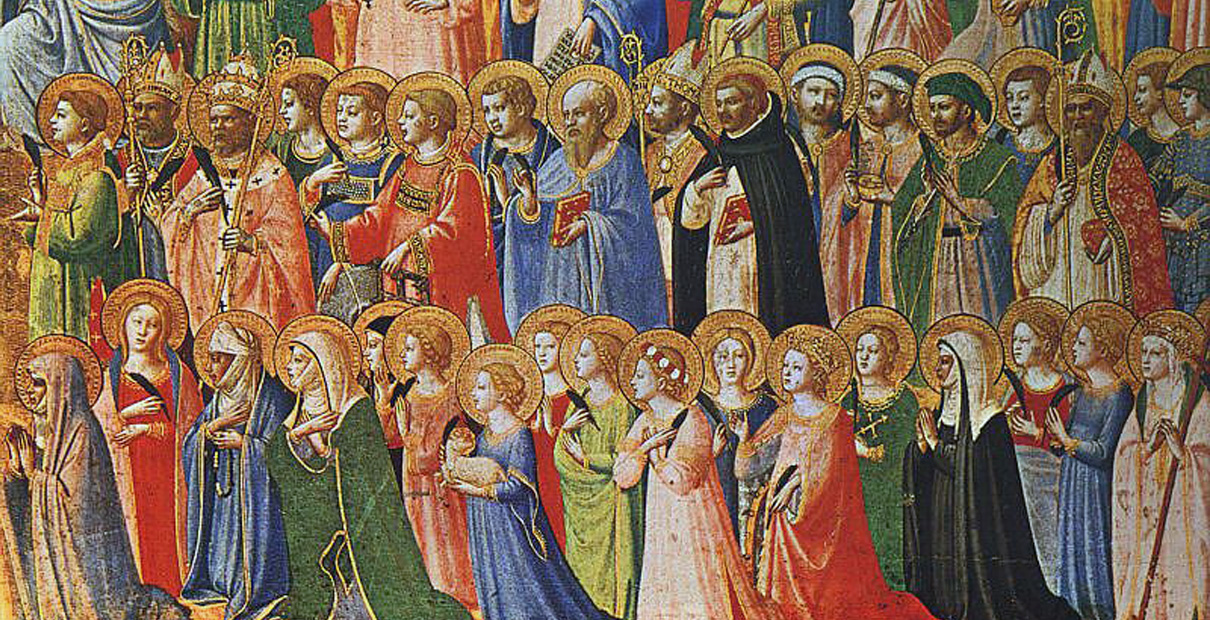
The vision of St. John is lavish and rich in symbolism.  The apostle loved by Jesus does not mean to give us a photo of heaven but paints with a broad brush so that we might glimpse the glory now hidden from our eyes but soon we shall see face to face.  It is a vision consistent with Scripture – the Elect of God both Jew and Gentile, the Lamb once slain but now enthroned on high, those around them falling down before the Lamb and His cloud of witnesses in awestruck adoration.  St. John not only sees others, he sees himself and his own future, then hidden with God in Christ but soon to be seen by the beloved disciple face to face.  It is a vision of glory.  And guess who else is there?  YOU and me.

While straining for a full vision of this glorious and heavenly future, the elder comes to John with a question.  Who are the saints of God?  Who are the elect of the Lord?  Who are the martyrs who gave their highest and utmost for faithfulness? The elder seems to press John a little too hard.  Why does John not tell him the answer?  Is he awestruck, mute before the heavenly vision, or ignorant of what it all means?  Then comes the answer.  “Sir, you know...”  Is John just passing off the question to somebody else?  Is he merely trying to get off the hot seat?

I suspect St. John knew exactly who these were.  He sees and knows them, many by name as friends in the Lord who gave their lives for the faith.  They may not be known or remembered on earth, but St. John is hinting at the most profound truth of all.  They are known by John, by the other saints who had gone before, and by the angels who rejoiced over their repentance.  But most importantly of all, they are known by God.  The world has forgotten them and even the people of God no longer recall their names or their stories.  But God cannot forget them.  They are the very reason He sent His Son in our flesh to suffer, die, and rise again.

These are the saints, whether martyred and their lives taken or witnesses whose most profound truth is the cross.  These are the saints – not those who have worked their way into God’s good side but those for whom the good Lord has emptied Himself into sin and death.  They are the saints, whose stories you know and still speak of and those whose stories are known only to the Lord.  John knows them but most importantly God knows them and though death causes the earth to lose its memory, God will never forget them. That is the good news of this day. We are the saints for whom Christ died and God can no more forget us than to forget Jesus.  

This is why we gather.  Not because the world remembers us or still tells the stories of our lives but because God cannot forget us and because the Lord knows the story of our lives and still loves us with an everlasting love.  You, my friends, are not forgotten.  Your plight is not forgotten.  Your sacrifices are not forgotten.  Your prayers are not forgotten.  Your good works are not forgotten.  You belong to the Lord and He belongs to you.  Your death is precious in His sight and your life is sanctified by the Spirit.  Whether you are famous or forgotten, whether you are marked by honor or anonymous saints, the Lord knows you and the Lord has heard your cry for mercy and the Lord has delivered you to be with Him forever.

“Sir, you know” is not some evasive cop out answer but the joyful acknowledgment that we are known to God, known to God in life, known to God in death, and known to God by the Redeemer who died our death to sin so that we might live His live in heaven with Him forevermore.  Yes, God knows your sin and every shameful thought, word, and action that lay like a bounty upon your head.  But God also know you as His own baptized children, washed in the blood of the Lamb, cleansed from sin and granted the new and everlasting life of Christ. He knows you as His own child, by adoption and choice – complete with all your bags and baggage.  God knows you and has rescued you from oblivion in Christ.

The world buries more than our bodies but our memories.  It does not take long after we die that no one can recall how we looked, the sound of our voices, the stories of our lives.  If the world is your mother, death will claim everything about you and will give nothing up to the future.  You are gone and forgotten.  But if the Church is our mother, we have been born anew in Christ.  God will see that our faces are not forgotten and the sound of our voices remembered and our stories told for all eternity.  God can no more forget you than He can forget His nature or disown those His Son has redeemed.  The glory of All Saints Sunday is the mighty remembrance that rescues you from the dust of the earth, glorifies your bodies for eternity, and prepares a place for you on high forevermore.

On this day, we speak forth from the altar the names of those who most recently have died and joined the chorus of God’s nearer saints.  In the pews we speak the names of fathers, mothers, sons, daughters, family, and friends who have gone before us with the sign of faith.  And we rejoice.  For God already knows them.  He cannot forget them.  They were His own in birth, were reclaimed by the gift of baptismal water, tasted Christ’s body and blood, and now live never to die.

We are not social security numbers that pass into oblivion or the dead whose tomb stones fall over or one statistic in a world of meaningless numbers of car accidents and heart attacks and covid deaths.  God knows us and those who know God know us.  John is not telling us His future but our own future.  John saw it and tells it to you so that in your grief, sorrow, despair, and loss you might be comforted.

You are the Beatitudes – the poor in spirit who are right in Christ, the mourners who are comforted by the empty tomb, the meek whose only power is faith, the hungry for righteousness who are made righteous in Christ, the merciful who learned mercy, the pure in heart whose only glory is faith alone, the peacemakers who forgive as they have been forgiven, the persecuted for the name of Jesus, and those about whom lies were told only because of you belonged to the Lord.  You are the Beatitudes and God has claimed you as His own, forgiven you all your sins, and raised you from death and anonymity to life and remembrance.

Who are they?  God knows.  And now YOU know.  God is not ashamed to be called your God, do not fear being known as God’s child.  He knows you better than you know yourselves, from the numbers of hair on your heads to the fears that live inside you to the sins you want to run from.  He knows you and has claimed you and washed you clean and forgiven you and raises you up to be with Him forevermore.  Who are those white robed martyrs?  They are us.  We are them.  And God has made us His, for the passing todays of this life and for all eternity.  Amen.

Church and communion. . .

The publications of the American Lutheran Publicity Bureau are not of an even quality, to put it mildly, but the Forum Letter is the better of them.  In fact, I find it always worth reading.  You might want to check it out as well.  In any case, the piece below by the Associate Editor of the Forum Letter, the Rev. Peter Speckhard, is an exceptionally well written and cogent argument over the question of where one communes.  I commend it to you and encourage you to spend a few bucks and at least subscribe to the Forum Letter (a monthly newsletter nearly always pithy and timely and worth your time).

Church and communion

A couple of months ago [FL August 2022], I wrote in these pages about our new parochial school principal, a Roman Catholic, who had concerns that his not taking communion in our services would offend people.  (I should note he was talking about the Catholic policy against it, not our policy against it.) The article detailed how I explained the situation to our congregation, which included explaining how examination for Holy Communion involved a mediating role of the teaching authority of the Church. One reader objected to that idea, asking, “One should examine him/herself in the light of the Scriptures. But why should ‘the Church’—and here I believe you mean ‘Synod’— become a mediator in this process?” The following is adapted from my response to that reader.

When I say that “the Church” has a mediating role in how we examine ourselves for Holy Communion, I’m applying the Small Catechism explanation of the Third Commandment. We all agree that we all have a responsibility to hold preaching sacred and to gladly hear and learn it. The disagreement begins when we ask, “What preaching? Whose preaching?” The catechism and the commandment from God can’t possibly refer to just anybody’s preaching of anything. God warns us repeatedly against false prophets and false preachers and teachers. If we are to hold sacred every sermon on AM radio, every pamphlet we get in the airport, every crackpot standing on the street corner explaining Revelation in terms of politics, or even every pastor in every pulpit in town, we’ll all be driven batty within a week.

Knowing what preaching to hold sacred is where the Augsburg Confession [AC] comes in.  C XIV says that nobody ought to be preaching or teaching in the church without a regular call. The called and ordained servant of the Word—that is whose preaching to hold sacred. Sure, you can hear the Gospel from a neighbor or your grandmother. And yes, the condemnation of the Law can come from many quarters, too. Even the AM radio sermon makes an occasional profound point worth taking to heart. But we are also free to disagree or ignore such preaching and teaching without violating the Third Commandment. Not so the kind of preaching AC XIV addresses. The preaching the Third  Commandment demands that we gladly hear and learn is that preaching done by the one authorized to preach.

But AC XIV just begs the question: regularly called or authorized by whom? Everyone who preaches claims to be authorized by God through someone or something, if only their own sense of mission. And even setting aside self-appointed preachers, every pulpit in town is filled by someone whom that congregation (or its overseers) put in place to preach and teach. Granted, we all might hear and learn edifying things from non-Lutheran pastors. Most of us do so quite regularly. But does the Third Commandment demand that you hold sacred and gladly hear and learn the preaching of every preacher in town? The Seventh-day Adventist railing against Sunday services? The Evangelical calling people to be re-baptized, for real this time? Of course not.

AC VII preempts the question begged by AC XIV. It does so by defining the Church, the calling entity from which the actual preachers behind the preaching in AC XIV get their authority, as “the  congregation of saints, in which the Gospel is rightly taught and the Sacraments are rightly  administered.”  Wherever that is, there is where the Third Commandment directs us to hear the Word. We are not free to deny or contradict such preaching; doing so is despising preaching and God’s Word and a violation of the Third Commandment.

A positive description of the relationship between AC VII and AC XIV would be “symbiotic.” A negative description would be “circular.” And granted, it is circular to define the right church as the place where authoritative preaching takes place and then define authoritative preaching as the kind that comes from the right church. There is a chicken/egg conundrum to deciding what church to join. You join the church that teaches the truth, but learn what the truth is from the church. That’s a tough nut to crack, and only the Holy Spirit can take a person from outside to inside that circular, symbiotic process.

But the Spirit does it, when it happens, by getting you to recognize the voice of your Lord and Shepherd somewhere. That voice has to take some kind of this-worldly form, but it speaks from above you with divine authority to judge and condemn and to pardon, forgive, and sanctify. Even with the Spirit’s help, you haven’t really joined a church until you’ve placed yourself under, not over, the preaching and teaching that goes on there in the name of your Lord.

The individual preacher may make mistakes now and then or not have an appealing personality. Even the great prophets and apostles were sinners. At issue is whether the preacher’s call comes through a congregation of the saints in which the Gospel is rightly taught and the Sacraments rightly administered. If it does, you must hold that preaching sacred and gladly hear and learn it. If it doesn’t, you are free to consider that preaching for what it is worth, be it gold or tin. It is up to the congregation to insist that its pastor’s preaching not transgress the confessional bounds of God’s Word, which is why Lutheran congregations all have an unalterable confession of faith to which they publicly bind their preachers at installation.

So far, so good. Congregations with a sound, orthodox confession of faith call preachers, and the Third Commandment tells Christians to heed their preaching. There may be more than one place in town where the Gospel is rightly taught, but the preachers in those places may not contradict each other from the pulpit any more than two pastors called to the same congregation are free to contradict each other from the pulpit. The congregation’s confession of faith does not contradict itself. If pastors contradict each other, one of them has strayed from the public vow he made at his installation. The hearer cannot examine himself meaningfully according to the teaching of both of them.

Of course, AC VII refers to the Gospel in the wide sense of the full counsel of God. Preaching, according to St. Paul, includes correcting, rebuking, and admonishing along with encouraging and comforting. The Third Commandment calls us to pay heed to both Law and Gospel. God calls us to be formed by all of it, not just the parts we enjoy. Especially on the matter of our confessing actual, real world, concrete sins and not just mentally assenting to the doctrine of original sin, it makes a big difference what God’s Word says is sinful when it comes to preparing for Holy Communion.

The nature of the Church, the nature of the call to preach, and the divine command to hold preaching sacred come together in how one prepares for the Sacrament. The Word and Sacrament cannot be divided. They are forms of the same thing—Christ. Divine Service rightly brings them together. It is the preaching and teaching of the Service of the Word by which one repents of sin and examines oneself for the Service of the Sacrament.  The “called and ordained servant of the Word” has authorization to forgive our sins, to preach and teach with the force of the Third Commandment, and to consecrate the elements on behalf of the congregation where the Gospel is rightly preached and the Sacraments rightly administered. Such authorization comes as a package deal.

What I wrote in my original article that merited strong objection was, “It makes no sense to examine yourself if you do not accept correction of your faith and life from anyone but yourself, and such correction can only come from a mediating authority between you and God. God doesn’t deal with you directly, but through the Church, through Word and Sacraments.” I think this is an important point. Going forward for communion is not an isolated act detachable from Christian formation and self-examination. Meaningful self-examination requires being formed by preaching and teaching, which stems from the authority of a congregation where the Gospel is rightly taught and the Sacraments rightly administered. In short, when you receive communion, you are (among other, more important things) publicly identifying the church whose preaching you hold sacred and gladly hear and learn. You are claiming to have examined yourself according to that church’s teaching.

I think the historical practice of every sacramental church body has included limiting communion (in normal circumstances) to those who accept the teaching authority of that church body. In the case of Lutheran churches not in fellowship with each other, the issue goes far beyond denominational loyalty or arrangement of the letters in the label.  The ELCA and the LCMS do not offer the same “answers in the back of the book,” so to speak, for the self-test. The difference is doctrinal, not merely organizational. We teach different things about how the commandments apply to our thoughts, words, and deeds. To commune in both places is to make a mockery of the teaching authority of one of those places, or worse, to claim the right to be your own teaching authority who sits in judgment over both places, which renders self-examination a pointless exercise.
 

Consider the section on the Office of the Keys in some editions of the catechism. The LCMS’s Concordia Publishing House editions note that these questions may not have been written by Luther, but they reflect his teaching and were included in editions of Luther’s catechism in his lifetime. One question relates to John 20.22—23, where Jesus gives the disciples the authority to forgive sins, and the next question asks, “What do you believe according to these words?” The answer says, “I believe that when the called ministers of Christ deal with us by His divine command, in particular when they exclude openly unrepentant sinners from the Christian congregation and absolve those who repent of their sins and want to do better, that this is just as valid and certain, even in heaven, as if Christ our dear Lord dealt with us Himself.”

Clearly, what is needed is recognition of God-given authority that is valid even in heaven. That authority especially includes calling people to account for their sins and withholding the Gospel from the unrepentant. The issue is not whether we consider all non-Lutherans to be unrepentant sinners. The issue is whether they are formed by our preaching and teaching.

The ELCA solves the conundrum by saying it doesn’t matter for communion fellowship if various preachers contradict each other. Communion fellowship only requires agreement on a few key points, and even those points don’t really matter much, if at all. That does indeed solve a lot of practical pastoral problems, but at the expense of undermining any confidence anyone can have that they’re hearing God’s Word rather than tentative human opinions. The LCMS (I would say properly) requires doctrinal agreement among preachers and teachers and actually tries to enforce it. But we do end up, then, sometimes fighting with each other or awkwardly explaining our policy and disappointing or offending people who want communion in a church where they do not consent to be taught and formed.

Consider, to use a timely example for 2022, abortion providers. Are they openly unrepentant sinners? What about people publicly and unapologetically having affairs? What about a couple in a homosexual marriage? If we are called to repent by a preacher whom the Third Commandment demands we listen to, but we don’t agree with his definition of sin, we can’t with any Christian integrity just find a more amenable preacher or go by our own personal definition of sin. If we do that (and I think a lot of people do), we are saying that the first preacher did not preach God’s Word or represent a congregation of the saints where the Gospel is rightly preached and taught. The sermon was just something to consider, like a newsletter article. I think many mainline Protestants think of sermons in Divine Service that way.

The attempt to have fellowship despite contradiction always ends up elevating personal, private opinion and interpretation above the teaching authority God gave the Church. In short, it makes everyone the pope of a church of one and renders the unity of communion a mere outward show.

So, the best practice: Receive communion where you accept correction of your faith and life. If you recognize the teaching authority of Rome, receive communion at Catholic Mass but not in Lutheran churches. If you are Lutheran, receive communion where you recognize the teaching authority (which cannot be both the ELCA and the LCMS since they contradict each other) but not in Roman Catholic churches. Such discipline has been recognized and practiced historically by all the sacramental churches, and it makes perfect sense. It does not really solve the ecumenical problem, or even make a phony attempt at solving it, but it does maintain the integrity of the Divine Service of Word and Sacrament for all parties engaged in that ecumenical problem.

As for ecumenism, I think it helps to recognize the nature of the problem not as disagreement on a list of specific points of doctrine that need to be addressed but disagreement on the source and nature of the authority to preach and teach in the Name of Jesus. Among Lutherans, disagreement on the nature of Scripture is what leads to division, just as among Catholics disagreement as to who is the rightful pope has led to division. It isn’t enough for Catholic unity to acknowledge papal authority if you don’t agree on who is the pope, and it isn’t enough for Lutheran unity to acknowledge sola Scriptura and the Confessions based thereon if you don’t agree on the nature of Scripture.

Our Catholic principal communes regularly. As do St. Paul’s members. He just does it about two tenths of a mile up the street from us, where he submits to the teaching authority of St. Thomas More Catholic parish. Then he comes to our services, too, and listens intently as to something interesting for him to consider. Nobody is being denied Christ by taking communion where they heed the Third Commandment and receive both Word and Sacrament.

If it matters who is kneeling next to you, it should not be because they are kin by blood or because you love them. The fact of “communing together,” as opposed to just communing, should only matter if you share the same faith. And since nobody can claim to fully understand (or in many cases even know about) every teaching of the Christian Church, the faith people who commune together share is functionally a matter of holding sacred and gladly hearing and learning the same preaching and teaching of God’s Word.

—by Peter Speckhard, associate editor

Sunday, November 6, 2022

Swedes for All Saints'. . .

Since this All Saints (observed) is the first since my mother died, I will put a Swedish slant on it all.  Growing up half Swede and half German, I learned the special music of both -- especially the hymns that you sought out for the most difficult moments such as a funeral.  I'm in my Svenska mood now so I present you with a few staples from a childhood of funerals as we remember the hope of the saints that is our hope as well.  These give a slightly different flavor to our All Saints observance -- less triumphal and more touching but with the same consolation in Christ's own resurrection that we too might be raised!


This Swedish folk hymn was written by Lina Sandell-Berg and it is coupled to the familiar melody that has always accompanied its beautiful words.  I cannot tell you how many times we gathered as a close knit community in the Nebraska hills to choke back tears and to bury sainted loved ones.  It is still a personal favorite.


This perhaps the most oft used funeral hymn of the old Augustana Synod congregations.  Written by noted Swedish Pastor Laurentius Laurentii Laurinus for his wife's funeral in 1620, it was revised two centuries later and, of all things, has ended up wedded to a Norwegian folk melody.  If you grew up among Swedes you would note the irony here.  In any case its words speak well of the home that is ours in Christ for this All Saints Day.


If you knew only one Swedish hymn, it would be this one.  If you, like me, grew up around Swedes, this is the one hymn you know in Swedish.  Written by the leading hymn writer of the pietist movement in Sweden, Lina Sandell Berg, it is one hymn of comfort, hope, safety, and refuge that still sounds in my ear in the voice of my beloved Grandmother Elvera Monson.  I think it but hear her sing it and I cannot sing it but long for the blest reunion which All Saints prefigures, the culmination of all that Christ has prepared and the end that brings eternity to those whom He loves and who have loved His appearing.


Saturday, November 5, 2022

Never too young to indoctrinate. . .

Funny how the same people who complain that Sunday school and catechism classes indoctrinate children without their consent have decided to exploit the youngest of our school children for the woke culture of sex and gender.  Look below at some resources used in Wisconsin schools:


Friday, November 4, 2022

Always a minority. . .

When the Pew Research Center released their report “Modeling the Future of Religion in America” a few months ago, they plotted out the trends noted over the past 30 years and came to the conclusion that  Christianity will lose it’s majority status in the US in the coming decades -- unless the trend reverses.

So, according to the Pew study, about 64% of Americans were Christian in 2020 (self-identified?); that broken down to 40% various Protestant (perhaps non-Roman Catholic would be more accurate) and 21% Roman Catholic. But the trends, hastened by the pandemic, do not paint a good picture down the road. Less frequent church attendance even among the regulars and the decline in the number of children and the number of children in church along with many other factors have led them to project that number could be as low as 35% in 2070 and even 25% in 2100.

Those in the study suggest that the US could and is perhaps now reflecting the experience of what has happened in Europe. “In Great Britain, for example, nones surpassed Christians to become the largest group in 2009, according to the British Social Attitudes Survey.” 

No projection is certain but it is certain that it could be more likely to come true if the churches do little or nothing about it.  Of course, other factors could also adjust the outcomes — everything from war to  economic depression to changing immigration patterns to religious innovations could slow or even reverse the current religious trends.

I have no doubt they are more likely to be accurate than inaccurate.  We have seen it coming for a long time.  It was first reflected in the demographics of most church bodies, the individual congregations, and the loss factor in both.  What is being projected will come as a shock to many -- everyone from the cultural Christians who believe a thin veneer of Christianity is good for us all to those who yearn for the good old days of the early decades of the past century.  It should not come as a shock to people who read the Scriptures.

Jesus asked "when the Son of Man comes, will He find that faith on earth?”  Jesus repeatedly warned that the institutions of government and the illusions of earthly power and influence were neither our comfort nor our hope.  We would be shackled and brought before the powers that be and we would face persecution and threat, division in our households, and false prophets who lie in His name.  All of this is conveniently forgotten when Christians imagine themselves to be an earthly power or kingdom.  But we are reminded over and over again that you cannot put your trust in earthly powers or kingdoms or flesh and blood rulers.  It was and has always been Christ alone.  This is not some halfhearted consolation prize we have to settle for — this is our confidence.  For with this comes the promise.  The devil cannot prevail.  We cannot lose what Christ has already won.

We have no game to win for God but only faithfulness to show.  He who endures to the end does not sound like we will enjoy an earthly triumph over our enemies — at least in the moment.  We will, however, enjoy the heavenly victory.  What Christ won was for us and His victory is ours by faith.  This was and is our hope -- not some position of power or advantage among earthly institutions but the real and enduring life that death cannot steal, the devil cannot trouble, the old Adam cannot fight, sorrow cannot afflict, disease cannot mar, and despair cannot touch.  It is for this we contend and not a super majority status.  Numbers have always been our temptation and often our undoing.  We ought to be counting the flock to keep them rather than counting the flock to judge our position against those not of the Kingdom.  Speak the Gospel boldly.  Worship faithfully.  Pray confidently.  Teach (catechize) diligently.  It will be enough for God even if it may not change the Pew Research Study model.


Thursday, November 3, 2022

Managing our death. . .

The world is not completely dense.  It knows that death is real, is there, and cannot be denied.  So the world has focused on managing that death -- making it possible, as much as can be, to control when and how it comes.  The reality of this was made painfully obvious during the pandemic -- the lengths we as people were willing to go to stave off death.  It is an unfruitful exercise.  If all you can do is manage your death, you are not living at all.  Although I have written about this with respect to people, I wonder if it is not also true of our Christian institutions.

It seems that nearly everywhere in Christendom there is gloom and doom and the admission that our best days have come and gone.  Therefore, without a friendly culture to aid and assist, it seems that too many of our Christian leaders have decided that the only job left is to manage the death of these institutions and church bodies.  Like the people mentioned above, the goal is to control that death -- to manage the decline, stave it off as long as possible, and decide how it ends so that some sense of accomplishment can come even of its death.

In doing so, Christian leadership has become focused primarily upon the institution and not the faith.  It is the work of institutional maintenance that seems to consume us now.  How do we keep the machinery of parishes, schools, colleges, agencies, organizations, and such going for as long as possible -- without actually growing them.  The gospel for this approach is “managed decline.”

Sometimes it happens that the population of an area, village, or even a city is in decline.  My own home town faces an uncertain future of aging citizens, fewer families needed to run the highly mechanized farms, fewer business on Main Street, and a fight to keep the doors of the school open as the student population declines and the cost goes up.  It is a place where the fight to survive is fought daily.  The churches in that small town are in various stages of the same decline.  They have fewer members, fewer dollars, and fewer prospects and so many of them are hoping at best for a holding pattern, postponing death as long as possible and managing the decline with as much dignity as possible.  I feel for them and know their plight and pray for them.  But that is not quite the same situation as denominational leadership which has decided that decline and perhaps even death are immanent and the best future is to slow the pace and push the actual date of that death as far out as possible.

In desperation some have decided to try anything and everything to reverse the trends.  Screens, praise bands, torn jeans and tee shirts, designer coffee, comfy seating, and a mall style buffet of things to satisfy every taste has been tried over and over again.  We seem locked into the idea that the only way we can grow is not to be who we are.  Perhaps it is our own lack of confidence in the means of grace that now comes home to roost as we manufacture a new identity every week in order to attract the jaded who go from church to church in search of what is new.  That is no more a viable strategy than to lock the doors to keep the faithful from leaving.

In fear some have decided to exchange the message of Scripture and the Gospel of Jesus' death and resurrection for a new paradigm of self-awareness, self-discovery, self-identity, and self-interest.  These are always a day late and a dollar short of the cultural wave that floats such ideas and they spend their time playing catch up with the trends and clean up for the parts of their churches that offend against the new national conscience.  But their pursuit of the obvious heard everywhere and the cause of the media that seems to drive everything now has not resulted in any growth or slowing the decline.  The people leaving are not necessarily going to other churches.  Perhaps this is the new churchly definition of quiet quitting.

Because they have always done it that way before, some go through the motions -- rehearsing week after week what they have always said and done but more as institutional maintenance than really being the Church.  In a small congregation where a couple of our members transferred upon a job change, these young faces were actually asked to move out of somebody's pew.  Ouch.  It is mine until I die, anyway.  I know that there are such congregations out there.  I certainly do not think they predominate but it is easy to see why they would hunker down until the last person there leaves and turns out the lights.  By all means we ought to serve the faithful who are there but by no means should we allow this to become the institutional form of shut-in visit -- a stop gap measure waiting for death.

There is an elephant in the room.  No one will talk about it because those who tried were tarred and feathered.  That is the absence of children in our pews.  Either they exist but their parents are not bringing them or bringing them so occasionally they are not being catechized by the liturgy OR they are not there at all.  Both are true.  We have loads of children (and their parents) who hardly ever darken the doors to the church (increasingly absent even on the high and holy days of Christmas and Easter!).  We also have loads of elderly without children in their homes and young who are not sure they want to marry or have any children.  We have some problems here.  A recent visit left me stunned as we went around the room updating each other on our families while many of my age said their children were never going to marry and they would never have grandchildren.  It is a real thing.  Perhaps we have presumed about marriage and family so long nobody thinks of these as God's order -- merely an optional choice.

I fear that we have not quite gotten to the point of trying with all our might to be who we say we are creedally and confessionally.  That is the lifeline that extends into our bleak situation.  No one has ever made another a Christian -- only the Holy Spirit -- yet why make the work of the Spirit more difficult by apologizing for who we are and acting embarrassed by the catholic and apostolic faith?  Unless our Confessions are mere relics of our past, they speak of a lively faith, fully engaged with the lives of people, confident that the Word and Sacraments will do what they promise.  Where congregations have a fuller liturgy, good music, solid Biblical preaching, faithful and lifelong confessional catechesis of youth and adults, and a presence in the community, they are doing more than managing their decline.  Most, if not all, are growing!  The point is this.  God has placed us here not to preserve the past or protect our interest or to postpone our death.  He has given us the life-giving Word to speak and live out before the world and with it the promise that He will shepherd, grow, and harvest His Church.  We know what we have been given to do; it is about time we do it or we will have no choice left but to manage our decline until death claims our church bodies and our congregations.

Wednesday, November 2, 2022

Why did we so easily shift to screens. . .

I spend a fair amount of my time on a computer.  No, it is not surfing the web or on social media or shopping.  I once spent a goodly amount of this time writing in longhand or typing out such things as sermon manuscripts or Bible study outlines or notes or minutes.  You know what I mean.  I probably spend more time on a computer now because so many things that were once available only in books and in libraries are now accessible to me at my desktop.  But it is time that has to be limited by the reality of the ministry which is not online (no matter what anyone else says) but personal.  The screen is a tool but not an end.  I fear that many in the church have this reversed -- they are too comfortable with the screen.  It has become no longer merely a tool but an end in and of itself.

Worship and pastoral care are incarnational.  That is more than simply personal.  In other words, it is not simply about the personality but the pastor as an incarnation of the Word made flesh by the office he bears, the orders under which he serves, and the gifts he bestows as the reason for this ministry.  Baptism cannot happen online.  Neither can Holy Communion.  It is questionable in my mind that private confession and absolution can happen via a screen -- at least effectively.  It is a growing conclusion in my mind that preaching cannot happen online -- certainly the Word can be heard but preaching is by nature incarnational and that requires hearing and seeing the person.  I am not saying that watching online or via digital means is not beneficial but it is not quite the same benefit as the in person hearing of the Word. Certainly you cannot minister to the sick and dying via a screen the same way you do it by being there at the bedside and addressing the suffering and those near death with the Word of the Lord that heals now and eternally.

When the pandemic came along, the timing was critical to the response.  We found out that most of what white collar workers do could be easily done at home, online, through Zoom, and by phone.  It was a far easier transition than any imagined and one that has proven hard to break -- even when the office is now accessible and the employer values in person work.  Some, perhaps even many, are resisting going back to in person connections because they find it unnecessary and an intrusion to the way they have come to relate to their work and workplace.  Remarkably, this shift to the screen was seen as a benefit rather than a makeshift way to adjust to the circumstances at the time.  Some are now saying that the cities filled with office buildings and cubicles could be a thing of the past.  Some of those predicting this shift are relieved and happy at the prospect.

Of course, there is work that cannot be done before the screen or at home.  The folks who cook the food that is delivered to our door or pack the Amazon boxes shipped at a moment's notice or make the items that Amazon ships do not sit in front of a screen.  They, like the nurses at the bedside, those hauling away our trash, the road workers, and the carpenters, had to actually do their work where that work required and with others who shared in their work.  As pastors, even some Lutherans and others with a sacramental understanding of how God works, found themselves just as much at ease with the substitution of the screen as the office workers who ended up working through it all at home.  And the people we serve, accustomed as they were to the screen for work and entertainment, seemed to find the adjustment to screens just fine.

Could it be that pastors see themselves and the churches see them in the way way as we see those who work before screens?  Has worship become so passive that it no longer expects or requires a real presence?  Is what we do on Sunday morning the creation of an entertainment event or the delivery of the gifts of God to the people of God?  Is the music of worship primarily something people watch or is it something that calls them to join their voices with the rest of the assembly?  Is prayer simply an individual activity or does the church pray -- together, Our Father who art in heaven?  Is live streaming the same as in person or just about the same?  Is the Church the home or in the assembly of those whom the Spirit calls by the Word, gathers to one place at one time, enlightens and sanctifies by the gifts of God that do what they promise?

Perhaps the easy transition to screens reveals something underneath that is worth our attention.  How do we see ministry?  How do we understand worship?  How do we define the Church?  What does it mean to be a sacramental communion?  What does it mean to preach?  If we spend some time on these things, we may discover that the pandemic only raised to the forefront things, troublesome things, that were under the surface all along.

Tuesday, November 1, 2022

Spare me. . .

An ancient liturgical verse paraphrases the words of Job (7:16):  Leave me alone, for my days are a breath.  The verse puts it even more bluntly:  "Spare me, Lord, for my days are nothing."  Job is filled with good news.  "Why do you not pardon my transgression and take away my iniquity? For now I shall lie in the earth; you will seek me, but I shall not be.” (7:21)  But this stark admission of our weakness, of the fragility of our lives, of the nearness of death, and of the end that depends upon the Lord and His forgiveness is not depressing.  It is somber and it is certainly disheartening to those who do not know the Lord or His mercy but to the Christian it is not maudlin but truth.  And with the truth of death comes also the truth of life.  Again, from Job:  "I believe that my Redeemer lives, and that on the last day I shall rise from the earth, And in my flesh I shall see God, my Savior.  It will not be some other, but I myself who shall see Him; my own eyes shall look upon Him. And in my flesh I shall see God, my Savior.

It might seem sad, melancholy, and even a bit pathetic that the Church gathers on All Saints' to recall those who died in the faith.  And there are tears as the names are spoken and the bell rings out into the silence that follows the mention.  But tears are not all we have.  We also have the holy joy and promise of the blest reunion with those who have gone before, the saints whose lives are not over but waiting with us for the final day that has no night.  We remember them not as a people ignorant of hope but as the confident who know that because Christ lives, all who die in Christ live and we who live in Christ now will live forevermore.

From Lazarus and his stinking body to the children who died before the fullness of this earthly life had been known whom Jesus raised to the Savior whose tomb was but a temporary home, the end is not death.  That is why this life cannot be our best life nor our only one.  In fact it is the briefest prelude to what eye does not yet see and mind cannot imagine but the heart trusts.  Your best life is not now.  It is to come.  Death has become a tool and pawn in the hand of God who turns the dead in into a new beginning.

That is the message of All Saints' -- the dead in Christ live and we live with them and this life will never be diminished by sorrow or stolen by death or corrupted by affliction and illness.  No, we are more than conquerors in Christ our Lord.  We speak the names of those who died not to cling to what memory is left of them but because God's speaking is life.  That is what happened to the thief who asked Jesus to remember him when Jesus came into His kingdom.  In remembering the dying thief, the man becomes the living saint -- all by the grace and mercy of God.  But what happened on that hill of crosses so long ago, is not an anomaly but the pattern of our own lives, for now hidden in Christ, but soon to be revealed when we shall see Him and the saints who have gone before face to face.


Monday, October 31, 2022

Authority was and is the question. . .

Although too often the Reformation is made out to be a conflict between personalities or practices or even about the justification of the sinner before God, it was not and is not primarily about these.  There was no Luther against the Pope that drove the Reformation.  It was, instead, a quest for authority and the question that had dogged Luther became the central issue for that which is rightly called the Great Reformation.  If you get this question wrong, it does not matter how right or wrong the answers to the other questions of the Reformation.

Where is the truth of God?  Where can one turn to the one authority that does not lie or change but is eternal?  What is the one foundation upon which you can build your faith, hope, and life?  All of these are wrapped up into the hit of the hammer that was heard around the world.  Is our faith built upon the Church?  Does it rest upon councils that do not err?  Is it guaranteed by popes (or bishops) immune from error?  What is tradition and it is dependable?  These were the burning questions that gave birth to the Reformation and with these truths the Lutheran fathers wrestled within themselves and before the Roman and civil authorities bent on preserving the status quo.

You cannot get to justification by grace through faith without the Scriptures speaking with authoritative voice.  Neither can you get to a treasury of merits or purgatory or indulgences or an infallible papacy if you begin with Scripture.  The challenge of that day, like our own, is less a question of where you end up but where you begin.  That is why the Reformation is not mere history.  For our own age has gone well past trying to posit the authority in tradition, council, or office (pope) and left us with so many authorities that there is but chaos and confusion left.  Reason has given way to experience and experience has become so individual and personal that it cannot speak beyond the realm of self.  Scripture has become a pawn in the hands of those who get to decide what it says to them and no one can issue any challenge to this deception.

But the answer is not quite as simple as inerrancy that some trumpet.  For we are not in possession of a book without error that simply witnesses to what was.  The authority of Scripture is not merely in its infallibility but in its efficacy.  The Word still speaks and is not only a record of what was once spoken.  Here the genius of the Lutheran confession is that Scripture is not merely a fence post to reign in error but the voice accomplishing that which it says and doing that which it promises -- right now among us!  The issue remains authority and the answer is not simply a book that cannot lie but a God who speaks through this changeless Word the eternal and life-giving Gospel.  While some are in search of a book or an authority that will tell others they are wrong and others are in search of a book or an authority that will allow their personal truth to stand, what we get in Scripture is a voice and a power by the Spirit to call forth faith, bring the heart to repentance, and build a new life and identity now and for everlasting life.  It remains this that is the challenge for our time -- authority and what that authority is.

Our debates of sex and gender, race and injustice, climate and peace so often remain debates about narrow issues instead of the wider and larger worldview that comes to us from the Word of God.  We are searching for proof texts to support our position while God is speaking the Word that seeks the lost and rescues the sinner and redeems the unworthy.  We have succumbed to the foible of talking about Scripture as if it were merely a record of the past or a suggestion for the future and not the voice of God accomplishing His purpose.  Luther was searching not simply for a word but a sacramental Word to trust in the face of a world and a personal life of disappointment, failure, and anxiety.  He was not alone.  Jesus is met not in our imagination or our feelings but in the places of His promise -- the Word that leads us into all truth, calls forth faith, and guides us as a lamp to our feet and the Sacraments of new birth, restoration of the fallen, and the food of heaven.

It was not for justification that Luther sought Scripture but in seeking Scripture he found the ageless truth of justification, hidden in the church of his day except where that Word simply spoke.  So where the radical Reformers insisted that too much error, falsehood, and deception had entered the Church that one must begin again and anew, Luther insisted that where the Word of God spoke and the Sacraments of Christ were administered, the Church continued to live -- even with error codified and confirmed at the highest levels of its structures.  It was for this that Luther emphasized the congregational -- not to detract from the obvious that the congregations together with their ministerium were also church but because what preserved the faith in darkest age was precisely the Word spoken and the Sacraments administered where the faithful gathered.  The trunk of the tree was and is not the highest offices but the lowly places where the Word is read and preached and the Sacraments administered.  The congregations are not the individual leaves but the higher offices of earthly structures.  For Luther, the authority of the Word was what gave growth to the congregations and the congregations flourished where this efficacious Word accomplished God's purpose and gave limb and branch and leaf to the rest of the expression of the Church.

The question then and now is authority -- whom do we trust?  The answer then and now is not council or office but the Word of God that endures forever.  We encounter that Word not in some ethereal plane of imagination and spirit but in the concrete of Word and Sacrament.  So that authoritative Word is primarily a liturgical one -- we meet that Word addressing us with law to bring us to repentance and with Gospel to raise us up as the justified and then to lead us as those being sanctified first and foremost on Sunday morning around font, pulpit, and altar.  This was the genius of the Reformation then and now.  If we are willing, we may find that this eternal truth will be the foundation not merely for survival but for the flourishing of God's planting that is His Church.