Thursday, October 18, 2012

False Impressions....

In a catechism class I asked what percentage of people identify as homosexual (GLBT total) and was surprised to hear from the students that they thought between one third to one half the population was gay.  When I asked if there were more Roman Catholics or gays, they all said more gays.  When I asked if there were more Lutherans or gays in the US, both youth and adults thought that were easily more gays than self-identified Lutherans.  Gallop suggests that about 15 million Americans self-identify as Lutheran (note I did not say they attend church) and this figures to be about 5% of the total or nearly 5 times the number one study found self-identify as gay.  When I asked adults, I found more reasoned responses but still rather surprising.  Many assumed between 15-20% of the general population self-identified as gay.  Even those on the conservative side were willing to grant 10-15%.

Perhaps if you let the media guide you, you would presume such high numbers.  In reality the percentage of the population identified as homosexual has never ever approached 10%, is generally thought to be less than 7%, and, some suggest, far less -- more like 2-3%.  Now, mind you, we are not talking the percentage who have had a same sex attraction or experience but who do not believe they are gay.  Even then, the numbers are not nearly as dramatic as you might think.

Now comes an Australian study that suggests even these numbers may be on the high side.  LaTrobe University did the study and the results are available here in summary or in fuller version in PDF format.  In its 2005 study on human sexuality, the Australian Longitudinal Study of Health and Relationships reported that .66 per cent of women and 1.03 per cent of men self-identified as gay/lesbian. Yet if you go deeper into the Australian study and look at Table 3 you will see the question of sexual identity is rather more nuanced.

Table 3: Sexual Identity, Attraction and Experience of Respondents


Sex


FemaleMaleTotal
Sexual identityHeterosexual98.0897.728,027

Homosexual0.661.0369

Bisexual1.261.23102

Queer00.021

Total4,1214,0788,199

Sexual attractionOpposite sex90.695.887,642

Both sexes8.893.31501

Same sex0.220.6435

Neither sex0.290.1719

Total4,1174,0808,197

Sexual experienceOpposite sex89.9491.087,418

Both sexes7.216.06544

Same sex0.10.3719

Neither sex2.742.5215

Total4,1174,0798,196

While the rate of self-identification as gay/lesbian in the population hovers at around 1 per cent, the rates for sexual attraction to the same sex and sexual experience are much higher.

My point is that we have generally false impressions from what we see on TV, what we see in the movies, what we read in the news media, and from the way this subjected is approached.  Clearly, the whole issue of gay and lesbian marriage, gay and lesbian rights, and gay and lesbian political influence has been inflated by the presumption of big numbers.  In reality, the percentage of self-identified gay or lesbian individuals is much lower.  I would suggest that the false impression of the size of the gay and lesbian population and their access to media have combined to give permission to the kind of experimentation that has inflated the numbers of those who have a same sex attraction or who have had a same sex experience.  The most pervasive influence of the media and its greatest danger to us are not the direct attacks upon the faith but the false impressions about the nature of what people think, how they live, what they want, and what is normal.  These are powerful forces both upon our thoughts and values and upon our willingness to stand up for what we believe.  This is not simply true in the area of sexuality.  We need to diffuse the false information and correct the false impressions that have so much sway over us (both in and outside of the Church).


Wednesday, October 17, 2012

He was bad but he was also apparently pro-life...

A posthumously released Michael Jackson “Pro-Life” song called “Abortion Papers” is hitting home for many listeners now that it has been released to the public.  In a previously-unreleased song, Jackson is heard taking a pro-life position and even goes as far as using the Bible to defend the pro-life position. Recorded in the 1980s, the song recounts the tale of a woman considering an abortion. Also known as “Song Groove,” the song  was released by Sony as part of the 25th anniversary edition of Jackson’s popular album Bad.

Despite the serious subject matter of abortion, “Song Groove” is an upbeat dance track that would have fit right in with other tracks on the album.

From verses and chorus:

Sister don’t read, she’ll never know
What about love?
Living a Christian soul
What do we get, she runs away
What about love?
What about all I pray

Sister confused, she went alone
What about love?
What about all I saw?
Biding a life, reading the words
Singing a song, citing a Bible verse

Those abortion papers
Signed in your name against the words of God
Those abortion papers
Think about life, I’d like to have my child

by Steven Ertelt | Washington, DC | LifeNews.com

Tuesday, October 16, 2012

Rules or Righteousness?

Sermon for Pentecost 20, Proper 23B, preached on Sunday, October 14, 2012.

    Rules are made to be broken.  Right?  That is sort of the holy grail of American ingenuity.  We don't make rules.  We break them.  Except that we tend to hold others to the rules we ignore.  In the same was God’s rules are often seen as arbitrary infringements upon our creativity and pleasure.  So we figure that God's rules are for us to break and for others to keep.  Right?  Today we encountered a young man who comes to Jesus who seems to ask the right question.  What must I do to earn eternal life?  Those are the kind of youth we need in the Church, right?  The kind who are concerned about eternal life as much as or perhaps more than this life and this moment.  But conversation with Jesus does not go so well for this guy.
    Jesus appears to answer this young man's question with an appeal to the rules.  We would call them the commandments.  When you ask a good question you hope for a better response than to be asked "have you kept all the rules?"  But this fellow was not disheartened.  Instead, he was relieved.  The rules?  Is that all?  Well, I have kept them since I was a child!  This has turned out to be easier than I thought, the guy was thinking.  But Jesus was not making an appeal to rules – no, Jesus was calling the young man to new life, to a righteous life, to a holy life.  This life was the fruit of such trust of God that nothing else matters.  This was a shock to the young man.  He thought he was home free when Jesus talked about rules but found faith simply beyond him.
    The commandments are not just rules and righteousness is not just keeping the rules.  If that were so, the Pharisees would be kings and queens of heaven.  But Jesus insists that our righteousness must exceed these expert rule keepers.  Jesus is teaching us about those rules – rules that are not in opposition to faith but flow from faith and trust in God.  The poor fellow wanted simple rules; instead he received a call to faith.
    He knew the rules but he did not know them as God’s revelation of all that is good and holy and righteous.  He saw the commandments as rungs on a ladder of achievement in which the prize he won was heaven itself. He knew the rules but he missed the God who spoke them.  Sometimes we do as well.  God’s speaking of the law is no less the voice of love than His speaking of the Gospel.  If the Lord was only interested in external renovation, rules would work.  But God was interested in far more.  The man was ready to renovate the external of His life but was not ready to trust in God alone.  The path of the Law is always easier than the call to faith – even when the way of the commandments cannot deliver any promise of salvation!
    Jesus spoke to the rich young man not of rules to be kept but of hearts to believe.  It is this righteousness of faith of which St. Paul speaks so eloquently in Romans.  The call to faith is not new.  It was implicit in the commandments from the very beginning.  Love God above all things and love your neighbor as yourself.  Such commandments and such love is not in opposition to faith but expects, proceeds from, and is contingent upon faith.
    The guy was ready to whatever Jesus asked except trust in Him.  He would obey whatever rules were laid down to earn a heavenly reward but failed to see that the only way the Law works for us is if righteousness is credited to us by faith and we are born again in Christ precisely so that we might love Him above all things and love our neighbor as ourselves.
    Jesus did not hate the man.  In fact, Mark makes it clear that Jesus loved him – loved him enough to address the greatest barrier to heaven – the man’s lack of faith and trust in God. Jesus does not hate possessions or wealth. But Jesus is blunt for us and our salvation.  Love for God and love for self and our possessions cannot live in the same place.  Or to put it in Biblical terms, God and mammon cannot be served at the same time.  We have great trouble with Jesus here because we come with the same issues.  We want to do what He wants of us but to believe and trust is harder than obedience.  Only the Spirit can impart this trust.
    It is our great temptation to reduce the law simply to rules, senseless rules, arbitrary rules, rules made to be broken.  Perhaps we have grown so accustomed to speaking of the law as rules to be obeyed that we have forgotten that God's commandments are also His gracious Word to us.
    For what has made the commandments impossible is not that we have not tried hard enough but that sin has turned our hearts against God and His Word – against the Law and the Gospel.  We were created to live life just as the commandments speak of that life.  What makes it impossible for us to obey is that we do not trust in God or believe His good and gracious will.  The suspicion of sin has made it impossible for us to trust in the Lord and so obedience refuses to be born in our sinful hearts.  Jesus loved the man enough to point out the wall that was keeping the kingdom from him – the wall of faith, or the lack thereof..
    The young man would have done anything to be judged righteous and to earn eternal life – except the one thing that is implicit in the commandments – to love and trust in God above all things.  He would have done anything except believe.  It was faith Jesus was looking for... faith and trust beyond self.  So we come today, as we have come before, struggling in the same way as this rich man – to let go of self and earthly things that appear to be treasures, and trust in the Lord whom we know through the cross.  And as always, the fervent prayer of faith is familiar.  Lord, I believe.  Help my unbelief.  Lord, I believe in the righteousness that comes by faith but I struggle with the doubts of a heart rooted in a righteousness of my own creation.  God, help me, a sinner. Amen

Something new... but not

I don't know how I could not have known it.  I have had many friends who are Orthodox.  We have had extensive conversations.  I know a few Lutherans who swam the Bosporus and we talked before they dove in.  Yet I was reading along an article in which the author said something he assumed was obvious but it was like tasting something familiar for the first time.  The Orthodox Bible generally follows the Septuagint order of the Old Testament instead of the Hebrew text (read that Masoretic Text).  How could I have missed this all these years?  Was I asleep when that was discussed?  Did I have a momentary brain lapse?  Hmmmmm, I wonder what else I have missed.

The order of the Old Testament Canon and its content is very different from the two sources.  The LXX was, of course, well known to Jesus and His disciples but the Church has always seen the Masoretic text as the standard.  I am not at all sure why Orthodoxy has chosen the LXX.  The authoritative Hebrew text of the Jewish Bible. While the Masoretic Text defines which books are of the Jewish canon, it also defines the very letter-text of these biblical books (hence the name, Masorah). The MT is the normative text used for translations of the Old Testament by both Protestants, and since 1943, also for some Roman Catholic Bibles.

The MT was the work the Masoretes between the 7th and 10th centuries AD. There are few differences from the text generally accepted in the early 2nd century and few from older Qumran texts.  There more differences of both greater and lesser significance in comparison to the Septuagint (earliest text 4th century).


The earliest extant version of the Old Testament is the Alexandrian translation of the 3rd century BC.
Commissioned by the Egyptian Ptolemy, Philadelphus, to expand the Library of Alexandria, the OT Scriptures had to be translated into the language of Alexandria, Greek.The earliest writer to give account of the Septuagint version is Aristobulus, a Jew living in the early part of the second century BC. In his Letter of Aristeas, he explains that the version of "the Law into Greek" was completed under the reign of Ptolemy Philadelphus.

The Apostles typically quote the wording of the LXX in the New Testament.  It makes sense that the spread of the Gospel among Gentiles would highlight the Greek text of the LXX and then that this would be the usual Bible for the early Church. Following the early Church, the Orthodox Church regards the LXX as its only canonical text of the Old Testament. 

Orthodox                                            Western (Catholic)
Genesis                                                Genesis
Exodus                                                 Exodus
Leviticus                                               Leviticus
Numbers                                              Numbers
Deuteronomy                                        Deuteronomy
Joshua                                                  Joshua
Judges                                                  Judges
Ruth                                                     Ruth
1 Kingdoms (1 Samuel)                        1 Samuel
2 Kingdoms (2 Samuel)                        2 Samuel
3 Kingdoms (1 Kings)                          1 Kings
4 Kingdoms (2 Kings)                          2 Kings
1 Chronicles (1 Paraleipomenon)          1 Chronicles
2 Chronicles (2 Paraleipomenon)          2 Chronicles
1 Ezra (2 Esdras)                                 Ezra
2 Ezra (Ezra / 2 Esdras)                       Nehemiah
Nehemiah                                            Tobit
Tobit                                                    Judith
Judith                                                   Esther (includes additions to Esther)
Esther                                                  1 Maccabees
1 Maccabees                                       2 Maccabees
2 Maccabees                                       Job
3 Maccabees                                       Psalms
Psalms                                                 Proverbs
Job                                                      Ecclesiastes
Proverbs of Solomon                           Song of Songs (Song of Solomon)
Ecclesiastes                                         Wisdom of Solomon
Song of Songs                                     Sirach (Ecclesiasticus)
Wisdom of Solomon                            Isaiah
Wisdom of Sirach                                Jeremiah
Hosea                                                 Lamentations
Amos                                                  Baruch (includes Letter of Jeremiah)
Micah                                                 Ezekiel
Joel                                                    Daniel (includes Susanna & Bel and the Dragon)
Obadiah                                             Hosea
Jonah                                                 Joel
Nahum                                              Amos
Habakkuk                                         Obadiah
Zephaniah                                          Jonah
Haggai                                              Micah
Zechariah                                          Nahum
Malachi                                             Habakkuk
Isaiah                                                Zephaniah
Jeremiah                                            Haggai
Lamentations                                     Zechariah
Baruch                                              Malachi
Lamentations of Jeremiah   
Ezekiel   
Daniel   

It may not be earth shattering to you, but I don't quite know how I missed putting this together -- brain freeze, perhaps, or just plain dullness.  Anyway, it was interesting to me.

Monday, October 15, 2012

What with inflation and all...


House of God or the Church's House

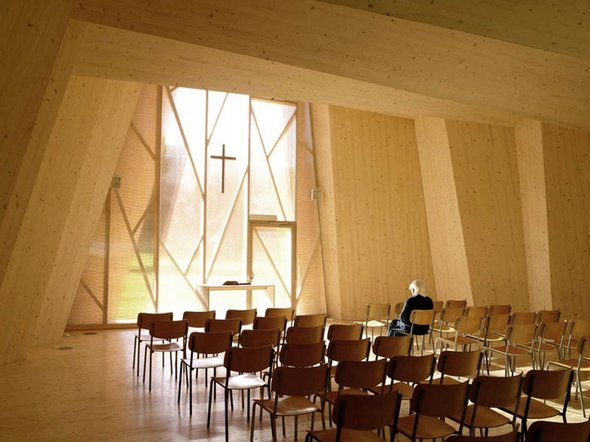
I have had an interest in church architecture for some time.  I have also had an aversion to much of what passes as church architecture today.  It is not that I disdain all things modern but that modernity has delivered to us many church structures for which worship is almost an afterthought.  The focal point of the structures has also shifted from the God whose house we gather by His invitation and favor to the people who have made His house their own, comfortable living room.

In the beginning this was fueled by the modern idea that the early Christian community did not build church buildings, did not even consider church buildings, and saw the home as the principal worship space by design (as opposed to because they had no money or legal standing to build).  Herein the archeology of the last 50-60 years has proven this myth false and rendered much of the premise of modern architecture obsolete.  It appears that there were church buildings used for worship -- from the beginning.  It began, of course, with the discovery of Dura-Europa and a church structure dating from 232 AD.  That has been the spring board for a host of other buildings built or remodeled by the Church for use in the Divine Liturgy.  Some of these were found in ruins but the majority have been referenced in Christian literature of the period.  A great article in the journal for the Institute for Sacred Architecture tells the story well.  

The problem is that we know very little about pre-Constantinian liturgy or Christian architecture. Yet from the scant literary evidence we do have, we should not reject the strong probability that even in the second century the Church owned land and built special buildings for the community. The earliest record of the special purpose church building seems to be from Chronicle of Arbela, a fifth-century Syrian manuscript which tells us that Bishop Isaac (Ishaq) (135-148) “had built a large well-ordered church which exists today.” The Chronicles of Edessa mention a Christian church destroyed in a city-wide flood around 201. Around the year 225 A.D. Christians acquired a piece of public property in a dispute with inn-keepers to build a church with the explicit blessing of Emperor Severus Alexander, who determined “that it was better for some sort of a god to be worshipped there than for the place to be handed to the keepers of an eating-house.”

Thus the disconnect presumed by modern architects who assumed that a focus on the assembly was the earlier direction of church buildings.  It renders some of the old assumptions as suspect.  For example, you can hear the bias built in through the comments of a couple of noted modern architects:

As Father Richard Vosko surmised, “The earliest understanding of a Christian church building implies that it is a meeting house—a place of camaraderie, education and worship. In fact, the earliest Christian tradition clearly held that the Church does not build temples to honor God. That is what the civic religions did.” This notion was put most forcefully by E.A. Sovik, writing: “It is conventionally supposed that the reasons that Christians of the first three centuries built almost no houses of worship were that they were too few, or too poor, or too much persecuted. None of these is true. The real reason that they didn’t build was that they didn’t believe in ecclesiastical building.”

If you plan on building a structure in which the principal activity is worship, specifically the liturgy, you need to read this article.  Its conclusions are inescapable for those who would force upon the Church another structure ill prepared for the Mass, with a focus upon the assembly rather than the Word and Table of the Lord, of a scale that emphasizes the place of the people, and without ornamentation designed to communicate the tenets of what is believed and confessed during the worship that takes place within its walls.

If the domestic model has no sure foundation, then the arguments erected for rejecting the hierarchical and formal models of liturgy; for discarding the sacramental language of Christian architecture in favor of a functionalist and programmatic approach to building; and for dismissing any appeals to the rich treasure trove of Catholic architectural history and various historical styles are susceptible to falling like a house of cards.

Sunday, October 14, 2012

Would that it were so, Joe...

Mr. VP, I know you misspoke but in that error is the hope of many...


These are a few of my favorite things...

The primary and exclusive aim of the liturgy is not the expression of the individual's reverence and worship for God. It is not even concerned with the awakening, formation, and sanctification of the individual soul as such. Nor does the onus of liturgical action and prayer rest with the individual.... So wrote Mgr Andrew Wadsworth...

It almost seems sacrilege to the ear so tuned to Protestant ideas of worship, rooted in the individual and reflective of the individual choice.  I fear that we as Lutherans would be hard pressed to agree with the sweeping statement I have quoted above.  We have become, well, less Lutheran and so we tend to think of worship as the venue for conversion or the domain in which the individual expresses his or her faith, choice, and praise.  We have forgotten much about who we are.

The liturgy is not our domain -- corporately or individually.  It is the domain of Christ and the means of grace that deliver to us what Christ has done in the once for all sacrifice of His body and blood on the cross.  It is the domain of the Church, more than merely the assembled congregation, in which the saints of old and the saints of today receive with joyful faith what Christ has done.  It is not so much a moment in time as the timeless moment in which yesterday and tomorrow encroach upon today, bring the past to the present and in this mystery anticipating the future promised.

We guard the liturgy not because we have some slavish obedience to the past but because this liturgy keeps us from stealing worship away from the hands of Christ and making it into what we do, what we offer, and what we accomplish.  It is entirely too easy for us to fall in love with our own voice in praise so that we forget who is being praised and, worse, forget that such praise is possible only when and where He has revealed Himself to us and given us permission to enter that mystery.

We Lutherans have become victims of our own insecurity so that we judge worship not by its faithfulness to Christ and His means of grace but by the fickle barometer of consumer appreciation.  If the individual likes it, it must be good.  If the individual wants more of it, why it must be great.  All of this would be humorous were it not for the fact that it is so easy and so common to substitute our own desire and energy for the desire of the Father fulfilled in the Son and the for the energy of the Spirit in bringing to our awareness and trust the work of our Mediator and Redeemer.

The weird thing about it is that so many Lutherans have come to believe that liturgical worship is suspect with respect to Jesus admonition to worship in Spirit and in truth and the worship that reflects our desires and delights is somehow higher, more noble, more authentic, and more effective than that silly stuff by the book or by rote.  The individual has taken our thinking captive and stolen worship right from the arms of the Lord who comes with the means of grace that makes it all possible.  His Word is cast aside in favor of our own words.  His gifts become second to the voice of our praise, the offering of our spiritual gifts, and the sincerity of our feelings.  We are so in love with the idea that we love Jesus that His love for us has become secondary and almost inconsequential.  But of course.  Why wouldn't Jesus love us -- we are so lovable!  It is God who is hard to love and so our love for Him is the greater achievement.

It is as if the most authentic worship of all is about me and what I think, feel, desire, and choose.  Little do we realize that much of contemporary worship has more in common with the golden calf than that God of the cross.

Saturday, October 13, 2012

Another perspective on work... reward... and retirement... and vocation

Do we work so we don't have to?  From weekend to vacation to retirement, we increasingly see work as a necessary evil to get where we want to be -- in leisure.  As pervasive as this view is, it is challenged by Luther, by the doctrine of vocation, and by the understanding of life as the arena of work that glorifies God in that work.  So comes the response of noted Lutheran Gene Edward Vieth in responding to Gary Gutting.

Read them both and reflect upon the positions.  I especially like Vieth's affirmation:

"God does not need our good works," Luther taught. "But our neighbor does." Our relationship with God is established solely by his grace in the atoning work of Jesus Christ. But then he sends us out into the world to live out our Christian faith in love and service to our neighbors.

Furthermore, God himself, in his providential care for his whole creation, is working through our human vocations. God gives us our daily bread by means of the farmer, the miller, and the baker. He protects us by means of lawful magistrates. He creates and cares for new human beings by means of fathers and mothers. He proclaims his Word and administers his sacraments by means of pastors. He creates beauty by means of artists and musicians.

and


The economy can indeed be a dog-eat-dog, Darwinistic, self-obsessed struggle, which we yearn to escape---whether on a weekend, a vacation, or retirement. But even the leisure, bought at such a cost, may still keep us trapped within ourselves. The doctrine of vocation, properly understood, frees us from our sinful selves through the gospel as our love for God overflows into love for our neighbors.  Our very work becomes transformed not in its substance---Christian workers mostly perform the same tasks as non-Christian workers---but in its meaning and in its value.

Friday, October 12, 2012

Can such a marriage be real?

Sermon for Pentecost 19, Proper 22B, preached on Sunday, October 7, 2012.

    It might seem a fool's errand to address the subject of marriage in the climate of the world around us.  In the midst of a culture in which cohabitation has become the norm, same sex marriage is approved one state at a time, and divorce is so prevalent, what we heard in the lessons today seems more than old fashioned, it seems downright irrelevant.  It might be nice to think of such a marriage as an ideal but it sounds like more theory than reality.  Yet Jesus is not speaking theoretically.  He is speaking of the Biblical underpinnings of this thing we call marriage.
    Jesus is not trading rules but addressing the foundation on which marriage is built.  That is made clear in the contrast between giving and taking.  Now, no different than in other ages, we are severely tempted to see marriage as there for the taking.  We marry because we have wants and needs we want fulfilled.  Marriage works, then, as long as we take out from marriage what we want.  So the success of marriage becomes the balance scale – are we getting as much as we are giving.  When the time comes and we determine that we are not getting as much as we are giving, then the marriage is at best on the rocks or at worst completely over.
    The temptation and downfall of marriage has always been the idea that marriage is there for the taking.  The Jews of Jesus' day were quick to quote Deuteronomy and justify the divorce of a woman when she or the marriage becomes objectionable – as if any marriage or spouse or family does not become objectionable to us at one point or another.  In other words, when you are no longer getting more from it than you are giving to it.  Jewish culture guarded this right as one given by God, decreed by Moses, and therefore as sacred as the very gift of marriage itself. 
    Judging marriage on the basis of what you get is pretty common.  Giving up on marriage that does not return what you think is faith is also common.  And with it was the idea that, once divorced, the people were free to go on with their lives.  This fragile understanding of marriage continues today – only the right of divorce applies equally to men and women.  We have still muddied up what marriage is and what makes it a gift of God in creation and what makes this blessed relationship the image of Christ and His relationship with His bride, the Church.
    Jesus insists that marriage is not for the taking but for the giving.  He insists that this is not new teaching but the very essence of the gift of marriage when God created Eve and Adam. Adam did not exclaim that Eve was pretty or all he could have wanted in a woman.  Instead he exclaimed in joy that at last he had flesh of his flesh and bone of his bone, completing him and making him whole.  Marriage will always be weak and vulnerable as long as it is defined by what it returns to us instead of providing the arena to give and serve the other.
    Jesus says that in marriage there is no longer two, but one flesh.  In other words, husband and wife give up self.  They are no longer two in some kind of negotiated partnership but both have surrendered self in order that the new creation of their life as husband and wife remains.  St. Paul insists that this is most fully visible in the self-less sacrifice of Jesus for us – giving up heaven and its glory to become incarnate, suffering and dying for us on the cross, and rising to impart to us the immortality that was His.  Husbands love their wives as Christ loved the Church and died for her.  They may not physically die but they die to self to love and serve the other.  Such love is reciprocated by the wife just as the Church, the bride returns what she is given by Christ.
    The whole nature of love is that it does not keep count or measure the giving and the getting.  It is the nature of love that it counts nothing but the giving and it counts this giving as joy, privilege, and willing gift.  In this love, it is not what we take or what we get but what we give that is important.  The marriage Jesus speaks of and Paul writes of is one where the spouse comes before self all the time.  The struggle in marriage is not between husband and wife but within each the battle to love without counting the cost and to give without bitterness, regret, or jealousy.
    A marriage built up taking what you think you deserve is an easy marriage to discard and toss away.  A marriage dependent upon getting more than you are giving is easy to dissolve when the tide turns against you.  But a marriage forged out of the love that joyfully gives and serves as Christ has for the joy set before endured the cross and its death on our account.  Well, how you can simply discard and dissolve such a marriage? 
    We admit this in the vows.  We promise to love not only in prosperity, good health, and in good times but in poverty, in weakness, in need, and in trouble.  This love is really not so rare.  The truth is that I see it all the time.  I see in the people in these pews whose life together endures despite the loss of job, the death of dreams, the loneliness of isolation, the death of a child, the test of affliction and illness, and the fragility of age and approaching death.  You see it too.   This kind of love and marriage is not so unusual but it does not call attention to itself.  It draws attention to the other.  In forgiveness and sacrifice and service we glimpse Christ’s love for us in those who love in His name husband and wife.
    This is what marriage is.  The romance and hope of youth are great but what endures is love that gives without fear, limit, or measure.  St. Paul says look and you will see Christ's love in marriages all around you.  God does not love us like husbands love their wives and wives love their husbands.  It is the other way around.  We love as husbands and wives as Christ has already loved us even to death on the cross.  Love is defined not by rights or obligation but by service, sacrifice, and giving.  We live a world of rights but Christ teach us the language of giving.  It starts here, extends into the home and the world.  And it changes everything we thought we knew about marriage, family, and home.  Amen

Some advice that is worth,well, not all that much...

I admit that I have not thought all that much about advice for the new Pastor.  As I read and listened to a couple of pieces advising the novices, I found myself somewhat conflicted.  I can understand why these folks were saying what they were saying -- go slow, get to know the people, make sure you know the sacred cows before you begin a slaughtering operation...  It is probably good advice.  But I did not follow it.  I went into intensive teaching mode and directed much of the subject matter toward things I identified as needing change right away.  I did not play fruit basket upset but in both parishes where I have served (and not been fired so far) my tenure was marked by a distinct move toward the catholic end of our evangelical and catholic Confessions and practice.

I let them know that the weekly Eucharist was where we were headed and that I would not be arbitrary but that neither would they be voting on this.  I wore Eucharistic vestments from the get to (neither parish had ever seen them before).  I chanted from day one (no previous Pastor had practiced this).  I reintroduced the chalice (after one had only had the individual cups and the other had long ago abandoned the chalice).  I did not ask or make them bow or genuflect or kneel but I did it consistently from the beginning.  I guess I broke all the rules about going slow and winning trust before making such visible and distinctive change.  But I also wondered if I accepted what had been and conformed to it, would that be saying to them that I found such, well, sub-Lutheran practice acceptable?  Tolerable?  And if it were acceptable or tolerable in the beginning why would a Pastor then one day decide to make changes?

In the end I have no advice about introducing change -- especially liturgical change.  I was who I am from the beginning.  I kind of think they knew I was different from my predecessors.  But while I was modeling such things and doing them, I was also doing what the advisors always tell you to do -- love your people, pray for them, be patience with them, teach them, display a sacrificial and pastoral heart to them...  I had folks who thought my Sunday morning practices at least a bit odd if not downright weird but Monday night I sat with them at the hospital waiting room and prayed when the news was bad and early Wednesday morning I rushed to the house when their broken hearts and broken lives intersected and postponed a vacation and day off or two or two hundred to remain with them when death left them grieving and alone.  When I asked for things I shopped around so that I gave them some choices and options and let them know I wanted the dollar to go as far as I knew they did.  I tried to listen as much as or even more than I spoke and often just venting was enough to diffuse discontent.  I don't know how to advise this or teach it.  I learned it by doing and by failing as well as succeeding in this endeavor.

I have no clue what they tell seminarians today.  I was told a bunch of hogwash about people who would follow their Pastor into the burning fires of hell if he so much mentioned it.  No one has ever volunteered to go there for me or even with me.  But I have learned that the people in the pew are neither impediments to my ministry or enemies.  At times, at least in the beginning, I had doubts about this.  I hope that those candidates about to be ordained have a bit more realistic idea of what to expect than I did though I doubt anyone can ever be fully prepared for the parish.

Disappointment is inevitable.  You have a great setting in Seminary -- good musicians, great preachers, good teachers, fine role models, etc...  And then you come out of Seminary to find a parish with a person who had a few years of piano before being told he or she was an organist... and you find out you are not as good a preacher as you thought.... and you struggle and fail to teach like the teachers who taught you... and your role models are far away from where the rubber is hitting the road by you...  It is impossible not to flirt with some disappointment and depression the first year or ten.  I still do.  Despair is, in many ways, the constant companion to parish successes.  Maybe it is inevitable.  Maybe it is by design.

One thing I will say.  Don't ever become a Pastor unless you are convinced it is the only thing you can do.  There.  I violated my own rule.  I gave you some advice that is worth not all that much.  Just consider the source and move on to the next blog...

Thursday, October 11, 2012

When you get to my age...

I had a funeral the other day.  The woman was a former member of the choir, pianist, and part of a salt of the earth couple married just shy of their 61st anniversary at her death.  She was almost 82 at the time of her death.  She was very close to the age of my parents and my in-laws.  Funerals like these have ripples well beyond the individual whom we commend to the Lord.  I was thinking of it in one way but the words of another member of the parish framed it all quite differently.

"When you get to my age," he said, "every funeral you go to is like a rehearsal."  Now there is something to think about...

It was not that long ago -- I remember it as a child -- when people did not think in terms of retirement.  They generally worked right up to death.  In farm fashion, this often meant the parents moved to town while the farm home was given to the son (or daughter and son-in-law) who was to continue the farming tradition.  It was not really a retirement -- these folks did pretty much everything they had done on the farm but they had to drive out there from town to do it.

Now retirement has changed the way we look at life.  The prospect of giving up work you have to do for the work (hobbies, interests, etc.) you want to do, has become very attractive.  There is not much Biblical about this notion -- try to find a work that means something like retirement in the Bible.  Can't be done.  It is not there.  But that has not stopped us from redefining life and seeking that day when work ceases and, as some retired folk are want to remind me, the real work begins.

Once age was just a birthday -- sometimes a milestone -- but a day not all that different from any other day of work, eating, and rest.  Now getting to a certain age in relatively good health is a pretty big goal for most folks approaching the late 50s and early 60s.  We have created a parallel universe in which we look forward to the surrender of the time clock, bosses, and due dates to be free to do what we want (so long as we can afford it).  I appreciated the honesty of the fellow who said the the funerals he attended had become dry runs for his own mortal future as well as that of many loved ones around him.

One thing retirement has done is move even further from our radar the idea that life is limited and that death waits for us all.  I recall a shut in from early on in my ministry.  She complained that her husbands pension was miserably small.  In the 1980s it was about $150 a month.  Her husband had worked as a New York City policeman, beginning his service after he left the army following WWI and ending his time about 25 years later.  At that point they had moved upstate and he began collecting his pension while beginning a new career in a lumberyard.  He worked there for 20 more years before retiring and then dying not so many years later.  I reminded this shut in who was then in her mid-90s that the NYC police retirement fund had not planned on her living so long and still collecting on his pension.  They had expected the two would have died many years before.  Image that.  Two careers and two retirements!  BTW this same lady sometimes said that all her friends were long dead and she did not have much chance for any real decent sins since she lived alone and seldom left the house!  She was a hoot. She would have understood that comment -- every funeral I attend is like a rehearsal.  She was not trying to put off death.  She had been ready for a long time. 

I don't think such talk is morbid or depressing.  It is in the glimpse of reality that the grace of God is made even more profound in our eyes.  To be sure, there is a certain sadness in every funeral and I understand it.  I shed my own tears for many of those who were more than mere names to me.  But it is also healthy to realize our own mortality and to remember that every funeral is, in that very real sense, a dry run or rehearsal for your own.  In life, in death, and all the days in between, abide with me, O Lord... Abide with me.

Wednesday, October 10, 2012

Two watches... no right time...

A person with one watch knows what time it is; one with two watches is never quite sure. So says an old saying that addresses the same issue of Scripture when Jesus says no man can serve two masters.  This is the problem with the kind of diversity in which we present two (or more) different faces.  We are never sure which face is the real one.  It reminds me of my Grandma telling me that if you tell the truth you don't have to remember how you spun the lie when you have to say it again.

Quite apart from anything else, Lutherans faces the problem of several watches and therefore no sure time.  For our early history and for much of the time following, who we are was shaped by our Confessions.  Our practice flowed from those Confessions.  We wore one watch.  Oh, to be sure, there were folks who deviated from our Confessions and those whose practices conflicted with those Confessions.  There will always be.  But the difference was that those who deviated in confession and practice were both seen and identified as exceptions, challenges, and even errors.  They were not the showing the correct time of Lutheranism (to extend the metaphor).  Now, the whole culture of diversity has said that Lutheranism wears many watches and we are have our own time.  It may be close but the preciseness of the time is less important than the fact that we all have our own watches.  In other words, Lutheranism has many faces, many definitions, and none of them is necessarily wrong or not authentic.  Lutheranism can exist in the form of a seeker service with contemporary music pumped out by a praise band and Lutheranism can exist in the form of the sung Divine Service and pipe organ and chanting and incense.  In this sense, Lutheranism is more of an idea than an entity.

The problem with this is that when we wear many watches we don't really know what time it is.  When Lutheranism wears many faces, no one knows what Lutheranism looks like.  When we embrace many confessions and practices we have no set confession or practice.  We don't know who we are among ourselves as a Lutheran family and so we don't know how to present Lutheranism to the world.  Nearly all of us know how untenable this is so we fight internally over contemporary vs traditional, maintenance vs mission, progressive vs repristination, modern vs ancient, etc...  What the world sees is a Lutheranism wherein even the Lutherans are not sure who they are.  Who wants to join such a church?

I am tired of the worship wars and the debates between inward focus or outreach.  We fight the same straw men over and over again and no one wins.  It seems to me we are arguing about something we say is already settled by our Confessions.  It seems to me that the only authentic face of Lutheranism is the one that still confesses what we have always confessed and the one that looks like those Confessions on Sunday morning.  If we want to be something other than this kind of Lutheranism, then we need to either ditch our Confessions or join a church body whose faith and practice corresponds to what we think and want to do.  Now, don't get me wrong, I don't want anyone to leave Lutheranism.  I would much rather that all Lutherans simply decided to be who we say we are in our Confessions and to make our liturgical, mission, and parish practice conform to those Confessions.

If you wear two watches, you never know which one tells the right time.  If Lutherans confess many confessions and wear many faces before the world and tolerate many practices on Sunday morning, we are like the man with many watches but who cannot answer what time it is.  The world pays attention to those who know what time it is -- they may reject them but the world has little respect for those who have no confidence in their convictions.  Think how we show our disdain for politicians who have no firm positions.  Again, my plea is not for anyone to leave but for us all to look at what we have said we believe and how this Confession is lived out in practice and to be what we are.  Period.

Tuesday, October 9, 2012

Repost of old "news...."

* * *
The latest Vineyard Music worship CD, “Intimacy, vol. 2,” has raced to the top of the Christian sales charts, but Wal-Mart is refusing to stock the album without slapping on a parental warning sticker. The ground-breaking — some say risqué — album includes edgy worship songs such as “My Lover, My God,” “Touch Me All Over,” “Naked Before You,” “I’ll Do Anything You Want,” “Deeper” and “You Make Me Hot with Desire.”
“We’ve had concerns about previous Vineyard CD’s, but this time they went overboard in their suggestive imagery depicting the church’s love affair with Christ,” said a Wal-Mart spokesman. “It would be irresponsible to sell this to 13-year-old kids.”

A Vineyard Music Group (VMG) spokesman defended the album. “We felt this was the next logical step in furthering people’s intimacy with the Lord, as the title implies,” said Sam Haverley, director of VMG public relations. “People aren’t content with yesterday’s level of closeness. They want something more. We feel this album gives them that.”

Wal-Mart represents a third of all CD sales, which has forced VMG to try to negotiate a deal. VMG proposed adding a heart-shaped warning sticker rather than the black-and-white label more often seen on raunchy rap albums, but Wal-Mart refused. VMG is considering issuing a censored version of the album.

“If Christians want to make R- or X-rated music, that’s up to them,” said a Wal-Mart spokesman, “but we don’t have to carry it.”
- Lark News, April 2003

Monday, October 8, 2012

The large number of very small congregations...

Somewhere it was pointed out that the average Protestant congregation has less than 75 members and an attendance of something between 30-50.  Even if those figures are off by a little, they are not off by much.  In the LCMS we have 1500-2000 parishes that come close to these numbers.  In other words, we have almost one third of our total congregations that fit this scenario.  Again, my point is not the numbers but the overall concern.

Some try to approach this from the vantage point of the top down.  Some voices have been raised to say that some, perhaps many, should be closed.  Period.  In the Roman Catholic Diocese of Milwaukee there is talk of closing half of their parishes and consolidating them because of a priest shortage and too many parishes too close together.  Others have been more blunt.  The excess capacity is NOT due simply to bad real estate (location, location, location) but to the fact that Mass attendance hovers around 20-25% of Roman Catholics.  The issue is not how big or where our buildings are but how few are attending regularly.  In this respect, we Lutherans share the same problem with Rome.

I am not an advocate of closing parishes (at least in general).  Neither am I an advocate of serving them with some sort of bandaid approach to ministry (read that deacons) until the last person in the building turns out the lights as they leave.  I think that the radical alternative is to renew these parishes.  Sure, some of them are in places where population declines have literally swept their potential community out from under them.  Funny, though, some of those who should be dying aren't and some who should not, are.  Statistics don't tell us everything.  The last thing I would advocate is giving up being Lutheran to emulate some other denomination or confession in their values and methodologies.  We will not rescue anything by betraying our confession to add a couple more bodies to the pews.  Either we will grow as Lutherans who confidently confess and live out that confession or we should simply leave and become the kind of Christians we envy so.  Common sense added to our courageous and confident confession will accomplish God's purpose.  Period.

One Roman Catholic has put together a set of questions for those who complain about dying congregations or closed churches: One may also ask the parishes that will be closed or clustered, a few questions, and these questions teach, even as they ask:
1. When did you start to notice a significant decline in membership?
2. What response was made to that decline?
3. Did the pastor and people work to evangelize?
4. Were drifting members ever contacted and encouraged to return?
5. How did the older members of the congregation fail to hand on the faith effectively to their children?
6. How did the Pastor and catechetical staff fail to hand on the faith effectively to the next generation?
7. What sort of financial plan was developed to secure the Parish’s ability to pay its bills?
8. When was the last time there was a vocation from this parish?
9. What is done to foster vocations?
10. Has the parish carefully maintained its buildings, or are they in disrepair?
11. How open is the parish to the wider community in which it exists?
12. Has the parish simply depended on [others] for vocations and monetary shortfalls or has it been carrying its load?
13. Did the pastor ever really level with his people as to how critical the problems were becoming in both the parish and the [District]?
14. How did things get this bad?

Although it is tempting to think that the solution lies with methodologies or with staff, I am not so sure.  I think that much of our problem is that we act like the defeated who cannot hope for anything better, that we have come to believe that we have nothing to offer the community and are here only to serve ourselves, and that our Lutheran identity just does not "sell" in the current market.  We do not need a marketing guru.  We do not need to clone praise band members.  We do not need to mirror the malls in church design.  We do not need to mimic the preaching of America's pulpit sweetheart Joel Osteen.  We simply need to be who we are.

There is just simply no avoiding the fact that, nationwide, only 20-25% of Lutherans are in Church on Sunday morning. Perhaps we are a church body not of 2.3 million members but of 800,000 or so who are actually in Church on Sunday morning.  Family sizes, birthrates, cohabitation -- these all contribute to the lack of Lutherans there but they do not explain why our kids are marrying outside and joining other churches or why the children we have are not there or why we are virtually invisible to the community around us. Financially, we Lutherans put 1-2% of our income in the plates.  These smaller parishes might be more viable if we gave more and what a tailwind it might be if we could turn our attention from paying the bills to speaking the Gospel in our neighborhoods and communities.

I am NOT ready to give up.  I am NOT ready to settle for makeshift ministers to simply prolong the agony.  I am NOT willing to exchange our theological integrity for a flash in the pan solution that betrays who we are.  I do believe that we possess the seeds of our success -- they are and always have been the means of grace.  Our confidence in these is key.  Our application of this preached and visible Word should be without embarrassment or apology.  A robust ministry begins with a robust Divine Service (speaking here not of all the bells and whistles but of the attention and priority given to the Sunday service -- source and summit of our faith and endeavors).  

Recently my District's church planting committee reported that they are focusing on planting congregations primarily in communities of 30,000 or more, that can be expected to "worship" (hate that phrase) 500 or more, that grow primarily through conversion (not transfer or renewal of lapsed Christians)... This in a District that has more than a third of our parishes which the church growth experts see as dying or no longer viable.  What might happen if we were able to invest and support and turn around even half these smaller congregations?  As we sat in convention listening to this, many of the delegates sitting at the tables came to the sober conclusion that this mission strategy has effectively written them off.  We can do better.

Sunday, October 7, 2012

The Top 25 God Songs

What's on YOUR Ipod?  If you are evangelical, chances are what you listen to in the ear buds or from your local Christian radio station or what you hear at church include a healthy smattering of the CCLI top 25.

I know that my folks never encounter this in church on Sunday morning but I also know a healthy segment of the faithful Lutherans in the pews have this kind of music running through their eyes the rest of the time.  Perhaps it is no different where you live.

October 1, 2011 and March 31, 2012). Report Period 1011 - United States
RankSong TitleAuthor/sCCLI#
1How Great Is Our GodTomlin, Chris\Reeves, Jesse\Cash, Ed4348399
2Mighty To SaveFielding, Ben\Morgan, Reuben4591782
3Our GodRedman, Matt\Tomlin, Chris\Myrin, Jonas\Reeves, Jesse5677416
4Blessed Be Your NameRedman, Beth\Redman, Matt3798438
5Here I Am To WorshipHughes, Tim3266032
6Revelation SongRiddle, Jennie Lee4447960
7Everlasting GodBrown, Brenton\Riley, Ken4556538
8Amazing Grace (My Chains Are Gone)Tomlin, Chris\Giglio, Louie\Newton, John4768151
9Jesus MessiahTomlin, Chris\Carson, Daniel\Reeves, Jesse\Cash, Ed5183443
10In Christ AloneTownend, Stuart\Getty, Keith3350395
11Your Grace Is EnoughMaher, Matt4477026
12ForeverTomlin, Chris3148428
13Open The Eyes Of My HeartBaloche, Paul2298355
14Forever ReignMorgan, Reuben\Ingram, Jason5639997
15How He LovesMcMillan, John Mark5032549
16You Are My King (Amazing Love)Foote, Billy2456623
17Holy Is The LordTomlin, Chris\Giglio, Louie4158039
18From The Inside OutHouston, Joel4705176
19Hosanna (Praise Is Rising)Baloche, Paul\Brown, Brenton4662491
20Shout To The LordZschech, Darlene1406918
21Come Now Is The Time To WorshipDoerksen, Brian2430948
22The StandHouston, Joel4705248
23HosannaFraser, Brooke4785835
24Lord I Lift Your Name On HighFounds, Rick117947
25Glory To God ForeverFee, Steve\Beeching, Vicky5384338

If you are like me, you probably only recognize a handful but that does not mean Lutherans, Roman Catholics and others are not using these either at home or in the car or at church.  In the Internet Monk discussion of the three new break out hits to make the list, a certain Miguel in the comments made this observation:

Reasons these songs are popular:
1. They’re simple. Their chords usually only change on downbeats, and you can teach it to your church band quickly.
2. They’re written by celebrities. I’ve heard far better songs written by the unheard of.
3. They’re recorded with top notch production. Trust me, if it was up to the way YOUR church sounded doing these songs on Sunday to make them sell, they’d be going nowhere fast.
4. They get exorbitant amounts of radio play on the three big Christian radio stations. People have been brainwashed into expecting to sing their radio pop favorites on Sunday morning.
5. The musicians are usually the other extreme from ugly. (My wife has a crush on Joel, not sure if it’s the accent or the hair, but she got irate when I suggested one of his songs for Sunday).
6. They are marketed like nobodies business. The machine behind these releases could rig nearly ANY song up to the CCLI top 25, and IMO, these songs prove this.
7. They are demographically targeted at youth. See “the Merchants of Cool” documentary: Cut and paste from the MTV playbook.
8. But most importantly, they don’t require deep thinking or doctrinal commitment/understanding to sing.


I think his eight points are pretty fair.  Church music is big business.  Whether you are Hillsong or Hilldale (that is the church next door).  It is no longer a hand maiden to the Word.  It is a cash cow for the producers, an earthly measure of success for the musicians, and a feel good medicine for the listeners... That cannot be denied.  I am glad that people are listening to this instead of the vulgar stuff that glorifies all sorts of evil (secular music) but I am not sure that this music is all the friendly to the cause of the Gospel.  Music has become a personal expression of taste and less a medium of confession and truth.  The sound of it is much more important that what it says.  It is beat driven instead of Word driven (remove the percussion and you cut the heart out of this music).

I do not think it is fair to write it all off and smugly open our hymnals as if this other stuff did not exist but neither do I believe that this Christian pop rock has a place in the liturgy.  We need new music, new hymns, new songs for Sunday morning -- this just ain't it!  And, sadly, the reality it that for too many (especially the younger end) this is the ONLY thing they hear.... 

Saturday, October 6, 2012

What do you see... Whom do you see?

Sermon preached for Pentecost 18, Proper 21B, on Sunday, September 30, 2012.

    How easy it is to interject competition into the nature of things!  Like children who compete endlessly over things trivial, we often take that which is great and make it into a competition.  It is as if we forget how lavish God’s generosity is and so we fear that our prayers are competing with the prayers of others for God’s notice and His answer.  It is as if we fear that God’s grace were in short supply and therefore if He is gracious to another, we will have suffer. Sometimes, we even turn the work of the kingdom into such competition as if were all fighting against one another for the same market share.  In such competitive thought, we all want to be the Wal-Mart’s of Christianity and forget all that Christ has told us of His kingdom.
    Once Joshua came to Moses fearing that Eldad and Medad were in competition with Moses’ authority and the seventy elders whom God raised up to assist Moses with the heavy mantle of leadership.  But the surprise is that Moses is not jealous nor does he fear the work of others.  In the same way Jesus’ disciples come rushing to the Lord telling him of one who casts out demons in His name but was not one of the disciples.  Make him stop they pleaded but Jesus is not concerned.  The kingdom of God is not a competition for power jealously guarded.  He who is not against Me is for Me.  Jesus is not looking to His side but toward the goal.  That is the struggle in the Church.  When we look at either side to see what others are doing, it is nearly always the path of spiritual ruin.  Spiritual success remains keeping our vision focused upon Christ, the message of the cross, and the grace of God.  Focus on anything else and spiritual ruin is sure to follow.  Focus on these and heavenly glory is our sure reward.
    This theme has continued over the last few weeks.  The authority of the Word is not diminished by many faithful voices speaking forth the Gospel.  Just the opposite.  To be sure, we cannot ignore when error is proclaimed as truth or the cross is displaced by other gospels.  We hold others to the doctrine of the Word and we are also held accountable to that same Word.  But we cannot do the Lord’s bidding in church, house, home, and neighborhood when we look sideways instead of at Christ.  We cannot do God’s bidding faithfully if we are more concerned about others competing with us than our own constant struggle to be captive and faithful to the Word of God and the cause of the Gospel.
    It is not the brand name we must jealously preserve but the faithful proclamation of the Gospel and the administration of the Sacraments.  My greatest concern for the health and life of this congregation and of the church to which we belong is not that we are not as competitive as others.  My greatest fear for us is that we are more concerned with what others are doing instead of our own call to be faithful to Christ and His Word right here and right now.  We will be held accountable as a church and as individual Christians not for the successful statistics so impressive in the world but for our faithfulness to Christ and His Word.  Our focus is not on those on either side of us but upon the Christ who suffered and died and rose again, and who called us to lift high this cross in His name to the ends of the earth.  The Church will not be judged faithful because of how well we stack up against our competitors.  We will be judged on our faithfulness to Christ and His Word.  In the same way, we as individual Christians will not be judged by God on earthly measures of success but by faithfulness to Christ and His Word.
    Our Lord has promised heavenly reward to those who act faithfully in His name.  That is where we are focused.  Competition is a needless distraction to the work that God has called us to do.  We are not in the business of building bigger earthly kingdoms but in building the Kingdom of Christ through the faithful administration of the means of grace.  Period.  How much good work is undone when we look more at what others are doing than keeping our vision focused upon the Lord and His Word?
    The righteousness we raise up before the world is not the righteousness of our own accomplishment but the holy life of Christ lived for us and the holy sacrifice of Christ on the cross for us.  This is what gains heavenly reward.  The ways we serve are always important to us but it is the service to the Gospel that is important to God.  Let me give an example.  The Pharisees were jealous of their rights, power, and privileges.  When John the Baptist came on scene they saw him as competition and worked carefully to undermine him instead of heeding his message that the Messiah was to come.  When Jesus came to fulfill John’s promise, He was likewise judged by the wrong criteria.  So fearful were they of competitors, they did in the realm of faith what Herod tried to do against a child he feared would take his crown away.
    That faithfulness to which we are called is demonstrated by Jesus over and over again.  In His day, the children, the disabled, and the women did not count.  But Jesus counts them.  He touches the untouchables with their illness and death.  He eats and drinks with sinners and in their own homes like we heard of Matthew a few weeks ago.  He holds up a child as the model of faith and says whoever serves this child does the good work of the kingdom.  Where the Pharisees were concern about where Jesus came from, Jesus showed forth the Kingdom of God in His faithful words and works.
    Our focus is not on those around us as if they were competitors with us.  Our focus is always on the competition within us to be faithful to Christ and His Word, to faithfully speak and live the good news of the Gospel, and to faithfully demonstrate the words of our lips with the actions of our lives.  It is great temptation to think that others have it easier than we do or that others are being more successful than we are.  Whether as a church or as individual Christians, the cause that needs to be our great concern is simply Christ and His Word – believing it faithfully, confessing it faithfully, and living it out faithfully.
    Our vision of Christian faith and life are clouded when our view is sideways and our vision is clear when we see Christ only.  That is what Moses had to remind a fearful Joshua and what Jesus had to teach distracted disciples and what we come for each week – to turn away from the distractions and to see Jesus, to repent our unfaithfulness and be forgiven and restored, and to go forth with this clear vision of Christ and His Word ever before us for one more week.  Amen.

The power of the spoken word...

One of the by-products of the near collapse of private confession among Lutherans, its shift from regular to occasional use among Roman Catholics, and its eclipse from the rest of the Christian world is that sin has become an internal matter.  Christians have become accustomed to speaking their sins only in their minds instead of out loud.  For Lutherans this means that the closest we generally come to actually admitting sins are the words of the general confession found in the service books.  It is always easier to confess sin in general than it is to specifically name our sins and it is always easier to confess sin when our voice melts into the many voices of those who say exactly the same words we say than it is to speak into the silence the sins we have thought, said, and done.  But, I would contend, that just as only confess sin in the vague generalities of common words or in the quiet of our hearts, so we are only absolved in general and in the hidden thoughts and recesses of our hearts and minds.  It is often difficult to know this forgiveness when the sin has never been spoken out loud and the absolution has never been spoken out loud or spoken personally toward the sin.

The "I don't have to confess my sins to anybody" has come to mean "I confess my sins to nobody at all."  I believe that there is grave danger for our spiritual lives in treating sin as an internal matter.  One of the dangers is that sin is never really owned until it is spoken out loud.  I well recall the first time I went to private confession and stumbled around with words that helped me get this off my chest but did not really communicate what it is I had thought, said, or done.  In the end, my father confessor was kind enough to ask me pointed questions.  Then and only then did the sin come spilling out of me.  I am not sure whether it was primarily out of embarrassment to name these sins before someone I knew or the difficulty I had owning up to the fact that these were sins.  I tend to think the latter was harder.  It was not the first time I had confessed them.  I had prayerfully confessed them in my heart many times.  I had thought of them while confessing the general sins of thought, word, and deed, of commission and omission, on Sunday morning.  But I still carried their burden and it was not until I said them out loud and heard forgiveness for these specific wrongs that I began to feel the full measure of the freedom of the absolution.

Part of the reason that sin and forgiveness are so difficult for us to handle in our lives together is that we seldom speak the sin out loud to the person we have wronged.  We simply say "I'm sorry" as if that is all that needs to be said.  So that forgiveness may heal the personal breech on earth as God has healed it in heaven, it is most helpful to actually say what it is that we are sorry for -- to address the sin as something real and evil is to speak its name out loud.  Of course, the response is equally vague -- "It's okay."  Well, if it was okay, why in Sam Hill did you make me say my sin out loud?  If we confess that sin specifically, then the least we are owed is a real absolution.  Not "It's okay" but "I forgive you."

In the old confessional service of The Lutheran Hymnal, there were some questions and answers designed to pump and prod us a bit before simply making the general confession.  Half of those question on page 48 dealt with confession and repentance but the other half dealt with the absolution.  It was not a substitute for private confession but it was certainly a more profound act of contrition than the general words we speak on Sunday morning.  If the Exhortation was used, the individual sins were not mentioned but the effect of that sin was laid out in unmistakable terms.  It is not just that we screwed up but that we were complicit in evil.  Here I am reminded of Berhold Von Schenk's old line, "I know the devil and I have done business with him..."  By speaking our sins out loud we not only own them but we identify them as evil and wickedness.  This is seldom done much anymore.

If we do not take sin seriously, it might be, in part, because we seldom speak of our sin's out loud and we hardly ever identify them as evil or conspiracy with the devil.  If we do not take sin seriously, it might explain the way we excuse and justify what we have done while holding others to a much higher standard.  If we do not take sin seriously, it is easy to know why the cross is so quickly ditched in favor of other subjects. We treat confession and absolution are merely preliminaries to the bigger and deeper subjects of the faith instead of the very nature of the faith at work.  No, I vote in favor of speaking the sin out loud so that the absolution may be heard out loud and the matter resolved by the power of grace.

I recall an old movie about a Roman Catholic boys school in Brooklyn in the 1960s.  One youth was being honest and forthcoming as he stood in line waiting for confession.  When a hot shot came over and asked him what he was going to confess, the hot short insisted he could not say that to a priest or would spend eternity doing penance.  Instead, like a bookie keeping track of odds, the hot shot taught the kind to be less specific and more general and to admit only what seems reasonable.  In the end the kind received an absolution worth about as much as this half baked confession and it left him with no comfort before his guilty conscience.  The blessing may come through the confession but the blessing is the absolution.  Both need to be honest, forthright, and pointed or they too easily become just words.  Heaven help us, indeed!


Friday, October 5, 2012

What a deal I have for you....

You won’t find a better opportunity to acquaint yourself with the hymns and songs of Martin Luther than this.
Concordia Publishing House’s set called, Martin Luther: Hymns, Ballads, Chants, Truth is available in MP3 download format at Amazon for only $5.49.

This set features 39 pieces composed by Luther, interspersed with some of his spoken quotes about the Divine gift of music to encourage our faith and express our worship. I bought this a few years ago and have enjoyed it immensely.

The blurb at CPH says:
This monumental recording project presents, for the first time, a complete recording of all the hymns, ballads, and chants composed or authored by Martin Luther. This four-CD set provides numerous vocal and instrumental settings combining Renaissance, Baroque, and modern instruments.
Many hymns are preceded by preludes composed by significant historic and contemporary composers. All texts are sung in English by a choral ensemble noted for vocal clarity. Historic narrative is provided, quoting Martin Luther concerning music, worship, and liturgy.
The CD retails for $44.95 (on sale now for $34.95 unless I am mistaken), so this is a great deal. If you click the link above, you’ll be taken directly to Amazon’s page for this recording.

HT to the Internet Monk for pointing this out!