Wednesday, August 15, 2012

Mary Day... a few thoughts...

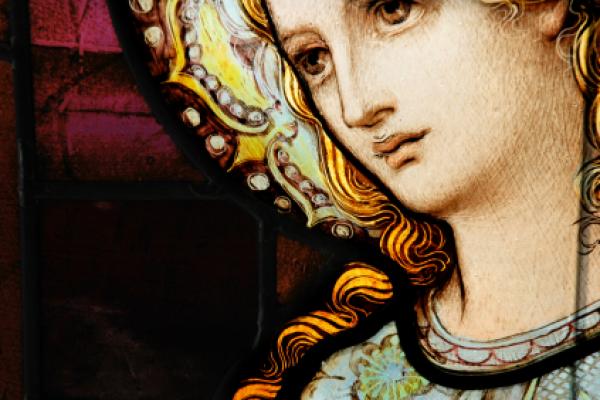
For Catholics, Mary is like the moon, for her light is always a reflected light. Whatever we say about Mary is meant to draw attention, not so much to her, but to Christ. Thus, for example, the claim that Mary is the mother of God is an indirect way of affirming the facticity of the Incarnation. Our feast for today--the Assumption of the Virgin--is similarly Christological in focus. It is meant to highlight the reality of Jesus' bodily resurrection from the dead. As the first and greatest disciple of the Lord, the Virgin Mary shares in the effects of this event, participating body and soul in the new life opened up by Jesus.

These words from Fr. Barron in an Assumption Day sermon resonate well with Luther and his own high view of the Blessed Virgin.  He does not suggest that we cannot or should not look at Christ but he does carefully point out that Christ's reflected light is the glory of the Virgin Mary and all the saints.  It is in this vein that the Lutheran Confessions commend the saints to us.  Charles Porterfield Krauth notes that the doctrinal sections of the AC begin with God and end with the saints -- a most appropriate perspective.  The Confessions call upon Christians to honor the saints by telling their stories (the history of the saints) so that we may follow the example of their faith and of their good works, as appropriate to our baptismal calling.  the joy of the saints' company is not that they invite us to focus on them. Rather, the very mark of the saints is that they invite us to focus with them upon the Lamb who redeemed them with His own blood, sanctified them in the waters of Baptism, and made them shining witnesses to the glory of His resurrection. They are not dead. They live in Him. Their spirits join us (and we them) in the Divine Liturgy (Hebrews 12!) and we sing a united song with angels, archangels, and with all the company of heaven. "Holy, holy, holy!"  (Borrowing a few words from good friend Pr Will Weedon here.)

Before we begin a polemic against the transformation of Mary's Dormition (falling asleep day) into her Assumption, I am pleasantly surprised by the nuanced words of Fr. Zuhlsdorf:  Although Ven. Pius XII also refers to Mary’s death in the document whereby he declared infallibly the dogma of the Assumption, and Bl. John Paul II advert’s to Mary’s death – as do some saintly writers – we do not know by a definitive or infallible teaching beyond a shadow of a doubt whether Mary died and was assumed body and soul into heaven at that moment or if she was assumed without dying.  We know with our Catholic faith, and by infallible authority, that at the end of her earthly life, the Mother of God was assumed into heaven and no stain of corruption touched her, in life or death.  For a long time I had, apparently wrongly, assumed that the Assumption was the replacement for her death, a prevention of that falling asleep to join the ranks of Enoch and Elijah.  I would suggest, however the tension between the honors Rome has accorded to her and the words of Fr. Barron that began this little piece -- words that suggest the light is not in Mary but reflected from Christ who is the Light.

Whatever, I think we Lutherans are wrongly suspicious of Mary and the saints.  I would hope that on this day we can echo the thought of Luther and of Fr. Barron and honor her as first Christian, first disciple, and one who shown with borrowed light.

Mom.... There's Jesus!

It was more than a generation ago.  I was standing at the counter in the Post Office doing my least favorite postal duty -- bringing in the trays of presorted bulk rate mail to go out at the discount rate for non-profits before a Post Master determined to find something wrong with what we had done.  Anywho, while standing there in line a child from my parish walked in with his mom.  They got the mail out of their box (we all used PO Boxes back then) and they stood in line a few folks behind me.  I watched him tug at his mom's coat until finally she bent low and he whispered something in her ear.  "What did he say?" I asked.  He said, "Mom, there's Jesus!"  It could not have come at a better time.  The Post Master was ready to begin some complaint about our work on the bulk mail and heard the woman repeat what her son has said.  So I turned to her and said, "Well, pretty close."  With that, the business was done and the gruff man at the counter took the monthly newsletters away to disappear for a few weeks before magically showing up in the mailboxes of our members.

When I told that story to another, she said "You didn't!" as if it were naughty joy.  But I did.  And it was not exactly naughty joy (though, truth to be told, there was some of that in it).  Children do see their Pastor's as Jesus.  Perhaps it helped that I had a beard.  Perhaps that made no difference at all.  To this little four year old, I was Jesus.  I was the one whom he saw hold babies in my arms at the baptismal font (for Jesus).  I was the one who preached from the pulpit (for Jesus).  I was the one who handed the host to his mommy and daddy (for Jesus).  It was not that I was the same Jesus whom he heard about in Sunday School (who walked on water 2,000 years ago) but I was still Jesus for him.  That is the nature of the Pastoral Office -- to be Jesus for the people of God.  What that means is that Jesus is the Word that borrows my voice, the baptizeer who borrows my arms, the host who feeds with my hands, etc.  That identification of the Pastor as Jesus is not a bad thing (to a point, of course).

 What is sad is when people no longer see Jesus in their Pastors.  I do not mean that they know his weaknesses and failings and no longer believe him to be infallible like the child may (for a brief moment of his life, anyway).  What I mean is when the people begin to see only the hands, only the arms, and hear only the voice and it ends there -- when they fail to see how hidden in the fragile and flawed flesh and blood of that Pastor and his ministry are the means of grace and the work of Christ.  When that happens, everything gets diminished.  The sermon then becomes only one man't opinion or take on things (maybe to be rebutted by another side -- if only to be fair).  The sacraments become merely signs with no power to convey what they signify (comforting ritual without the power to deliever what they sign).  The vestments become all about the Pastor and not about the office of bearing Christ to God's people.

There are those who are happy when such identification of Christ with the Pastor fades.  They have had enough of people and their god complexes -- but that is not what I am talking about.  The Pastor is not God but God is in the Pastor and the ministry he brings of Word, Sacrament, counsel, comfort, admonition, and encouragement (edification is the old word).

The collar helps in this -- both to remind the Pastor it is not about him and to remind the people it is not about him, either.  It is about Christ.  I miss the old days of walking down the halls of the small hospital near my first parish and having folks call out "Hey Pastor (or Father), would you pray for me?"  I miss the warm smiles in the small nursing home when I came to visit and it seemed every wheelchair in the place was lined up for them to see Jesus (to see Jesus in me and my ministry to them of Word and Sacrament).  I miss the people who waved because they saw the collar and, whether or not they knew me, it reminded them of Jesus.  I even miss those who whispered expletives deleted under the breath because of seeing the collar -- for good or ill, they saw that collar and they were reminded of Jesus, perhaps convicted by Christ for something in their past).

I recall once sitting at a table at a wedding reception following the service of marriage at which I had just presided.  My wife was not able to attend and I was there alone, at a table of folks I barely knew (why do they sit a Pastor with all the troubled folks and black sheep of the family???).  Anyway, one guy at the table, perhaps 70 years old, an old German, could barely contain his contempt at me.  Finally he blurted it out.  "Pastors are nothing but g__ d____ blood sucking leeches!!"  The silence at the table was more unbearable than his words.  I choose not to respond but, shortly there after, excused myself and thanked them for their company.  The man was not cursing me.  He did not even know me.  He was cursing God.  We do that sometimes when the hurt becomes too great to bear.  Years passed by and a member asked me to visit her dying sister whom she was caring for (her husband just could not handle it, she said).  You might know where this is going.  When I had the funeral for this woman, I discovered her husband was that man at the wedding reception.  He had refused to ever be there when I came to her but now it all became clear.  He was angry at God for his wife's illness.  Who wouldn't be?  Some days after the funeral he came to seem me at the Church.  He came with tears and anger and the heaviest pain of loss.  He came seeking hope where none had been and redemption that his wife might be more than a memory.  He came with repentance over anger for her illness that had robbed them both of the final days she lived.  He came because of a collar and because he wanted someone to speak for God, no, to speak God's voice to him.  It was actually one of the highlights of my ministry (so far) and it has continually reminded me what being a Pastor is all about.  "Mom, there's Jesus!"  If I do it right, the little boys of this world and even the bitter old men will understand that where the collar is, there is Jesus.

Now if you feel you cannot but comment and condemn what I have written, go ahead.  But I think most all of us know what I am saying and what I am not when I tell these stories...

Tuesday, August 14, 2012

Change or die.... change and die...

We all know the scenario.  Plummeting religious affiliation, fading denominational loyalty, dropping attendance, increasing disillusionment with religious institutions, waning interest in things doctrinal. . . you name it.  The sky is falling.  Behind these somber statistics from Barna come those who insist that the Church must change or die.  Diana Butler Bass is currently making the rounds with her own depressing talk of the demise of the Christian Church and her hopeful affirmation of a post-Church Christianity or new spiritual awakening is hardly something new but it is getting a lot of play nonetheless. 

A couple of things stand out in her sociological analysis of the state of (mostly Protestant) Christianity.  First of all, while aspects of her sad picture of the faith may cross over into the Roman Catholic, Orthodox, and LCMS communions, the overall state of Christianity in these churches (creedal, liturgical, sacramental, and with deep historical roots) is healthier than the old-line Protestants she writes and speaks to and about.  Second, social justice (her take on "service driven faith") is an old band-aid for sick and dying churches that seldom does much but kill off what little remaining orthodoxy of faith and practice remains as vestige of an often vibrant past.  No matter what is posited by Bass and others, the vitality of Christianity still lies with so-called conservative churches -- that is, those serious about Scripture, doctrine, and piety. 

Over my own short life (just shy of 60 years) I have heard from all sorts and kinds of people purporting to speak theologically about the death of God or, at least, the death of Christianity.  In fact, one of them, whose recommendation on the back of Bass' latest book Christianity After Religion, is was the chief architect of the death of God theology now either dead and done itself or morphed into what Bass and others are now hawking (Harvey Cox in the 1960s).  I will admit that I once feared these statistics and listened to the predictors of Christianity's death.  Interestingly, I thought the answer lie with the opposite of the prescriptions being offered by most commentators today.  I thought liturgical renewal by recovering of the ancient forms and theological renewal by refreshed confidence and teaching of the old Confessions was the key to revitalization.  But, who am I?

Now that I am more at the end than the beginning of my active life as a Pastor, I am less and less concerned by the doomsday prophets and less and less enamored of their insistent pleas to change or die.  Church bodies are born and die.  It is a fact.  We are seeing the slow death of once great churches like the Episcopal Church or the Evangelical Lutheran Church in America largely because they have listened to the critics and drunk from the grape kool-aid of modernism, moral relativism, and distance from Scripture and confession.  Even though they lay hold to the liturgical tradition, they do not have confidence in the pericopes they read or the old Gospel once preached and have married a rather traditional worship life with a radical preaching of law as Gospel, works in place of dogma, and social justice as the only relevant truth left to us.

My own LCMS may die.  The Church will not.  Neither will it be reborn as substantially different from what it is.  Where the Word is rightly preached and the Sacraments administered according to Christ's institution and command, there is the Church -- because, as God declares, there is God and His grace.  Apart from these means of grace, there is no church.  Period.  We cannot reinvent the Church.  We have neither the authority nor the power.  We cannot reinvigorate the Church.  We have neither the authority nor the power.  All that we can do is to be faithful to the Word and Sacraments.  In this faithfulness, God has promised to work (though we seldom are confident that His promise, in this regard, is sure).  Anything other than the Word and Sacraments and that group which is reborn will be anything but the Church.  It may be relevant.  It may grow.  It may be vigorous.  It may be entertaining.  It may put the Church to shame in its good works.  But it is not the Church and it will eventually die, withered from being cut off from the vine just as the people in it will die without the life-giving grace of God delivered only where His Word is rightly preached and His Sacraments faithfully administered according to His intent.  Works do not give birth to faith.  Faith produced works.  It is this that Bass and others seem most to forget.

Do not hear me wrong.  I do not excuse or justify the laissez faire attitude of some within Christendom.  We cannot sit on our orthodoxy as if it were a comfortable couch and watch the world go by.  We are here to engage the world.  We all agree to that.  The conflict lies when we begin asking with what are we to engage the world.  The means of grace are the only tools and currency of the Kingdom -- to grow the Church and to engage the world.  Where this life-giving Word is preached and the Sacraments the center of life and piety, a rich and sumptuous life of mercy, service, and good works will demonstrate that the Word is not a treasure to be kept and hidden but the working vehicle of grace that enable us to love as Christ has loved us.

BTW you can read one similar critique of Bass from this source.

Monday, August 13, 2012

Good words....

A few weeks before his unexpected death, at a meeting of the General Synod of the United Evangelical Lutheran Church in Germany (VELKD), Werner Elert participated in a discussion which preceded the adoption of the first part of a new liturgy for that church. His extempore remarks on this occasion are here translated from the Informationsdienst der VELKD (January, 1955) both in memory of this distinguished theologian and churchman and also on account of their significance for American as well as European Lutheranism.. . Pr. Matthew Harrison from Mercy Journeys (blog).

". . . .  I have a different understanding of preaching from that [set forth in Leiturgia]. The preaching of the ancient church . . . was doctrinal preaching. It was an expression of the orthodox faith of the church at that time. Accordingly it is subject to the prejudiced charge which is leveled against all forms of orthodoxy, including the orthodoxy of our time, that the preaching was dry and irrelevant and of interest only to learned theologians. I wish that you could see some of the few extant fragments of paper on which stenographers recorded sermons. Perhaps you are aware that the extant sermons of the great Church Fathers, including those of Augustine, were not written by themselves but were recorded by stenographers. When one sees and deciphers the hastily written shorthand notes of the stenographers, one can get an impression of what preaching was like at that time. Sermons were not dull doctrinal addresses in our sense of the term. Congregations were attentive. Records reveal the tremendous, dramatic emotion which the sermons evoked, even the cries with which the auditors interrupted the preacher. The stenographic reports give us all sorts of information, even that Augustine had a bad cough on one occasion. This is alluded to in a passing remark, ‘Pardon me, I could not help coughing, for I have been preaching a great deal the last few days.’

"If one reads the great sermons on the dogma of the ancient church which Gregory Nazianzen preached in Constantinople before he was elevated to the patriarchate—the entire dogma of the ancient church is contained in four sermons which have been published on

the basis of stenographic reports— one must be astonished at the intellectual and spiritual power of the preacher, who was able to communicate the teaching of the church to his hearers in such a compact, vivid, and existential manner, for what he treated concerned life and death. This is what services were like in the ancient church. Our honored liturgiologists . . . will say that all of this is well known. But there is still danger that we misinterpret the ancient church when we see it only in the light of the Benedictine investigations and inquire only about the origin of the Kyrie and ask when the Hallelujah was first employed. . . ."

My comments...

Some have tried to make Elert's comments into a rebuke to the liturgiologists of the day and to the liturgy itself.  In reality, Elert is not so much condemning those liturgical scholars or choosing preaching over the liturgy as he is calling for the catholic liturgy in which preaching is neither an option nor an extra.  Rather, it is integral to the liturgy itself -- the authentic liturgy of evangelical catholicism.  In addition, he is insisting that this preaching is not just proclamation but doctrinal preaching which not only taught the hearers the faith but called them forth in faith, engaging them in what has been belieeved, taught, and confessed in the orthodox Christianity from the beginning. His is not a choice between them but a call to faithful liturgy which includes faithful, doctrinal, orthodox preaching.  I am reminded here in the way that Bishop Bo Giertz took what others had pitted against each other and placed them together within the creative tension of the Spirit (in his great booklet Liturgy and Spiritual Awakening -- still a good read!).

The scandal of modern worship is not merely the vapid character of contemporary music and its texts but the abuse of the sermon so that the Word does not preach and teach but informs and entertains.  In the same way, the scandal of worship among some Lutherans today is that the form is revered (liturgy) but its content forgotten (doctrinal preaching as part of faithful liturgy as well as what the liturgical texts confess).  On the one hand, we have on both sides of the debate those who would insist that the sermon saves the mistakes of the worship service (and makes it "Lutheran") and those who insist that the liturgy does not much need preaching.  Lutheran liturgiologists insist that both are equally wrong.  What happens in worship is not inherently neutral but itself confession ("As often as you eat of this bread and drink of this cup you proclaim the Lord's death until he comes...") and yet that liturgy (faithful confession that it is) presumes and expects faithful, passionate, doctrinal, orthodox proclamation.  The altar and pulpit point to the same things or one of them has it wrong.

An Orthodox priest friend once told me that the main vehicle of catechesis in Orthodoxy is the Divine Liturgy and the preaching that takes place within it.  As Lutherans we should not disagree.  When President Harrison laments the state of preaching he is not talking about delivery so much as what is preached.  If it is to belong to faithful catholic liturgy, the sermon must be faithful and doctrinal and preach that catholic faith.  Where this happens the Church is vibrant with the work of God and steadfast and immovable before the changing faces of the world.  Where this does not happen, it does not matter how aesthetically beautiful the liturgy or dynamic the preacher, the people of God are left hungry, wanting, and distracted from the faith that gives them and sustains them in God's life.

Sunday, August 12, 2012

Washington Post Op-Ed Piece by Pres. Harrison

The link to the article is below:

An op-ed article titled "HHS mandate: An attack on all people of faith" -- co-written by LCMS President Rev. Dr. Matthew C. Harrison and the Rev. Samuel Rodriguez, president of the National Hispanic Christian Leadership Conference -- appears in the Aug. 9 online edition of the Washington Post newspaper.

In the article, Harrison and Rodriguez say the U.S. Department of Health and Humchaplains-mch.gifan Services' (HHS) mandate requiring religious organizations to cover contraceptive services "goes to the very heart of religious freedom in this nation.

"We believe the government has overstepped its bounds," the writers say. "This controversy is not merely about birth control and the Catholic Church's views on it. The mandate stands as a de facto requirement to sacrifice conscience and faith on the altar of political expediency."

Even with the mandate's exemption for religious organizations -- which requires those organizations to provide services "primarily to people of our faith," according to the op-ed piece -- "most religious organizations, including hospitals, social services organizations, publishing houses, schools and more, will fail to meet the required provisions and will thus be subject to this mandate."

Harrison and Rodriguez say "a multitude of religious organizations will be forced to carefully consider if they can in good conscience continue to provide services because they cannot and will not go against their fundamental convictions to provide service to all regardless of whether those served share their beliefs."

They say that "religious freedom is a right guaranteed to every American by the First Amendment -- set forth by the founders of our great nation. The state cannot take them away. We are committed to working to ensure that we remain free to practice the teachings of our faith.
"Freedom of religion extends beyond the practice of our faith in houses of worship. We must be free to put our faith into action in the public square."

To read the entire article, click here.

What is a traditionalist?

You can read here or here or here about the pleas from some in the Anglican Communion that the next Bishop of Canterbury must be a traditionalist.  Nevermind that none of the current candidates could be seen as traditionalist -- except in terms of the most radical theological and ethical extremes of Anglicanism.  Apparently, traditionalist does not mean what it implies but simply references a return to where the Anglicans (and ELCA) were prior to the consecration of Gene Robinson or the ordination of openly gay and lesbian priests.  It is a liberalism different from the present churches by degree rather than essence.

Some years ago (3 to be precise) I raised the question of whether or not the issues in the ELCA and Anglican Communion were merely about sex.  While some were quick to assure me that this was not, indeed, about sex but about orthodoxy in fiath and practice, the fears seem to have been proven true.  Those leaving the ELCA do not want an orthodox Lutheranism but an ELCA minue the most egregious social Gospel liberalism and an ELCA content to duck the GLBT question and worship in LBW.  Now I may still be proven wrong but it seems highly unlikely at this point that those who have left the ELCA are disowning any of the other issues that threatened the orthodoxy of their former home.  Women's ordination, feminist theology, politically correct speech about God and everything else, and historical cricitical methodology and presuppositions are all firmly entrenched in the NALC and LCMC.  The same is true of Anglicanism.  The voices for traditionalism have not heard what the African Anglicans are really saying.  They want to dial back the pace and progress of liberalism but not disown it.

I might add that Missouri faces its own parallel when it comes to worship and music.  We want to dial back the degree of diversity but not embrace the formal principle of a commonality rooted and shaped by the official worship books of our Synod.  We differ in degree more than in essence with those troubling extremes.  Perhaps this is why it is so hard for some to hear Pres. Harrison and his call to repentance or to have an honest conversation about the ramifications of our wide divergence of worship forms and communion practices.

In all of this I fear that I am also misunderstood.  I do not hearken back to a Waltherian utopia.  I long instead for a Lutheranism so fully at home with and and in tune with its confessions that it becomes the evangelical and catholic church of its origins.  I long not to be more conservative or less liberal but to be the church we claim to be in our confessions --both in expression and in practice.  Where we are neither embarrassed nor ill at ease with this catholic identity so fully rooted in the Gospel but happy and proud and confident that this is not only who we are but is who we should be still.  I long for a Lutheranism which is less Missourian and more Confessional and Catechetical (the kleine version).

The more entrenched liberalism becomes, the more we will be content to slow its pace instead of casting off its shallow identity and false face of Christian truth, doctrine, and identity.  And that is what I fear most of all... for ELCAites on the move out... for Anglicans seeking a minor course correction... and for Missourians who want to be more like their Grandpa's Lutheranism than the one the Pastors pledge to in their ordination and the parish holds up as its standard of doctrine and faith in their counstitution.

Saturday, August 11, 2012

Proselytizing art, music, and imagery...

The Seventh Circuit handed down what could be a major Establishment Clause case, Doe v. Elmbrook School District. The case involves a Wisconsin school district’s decision to hold public high school graduation ceremonies inside an Evangelical church sanctuary. Relying on three different tests found in the Supreme Court’s Establishment Clause jurisprudence — the endorsement test of cases like McCreary, the coercion test of Lee and Santa Fe, and the no-proselytism test of Stone v. Graham — the Seventh Circuit ruled, en banc, that the ceremonies violated the Constitution. Here’s a good summation of the reasoning from the decision itself: “An unacceptable amount of religious endorsement and coercion occurred when the District held important civil ceremonies in the proselytizing environment of Elmbook Church.” [From Mark Mosesian writing for the St. John's University School of Law]

I am not at all sure how I react to the ruling itself but I find it interesting, to say the least, that the Court insists that the environment of Elmbrook Church was proselytizing.  As far as I know, the building includes a Latin cross, has hymnals in the pews, and perhaps some literature stuffed in the hymn racks (don't we all have this -- deliberately and accidentally as people leave their bulletins in the pews?).  So if the environment of Elmbrook Church is proselytizing, what might they think of Grace Lutheran Church of Clarksville, Tennessee, and its stained glass, painting, statues, paraments, Christus Rex and crucifixes, etc.???  Or St. Pat's in NYC?  Or one of the great Orthodox churches in our nation?

Back to my point... I am not sure that the Lutheran folks in our pews see the environment as proselytizing.  We have lived through generations of distance from and detraction of religious art and imagery and it has made an impact upon us in the pews -- but, according to the Seventh Circuit Court, the world still sees art, imagery, even hymns as proselytizing.  Well, good for them.  I wish we had such confidence in these church usages and ceremonies (to use confessional terms).  I wish we saw the great value and teaching role of this art, these images, and the hymnody (as well as their role in worship).  I wish we as Christians had such confidence in the power of images, art, and music to proselytize.  My great fear is that we do not have that kind of confidence anymore.  We tend to view these as neutral (at best) or negatively (at worst - especially when we think the Church should look as bland as the mall in order to entice people to come).

Funny, isn't it, how seriously courts take religious art, music, crosses, and statuary... and how casually so many within the church treat these very same things.  Just my own weird angle on this... You are free to have your own opinion.

Friday, August 10, 2012

Jesus the Giver or Jesus the Gift

Sermon preached for Pentecost 10B, on Sunday, August 5, 2012

Both Mark and John's Gospels report the relentless crowds following Jesus, especially after feeding the thousands with a few loaves and fish. They rejoiced in food they neither purchased or prepared. But they knew this was not ordinary bread. It was miracle bread – the kind of miracle bread their forefathers had known in the wilderness. Their focus was on the result and they followed Jesus because they saw in Jesus the one who could make the miracle happen. The miracle bread was something Jesus did. But Jesus was the Giver of miracle bread. Jesus was and is this miracle bread. He is the miracle bread that satisfies hunger and feeds eternal life.
The disciples were ready to do about anything to get ordinary bread that arrives in a miraculous way but they were not prepared for the miracle bread that is Christ's flesh for the life of the world. Even more miraculous, Jesus insists that we can never do anything to get this miracle bread from heaven which is Christ's flesh. It is Jesus' alone to give and it is recognized and received only by faith. This discernment of Christ's body is key to receiving its benefit and blessing. Without faith, it is but bread to us – bread that comes in a miraculous way but gives us nothing but ordinary bread.
Every now and then when the day is long and busy, our family wishes that somebody would just come in and prepare us a great meal for us to enjoy. Maybe you feel the same way. Wouldn't it be great if we did not have to be concerned about the mundane of feeding ourselves or cleaning up after us. What would you do to have someone give you food you did not have to purchase or prepare? What would you do to miraculously take care of these ordinary things? Most of us would probably do just about anything.

We would do what Jesus commanded us. We might not like living by His rules but if we could get what we wanted, we probably would make the sacrifice. We would give up our favorite things and take on the things we find most distasteful. We might not like losing out on our favorites and we might have to force ourselves to do what we do not want, but we might just do it in order to be relieved of these earthly cares and responsibilities.
We would do anything and everything to get ordinary bread in a miraculous way, what would we do for miraculous bread that comes in an ordinary way? Here is the rub. In order to get this miracle bread in an ordinary way, we cast aside our works, our sacrifices, and our efforts. What Jesus asks of us is simply faith. Even this faith comes as the fruit of God's work in us, the work of the Spirit who teaches our fearful hearts to trust.
Now these same people would do anything for a sign. Their lives were filled with uncertainty and they were always looking for some hint from God to show them the way. They also felt they deserved such a clue. After all, their ancestors got manna in the wilderness. They got a sign. Before they gave up all to trust in Jesus, the least He could do was to give them the kind of sign that the Israelites got wandering their way to the promised land.
So they asked for a sign – some down payment on the future with a little sign, a little miracle, to make it easier to meet Jesus on the turf of faith for the big miracle. Show us a sign and we will believe and we will follow. But here is the problem. We see in Jesus the Giver of good things and the Worker of miracles and the Doer of signs to help out fearful followers. In this way we are just like the people that followed Jesus. We do not see Jesus as the miracle or the bread of life. We see Jesus as the miracle doer, the giver of the Bread of Life. So we come to Jesus seeking His works but not Him.
What Jesus said that is so shocking is that HE is the Bread of Life. Jesus is the miracle. Jesus is the sign. Jesus is the gift. Jesus does not give signs – He is the sign. Jesus does not give miracle bread – Jesus IS the miracle bread come down from heaven to give life to the world. Jesus does not give us good gifts – Jesus is the good gift of God who forgives our sins, who restores our lost lives, who clothes us in holiness, who raises us from this body of death to life everlasting. Jesus is not here as the dispenser of God's grace and bread and gifts – Jesus IS grace embodied, the bread of life, and hope's gift.
The crowds that followed Jesus were glad to eat what they had not purchased or prepared. "Give us this bread all the time!" But Jesus is no bread king who comes to relieve us of what is ours to do. He is come to do for us what none of us can do for ourselves. He is come to lead us into the kingdom of God, to forgive our sins, to restore our fallen lives, and to redeem us from death to life eternal. Without faith all we want from God is bread, plain old bread, a full belly and a well satisfied life that we did not have to work for, earn, or make happen. But with faith, what we see and what we seek by the Spirit's guidance is not the gift but the Giver Himself, the real gift.
Faith prays, "Lord, give us this bread always" – the miracle bread that is Jesus Himself. And where do we get it? You cannot pay for it with works or earn it with effort or merit it by worth. The miracle bread that comes down from heaven and gives life to the world is available only here — at the Table of the Lord. Jesus comes and gives us His very self to eat and be satisfied, to eat and live forever, and to abide in Him eternally. Faith teaches us to pray not for the ordinary things – this is our natural desire to get things we neither work for or pay for. Faith teaches us to pray for the extraordinary – for the Bread of life – Christ's flesh for the life of you, me and the world. Amen

Could there be others to follow?

The Vatican announced that it has stripped a prestigious Peruvian university of the right to be called a "Catholic" institution.  You can read it all here.  I know nothing of the school or of all that led up to this decision.  I only know that it is about time that church institutions recognized that they cannot at the same time laud their churchly ties (for fund raising and student recruitment) and deny church teaching and flaunt their independence from church oversight.  It is a good thing that this is being reinforced in the Roman Church.  Could there be others to follow?  Who would know?  Not me.  But as a Lutheran it galls me that there are many such Lutheran institutions of higher learning who promote their Lutheran legacy but deny church teaching, brag about their independence from any oversight of teaching or practice, and then cash in on those so-called Lutheran credentials for endowments and buildings and student recruitment.

We may not put a lot of budgeted cash into our Lutheran colleges and universities anymore but we as Lutheran church bodies give them access to our donors and our kids.  Maybe it is time we stopped these schools from cashing in while glorying in their disagreement with fundamental church teaching and faithful church practice.

I am not pointing any fingers right now but simply making a general observation.  Perhaps it would do us well if we had a mechanism for saying that this school or that no longer bears the right to be called Lutheran.  If we cannot do that officially, then we can unofficially treat some of them as high priced legacy schools so distant from the church they purport to serve that they have become secular institutions (like Harvard, Yale, and Princeton).  Let them stand or fall on their own merits without the veil of legitimacy that their Lutheran identity has given them.  Well... rant off...

Thursday, August 9, 2012

Lessons from the demise of liberal Christianity


Here are a few good words from Dr. Timothy George, founding Dean of Beeson Divinity School, in response to Ross Douthat's significant and well read article, Can Liberal Christianity Be Saved. I am especially enamored of his first lesson -- the intrinsic connection between the vitality of the Church and its theological integrity -- although I would have used orthodoxy in this equation.  We are constantly told (even by missional folks in the LCMS) that you cannot believe like or look like your grandfather's church and still be relevant today.  Dr. George seems to suggest that we cannot merely provide a thin veneer of piety and faith along with the traditional marks of our communion (be they high or low church) and call it Christianity.  But surely his point is equally directed at those who disdain the traditional marks of Christian liturgy and worship in favor of modern and contemporary worship and music.  Biblical integrity means standing within the pale of Scriptures as they have been believed and taught through the ages (might I call it creedal Christianity).  It is the great tragedy of our age that those communions with great heritage and form have distanced themselves from the doctrine of this heritage and with the faith given form in the liturgy.  Choosing a Christianity lite, they have gutted the faith and left it merely a shell of its former self.  You read it...

Three Lessons

What are we as evangelicals to make of these developments? Here are three lessons.

1. There is an intrinsic connection between spiritual vitality and theological integrity.
The debate over homosexual practices within the mainline denominations is not the root cause but only the presenting issue in the devolution Douthat has described so well. At the heart of this issue is a broken doctrine of biblical authority, a loss of confidence in the primary documents of the Christian faith. The patina of pietism and the lushness of a well-rehearsed liturgy are no substitute for what the Thirty-nine Articles calls "the sufficiency of the Holy Scriptures." Apart from such commitment, it will not be long before other cardinal tenets of the Christian faith become negotiable, including the Trinity, the full deity and true humanity of Jesus Christ, and redemption wrought through the sacrifice of Jesus on the cross. Two of Chuck Colson's most important books were The Body, a study of ecclesiology, and The Faith, a call for renewed orthodoxy. The church and the Bible are coinherent realities in the economy of grace. One will not long survive intact without the other.

2. The continuing saga and approaching collapse of mainline denominations should prompt us to pray.
Within each of the mainline denominations, there are many faithful believers who have not "bowed the knee to Baal." Often they face harassment, discrimination, and litigation. Pray that they will remain faithful in the face of such assaults, and pray that they will find communities of love and support in what for many will be an increasingly isolated position. Some impatient evangelicals on the outside may be tempted to say, "Well, why don't you just leave?" But breaking with the church in which one has been nurtured in the faith, often from childhood, can be like abandoning one's mother. Like marriage, according to the Book of Common Prayer, such a decision should not be made unadvisedly or lightly, but reverently, deliberately, and in the fear of God. The words of the apostle Paul are surely pertinent here: "Let everyone be persuaded in his own conscience."
But while we pray for those who remain as faithful witnesses swimming against the tide, we should also lift to the Lord in our prayers those who have responded to the Spirit's leading to establish new communities of faith and ecclesial alignments. There is no place for self-righteousness on either side of this divide. However much ecumenical advance we have made, Protestants of all kinds remain divided from the Roman Catholic Church, the most glaring evidence for which is the lack of a common table to share the Sacrament of Unity. Going back even further, Catholics of the West have been separated from Orthodox believers in the East since the Great Schism of 1054. In the meantime, let us renew our commitment to the quest for Christian unity, even as we find ways to celebrate what Tom Oden called 25 years ago "The New Ecumenism." In all of this we seek to bear witness to God's love and grace in this fragile world.

3. Evangelicals have no room to boast or gloat over the "sickness unto death" in the mainlines.
The Roman Catholic Church and the Southern Baptist Convention are the two largest denominations in North America. Significantly, both groups have resisted pressures for theological accommodation in recent decades. But both face stresses and conflicts of their own, including some of the same temptations that beset mainline Protestants a generation ago. Among progressive Roman Catholics and some evangelicals today the temptation is to imitate the fading ethos of liberal Protestantism, in reaction to "authoritarian" dogma, "conservative" politics, or both. In both cases, the motive is often apologetic if not evangelistic: to win over religion's "cultured despisers" to a kind of vague neo-spirituality. While the intention may be worthy, the results are likely to be disastrous: a social gospel that is all social and no gospel; a church that has nothing to say that secular elites have not already said, and usually said better; a horizontal faith with a penchant for the instantaneous and the disconnected but with no confidence in the overarching storyline of God's redemptive love from creation to consummation. The trajectory from Friedrich Schleiermacher to John Shelby Spong is a well-worn path. As Peter Berger once said, "He who sups with the devil had better have a long spoon."

Wednesday, August 8, 2012

Provocative or Public Offense?

This was from an article in THE LUTHERAN about couples living together and those choosing not:
...a University of Minnesota Lutheran campus-ministry counselor. “When I prepare [couples for marriage],” she was quoted, “I find it easier to talk to those who have lived together because they know what it takes to live with another human being. I see much more openness to sharing things that have been struggles.”

So.... a Lutheran campus Pastor (ELCA) finds it easier to talk marriage to those who have lived together.  Well, that settles it.  Lets just have all couples live together first because then we have something to talk about in premarital counseling.  Hmmmm.  By the same logic, lets have folks break all the commandments (in action and not in thought or word only) and then it will be easier to talk to them of forgiveness and repentance.  Have you ever heard such screwy talk?

I am not always a fan of some of the stuff in the national magazines of other Lutheran bodies, but it seems that in the ELCA their official journal seems to be intentionally provocative and needlessly so... unless, of course, they have an agenda which is at odds with the published positions of the church body they serve.  Ahhhh, could that be it?  That might explain why THE LUTHERAN has so often written positively of gay and lesbians and gay and lesbian clergy well before the 2009 vote of the CWA... or why they can speak positively of contemporary worship while the ELCA was introducing its new hymnal to the Church... or a thousand other things.

A million years ago I recall an article in the then LCA THE LUTHERAN which spoke in defense of those who have soccer or other family or sports activities on Sunday morning and therefore are not in Church.  A former LCA family that had joined our LCMS congregation brought it to me and asked "What do you think of that?"  This came after a family decided to leave our congregation because they said the expectation of catechism and worship attendance for their children was extreme and unreasonable.

The point I am making is that the journal of a church body is an organ of that body.  It has not journalistic independence from the church body it serves.  That does not mean that it lies or distributes propaganda but that it can and should be expected to reflect the positions of the church it represents in print.  When I open THE LUTHERAN WITNESS I do not expect articles which challenge the doctrinal position of the LCMS.  On the contrary, I expect articles which are consistent with the belief, teaching, and confession of this church body.  Why, then, does the ELCA seem to countenance and even encourage provocative articles which flaunt disagreement with their church body's position and public faith?  The only real reason I can come up with is that there is no public teaching in the ELCA, no doctrinal position, no confession, and no truth which cannot be questioned, disputed, and denied and the sources good standing in that church body be broken.
The conclusion may be flawed but it seems that from the very pages of the ELCA house organ thatg conclusion is supported.  Can someone give me another explanation?  If it is true that there is no public teaching and confession of the ELCA which members in good standing cannot deny or dispute or question, then the ELCA is in far bigger trouble than approving a lifestyle for lay and clergy which is in conflict with the Lutheran Confessions and the historic position of the Church from the get go.  Indeed, it may end up that believing in God at all is optional within the official parameters of the ELCA -- signalling its movement into the sphere of the UCC once and for all.

Tuesday, August 7, 2012

Who is the victim?

So now, after 20 years, one of the few congregations in the ELCA removed because of its gay and lesbian stance, has decided to let its painful wounds heal and rejoin the Church now on its side of the issue.  The article quoted below (Huff Post/San Francisco) describes the decades of pain and hurt they endured because of their prophetic stance and puts the emphasis upon their grace and forgiveness to end their separation from their national church body.  But who is the victim here?

First and St. Francis chose to disregard the structures of the church body to which they belonged, to violate the standards of conduct for clergy, and to flaunt this before their church by doing what was illegal.  Then, when they were treated with great patience but finally expelled, they act as if they were the victims in the whole mess.  They were not prophetic (at least in the sense of Scripture and tradition) but rebels and just because the church that kicked them out chose to rebel in similar fashion and jettison the historic faith and practice does not justify nor vindicate their claim. The victims of the ELCA mess are the faith and the practice of that faith.  ELCA knowingly chose to disconnect from the stance of the Lutheran confessions and the unbroken practice of the Church.  They were not and are not alone in their rebellion against Scripture and tradition but might does not make right.  Besides, they still and will for a very long time still represent a minority of Christians.  Other Lutherans, the Roman Catholic Church, and the Orthodox (plus Protestants like the Southern Baptists) make up the vast majority and they are on the opposite side of this issue.

The idea that these were positive and forward thinking and the rest of us are backward thinking is ludicrous.  There is no positive and forward thinking in breaking with your Christian past.  It is so very frustrating when again and again the Church is portrayed as the oppressor for being faithful and the rebels as being wise and loving and prophetic.  This is the terrible lie which is being foisted upon the people in the pews but their passivity leaves the power in the hands of those breaking with Scripture and tradition.  Christ is the victim in such lies and distortions perpetrated in the name of being prophetic, forward thinking, and loving.

Read for yourself:
After nearly two decades of separation sparked by its inclusion of a gay pastor, a San Francisco congregation has finally rejoined the Lutheran Church.

On Sunday, First United Lutheran Church voted to rejoin the church nearly three years after receiving an apology and an invitation to reunite, according to the Examiner.

The reunion follows a 17-year split between the congregation and the Lutheran church after the congregation ordained--and refused to abandon--an openly gay pastor. The congregation was suspended in 1990, and formally expelled in 1995. Another San Francisco congregation, St. Francis Lutheran Church, was also cut loose for its protection of two lesbian pastors in the same year.

Finally in 2009, The Lutheran Church voted to admit gay and lesbian pastors into the clergy, issuing an apology and an invitation to reunite to both of the San Francisco congregations.

"There's been an acknowledgment that these two congregations were forward-thinking and committed to their ministry," said Bishop Mark Holmerud to the San Francisco Chronicle at the time. "They took a stand, paid the consequences, and our church has finally seen the wisdom of our opening the rosters to all committed gay and lesbian couples. And we're all the better for it."
St. Francis Lutheran Church accepted the invitation. But members of First United, still wounded from years of exclusion due to discriminatory practices, didn't immediately embrace the invitation.
"Opinion in the community was divided," wrote First United Reverend Susan M. Strouse in a blog post about the congregation's consideration. "Some asked, 'Well, why wouldn't you?' Others, 'Why would you?'"

But on Sunday, First United finally accepted.

"It's like we've been without a part of our body," said Holmerud's assistant Nancy Nelson to the Examiner. "This is a time to celebrate a painful period in our church coming to a close."
In her blog post, Strouse described the process that eventually led to the church's decision:
"The discussion revealed some fear: of loss of identity, of uniqueness, of forgetting our history," she wrote. "It also revealed awareness: of the need to forgive, of the danger of moral superiority, of the courage of the ELCA to change the policy. And possibilities: of what gifts we could bring to the denomination, of being part of working for change from within the system, of being part of something bigger than ourselves."

Monday, August 6, 2012

To be lighthouse, we have to be light, even when the world prefers darkness.

To be a lighthouse, we have to be light, even when the world prefers darkness...  I have searched in vain for the original source of this wisdom.  Perhaps you know it and can enlighten me.  If you Google the quoted, you will find many uses all relating to responses to anti-Catholic bloggers.  It is too great a quote to be hoarded so I will confiscate this quote for this blog.

Perhaps our greatest weakness as a church and our greatest vulnerability is our desire to be liked, even loved.  We will bite our tongues and smile through gritted teeth in order to be a more friendly face to the world around us.  Oh, sure, there are those among us who love to be hard, rude, and angry.  All churches have them but the vast majority of folks want their congregations, their clergy, and their church structures to be seen by the world in a positive light.  There is nothing wrong with this except when we allow this desire to overrule our commitment to faithfulness to Scripture and tradition (another word for confession and practice).

We want to be people who are seen to be easy to get along with, who are friendly and nice, who do not say negative things but remain tolerant, accepting, and approving of others (and their "truths").  I am convinced that this is the reason why Lutherans stop looking like Lutherans on Sunday morning, why we shrink from the catholicity of our confession before a Protestant landscape, and why we so quickly adapt the methods and principles of others within our own theology and practice. 

I hear things all the time about those guys from Ft. Wayne (and some from St. Louis) who are hard to get along with and who insist upon a greater degree of unanimity in doctrine and uniformity in practice.  They are always the bad guys and those speaking wistfully recall others who were not so hard or rigid.  In reality, they are not terrible people but folks who take our confession seriously enough to remain true to it even when it offends others.  They are unkindly branded for their faithfulness.  I am not saying that they are always right or always compassionate or always speaking the truth in love.  Sometimes they are not and do not.  But what binds this group of newer clergy together is a deeply held desire to be the light even when the world (and perhaps some in the church) prefer darkness.

There are many things that these folks may need to learn about putting a more winsome face upon orthodoxy -- there is no denial here -- but the scandal of the church and the churches have been the unfaithfulness to doctrine, the rebellion against Scripture, the disdain for tradition and its legacy of faithful teachers, and a refusal to be bound by anything but what the individual desires or believes or deems right.  I have to admit that I am heartened by their desire to be the faithful to the light.  I am hopeful that they will learn to be more winsome in their witness to the faith but I pray that they may never lose their desire to be the light even while the world prefers darkness.

The world does not need a watered down Lutheranism or a Lutheranism Lite.  We do not need to relegate our Confessions to history and make up the faith as we go along.  We do not need a false persona of religion which is uncomfortable in its own skin so that it tries on the clothing of others.  If Lutheranism lives or dies, let it be as Lutheranism -- and the evangelical and catholic reform to the faith once confessed that was its source and its glory.  We have tried so many different things, why not trying being authentically and unapologetically Lutheran.  If we die it will at least not be because we feared our own identity.  Let us be those obedient rebels who raised up the Gospel when it was in danger of being hidden and renewed the sacramental life of the Church when it was in danger of withering on the dead vine of human work and achievement.  Orthodoxy will probably always be misunderstood but, last I read, it was not understanding God was seeking but faith, born of the Spirit's work through the means of grace. 


To be a lighthouse, we have to be light, even when the world prefers darkness...

Sunday, August 5, 2012

A missing element...

Circuits generally meet givging the local clergy a chance to dialog.  The Pastoral Conference offers it to districts or sections of districts once or twice a year.  Synodical conventions happen every three years but for the benefit of a very limited group within the Church.  But it would be nice if there was an occasional gathering of regions.  We suffer in church bodies from the increasing suspicions, divisions (geographical as well as ideological) and distance which confirms stereotypes and prevents the honest conversations essential to unity of doctrine and practice.  This is not good.  People on the coasts have a view of the heartland and people in the heartland have a view of the folks on the coasts and neither is very flattering.  Not good.

I might be an anomoly in all of this with roots in Nebraska, history in the Atlantic District (Long Island and Upstate), location in the Mid-South (Tennessee), and frequent conferences, symposia, and meetings.  I have family in Ft. Wayne and get there often and am only four hours from St. Louis. Still, I lament how seldom I meet with or talk to LCMS Pastors only 1-2 hours away -- much less those much further from me.  I wonder often if I am the only one who thinks this way, the only one who faces this problem or that, or the only one who struggles with this or that.  I wonder if I am the only one or whether there are other brothers who lament the same distance (again, geographical and theological) and what it has done to our collegiality as clergy and our life together (koinonia) as a church body.

Once the common experiences of the Junior and Senior College system and the two Seminaries bound us clergy together with significant ties well beyond simple likes/dislikes/interest/ideology.  With the loss of these unifying elements, it is easier to feel a distance that may not always be there.  The move from a single to a married student body further diluted the opportunity for a collegial clergy and its resulting familiarity and trust.

So what can we do?

Saturday, August 4, 2012

Who talks like that?

I well recall the Sunday some thirty years ago when a member asked to see me about something.  It was after a Sunday service and I was a young Pastor.  I was all set to dole out some of my newly minted pastoral wisdom and to offer my deepest pastoral counsel and advice but that was not why he had come.  He asked me to define a word.  The word was purview.  I guess I had used it in the sermon on Sunday.  He could have looked it up at home but he was making a point.  "Who talks like that?" he asked me.  He was not being rude or disrespectful.  He was being kind, in his own way. 

The parish was mostly blue collar with a minority of college educated folks.  Many of our folks were in technical trades.  They were not stupid or backwoods.  But they did not use terminology like that.  He was telling me to be careful the vocabulary I used to make sure I did not miss being understood because of a poorly chosen word.  It made an impact on me.  I resolved to write and to speak more plainly -- to be more conscious of the vocabulary of most folks in the pews.  That does not mean talking down to them or avoiding Biblical terms but it does mean thinking about what communicates well. I remain thankful for this man's kindness in pointing out a problem I did not know I had.

That said, there is a distinct problem with the way we talk today.  I am speaking to those in the Church.  We are further and further removed from the vocabulary and syntax of the Scriptures and our Confessions.  No, I am not talking about King James English.  I am talking about the lack of familiarity with the names, places, events, and concepts inherent to faithful and Biblical proclamation and teaching. This not about our witness to those outside the Church -- we need to speak in the language of the unchurched in order to effectively proclaim the Gospel to them.  I am speaking of the internal speech of the pulpit, prie dieu, and catechetical classroom. 

Part of the function of Bible study and catechesisis to become conversant in the vocabulary and syntax of the Scriptures and tradition.  Increasingly, however, we are forsaking this language, vocabulary, and geography for the commonalities of the marketplace.  In other words, the Church no longer seems to believe that familiarity with the Scriptures, tradition, confession, and catechism is all that important.

It troubles me that we have so casually jettisoned the distinctive vocabulary and cadence of Scripture and tradition as if these were not important.  In our rush to adopt slang and common speech as something of great value to the liturgy and classroom, we have surrendered something of great value and substituted something of dubious usefulness.  Again, I am NOT speaking of how we speak to the world but of how we speak one to another within the settings of worship and catechesis.  Who talks this way?  Christians do.

On the other side of this subject, I am shocked by the vulgarity of TV, movies, pop songs, and other conversations.  The crudeness and casual use of obscenity make me wonder if these, too, will find their way into the Church sanctuary and educational wing.  Who talks like that?  The folks in my parish, neighborhood, and community are not prudes and are not saints yet they do not routinely drop the F-bomb into every sentence nor do they use obscenity with routine effect. 

Now I know that there are those who do talk like this.  I am not stupid.  But the fast majority of folks speak with some sense of decency.  Why must we endure the vulgarity and obscenity of the TV, movies, and pop music as the norm for all speech?  Who talks like that?  I am not alone in being shocked by the fact that the average family with pre-teens cannot sit and watch movies and TV without embarrassment.  Will we find ourselves soon just as embarrassed by the kind of things we hear in Church?  Who talks like that?

Churchill's dictim...

Every one has heard Churchill's famous dictum that we shape our buildings and afterwards they shape us.  It is an obvious truth that is too often forgotten.  In addition, the benefits of the influence of our building past are often debated.  For example, Vatican II created an architectural revival that has only recently paused for a moment of reflection.  Maybe it is well time that we parse the impact of those architectural changes and think a bit about their benefits and draw backs.

It would seem that the first centuries of Christianity following Constantine set a rough pattern or form for the Christian assembly that receive refinement and elaboration across the centuries until it seemed to reach a zenith in the medieval cathedral.  This was for generations upon generations the final pattern of the form for the Christian assembly.  It was duplicated on various scales for many, many years.  From the small country parish to the suburban or small city church buildings of various locales and times, the cathedral influence was not without impact.  It was a ghost image that we Lutherans could not replicate on scale but it did not stop us from erecting our steamboat gothic knock offs of these great European buildings.  Inherent in this form is the distinction between the chancel and nave, the ad orientem altar placement, and the rectangular shape (which benefits visual and musical elements of the liturgy).

Then in one fell swoop it all changed.  Rome breathed new air into the old lungs and renovation and new structures began coughing up all sorts of shapes and designs which made the old elongated box and its formal divisions seem positively antiquated.  The Church stopped looking like the Church and began to take on the persona of the shopping mall and generic assembly space with some of the harshest edges and distinctive shapes ever imagined.  This was not just about a change in style but a revolution and an intentional disconnect with the past.

It seems to me that slow and deliberate development is one of the kinder things that has happened to the liturgy and to the Church (in form as well as practice).  I think our slow and methodical evolution of the architectural form that houses the Church is a good thing and the rush of change has actually been dangerous and disastrous for the Church.

I am more and more convinced that the shaping of the buildings of Christianity was a blessedly slow and deliberate process that reaped huge benefits for the Church in that age to age we appeared the same to those inside and outside the household of God's people.  Slow steps meant that we kept the connection and kept the faith with those who came before us while at the same time adding the best of what we offered today as a living legacy for those yet to come (I read something like that by Norman Nagel in the Introduction to the much maligned Lutheran Worship hymnal).

The radical architectural disconnect with our past was precipitated by those who were foisting a theological, doctrinal, and liturgical revolution.  Whether intention or inadvertent, they have left us with a couple of generations of buildings unfriendly to their main purpose and at odds with what it is that we have believed, confessed, and taught over the years.  So I am glad to see us return to the familiar forms and shapes, to renew the old buildings we treated so shabbily in the revolution, and so attentive to the legacy of our past.  We may not be able to undo all the structures we erected in the name of modernity but we can at least learn from our mistakes.

Friday, August 3, 2012

The stickiness of our faith and confession. . .


This graphic presents an interesting picture of the "stickiness" of our faith.  To put it bluntly, of those raised in the Lutheran faith, 6 out of 10 will remain Lutheran.  Now the bad news is that 4 of 10 will not but let us not minimize the good here -- better than most denominations but not as good as our Roman Catholic and Orthodox brethren.  Key here is catechesis and liturgy -- as we embed the apostles doctrine (teaching) and Eucharistic life together as source and summit of our faith, we equip our people with the resources to live out that faith both now and throughout their lives.


Thursday, August 2, 2012

The Royal Priesthood...

Priests in the priesthood are people who talk to God about their neighbors.  That is prayer. The sainted Dr. Kenneth Korby The Pastoral Office and the Priesthood of Believers, Lord Jesus Christ, Will You Not Stay? p. 341.

Reminded to me by Pr. Will Weedon, this quote was remembered after a discussion with the Church Council on our missionary presence in the community.  What is the Church doing?  Well, before you get to the question of what the Church is doing, you must answer the question who is the Church.  The Church in the community is the role and purpose of the royal priesthood.  Gathered around the Word and Sacrament for worship, prayer, strength, and equipping, the focus of this is not merely internal but external.  Walking out the doors of the building, we confront the world on its turf.  The royal priesthood imparted in baptism manifests itself in the words of witness, the works of mercy, and, most especially, in the ministry of intercession.  We too often focus upon what we do in the sense of words and works directed to them and not enough on words and intercessions directed for them to God.

Until we see the friends, co-workers, and neighbors around us as people as near and dear to us, worthy of our prayers, and the desire of our hearts, our other efforts will be hindered.  We pray for those nearest and dearest to us.  We pray for our family, our friends, and the folks who sit with us in the pews.  When we pray for the unchurched, we are saying they are near and dear to us, the most important folks in our lives.  The Lord hears our prayers and our prayers reflect what is most important to us.  With this awareness, we pray for our neighbors.  That is our priestly duty and our delight.

Wednesday, August 1, 2012

A Lutheran Heart Attack....

If you want to know what a Lutheran heart attack looks like, click on the video below and watch with amazement and amusement (just like B16) at the world's largest thurible take off to the wonder of clergy and lay, alike.  It all took place in November of 2010 and I think I might have posted it before, but, well, it is just the most awesome thing to see...  all the while giggling at the howls and hoots that would happen if such a thing were ever hoisted up and swung in your average Lutheran congregation.  Who says you can't have fun in church????

Click on this link for the Vimeo Video....

(Darned thing would not embed properly)

The fuller version. . .

Here is the fuller version, including the short video at the beginning, of the longer Bible study presented by Dr. Matthew Harrison, here in Michigan, but elsewhere throughout the Synod as well... a good witness...