Wednesday, April 10, 2013

A Freudian slip. . .

Sigmund Freud’s view that “biology is destiny”was shocking enough when he fomented it but even Freud could not have foreseen how that phrase might be used today.  We seem inexplicably resigned to the idea that our lives are defined by genitalia and that that desire is beyond control.  It is as if we have come to believe that the manifest destiny of mankind of defined by sexual desire, that the cruelest bondage of all is that which restrains or directs this desire, and the captivity to conscience has held humanity back from its greater destiny and accomplishment.

No less than the Supreme Court has ventured in to add its own legitimacy to Freud's dictim.  In Christian Legal Society v. Martinez, Justice Ginsburg wrote for the majority (5-4) rejecting the distinction between “status” and “conduct” made by the plaintiff.  In other words, she challenged the notion that homosexuals may not be able to change their nature, but they can choose how to behave. What is true for gays, is surely true for straights as well.  Biology is our destiny and since desire is "natural", it is "unnatural" to restrain or redirect it.

Hmmmm,...  If we used the same reasoning for children, it would be child abuse to potty train them.  But that is exactly what we are given to do by God.  God trains desire by implanting conscience and His law within the heart.  God trains desire by killing and giving life in baptism.  God trains desire but eschewing the worldly ways and holding up the radical path of discipleship, obedience, sacrifice and service -- and equipping us by His grace and Spirit to walk in this new way by faith. 

We Lutherans should be most comfortable with the idea that nature is not our best guide.  We are accustomed to confessing most Sundays that we are by nature sinful and unclean.  Yet this is precisely the conflict with the world around us.  If we were born with this desire, we must honor it (says the world).  No, Christ has given us the new birth of baptism that we might kill exactly that -- what is natural but unclean.  Instead He trains us to renounce ungodliness and worldly passions, and to live self-controlled, upright, and godly lives in the present age... Titus 2:12.

Christianity insists that Freud has it all wrong (even if we cannot blame Freud for our modern surrender to desire).  Biology is not destiny.  God gives us the faith, the will, and the new desire to say simply "no" and this is a good thing.... a great thing.... a wonderful thing.  It is impossible to say "yes" to the good without at the same time saying "no" to the evil.  Some Christians are preoccupied with simply nay saying and never get to the point of saying "yes" to anything.  Other Christians find it hard to say "no" to anything and end up saying "yes" to everything.  In both cases, we have lost our way and the world has lost a voice to lead it beyond the darkness and dead ends of desire to the noble place of virtue and love.

Why Do Eastern Orthodox Churches Continue Enabling Opposition to Orthodox Values on Abortion, Sexual Morality?

Why Do Eastern Orthodox Churches Continue Enabling Opposition to Orthodox Values on Abortion, Sexual Morality? That is a question posed by a blog and you can read the author's comments here. But it is also a question many have wondered about for a long time.

Why do the Orthodox publicly identity so strongly with organizations like the National Council of Churches and individual Protestant churches within that group and why has Orthodoxy seemed to have lost its voice on the greater moral and theological errors of the day (like abortion, same sex marriage, ambiguous confessions of God, and anti-creedal doctrines)?

For all the great appreciation and respect I have for Orthodoxy, I am just as mystified as this author by the willingness to continue in the empty forms and gestures of the NCC and why Orthodoxy has remained mostly hidden in the great debates of our time over issues of sexuality, abortion, and anti-Trinitarian definitions of God? If there are Orthodox who could explain this, I welcome their help in figuring out why Orthodoxy in America seems more comfortable with liberal Protestantism's rejection of Biblical authority, the unique revelation of God in the Trinity, and the full embrace of a liberal social agenda? If I have missed out where Orthodoxy has vigorously disavowed these associations and positions, I welcome the the chance to correct the record here.


Discardable Holiness. . .

By chance I watched the same scene -- once "Fiddler on the Roof" and another in a World War II movie whose title I have forgotten.  In both it showed the Rabbi taking the Torah from a synagogue as the Jews were forced to leave their home.  A friend once said to me, "As a Jew, your whole life is summarized by the end of the Passover:  "Today - (wherever);  Tomorrow - Jerusalem."  Yet even within that transience, there are there is the eternal.  In both movies the eternal is shown in the Torah.  The scroll is carefully, reverently, and lovingly taken down and wrapped for the journey.  The building and so much of life is left behind but the Torah is eternal.  "Heaven and earth may pass away, but the Word of the Lord is eternal..."

It occurred to me how this stands in stark contrast to the way we Christians treat the book of Scripture and the things of God's House.  An example is Roman Catholics and the awful tradition of newsprint missalettes that hold the sacred texts of the Mass, the pericopes for the quarter or month, and a few hymns and chants.  Use it and then throw it away.  We Lutherans do not have a much different approach to the worship of God's House.   We think of worship as captive to the moment than the presence of the eternal.  We chit chat before, during, and after worship as if what goes on there is trivial instead of substantial.  The heritage of burlap banners and music that sounds like the moment all agitate against the idea of the eternal that God is speaking through His Word and delivering through His sacraments.

Someone once suggested to me that I-Pads might replace bound hymnals.  I hope not.  Yes, it might be more "green" but with that comes the terrible baggage of utilitarianism and our captivity to the moment.  The House of God deserves something more than an image on a screen or a program on a tablet computer or the news print of something cheap that we plan to trash as soon as we get done with it.  I vote for something substantial and something that endures past the moment.  We don't need an image captured on a screen.  We need solid and substantial things to reflect the solid and substantial Gospel of Jesus Christ and Him crucified.

The lesson that technology screams to us is that it is temporary.  The new computer you want is out of date as soon as you get it.  The cell phone or mp3 player or video game you like so much is here today and gone tomorrow -- replaced by something newer if not better.  Books are not eternal but they give us a sense of something somewhat permanent.  I pray that we never stop using them.  I pray that the art of God's House never ends up being mere holographic images or screen captures -- things not real and not substantial.  I fear that we have already allowed worship to be infiltrated by the ugliness of the temporary, the moment which forgets its past and has no future.

Give me things that help me see the eternal.  A Gospel book bound and adorned with fitting ornamentation... a chalice of precious metal that has touched many lips in the past and will be the cup of many faithful in the future, a hymnal which gives us our legacy as well as the best of our present in text and tune, and a reverence which speaks eternity in a world that cannot see beyond the moment...

Perhaps this is why we find it so hard to to deny ourselves or to give up any opportunity -- even though we know we will regret it later.  We are all about binges and giving in to desire and jumping into to things we have not fully thought through...  This weakness is a burden upon us that we cannot overcome as long as dwell in this flesh and blood.  But at least the way we approach worship and the things of God should challenge such notions instead of reflecting them,

Tuesday, April 9, 2013

From our "friends" in Saudi Arabia. . .

I wish just once we might hear as much passion from the Obama administration about the plight of Christians suffering in the Middle East as we do affluent, educated, politically connected, and media savy GLBT folks in the USA. . .


From the Christian Telegraph:
Saudi Arabia declares destruction of all churches in region
Earlier this month news reports surfaced out of Saudi Arabia that raised the red flag for Christians, reports MNN.

Todd Nettleton, a spokesman for the Voice of the Martyrs USA, says, “The Grand Mufti of Saudi
Arabia–the top Islamic official in the country of Saudi Arabia–has declared that it is “necessary to destroy all the churches of the region.’” Nettleton goes on to note that the report hasn’t surfaced anywhere except on the Council on Foreign Relations Web site, which was then picked up by The Atlantic.

Ranked second on the Open Doors World Watch List (a compilation of the 50 countries where persecution of Christians is the most severe), the news is not really a surprise. There is no provision for religious freedom in the constitution of this Islamic kingdom.

All citizens must adhere to Islam, and conversion to another religion is punishable by death. Public Christian worship is forbidden; worshipers risk imprisonment, lashing, deportation, and torture. Evangelizing Muslims and distributing non-Islamic materials is illegal. Muslims who convert to Christianity risk honor killings and foreign Christian workers have been exposed to abuse from employers.

Sheikh Abdul Aziz bin Abdullah, the Grand Mufti of Saudi Arabia, created an implication with his assertion. Nettleton explains, “This was in a meeting with Kuwaiti officials who came to Saudi Arabia. They were asking this Islamic official ‘What should we do about the churches?’ His statement was, ‘There should be no Christian churches on the Arabian peninsula.’”

According to the report, the delegation wanted to confirm Sharia’s position on churches. Essentially, Nettleton says, “If you have churches in Kuwait, which they do, they should be destroyed. The interesting thing about this is that there are no churches in Saudi Arabia. There are no church buildings that are allowed to exist there. So he clearly wasn’t talking only for his own country: he was trying to export this ideology to the surrounding countries.”

If this is graffiti... bring your paint and come to Clarksville

You can read the whole story here.

In L’Hospitalet, near Barcelona, a priest let a bunch of graffiti artists go to town on his church. Specifically, on the dome ceiling above the main altar. You know, the space Michelangelo liked to paint.
The Santa Eulalia church is neo-Romanesque in design, with a Catalan twist. Inside it’s austere. The walls are painted nondescript colors, the statues of Jesus, the Virgin Mary and the Saints are simple. To compensate Father Ramon Borr decided to make the main dome a little different. 


The ceiling over the sanctuary in L'Hospitalet's Santa Eulalia church is decorated with a romanesque painting done by graffiti artists "Rudi" and "House." (Photo: Anne Cassuto)
The ceiling over the sanctuary in L'Hospitalet's Santa Eulalia church is decorated with a romanesque painting done by graffiti artists "Rudi" and "House." Father Ramon Borr found them online and convinced them to accept the challenge - and brighten up his austere church. (Photo: Anne Cassuto)

Monday, April 8, 2013

A Presidential Easter Sermon. . .

From the News Reports:

The President, first lady Michelle Obama and daughters Sasha and Malia took the short walk across Lafayette Park to St. John's [Episcopal] Church Sunday morning.

Obama was greeted by several parishioners with handshakes and smiles as the church members were returning to their seats from Holy Communion, which the first family also joined.

The sermon by Rev. Dr. Luis Leon was based on the Gospel of John and the Resurrection of Jesus. Leon said the message of Easter was about the 'proclamation of victory, the victory of powerful love over loveless power.'

He said the 'Easter vision' was the ability of the congregation to recognize the presence of Christ in their life, which would allow them to see the world in a new way without pain, loneliness, injustice, war, hate and despair. Instead, with the new vision, he intoned, they can see with love, hope and truth.

Leon used his sermon to encourage parishioners to look forward and not be stuck in the past, and he added a political edge with criticism of some right-leaning conservative Christians.

'The captains of the religious right are always calling us back, back, back,' he said. 'For blacks to be back in the back of the bus, for women to be back in the kitchen, for gays to be in the closet, and for ... immigrants to be on their side of the border,' he said.


The Obama's have previously worshiped at St. John's, including Easter services in 2009 and 2012. They attended Easter service at Shiloh Baptist Church in 2011.

Leon used his sermon to encourage parishioners to look forward and not be stuck in the past, and he added a political edge with criticism of some right-leaning conservative Christians.

'The captains of the religious right are always calling us back, back, back,' he said. 'For blacks to be back in the back of the bus, for women to be back in the kitchen, for gays to be in the closet, and for ... immigrants to be on their side of the border,' he said.


It is hard to see how such a comment could even find an incidental place in an Easter sermon drawn from the Gospels.  The sad truth is that preachers sometimes play to their hearers and this is one example of manipulating the events and text to speak a message certain hearers desire to hear.  Such a sermon may be what we want to hear but not what we need to hear...  In this case, the preacher may have pleased a President but failed him at the same time....

What ever became of awe....

You can call it fear if you want to but I prefer to call it awe.  There is a sense of the grandeur of God that flows throughout the Old and New Testament.  This is inherent in the worship both of the old covenant and the words of worship throughout the text of the Gospels and Epistles.  Certainly, the sacred images of Revelation convey that sense of awe.  A sense of awe both diminishes the person before God at the same time that person is elevated by God.  It is the heart and center of our encounter with the Most High God who has delivered to us His own Son as Savior and Redeemer.

Many contemporary worship songs speak of majesty or the awesomeness of God but I do not believe they get the nature of awe or reverence. Awe and reverence imply distance and not familiarity -- not the kind of distance that repels but the kind of distance that respects what is before us and does not presume until bidden.

The Divine Service and the Liturgy of the Hours all expect and encourage such reverence and awe.  God is unapproachable except where and when He bids us to come and enter into His presence.  Before the Lord we feel small.  This smallness is not so much painful as it is instructive.  Before the Lord we know who we are and who we are not.  In the surprise of that encounter, the Lord who is all in all descends to us and comes to us in ordinary forms with the mystery of His presence and the richness of His gifts.  This mystery both gives us pause and creates in us the desire to approach -- the approach that comes not with our desire but with the bidding of the Lord.

When the Pastor presides well, he leads and teaches this reverence and awe at the same time.  It is as if the Pastor and the liturgy speak the same language and, indeed, reinforce the same truth.  When the Pastor does not preside well, he takes the things of God and makes them common, ordinary, and routine.  Nothing about God is common, ordinary, or routine.  Even the flesh and blood of our Savior is unique for it holds the very Son of God.  Pastors who preside well never lose sight of this fact.

I am sorry to say that too many Pastors feel uncomfortable and communicate their uncomfortableness to the people -- not in the sense of awe or reverence but as those who are uncertain and self-conscious.  Pastors need to be at home in the chancel in order for them to preside well and demonstrate the awe and reverence with which we approach the mercy seat in Christ.  At the worst, some Pastors are downright goofy in the chancel.  They joke about their ineptness or ad lib continuously in their nervousness.  They discourage the people from taking the liturgy seriously and that means taking the Word and Sacraments seriously.

Note that I am NOT saying that Pastors need to be somber all the time nor do they need to be stern.  What they need to be is aware -- aware of the great mystery of the God who comes to us hidden in earthly forms that convey heavenly grace.  I wish I knew how to teach this.  I wish I knew how to describe it better.  I can recognize better than I can either teach or describe it.  What a difference this makes!

Lutherans are not the only ones who suffer the sins of poor presiding.  I have found some of the worst offenders in Roman Catholic parishes.  In an effort to be folksy and winsome, some priests have become comedians and have stolen the spotlight from the Lord.  Lutherans Pastors often show their unfamiliarity with the liturgy while Roman Catholic Priests sometimes treat the chancel as if it were the family room and work against the mystery of Christ's presence by their casual and irreverent manner.

Once I had another Pastor say to me that he had never seen such "high church" liturgy but at the very same time he sensed that this was both natural (not contrived) and flowed directly from the character of the Divine Service.  I took it as the highest compliment.  What he was seeing is what I am trying to describe -- the most profound sense of awe, the attitude of reverence, which both diminishes us and elevates us because it invites us in.  People who do not like the ceremonial of the liturgy do appreciate the reverence which permeates what we do on Sunday morning.  No one wants a God who is uncomfortable being God.  We are drawn to the God who is every bit the Most High yet whose grace invites us into His mystery without diminishing that mystery at the same time.

Wherever you find such reverence and where you find a Pastor who, by his presiding, communicates well this awe and majesty, you need to stop and pay attention.  This is a place where the Lord is present among His people and His people know it.  This is what I believe St. Paul is referencing when he uses that term "stewards of the mystery."

Sunday, April 7, 2013

Talk about equipping your military chaplains...

We thought our parish was doing something when we purchased a mass kit and prepared to send a big box of devotional literature to one of our chaplains (a member being deployed).  I guess we do not supply our chaplains in the US military the way the Russians do...  see for your self...


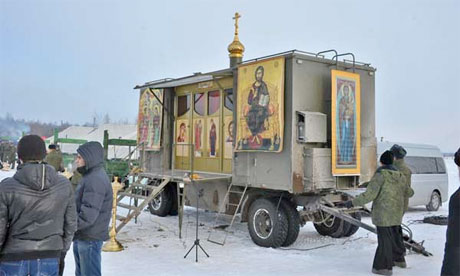
The Russian military unveiled an unlikely new weapon in its arsenal this month – an army of parachuting priests. The unit of chaplains, who have joined the Russian Airborne Force to train in parachute jumping and vehicle assembly, will operate out of flatpack churches that can be airlifted in to wherever soldiers may be stationed.
The church could be mistaken for a standard-issue army cabin, taking the form of a khaki-coloured shed on wheels, were it not for the cladding of gilded icons and the majestic onion dome spire sprouting from its rooftop. The mobile prayer room has also been fitted with a “life-sustaining module”, which includes a diesel power source, an air-conditioning unit and a fridge, reported Russia Today.
The chapel is flown in as a kit of parts, delivered via the kind of airborne platform usually used to carry armoured vehicles and other heavy military equipment, and is then assembled on the ground. Within, the gilded interior incorporates crucifixes, bells and icons, as well as a mini theatre – which can be extended sideways with additional wings, thus forming the cross-shaped plan of an Orthodox church.

HT to Gene Veith and the Guardian

Christian baggage. . .

A member forwarded me this little article entitled "It's OK to call yourself a Christian."  It is a nice little foray into the somewhat murky waters of Christians who like certain aspects of the faith (they like Jesus) but look down on doctrine and structure and, well, Christian people.  Read it for yourself.  I was struck by some powerful words near the end.

In a culture of narcissism, the easiest way to follow Jesus is from a distance on a solo stroll to the beat of the same drummer you have listened to your whole life: your own personal preferences and already held beliefs. From a distance, you are safe from the assault of community.

People will explain to me that without the Church, they are traveling light, without all that Christian baggage. But what exactly is this baggage? It’s people—who might actually be some of the best road companions there are.

The strange thing is that there are certain similarities between the most conservative of Christians and these cultural Christians who are wary of the "baggage" that comes from being too close to Jesus.  Both sides have a common dislike:  people.  Though they dislike people for different reasons.

I know some folks who feel more comfortable with a smaller church.  I do not mean congregation.  I mean church as in the total number of Christians.  They grumble about nuance of doctrinal agreement and argue with ferocity even with folks about 99% in agreement with them.  They are suspicious of other Christians and seem to have forgotten Luther's call to charity.  They prefer a 99.44% pure church over one that might allow someone to slip in who does not know, cannot articulate, and who cannot argue for the genus maiestaticum without skipping a beat.  They would feel more comfortable if there were no visitors on Sunday morning and that new members stayed away until they got their doctrinal Ps and Qs down to a T.  They do not trust other Pastors and are skeptical of every aspect of church that is larger than or different from their own little corner of the vineyard.

Okay.  I exaggerate.  But you know what I mean.  In short, they seem to think that the biggest problem in the Church is people.  It is true.  People are messy.  People are hard to deal with and harder even to love.  They are weak and oversensitive.  They are stubborn and head strung.  They are lazy and complacent.  They are bulls who charge when a little caution is needed.  They are people.  Sinful people.  Sinful by nature and unclean.  Sinners in thoughts, words, and deeds.  Sinners by act and by failure to act.  But our Lord loves these sinners and welcomes them and has died for them.  They are not optional in the Church -- no matter how uncomfortable they are to us.

On the other hand, there are those such as this article pointed out.  They do not like the Church because of its "baggage."  Yes, the Church has baggage.  A history of dealing with people, with heresies, with conflicts, with flaws, with failings, with schism, with division, with immorality, etc...  We all know it.  It is painful to us and so painful that some would prefer a Jesus who came with church optional.  But that is not how Jesus comes.  No matter how much these folks dislike or even hate the baggage of sinful leaders who fail them and sinful disciples who screw things up, the Church comes with baggage and the Church is not optional (just because you want it to be).

Everyone wants a religion that is one person deep and one person wide -- no conflict there.  Unless you actually look in a mirror and see yourself honestly.  Then even a one person church might just be too big.  If you hate the baggage of doctrine, troubled history, and flawed people, you better do your church a favor and NOT join so that you will not taint it any more.  Frankly, those folks who skip church because they do not like the "baggage" that comes with it are wimps and wusses.  They are afraid of everything.  They have not heard the promise of Christ repeated ad nauseum in Old and New Testament.  "Fear not.  I am with you."

We care about truth BECAUSE we care about people.  We welcome sinners because the people of God are sinners for whom Christ has died and in whom the Spirit has worked faith and repentance.  But they are still not perfect and so restoration is as much the business of the Church as is conversion of the unbeliever.  Christ teaches us love for God that is displayed in love for neighbor -- messy, dirty, stinky, troublesome, unloving, and unlovable neighbors.  Like you.  Like me.  Christ is our Good Samaritan who loved and loves us even with our wounds and weakness but, thankfully, does not leave us bleeding and dying.  He saves us at the cost of His own blood.

We contend for truth and pure doctrine BECAUSE this is the truth that saves the people for whom Christ died -- not because there is anything special about purity for purity sake.  Our holiness is not some lofty and dusty virtue that sits on a shelf.  It is the holiness of life and service, loving God by loving neighbor.  Yeah, there is a ton of baggage in the Church and YOU, everyone of YOU, as well as ME are weight in that baggage.  If we ditch the baggage we ditch the reason why Christ suffered and died.

In the end, it is fear that moves us to disdain the baggage.  Christ casts out fear.  If we fear the baggage, it must be because we do not trust Christ.  That is the baggage we ought to be concerned about -- at least as much as our fear of Christian sins aired in public, doctrinal conflict, the threat of heterodoxy, and impurity.

Sure, we have problems

Saturday, April 6, 2013

A little child shall lead them. . .

I have often admonished parents that their children, even their very little children, are often much more attentive to what goes on at the altar then they are...

Case in point. . .


It is one thing to mock the things of God... it is quite another to find them a magnet and to desire, even from a young age and lacking much understanding, to appreciate what it going on at the Table of the Lord and to want to participate in these.  Some may not like things such as this but I believe that where this proceeds from the piety of the child, under the good tutelage of parents who have brought their children often to the Lord's House, it is reflective of the young faith formed and nurtured by the Holy Spirit... And that is a good thing.

Parents, don't discount what your children learn from Mass... and don't park them in the back pews where they see nothing of what takes place... give them a solid view of the chancel!

Simply because I find it fascinating. . .

Friday, April 5, 2013

Why do you seek the living among the dead?

Sermon for Easter Sunday, preached three times on March31, 2013... in one form or another...

    The words we heard in the Gospel are both distant from us and as familiar to us as life itself.  Scripture tells us that they went to the tomb – they being Mary Magdalene, the other Mary, Joanna, and some others.  They were on their way to the grave after a death filled with sorrow in the midst of a busy holiday.  We get it.  It's nothing new.  It happens to us, too.  Death comes at inopportune times when we cannot give grief its due.  Now they were at the grave to finish the job of burial and to cry out their grief.  We do it too.  When love is left with a broken heart and pieces to put back together, we try to look for ways to repair our sorrows and heal our wounds.
    Sometimes death finds us in denial.  Part of the reason we go to the funeral and the cemetery is to make death more real.  When we don't want to believe, the turned up sod and temporary marker forces us.  Life is gone.  Death is done.  The grave has won.  Before grief can heal, death must be real.   We might hope it was all a mistake but when you get to the cemetery, you realize it is real. We know it.  We have been there.  We have the scars.  We still carry the pain of the loss.
    So they came.  Mary Magdalene whom Jesus had cleaned up and give her back her life when all she had were dead ends... and the other Mary and Joanna and the others.  What were their stories?  We don't know.  But they all came to the grave wishing they did not have to be there, hoping it was not real, but expecting to find death.  Even their memories could not console them now.  No laughter or hope was left.  Death had taken everything from them.
    But when they went in, there was no body of Jesus.  Now even the body of Jesus was gone.  Only strangers left where the body should have been.  Now their grief was met by fear and confusion more scarey than death.  Where did they take Jesus’ body?
    Then comes the voice: "Why are you here?  Why do you look for the living among the dead?  Jesus lives.  Don't you remember?  He told you."  How could they remember?  All they could think about were the betrayal by a friend, the terrible but innocent sufferings, and the death, oh the death.  Who heard “... and the third day rise?"  That memory was like a ghost in their thoughts.  Not scarey but not real either.  They left with a story to tell.  They ran to the disciples but the disciples thought it idle speculation.  But not Peter.  Peter wanted to believe it. He needed to believe it.  So desperately that he ran to look for himself and see how death could become life.
    Today we are Mary of Magdala... and the other women... and the disciples . We come here because we have a past filled with disappointments, sorrows, pain, and dead ends.  We seek a future.  Jesus has promised us this future. We come as mortals facing our own death and as the sons, daughters, mothers, and fathers who have given up our parents and children to death.  We come seeking more than comfort.  We want life stronger than death.
    Today we come.  We wear the stink of death... we bear the sting of death... we are marked with sin... our eyes heavy with sorrow and swollen from the tears of grief. We come because we know sin is real.  We look into the mirror of our hearts and do not like what stares back at us.   Our disappointments have given way to despair, to cynicism, to skepticism, to bitterness... We know the death of the body is real.  But we also know the death that has killed our hope, killed our peace, and killed our joy.  You cannot wish this death away.  We know how hard our hearts have become and now we want to know if hope is real, if the promise of the empty tomb is strong enough to hang our hopes, our dreams, and our lives upon.   We want to know where tears of sorrow can be met with honest and real joy.
    Today we come.  A pat on the back will not due.  The promise of a next time will not suffice.  Staring into death, His voice speaks to us: "Why do you look for living among the dead?"  That is our problem.  They say insanity is doing the same thing over and over again but expecting different results.  The truth is our lives are filled with the insanity of the ruts that send us down the same road of sorrow, of disappointment, and of bitterness.  Now our Lord challenges us to let go of the dead wounds and memories, of the disappointments and despair, of the sins and guilt.
    What may seem an idle tale or words that promise something too good to be true are real.  Christ is risen.  You too shall rise.  Easter beckons to us.  Hope slaps our disappointment in the face.  Don't be afraid.  Don't live as the dead among the living.  Don’t keep yourself distant from the present hope that God has given you.  He has proven His love on the cross and in the empty tomb He has proven His power.  You are not on your own nor are you your own.  You have been bought with a price.  You belong not to death but to life in Christ.  Sin, death, and the devil have all had their shot at you.  But Christ has won you.  Live not for yourself but for Him.
    Now Christ stands between you and death.  Death cannot claim you without going through Him.  He has already died and risen and death has no more power over Him... so it has no more power over you.  Your life is now hidden with Christ... your life in Christ...  How profound is this freedom! 
    The world really does not expect Christians to be perfect.  It knows better.  The world does not expect Christians to be holy or righteous.  But the world does expect from Christians and it has a right to expect from us that we are people of joy.  Easter is about the joy of sins forgiven, lives reborn, death overcome, and the blessed reunion in heaven.  What impact would it have on us and on our witness if we took this joy as seriously as we do disappointments, dead ends, broken promises, and death?  In Christ’s resurrection is confirmation of our redemption, the down payment of our own joyful resurrection, and the means to live this holy joy amid a world still broken.
    You may have come today like Mary bearing the burden of death... but Christ sends you home with His life in You.  This is not about trivialities like feelings or happiness.  It is about the dead being made alive, sins forgiven, and heaven prepared for you.  You may have come today like the Marys who came to Jesus' tomb.  Don't go home the same way.  Do not let your hearts be captive to death or surrender your joy to disappointment and pain.  The joy that endures is the fruit of Christ and His resurrection for you and in you.  Why do you seek the living among the dead?  Why indeed!  Don't surrender your life to despair.  Stop living in fear.  Christ is Risen!  He is risen, indeed!  The life you live is not yours; it is Christ living in you.  Forgiven, set free from death, live this Easter joy!  Amen!

Situation Liturgical Theology. . .

I grew up in the age when situation ethics took the scene by storm.  Joseph Fletcher had a hit book with a subject and an approach to ethics and morality that fit the moment.  We were a nation, a culture, and a Christianity facing change.  From the seeds of free sex, anti-war sentiment, and the rise of a counter-culture movement was born an ethical approach in which rights and wrongs were replaced with shades of gray.  It was a time in which principles gave way to context, the triumph of an ethical system in which acts were no longer judged against a codified morality but against the immediate context.  In such a system the very same action could be morally right in one context and morally wrong in another.  Whether intended or not, the implicit understanding of this case by case ethical approach was to leave it to the actor to judge his or her own actions.  It became almost sacred to believe that just as the context would determine the rightness or wrongness of an action, so the actor was the only one truly qualified to judge the context and therefore the morality of what he said or did.

While not so radical as it was in 1966, the approach has become ordinary.  From its fruits we have reaped abortion, free sex, and transformative approaches to marriage and family.  Who would have thought that an approach to ethics might be used for liturgical theology and practice.  That is exactly what seems to have happened.  At the time Fletcher was finishing his book, churches in America were beginning to break out of the liturgical patterns of their past and explore what they found outside their own heritage.  Within a decade, the cultural turmoil would give way to the start of a liturgical chaos made possible in large measure by the technology of a photocopier within financial reach of almost any parish budget.  Another decade and the personal computer would make it easy what the copy machine had made possible.  Another few years and desk top publishing would make what you see in an average worship bulletin as clear and artistic as what was once possible only by a mighty publishing concern.

Now the worship of the churches has become extremely congregational.  Not content with the ordinary options inherent in the liturgy, the freedom afforded the local clergy and congregation have made it hard to define what is or is not representative of their own theological tradition.  It is not that parishes are printing out the entire worship service or hymns for ease of use but that what they print out is borrowed from every possible source or created as a liturgy du jour week after week after week. 

Liturgical theology has given way to the rise and rule of context.  Context now governs all things liturgical.  What we do and how we do it are defined locally.  The freedom to do what is appropriate to the circumstance has become license to do whatever is desired.  This liturgical chaos is not limited to Lutherans.  Roman Catholics complain about ad lib and ad hoc versions of the Mass that is supposed to be governed by laws and rules.  Methodists and Presbyterians have joined everyone else in picking and choosing a liturgical identity for Sunday morning which varies with the landscape.  There are certainly those who complain about this (me being one of them) yet the principle to which the practitioners of this liturgical entrepreneurship appeal is freedom (another word for context).

Nothing in worship is right or wrong anymore.  No one can judge another for context is everything and only the local situation can judge the context.  We have taken congregationalism to the extreme and made it the prime liturgical principle as well.  Liturgical decisions and choices follow flexible guidelines rather than absolute rules and must be reviewed on a case by case basis, with those invested in the context making the ultimate determination about what is right.

Moreover, the flexible guidelines are no longer liturgical theology or specific rubrics but completely different concerns.  Appeal to the unchurched, cultural practices, and personal preferences have become the only guidelines that apply to the decisions made about what will happen on Sunday morning.  We have completely reversed St. Paul's dictum about not all things possible being beneficial and have decided that because it is possible it must be good -- how good waits to be determined until after it is used and the criteria for judgment have everything to do with what people think or feel and almost nothing to do with what is faithful to the standard of belief and the confession of faith.

Situation ethics is an exception morality in which outcomes determine what is moral and what is not.  Situation liturgical theology and practice is an exception based practice in which outcomes determine what is good, wise, right, and salutary.  Though no one would do this, it is about like taking a poll of the folks after each action in worship and deciding then if it "worked" or if people "liked it" or, best of all, if it was "moving".

The liturgical chaos spread across nearly all churches in America will not change until we ditch this situation approach to liturgical theology and practice.  It will not pause until we begin to believe that we have just as significant responsibility to our confession of faith and other congregations who confess this same faith as we have to the local situation.  It will not relent until we affirm that doing whatever seems right in our own eyes is not a definition of liturgical success but of selfishness, self-centeredness, and sin.  

Right now it does not seem that we are willing to surrender any of what we believe is our right to do what is right in our own eyes.  The only love not worth mustering is the love that might infringe upon our freedom to do as we judge right through the lens of context.  The greatest sin in our age of liturgical confusion is that we did not do what we could have done but did what we should have done.  That might imply that the tyranny of context is not a good thing and that is one step further than most, even some conservatives, are willing to go.

Thursday, April 4, 2013

The witness of blood and water. . .

Sermon for Good Friday evening, preached on March 29, 2013.

    The Romans were brutally efficient.  They had long before perfected the art of crucifixion.  They had turned it into something like an art form.  It happened so often, it was routine.  Brutal, yes, but ordinary.  So when the spear pierced the side of Jesus, there was a surprise.  Blood and water flowed.  The shock was duly noted.  Witnesses saw it.  Pilate was surprised by it.  But even death must follow the script which God has written.  So that in death, we might find the life Christ has come to give.
    They pierced the side of Christ to see if He were already dead.  And the blood and water that flowed showed that He was.  There in signs and witness of His death we find a hint of Baptism and Holy Communion, the sacraments of life and worship.  In this very means used to authenticate Jesus’ death, it the means used to impart to us His life through the means of grace.  The witness of death becomes the testimony of life.  The early Church made much of this detail.  We cannot afford to overlook it.  The sign of Jesus death has become the sign of His life.  The blood and water point us to where the fruits of His death are accessible to us.
    Witnesses confirmed it.  This is how it was.  And that is how the Church works.  We are called and gathered by the means of grace, the witness of Jesus life and death through which the Spirit works to impart faith to our fearful hearts.  And we are sent not as evangelists so much as we witnesses to what God did and continues to do through the means of grace.  The Spirit has called us to this water that connects us to Calvary and His cross, the water that gives life to those who die there with Christ and in Him.  The Spirit feeds us with this bread and wine that bestows the crucified flesh and shed blood of Jesus.  We speak the saving story to others and they are drawn to the place where the Spirit works, to the means of grace, to the Word and Sacraments.
    Calvary has brought heaven near.  That is what the witness confirms to us.  That is our witness to the world.  Here, hidden in Calvary's death is heaven's life.  The Word that tells what happened is the Word that imparts to us the heavenly life – the visible Word of baptism and the Eucharist through which we are born anew and sustained in this new life.  Heaven is brought low in the cross and that cross is brought near to us in the Word, Water, and Meal.
    Scripture is filled with witnesses.  Some of them saw and understood what they saw.  Others saw and did not get what it was they beheld.  Jesus calls us witnesses and sends us forth just as He sent forth His disciples.  We are called witnesses – not simply spectators who watch a distant event but as those who have a stake in what happens and who are born anew by the life surrendered to death and the death that holds forth life.
    We are called not to explain God or defend Him.  We are called first to trust in the death that gives us life on the cross.  And we are also called to speak this Gospel of the cross to those who have not heard.  Our Lord has willingly surrendered His life for us on the cross.  Our life comes from that sacrificial death and no where else.  Calvary is not some rite of passage our Lord went through, it is the culmination of His saving work and our salvation comes from where this Word is proclaimed and the sacraments of the cross administered.  Where blood and water once flowed in death, now God has made them flow for life – with power to save every sinner and give life to all under the power of death and to forgive and make holy the worst of sinners.  This is what we witness.  Water and blood that once flowed to mark the death of Christ, now flows for the life of all who will be redeemed.  This is our joy, our hope, and our witness to the world.  Amen.

A cause closer to the hearts of God's people...

We have heard it all before.  Sin does not sell well today.  Entertainment does.  Self-interest appeals.  And people define their self-interest not in terms of sin and redemption but "a better life now."  So many churches have given up on the call to repentance, on the Word of the cross, on the Gospel born of suffering and death for sin that cannot be wished away or fade away through avoidance.  Others have come to terms with death and made it natural to life.  Death is but one passage in a life of many passages, they say.  If you cannot avoid death, at least make it friendly.

Bishop Bo Giertz had his own journey from unbelief into a vigorous Lutheran faith and a robust sacramental piety -- going against the flow of culture and the cultural Christianity that loves the world as much as God.  In his daily devotional book, Att leva med Kristus:daglig läsning för trefaldighetstiden, published some forty years ago, he expounds on a daily basis the same warmth of faith and confessional practice most known through his work The Hammer of God.  Thankfully, this volume was published in English by CPH in 2008 as To Live with Christ.

It has become a favorite of mine (and my son's, as well).  Reading through the devotion from the Tuesday after the First Sunday in Lent, Bo Giertz tackles the subject of a cultural, me-centered Christianity with characteristic bluntness.  The Church must continue to preach repentance and faith even thought the world believes the Church must get with the times and engage a cause closer to the hearts of the people than the salvation of their souls.

According to Bo Giertz, this is the great temptation facing the Church.  We have preached and preached Christ and Him crucified and it seems we have made little progress, we have made little difference in the state of the world, and have little to show for all our efforts and energy.  Like Satan proposing that Jesus jump down from the top of the temple to both test the Lord and display His power, the Church is severely tempted to find something more relevant to preach and something more dramatic than the Divine Service.  

What would Bo Giertz think of his beloved Swedish Church?  It has long ago left behind the call to repentance and the Gospel of the Cross to become merely a social movement dedicated to the latest and greatest in pop psychology or social trend.  The words of this confessional Lutheran Bishop ring as true today as when he penned them forty years ago.  Our great temptation is to find and take up a cause closer to the hearts of God's people than the salvation of their souls.  But there is no cause more urgent, no need as great, and no purpose as high and noble as the proclamation of this saving Word, the means of grace that bestow what they promise, and the community created by the Spirit speaking through that Word.

That there may be a cause closer to the hearts of the people than the salvation of their souls is in little doubt.  Of course there is.  But that is the consequence of sin.  That there is another Gospel or another Word which the Church can or should proclaim may be in dispute but the Scriptures are clear.  There is only one Word that saves and that is the Word of the Cross, only one Christ and that is the Christ who is that Word made flesh, and only one crying need for a humanity captive to sin and its death, the salvation of souls.  We can choose not to listen to the Lord and to listen to our own hearts or the crying voices of the culture.  If we do, we have nothing to say of consequence and nothing to offer that can redeem us from this loss.  It is either Christ and the preaching of repentance and forgiveness in His name or we are have sold our birthright as the Church and gutted the message of its saving power.

Every age has faced this grave temptation but none more acutely than we face today.  God help us or surely we will become the very enemies of the truth we think we represent.    

Wednesday, April 3, 2013

What does the Church have to offer. . .

Of all things I found myself in a doctor's waiting room while the TV blared The View.  It was so loud that I found myself listening in spite of myself.  In one segment about a new pope and what that pope might be and do, the point was made that there is nothing for children in the Mass.  Roman Catholics need to have children's church because there is nothing for kids in the Mass -- what with all the strange words, rituals, and postures.  How can we expect them to get anything out of that?

It is a common question.  I have had people ask me the exact same thing.  What does the Church have to offer children?  Should we not cater to them by including some children's music, a children's sermon, and some simplified liturgy that is understandable to children?  If we don't, wouldn't we better serve children by dismissing them from the "adult" nature of the Divine Service and sending them somewhere for content designed for children in mind?

I have also had people say the same thing about disabled (both physical and mental handicaps).  What does the Church have to offer those who physically cannot participate by speaking or singing or standing or kneeling?  I have heard people say the same thing about the single, the single parent family, gay people, etc...  What does the Church have to offer people who are alone, unmarried, and without a family (implication being that everything in worship is designed for the family)?  What does the Church have to offer those single parents who must wrestle with their children alone and who often miss out on parts of worship because they deal with restless or moody children (implication being that since children don't get anything out of worship, at least the parent could appreciate the service without the constraints of uncooperative children to deal with)?  What does the Church have to offer gay people (implication being that the only thing the Church says to gays is that they are unwelcome, evil, and corrupt)?

All of these questions begin with a false premise.  We could spend a great deal of time dealing with the straw men used to dismiss what the Church has to offer folks who do not fit the prime mold of those who are there on Sunday morning.  But I will not do that.  Instead, I will offer a general response to the same question poised for different people and different circumstances.

What does the Church have to offer?
  1. God's Word...  the simplest answer.  We offer the Word of God, rightly preached, the Law and Gospel properly distinguished, speaking the Word and applying the Word in the sermon, so that God may work as He has willed and promised in the life of the person (no matter the age, the maturity, the ability, or sexual orientation).  The Word of God is a means of grace.  God is present in His Word and works through His Word.  This is not exclusively nor primarily understanding but the communication of the Truth that endures forever, the Truth that is our way, and the Truth that manifests God's presence and His gifts.  Faith is not an "aha" moment in which we finally "get it" but trust in the will and works of God that give us life and salvation.
  2. The Sacraments of Life and Worship... We offer the means of grace, the visible Word, through which God comes to us in the fullness of His divine mercy to impart to us the grace that enables us to stand.  Through baptism we enter into the mystery of Christ's death and resurrection, we are forgiven of our sins, we die and rise to new life in Christ, and we exchange the old identity as no people for the new identity as the people of God.  Through the absolution we who continue to sin find the power of grace both to call us to repentance and confess our sin as well as to forgive that sin and restore us to our Lord.  Through the Eucharist we both become aware of our hunger and thirst and our hunger and thirst are satisfied by the bread which is His body and the cup of His blood, the intimate table fellowship that both unites us to the God whose table it is and binds us as a people who confess a common faith and live within its boundaries and discipline.
  3. Catechesis...  We offer not only the directed catechesis of the confirmation program (youth and adult) but the ongoing catechesis of the liturgy and hymns of the Church.  Faith is not something learned and mastered as if one were learning a language but it is also a culture and identity into which we are drawn and which we take on little by little through the liturgy and hymns of the faith (as well as the Word and Sacraments).  Singing the faith is especially helpful for children and those with limited intellectual ability but this is NOT the dumbing down of the faith.  Just the opposite.  It is the life of the faithful in which the faith is passed on by the form and words of the liturgy and the words and music of the hymnody.
  4. Holy Life...  We offer the vision of the holy life of faith.  Here the sanctoral cycle is especially helpful and it is a sad reality that too many of our parishes and people have lost touch with this side of the church's calendar.  We learn from and grow into the holy life of the faithful by knowing the stories of the faithful in whom and through whom God has worked.  They are not so much the objects of our attention as the God who worked in them and through them.  With this is our sense of a chaste and pure life (no matter where we find ourselves -- married, single, youth, aged, etc...).  We do not mirror the values and goals of the world around us but the holy life of our Lord Jesus Christ.  This is a goal of moral purity to be sure but it is surely more than that.  It is the life of self-denial in which we learn to love our neighbor as Christ has loved us, where we learn to delight in the path of service, and by which we learn what it means to be great in the Kingdom of God.  Holy living (perhaps we could call it sanctification but I am not sure that word says much anymore) is not the domain of those who serve the Church in churchly vocations but the path of life for all the baptized.  
  5. True self-esteem...  We just passed through Lent, Holy Week, and Easter Sunday.  Throughout this path walking with Jesus to the cross we were reminded that our value is not something we discern or place upon ourselves but is reflected in the price our Lord was willing to pay for our redemption.  We have value and worth not because of our abilities, gifts, productivity, or success.  No, we have value and worth because we were purchased and redeemed by the holy and precious body and blood of Christ.  Luther reminds us of this in the explanation to the second article of the Creed.  In a world where fake and empty versions of self-esteem leave us high and dry when we depend upon them most, we have the great and blessed reality of the cross from which we draw our value as persons and learn the self-esteem that is true and real.  As we learn to sing it, "God's own child I gladly say it, I am baptized into Christ..."
It is both foolish and demeaning to believe that in order for the Church to offer something to people we must dumb down what we say and do, cater to their whims of personal taste, accept and celebrate their sinful desires, and encourage them to use their freedom for self-fulfillment and the pursuit of pleasure and happiness at the expense of others and themselves.  We do not baby sit the people of God (no matter what their ages).  No, we engage them with the Word and Sacraments, we lay before them the ongoing path of catechesis and maturity of faith, we teach them the liturgy and the hymns which are the culture of the faith, we hold before them the vision of a holy, chaste, and good life (of good works), and we honor them with the self-esteem that flows from the value and worth placed upon them by our Lord's sacrificial death.  We have a great deal to offer them in this Gospel and apart from this Gospel nothing much to give them at all.

Easter Greetings


Noonday Sermon for Good Friday

Sermon for Noonday on Good Friday, March 29, 2013.

    Mark, Luke and John all tell us what Jesus said when He died.  "It is finished..."  "Father, into Your hands I commit My Spirit..."  But Matthew says only "He cried out with a loud voice and yielded up His spirit."  The death roar.  Some would say it was the cry of defeat for indeed Jesus did die.  It would seem that Satan had won, the scribes and temple authorities had won, death had won.  But this was not the sound of defeat.  When you have won, it does not matter what you say...
    This was not the sound of defeat.  Oh, it may seem as if Jesus has lost.  He cried out to God in the loneliest of voices: Eloi, eloi, lama sabacthani.  "My God, My God, why hast Thou forsaken Me?" But this was the plan, the plan of salvation prepared before sin even entered the world, the rescue plan that from the beginning required that a holy life be given up in the exchange for the unholy lives of sinners like you or me.
    But His shame has become His honor.  He did not shy from the cost of our redemption.  He was obedient even to death on a cross.  He died for us that we who live through His death should not live for ourselves but for Him.  The roar of His voice when the last breath came out of Him was the lion's roar of victory.
    Though His victory was hidden in the appearance of defeat, He did not lose.  More importantly, He did not lose us.  He won us by His death that sets us free from death and forgives our sins.  We see that in ripping of the curtain of the temple in half exposing the holy of holies.  We see that in the graves of the saints who gave up the faithful dead by His death.
    A famous coach once said, "Winning isn't everything; it is the only thing."  We live in a time in which we focus more on everyone getting to play than on who wins or loses.  In a world where justice and fairness and equity seems most important, we face a cross where mercy won over justice and the saving will of God prevailed.  Calvary tells us that winning is not everything, it is the only thing.  We don't need a win; we need THE win.  We do not need a Savior who can win, we need a Savior who must win –  who will do whatever it takes to win us free from the grip of sin and the grasp of death.  For Jesus, winning is the only thing and death is what He is gladly willing to pay to defeat our enemies and make us His.
    What happened on Calvary was no prayer meeting.  It was not a game for the spectators.  It was the battlefield on which rested our lives and our death, our sins and our forgiveness, the triumph of unrighteousness or the victory of the holy One whose holy death has redeemed us.  We are there.  Not as those who fight but as those who have a stake in what happens.  We are there.  Not as spectators but as those whose very existence hangs in the balance of Jesus' suffering and death.
    And Jesus cried out with a loud voice... yielding up His spirit.... Friends, that was the sound of victory, the voice of triumph, and the end of the saving work of God in which the sins of the whole world, and your sins and mine, were overcome...   In which death died so that we might live and live new and holy lives today and everlasting and eternal lives with Him whose victory is our hope, our faith, and our salvation.  Amen.

Scarey... and Scarier...

At a Florida hearing

“So, um, it is just really hard for me to even ask you this question because I’m almost in disbelief,” said Rep. Jim Boyd. “If a baby is born on a table as a result of a botched abortion, what would Planned Parenthood want to have happen to that child that is struggling for life?”

“We believe that any decision that’s made should be left up to the woman, her family, and the physician,” said Planned Parenthood lobbyist Snow.

Rep. Daniel Davis then asked Snow, “What happens in a situation where a baby is alive, breathing on a table, moving. What do your physicians do at that point?”

“I do not have that information,” Snow replied. “I am not a physician, I am not an abortion provider. So I do not have that information.”


Postscript...

The woman answering the question is:  Alisa Snow.  Alisa is a graduate of the University of Tennessee where she earned a bachelor’s degree in communications/journalism. She was a founding member and secretary of the Sunset Rotary Club of Tallahassee and serves on the board of Catholic Charities of Northwest Florida-Tallahassee. She is a member of the Florida Association of Professional Lobbyists.


Liesure time Christianity. . .

Excerpt from George Weigel's new book Evangelical Catholicism:  Deep Reform in the 21st Century.

Throughout the Western world. . .we can no longer sit back and assume that decent lives lived in conformity with the prevailing cultural norms will somehow convey the faith to our children and grandchildren and invite others to consider entering the Church.

Though Mr. Weigel is directing his commentary on the state of the Roman Catholic Church, his points are well taken for Christianity in general and Lutheranism in particular. For too long we have become comfortable with a Christianity which is more like the "Y" than the Church of the New Testament and early Christianity. He is absolutely right that Christianity as a hobby, leisure time activity, or entertainment does not pass down. I well recall one of the lyrics when my kids were teenagers and listened to the group Lost and Found.

I went to my church on Sunday, just to hear good news.
And I confess it's been years more or less since I've warmed these pews.
I am looking for something stronger than my own life these days
but the church of my childhood seems like the YMCA.

Every Sunday is just like the last,
as if the church has no history and the people have no past.
We just sing the songs we like to sing and we preach about the news
and we think up some new thing just to fill up the pews.

I want palms on Palm Sunday, I want Pentecost still to be red,
I want to drink of the wine and eat of the bread.
But they strive for attendance while I starve for transcendence,
but I count among this body both the living and the dead.


The great indictment against the boomers, the great loss lamented by the children of folks my age, is that we have not passed on a Gospel of substance, a Word that has power to do what it says, Sacraments that deliver the grace they speak of, and the God who is truly present through the means of grace. Instead we have starved our children of substance, truth, meaning, and the concrete reality of Christ with us in favor of a feel good church that offers us discardable liturgy and music that fills the moment but leaves the soul empty.

This is compounded by a personal piety and lifestyle which bears little resemblance to the Gospel but fits it quite nicely with the tenor of the world. We are way too comfortable in our sins, far too uncertain about our faith to witness it to others, and far too self-absorbed to live as the people called out and set apart for the Lord and for the good works that flow from repentance and faith. Our charity has become as seasonal as the Christmas decorations and our lives hesitant to sacrifice for anyone or anything (not even for children). We discard life as if it were cheap and we indulge our passions without shame and do it all while wearing a cross around our neck, with a tattoo of a favorite Bible passage on our skin, and carrying around the latest self-help how-to book hawked by the current spiritual guru du jour.

We have built gyms and have great sports programs, we have mall-type buildings with rooms for all ages, we have big parking lots, we have fine sound systems, we embrace all the current technology, and we try very hard... but what we have failed to do is speak the mystery of the God who makes Himself known to us in Christ or steward the mysteries through which Christ is made known to us (the means of grace). God does not care how many kids are playing basketball in the church gym on Thursday evenings and, apparently, the kids playing bb are not seeing this as a slam dunk for Jesus either. What we give them and what they want and need are two very different things.

Such a Church proclaiming such a faith and such Christians confessing and living such a faith cannot continue -- not necessarily because God will end it but because it is lifeless, empty, and already passe. Our children and grandchildren are not abandoning the Church because it is too passionate for the Gospel and the Kingdom of God. They are drifting away because we have consigned them to babysitting, entertained them to death, confused fun with piety, held out unrealistic ideas of what it means to live in but not of the world, and kept them on baby food instead of feeding them the real food of the Word. They have not tried Christianity and found it wanting, they have not found true Christianity.

Am I generalizing? Of course. But the reason I am speaking in this way is that there are still people out there and folks in leadership positions in the Church who are guiding us away from a robust Christian (and Lutheran) identity in favor of church growth and transformational models rooted in the same flawed and failed ideas that we can borrow from the world instead being faithful to Christ and the Church will grow. If it does, who wants it? Not God and, apparently, not the youth who have tried it and found it too bland and tasteless to consume. And did not Jesus talk about salt that has lost its savor?

Tuesday, April 2, 2013

How long. . .

Sermon preached for Holy Thursday Evening, March 28, 2013.

    Like restless children, we are impatient.  How long? We ask.  The only things that take too long are the things not in our control.  Jesus is clear.  The Kingdom of God will come in God's own timing.  Until that day when all that is will be folded into what is to come, we wait but we wait around the means of grace, the Word and Sacraments.  Jesus will not eat or drink again until the Kingdom comes but that is the wait of faith, the waiting of the people of God around the Table of the Lord.  We wait best by eating the food of His flesh and drinking the cup of His blood.
    How long will talk of sin and forgiveness dominate everything in Church?  Until the Lord comes again, we meet Him always as His sinful but repentant children.  We come to Him through confession and absolution to have our dirt removed, to be made clean again, and to be restored to righteousness through the voice of the Gospel.
    And that is exactly where we meet each other.  Wearing this clothing of flesh and blood means we will not progress past sin or outgrow the need of absolution – neither before God nor with one another.  So we meet each other where we meet God.  As those who come confessing our sins and asking for forgiveness, whether once or seven times or seventy times seven.  How long?  Until we sinners are raised up to heaven.
    How long must we come to be stirred up to do good works, to be recalled from our detours away from the House and Table of the Lord?  When will the day come when we do not grow weary, become distracted, or fail to need to be renewed and refreshed in the holy purpose of bearing God's fruit in our daily lives?  Not until Christ comes again.
    Just as God must daily reclaim us, so we must daily reclaim each other.  What God did for us, we do for others in His name.  Like Cain and Abel we must be reminded that we are our brother's keeper.  As God has acted to seek us our, reclaim us, and restore us to righteousness in Christ, so is the work of the Church a never ending work of seeking the lost, reclaiming the wanderer, and restoring those who have exchanged Christ's holiness for the filthy rags of sin and rebellion.  All so that none may be lost, as much as we can help it, anyway.
    Holy long will we meet at this table to eat the food of Christ's body and blood?  There is no exact date.  This is where we meet the Lord until the Kingdom of God comes and this meal gives way to heaven's banquet feast.  This is the place where salvation may be found until that day finally gives way to the day of judgment.  Once Israel grew weary of the Passover and it became an empty ritual to them. That is the great danger among us as well – to define our spirituality and the center of our piety in some other locus than this place where Christ feeds us His flesh and gives us His blood to drink.  When the Passover was fulfilled in Christ, the Jews  were caught unawares; they had long ago given up hope of its fulfillment.  Let it not happen to us.  Let us remain vigorous in the faith and in the eating and drinking of this Holy Supper until Christ comes again.
    Here is where we meet the Lord.  Here is where His Spirit is at work in the means of grace.  Here is where we find and have our identity as the children of God renewed.  Here is where God meets us as He has promised.  And it is here the Church comes, seeking the Lord where and while He may be found, while mercy is offered and judgment withheld.
    Until the Kingdom of God comes to completion, this is where we come.  Sinners to repentance, the weary stirred up to good works, the wanderers reclaimed, and hungry and thirsty fed and nourished upon the Holy Body and Blood of Christ.  The house of the Lord and His table are not optional.  God is here. Rich with salvation.  Until He comes, this eating and drinking is also our witness to those who have fallen away and to the world that does not yet know Him.  But the day is coming and is nearer still when all you see will be replaced by heaven's reality.  Do not lose heart.  Do not give up.  Do not fall.  Come... eat and drink.  Until the Kingdom is fully come, this is our hope and our home.
    There are many who believe that the book of Hebrews is actually a sermon from the early church.  If that is the case, it certainly reaffirms the ongoing temptation before us and the ongoing need and life of the Church.  Listen again.
    15The Holy Spirit also bears witness to us; for after saying,

    16“This is the covenant that I will make with them after those days, declares the Lord: I will put my laws on their hearts, and write them on their minds,”
   
    17then he adds,  “I will remember their sins and their lawless deeds no more.”
   
    18Where there is forgiveness of these, there is no longer any offering for sin.
   
    19Therefore, brothers, since we have confidence to enter the holy places by the blood of Jesus, 20by the new and living way that he opened for us through the curtain, that is, through his flesh, 21and since we have a great priest over the house of God, 22let us draw near with a true heart in full assurance of faith, with our hearts sprinkled clean from an evil conscience and our bodies washed with pure water. 23Let us hold fast the confession of our hope without wavering, for he who promised is faithful. 24And let us consider how to stir up one another to love and good works, 25not neglecting to meet together, as is the habit of some, but encouraging one another, and all the more as you see the Day drawing near.

Fun with Legos


You have a big mouth. . .

Growing up, my mother often told me I had a big mouth.  There is a two fold meaning here.  I was a fat little kid because I ate too much.  I literally did have a big mouth.  But what she was referring to was more the kind of big mouth that speaks when silence is better and that shouts when whispers are due.

Not a few have said to me, "Pastor, you don't need the microphone for me to hear you."  That was not always meant as a compliment -- if you know what I mean.

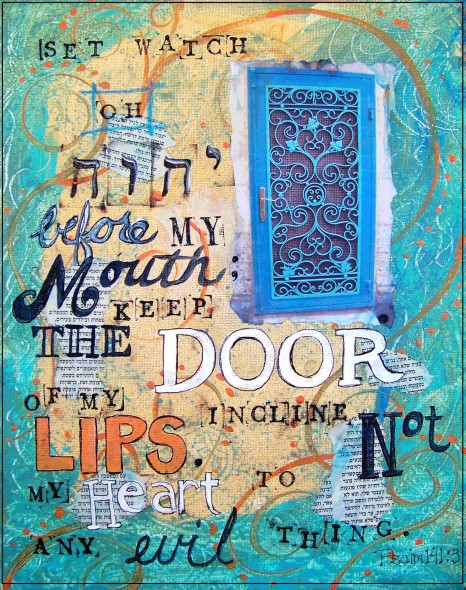
Funny then, or perhaps not funny at all, that through Lent the part of Psalm 141 assigned to me in Evening Prayer includes these words.  Set a watch before my mouth, O Lord, and guard the door of my lips...  Those are hard words for me to chant.  They are not theoretical but practical and personal.

Maybe you are someone like me -- prone to open mouth and insert foot, to speak now and think later, or nicknamed the "mouth that roared."  Our patron saint could be Peter -- another big mouth that did not always serve him well.

As Lent fades away, the words will be chanted less often but the wisdom needs to be regularly heard.  It occurs to me that these words may not have been as significant when the Psalmist penned them but now, in an era wherein we speak through technological means that multiply the impact of our words, they are more important than ever.

I have a friend who says "only a twit tweets."  Translation:  those with big mouths get into even more trouble when their words must be compacted into a few characters and then get sent all over the world with nary a qualm about who will read them or a fear that maybe you spoke tweeted too soon.  Like most of you, I have too often pressed SEND or POST and then thought better.  But... too late.  As we sing in a favorite line from a hymn: (696 O God My Faithful God)

 Keep me from saying words
    That later need recalling;
Guard me lest idle speech
    May from my lips be falling;
But when within my place
    I must and ought to speak,
Then to my words give grace
    Lest I offend the weak.

Words can be healing and encouraging but too often they wound and destroy.  How many congregations suffer because of  hurtful, even hateful words, words usually whispered in secret because those kinds of words do not like the light of day and neither do their speakers?  How many wounds have we caused because we spoke when we should have listened or reacted without thought and prayer?  How many naysayers use words like crowbars to tear down what others have built but seldom speak positively or offer something more than criticism?

As I sing these words from the Psalm and light the incense for Evening Prayer, this is what I think about.  And also Luther's explanation to the 8th Commandment. We should fear and love God so that we do not tell lies about our neighbor, betray him, slander him, or hurt his reputation, but defend him, speak well of him, and explain everything in the kindest way.

Lord, give me a charitable tongue.  If You cannot give me that, set a watch before my mouth and guard the door of my lips...

Monday, April 1, 2013

Thank you, Pastor. . .

The upside is that their only aspiration is for their congregations to taste of the life, blessing, and joy that God offers us through the gospel. But what frustration, also; it’s so often like pushing a rope. We congregants are hard of hearing, we stumble, we are distracted by the world. The pastor implores those in his charge merely to “taste and see that the Lord is good.” They know, they know, that if only we taste we will, like them, want more. It’s sitting there, right before us. They would love for us to share what they have. But we don’t even taste. 

Read the whole article here. . . 

With these kind words and more, James R. Rogers, department head and associate professor of political science at Texas A&M University, currently serving on the Board of Directors for the Texas District of the Lutheran Church-Missouri Synod, offers kind appreciation and encouragement for those who serve as Pastors. . . and I, for one, am most grateful for his generosity and thoughtfulness.

Who says Lutherans do not have crucifixes?


Artifact: Crucifix

large photo
 
Date:
circa 1868
Size:
17.75 x 9 x 38.5 inches (w x d x h)
Significance:

This wooden crucifix was used in the second sanctuary of Immanuel Lutheran Church, Saint Louis, located at 15th Street and Delmar Avenue from 1868 to 1919. Immanuel was one of the four congregations that made up the Saint Louis Gesamtgemeinde(joint congregation) under C. F. W. Walther.
Click here to view a larger image of this artifact.

"Pieces of Our Past" is a bi-weekly email newsletter published by Concordia Historical Institute (CHI) that showcases Synod’s history through items in the CHI collections.
Learn more about CHI and how you can be a part of preserving Lutheran history for generations to come by calling 314-505-7900 or visiting www.lutheranhistory.org