Tuesday, December 13, 2022

Fools. . .

“Thinking themselves wise, they became as fools” (Rom 1:22).  Though St. Paul was addressing a Christian context, his words hardly are constrained to the foolishness that passes for wisdom today among Christians, Christian leaders, and Christian churches.  It is a sad fact that foolishness abides everywhere and what passes as wisdom only confirms the speaker a fool.

We speak foolishness all the time.  The media constantly refers to abortion as a “women’s issue”—yet about 50% of babies murdered are male so it is not quite a women's issue when the death is equally spread to boys as well as girls.  Or when we call abortion a health issue when the whole point of abortion is not health but death.  Or when critics of those opposed to abortion tell the pro-life contingent: “If you don’t like abortion, don’t get one.”  That is the modern day equivalent of telling an 1860s abolitionist: “If you don’t like slavery, don’t own a slave.”  

Another foolishness of the moment is that the chromosomes and DNA have no voice in deciding who is male or female.  Coming on the heels of Covid protocols and a vaccine that is urged by those who insist you listen to the science, it is the height of foolishness then to let science be gagged and bound while others with nothing more than a feeling or desire determine what constitutes a man or a woman.

I could go on.  I won't.  It is too depressing.  But I will mention a few of the idiocies that pass as wisdom in the Church.  For example, where is the wisdom of those who insist that it matters less what you believe than how sincerely you believe it?  Or those who insist that worship is neutral and you can worship however you please but that does not affect or shape what you believe.  Or those who insist that truth and meaning do not exist in Scripture or the Sacraments until you assign them truth and meaning by your belief.  Or those who insist that music is neutral and contributes nothing to the meaning of that music -- it all comes from the text.

It was once possible to debate what is truth and what it means but when perception and feeling are accorded a higher role than what the words actually say, it is no longer about the words anymore and solely about the person.  It has surely become that way in our culture and in our politics and we can decry it and complain about what that has done to our society and nation.  But we are urged not to put our trust in earthly rulers and kingdoms.  Instead, God calls us to trust in Him -- in His Word.  The foolishness that passes for religion and faith today makes it even more difficult to trust in that Word, to call people to know God through His Word, and to have faith and confidence in His mercy.  Our people are caught up within the tension of a world which deprives us of any truth larger than ourselves and of any meaning beyond the one we assign to it.  That foolishness will be our undoing in so many ways that hinder our lives now but the worst of it is that it conspires against the only hope that promises a future beyond the present life.  That is what happens when we insist that the Word cannot mean what it says since we do not like or agree with what it says.  Words matter.  Truth is objective.  It is the voice of the fool who says otherwise.


Monday, December 12, 2022

Least in the Kingdom. . .

Sermon for the Third Sunday in Advent preached on December 11, 2022.

It must have been hard for St. John the Baptist.  After preaching repentance to the high and mighty, ushering crowds to the edge of the water for baptism, and being such a force that even Herod the King could not threaten him, it was gone. He was alone and in prison, waiting for a certain death.  His disciples are fidgeting – uncertain what to do and what to believe.  John sends them to Jesus both for himself and for them.  “Are you the one who is come to come or should we look for another?”

It was a question no one could answer with words.  John the Baptism was a man of words – like any preacher.  His disciples followed him because of the words he preached.  But at this juncture, St. John was looking for more and so were his disciples.  Jesus knows this.  Jesus does not dazzle them with sophistry.  He points to the signs of the Kingdom.  What do YOU see and hear?  The blind see, the lame walk, the lepers are cleansed, the deaf hear, the dead are raised, and the poor hear good news.  Notice that Jesus does not point them to themselves or their own lives or their own answered prayers.  What they see are the marks of the Kingdom and not simply the markers of their own satisfaction with how things were going.

Jesus comforts John with the assurance that he was faithful.  He did not bend his preaching to the wind of public opinion or dress for success.  John was a mighty prophet – mighty in word but mighty in deed.  Jesus was assuring John that the Kingdom John was preparing for was also mighty in Word and mighty in deed.  John was Elijah – the prophet who did not die but was gone up on a chariot of fire is now come down to wait in prison for the Kingdom of Heaven to come.  He who has ears to hear, let him hear.

My friends, faith is a waiting game. It is not about the moment or the short term but endurance.  We all wait upon the Lord. From the rich and famous to the poor and anonymous, we wait upon the Lord.  But the Lord we wait upon is not a God whom we do not know.  He is our Savior. He is God in flesh. He is the redeemer who pays for our redemption with His blood.  He is the risen Lord whom the grave could not hold.  He is the healer in whom all our ills of body and soul will find an answer in the resurrection of the body and the life everlasting.


John will not make it out of Herod’s prison.  There he will die.  His head on a platter by the command of a corrupt and blaspheming pretender to the throne.  But John did not die a failure.  And John will not end in death.  John’s victory is the victory of God’s Word of hope and promise fulfilled in Jesus Christ.  John’s end was not decided by deceiving mother and her voluptuous daughter.  John’s end was decided when Jesus rose from the grave, when He ascended to His place of glory at the right hand of the Father, and when He said that today we shall be with Him in paradise.

My friends, you live in the tension between what faith sees and what your eyes see, between what faith knows and reason sees, between the promise and its fulfillment.  You live where John lived but now John sees face to face and soon you shall see clearly as well.  Do not hold too tightly onto a life that is meant to pass away, to a body that is meant to be replaced with one new, and to a world that is even now passing away right before your eyes.  John did not look like a victorious believer living a victorious life but Jesus said John was the mightiest of all the prophets ever to speak thus saith the Lord.

You may not look like a mighty believer living a victorious life either.  But Jesus says you are even greater than John – any and everyone who is least in the Kingdom of heaven is greater than the greatest of the prophets every to live!  That is simply because John believed a promise when everything said to give up hope and you believe in the promise kept and the Word fulfilled when everything said it would never be.  We confess the creed every week because we need to be reminded of the fact of what Christ accomplished for us.  By this creed Jesus points us what He has done just as He once pointed John’s disciples to what He did.  

You are not alone.  God’s Word still speaks.  His absolution still restores.  His flesh and blood still feeds.  What matters is faith.  Faith waits for God’s future to come.  And in the meantime, faith turns our doubts and fears to Jesus.  He is our comfort, our hope, and our peace.  Least in the Kingdom is greater than the mightiest everywhere else.  Don’t surrender your hope.  Let it build you up.  When you face the worst moments, do not tear up in despair or waver in doubt but look with eyes of faith to see all that Christ accomplished and all that is yet to come.  Then wait.  Wait upon the Lord.  Wait patiently.  God is faithful and He will bring it to pass.

John had to wait until the body of death he wore was replaced with the body of life.  We are in the same place.  We should work like dogs to make sure that the love of God is manifested in our loveless world but we dare not believe the lie that this world is getting better or that we will figure out a way around death.  There is only one shape of faithfulness – to wait upon the Lord now and eternally.  Though this body be destroyed, yet in my new flesh shall I behold the face of God and not another.  Job said it long ago, maybe John forgot it in the moment, but Jesus is there to remind them and us that this is the Gospel and this is our faith.

         1The wilderness and the dry land shall be glad;
  the desert shall rejoice and blossom like the crocus;
        2it shall blossom abundantly
        and rejoice with joy and singing.
      The glory of Lebanon shall be given to it,
        the majesty of Carmel and Sharon.
      They shall see the glory of the Lord,
        the majesty of our God.
 
        3Strengthen the weak hands,
        and make firm the feeble knees.
        4Say to those who have an anxious heart,
        “Be strong; fear not!
      Behold, your God
        will come with vengeance,
      with the recompense of God.
        He will come and save you.”
5Then the eyes of the blind shall be opened,
        and the ears of the deaf unstopped;
        6then shall the lame man leap like a deer,
        and the tongue of the mute sing for joy.      

 For waters break forth in the wilderness,
        and streams in the desert;
        7the burning sand shall become a pool,
        and the thirsty ground springs of water;
      in the haunt of jackals, where they lie down,
        the grass shall become reeds and rushes.
 
        8And a highway shall be there,
        and it shall be called the Way of Holiness;
      the unclean shall not pass over it.
        It shall belong to those who walk on the way;
        even if they are fools, they shall not go astray.
        9No lion shall be there,
        nor shall any ravenous beast come up on it;
      they shall not be found there,
        but the redeemed shall walk there.
        10And the ransomed of the Lord shall return
        and come to Zion with singing;
      everlasting joy shall be upon their heads;
        they shall obtain gladness and joy,
        and sorrow and sighing shall flee away.

In the Holy Name of Jesus.  Amen.

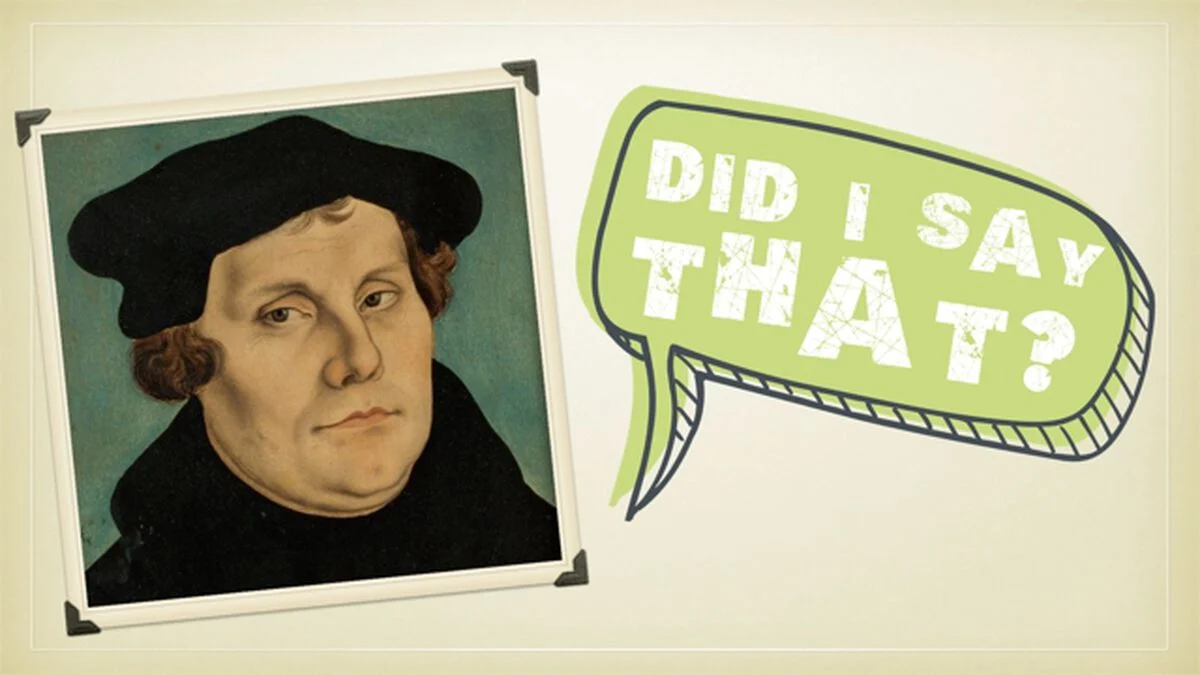
Things we wish Luther had never said/written. . .

So it seems some Roman Catholic blog has put together a list of the 38 Most Ridiculous Things Martin Luther ever wrote (or said).  Only 38???  I could come up with a far bigger list.  But a quick survey of their list indicates that they are not quite reading Luther correctly and some of those things listed are not quite the outrageous or ridiculous things they thought.  Whatever.   I am sure that Luther said far worse and far more shocking things and somebody must have written them down if he did not.  So what?

Lutherans are not bound by every word that proceeds from the mouth of Luther (or his pen) but only by every word that proceeds from the mouth of the Lord (plus the official confessional documents to which we subscribe).  It really does not matter much to me what crazy things Luther has said.  I say some real doozies from time to time as well.  Let us not forget how many bishops have put their foot in their mouths and chewed away.  Or, for that matter, the king of ridiculous religious quotes in our own time, Pope Francis!  

Unlike Luther, whose words have no official authority among Lutherans (except for those in the Confessions -- a relative few of his writings), Pope Francis is the mouthpiece of the Roman Catholic Church,  the chief interpreter of the faith, and the one who called the Vicar of Christ Himself.  Luther's outrageous expressions do not bind anyone but Rome is bound by what their popes say and this one is the master of fog, delusion, and diversion.  So, while Rome wants to paint Lutherans with every crazy things he ever said or wrote, Rome itself has already been painted in a corner by this (and a few former popes) who said the most outrageous and ridiculous things while sitting on the throne of St. Peter.  All in all, if we pitted what Luther said against the one who claims to know God's mind better than, well, God, I don't think dear Martin would fair that badly.  A little smug laughter from the banks of the Tiber is the nervous humor of a people who better not throw stones in their own glass house.  We can lift a Lutheran beverage and laugh at Luther with the best of them because at the end of the day the words that matter to us most are the words that proceed from the mouth of God, the Word of the Lord that endures forever.  About that, we are most certainly not laughing.  If Rome was smart, they might adopt the same rule.

Sunday, December 11, 2022

Misremembering. . .

I have approached that stage of life where I am beginning to wonder if my memory has always been this bad or if I simply do not remember when it was good.  My aunt referred to this as "alltimers disease" since she was sure this cognitive impediment had been with her as long as she could remember.  We seemed doomed to not remember where we put important things while recalling the exact location of those things that do not count and of misremembering the things we want to recall forever.  It might be simply age and its consequence of mental frailty or it simply could be a lingering fruit of the fall.  In either case, it is sin.

When we gather before God, we think we have something to say that God wants to hear -- as if God were truly impressed by the invention of our words or music.  But the most profound thing that comes out of our mouths is what God has first said to us.  Indeed, the liturgy is nearly 100% Scripture, said or sung, but not because we decided it should be.  Instead, God knew what sin would do to our minds and hearts and so He directed from the earliest of days in the wake of the fall of Adam that His Word should be upon our lips.

Like many, I find myself remembering what I think God said somewhere because it fits what I want Him to say.  In reality, I have misremembered what God has said.  Some of it is merely amusing but much of it distorts the truth that endures forever.  If misremembering is clearly our problem, then being in the Word of God is clearly the answer.  That is why the Church Year is important as it repeats the Word of God and tells the stories of Christ's life over and over again in detail throughout the year.  That is why the Liturgy is important because it is not the words we want to say to God but we want to say what God has said and therefore keep that Word in heart and mind.  When the disciples received the promise of the Spirit, it was so that the Spirit might bring to their remembrance all the things they would have surely misremembered had they been left to their own memories.  Wow.  That says something.

So as we find ourselves a couple of Sundays on our way to Christmas, so early in this new Church Year, we would be wise to consider why God's Word read and preached is the center (with the Sacrament) of the Divine Service and why the versicles and responses and ordinary of that Divine Service were not left to our imagining but a speaking back to God what He has first said to us.  The stories bear repeating not simply because they are good and important but because they fade from our memory without the constant retelling, and, worse, they become misremembered until they no longer bear much resemblance to the Word.

When you get to that point in your life where you begin to wonder if your bad memory is merely something you are now more fully aware or if it is indeed the sign of a memory failing, then you begin to realize how important it is to repeat what God has said.  Often I think back to a blind elderly woman I visited in the nursing home.  What she wanted me to do was to read to her the hymns from the hymnal (The Lutheran Hymnal!).  I watched as she moved her lips as I read them -- tens of stanzas and her lips kept repeating the words.  She did not want to forget or, worse, misremember the words that formed her faith from childhood and now to the twilight of her life.  She was wise and was teaching me what now I find the very thing that I need and you -- to say back to God what God has said to us.  Whether that comes in Scripture or in the paraphrase verse of a hymn, it is a very important part of both worship and life.

We live in a time in which the frailty of age often shows up in the disorders that rob us of our memories or distort them.  How important is it then for us to keep repeating what God said so that He knows we know and believe His Word as well -- especially in those moments when our minds struggle to recall them.  This is one profound truth I have learned from providing pastoral care to those who suffer such.  The oldest memories and the oldest words are the last to go.  I have watched as some people struggle to recall their own sons and daughters or spouses but who can repeat the Our Father or Creed without skipping a beat.  In the end, that they remember this word is the most important thing of all.


Saturday, December 10, 2022

Like a duck....

Honestly I grow weary of explaining to people it is not simply a matter of taste or preference or high culture or low and certainly not mission vs maintenance.  When we as Lutherans countenance different Sunday morning rites (by this I do NOT mean different page numbers in LSB but the difference between non or anti-liturgical worship and liturgical), we are encouraging different churches and different faiths within the same jurisdiction and even within the same congregation (when multiple styles of worship are offered).

Worship wars are not about worship.  Lex orandi lex credendi is not about which drives the other (orandi or credendi) but how they are intertwined and affect one another.  Change how we pray and you will change what we believe.  Change how we worship and you will change what we believe.  Change what we sing and you will change what we believe.  It was and has always been a concern for the faith of the faithful.  It was never about the vestments worn or not or if the pastor faces the people or the altar or pipe organ or guitar or screens or hymnals or tympani or bongos or anything like that.  Those things are themselves manifestations of a different faith.  When we decide that whether the Divine Service or not what makes it Lutheran is somebodies intention, we have turned the faith into something theoretical instead of something practical.  Nobody confuses eating prime rib at a fancy downtown restaurant with  munching down a Krystal burger while driving in the car.  Fast food is its own culture -- whether you like it or not.  The table with a linen cloth and heavy silver and fine china is its own culture -- whether you admit it or not.  Liturgical worship and evangelical style seeker service contemporary worship are different cultures and end up manifesting different churches in the end.

The problem is not primarily what is done but why and what end it manifests for those doing it.  We in the Missouri Synod have decided that non-liturgical worship and liturgical worship are both legitimate expressions of our confession.  No, we did not vote on it in Convention or legislate it into being through constitution or bylaw.  We did it by remaining silent when congregations abandoned liturgy and hymnal to invent their own form of worship (which bore little resemblance to our Lutheran liturgical tradition).  We did it by imagining that you can keep the faith as an idea while worshiping with a form that fails to express that idea or even perhaps conflicts with it.  We did it by presuming the adiaphora applied to everything and meant that anything we chose to do was just as legitimate and faithful as what had been handed down to us.  What has been missed is that we have created different churches as a result (and different congregations within the same building).  The people who do to one format will not go to another, do not know the order or liturgy or words or songs of the other.  Even more, without the liturgy, the faith itself is different -- not rooted or flowing from the means of grace but appealing to and finding its home in emotion, entertainment, and enthusiasm.  

The old expression says "if it looks like a duck, swims like a duck, and quacks like a duck, then it probably is a duck." Everyone knows this.  So if the way you worship has more in common with Evangelicalism or mainline Protestantism or the Baptists, the world will judge you that and they will be correct -- despite your protests.  The sermon alone does not make something Lutheran.  A fine Lutheran sermon within such a non-liturgical form of worship cannot baptize the rest of what is there to make it and the people using it formally Lutheran.  

The reason why the old church buildings were so large is not simply that they planned for the Christmas and Easter crowd.  They had only one Sunday service.  Everyone was together in the same place at the same time for the same liturgy and sermon.  It is a modern invention to have multiple services at multiple times and it is even more modern to have multiple styles of worship at those different times.  Sometimes they even occur simultaneously in different parts of the same building.  But the people are not confused.  They will not attend where there is room but only where it fits their preference.  In days of old our parishes had a different fellowship because they were together weekly as a whole and they had a different understanding of their confession and faith because they experienced it in the same liturgy and it the same place on a weekly basis.  All of that has been turned upside down.  Even when the liturgy is identical but offered at different times (as in my parish), the fellowship is divided.  When what happens at those different times is different, the faith believed and confessed becomes different.  It may not be by design but it is inevitable.

If we find it hard to manage these different churches within the same denominational structure, how can we manage these different congregations within the same building?  While I do worry about the division over preference, I am more worried that we are developing two different theological identities in our church body and in congregations that offer multiple styles of worship. Once that has happened, how do you ever get back a common sense of identity, confession, and piety?

Friday, December 9, 2022

What happened to the full pew?

The Church has always been one generation away from extinction -- at least from an earthly perspective.  Without insight into the will and purpose of God, we are often left to comfort or upset our souls with the earthly perspective on things.  That is what we have done -- wondering where all the youth and children have gone.

One of the more obvious conclusions is that the generation that is looking for the missing faces did not do its own job well and so they passed on a habit rather than a faith or a cultural view rather than a conviction.  I suppose there is truth in this.  It is certainly the case that today it is not merely a habit that benefits our children and grandchildren (though the good habit of being in church weekly is a good place to start).  It was and has has always been and will always be about catechesis -- teaching the faith with the habit.  If we kept the habit but left out the catechesis, our children and grandchildren will probably wash up on the rocks of why, what does it return to me, and what am I getting out of it.  If we had the catechesis with the habitus, then our children know whether these are the right questions and what are the correct answers to those questions that are legitimate.

There is also the wild card of marriage (although there is actually less marriage than before).  When the children of Christian parents and homes marry those who do not have the experience, background, habit, and understanding of worship, it is typical that the Christian's attendance will wane.  Without multiple generations in the pews to help, it is largely up to the one who did attend regularly and faithfully to explain why the family should be doing this together.  That is often less successful than we hope.  In the end, it is typical that after a while the faithful one becomes less faithful and the catechesis and habit of the home gives way to other things that compete with and distract from Christianity.

Yes, the culture has changed.  No, it is not as friendly toward the Church as it appeared to be in other generations.  But this is a familiar boogeyman that is not worth the blame.  Indeed, it is an easy and exploitable enemy to blame but one that often masks our own failures at home and in the Church.  Key among the issues is the fact that the Church is no longer essential to most folks idea of Christianity.  Long ago we bought into the lie that faith is self-starting, self-supporting, and self-sustaining.  With that came the extra burden on the Church to provide herself both relevant and worthwhile.  Since it is not a commonly accepted fact that faith requires the Church more than the Church requires the faithful, the Church is seen as more than less non-essential but even gets in the way of the faith.

It is not uncommon to hear some say that they feel closer to God on their own terms (such as hiking in nature) than they do through the means of grace.  What they are often saying is that the forms get in the way of their idea of communion.  They did not stumble upon this themselves but learned it from parents who themselves were not quite convinced the Church was essential and often judged the Church to be an impediment to a lively faith.  That said, the Church that will survive is not the Church that caters to the idea of relevancy but lacks the historic, transcendent, and reverent atmosphere for worship to take place.  If anything, the pop churches of the past may be trying to learn ritual and liturgy simply because their pews are suffering as much as anyone else's pews.  Still, I lay it at the feet of a well-intentioned but flawed catechesis that just keeps on giving the wrong message down to the third and fourth generation of those who love Him but not enough to worship Him.

If you want the pew full, teach them.  Teach them well.  Teach them well and build the habit.  Build the habit until it forces them to learn it all again.  Do it at home, in the classrooms of Sunday school and confirmation classes, and keep on doing it until we get it.  The problem is not figuring out what to say to a new generation (God's Word, duh) but the problem is teaching it until it informs their thinking and doing it until they cannot imagine not doing it.  But boy are we behind the 8 ball now....

Thursday, December 8, 2022

Hear that sound?

If you hear a groaning and scraping sound, it is Luther rolling over in his grave.  In an article on Luther's monumental work of translating Scripture into German, a writer in the Living Lutheran magazine stated unequivocally "What Luther manifested first and foremost was a private way of reading and interpreting Holy Scripture..."  So that is the legacy of Luther's work wresting Greek and Hebrew into a form of German he largely invented.  "Now that Luther has given the Bible to the people... we have as many interpretations of Scripture as we have readers; instead of one Christian church there are many, some bitterly opposed in their interpretations of the [W]ord."  If this is what was left by Luther and what Lutherans claim credit for, Lutheranism has plenty of problems.

If this were true, then Luther would be the perfect child of Erasmus -- one who multiplied the humanist and individualist ideal to the highest ruling chair of Christendom.  There is no higher place than to sit above Scripture and decide what the words say and what they mean.  If this is what Luther's legacy of translating the Scriptures into the language of the people, then Luther would be the first to admit that he has much to repent of and much to atone for.  Luther made the Word available in the vernacular so that the Word might be incarnate in the hearts and minds of the hearers and not the other way around.  His gift to the Church was not the privilege to decide what the Bible says and what the Bible means but the ability to hear the living voice of the God who did not merely speak once but continues to speak.  It was the gift of a sacramental Word to a people whose ears and hearts and minds were created to hear, even if sin had corrupted that hearing.  And the life of that Word is imparted to those dead in trespasses and sin and received by faith empowered by that same Spirit to receive it by faith.

Luther was captive to this Word and not captive to his conscience.  His conscience was under the Word.  There is little legitimacy in the view that Luther would have rejoiced to see the day when every Christian was his or her own magisterium.  Luther certainly hoped that everyone who read the Word of God would have the same joyous encounter as Luther himself did -- meeting the God of steadfast love, mercy, compassion, and forgiveness.  This cannot and will not happen if the Word becomes the subject matter over which we are the master.  But that, sadly, is precisely what has happened among liberal and progressive Lutherans who see the Word as a mere starting point or reference for their own opinions or emotions to build upon and even transform that Word.  However, the same fallacy can easily befall those on the conservative side of things.  Consider, for example, that Luther's catechism was prose, a sort of written form of a homiletical address whereas our version of his catechism has become a book of texts to prove our points -- so much so that what we have added not onnly predominates but dominates that catechism.  At the same time, Luther would never have surrendered his role as teacher of the faith to a Bible study in which everyone said what they thought the text said and what it meant and how it touched them.  Yet that has become normative for too many Bible studies among Lutherans -- even conservative ones.  

It is about time that we confront the elephant in the room.  Putting the text of the Scriptures into the hands of laypeople was never meant by Luther to be the surrender of the Church's teaching magisterium or the presumption that the Word of God said nothing and meant nothing until we decided what it said and what it meant (and how it applies).  It is a convenient lie to justify our own desire to be the masters over the Word of God.  In this way we are not all that different from those who entertain and allow those entertained to decide if it was worth paying for.  To lay this at the feet of Luther or any other translator who takes the Biblical languages and renders them into a faithful vernacular is to thrust upon that translator our own sins.  It is certainly convenient to do, but a lie nonetheless.

Wednesday, December 7, 2022

The evolution of things. . .

Until the time of the Reformation, pastor's self-communion was never an issue.  It was a given.  The pastor communed first and then the assistants and then the congregation.  Apparently Luther had no issue with it since he made it a rubric in the Formula Missae:  "while the Agnus Dei is sung... communicate, first, himself, and then the people..."  Of course, we all know Luther's issue with the pastor communing with no congregation present and his challenge the private mass is well known and documented.  Here the issue of the pastor communing himself is not an issue of whether or not he should but the idea that the private mass is his own little private domain in which the sacrament is a personal vehicle and not the public mass.  So his words in the Smalcald Articles cannot be applied to the public Divine Service but must be viewed in Luther's own context.

All of this might be only mildly interesting except that I never saw a pastor commune himself until I went to college.  In the intervening time between 1523 and the 1950s and1960s, the Lutheran pastor no longer communed in his own congregation.  During the time I grew up, the pastor communed at the winkel or circuit gathering.  There was the appropriate forum for the pastor to commune and it was out of eyesight of the people he served.  I do not know how this happened or what the intention was but it severed the pastor from the assembly in ways that were not helpful then and are somewhat scandalous now.

By the time I made it to seminary a new invention had come to my home parish and to the Lutheranism in which I grew up.  That was the invention of having an elder commune the pastor.  I was quite shocked by the pastor communing himself at the campus Eucharists at St. John's in Winfield, KS, but it was even more shocking when the elder (usually a family member in my small interrelated congregation) stepped up to the altar and gave the pastor the body and blood of our Lord.  My father explained it that the pastor had requested it and since we went through a pastoral change while I was at the end of my high school days and the beginning of my time in college, I knew this was probably true.  What stuck out to me was how odd it was that my relative in a suit stepped in to take the place of a pastor serving my vested pastor who had presided in the Divine Service to that point and would then take over and finish the service.  While the pastor never communing with the congregation was odd, this was no less and might be even more strange and incomprehensible (except out of some pious humility).

Now we have seen the pastor's self communion restored more or less -- more in the liberal parts of Lutheranism and less in the smaller conservative ones.  Officially, however, the self-communion has been restored to the rubrics of the major Lutheran bodies (enshrined both in Evangelical Lutheran Worship and Lutheran Service Book.  It is clear that some pastors are uncomfortable about it still.  The elders are still communing some pastors.  Assisting pastors are communing the presiding pastors.  Pastors are still communing at winkels.  A new wrinkle is that pastors are communing at the end rather than at the beginning of the distribution.  That is one I do not like though I understand.  If the reliquae are being consumed, then the pastor can consume them at the end while communing.  But the consumption is different than the communion -- something I do not think many pastors appreciate.  When you consume the reliquae you are not communing for a second, third, or fiftieth time in fifteen minutes but consuming the reliquae.  Do you say "the Body of Christ" or "the Blood of Christ" after every host and sip?

So when does this end?  There are many factors that shape liturgical practice and many of them -- dare I say most -- have little to do with theology but a great deal to do with piety.  When piety changes, practice changes and when practice changes doctrine changes and when doctrine changes, we have trouble in River City, my friends.  Unfortunately, that is the back door that too many things use to enter into the life of the Church.  Some of them are simply goofy or odd and not particularly nefarious (as perhaps the pastor's self-communion) but many of them are more than foolish and benign.  That is why we need to watch ourselves and our practices lest they become the doors through which we end up changing what we believe.  For what its worth, I have for more than 42 years communed myself and the only people who have had an issue with that practice, oddly enough, have been other pastors.  Go figure.  I guess it is a small thing in a world in which communing at home in front of a screen while the pastor says the right words from a video or livestream has hold of our imagination and become almost acceptable even among Lutherans...

Tuesday, December 6, 2022

Governance is not the same as ministry. . .

Nearly every congregation I know has trouble recruiting leaders.  In some parishes, the same people have been doing the same jobs for more than a generation.  In some churches, the worst job of all is to be put on the nominating committee.  Governance was a high profile and high priority thing 50-70 years ago but not so much since.  It is not just the church that struggles to find and convince people to serve as leaders and officeholders.  Look at any volunteer organization (PTA/PTO or civic group, etc.) and you will see the same problem.

For a very long time we have presumed that service and governance are the same.  It is easy to understand why.  There was a need early in the life of the church to organize what had become chaotic and burdensome.  Think of Acts 6-7 and the setting apart of deacons.  Too much was put on the plates of too few and so another office was created.  The formal structure of things (the three fold pattern of ministry) was the church's response to such disorder and overwhelming responsibility.  The trouble is that the work of the Church and how we govern ourselves can sometimes be at odds with each other  When there is no heart to serve, governance becomes a big problem.  When governance is messed up, it impedes the heart to serve.  Both of these can create conflict that works against the sense of community or fellowship of the people of God.  We all know this.

The models we have used to organize the Church have tended to mirror the political and cultural realities around us.  In America that means we organized ourselves democratically with holding office and the vote were the big deal.  At least, that is how it was.  Now voting and office holding are not so big but doing things is.  In effect, we find ourselves recruiting people more for the formal structure of the organization of the congregation instead of recruiting them to do what needs to be done.  In most parishes this means we are spending more time on the governance than on the doing of the work God has called us to do and finding it all, on the whole, less than satisfying.  In fact, we complain bitterly about the task of finding people to run for office and then fulfill the typical pattern of office holding -- holding meetings where we plan and discuss things but often fail to do much.


Governance is not unimportant but it is not the primary thing the Church does.  What the Church does, what God has given us to do, really sits on the fringe of or outside the realm of governance.  When things do not work well, we tend to reorganize the formal structures (of denominations as well as congregations).  But all of this effort can sometimes steal the thunder away from the things we are to be doing as the Church.  Our most basic purpose is to gather around the Word and Sacraments through which God works in us and equips us to do His bidding in the world.  Often this can feel like the periphery of the main work of dealing with property and facilities, running programs, and managing the business of the Church.

Part of the reason for this is that we live in a world in which the high value is placed on goods and services and, today, consumer satisfaction.  We end up echoing the business strategies for success we hear in the world around us instead of heeding the voice of God and doing what God has called us to do -- both clergy and lay.  The Church is not a business and the congregation, no matter how we organize, is not in business to do what businesses do and our success cannot be measured the way businesses do.  We cannot purchase success nor can we organize for success.  We are to be faithful.  Of course, that faithfulness is not simply to the means of grace but also extends to the financial and property resources in our care but all of these are tools to support the main thing -- the Divine Service and the witness before the world of God and His rich gifts.

Every congregation has formal leaders who are elected to offices and serve terms.  Every congregation has informal leaders who hold no office but whose voice is respected and whose lead is followed; these tend to be long term people within the parish.  Every congregation has ad hoc leaders who work on projects or tasks without formal election or even appointment but who get things done.  Every congregation has a very few folks who might be paid staff except what they do, they do without compensation -- treasurers, Sunday school superintendents, financial secretaries, etc... who go above and beyond and have for many years.  The key lies in not trying to make one group into another but to establish a formal structure to accommodate the informal leaders while building in accountability all the way around and a sense of investment in who the congregation is and what that congregation does.  The other key is to keep this from competing with or displacing the core identity and purpose of the Church gathered around the Word and Table of the Lord.  

The goal ought to be to have every class and level of leaders from the office holders elected to the few who have done the same job forever to train up others who know what is done and can assist or even take over.  This does not happen over the short term but is a long term investment in encouraging and raising up leaders over and over again. 

Another good thing to remember is that St. Paul did not mean every congregation must do everything when he said he had become all things to all people.  This was not a process or governance challenge.  So there are things every congregation must do and should do as well as they are able -- excellence is not something reserved for large parishes.  Worship and pastoral care are two of the central things that are both the core of the identity and that for which we expend more effort, energy, and resources to do well.  Sadly, too many congregations presume that worship can be done on the cheap and that the real focus ought to be on facilities or programs.  Wrong.  If what happens in the weekly gathering of God's people around the Word and Table of the Lord is treated as no big deal or if no investment is made in this assembly, everything else will suffer -- no matter how wonderful the building or the programs!  So maybe you cannot do everything you want to do.  If you have no small children, why put all your energy into winning over the young family that is being courted by a dozen other congregations?  If your people are graying, focus on that age group.  They have friends and family who do not belong or attend.  Besides, this group is often more open to the invitation than you thought.  Maybe you cannot have a school or a sports program or a large choir.  Don't beat your head against the wall in pursuit of something that does not fit with who you are.  Don't think that turning the chancel into a stage and putting a band up front will pack in people either.  As Lutherans you have something to offer which is a "market" without many competitors -- reverent worship, solid hymnody, Law/Gospel preaching, and faithful lifelong catechesis.  That is who you are theologically and that is who you need to be in a practical sense to your neighborhood or community.

In the same way, governance can easily be kept light and fluid -- something to fit the size and scope of the parish and not a huge formal structure that requires as much time and energy to maintain as it accomplishes anything.  Know who you are as a parish and look at who your leaders are and what kind of leaders they are and then put it together to work in a flexible and fluid way so that you spend your time doing what God has called the congregation to do and aiding the people God has called to do His bidding in the parish and in their homes and in their community.  That is the best answer to finding the balance between ordering this appropriately and keeping the focus on the work of the Kingdom.  Now if you can give me a quick and easy way to implement this, I want to know about it.  That is what we are working on in my parish.

Monday, December 5, 2022

Preaching in the wilderness. . .

Sermon for the Second Sunday in Advent (A) preached on Sunday, December 4, 2022.

Though we might imagine it would be nice to have seen and heard St. John the Forerunner, I do not think we would be able to bear his voice or his image.  We live in a world that vaccinations are more urgent than repentance, where the opinion of people and social media matter more than God, where the only real sin is not being what you want to be and doing what you want to do, and where death masquerades as life and life is treated as something cheap, easy, and worthless.  If you think John was a handful 2,000 years ago, what would John have to say about us?

St. John preached in the wilderness.  That does not mean he was in the rural country or the lonely desert.  The wilderness in which John preached were the urban wonders and sophisticated cities of a once mighty nation.  Here were the people who had diplomas on their walls and the shiney new technological toys on their shelves.  They were a proud people who thought much of themselves and much of the world in which they lived.  Long ago St. John looked at the urban wonders and pride of a nation and said repent, warned them that God had the axe laid to their root, and the fire kindled ready to consume them all.

We don’t have many like St. John anymore.  We as people won’t countenance those who point out our faults or expose our emptiness.  We live in a world in which being male and female is a momentary feeling, in which marriage is what you define it, in which good is judged evil and evil lauded as good.  Worse, we live in world of churches silent before the corruption all around us and preachers who don’t think sin sells anymore.  We live in a world that needs St. John the Baptist more than ever but he seems to have disappeared.

St. John refused to tell a lie to make people feel better about themselves, refused to bow before the accouterments of power, and refused to treat the problems of our live as a game or hobby.  It was always life or death for John.  Is it life and death for you and me?  That is the haunting question of the day.  We toy with things that matter and treat seriously the things that do not.  Nowhere is that more true than in the Church.  We apologize about the things we ought to defend with our lives and we defend to our death the things we ought to be apologizing for.  Where are those who speak like St. John the Baptist today?
It is to our shame that cannot bear the voice of John in our own time.  It is to our loss that we have allowed the Gospel to become little more than “to your own self be true.”  John was willing to be a thorn in the comfortable side of his day – even if it cost him his head on a platter.  Are we willing to suffer the discomfort of repentance or to be the irritating voices calling others to repentance?  God is calling us to stand up and stand out.  To run to the font where forgiveness washes us clean.  To make haste to the place where sins are forgiven and the sinners restored to clear conscience and a place among the holy people of God.  To bear the fruit of righteousness instead of the poisoned fruits of sin and death.

My friends, the Kingdom of heaven is nearer than it ever was.  The axe is still laid against our roots and the roots of our crooked generation.  The great sophistication of education and technology, of medicine and politics, of leisure time and money to live as we please – these cannot save us.  We are condemned by our abundance because there is no room left for repentance.  We are not satisfied by the riches we have because the longing of our hearts always was and always will be about God.  And we are lonely and sad not because we have no friends but because we do not know God’s friendship in Christ.

Even if we have faith rightly rooted and planted in Christ alone, we have not borne the fruits in keeping with repentance.  Churches have sought members instead of disciples and a faith that lives on the fringe of our lives instead of its core and center.  Faith has not been the beating heart that gives life to our bodies and it has not been the light that shines our way in the wilderness.  Because of this we are warned just as the people of old were warned:  Every tree that does not bear good fruit will be cut down and thrown into the fire.

It would all be too much for us and we would be left in despair except that God has an answer.  St. John pointed to the answer then and we are directed to that answer now.  The Christ has come to baptize us with the Holy Spirit and with fire.  St. John’s sacrament of repentance has become in Christ the sacrament of new life.  By baptism we were connected to Christ’s death and resurrection.  By baptism we who were no people have become God’s people.  By baptism we were washed clean of all our sin and clothed with the righteousness of Christ.  By baptism we wear God’s name upon us and we belong to Him.  As the baptized people of God, our citizenship is not is not in temporary borders but the heavenly city.

St. John was no prophet of doom but the voice of hope.  Even a sophisticated wilderness is not without hope.  God has not written off anyone of us even though we might write off God.  Now is still the day of salvation.  The day is waning and the day of judgment is coming soon but not today.  There is hope where God’s Word is preached in its truth and purity, where baptismal water still calls and claims us for the Kingdom, where absolution still restores the fallen, and where the flesh and blood of Christ feed food for today and for eternity.

St. John was hard and unrelenting in his call to repent but he was not a hopeless voice.  He was and remained focused upon Him who comes in the Name of the Lord, the mighty One of whom St. John was unworthy – just as we are – and in whom the mighty enemies of sin and death are fully and finally overcome.  St. John pointed to the water of hope and the baptism of repentance for all who could not bear the wilderness or darkness or shame or pain of the life sin had created.  That is still what the Church and every faithful preacher does – we point to the water of hope and the baptism of water and the Spirit for all who despair the darkness, are lost in the wilderness, hidden in shame, aching for hope.  

What is our answer to God’s judgment?  Let the axe fly!  We are ready.  Our hope does not lie in the rescue of a lost world but in the new heaven and the new earth.  Our future does not lie in something we might create but in what God has done to make everything new.  Our lives are not attached to this world but destined for the world which is to come, where death is no more and sin has no more claim on us.  Let the axe fly!  We are ready.  We believe in the Lamb of God who takes away the sin of the world and we are here right now to feast upon that Lamb and to drink His blood.  Let the axe fly!  We are ready.  We are not yet who we shall be but we are God’s children now, and what we shall be we see by faith in Christ alone.  Our Advent prayer remains that God will not allow our interest in the wilderness from stealing from us the shining city of heaven.  In the Holy name of Jesus.  Amen.

Not the kind of protection worth having. . .

The politics of the Democratic Party see encoding in law protections both for abortion and same sex marriage as key to their future success.  Maybe so.  On the later issue  the Senate version of the Respect for Marriage Act supposedly provides a balanced legalization of what the Supreme Court decided to impose upon us all.  The issues enjoys the support of a bipartisan coalition of senators (50 Democrats and 12 Republicans) who voted to block a filibuster of legislation that seems both to protect same-sex marriage if Obergefell falls and to protect religious-freedom dissenters, including explicit protections for tax exemptions.  I wish I could say I am encouraged.

Of course, the bill doesn’t give either side everything and is a great disappointment to those who wanted a law to go further than Obergefell but supporters insist it still contains crucial provisions that should provide a modicum of comfort for (almost) everyone. True, it states that “no person acting under color of State law” can deny “full faith and credit to any public act, record, or judicial proceeding of any other State pertaining to a marriage between 2 individuals, on the basis of the sex, race, ethnicity, or national origin of those individuals.”  What this means is that if your marriage was legal in the state where you’re married, then no government officials from other states and localities can refuse to recognize the validity of that marriage on the basis of sex, race, ethnicity, or national origin.

The key problem is that this encodes in law the idea that on the basis of sex means the full list of initials (LBGTQ+).  That is the issue at the core of those who reject both the SCOTUS decision and any attempts to encode its provisions in law.  Is that what on the basis of sex meant when those words were penned?  It does not take much of an historical view to see that it does not.  Nobody knew those initials or what they stood for when that phrase was written and it was exclusively seen as expressing protection for both male and female.  So the issue here is not simply the court decision but the view of the constitution and law which says words evolve in meaning and the law changes (or court decisions change) as we progress in the meaning of those words.  By this idea, nothing is constant in law and everything is subject to the changes of culture and society -- even and especially a politicized Supreme Court concerned about being seen as either irrelevant or ideological.

So what does this offer for religious freedom and those who oppose the law and court decision (though not as homophobes or haters but as a matter of religious truth)?  Its supporters insist the bill will do two important things. First, it declares that “[n]othing in this Act, or any amendment made by this Act, shall be construed to diminish or abrogate a religious liberty or conscience protection otherwise available to an individual or organization under the Constitution of the United States or Federal law.”  I wish I found that encouraging.  When Obergefell was being argued this prescient exchange remains in my memory.

Six and one half years ago Solicitor General Donald B. Verrilli Jr. (from the Obama administration) argued that the Court should recognize a constitutional right to same-sex marriage. Justice Samuel Alito asked him a question that was behind the concerns of many millions of people of faith (not fringe people but Roman Catholics, Orthodox, LCMS, and conservative Protestants).

Justice Samuel Alito: Well, in the Bob Jones case, the Court held that a college was not entitled to tax-exempt status if it opposed interracial marriage or interracial dating. So would the same apply to a university or a college if it opposed same­-sex marriage?
Solicitor General Verrilli: You know, I—I don’t  think I can answer that question without knowing more specifics, but it’s certainly going to be an issue. I don’t deny that. I don’t deny that, Justice Alito. It is—it is going to be an issue.

It is going to be an issue.  If the response of Solicitor General Verrilli raised alarm nearly seven years ago imagine it within the context of all that has happened since.  The theologically conservative Christian folk who sighed with sadness when the SCOTUS acted in Obergefell now had an even larger concern. Would their continued stance that marriage is a union between a man and woman become the equivalent of white supremacists?  All of a sudden this was not about Obergefell alone but also about the Bob Jones decision in which the court infringed upon the religious freedom of what many then and still find an obnoxious religious university to insist that no freedom covered them and their stance.  If you are like me, you ought to be concerned.  Size does not insulate us from the branding of a consistent theological conclusion that has been shared by the majority of all Christians down to the present generation as something not to be tolerated.  The Court has not provided us a refuge either.  Neither will this law protect us.  Voters beware.

Sunday, December 4, 2022

Different times, the same Word...

Some years ago Prof. John Pless did a continuing ed class on Hermann Sasse.  For those of you who do not know who Hermann Sasse was, either Google him now and come back to read or visit another blog and skip mine.  But it is not particularly Hermann Sasse I am talking about.  It is about the timelessness of God's Word.  

In that class, we read two sermons of Sasse while he was serving a parish.  They were both Advent Sunday sermons -- one while the Nazis were on the ascent, doing well politically and militarily in Hitler's quest for supremacy at home and in the world stage.  The other was when the war was not going well and it was clear that the Nazis were failing in their political and military campaigns at home and throughout the world.  What was stunning is that the sermons preached the same call to repentance, the same warning against trusting in earthly rulers or kingdoms, and promising the same forgiveness and love of God as their hope and shelter.  What was even more stunning is that both of the sermons could be preached today without much change -- different times but the same Word that endures forever.

It amazes me how we work so hard to find the word for the moment, the word for the times we are in, when the Word speaks clearly and consistently the same truth for all times.  We seem to be more cognizant of the moment than God is and this is not a good thing.  What we preach is not a particular word for a particular moment but the Word of the Lord that endures forever.  Of course, I am not saying we should be oblivious to the times but neither do we need to search the Scriptures for what we think is the right word for this moment and be preaching faithfully the whole counsel of God's Word all the time.

When we approach the Scriptures, the preacher's task is not to decide what Word needs to be heard but how to preach the Word that God has spoken.  The familiarity with the people of God is not primarily a benefit to figuring out what they need to hear but knowing how to apply that Word and how to speak it to this particular assembly of  hearers.  In this respect, the lectionary is a tremendous benefit.  Whether one year or three is less critical than the idea that the hearers hear the full exposure of texts, authors, and subjects.  This is and should be a discipline for the preacher -- use the texts assigned!

I will admit that I grew up in a time when the lectionary was heard (minus the Old Testament reading, of course) but was almost never the basis for the homily.  There was a system of preaching texts which was used as the primary text of the sermon and the pastor would read this as the introduction for his sermon.  My brother and I would opine on how much shorter the whole service would be if the preacher just skipped the pericopes assigned and read his preaching text alone.  Some have forgotten about this tendency that was common before the 1970s for the sermon to be completely unrelated to the lectionary readings appointed or the season of the day.  In fact, these were assigned more doctrinally than seasonally to fit the Church Year.  We inherited this from our German ancestors and it was a practice still in use in the SELK today (though perhaps less universally).  While it is not the worst thing in the world, it is not a good practice either.  At least it is a foolish one.  And it proceeds from the false idea that the preacher knows best which word to speak as well as being under orders in his office to preach the Word faithfully.  Honestly, I am sure that more preachers choose texts on the basis of what they want to preach or what they find easier to preach than on the basis of what they think the people need to hear.  Preach the lectionary.  What is so hard about that?

Sasse preached the lectionary and that sermon could be preached today almost word for word and was appropriate for a time when the world around those Lutherans was changing under the rise of a fascist dictator and when it was changing even more as the German war machine was being overcome by the Allies.  Yet there in the pulpit, even under the duress of a state sponsored system of spies, that Lutheran pastor preached the Word in season and out, so that the people of God might know the basis of their hope, their peace, and their security.  I wish it could be said about us today as clearly as I saw it witnessed in the 1940s in the sermons of Hermann Sasse.  Different times, the same Word.

Saturday, December 3, 2022

The Problem of Authority. . .

The root of the problem that resulted in the Reformation was not quite justification as some might assume.  The question of how the sinner is justified before God is a question that hinges upon another question more at the core and center of the Reformation than even justification itself.  That is the question of authority.  It is a question that has come back to haunt both Rome and Lutheranism and that is now at the core and center of the present and future of these churches.

Rome did not deposit the full authority of the Church upon Scripture.  Instead, Scripture is one of three legs upon which Rome is built -- Scripture, Tradition, and a third leg that has variously been identified over the years.  For a time it was reason and the great philosopher theologians of the Roman tradition utilized logic and reason to both explain Scripture, defend the faith, and add to the faith things that were never explicitly or even hinted at within Scripture.  After Trent and especially after Vatican I, this leg shifted to the authority of the papacy.  The modern era brought with it a pope who was a player on the world stage and through the media of the day the popes became visible figures who were seen and heard by most of the faithful as the papacy had never been before.  The cult of the papacy was surely enhanced by the decisions of Vatican I but it has also been encouraged by the occupants of the office.  In this age of an imperial papacy, the only real power has been the power of the pope and not simply the authority of his office but also of his personality.

Rome's weakness has been that Luther was correct.  Councils and popes have erred.  Tradition has had its own internal conflicts, not in the least of which is the whole question of what falls within that Tradition and what is aberrant of on its fringes.  Without Scripture as the final authority and arbiter of truth, there are often competing claims to orthodoxy among the voices of Scripture, Tradition, and magisterium.  Further, while no one would suggest that the Rome of today is the same Rome of Aquinas, reason has not relinquished its role and primacy especially when it comes to Scripture.  Rome has been quick to find accommodation with the changing conclusions of science over the origins of man, the historicity of the people and stories of Scripture, and the veracity of the text itself.  That is coming to roost now as their leaders look for ways to make peace with feminism, homosexuality, trans identities, and current avenues of reproductive technology.  The split in Rome may actually come over authority -- council or papal or synodal (whatever that means) or Scripture.  It seems that the Germans seem to be pitting one against another in their view of what Rome ought to look like and say to the world.

Protestantism is another story.  For all its history of fundamentalism and its official adherence to the inerrancy of Scripture, the reality is that Protestantism has been broken on the rock of reason over and over again.  People say they believe the Bible until you talk about baptism or the Real Presence and then there is the ever present but that deviates from what the Word says.  From Calvinism to Arminianism to the every present issues of sex and gender, every side insists that its point of view rests upon Scripture and they alone are correct.  But Scripture cannot say one thing to some and something else to others?  Without any magisterium to decide (like James in the Council of Jerusalem in Acts), the whole gamut of Protestantism from Bible thumping fundamentalism to smooth and hip evangelicalism can say what it wants, insist that it is what Scripture says, and no one can challenge this (at least credibly so that orthodoxy is maintained).  For this reason, Protestantism is beginning to reflect the individualized faith in which doctrine does not really matter but feelings do -- a movement without a real sense or need for church at all (except for those who like it).  Online can replace the in person versions of this church and without any understanding of sacramentality (even of Scripture), Jesus is where they want Him to be saying what they want Him to say.

Lutheranism seems clear to those inside her but even that is rather a mess.  Confessional subscription is claimed by all Lutherans but the shape of that subscription varies.  Every Lutheran body insists that it is standing in the line of the confessors and reformers but those bodies are radically divided over doctrine and practice and not in communion with each other (or, if they are, insist that one does not have to agree with what the Sacrament is or what it conveys to receive it side by side).  There is no way to figure out the conundrum between those who claim a Lutheranism that embraces all the isms of the moment with those who insist it does not.  There is no way to end the debate and so the world looks at Lutherans wondering which kind of Lutheran is the real one.  To those outside Lutheranism, it is a fruitcake of choice fruit and a few nuts held together by a sweet dough.  I would be hard pressed to disagree even as one who would insist it is still the best option around.

Lutheranism says Scripture alone, though not the naked Scripture stripped out of the believing community (tradition) which has believed, confessed, and lived its truth over time.  Yet we cannot agree over what Scripture says either.  So the conservatives end up proof-texting their way through Scripture and the mighty Lutheran orthodox theologians to arrive as justification for why their position is the only correct position.  Moreover, some have regarded the claim at the end of the Augustana as merely a perfunctory platitude for the moment and not the claim to be catholic in doctrine and practice.  In that respect, some Lutherans are quite comfortable being sectarian if it suits their mood and purpose.  On the one hand, progressives seem quite comfortable with disagreement as long as there is tolerance while the conservatives seem intent upon making the requirements for agreement larger and larger and, in effect, upon making the circle of the church smaller -- bettesr a small orthodox church where we all agree (for now) than a larger church where the rules are bent.  Some are left looking in the rear view mirror when Lutheran seemed more united in theology and liturgy and the numbers were on our side and pine away for that day, having somewhat given up on the future except to order the decline and stave it off where possible.

Lutheranism writes better than it reads and lives better in the imagination than it does in reality.  I say this not because I have given up but because the confessional and theological writing is grand and the problem lies not with what is written but those who read it through the lens of their own preoccupation.  So the catholic claims of the Augustana have been replaced by the life of Lutherans who no longer want to be bound by those claims and who think that Lutheranism can be summed up by a mainstream of Lutheran faith and practice, an average of the practices that fits under the generic beliefs.  This is a surrender not only to defeat but to the very essence of the Lutheran claim for an efficacious and living Word that bounds even as it gives life.  While those on the liberal fringe of Lutheranism keep the rites to look the part, they have long ago surrendered the content of what is believed and confessed.  Those on the conservative side insist that they have kept the faith but view a minimalism of rites and ceremonies as necessary to preserve what is confessed.  If the Lutheranism we claim is true to Scripture and tradition as the Augustana claims, why would we not practice it rigorously?  Is there a fault for being excessive in a piety that expresses in life what we say we believe?  The answer to Lutheranism's problem lies within our own confessional identity -- be those who insist that we have not departed from catholic doctrine and practice.  Do it without qualification or embarrassment.  Do it without muddying up what the words say and mean.  If the authority rests upon a living Word that does what it says because it is the voice of Him who speaks, then live out that authority to its fullest.

Rome is not only broken but is continuing to break up under a council some say had to be and others say killed the church and a pope who is a muddled witness at best or undermining the faith at worst.  Without Scripture as authority, who is there to say which is Roman and which is not?  Protestantism imploded under the weight of its own emptiness and now it seems nobody cares about truth or doctrine anymore -- only about making people feel better about themselves.  Lutheran has allowed its once clear voice to be corrupted by those who make the claim but have abandoned the substance or by those who have chosen a point in time as our pristine moment and would like to revisit that moment forever.  Rome probably cannot be rescued from itself and will end up being a loose confederation of national churches around the imagined authority of a Roman Pontiff.  Evangelicalism will soon become a religious voice of culture and conservative Protestantism will schism itself into obscurity.  It seems to me that Lutheranism has the easiest path to renewal if we are willing.  And that is where Lutheran's weakness lies -- are we willing to be who we say we are?


Friday, December 2, 2022

Medical aid in dying. . .

That we use language in absurd ways should come as a surprise to no one.  Gays are hardly gay at all and are afflicted by higher rates of sadness, more despair, and increased desire for and attempts at suicide than the popular not called gay.  Data suggests that suicide among gay and lesbian people is two to seven times more often than heterosexual comparison groups. Gay men and lesbians have significantly high rates of risk factors that increase suicide risk such as suicide attempts, alcohol abuse, drug abuse and interrupted social ties.  But this post is not about that, it is about the new way we define medicine.

Medicine was once the specific vocation to fight against death but has now become a tool in compassionate dying.  In other words, medicine and its tools no longer have healing or the relief of pain as their goal but aiding and assisting those who have determined their lives are not worth living and making this decision for those who cannot or will not make this decision for themselves.  Canada, often the precursor of what will eventually happen in America, introduced the idea of medical aid in dying for adults with “enduring and intolerable suffering” and who can “reasonably foreseeable death.”  In 2021, Bill C-7 was passed, which legalized medical aid in dying for those struggling with mental illness -- a population that is already prone to increased suicidal desire or attempted suicides.  Now it is being introduced on behalf of those for whom traditional treatments or avenues of relief for their physical ills is either impossible to find or delayed for whatever reason.  Therefore, impoverished people are turning to medical aid in dying, in part, out of desperation because they lack access to the resources for the treatment of their ills.  In other words, if the medical system is broken or cannot or will not provide the treatment you desire or require, that in and of itself justifies access to medical aid in dying.

It is not death which is the problem or illness or affliction but suffering -- literally any kind of suffering (physical, emotional, spiritual).  The job of the medical professional is now not only to address the problem or illness or affliction but to offer a way out of any suffering but especially that suffering which is considered more than anyone should have to bear.  As one commentator put it, while many are “dying for the right to live,” others are "living and agitating for the right to die."

The impetus for medical aid in dying is not simply compassion on the suffering that those who seek this aid have said they endure, the reality is that medically assisted deaths could save millions in health care costs throughout the world but especially in the aging populations of the West.  If you want it put as bluntly as possible, body bags are cheaper than treatment and certainly less expensive than the virtually inaccessible palliative beds of nursing homes and hospitals everywhere.  So, because we have decided that we either cannot afford or refuse to afford the cost of therapeutic or palliative care, compassionate death is a more effective and efficient.  All of this, of course, comes with a cost and that is the redefinition of what medicine itself means.

 In 2021, Canada euthanized 10,000 people of various ages.  Since its legalization in 2016, it has not only become normal and mainstream, medical assistance-in-dying (MAID) has even been performed in a church in Manitoba. This gives to the medically assisted death (a strange oxymoron) not only a legitimacy but a standing as a quasi-sacramental rite in which the faith makes holy what is essentially a secular act.  Though this church called it a “crossing over” ceremony hoping to connect the medically assisted death to the Christian home of some kind of sanctified existence beyond death, there is little parallel here to the commendation of the dying and the funeral rite with its focus on death that has been overcome with the life of Christ.  Where Christianity gives to the body and the life of the embodied person a dignity from God's creation and redemption, this agitates against the intrinsic value of life and the body.

Already Canada and parts of Europe have fully embraced the change of medicine into the healing care of those living to prolong and make their lives better.  But America has embraced this in theory even though we have not yet encased this in law or legal practice.  Be assured of this, it is coming.  It comes not from the radicals but from the ordinary and those within our pews who have decided that the world is right -- there are things worse than death.  Once we make that determination, it is a short hike to having medicine hasten death and the government support this culture of death and pay its bill.

Thursday, December 1, 2022

In the cold of winter. . .

Once we spent hours out of doors because we had to -- the old days when homes were not filled with screens and bins of toys.  The children spent much of their free time outside -- from the chores that were their duty to the leisure that they pursued as soon as jobs were done.  Now we have the situation in which people, especially children, are spending more and more time indoors and alone.  This is the fruit of another era -- the age of the pandemic when the outdoors were safer than indoor gatherings.  Winter was an age of cold, of snow, of steamy breath, and rushed feet.  Now it is an age of cold in another way.  People seem consumed by anger and the atmosphere of home, workplace, neighborhood, and community has cooled over the years to the point where rage seems epidemic.

As a pastor I know of and have experienced AND hear from our people the phenomenon of anger and rage as a new norm for adults but also for children.  Our sons and daughters seem consumed by rage and the news seems to support this conclusion.  Shootings or attempted shootings, assaults in the safe places such as schools, and the lack of targets or reasons for the violence all point to the increase of anger and bitterness that children and young adults seem unable to deal with all attest to this reality.  

Sadly, even congregations are not immune from conflict, anger, and dispute.  So many pastors and other church workers find themselves tested, burn out, and empty because of all the anger and rage that is in society at large but also seems to be typical in congregations as well.  Ask any District President and they will tell you the significant amount of time they spend trying to put out fires in congregations in their Districts.  Some find the congregation a safe place to vent -- since they probably won't ask you to leave no matter how outrageous you are and they tend to bend over backwards to make you happy.

Homes are not the safe places of acceptance and forgiveness they should be.  In our age, it is considered hypocrisy for husbands and wives who are parents to hide their own disputes and disagreements from their children.  Instead, we feel bound to be transparent to our children and let it all hang out -- no matter how harmful that is to children and their development.  How much of our own discontent and rage do we end up passing onto our children because we do not know how to deal with it?  For the Christian, this is the failure of repentance and the lack of clear focus on absolution.

Rage, anger, dispute, contentiousness, and the like are the natural fruits of sin -- sin unabated by either a civil righteousness that offers a veneer of public politeness and decorum OR untouched by the blood of Christ that forgives sin and reconciles sinners.  We have seen a lot of this.  It was there before Trump and will be there long after his name is forgotten.  You cannot blame the lack of civility and common courtesy upon any one individual but it is the certain outcome of a sinful humanity unhitched by anything that would restrain the rage or resolve it by Christ's own work of absolution and reconciliation.  The cold of winter is less about the temperature or the weather but about the cold character of humanity in the winter of our discontent -- without a sense of public face to restrain us or the blood of Christ to contain that anger and deliver peace.  Get ready for things going south even further in this area....

Wednesday, November 30, 2022

People look East. . .

"For as the lightning comes from the east and shines as far as the west, so will be the coming of the Son of man.” — Matthew 24:27

People, look east. The time is near
Of the crowning of the year.
Make your house fair as you are able,
Trim the hearth and set the table.
People, look east and sing today:
Love, the guest, is on the way.
by Eleanor Farjeon; stanza one

It is St. Andrew's Day, the day that triggers the start of Advent.  Advent, if it is anything, is an eastward facing season.  There have been a lot of opinions rendered about facing East.  We have all heard the real estate mantra, Location, Location, Location!  Well, what about where the altar is located and how the people face?

Traditionally, churches should face east.  We all know some of the reasoning -- East is the direction of prayer and Christ will come from the East when He comes in His glory.  Well, there are others but those depend upon where you are Eden's Paradise was believed to be in the east and Jerusalem lies in the east.  So it was natural that Christians would face both East and Christ as they faced the Altar.  Before I launch into this, it should be noted that the term ad orientem itself means to the east.  So the orienting of the church building to the east become the very word for how a building is sited or oriented.  The goal in this orienting is to see the sun rise through the windows during the mass.

However, the earliest Christian churches in the Holy Land did not face east but Jerusalem, the city of the Messiah and where He was crucified and rose.  When blessed Saint Helena made her famous pilgrimage to the Holy Land and talked her son Constantine into building the Church of the Holy Sepulchre, the building did not face east but the apse and the anastasis, the chapel with the empty tomb, was in the west the very same orientation as the Temple of Solomon whose front door faced east.  Maybe there was some intended symbolism here the Christian altar seen as the fulfillment of the ark of the covenant in the west part of the Temple.

Move to Rome and the four of the most ancient and most important basilicas of Rome, Saint John Lateran (AD 324), Saint Peter’s (AD 330), Saint Sebastian’s (AD 330), and Saint Mary Major (AD 432), are not east facing but have their altars in the west. These were built by some impressive figures Constantine and the popes.  Did they build them backwards?  Or think of the great churches of Florence, arranged not to face east but in a circle around the great Duomo, the Cathedral of Santa Maria del Fiore in the city center.

The orientation of the church building, no matter what direction it faces, is always east liturgical east.  Just as the direction the people face is always east — liturgical east.  Advent reminds us of this.  It is not a geographical point that east makes but a theological one.  In an ideal world they might always be the same but every church structure must be conceived of in reference to the site and other buildings around it.  The lesson here is not good geography but good theology where we face is defined not but bricks and mortar on the ground but the direction of our hope.  Perhaps we might remember this more often as we find Christianity failing not because our buildings are backwards or whatever but because our theology no longer flows from Christ or leads to Christ which is the point of it, isn't it?

Tuesday, November 29, 2022

Not nostalgia. . .

Much of what passes for argument in what should or should not be done in worship is accused of being nostalgic for another age -- older folks who can remember TLH and the liturgical and doctrinal uniformity imagined in the 1950s and before.  Of course, this is foolish.  The only nostalgic folks in this are those who grew up as rock and roll unfolded into full bloom and who think that they should hear the sounds of soft rock in church on Sunday morning -- the ballads of the folk side of this genre or the music with a beat that you can dance to.  In either case, it is the nostalgia for a time in which truth began to surrender to feeling, morality to what feels good in the moment, and faith to feelings.  It was probably inevitable that in this view, Jesus would become a boyfriend or BFF rather than the mighty Word that spoken creation into being now incarnate and certainly rather than the Savior who pays for the sins of the world.

Strangely, those who are not old enough to have lived when TLH was in its prime are the ones who seem most nostalgic for its heyday.  I have written before that because they did not grow up or live as adults in the era when TLH was the hymnal for our Synod and the Common Service more common among all Lutherans, they do not realize the inadequacies and lacking of that era.  Clearly, however, the push to recover a common liturgy and common doctrine is not nostalgia -- the boomers who can recall these days tend, as a group, to be moving in an opposite direction.  Neither is it quite nostalgia among those who cannot recall the origins but who can appreciate the blessings of unity in liturgy and dogma.  What might be more appropriate is a deep sense of reverence, even awe, for the presence of God and the things of God.

Admittedly, it does not quite work to make TLH casual.  Forms had to be invented to supplant that book if a casual, God my buddy style of worship and music was desired.  Unfortunately, all the sins of this perspective get blamed upon the modern liturgical movement.  That is not quite true, either.  While it is fair to say that diversity and an embrace of local culture and the domain of preference left the door open for the worship band and diva and the love songs that imagine Jesus who is no longer present sacramentally, neither Vatican II nor the modern liturgical movement that attracted Lutheranism was about abandoning reverence.  It was more about making the forms more accessible, to be sure, and more united (all in one book for Lutherans), but it was also about restoring a profound sense of baptismal life and identity, a hunger and yearning for a Sacrament that then was celebrated monthly or less, and the rediscovery of the sacrament of absolution within the life and piety of the people and their pastors.  The problem for Rome was that Vatican II's direction was replaced by the personal goals of Annibale Bugnini and a distracted Pope Paul VI who rubber stamped his radical reforms.  The problem for Lutherans was far different.  The work of the liturgical movement and a common hymnal got hijacked by the radical cultural shift within America, the battle for the Bible, and the maturation of a thoroughly American form of Lutheranism more at ease with itself than it had ever been.  Put that all together and it is rather remarkable that the worship reforms of the mass were as tame as they ended up being -- certainly more moderate than some of Missouri's own experimenting in Worship Supplement (1969) and the first editions of the ILCW trial offerings.  In fact, looking at ELW and what happens among the evangelical wannabes of Lutheranism, even LBW seems thoroughly serviceable in hindsight.  But when they appeared and later LW, the break with our past dominated and, at least for Missouri, created a window for TLH to live on in practice but most of all in our dream of a more pristine and ordered past.

What those under 40 are looking for is radically different than their parents and grandparents imagined from the liturgical reforms of the 1960s-1970s.  They are not nostalgic as much as they are panicked by a piety that seems plastic and worship that is self-serving and self-referenced.  They are looking not for something from the past but something in a continuum with that past, a deliberate reform that marked a hermeneutic of continuity that has made even more attractive the Latin Mass among Romans and the Divine Service out of the Common Service tradition among Lutherans.  They are searching for authenticity, reverence, transcendence, and, most of all, integrity among the preaching and the liturgy.  You cannot blame them for nostalgia but you can blame those who used the moment of reform to introduce an alien spirit into the Divine Service, stripping it of all that had made worship distinctive and therefore God's work.  The nostalgia of those for folk rock and soft rock has taught their children and grandchildren to look for something different than their families desired and this has led them to look all the way back to 1941 in Lutheranism and the 1950s in Rome.