Monday, February 12, 2024

The Greatest Revelation. . .

Sermon for the Transfiguration of Our Lord (B), preached on Sunday, February 11, 2024.

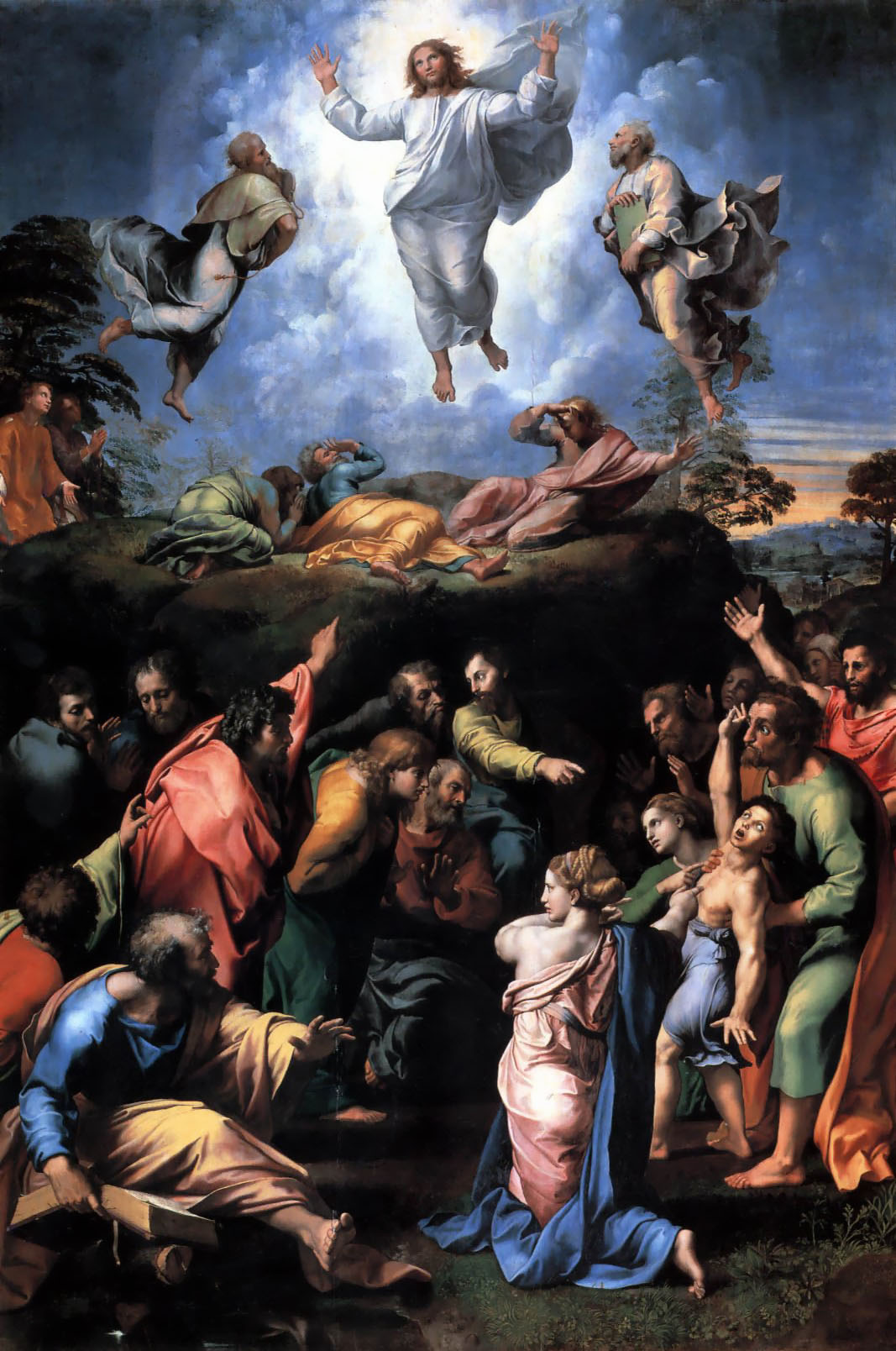
No one would expect the disciples to fully get who Jesus is right away.  Jesus does not.  He nurtures them in the faith, revealing Himself to them, revealing Himself in the Scriptures, and revealing His purpose in coming.  Jesus identity is obvious to us but it was hidden behind miracle and message that often left the disciples dazed and confused.  But when it comes to this day and what happens upon the Mount of Transfiguration, the glory of our Lord is revealed, the scales fall away from the eyes of the disciples, and the truth cannot be mistaken.  Jesus is the Son of God.

How could they not get this?  Peter, James, and John were there for the great revelation that also included Moses and Elijah.  There was Jesus without any veil over His glorious identity.  There was Jesus to whom Moses pointed as the very Lawgiver who fulfilled that Law.  There was Jesus to whom Elijah pointed as the prophet of prophets who fulfills every promise of His coming.  The cloud, the voice, the patriarch, and the prophet made it unmistakable.  This Jesus is the Son of God in flesh and blood who has come to save His people.

The first instinct of the disciples who watched Jesus transfigured before them was to be afraid.  Mark tells us they were terrified.  Now you might think that fear and terror would silence them in the midst of such a miracle.  You would be wrong.  While Moses and Elijah were talking with Jesus, Peter opens his mouth to say something.  Imagine that.  The great patriarch Moses is conversing with the great prophet Elijah and they are both talking to Jesus about His exodus – His departure.  Luke wanted us to know that they were talking about Jesus suffering, death, and resurrection and not some casual conversation about the weather.  But Peter interrupts the solemn occasion with some childish banter about setting up camp because it was so cool to be there.  Really????

In this brief turn of events you see what the problem was and is.  Jesus is always talking to us about the cross and we are not listening.  Jesus is always talking about His death and resurrection and we interrupt Him with foolish words about how cool it all is.  Now Moses and Elijah are there to say the Law and the Prophets were all about the cross.  On the Mount of Transfiguration it took the voice of the Father in heaven to tell them to shut up and listen.  And on the way down the mountain, it took Jesus to tell them not to speak of what they had seen and heard until He had risen from the dead.  
Only six days before Peter had cut off Jesus as soon as Jesus spoke of the cross and here and he shut down this conversation also.  None of us wants to talk about the cross, about suffering, about sacrifice, about death.  The cross is not the shape of glory in our play books and so we are ready to shut down the game as soon as Jesus mentions it.  It is as if Peter was saying again what he had said and been rebuked for only six days before.  Not the cross, Jesus; not the cross if I have anything to say about it.

But that is the point.  Even at this moment of glory, the cross is neither absent nor forgotten.  It is front and center.  Peter interrupts the conversation about the cross because Peter does not want to hear about it.  We are there right with Him.  We are not interested in hearing about the cross either.  We are tired of such sermons and weary of Bible studies where the cross is front and center.  It is the thing we don’t want to talk about but it is the only thing Jesus must talk about.  

Few people are worried about the divine glory of God’s Son.  We are not afraid of it at all.  We want it.  We are tired of church services with the same script every Sunday and we are tired of praying if we cannot be assured of getting the answer we want.  We tell people about the Church and the Gospel with nary a mention of the cross – we talk about nice people, about youth programs, good music and the like.  We cannot tell them about the cross – that might turn them away.  We are all in search of some glory, some excitement, something new and different, and something new and spontaneous.  We are tired of the same old talk about the cross.  In this, we are just like Peter and, I suspect, the rest of those who followed Jesus.

At this moment of Jesus great revelation and when His glory will not be hidden, we think the conversation is going to be exciting.  In reality, it is the same thing that Jesus has been harping on since they followed Him – the cross, the cross, and the cross.  What we think we have heard enough about, Jesus insists on talking about over and over and over again – and with Jesus every faithful hymn, every faithful pastor, and every faithful Bible study.  

When they were chastened by the voice from heaven and shocked when Moses and Elijah suddenly were gone, Jesus was still there.  Jesus is always still there.  Jesus is always teaching us that we never outgrow the cross, there is no glory except the cross.  So when the rooster crows to announce our failure and when the doors to the church are locked out of fear of those outside, Jesus is there to manifest the power of the cross.  To sinners needing to be forgiven and the fearful who worry more about the enemies out there than they trust in the Jesus who is with us here.  Jesus is there to manifest the power of the cross.

Jesus told them it was time to go back down the mountain but the world and the rest of the disciples were not ready to hear what they had seen and heard upon the mountain.  The message they would bring to the world was not going to a moment in the clouds with Moses, Elijah, and Jesus.  The message they would bring to the world was Christ crucified and risen for the forgiveness of our sins.  

My friends, we live in a world in which Church is about everything except the cross.  We tell the world about our scout troops and youth groups and senior lunches and men’s clubs and yard sales and musical concerts and all kinds of things.  Some churches have pronouncements on every world event or cause.  It is not that these are bad.  They are not.  But they are not the cross and the cross is what makes us unique.  We are constantly being taught this just as the disciples were taught on the Mount of Transfiguration.  It is all about the cross – the glory and the hope, the peace and the promise, the power and the presence.  We cannot be offended by the cross or scandalized by the suffering our Lord endures.  For this is the only Gospel that can offer salvation to us.  That is what Jesus was teaching to Moses.  The Law cannot save anyone.  Only the cross.  That is what Jesus was teaching Elijah.  The core and center of the kerygma is Christ crucified and risen.  That is what Jesus was teaching Peter.  And that is what we are being taught week after week.  Listen to Him.

Christianity's gift -- the value of life. . .

Though Christianity is often tagged as the boogeyman behind the ills of the modern world, many have undertaken to show that this is a false view of Christianity and of the world.  You can read others for such a defense.  For my money, the singular gift of Christianity to the world (apart from Christ Himself and His death and resurrection) has been the moral equivalency of all life.  Certainly, this was not the prevailing view of other religions or cultures and it is not today. 

None of the Romans believed in the moral equality of all human life.  They believed just the opposite.  It was taken for granted by the Romans that some lives were more valuable than others, that some lives were to be preserved at the cost of other lives.  The same view prevailed among the ancient Greeks also.  You would look in vain to find a Roman or Greek of any stature who would dare to suggest that the life of the unborn or the child or a woman was equal to a man and then only to certain men.  All across pagan Europe from the Vandals to the Goths to the Vikings you find a normal and normative belief that lives are not equal nor are they worthy of equal protection.  Where do you find this in Islam?  People simply believed nothing of the sort until Christianity came along.  For Pete's sake, survey the history of China or Japan.  Look at the great empires of the Inca or Aztec people -- don't forget that both societies were still practicing human sacrifice when the Spanish arrived about 500 years ago.  There is no civilization that would grant all or even most lives protection, value, and worth apart from Christian influence and intervention.

Indeed, the very mark of the undoing of our Christian influences in the West can be seen in the way we no longer as a culture and civilization give any credence to the moral equivalency of life.  From abortion to assisted suicide to euthanasia, we live in a time in which life is relative and its status more fragile than it has been since the dawn of Christianity itself.  Though the secular world loves to blame Christianity for war, violence, a class system, prejudice, racism, and slavery, these things existed long before Christ was born and were challenged precisely by a Christian worldview.  Though secular liberals and progressives daydream of a world without Christianity, the reality of what that world would look like is scary to everyone who is not in the majority or in control.  The creed of liberals insists that the protection of rights and the value of life extends to all, try disagreeing with the propagandists of this liberalism and you will see how quickly rights are selectively granted.  We see the evidence of this all around us.

The end result of a world in which Christianity is exterminated or silenced is a threat to the value and protection of all life.  We may not see it now but it would not take long under the scenario imagined by progressives and liberals before we would see the truth of it all.  Christianity is not a danger to the value and protection of life but its savior.

Sunday, February 11, 2024

Luther on the Transfiguration

To consider Christ’s glorious Transfiguration on its own is eye-opening; to hear how Luther describes this glory as yours nearly bursts the eyes from their sockets, bringing hope to the Christian heart. Luther’s use of the Transfiguration to teach the hope we have in the resurrection of the body is truly wonderful, for when you hear the vivid picture of how Jesus’ “face shone like the sun, and his clothes became white as light” (Matthew 17:2), Luther would have you see what this means for your eternal good:

The resurrection of the dead and the future glory and brightness of our bodies are shown. For this was something very remarkable, that Christ was transfigured while yet in the mortal body, which was subject to suffering. What then shall it be, when mortality shall have been swallowed up, and nothing shall remain but immortality and glory?[1]

What a thought! As glorious as the Transfiguration was, yet since Christ was still subject to suffering, it is not even the full picture! Jesus gives but a sneak-peek of what will be. Now that He is crucified and risen, death no longer having dominion over Him, you have hope of the same immortal glory as your Lord.

The hope of another life beyond the present life is quite comforting, especially as we suffer. Luther elaborates on this when discussing what Moses and Elijah appearing with Jesus teaches: “There is added the appearance of Moses and Elias, who prove by their appearing that they had never really died, and that there is yet another life, besides the earthly life, from which they were transferred.” [2]

While Luther also sees Moses and Elijah appearing “in order to testify that Jesus Christ is truly the promised Messiah, according to the law (i.e. Moses), and the prophets, (i.e. Elias),” his concentration here is on the comfort of the life to come, the hope that the faithful have after this present life of labor is over. Just as the Transfiguration testifies to this truth for Moses and Elijah, so too is this your hope, to be transferred from this life of sorrow to life immortal with Jesus and all the saints.

With the hope Jesus’ Transfiguration brings, Luther says, we are able to look at death in a different light:

This appearance teaches us also that we should despise death, and look upon it merely as an emigration or a sleep. In short, this appearance proves that this life is nothing at all in comparison with the future life.[3]

What do you have to fear in death when Jesus shines like the sun for you and is white as light to enlighten you to what He has done on your behalf? No, there is nothing to fear in life or death when you compare it to the future life our Father has in store for you through Jesus Christ, our Lord.

From where does such certainty come? Luther writes, “This appearance proves that sin is overcome. For it necessarily follows as an incontrovertible conclusion, that, where death is overcome, there sin is also overcome.” [4]

The Gospel shines forth in the Transfiguration since it previews Jesus’ resurrection, which guarantees that His death truly did atone for the sin of the world. Never one to bypass the salvation of Christ’s cross, Luther proclaims what Jesus, Moses, and Elijah were discussing together on the Mount of Transfiguration: His exodus from this earth via His crucifixion (cf. Luke 9:31). The fact that Christ foreshadows His future resurrection is a testimony that the cross cannot keep Christ down. Rather, He overcame death and sin and He did it for you and for all.

Jesus was transfigured before three disciples. Why? To strengthen them in the faith. Luther says:

But he permitted those three mentioned apostles especially to see this appearance, in order to guard them against the coming offense of his cross and crucifixion. Yet he accomplished little thereby, for they all were offended with him. Yet this appearance had its advantage after the resurrection, and served to strengthen their faith in Christ, that he was the Son of the living God, and that his kingdom must be regarded in a spiritual sense.[5]

This indeed strengthened the disciples after the resurrection, most evidently St. Peter, who wrote that they heard the voice of God the Father say about Jesus, “This is my beloved Son, with whom I am well pleased” (2 Peter 1:17). This encouraged them to continue to confess Christ even to death. St. Peter goes on to encourage you when he writes that in Scripture you have a “more sure word,” one which “you will do well to pay attention as to a lamp shining in a dark place, until the day dawns and the morning star rises in your hearts” (2 Peter 1:19).

Luther’s treatment of the Transfiguration finally focuses on the Holy Trinity. “The whole, holy Trinity appears here to strengthen the believers; namely, Christ in his transfigured form, the Father in the voice, and the Holy Ghost in the bright cloud.”[6] In your baptized life you are learning more and more who your Triune God is, how He works for your good, three Persons in one divine unity.

The Transfiguration of our Lord is an apt portion of Scripture to consider before Lent begins since we get a sneak-peek at the resurrection before we head into the season of repentance that leads to Easter. Let Luther’s treatment give you hope in the midst of Lent, reminding you of Christ’s resurrection and your own.

 The Rev. Stephen K. Preus was pastor of Trinity Lutheran Church, Vinton, Iowa, at the time this was written, 2017.


[1] Luther’s Explanatory Notes on the Gospels, 101. Emphasis added.

[2] Ibid.

[3] Ibid.

[4] Ibid.

[5] Ibid.

[6] Ibid.


Saturday, February 10, 2024

Causing offense. . .

The Methodist Church of Great Britain has called on its ministers, deacons, and elders to stop using offensive terminology such as “husband” and “wife” to avoid making assumptions that are not “the reality for many people.”  The church added the changes to its “Inclusive Language Guide,” an initiative aimed at preventing the use of “hurtful language” directed at groups the Methodist Church believes have been “marginalised and/or demonised by common culture.”  The church plans to update the Inclusive Language Guide every six months to avoid using language that could offend groups it perceives as marginalized.  Then you wonder why Methodists are imploding?  Really?  This is the big problem the British Methodists needs to deal with?  Not sin?  Not death?  People who offended by ordinary terms like husband and wife.  Yup, Jesus is certainly good with this idea, isn't He?

The progressive idea is to make every exception into the rule.  If there are families without a husband or a wife, then all families will be stripped of the terminology.  What works for marriage will work for as many other faithful and Biblical and traditional terms -- just about everything!  Instead of striving to preach Christ crucified and risen, the Methodist Church is working to eradicate such terms as “partner,” “child,” and “parent” in order to be sensitive to and show solidarity with those “relationships [that] come in many varied expressions.”  The Methodists are certainly not alone.  Language is undergoing a radical transformation at the hands of those who find sterile terms preferable to traditional ones.  In this case, the Methodists have specifically addressed the issue of gender identity, insisting that “using a person’s chosen pronouns is helpful as it honours their identity.”  Expect that other vocabulary words will be on the banished list as well -- such as ‘brothers and sisters which is neither inclusive nor friendly to the non-binary among us.  Oops, Jesus.  You should have known better!

And to think.  We were worried about our enemies in the world and the devil roaring about seeking to devour someone!  I guess we had it wrong.  We were our own worst enemies all along.  Honestly, Jesus, You should have known better!

Friday, February 9, 2024

How odd!

It was reported that the prefect of the Dicastery for the Doctrine of the Faith (DDF), Cardinal Víctor Manuel Fernández, commenting on the reluctance expressed by individual bishops and bishops’ conferences (some 1,000 in number)  regarding the implementation of Fiducia Supplicans: “it’s proper for each local bishop to make that discernment.”  So, let me get this straight.  It is proper for each local bishop to decide whether or not to bless individuals in a same sex relationship but the very same bishops are not equipped to decide whether or how to allow the Latin Mass in their dioceses.  

When he was asked if this declaration is a first step toward the acceptance of homosexual behavior or equating marriage with unions between persons of the same sex, Fernández replied: “That perception is totally incorrect and whoever says that has either not read the text or is ‘in a bad mood,’ allow me the expression. The statement states clearly and endlessly that these are non-ritualized blessings, so that they are not interpreted as a marriage.”  Begging the prefect's pardon, but it would seem that Francis and the head of the dicastery are the ones in a foul mood.

Beware of Greeks bearing gifts needs to be recast as beware of popes bearing gifts.  In the case of Francis, the gifts he brings are confusion and central control -- both of which are exploited well by those seeking to undermine traditional moraality and dogma.  Rome is in a very bad way and, as they say, when Rome sneezes, we catch a cold.  Again, my point is that there is less reason than ever before to be jealous of anything Roman Catholic except a few good buildings and artwork.  The rest of Rome seems to be rotting from the center as the pope alienates those who are most serious about what is believed and how it is practiced in favor of those who are not so serious about either.

Lutherans should not be smug.  We have our own problems with the same thing.  So many Lutherans are muddying up the waters of what we believe, teach, and confess that, as in Rome, the conservatives are deemed dangerous and the progressives and liberals are considered safe.  It is long past time for Christianity to realign itself along the lines of those who are pay attention to Scripture and apostolic tradition and those who don't.  Maybe we all need a grand divorce in the Methodist style.  Offer some cash and some weak institutions to those who want to erode the faith from within and let all Christians depart for groups that are consistently and authentically Christian.  Roman Catholics will soon have to decide how long they can abide a pope determined to kill the faith with confusion and centralized control so that what was will be lost and what will be is nothing remotely recognizable as orthodox.  Lutherans will have to decide the same thing.  How long before we can abide groups using the name Lutheran but refusing to pay any attention to the Confessions that say what we believe, teach, and confess.  I hope it comes sooner rather than later but things move slowly in the machinery of Christendom and we will have to swallow hard for many more years before we see any movement on this.  The progressives have already decided that they have more in common with the liberal fringe of Christianity that is almost unitarian than they do with the people who pay attention to Scripture, tradition, and confession.  This is just as true for Lutherans as it is for Roman Catholics.


Thursday, February 8, 2024

A parody of ecumenism. . .

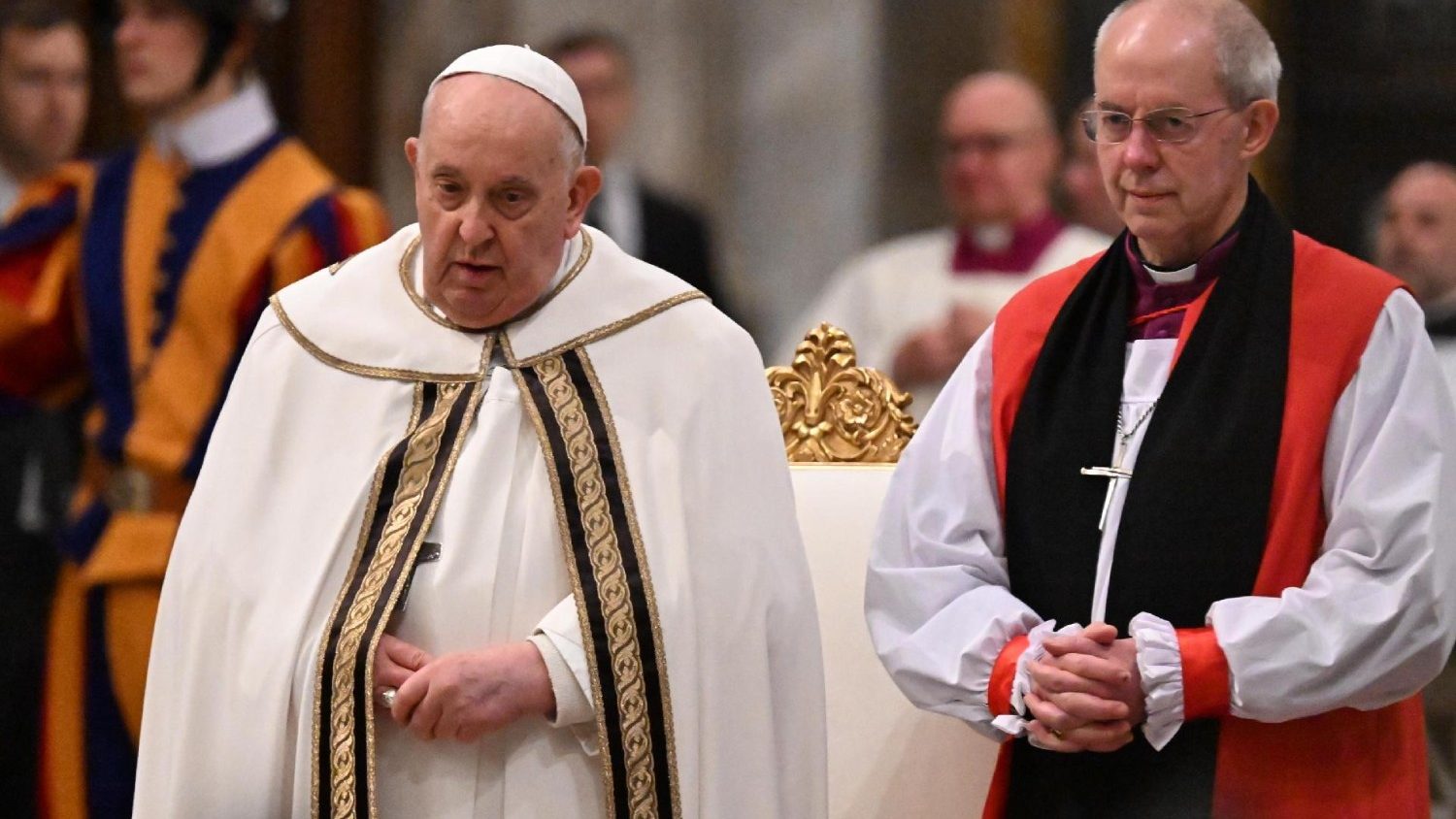
Now that the photographers and press people have moved on to other things, it might be worth a quick look at what was accomplished when 50 or more Anglican and Roman bishops gathered for a week of study and prayer together a month or so ago.  At the end of it all was, of course, the obligatory press release.  This one was entitled "Our Common Witness, Calling, and Commitment."  This was a celebrated end to an ecumenical summit of "Growing Together".  There was the predictable call for unity and a shared mission.

Organized by the International Anglican-Roman Catholic Commission for Unity and Mission (IARCCUM), January 2024 meeting had the full support from the Dicastery for Promoting Christian Unity in Rome as well as the Anglican Communion Office, Secretariat to the Anglican Communion.  "After four centuries of conflict and separation, the Catholic Church and the Anglican Communion have now been on a walk towards reconciliation for almost six decades. At times, the path has been bumpy, but the Holy Spirit has been at work and our churches have persevered in a dialogue which has been extraordinarily fruitful," the joint statement reads.  It was undoubtedly crafted at the highest levels of both communions so it invoked the sacred cows of synodality, relationships, and people over the discredited notions of doctrine, creed, and confession.  It seems both Francis and Welby found common ground here  --  not to mention the dutiful reference about climate change, diversity, and injustice.  Welby and his group were able to celebrate an Anglican Eucharist in the Catholic Church of St. Bartholomew on Tiber Island in Rome -- something technically not supposed to happen.  The Anglicans included a pair of women bishops -- something else not quite kosher for Rome.  But it was all good and a good time was had by all.  Undoubtedly, they all went back to their day jobs patting each other on the back for all that was accomplished.

If this is what passes for ecumenism, then we are in big trouble.  On the one hand, you have a fractured Anglican communion bleeding off people faster than anyone can count and a Pope who talks out of both sides of his mouth and leaves a wake of confusion wherever he goes.  This might be good for a fake ecumenism but it is not salutary or beneficial for any real conversation between disputing Christians.  The real duty of ecumenism is to bring the diverse together under the banner of God's Word, affirming every word of the creeds, and confessing without apology the sacred deposit (no matter who might be offended).  That is not what happened here.  Rich with empty symbolism and muddy words which mean whatever the Humpty Dumpty says they mean, both churches are broken and in trouble.  The Anglicans have plenty of clergy but no people.  The Romans have plenty of people but no clergy.  Each puts on a good show and has colorful vestments but neither of these made up for the lack of substance behind those words and the spectacle of solemnity.  The statement insisted that they had equal dignity but failed to acknowledge they also have equal challenges to their very existence.  Will there even be an Anglican Communion in a decade?  Will there be anybody in Church in Europe or England in a decade?  What will this pope and this archbishop leave as the pieces their successors will have to put together (or ignore)?

Canterbury is quick to say "we are not like those other Protestants" and Rome is not sure what that means since both groups have an uncomfortable relationship with Scripture and with the voices of their forefathers.  In this meeting you might have heard both Anglicans and Romans echoing each other in distancing themselves from the faith believed, taught, and confessed by those who went before them.  "You have heard it said... but I say to you..."  Honestly, I prefer the rancor and dispute of people who take their differences seriously to the papered over divide of what was a parody of what ecumenism should be.  But who can turn down a good photo op and junket when there is a pile of problems waiting for you on your desk when you get home.... 


Wednesday, February 7, 2024

The limits of understanding. . .

The majority of men in every generation, even those who, as it is described, devote themselves to thinking, live and die under the impression that life is simply a matter of understanding more and more, and that if it were granted to them to live longer, that life would continue to be one long continuous growth in understanding. How many of them ever experience the maturity of discovering that there comes a critical moment when everything is reversed, after which the point becomes to understand more and more that there is something which cannot be understood.  —Kierkegaard, Journals

A conversation with someone left me recently perplexed.  The individual has little use for much of anything but conversation and catechesis.  The person is looking for understanding.  All of this is well and good but understanding and comprehension are not the promise of the Gospel.  We are not reasoned into the faith by logical argument or convincing evidence.  Faith is the fruit of the Spirit's work in us -- not against reason always but not because of it either.  Faith comes by hearing the Word of God.  Trust is not the end result of well argued debate but the Spirit's work which begins with the end of reason and understanding and comprehension.

If you have read this blog before, you know that I have some apprehension about the way we often study the Bible.  We tend to be driven by the quest for knowledge, fueled by the desire to understand God, and preoccupied by things not central to the faith.  Everyone in the world would rather go to a Bible study on Revelation than slog it through Hebrews.  It is not because portions of the Word are of more or less value but that we want to know what we want to know.  In many and various ways God spoke to His people of old through the prophets but now He has spoken with finality through His Son.  When the disciples were being led out to the place where our Lord would ascend, He had to do a remedial catechetical lesson opening the Scriptures to them so that they would see Him in them.  I wonder if we are less interested in seeing Jesus than in understanding and comprehending and therefore predicting God's works and ways.

The fear of the Lord is the beginning of wisdom and that fear begins with the realization of where our knowledge and understanding end.  The wisest man of all knows that he does not know everything and knows where the limits of his understanding begin.  It is the fool who presumes that with enough effort you will comprehend everything.  Christianity is not a scholastic faith but a child-like one.  That is surely no justification for remaining an infant in the faith but neither is it the presumption that knowing the Scriptures or getting God is a substitute or an equivalent for faith.

Mystery is just as important as understanding.  The mystery of God coming to us through the means of grace and accomplishing in us what He says and signs in this Word and Sacraments is not to be trifled with.  Yes, we proclaim Lord, I believe but we also add help Thou my unbelief.  We are not evidenced to the conclusion of faith but the assured that the facts are not in conflict with the mystery but lead us there to the manger, the cross, and the empty tomb.  Reason led to the tower of Babel but the voice of God speaking through His Word kept for Him a people to be His own possession. 

I must admit that Lutheranism is not much of an organized religion -- especially in the sense of providing a neatly packaged and thoroughly understandable systematics.  I would venture to say that all Christianity that is orthodox and catholic is the same.  That is not to say that there is no place for the tomes of some of the great thinkers but this is not what we are all called to be.  We are called to faith.  To believe in spite of what our eyes see, our minds think, and the science we postulate.  In the end there is nothing reasonable about a God who gives up His only-begotten for a people still His enemies and who wish to have nothing to do with Him.  There is nothing understandable about a suffering which pays for sin and a righteousness to be gifted to those who have none of their own.  Faith is trust precisely when we hit the limitations of our reason, understanding, and comprehension.  That is not something we admit with regret but with relief.  God, be merciful to me, a sinner.

Tuesday, February 6, 2024

Kids missing school. . .

Absenteeism from school is hardly new nor is it only a problem today.  That said, absenteeism in public schools is becoming chronic, affecting nearly 70 percent of the highest poverty school locations.  This is triple what it was prior to the pandemic.  In schools located in poverty areas, some reported as much as a third of the student body as chronically absent (that means missing at least 10% of the days in the school calendar-- about twice monthly or more).  It is clear that prior to the pandemic school attendance was the accepted norm by all but this is not the case now.  Even in school in affluent areas, absenteeism has increased 3-4%.  Using Ohio as an example, chronic absenteeism hit 30 percent in the 2021-22 school year -- up from about 17 percent of the students the full year prior to the pandemic.  In some states, notably California and New Mexico, the rate of chronic absenteeism has hovered at double what it was before the Covid.

It is clear that screens is no substitute for in person classes and that the screens have been a negative effect not only upon the academic standards of our schools but also the way in which some students and families view education.  We all know that the schools are already overburdened with noneducational responsibilities -- from socialization to making up for things missing at home to the indoctrination of the current social mores concerning sexual desire, gender, racism, etc.  We also already know that we struggle to find qualified and effective teachers and that the teachers there are leaving their jobs at higher rates than before.  Now it is clear that a significant portion of students in public schools are finding excuses simply to opt out and this will only increase the distance between the haves and have nots in our society.  Further, those who drop out are more likely to be involved in the criminal justice system along the way.

The problem is not money.  We are spending far more than we have ever spent per pupil.  The problem is not simply the family -- although this is certainly a contributing factor.  Could it be that part of the problem is that schools are trying to do too much and too much of what we have asked them to do has little or nothing to do with their educational task?  We feed students who come to school hungry.  We try to mirror what is missing in their family life through social programs in the school.  We use the time in school to promote a largely progressive and liberal view of everything from pot to sex.  We are sensitive to their feelings and have done everything in our power to make for a pleasant environment.  Maybe we are trying too hard to do other things and not hard enough to accomplish the educational task that was and should remain the primary focus.  

Home schooling, parochial, and private schools are competitive in part because they are stronger on the academic part of things than public schools.  Indeed, some religious schools are broadening their appeal beyond their faithful precisely because they have higher academic standards.  It does not hurt that they have an investment in the educational enterprise as well.  This could become a lesser factor as vouchers and other programs make more choices available to those with fewer financial resources.

There is another factor.  The chronic absentees are not only missing out on an education, they are also missing out on the shared experience and the community that schools provide.  This undoubtedly contributes to such youth being more involved in the justice system but it also deprives them of one of the most commonly shared experiences of life -- school and graduation.  While everyone should be first of all concerned with the education they are missing, it is a good thing when students interact within the educational community to share a common experience and to appreciate the differences that need not divide.

Kids missing school is hardly a new thing.  The increase in absenteeism and its chronic condition especially manifest among the poor can only be bad news on a variety of fronts.  But this could be a real opportunity.  Private schools, especially parochial schools (whether classical or not), have always excelled in working closer with the parents and families to address problems and encourage the students to opt in rather than opt out of the program.  Yet the great temptation to religious schools will be to focus on this even more than the one distinctive of Christian witness, faith, and life.  This catechesis is and should always be the heart and core of our identity and not simply window dressing.  That said, this is one more reminder that over all the public educational system in America has been struggling and the pandemic has only drawn even more attention to its failings. 


Monday, February 5, 2024

Hidden details in a familiar story. . .

Sermon preached on the Fifth Sunday after the Epiphany (B), on Sunday, February 4, 2024.

Though we tend to look for the big point in Jesus’ miracles and teaching, sometimes the details themselves are quite important.  For example, in the Gospel we heard read today our Lord heals Peter’s mother-in-law.  The joke is be that Peter would have been okay without this miracle but the hidden detail here is that Peter was married.  Though we never hear much about the families of the apostles, we can presume that most of them were married.  You cannot have a mother-in-law without having been married.  The hidden detail is that although the Western Church developed the discipline of celibacy, it was not well known at the time of Jesus and the idea that you need to be unmarried to serve the Lord is equally foreign to the Scriptures.  The disciples had families and they did not have to choose between family and service to the Lord.  St. Paul admits this when he mentions the wives and families of Peter and other disciples.

Our world is not so sure family is a good thing.  More and more folks are choosing never to marry and those who marry choosing never to have children.  God created us for family.  Sure, sin has added its trouble to family life but the answer to that trouble was not to ditch the idea of family.  No, our Lord answered the problems sin created for husbands and wives and parents and children with forgiveness.  Where forgiveness reigns, love flourishes and where love flourishes forgiveness reigns.  I suspect this was as true for Peter in his home as it is for your home and mine.  Though this is obvious, it is easily and often forgotten.

The illness of Peter’s mother-in-law was likely an infection of some sort.  She suffered from a fever, a high fever.  St. Luke was a physician and he adds a detail not present in Mark’s account.  He tells us that Jesus rebuked the fever.  This means that Jesus did not ply the woman with homemade cures or apply the normal treatments of the day.  What Jesus did made it clear that her healing was by His action and His action alone.  This was an interruption of the laws of nature.  Our Lord intervened in the natural course of an illness to bring healing to the woman.

Jesus rebuked the fever as He had the demons in the account just prior to this story.  This shows us that just as demons were contrary to God’s will and purpose, so was illness a reflection of the corruption of our flesh caused by the introduction of sin into God’s creation.  We were not meant to suffer.  Suffering comes to us because of sin.  Illness and affliction are the enemies of God just as they are our enemies.

Another hidden detail is that as soon as Peter’s mother-in-law was healed, she got right up out of her sickbed and she served the family.  We live in a culture which loves me time, enjoys leisure, but merely tolerates work.  That is an alien concept to the New Testament.  Work is not an enemy of life or even of the good life or especially of the redeemed life.  We were created for work.
 
The fact that we live in such an individualized life in which our wills, desires, wants, and needs dominate obscures the fact that love serves.  Indeed, service is the shape of love.  Later in Mark’s Gospel our Lord will put this in blunt clarity.  “The Son of Man came not to be served but to serve and to give His life as a ransom for many.”  Peter’s mother-in-law used the gift of healing to enable her to fulfill her calling.  Indeed, all healing is given by God to us not so that we can get on with our lives and do what we please but for the sake of the Kingdom.  So that we might serve one another as Christ has served us.

Here is another detail often missed.  Healing is not God’s reward or special favor for those He likes better than others.  Nor is it something bestowed because we ask in the right way, with the magical words.  There is no reference to anyone asking Jesus to intervene.  Our Lord heals the woman not because she was special or He received a special request or even because of Peter.  Healing is a sign and mark of the Kingdom.  Jesus heals the woman to display the kingdom of God.  He heals to show that He is who He has claimed to be.  Jesus heals to show that He is the true Savior and Redeemer who has brought true life into the world.  It is as if each and every healing were a way of announcing who Jesus is and why He has come.  In contrast to the way we make miracles about the person – their worthiness to be healed or what they did to get God to heal them – God makes healing to be about the kingdom.  This healing is the precursor to the ultimate healing – whether you are the mother-in-law of the one who is supposedly the first pope or not, healing of an illness is a temporal and temporary gift.  The eternal healing comes when we wear the new and glorious flesh in the resurrection – bodies that can no more be corrupted by illness or affliction than they can by held prisoner in the grave.

The healing of our mortal bodies whether by the miracle of medicine or the direct intervention of God will not last.  We have made everything about the moment – what we want, how we feel, and what we think we deserve.  But Scripture points us always to what lies behind the present, to the eternal prepared for us in Christ that we might be where He is forevermore. 

If we pray earnestly and our loved ones are not healed, that does not mean that God is against us or we don’t have enough faith.  We want a rational explanation, a sort of cause and effect reasoning why some are healed and given longer lives and others are not.  But this is not about reason or even about magical words that enable you to get what you want.  It was and is about faith.  Within that faith we are reminded that healing begins with forgiveness for all our sins, that healing is an eternal gift and blessing which we can know now only in part, and that both have their source in the cross.  The wounds of Christ are our healing.  

As hard as it is to know that not everyone will receive the momentary healing of the body for today, it is hard to comprehend that all who believe in the Lord Jesus will receive the perfect healing of everlasting life.  This too is a truth hidden not just here but in every account of Jesus healing the bodies or diseases of people.  Our Lord does not pick and choose but gives to all Christians the perfect healing of redemption even while only some have the cancer go into remission or live to recover from their surgery or have hearts that will beat a normal lifespan or birth defects that will be corrected.  Whether we live or die and no matter how long we live or when we die, we belong to the Lord.  He has owned our sins upon the cross and our weakness in His own flesh.  He bestows upon us the eternal healing of forgiveness for our sins and the eternal promise that those who live in Christ by baptism and faith today shall dwell with Him eternally.

Hidden details and the profound truth – By His stripes we have been healed.  Until the day our Lord has appointed, we focus the strength of our redeemed lives upon the Lord in thanksgiving for His salvation and upon our neighbor as Christ has loved and served us.  When the Lord comes in His glory, we focus upon the resurrection of the body and the life everlasting – fully known, comprehended, and realized by God’s grace and favor.  Amen.

Not to raise an old conflict but...

We were told over and over again.  Follow the science.  If it is about the science, then the science is concerning.  According to one of the most comprehensive studies so far, Italian researchers have shown that those who received at least one Covid jab were about 30 percent more likely to be infected with Sars-Cov-2 than the unvaccinated, see the Italian research here.  It clearly shows that Covid shots raise the risk of getting a Covid infection.  The post-Omicron variant revealed that the shots performed even worse than before, with those vaccinated at about 50 percent higher risk of being infected by Covid.  The peer-reviewed study also noted the differences between the vaccines.  Among those people who have taken three or more Moderna mRNA jabs, the Moderna-only recipients were 71 percent more likely to die from all causes than people who took only Pfizer jabs -- a statistic even after the researchers adjusted for age and medical problems.  Moderna’s vaccine contains much more mRNA than Pfizer’s, so the finding begs the question of whether the mRNA is driving those deaths and if the more times vaccinated increase that risk.

While some will gloat and others dispute this, my point is not about the results of the study as it is about the nature of science.  Science does not rest on suppositions but on data.  The more data we find out, the clearer the conclusions that can be drawn.  That is science.  Science, real science, is not ideological.  It does not proof text for the sake of its point but adjusts as the data guides.  Real science is not a conclusion that never is reviewed but the constant review of the conclusions.  Science cannot substitute for religion and certainly not for Christianity.  Science is not something you believe in -- unless you believe in a process without presuppositions or conclusions unless the data hold to them.  My point is this.  You cannot have science as your God.  It is a fool's errand.  Neither can science exist outside of or apart from the moral values that define the boundaries of what is good in comparison to what may be possible.  As Scripture plainly tells us -- all things may be possible but not all things beneficial (salutary).  Science depends upon its partnership with morality and the higher truth of religion or it will always end up ahead of itself.  Follow the science means following a wandering path that must occasionally reverse itself or turn in an entirely different direction.

If there is a lesson from the pandemic about the science, it is this.  Science will give you its best guess now but it reserves the right to change that guess as the data come in.  Especially in areas like mRNA, science is not settled but constantly moving.  It is for this reason also we cannot make science our God.  We need not a log flowing along with a current but an anchor to hold us fast.  Those who pit science against faith are setting against each other the very things that belong together.  As we have repeatedly seen, the science eventually catches up to the faith if we let it.  It helps no one -- even advocates of science -- to presume that what science says now is the last and final word on anything.  True science is always looking and always learning -- therefore, always adjusting.

There are a host of other areas in which we have failed to listen to the science and allowed the fake science to become ideological and a sort of religion.  This includes, for example, the way Americans have distanced themselves from others in the West in taking the aggressive course of treatment (puberty blockers) with trans youth.  In fact, the true science dismisses the legitimacy of felt choices that violate the objective data and thus raises questions about the primacy of feelings to define everything from sexual desire to gender.  There is no science to support this.  The fake science of ideology has led us where true science would refuse to go.  I could list other examples.  The reality is that when we build a wall between science and faith, science and morality, technology and values, we always end up with huge problems.  We will have to face this on a host of fronts soon -- from reproductive technology to artificial intelligence.  Now is not the time to trust the science.  Now is the time to sort out fake science from true science and to bring to bear upon our observation and conclusions the divine revelation of Scripture. 

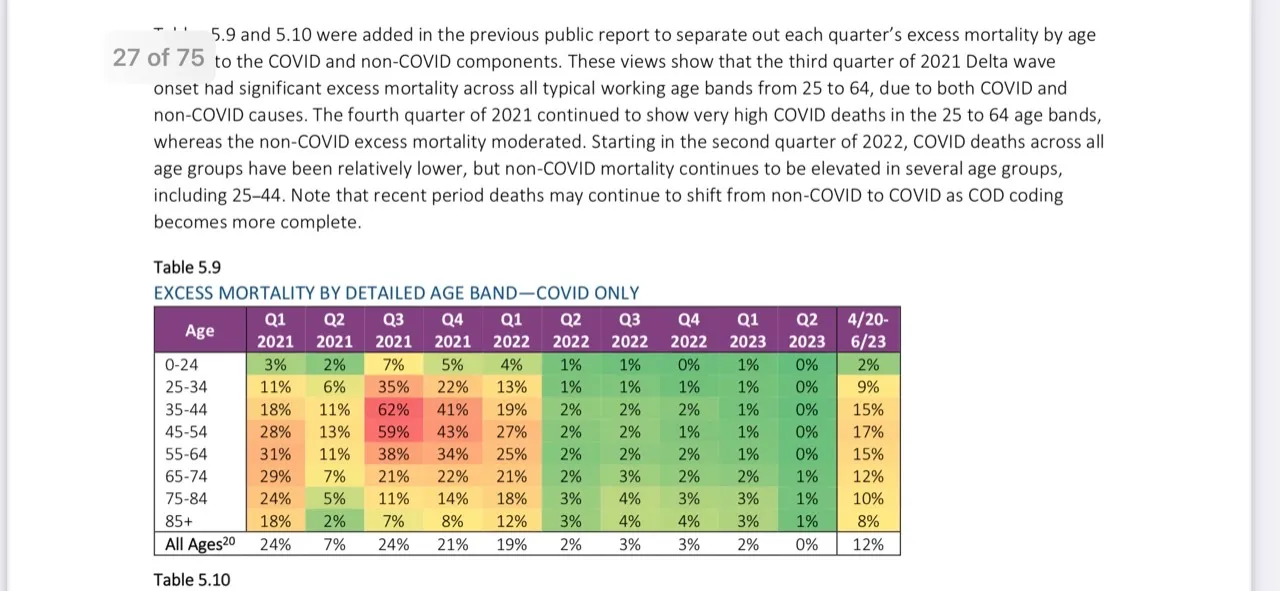
By the way, actuaries have released a table showing their data on the mortality rate for the years of Covid and thereafter:


Sunday, February 4, 2024

We are not Rome. . .

I got a lengthy email from a reader who insisted that I paid far too much attention to Rome and the Pope and that if I was really a Lutheran the stuff happening or not happening there should be of little consequence to me.  I have also had some folks say the same thing about the ELCA and suggested to me that none of that matters to the LCMS.  If you agree with my critics, you may not wish to read further.

Unless you live on an island or in some community in which everyone is churched -- neither of which is true of you -- it does matter what the Pope says or the ELCA says.  The careful nuances of those who make much of such things is lost to nearly everyone outside your very small circle.  People judge Christianity on the basis of what the Pope says and does and that includes Missouri and those with whom she is in fellowship.  People judge Lutheranism on the basis of what the ELCA says and does that includes Missouri and those with whom she is in fellowship.  You do not live in some sane world in which people listen to you to decide who you are.  People are want to make snap judgments and those in the news are the ones who feed such snap judgments.  Unless you do not care about those outside the faith or the faithful with whom you gather, you are a fool to ignore what Rome or the ELCA or evangelicals or Protestantism in general says and does on the world stage.  

I do not care because I want to be Roman Catholic or ELCA or anything else for that matter.  I care because I know that those who come from no or nominal Christian background and walk into my parish have a pre-existing idea of who we Lutherans here are.  Christianity is not some new faith that they have never heard about.  They are predisposed to the (false) belief that they already know what a Christian is and believes and how that Christian lives.  It might be easier for me to start with a clean slate introducing the faith to those outside of it but I cannot afford that luxury and neither can you.  We live in a world in which those who are our harshest critics and our biggest skeptics think they know what we believe and teach simply because they pay attention to the news (itself largely unreliable) and because those on the edges always claim the biggest slice of the news pie.  Part of what we must do is to disavow people of the false perceptions, images, and understandings of Christianity (and Lutheranism) that they have gleaned from those who claim the headlines.

In the past I have had folks from the ELCA who fearfully walked across our door because they were warned about what Missouri was like and had to discredit the rumor with the facts.  I have also had Roman Catholics walk through the door thinking they were entering a Protestant world only to find that the LCMS is not quite Protestant -- some were shocked that the Mass was held with more reverence and devotion among us than the church from whence they had come!  Every honest Lutheran pastor who desires to be faithful to the Lutheran confessional identity and serve as an instrument of the Word in the Lord growing His Church has to know what is going on in other communions.  We have to be ready to respond to the false ideas and ideals paraded as Christianity by those who are barely Christian, if that.  We also need to be ready to teach our own people what other churches believe, teach, and confess (and practice).  Unless you live in a hole in the ground or your people do, you owe it to them to know what is going on around you.  But throwing mud back is not the way of the faithful.  Our calling is to put the best construction on everything (with Luther) but to speak the truth in love.  Sadly, some of us seem to delight more in the screw ups of other churches than we do anything else.  I take no delight in the damage done by the current Pope or the direction of the ELCA or anything in between.  We ought all to be saddened and chastened by the quickness of a church to lose its way.  We ought all to be sorrowful for the blurring of the Christian witness with the decisions of an erring Pope and Lutheran leadership.  We are painted by their broad brush by those outside the faith and we are left with the job of repairing the damage they have done to all of us who strive to be catholic and orthodox.

Saturday, February 3, 2024

My moral fiber is sufficient. . .

If you have the stomach for it, you can tun into a recent BBC interview with Dr. Anthony Fauci, including his “complicated” relationship with the Roman Catholic Church.  As is typical of Roman Catholic public figures (like President Biden), the relationship these people have with their own church body is less complicated than it is distorted.  Certainly Fauci has all the ambiance for being a Roman Catholic public persona.  He and his wife studied, were married, and their children were born at the Roman Catholic Georgetown University.  He thinks the chapel there is "really nice”  but he is referring to the aesthetic and not to the faith and dogmas behind it all.  Fauci makes it clear he does not practice the faith but is a cultural Catholic:

A number of complicated reasons. . . . First of all, I think my own personal ethics in life are I think enough to keep me going on the right path. And I think that there are enough negative aspects about the organizational Church, that you are very well aware of. I’m not against it. I identify myself as a Catholic. I was raised, I was baptized, I was confirmed, I was married in the Church. My children were baptized in the Church. But as far as practicing it, it seems almost like a pro forma thing that I don’t really need to do.

Only a fool or amnesiac could forget the division that marked Fauci's time as a public figure—and the legacy of his leadership during Covid has not been without its critics.  However, Fauci seems to be on the side of the majority of Roman Catholics in America when it comes to his relationship with the church he claims as his own.  It has become rather ordinary and typical for Roman Catholics to complain more about their church than to adhere to its doctrine or faithfully practice the faith according to the church's own rules.  Critics remind us all the time that nearly half of those raised Roman Catholic leave never to return.

Fauci could do worse than to filter his own self-important morality through the lens of Scripture and the faithful Christian tradition.  But he won't.  Sadly, public figures of nearly every religious tradition seem to feel the need to reject the faith of their upbringing as the birthright of their political future.  They love to hold onto images but cannot reconcile themselves to the substance of what is believed.  We have long known about this and witnessed those who belong to faithful pro-life churches turn away from the teaching of their churches because they either believe it wrong or a drag on their election.  In Fauci's case, it is a conflict with what he declares to be settled science -- though I am not at all sure Fauci really cares about the settled science as much as promoting and defending his own particular opinions.  In any case, it is the job of the Church to note the distance between political figures and their churches, between their public stands and the stands of their church bodies, and when they have given up any moral authority but their own.  It is always the start of something that will not end well.

Friday, February 2, 2024

Christmas is not quite over. . . yet

The Presentation of Our Lord and the Purification of the Blessed Virgin Mary fall on the fortieth day of Christmas.  So now you have my permission to take down your Christmas decorations!  Though we sing of twelve days of Christmas, this is, in my mind, the real conclusion of the whole Christmas cycle.  Though in just a few weeks we will be past the Transfiguration of Our Lord and into Lent where our attention turns on the glory of His holy Cross and Passion, for now a bit of Christmas business remains.  And here we are, beckoned by the Lord back to the holy mother carrying in her arms her first-born and the Temple requirements fulfilled.  There with the infant Lord Jesus in the courts of His House, His Holy Sanctuary, a couple of more surprises.  We find an old man who sings of his waiting fulfilled and the peace that allows him to depart and an old woman who worshiped and prayed night and day for this day to come.

The Scriptures are filled with curious details.  Some delight us.  Some make sense to us.  Some confound us.  But most of them were not meant for us to comprehend or give consent to -- rather, they exist as part of God's great plan and work.  This goes all the way back to Eden when God cursed the woman with pain in childbirth while at the same time promising a Savior Who would be the Seed of the Woman.  From Eve on down the line to the Blessed Mother, every aspect of a woman’s fertility and childbearing among the chosen people was both a proclamation of law -- of the curse of sin -- and a proclamation of the promise of the Gospel.

The child Jesus is brought in remembrance of details.  When the Lord brought against Pharaoh and the whole land of Egypt the tenth great plague, He sent the Angel of Death by night to slay all the firstborn sons of both man and beast.  Down from the firstborn of mighty Pharaoh on his throne to the lowliest of the slaves, the plague fell.  Except, of course, on the chosen.  Every firstborn son of Israel was spared the death of this plague, covered and protected as they were by the blood of the Passover Lamb.  Where the Lord’s avenging Angel saw the blood of the lamb, he passed over the home and spared the son.

Thus by the Lord's command and promise, every firstborn son of Israel (man and beast) belonged to Him by right.  These firstborn sons belong to Him, because the Lord spared them from death and sanctified them for Himself in the Exodus.  From this, then, came the requirement that the firstborn animals among the people were to be sacrificed to the Lord as His, and all the firstborn sons of the people were to be given to the Lord for His service.  Now it came to Jesus, God's own Son, to be presented in fulfillment of the law.

On this Candlemas, we make our way back to Christmas for a time before heading onward up to Transfiguration's mount and down the valley to the cross.  Not just details but God at work guiding the plan to its promise and our salvation.  No wonder we can depart in peace.  God has done all things well. 

Thursday, February 1, 2024

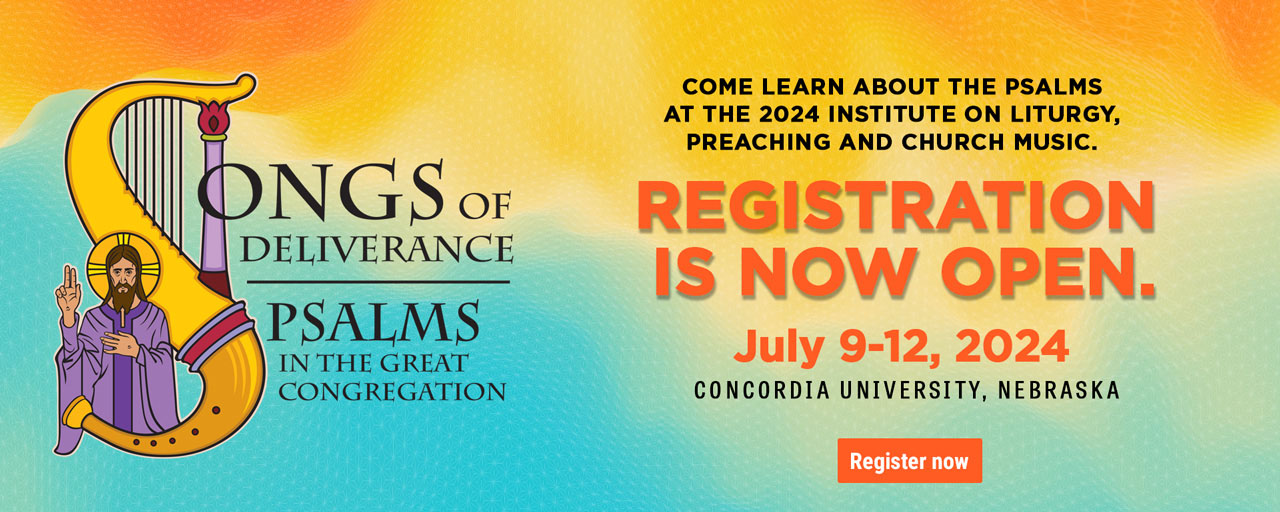
Register NOW!


Registration is now open for the 2024 Institute on Liturgy, Preaching and Church Music on July 9-12, 2024, at Concordia University, Nebraska (CUNE) in Seward, Neb.

The Institute, which is being presented by LCMS Worship, returns under the theme, “Songs of Deliverance: Psalms in the Great Congregation.”

With the Psalter as its focal point, this conference will feature fresh and perennial topics on music, leadership, preaching, pastoral care, art and spiritual growth in Lutheran worship.

Participants will be able to choose from a variety of instructive and interactive sessions addressing practical topics of interest to musicians, pastors, teachers, interested laypersons and many others. We’ll also take up a challenge together: pray all 150 psalms.

Registration is open through April 19 at the early-bird rate of $350 per adult. Regular registration is open from April 20 through May 17 at the adult attendee rate of $400. Two-day, one-day and full-time student registrant options are also available.


Institute information     Register now

For attendees


Wednesday, January 31, 2024


 Now is the time to register!

Too much to remember. . .

Watching a documentary of sorts on the Edwardian era and in particular with table settings and manners, the narrator commented that the rules were simply too much to remember.  At that, the authority on such things responded that it was not remembered at all but had become instinctive to everyone sitting at table. While I would have loved to been there as a visitor to Highclere or any of the other great houses of that era, I am sure I would have found the rules too much to remember as well.  I am certain I would have been watching those around me for clues and cues to figure my way through it all.  Those born to it make it look easy.

The same comment came to me when I was explaining the various ceremonies of the liturgy -- from bowing at the name of Jesus to genuflecting at the incarnation in the creed to the elevation to the sign of the cross, etc.  The person thought it was simply too much to remember and it took away from worship to be preoccupied with what to do and when to do it.  But of course, I responded.  That would be true except that it becomes instinctive with practice until you do not think to do it but only notice when it is not done.  I am sure that it did not help.  The point was not how difficult or easy it was to remember the rubrics and observe them.  The point was that the individual did not want to learn them or do them until they did become instinctive.

I have long insisted that the pastor's job is not to model his own preference or a middling example of what many might prefer but to model before the congregation the fullest expression of the liturgical habitus that belongs to the Church Catholic.  Indeed, if people do not see it where they ordinarily worship, it only reinforces the whole ridiculous idea that none of it is important or worthwhile unless and until I decide it benefits me.  The pastor should not be a novice to the faith (or to Lutheranism) and part of the job of pastoral formation at the seminary should be to expose the pastor to a fuller ceremonial than he may have experienced before and to the fullest expression as can be.  This is precisely so that he may model that fuller ceremonial to the congregation so that they know that these things are, indeed, Lutheran, and part of ordinary Lutheran practice (if not now, at one time and if not here, then at other places).

The pastor does these so often that they become instinctive.  Indeed, it nearly killed me to not genuflect when I had a broken leg and was not able to do so.  It was not because I think that this is somehow a make or break practice but that I had become so accustomed to it that not doing it felt odd.  I heard a younger pastor who had not grown up with Eucharistic vestments but wore them regularly say that he felt naked without it.  Of course.  Not because the lesser ceremonial is wrong but because that is the whole benefit of the ritual -- for it to become normal and ordinary so that you do not think about doing it but only think about it when it is not done.

It is not too much to remember any more than any other repeated gesture is too much to remember -- it all becomes a good and salutary habit.  That is what ought to happen with ceremonies.  We learn them so that they become a part of us.

Tuesday, January 30, 2024

Making death kind. . .

Until modern times hardly anyone would have thought death was kind.  If anything, the portrayal of death was always as a dark and unwelcome visitor, a thief who stole from us life and loved ones.  That view of death is waning as we have made our peace with death.  Indeed, it could be that we have gone much further than simply being friendly with death.  It has become a kindly figure in our lives -- more kindly than we would judge life itself.

The vast majority of people would find it hard to disagree with the statement that there are somethings worse than death.  From this comes the tacit approval of aborting children thought to have some deformity or handicap.  Even some of those opposed to taking the life of the unborn find it understandable to choose to take the life in the womb as a better and more kindly act than allowing a birth to a less than full life.  From this comes the difficulty even some of those opposed to abortion have of telling someone who is suffering in body or spirit that they cannot take their own lives and end their suffering.  From this comes the difficulty of even some of those opposed to abortion to condemn the euthanasia of those who seem to have no memory or cognitive activity or physical mobility.  The old line between offering only palliative care and extraordinary measures has slowly been erased so that even food becomes too much in the minds of some.  Death is kinder than life for many of those who would ordinarily say that abortion is wrong.

The cause of life is not merely an end to abortion.  It is even beyond the protection of life from its natural beginning to its natural end.  It is the view of life as sacred even amid suffering and handicap.  No life is so casual or precarious that we can dispense with it as a life unworthy of life or a life not worth living.  We are not the judges.  We are the guardians of God's precious and sacred gift.  That is all we can be.  Despite our technology and prowess with it, we are not the moral wizards who get to decide which life has value and which does not.  No matter how little you try to embrace this idea, it will lead you down the wrong path until no life has value until we assign it.  That is the beginning of the end.  But that is almost where we are now.

The votes on assisted suicide and abortion rights that have prevailed among us even against the overturning of Roe shows that this is not and never was a simple matter of one procedure.  It is inextricably woven into everything from reproductive technology to birth control, from how we deal with the aged or infirm who cannot produce to the way we view handicap and deformity.  We seem to have less stomach for life than we have for death and so even those who might come down on the right side of abortion are coming down on the wrong side of life.  Death is not kind nor friendly.  God may, in His infinite wisdom, be merciful to us in our suffering but death is never an ally of life nor even indifferent.  You cannot make death into a kindly figure.  Death is and will always be the dark figure without form or face who comes to steal what God has given.  The miracle of God is not to make death more friendly but to end its tyranny over us once for all with the resurrection of our Lord.  God has exposed death for what it is so that the life He offers in Christ may be more than our comfort but our hope.  Nowhere is this more profoundly true than in the midst of the lives of suffering who endue with grace, dignity, faith, and hope.  Sadly, we pity what we ought to be honoring as heroic.

Monday, January 29, 2024

A crisis of authority. . .

Sermon for the Fourth Sunday after the Epiphany (B), preached on Sunday, January 28, 2024.

Authority the word or concept has lost some of its value of late.  It started long ago in the rebellious years of free love and no war.  It matured into deep suspicion and skepticism of those who claim authority. It ended up with resistence to those who exercise it.  Our world is a political mess and it is not much different here at home.  The real authorities sit in silence as those who claim authority stir up violence and issue threats.  Our schools are locked down and inside it seems like the inmates are running the asylum.  We cry out for law and order but we suspect the police of being bullies and bigots.  Surely it is the wrong time to preach on authority.

Yet authority is exactly what our world is crying out for – not imaginary authority or imagined authority but real authority.  We are not talking about the kind of authority that comes from more money or a bigger gun or more votes or more alphabet salad behind your name.  We are talking about divine authority – authority over life and death.  This is the authority of Jesus.  It is not His because He claims it but because He exercises it.  He demonstrates this authority by forgiving the sins of sinners, by transcending the laws of nature, by healing the sick, by raising of the dead, and by casting out demons.  

All of this was not lost on the crowds of Jerusalem and in the outlying areas even into Capernaum.  They had heard the stories all right.  Even without a newspaper or screens that give us breaking news every second, Jesus had already become a celebrity, a phenomenon.  But the authority of Jesus was not displayed simply in the drama of food multiplied or the sick healed.  In fact, the first place where the people noticed something different in Jesus was in His teaching.  Jesus taught them as one with authority – different from the rabbis and scribes and teachers they had known before and heard from their religious leaders.

The teachers then footnoted their teaching with rabbinical authority.  But Jesus did not quote others.  Jesus spoke the Word.  Even more, He spoke it as one who knew that Word inside and out.  He spoke the Word as its author.  That is the meaning of real authority.  Jesus is the author of the Scriptures, the Word eternally begotten of the Father and now incarnate in the flesh and blood of the Son of Mary.  Jesus was pretty clear about this.  “You heard it said but I say unto you...”  The Pharisees, scribes, and elders tried to fact check Jesus but every time they tried His authority only increased and they backed off.

Furthermore, Jesus did not try to convince them that He was right.  He did not defer to the judgment of His hearers.  There is no democracy to determine what the Word of God is or means.  There is no need to marshal opinions to one side or another.  There is no vote.  Jesus speaks bluntly – too bluntly for our ears but so bluntly that He is unassailable.  Even His opponents note this.  At the end of His ministry they admit that Jesus does not care about the opinions of others and He cannot be swayed.  He is one who is of the Word and who keeps the Word.

The Church has lost this kind of authority.  Some might point to doctrinal conflicts or moral failings of the clergy or the many other options available to people as the reasons for this loss.  I am sure they contribute.  But the real reason why the Church has lost its authority is that we are no longer people of the Word of God.  Unlike Jesus, we do care what people think.  We even change God’s Word on the basis of what people think.  We have turned Bible study into a free for all where everyone gets an opinion and we have made doctrine into a bad word.  As a result, the world looks at Christians and sees a leaf blown through the air, without anchor, purpose, or goal.

Jesus came to manifest the authority of His Word, putting into flesh and blood and deeds what Scripture says.  He came to restore creation, bringing what and who God made back to God.  He came to repair what sin broke, covering our sins with His righteousness and repairing death with the life that cannot die.  He came to deliver the helpless from the devil’s temptation and power and to cast out demons from the people of God.  He came to plant hope where despair or indifference once reigned and build that hope on the promise of a new and everlasting heaven and earth.  He came to bestow the gifts of God upon the undeserving who can offer God little more than their sins which they confess and their trust in His mercy.

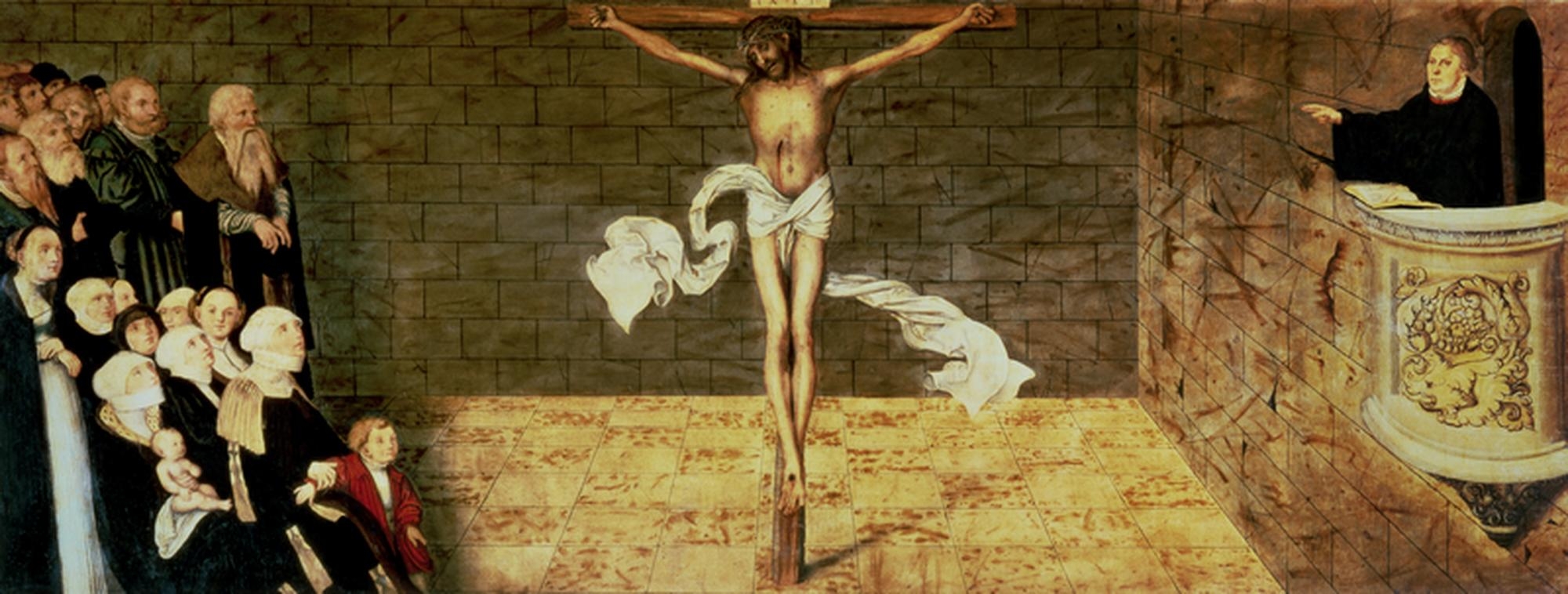
This is why the Church exists and what the Church has been given to do.  While it is a good thing to organize food drives for the hungry and financial help for the needy and to sponsor youth programs and events for senior citizens and even musical concerts for everyone.  This is not why we are here.  We exist to proclaim the Word of the Lord that endures forever and to proclaim it without apology or embarrassment or avoiding its sharp edges.  We exist to forgive the sins of the penitent and to teach knowledge of salvation and to serve the people of God with the gifts of God through which they are saved.  We do not have authority because people like or respond to what we do.  We have authority because of His Word.

As we wield the two edged sword of that Word, people are saved, kept in their salvation, and delivered from death to everlasting life.  The miracles of Jesus were not in place of the Word or more profound than His Word.  The miracles of Jesus were in support of the Word so that in words and deeds there was one message, one authority, and one purpose being accomplished.  If we as the Church had the same clarity to what we said and what we did, just maybe the Church would not be in the mess that it is right now.

What the Church does not need are more programs or a better social media presence or more people who think we are doing a good job.  What we do need is as simple and blunt today as it was when Jesus was in the synagogue of Capernaum.  We need to be people of Christ’s Word, under the authority of that Word, and captive to that Word and not to the whims of feelings, opinions, preferences, or wants.  We need pastors who will be the same – teachers of the Word who wield the authority of that Word in order to fulfill Jesus’ own saving purpose.  We need people who will insist that they be given God’s Word in full strength, the whole counsel of that Word, and who will make it the bedrock foundation of their homes and lives.

The Pharisees said that Jesus did not care about the opinions of people but Jesus does care about people.  Jesus does not defer to the authority of others but exercises the real authority of the Word of God because it is the only Word that saves.  When Christianity begins to do the same, the people will once again be astonished by such authority and be drawn to it because it is the only Word that saves.

Authority is not the problem. . .

Though we live in a Christian world in which Christians have become embarrassed by such things as the masculine names for God made known to us in the Scriptures and the kingly nature of the Savior who is born of Mary, authority is not the problem we need to fix.  Though we live in a pseudo-egalitarian world in which everyone is supposed to be equal and count the same, the Son of God is designated King from the promise given before His birth to His birth as King of the Jews to the sign placed by Pilate above the crucified Lord.  This is not a problem for us to fix but an article of faith for us to believe and confess.

It was a sad day when supposedly well-meaning Christians decided that some texts of Scripture and hymns were too militant and that king and kingdom were terms to be avoided.  Some Lutherans continue to do this (reference Clint Schnekloth who is a proud ELCA pastor and who drops the g so the offending word ends up kin-dom).  It seems that we have reversed the mantra of Israel who begged the Lord for a king so that they would be like everyone else.  Now we want nothing of a kingdom nor of a Savior who is a King.  Nope, we want nothing of patriarchy or monarchy of any kind and will reject any Jesus who does not know to be as enlightened as we are.,

That is the problem.  We have rejected a Savior who is born King and rejected the Kingdom He has come to rule.  In so doing, we have ended up with the chaos of diversity in which stupidity is deemed wise and wisdom has gone begging.  In our dream world, there are no sins and no redeemers but there are also no rulers or subjects.  We rule ourselves.  The fruits of Eden are not the choice of the wrong kings but no kings or, better, a kingdom not of priests to serve but of kings who do what they please.  In this world of our dreams, there are no authority figures (at least none we will admit) and freedom has become license to continue Eden's rebellion where and how we please.  Remember here I am not talking about the world out there but those who claim the name Christian and who believe themselves to be true to Jesus.

Congregations want to reshape the Gospel into something the majority can vote on and they want to be able to fire their pastors at will.  Authority even of our Confessions is but lip service to many Lutherans and even Lutherans view the pastor as an employee.  Indeed, the worst thing a pastor can be is to be faithful (which translates into domineering in the minds of many).  The discipline of the congregation has largely been lost.  We find it impossible to hold those in pew accountable for their public sins anymore than we do the pastors for theirs.  We deal with discipline by ignoring the trouble and hoping that it will go away or by talking about anything and everything except sin in the Church.  No kings are allowed to upset that ideal -- not even Jesus!

We presume authority is the right to tell people what to do and then punish them if they don't.  That was never the kind of authority Scripture speaks of nor is it the authority of Christ.  If that is all authority is -- the right to tell others what to do -- it is no wonder that we chafe under it or fight over who exercises it. Christianity transformed the world not with a God strong enough to take down all the other gods of Rome and Athens but with a God strong enough to suffer and die.  Authority for those who would follow Him is not the pursuit of unrestrained license and freedom to do what you please but taking up the cross, following Jesus, loving God above all things and your neighbor as yourself.  The authority refused the sexual indulgence of Rome, the misogyny of a world in which men were better than women, and the false morality of a world in which children, especially the unborn, did not matter.

Christianity did not dismantle one authoritarian regime in order to replace it with another.  We did not exchange one self-serving dictator for another.  We got a King who dies for His subjects and who earns His authority by means of the suffering of the cross and the death to redeem the dead to life.  This is not a King who comes with a list of demands or a new set of rules but of love strong enough to forgive and life strong enough to raise us with Him.  That does not mean that anything goes but that His kingly reign comes not by abandoning all that He was incarnate to do.  Rather it means drawing us into Him and into the shape of His service until to the world the King and His subjects are one.  This authority does not ignore sin or wish it away or shrug it off but confronts it -- all sin, even the pet sins and desires of our hearts we never think to confess.  He brings it out into the open not to condemn us but to save us.  Love does not let the sinner off but applies the currency of Christ's own blood to pay its awful price.  If anything, this is an authority vastly superior and with a higher claim on us than one which comes with demands and commands.  In this Kingdom of Christ we do not live in the chains of His oppression but in the freedom to live as one of His own, under Him in His Kingdom now and even forevermore.  It is high time that we began to act like it and to abandon our foolishness in favor of His eternal wisdom.