Tuesday, January 10, 2012

Jesus is baptized for ME!

Sermon for the Baptism of Our Lord, preached on Sunday, January 8, 2012.

    Have you ever had the feeling that something was not right?  John the Baptist had that feeling.  He had been standing in the waters of the Jordan and preaching repentance, accustomed to the sinners who came lamenting their sins and desiring to be right before God.  And then Jesus shows up – the same Jesus who caused John to jump in his mother's womb.  This Jesus was no stranger to him.  So when he knew something was not right, this was more than instinct.  This was faith.
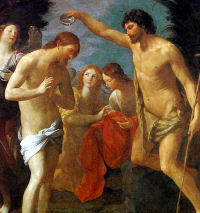
    Jesus was no sinner in need of repentance.  Jesus did not come lamenting his own fall from grace.  Jesus came as the one and only righteous man.  John knew this.  He was, after all, the messenger who came before Jesus to prepare His way.  John proposed a switch to make it all right.  Jesus the righteous would baptize John the sinner.  Jesus insisted that this wrong must go forward – He must be baptized by John "in order to fulfill all righteousness."  So John baptized Jesus and immediately the heavens opened, a dove descended, and a voice proclaimed Jesus "My beloved Son in whom I am well pleased."  This voice was not for Jesus – it was for John and for every sinner who meets Jesus in the baptismal waters.  In baptism we encounter the wrong that makes us right, the holy One who should not be there comes to bear our sins for us.
    To save us Jesus becomes one of us.  There is something wrong there.  God becomes flesh and blood like us.  This is no mere appearance or costume. This is no appearance or image of something that is not there.  This is a real as a baby's cry, as blood that bleeds red and flesh that feels pain, suffering, and even death.  We come to baptism in shock that the innocent God made Himself dirty and guilty for us sinners.  The Most High God who dwells with us in the surprise of flesh and blood, the immortal God has made Himself mortal, all so that He might die and we might live!
    To save us, the Lawgiver makes Himself subject to the Law.  We learn from our culture that those who make the laws are above the law.  But not Jesus.  He makes Himself subject to the whole law; He suffers with us every limitation and burden of life lived as a mortal, under the demands of the Law.  But unlike us, He does not fail this Law.  He fulfills it perfectly.  Not as one to show off how good He is but as the Savior who gives us the fruit of His holy life and righteousness.
    He bears the full burden of our sin.  Jesus is not a model for us to follow, someone we could be and should be if we tried hard enough.  No, Jesus has come to carry our load of sin– even when that load means bearing the burden of the cross and death and then turns around to bestow upon us all that His obedience has earned.  Jesus is not there in baptism because He has to be but because He chooses to be for us.  He puts Himself in the wrong place (our place) in order that we might be made the righteous and holy children of God.  He entered baptism to bear our death that we might rise in baptism in His life.
    His righteousness, His holiness, is not some badge of His honor but the gift given to unworthy and undeserving sinners.  Like Cinderella who dresses up in borrowed clothing, He comes to cloth us in what is not ours but His.  The surprise of grace is that we wear this vesture of righteousness forever.  We fear no bewitching hour when it all disappears.  It is ours forever, the wedding garments that prepare us for the marriage supper of the Lamb.
    The sad truth is that we have it all wrong.  It happens every time we baptize an infant. We wince when the baptismal liturgy speaks of this child so marked with sin that he is under Satan's power and dead eternally.  Surely not, we think, they are so cute!  The words of baptism do not fit our image of the “innocent child.”  What makes baptism unusual is not that “innocent” babes need to be saved but that salvation is planted there, hidden in the water set apart by Jesus’ Word, and endowed with all the power of His grace.  Here in these waters, we find the Righteous One who dies for the guilty, the Innocent for the sinner, Him who is the life who becomes death for us.  We find the words of baptism at odds with our image of the sweet little innocent baby.  But the surprise of baptism is that Jesus is there – not for Himself but for us – enabling the great exchange of His grace for our guilt, His righteousness for our sin, and His life for our death.
    You know how those weight loss programs show a skinny person as their spokesman? We think “why would that person need to diet?”  If you look into baptism, you see that the only person who should not be there is Jesus.  We come out of need for the promise attached to baptism, Jesus comes to embrace our burden and take responsibility for our sins.  This is no Cinderella story in which the magic is momentary – this the power of grace that marks us for God and His kingdom for all eternity.  There is no greater power than that which Jesus brings to the baptismal font.
    What should be wrong, becomes right for us.  Jesus does not need what baptism offers but bestows the grace that enables sinners to live.  And this is no mere second chance to screw it all up again – the forgiveness and redemption hidden in baptism washes away our every sin and gives life to our death darkened lives.  John’s baptism is no more.  Jesus has fulfilled it and replaced it with the promise John could only dream about – forgiveness free and full, life stronger than death, restoration to the lost children of our heavenly Father!  And now the voice that once rang out through the heavens for Jesus, shouts to you and to me: You are my beloved sons and daughters, in whom I am well pleased!”

New to Grace Lutheran Church...

A couple of new arches, painting, and statues on the far side walls just outside the chancel... thought you might be interested...

This is the Good Shepherd Statue...
This is the Thorvaldsen Statue of Christ...


These match the altar arch which is shown below.

The "after" photo...
The "before" photo

Once again Pr. Esget has mined a one in a million...

Pr. Esget at Esgetology has found some of the oddest and weirdest things you can find and this one is no different...  Tis the season when you have an I-Pad Christmas Eve at a Lutheran Missouri Synod Church in Texas (everything they do there is bigger and better than everywhere else).... You watch... and pray...


Luther was not an iconoclast... (unlike some of his modern day followers)

Interesting pictures on the good Synod President's web site.  He gives us photos taken from his German tour and I was most impressed with the shots of a pulpit from the chapel in the Torgau Castle, a chapel which Luther dedicated and, in particular, the pulpit from which he preached.


Lutherans are (were) passionate about the arts in service to the Gospel and worship.  The early Lutherans knew what more modern day Lutherans have forgotten -- the visual image that accompanies the verbal confession IS important.  Would that we were as convinced today of the useful purpose of the arts in service to the Gospel within the architecture and appointments of the church!  I would love to see such a pulpit today (and would love to see those plexiglass lecterns melted into blobs).  Oh, it is true, we just might spend the cost of such a pulpit putting in a first class audio and visual system to enhance the sound of the praise band or to make sure everyone can see the PowerPoint slides of the Pastor's sermon but I think that the ornate pulpit is more durable!

We are just finishing the second leg of plaster and paint work in our chancel and nave.  In the end we will have four more places where the symbols of the faith are prominently displayed and two statues to direct our attention to the word and promise of God.  One will have the words "I am the Good Shepherd" with a statue of Jesus as the Good Shepherd with a lamb in His arm and a staff in His hand.  The other will be the familiar Thorvaldsen Christ (which was on the ornate altars of so many Lutheran congregations of the prairie -- including my own).  This will have above it "Come to Me and I will give you rest."

If things work out well, we have a couple of other projects to add to the existing investment of stained glass, jacobean frontals, banners, Christus Rex, pipe organ case, processional crucifix, brassware, etc...  We have not spent a fortune (all told the total for all of this spent over 10 years or so is about equal to what we give each year toward missions).  Even good art does always come with a huge price tag.

Monday, January 9, 2012

Oooops.... forgot to post this January 6... better late than never

I have this in my archives from years ago.  It never fails to enthrall me.  Hearing a poet read his own poetry is rich enough but this is T. S. Eliot and the poem, a favorite, the Journey of the Magi....

Click on the link and listen to it. 

Poetry and hymnody are both gifts to the Church in which authors compress and combine images and words to form the barest number of syllables to form the richest of portraits.  Designed for hearing more than reading, the words of the poet and hymn writer give us forms that beg for a voice and whose voice continues long in the fabric of our memory.

I long to be one but am happy enough to enjoy their work.  It is almost an intrusion, of sorts, like a little boy listening in to what adults speak in muffled voices, but that makes their gift even richer still.

How to teach a sense of community...

We have no trouble attracting visitors but we have noted of late that many do not return after a couple of weeks.  Discussions have raged about the increasing isolation (self-imposed) of our culture and the fact that Church does not offer to most their primary circle of friendship or socialization (anymore). We have also found visitors less and less likely to give us contact information for follow up (even failing to give us a last name, at times).  We have talked about all the usual culprits in keeping folks from connecting to the community of faith.  I will admit not being altogether convinced that these are all the reasons.  It does not help that others have expressed similar problems -- in very different congregations and in very different parts of the country.

Let me give an example.  I cannot believe that anyone in their right mind is attracted to Mormonism because of the doctrine.  It is a kooky story of an illiterate man who finds golden tablets which an angel comes down to translate and then angel and tablets disappear with only the written text to prove anything.  It is a crazy faith of religious underwear, alien origins, Native Americans who are a lost tribe of Israel, etc.  Only a crazy person would choose this recent so-called revelation over the history and historicity of catholic Christianity.  Yet the Mormons grow.  They send forth their youth on 1-2 year missionary journeys designed as much to solidify them in their faith as to spread it.  And the parents foot the bill.  Why?

I have to hand it to them with respect to community and caring.  Mormons are weak on truth but they certainly excel on community in which truly you are your brother's keeper and it is your duty to inconvenience yourself for the sake of your neighbor.  They are strong on family connections and drawing people in by way of those family ties and community bonds.  They manifest a caring relationship that is so often absent among other churches.  It is my opinion that this is what makes them so attractive.  At the same time, this is the Achilles' heel of most suburban and urban congregations (yes, Lutheran, too).  We have tended to see the care of the poor and needy as either the government's responsibility or the responsibility of somebody who is not me.  Of course there are exceptions but I see our greater weakness as this sense of community and the deep, deliberate connections that bind us together.

I wonder if this is also part of the reason why mercy is one of the three emphases in our Synod's three-fold expression of values (witness, mercy, and life together).  Though it may not be entirely a fair characterization, the LCMS is not exactly known for its compassionate care.  Our life together has been strained by rudeness and smugness as much as conflict and theological distance.  We do not follow Luther's admonition to put the best construction on everything and we tend to be just the opposite of Nathanael (in whom the Lord saw no guile).  It may be that the same trouble expressing how to encourage and move a church body in this direction is why we have not heard as much about mercy as we have witness and life together.  I am not consoled by the fact that my own parish may fairly reflect the weaknesses of my church body in this area.

What I am interested in is not an intellectual discussion about the rightness or wrongheadedness of my observations.  What I am looking for are ways to make a positive improvement in my own congregation's sense of community, means to strengthening the bonds between us as members and family in the faith, and encouraging ways in which we can take responsibility for one another.  If you have some advice and help, please share it with me.  If you have a program or tool or simply an experience to share about how your congregation was encouraged to manifest a more caring attitude and a deeper responsibility toward each other, I would be happy to hear about it....  so, I guess I will wait to hear from you?!


Bump it up

From a comment came this story of a Lutheran Pastor who lost a football bet and had to conduct the service in a team jersey and skirt...  And you people think I am weird????  Only shows to go ya, truth is always stranger than fiction....


Sunday, January 8, 2012

Your teens are capable theologians...

One of the ever present sources of angst is the catechism curriculum and the constant need to invent new resources to teach the same old stuff.  Lutherans seem to have an epidemic of self-loathing when it comes to what we do to prepare our young people for first communion or confirmation.  A friend sent me this link to an article on the reform of confirmation.  You can read it for yourself.  I know nothing of the source but suffice it to say it was being read in the Augsburg Fortress offices and the President of AF liked it a lot.  Not so much for me.  Let me just pick on one point...

According to the author, we can improve confirmation [instruction] if we acknowledge -- without fear that even teenagers are capable theologians when given the opportunity... and that your students will not be prepared for life because they have prepackaged answers to the hot topic questions but because you are willing to ask questions for which you do not have the answers... 

That would certainly seem to preclude use of the Catechism (a book which teaches through the use of questions and answers -- prepackaged ones from nearly 500 years ago!).  It would also seem that the purpose of instruction is not to impart knowledge [answers] but rather to teach them to think for themselves.  Now I would agree that thinking for themselves is a good end but without the tools you have placed within them (the knowledge of Scripture and the Catechism, the use of the hymnal, and an understanding of the way of worship in the liturgy), I cannot for the life of me figure out how they are supposed to think for themselves.

The author concludes with the question Did the hair on the back of your neck stand up?  My goodness, she is psychic! How did she know her words were doing just that?  I once thought alone the lines of this author -- don't teach the children, just lead them and show them how to think them through for themselves.  Thank goodness a concerned mentor had the sense to tell me to stick with the catechism first and see if they learn to the use the tools before handing them a rough piece of wood to make something of.

It would seem that this is exactly the wrong thing -- to give our kids permission to explore on their own without warning them of the dangers or giving them the tools to help them arrive at the right destination.  Memorized answers are no substitute for well thought out answers but if we could get there on our own God would have no need for His Word or the Spirit which enlightens us with respect to the Word.  Before you think them through, memorized answers give you the framework to make the jump between question and answer.

BTW, since Augsburg Fortress press is drowning in red ink and had to let go curriculum writers and editors due because the sales of adult faith formation resources have been disappointing... [their own words]...  maybe it could have something to do with the screwy ideas about what constitutes faith formation resources.... ya think?

Saturday, January 7, 2012

It is Sunday morning.... it's party time!!

Sure those who make a big deal about contemporary Christian music are just reflecting a culture clash, a snob struggle, a difference in musical taste...  Everyone knows that people are drawn to contemporary Christian music for the lyrics and not for the beat or the sound.  Why, CCM is really not much different than the hymns in the hymnal except that they are contemporary.  Both do an equal job of communicating the Gospel...

Oh, the depth of the riches and wisdom and knowledge of God!

HT to Pr Esget at Esgetology.... make sure you have a strong stomach to watch...

Playing Church...

A serious question came to Fr. Z at What Does the Prayer Really Say.  "Is it okay if children 'play' church?"  My mind raced back to the vivid memory of a special funeral held in our back year.  We had a couple of turtles and one of them died.  My mom had been cleaning the turtle and they normally loved to extend their neck into the water flowing from the faucet.  This time the turtle did not come out to play.  When mom shook the turtle, the head came out limp and dangled beside the body.  He had gone to be with the Lord.  I don't recall how old I was -- I know it was before 1965 but how many years before then I could not tell you.  What to do?!?

As I recall it my brother and I made a casket out of a Kleenex box.  We opened the side and slid the turtle in so that the transparent plastic that held the tissue up served as a fine open casket.  The neighbor kids gathered to pay last respects and I got out the old hymnal (TLH) to pray, sing, and commend this blessed creature to God's eternal mercy.  It was not done as a joke but with the greatest of seriousness.  All in all I believe it was one of the best turtle funerals that Northeast Nebraska had ever seen.  Follow the burial I believe we went inside for some kind of refreshments.  The turtle was Lutheran -- he must have been cause we were (are).

Now when you stop laughing and decide to read on, I did not post this for the humor of it (though I do understand that some of you are practically giddy at the thought of me as a child giving a fine Lutheran send off to our turtle).  That turtle funeral was the concrete expression of what I had learned in Church on Sunday morning, in Sunday school, VBS, and from the faithful prayers and witness of my wonderful parents.  It was natural for me to think of a funeral, a Lutheran funeral, using the hymnal that I used on Sunday morning and drawing comfort and consolation from the faith that spoke to me of life and death and resurrection.

I wish more kids played church -- not as a joke but as kids do -- enacting in their play what they see and hear and believe.  As kids we played cowboy, we played army men, we plotted out villages in the dirt and roads on which to drive -- all of these were learning experiences as well as the living out of the things we knew and loved and respected and believed.  My kids knew what church was and it was as much as part of who they were as anything else.  I know that one or two of them played out what they saw me do on Sunday.  That's a good thing.  Children should and we don't need any prudes suggesting that it is irreverent or foolish. 

So if you find your kids playing church, don't yell at them.  Take them seriously because they are being very serious about very serious things.  If you must laugh, do it after they have gone to bed.


At the same blog I saw a picture that made me green with envy.  Some kid born about my time had a mom who sewed him up some vestments and he had an altar set up that would have made my little Lutheran funeral look like a Baptist revival.  I don't know what I can do but imagine what I might have done and what the whole neighborhood of kids might have learned if I had only had the tools and resources this boy had.... oh, well, I still think we gave our turtle a mighty fine send off -- even if we were a little sparse on the amenities.

Friday, January 6, 2012

A Blessed Epiphany!

There is great sadness in my heart every Epiphany.  It, like Ascension, has become a largely forgotten day on our calendar.  Sometimes we move Epiphany to a Sunday and even when that works, Epiphany is like an add on to the service rather than the important holy day it is.  Other times we schedule mid-week services upon the actual date -- only to see a hand full of folks show up.  Now, I do not mean to disparage those who come, but it is hardly fitting for this day that the world passes it by -- joined by those in the Church also.

As I drive by the growing pile of Christmas trees dropped off at the local state recreational area, it is clear that Christmas has come and gone.  It started already on Christmas Day when the first tree hit the asphalt spot -- destined to become mulch on the trails at Dunbar Cave.  We are so done with it all that are ready to give it all up -- the hymns and carols and sentiment of Christmas as well as the trees and decorations.  We have already used and broken some of our gifts, cashed in some of the gift cards, and returned the unpleasant things we were surely given by mistake.  We don't want twelve days of Christmas and an big bang from Epiphany.  Even as Christians we are ready to get on with it.  One year a preschool mom asked me why we had forgotten to take down the Christmas wreathes on our door -- it was January 2 and time to move on.  So it is not hard to figure out why Epiphany has gotten lost in all of this.

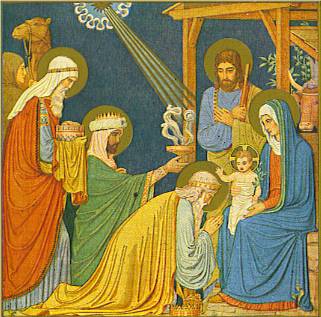
Epiphany was once bigger than Christmas and still is in Orthodoxy.  It is not just about the Wise Men/three kings from Orient are.  It is not just about gifts to the Christ child.  It is not just about Gentiles welcomed to the Infant King of the Jews.  It is not just about Light -- in the midst of darkness, that shines in the darkness, and the darkness has not overcome it.  It is not just about the end of the twelve days of Christmas.  It is and much more.  It is about revelation, the step by step revelation of Jesus as the Son of God in human flesh and blood -- from the visit of the Magi to the baptism in the Jordan to the miracles large and small, to the disciples called, to the preaching that the Kingdom of God is come in Christ, and MORE!

The prolific commentator and commenter Past Elder (aka Terry Maher) wrote exhaustively on Epiphany.  You can read it all here and I will not bother to rewrite what he put up last year. Suffice it to say that it is a shame we have let the wind blow out our candle and leave us in darkness in this day of light.  We can do better.  We have tried both moving it to a Sunday and a mid-week observance when it falls (at different times and at the same time) and we will labor on valiantly trying to recapture what has been lost.  It is an uphill battle and I pray you better success than I have had.

Thursday, January 5, 2012

Music in the Church

Rome, not always the high water mark in church music, has become aware of this problem of music that conflicts with the faith and with the nature of what happens in the Mass and has begun to do something about the sad state of music in worship in the average Roman parish.

From Mons. Valentín Miserachs Grau, the President of the Pontifical Institute for Sacred Music:  [T]he Church has always requested as essential connotations of liturgical Sacred Music: holiness, excellence of the forms (true art) and universality, in the sense that liturgical music could be acceptable to everybody, without shutting itself in abstruse or elitist forms and, least of all, turning down to trivial consumer products...  This one is a sore point: the rampant wave of false and truly dreadful liturgical music in our churches... how is it possible that the musical praxis in our churches distances itself in so evident a way from the same doctrine?

[On the issue of experimentation:] One cannot transform the “oratory” into “laboratory”.... The second aspect of the problem derives from a false interpretation of the conciliar doctrine on Sacred Music. As a matter of fact, the post-conciliar liturgical “renewal”, including the almost total lack of mandatory rules at a high level, has allowed a progressive decay of liturgical music, at the point of becoming, in the most cases, “consumer music” according to the parameters of the most slipshod easy-listening music.

While Rome's concerns and its methods of dealing with the problem are not exactly the same as Lutherans, it is a good thing that Rome is awaking to the growing distance of the music of worship -- both in content and style  -- from the faith the Church believes, confesses, and teaches.  It will certainly take some time for this top down approach to change the Haugen-Haas pop hymn culture of the local parish, but at least they are doing something.

The best that we can hope for among Lutherans is a good conversation and some leading by example.  We lack the jurisdictional authority to tell a local congregation what they can or cannot sing.  Whether good or bad, that is the way we operate.  Nevertheless, we have abused our liturgical freedom both to the detriment of the unity of the Church and the catechetical well-being of the folks in the pew.  This is one area in which we all share the need for some repentance and change.  We have borrowed from those who have a completely different understanding of worship and a different theology and the price we have paid is that our people do not see the difference between the pop gospel songs they hear on Christian radio and the hymns of the faith (both new and old).

For us it is not about changing the rules or enforcing the ones on the books -- it is about convincing Pastors and those who plan and lead worship to be more faithful in their calling.  It is about believing that what can be done is not the same as what should be done.  It is about putting the effort in to choose music for the liturgy that reflects the lectionary and not personal taste.  It is about getting serious with respect to what we confess to our people and to the world when we use music that conflicts with the faith or is trite, trivial, and banal in content and style.  It is about paying our parish musicians a decent wage so that they can be serious about their craft and about recruiting others for this noble calling.  It is NOT about style vs substance, NOT about culture warfare between high brow and low brow music, NOT about whatever works, NOT about what people (or Pastors) want, and NOT about musical instruments (though I would argue that the guitar is not a melodic instrument and therefore cannot on its own support congregational song).

Wednesday, January 4, 2012

Singing Christmas Trees

GetReligion has a story about the 1980s and the rise of the singing Christmas tree as a fixture of this holiday season.  Living next door to one that puts on a great show every year, three performances, to a packed house every time, I can attest to the popularity of this strange phenomenon.

GetReligionAcross the country, churches will soon be groaning at full capacity as millions of Americans, from the deeply devout to the twice-a-year attendees, pack their local congregations to participate in a Christmas Eve service. But this month, some of those churches will also present what has become a tradition in the modern evangelical megachurch: the Singing Christmas Tree. In these productions, church choirs perform a musical celebration while standing inside an enormous Christmas tree platform that reaches to the ceiling, often accompanied by extravagant light shows, dancing church members, and sometimes even fireworks. Displaying all the kitsch and some of the camp of your favorite Broadway musical, Singing Christmas Tree pageants represent the quintessence of the modern megachurch experience: oversized, ostentatious, and a strange blend of the sacred and the secular.

I tuned across the stations the other night and caught a portion of the local singing tree.  It was full of kitsch, odd costumes, flashing lights (that almost gave me a migraine), lots of slapstick humor, and some amateurish singing (soloists with back up choir and orchestra band).  Most of what I caught were secular tunes though I did not last much more than 15 minutes or so.  And I caught sight of a few Lutherans there, too.

From Slate.comChurches, most often Baptist congregations, got in on the act in the 1960s and ‘70s, setting up Christmas tree platforms inside their congregations and inviting community members to their productions. Most of these productions were simple affairs—the church choir was arranged on a tiered structure draped in garland boughs and red ribbons. There it would sing through a medley of Christmas hymns. The pastor would read the account of Jesus’ birth from the Gospel of Luke while a handful of church members re-enacted the nativity scene. Nativity plays have always figured prominently in American churches’ holiday celebrations. But the Singing Christmas Tree pageants that became popular in evangelical circles in the late 20th century inadvertently brought the season’s secular trappings directly into churches’ Christmas observances in a way that dramatic recreations of the first Christmas in Bethlehem had previously avoided.

Bellevue Baptist in Memphis reigned as King of the singing tree -- to which other Baptists were green with envy -- until First Baptist in Orlando doubled up the pleasure with not one but two giant singing trees.  Ostensibly the purpose of these extravaganzas is to save souls -- that is the claim of the late Adrian Rodgers of the Memphis congregation -- but in all honesty this is about entertainment more than message.  I am not sure what a person would be saved to from the odd combination of comedy and song that supposedly introduces people to their Savior -- and what kind of Savior?  A happy Jesus, full of humor and good fun who makes sure a good time was had by all?

If you ask me, and no one has, it would be better if those who put on such glitzy shows would simply own up to their entertainment value and leave it at that.  It is a poor substitute for Christmas worship services (unless the church's worship is on par with the singing tree shows).  It is not a show I want to see but, as entertainment goes, we have different choices.  Clearly there is a great difference between a choir singing a Benjamin Britten's Ceremony of Carols or Paul Manz's E'en So Lord Jesus Quickly Come and a hootenanny version of The Twelve Days of Christmas and it has nothing to do classical vs pop music and everything to do with text and message.  But, if that is your cup of tea, go and have a good time.  Just don't call it worship and don't tell me it is an evangelistic enterprise.  Jesus does not give a hoot if you have America's tallest or biggest singing Christmas tree.


Of the taking of polls there is no end...

Gadfry, I am sick to death of Iowa and its caucuses.  The polls tell us Michele is up, then Perry, then Newt, then Ron, then Rick, and now Mitt... who cares anymore!  Just get the whole blankety blank thing over with!  But that is not the only thing in the news.  We have Barna releasing new data every day on how unreligious Christians are.  We have the Southern Baptists (LifeWay) releasing polls on the services held or not on Christmas.  Now a reader in Germany sent me this link that says 80% of German Roman Catholics probably don't believe in a personal God (do they prefer and impersonal one???).  I am being slowly tortured to death by polls.  I even got phone calls over the holidays to ask how I was going to vote in the Tennessee primary (which isn't even until like August and by then there won't be any choice left).

Our government and leaders are failing because they read polls instead of doing what is good, right, and best for us.  Now the media is trying to get the Church to read polls and make changes in doctrine and practice on the basis of the results received by a sample survey with a 3% margin of error.  Really!  I believe that the devil is killing us by polls -- polls that throw in our faces what we thought yesterday, fifteen minutes ago, and what we might think tomorrow.

Once I had a person suggest that we should take a poll to see how people like our worship services.  Once I had a guy tell me that before we take the second of three votes on building on to our building, we might take a poll to see what people really think.  Once I heard of a Pastor who polled the congregation on what he should preach about on that Sunday -- obviously he had well prepared for that sermon!  I have heard calls for polls to decide which hymns should be in the hymnal, how often we might celebrate the Eucharist, and whether or not the Pastor is doing his job to the satisfaction of the folks in the pews.  Polls are the devil's instruments!

I recall when AAL did that study of generations.  It informed of us of the very things we did not wish to know -- that we a flawed, failed, and sinful people who believe half the time and wrestle with our doubts and fears the other half so that at any given moment we are not sure of anything -- even our own names.  I have a copy of that book on my shelf.  It is filled with dust.  I cannot remember the last time I opened it or if I ever read anything in it.  Polls tell us that our faith is fragile, that we have itching ears, that we move the direction of the wind, and that we are fascinated by new and different things (whether real or made up) -- but we could have found all of that out in Scripture for much less than the cost of a first rate pollster and a couple of thousands of computer print offs.

I pray that no one in St. Louis at 1333 S. Kirkwood Road is taking or paying attention to polls.  Now I am not a Biblicist.  I do not believe that we ought to cast lots in the way that Matthias was chosen Apostle.  I am not in favor of governing the Church or the congregation with a group of 12 Apostles.  I am not a Luddite and do not eschew the modern conveniences (aka blogging).  But.... we do not need a magnifying mirror to see the weakness and failings in our feelings and thoughts.  The Church of God deserves something better than the whims of the moment to define who we are and what we are to do in worship or ministry.  God save us from the pollster and their wet thumbs stuck up to test every breach of wind, change, or chance.  It is precisely this that I think the collect is referring to when it calls upon us to pray: 
Assist us mercifully, O Lord, in these our supplications and prayers, and dispose the way of thy servants towards the attainment of everlasting salvation; that, among all the changes and chances of this mortal life, they may ever be defended by thy gracious and ready help; through Jesus Christ our Lord. Amen.

"What change is this, I Sweet love?" says Shakespeare.  We are in love with change but even more in love with what we think or feel about such changes.  We waste our mighty communication technology to ask each other where we are, what we are doing, what do we think?  Lord, save us from ourselves, from the tyranny of our thoughts and feelings, from a destiny determined by whims, by a snapshot of time that attempts to explain the past and portend the future, and, most of all, from those who make their business finding out what we think about this or that in seven words or less...

Tuesday, January 3, 2012

The Exclusive Claim to the Word Catholic...

This was passed on to me from a variety of sources.  Apparently the Roman Catholic hierarchy is laying exclusive claim to the word "Catholic" and is contacting bloggers and other media uses it claims are in violation to this exclusive use claim.  Perhaps this will create a stir among the Old Polish National Catholics and some other splinter groups.

In my mind, this is one time when the use of the word "catholic" in the creed makes it a confessional issue and, perhaps, we ought to capitalize the "C" just to put it in the face of those in Rome who are trying to claim exclusive use.  It would be the equivalent of "Lutheran" being claimed as exclusive to the official channels of a jurisdiction and off limits to others.

The Church encourages the Christian faithful to promote or sustain a variety of apostolic undertakings but, nevertheless, prohibits any such undertaking from claiming the name Catholic without the consent of the competent ecclesiastical authority (see canon 216 of the 1983 Code of Canon Law). For some time, the Archdiocese of Detroit has been in communication with Mr. Michael Voris and his media partner at Real Catholic TV regarding their prominent use of the word “Catholic” in identifying and promoting their public activities disseminated from the enterprise’s production facility in Ferndale, Michigan. The Archdiocese has informed Mr. Voris and Real Catholic TV, RealCatholicTV.com, that it does not regard them as being authorized to use the word “Catholic” to identify or promote their public activities. Questions about this matter may be directed to the Archdiocese of Detroit, Department of Communications.

The official letter is here....

A Lament..

A Southern Baptist Pastor once told me that they would have church on Christmas when Christmas fell on a Sunday or a Wednesday, otherwise, it was a day better spent with the family.  Apparently he was not alone in that conclusion.  I was told by some folks here in Tennessee that a few Lutheran congregations were shuttered up tight on Christmas Day (even though it was a Sunday).


Some data on the subject (courtesy of LifeWay):
  • 6% of Protestant churches planned to have a Christmas Eve service, but no service on Christmas Day.  28% planned to have service on Christmas Day, but no service on Christmas Eve.  63% planned to hold services on both Christmas Eve and Christmas Day.  Compared to other regions of the nation, Protestant pastors in the South are the least likely (62%) to hold Christmas Eve services.
  • Full-time (71%) and part-time (74%) pastors are more likely to be planning a Christmas Eve service than bivocational or volunteer (53%) pastors.  Pastors identifying themselves as “mainline” (87%) are more likely to have a service on Christmas Eve compared to those identifying themselves as Evangelical (70%).
  • Nearly as many Protestant pastors plan to host services on New Year’s Day (88%) as Christmas Day (91%).  26% are planning for their church to hold services on New Year’s Eve.
  • 74% of Americans agree (strongly or somewhat) that “Christmas is primarily a day for religious celebration and observance.”  But, 67% agree that, “Many of the things I enjoy during the Christmas season have nothing to do with the birth of Jesus Christ.”
Like it or not, the liturgies planned for the “domestic church” are far more meaningful to many people today.  Celebrating Memorial Day, Independence Day, Labor Day, and Thanksgiving Day are often seen as more churchly days in some of these places than Christmas.  Some remain convinced that all holidays (of all sorts) are best celebrated domestically instead of in church.  Don’t forget the mega-liturgy of Super Bowl Sunday!  Requiring attendance at church on a family day is nothing is seen by some as nothing less than man-made legalism, forcing people to focus upon an institution and contributing big collections than it is about authentic worship of God.

All of which is very interesting for this Lutheran living in the heart of Dixie... especially when remembering all those Christians who faced persecution and terrorist threat to be in Church on Christmas!!

You can read some local coverage on this matter here (courtesy of The Tennessean).

Monday, January 2, 2012

My eyes have seen Thy salvation....

Sermon for Christmas I, preached on Sunday, January 1, 2012.

    Preaching is a humbling task for those who take it seriously.  Every preacher should be humbled by the opportunity and the responsibility that accompanies it.  More than this, every preacher is humbled by the fact that despite your hours of preparation, your best efforts at delivery, and the most creative writing skills, many will not hear what you have to say and few will actually recall your words beyond the present moment.
    Pastors look into seas of faces week after week and especially at Christmas but behind it all is the question "who is listening?"  Simeon sings today "mine eyes have seen Thy salvation..."  He reminds us that good sermons are not just words – they create images within our minds and hearts as well as fill our ears with words.  Faith recognizes and responds to what the Word speaks into our ears and paints onto the canvas of our minds and hearts.  Simeon saw the same infant Jesus everyone else saw that day when Mary, Joseph, and Jesus entered the Temple.  Simeon saw exactly what they saw and more!  Faith transformed what he saw.  In the face of the Infant everyone else saw, Simeon saw the face of God, His Redeemer.  So what do you hear and what do you see in the temple of the Lord this morning?
    Perhaps a hundred or so folks saw Jesus being carried into the arms of the Temple by Mary and Joseph.  But what did they see?  Without faith, they were blind to what God was doing. They saw nothing at all – nothing to remember, nothing worth paying attention to, nothing unusual.  But an aged priest named Simeon and an elderly woman named Anna saw something completely different.  They saw in the arms of Mary the promise of the eternal Father, the Savior, God's Son in flesh and blood, Him who was set for the rising and falling of many.  They did not see a baby – they saw Jesus, the Son of God, in flesh and blood, fulfilling the promise of God!
    Faith shapes the vision of God's people and leads us beyond what we might see on the surface.  If a sermon does its job, it helps you to see by faith what your eyes alone cannot see.  In fact, we assist your vision here in God's house with the images of the faith present in the stained glass windows, the paintings on the wall, the statue of Jesus, the symbols and colors of the paraments...  All of these are here to guide your eyes of faith to see in Jesus – in whom the ancient promise of God is fulfilled and kept for you and your salvation.  Through word and image, God prompts us to see beyond the surface.  Prompted by word and image, our faith beholds God's Son where He reveals Himself – in the means of grace.
    We are blind to God and His mercy because of sin.  But the Lord has seen to it that the blind may see.  He has come in Christ to shatter the darkness of sin.  No one can see in the dark. How often haven’t we felt our way through a room trying to figure out the darkness and find our way.  Apart from God’s action to shine the Light of Christ into our darkness, we would be left blind.  But Jesus is the light of God that enlightens the darkness – both for today and forever in heaven.  He is the light that enables us to see.  Christ is the Light that enlightens all people, the promised Light of the Father who is come into the world. 
    The candles we burn in church are an anachronism.  We do not need their light.  We have manufactured better lights and we generate electricity to run them.  But we continue to burn candles to remind us that just as their light is God’s creation and not the fruit of our efforts or ingenuity, so does the light we need to enlighten the darkness of sin and death come from God alone.  These candles point to Christ the Light of the world.
    The blessed Virgin Mary gave birth not to simple flesh and blood but to the flesh and blood of God Himself.  Because of who Christ is as God incarnate, Mary is called "Theotokos" – the Mother of God.  Earthly eyes see only a mom and a baby like so many others but faith sees the unique mother who retained her virginity even at the birth of her first born Son and the unique Son who is God Himself, God of God, Light of Light, True God of True God as we confess it in the Creed.  If a sermon does its job, it helps you to see by faith that the child of Mary is the Son of God and she the Mother of God.  Jesus did not become something but was from His conception God in flesh.  Born of Mary, He is manifest for the world to see and yet only faith enables us to see what is always there.
    In the means of grace we find the same situation as Simeon and Anna.  We see what is there because we have eyes of faith like they did.  The Word of God says this water is the living water that kills and gives life, that cleanses and makes righteous, that seals in us grace of everlasting life.  The Word of God says this bread is heaven's bread, and in this bread is the body of Christ; that this cup is His blood; that when we eat this bread and drink this cup we participate in the body and blood of Christ, we receive His gifts, and we are nourished and sustained for now and for eternity.
    The Word of God that we hear each week and read in our Bibles is not some version of truth or a record of the past or moralism to guide us to better lives. It is the living voice of God, who still speaks, who still acts to forgive, restore, and guide His people.  Faith hears this voice of God speaking in the Word, speaking right here in the words of this sermon, sung in the words of the hymn, and chanted in the words of the liturgy.  If a sermon does its job, it helps you to see by faith what is there in the means of grace, the Word and the Sacraments.
    Children can see Jesus.... the blind can see Jesus... even the Pharisees saw Jesus when His own disciples missed it... what do YOU see?  Every week we come here to see Jesus.  With our eyes we behold the water of His promise, the sacred meal of His gift, and the fellowship created by common birth in baptism.  Our eyes are aided by faith so that we see in this water Jesus Himself, in this bread and cup His flesh and blood, and in this fellowship the body of Christ, His Church.  Long ago the disciples received a request: "Sir, we would see Jesus."  We come here with the same request and if the sermon does its job, it points us to Jesus – not some imagined Jesus out there somewhere, but the Jesus of baptism, the Lord’s Supper, the Word of God, and the His body, the Church.  Where is Jesus?  Like Simeon of old, faith leads us to see Him where He has made Himself accessible to us – in the means of grace.
    Do you want to see Jesus?  You already have...  He is here, the glory of the Father, who comes to us in the flesh of Jesus, our Savior hidden still in water, bread, wine, and the Word.  It is kind of funny, really, that the one Lutheran innovation in the historic liturgy is the use of Simeon’s song as our Post-Communion canticle.  At the end of the service we sing with Simeon, "Mine eyes have seen Thy salvation..."  It is no exaggeration.  We have seen Jesus, the one and only true God and Him only. He is where He has promised to be.  We see Him just as concretely and real as Simeon of old.  We see Him just as full of grace and truth as Simeon saw of old.  If the sermon does its job, it guides us to see Jesus that we might be like Simeon of old.  So we sing Simeon’s song – not as a reminiscence but because here we have seen what Simeon saw – our salvation in the face of Christ in the water of baptism, the bread and cup of the Eucharist, and the voice of the Word.  Amen.

A Little Ditty from CS Lewis I had never seen before

A friend passed this on to me -- something I had neither heard of nor read before... I pass it on to you:

Xmas and Christmas: A Lost Chapter from Herodotus

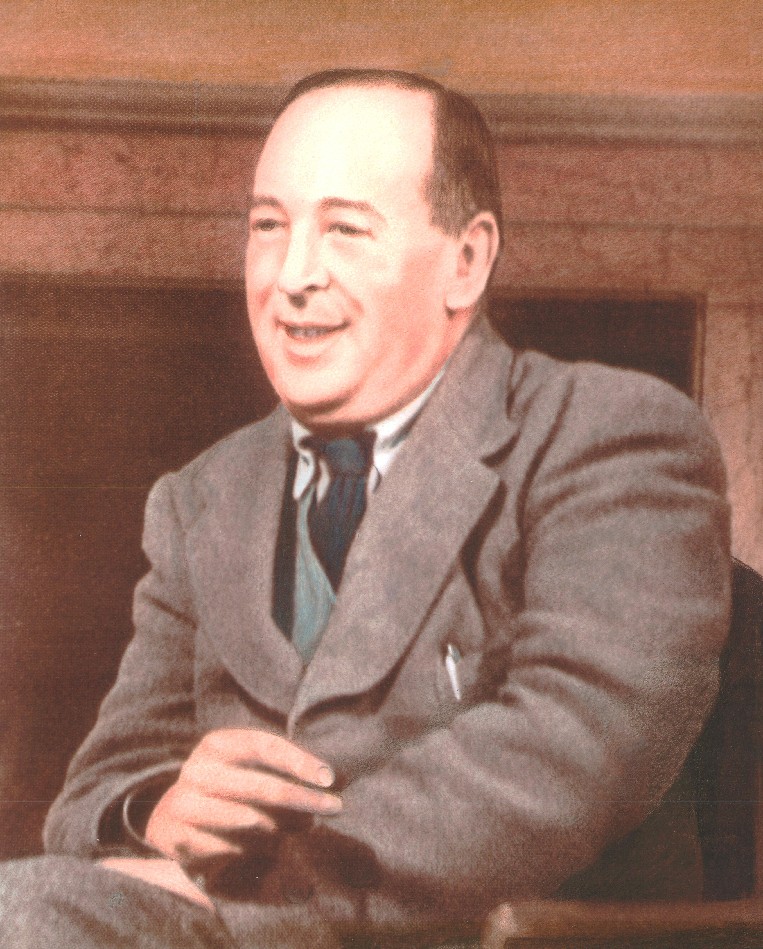
by C. S. Lewis

And beyond this there lies in the ocean, turned towards the west and north, the island of Niatirb which Hecataeus indeed declares to be the same size and shape as Sicily, but it is larger, though in calling it triangular a man would not miss the mark. It is densely inhabited by men who wear clothes not very different from the other barbarians who occupy the north western parts of Europe though they do not agree with them in language. These islanders, surpassing all the men of whom we know in patience and endurance, use the following customs.

In the middle of winter when fogs and rains most abound they have a great festival which they call Exmas and for fifty days they prepare for it in the fashion I shall describe. First of all, every citizen is obliged to send to each of his friends and relations a square piece of hard paper stamped with a picture, which in their speech is called an Exmas-card. But the pictures represent birds sitting on branches, or trees with a dark green prickly leaf, or else men in such garments as the Niatirbians believe that their ancestors wore two hundred years ago riding in coaches such as their ancestors used, or houses with snow on their roofs. And the Niatirbians are unwilling to say what these pictures have to do with the festival; guarding (as I suppose) some sacred mystery. And because all men must send these cards the marketplace is filled with the crowd of those buying them, so that there is great labour and weariness.

But having bought as many as they suppose to be sufficient, they return to their houses and find there the like cards which others have sent to them. And when they find cards from any to whom they also have sent cards, they throw them away and give thanks to the gods that this labour at least is over for another year. But when they find cards from any to whom they have not sent, then they beat their breasts and wail and utter curses against the sender; and, having sufficiently lamented their misfortune, they put on their boots again and go out into the fog and rain and buy a card for him also. And let this account suffice about Exmas-cards.

They also send gifts to one another, suffering the same things about the gifts as about the cards, or even worse. For every citizen has to guess the value of the gift which every friend will send to him so that he may send one of equal value, whether he can afford it or not. And they buy as gifts for one another such things as no man ever bought for himself. For the sellers, understanding the custom, put forth all kinds of trumpery, and whatever, being useless and ridiculous, they have been unable to sell throughout the year they now sell as an Exmas gift. And though the Niatirbians profess themselves to lack sufficient necessary things, such as metal, leather, wood and paper, yet an incredible quantity of these things is wasted every year, being made into the gifts.

But during these fifty days the oldest, poorest, and most miserable of the citizens put on false beards and red robes and walk about the market-place; being disguised (in my opinion) as Cronos. And the sellers of gifts no less than the purchaser’s become pale and weary, because of the crowds and the fog, so that any man who came into a Niatirbian city at this season would think some great public calamity had fallen on Niatirb. This fifty days of preparation is called in their barbarian speech the Exmas Rush.

But when the day of the festival comes, then most of the citizens, being exhausted with the Rush, lie in bed till noon. But in the evening they eat five times as much supper as on other days and, crowning themselves with crowns of paper, they become intoxicated. And on the day after Exmas they are very grave, being internally disordered by the supper and the drinking and reckoning how much they have spent on gifts and on the wine. For wine is so dear among the Niatirbians that a man must swallow the worth of a talent before he is well intoxicated.

Such, then, are their customs about the Exmas. But the few among the Niatirbians have also a festival, separate and to themselves, called Crissmas, which is on the same day as Exmas. And those who keep Crissmas, doing the opposite to the majority of the Niatirbians, rise early on that day with shining faces and go before sunrise to certain temples where they partake of a sacred feast. And in most of the temples they set out images of a fair woman with a new-born Child on her knees and certain animals and shepherds adoring the Child. (The reason of these images is given in a certain sacred story which I know but do not repeat.)

But I myself conversed with a priest in one of these temples and asked him why they kept Crissmas on the same day as Exmas; for it appeared to me inconvenient. But the priest replied, “It is not lawful, O stranger, for us to change the date of Chrissmas, but would that Zeus would put it into the minds of the Niatirbians to keep Exmas at some other time or not to keep it at all. For Exmas and the Rush distract the minds even of the few from sacred things. And we indeed are glad that men should make merry at Crissmas; but in Exmas there is no merriment left.” And when I asked him why they endured the Rush, he replied, “It is, O Stranger, a racket”; using (as I suppose) the words of some oracle and speaking unintelligibly to me (for a racket is an instrument which the barbarians use in a game called tennis).

But what Hecataeus says, that Exmas and Crissmas are the same, is not credible. For first, the pictures which are stamped on the Exmas-cards have nothing to do with the sacred story which the priests tell about Crissmas. And secondly, the most part of the Niatirbians, not believing the religion of the few, nevertheless send the gifts and cards and participate in the Rush and drink, wearing paper caps. But it is not likely that men, even being barbarians, should suffer so many and great things in honour of a god they do not believe in. And now, enough about Niatirb.

It all started with the ordination of women...

There are those (many whom I call friends) who talk as if all the problems of the Church today can be traced to the ordination of women. Prior to, what, 1958 in Sweden, or 1970 in the US, Lutherans were putt-putting along smartly on their way to world dominance. Once some decided to ordain women, it seems the Lutherans have imploded (Missouri's schism, the schisms of the ELCA, and the eruption of new Lutheran groups both small and smaller).

Let me begin by saying I do not favor the ordination of women. In fact, I do not believe the the Church could ordain women if it wanted to! It goes beyond the authority of the Church to choose this path. We cannot vote to overturn the inherent Scriptural problems and the unbroken tradition of the Church anymore than we can change Holy Communion into pizza and beer. We cannot do this because we lack the authority. Period. I think it is a fool's exercise to try and argue that women may not be ordained from Scripture alone or appeals to the order of creation and such. It is not that I do not find these convincing. I do. But even if we do not find these arguments convincing, we simply have no authority to displace the universal tradition of the Church and the Scriptural impediments to such a change in thinking. The same can be said about changing marriage. It it not that we could but shouldn't but that we can't even if we wanted to. What does happen, however, is that when we depart from Scripture and tradition in this circumstance, it is not only about this issue. In fact, it is almost never only about this issue (women's ordination). It becomes the license and legitimacy for the Church to ignore what Scripture say about others things and to listen instead to the heart or to the culture or to the idea that God is doing a new thing and changing His mind.

Even those in favor of the ordination of women recognize that this represents a mighty departure from the way Scripture has been read by the Church in the past and by the unbroken chain of orthodox and catholic tradition and practice. The honest ones, to their credit, insist that this is precisely why they are in favor of breaking with Scripture and tradition. This new thing completes what we have seen begun in Scripture and the ongoing revelation of the Lord will continue to close old doors and open new ones. But this is precisely the problem. To his credit, Luther did not believe that justification by grace through faith was a new thing God was doing. He insisted that it was THE old thing that was always believed, confessed, and taught. It was the catholic position to which Rome was departing and this was the whole need to correct the rudder and return the ship of the Church to the proper course consistent with Scripture and the voice of the fathers. No one suggests this about women's ordination or about any other changes in marriage definition or gender issues. Everyone knows and everyone believes that this is a new thing which the Gospel compels us to hear and heed -- even though it means breaking with the Scriptures and tradition. And this is exactly the point. There is no end to the breaks with Scripture and tradition when you begin disregarding what the Church has always believed, confessed, and taught. Those who like to create a link from the ordination of women to every theological heresy or distortion are simply wrong. But there is a sense in which there is some truth to what they say. The churches that have chosen to ignore Scripture and tradition and ordain women have also chosen to leave behind what the Scriptures teach about such diverse and disparate subjects as evolution and creation, same sex marriage, gay and lesbian ordination, etc. It is not that one causes the other but both proceed from the same poisoned well.

Finally, those who have chosen to ordain women and have entered into radical departures from established teaching on marriage, family, gender, etc., have also chosen to give to social justice movements a prophetic identity which is not theirs to give. The truth is that when we listen to prophets of social justice and this requires us to abandon our identity with the teaching of Scripture (the unchanging truth of God's Word) and the unbroken catholic practice of the Church from the earliest of ages, we have set up a house of cards in which every doctrine and every truth is one second guess away from being likewise abandoned. Creeds and confessions do not in and of themselves make us orthodox but they do scream out at us when we are tempted to listen to the voices within us or outside the Church to change the meaning of their words or relegate them to the passive status as historical documents. Protestantism has found it easier and easier to drift hopelessly and helplessly away from the moorings of Scripture and tradition -- in large measure because most of Protestantism is no longer creedal or confessional. You can read D. G. Hart in his The Lost Soul of American Protestantism for a more chronicled and detailed outline of this point of view. Lutheranism has been slower to lurch into the free fall of feeling and ongoing revelation and social justice -- but not by much.

Once some Lutherans have effectively disregarded their own Confessions, either by reinterpreting them or by isolating them to a historical period or perspective, there is little that will keep this group from the great abyss relativism. Missouri has so far kept from this largely for a couple of reasons -- we are much more homogenous, we have a clergy taught by relatively few and mostly "insiders," and our liturgical identity and catholic confession were two sides of the same coin. Our danger is that our loss of liturgical identity will be accompanied by a more evangelical theology whose perimeters are no longer kept in place by a living document like our Confessions. What is absent from worship will soon be absent from belief. It is no secret that those most in favor of Missouri ordaining women are those who are most free with the definition of Lutheran worship, the most accepting of creative ways of doing parish ministry, and the most adept at borrowing from non-Lutherans to fix what they believe is broken among us.

 So... does everything that is wrong with Lutheranism go back to the ordination of women? Well, yes and no... No, because the ordination of women did not cause every aberration but yes, because the same treacherous road used to approve the break with Scripture and tradition to ordain women will come home to roost in other areas and for other doctrines and theological positions. One can see it in the extremely small minority who rant and rave under the acronym OWN -- Ordain Women Now. This old coalition of more liberal Missourians has found a strange and pleasant ally among those who desire to see us liberated from our liturgical tradition as well. We all know that the refusal to ordain women has nothing to do with superiority of male intellect, strength, or other trait. We all know that the refusal to ordain women has nothing to do with the denigration of women or their place and role within the Church. We all know that the refusal to ordain women is not about simply having male genitalia. Since the Scriptures do not speak with kind of clarity that will shut up those in favor of women's ordination (any more than the clear Scriptures stopped homosexual marriage from being the default position of some Lutheran churches), I prefer that we stop fighting about the nuance of Biblical interpretation and affirm that Scripture is upheld by unbroken tradition and that the core issue here is not should we ordain them but can we. It is my position that we can no more ordain women than we can change the doctrinal truth of Jesus humanity and divinity. It is above our pay grade to presume to make these changes. It is only our place to believe them [the doctrines revealed in Scripture], to confess them, to teach them...

Sunday, January 1, 2012

A Christmas hymn new to me...

HT to Stephen Starke for this one...

My Heart Would Ever Wander


(Mitt Hjerte Alltid Vanker)

1. My heart would ever wander
To where my Lord was born,
My thoughts return to ponder
That humble stall forlorn:
My faith there finds its treasure,
Its home of pure delight,
Its peace beyond all measure
This blessèd Christmas night.

2. Palm branches I would scatter
Around the place You lie.
For You alone, Lord, matter;
For You, I live and die.
Come, let my soul be finding
The joy that makes me whole:
Yourself to me, Lord, binding
Here, deep within my soul.

3. Lord, come, each bolt removing;
Unlock my heart and mind.
My longing sighs are proving
The welcome You will find.
Your love my heart obtaining:
You purchased it from sin,
Thus evermore remaining--
Your love, wrapped here within!

The Greatest Generation and its legacy...

I am blessed to be the son of two wonderful and amazing people.  Both my parents were born prior to the Great Depression and their childhood was shaped by the devastation of that era.  They grew up with little (in comparison to me or to my children).  They worked from early youth with family chores and to make a buck here and there.  They endured adversity and want only to find the world at war in their young adulthood.  They and their families worked and served at home and abroad to secure victory against the Nazis.  Their married life was shaped by Korea and the Cold War.  My father started his own business and poured his heart and soul and countless hours of effort and energy to make a living and to make a life for his family.  My mother worked in the business and kept the house and served as primary parent on site.  In addition to all of this, both were extremely active in the community -- the Town Board, the volunteer Fire Department, the Women's Club, Scouts, etc...

Their legacy was one of sacrifice and service.  I will readily admit that I lived a rather privileged life.  We were neither wealthy nor people of leisure and yet my brother and I grew up in a safe, secure, loving, Christian home and, though we complained, we lacked for nothing.  Unlike some other parents of this Greatest Generation, they did one more thing.  They passed on their values.  We grew up with a sense of debt and duty.  We were consciously in debt to those who sacrifice had provided us so much and we were told in words and actions the value of remembering this debt.  We lived with a sense of duty.  Maybe it was growing up in the small town where everyone knew your business or the values of the Lutheran country parish in which I was taught the faith or my parents -- or a combination -- but we understood that with all we had been given came a serious sense of duty and obligation to preserve, protect, and pass on what our grandparents and parents had made possible.

I am not the product of "old Americans" but really rather recent immigrants -- most of them in this country only a few generations prior to my birth.  I do not know if this contributed to the way I was raised or the values I was taught.  My own perspective is too tied up in the things I knew and know about my family, church, and home town to be able to see this objectively.

Yet I am often thoroughly ashamed of the selfishness of the Baby Boom generation to which I belong.  Too many of us took what we had been given as birthright and not gift, we used it as license rather than responsible liberty.  We have magnified our faults in the way we raised our children -- teaching them to be even more self-absorbed than we were or are and forgetting to pass on to them the values of debt, duty, sacrifice, and service.  I am not talking about the school of hard knocks.  I am talking about the distinctly Christian values that accompany the privilege of freedom in Christ and how that liberty is lived out in daily life.

If I could fault my parents at all it is that they made my life too easy.  It was not until young adulthood that I fully understood what they had passed on to me in the way they lived and believed.  I was a Christian to be sure but the full impact of the faith they lived and still live was not fully apparent to me until I was married and on my own as a Pastor a couple of thousand miles away from the Nebraska heartland where I grew up.  The full measure of the debt I had to them and to those who came before me and the full acknowledgement of my duty as a Christian, husband, parent, and member of the community did not hit me until after I had left my family to begin my own.

Now this is not meant to be rant.  My purpose is not to trash those of my kid's generation or my own fellow boomers.  My point is this -- we pass on nothing of value to our children unless we pass on the values necessary for them to receive what they have been given.  Living in debt to others is a powerful motivator for community, neighborhood, citizenship, and church.  In fact, it is the primary guiding principle of stewardship.  What we have is not our own and we are not our own.  What we call our own is what God has given to us and we, too, have been bought with a price and our lives do not belong to us.  "He died for all that those who live should not live for themselves but for Him..." words that surrounded a crucifix on the back wall of my first parish - so that I could see them throughout the service and the people saw them as their final image upon leaving the nave.  That is what my parents taught me.

Duty is not imposed -- duty is acknowledged and accepted.  In the old words of the Book of Common Prayer the Eucharistic liturgy said "it is truly good, right and our bounded duty to give thanks..."  Duty is a good word and duty is what accompanies gift -- the gift of a life and home and family and the gift of God's life, the home within His love, and the family of His Church.  Duty is not something burdensome for its burden is our delight and its responsibility is our joy.  We need to teach a sense of duty lest the gift of God in Christ become common and ordinary.  Duty is acknowledged as when the Christian realizes that salvation is free to us but cost Jesus His life on the cross.  Duty is accepted as the responsibility to keep and pass on that which was given to you.

I have not given up on the future as some have.  For one, my congregation is a church home to many young men and women in the Army.  I have seen their sense of duty at work in the sacrifices they have born for our nation over the past nearly 20 years and I continue to be impressed by their dedication and their sense of duty.  I see the many medical professionals in my parish (most especially my wife) whose dedication and service is not due to the paycheck but to their sense of debt and duty lived out in service to the sick.  I am amazed at the number of teachers in my parish who work so hard every day not only to teach the various subjects but the love of learning and the values that give that education meaning and nobility.  I could go on and on.

I know that I have probably done too much to make my children's life even easier than was mine growing up.  I know that we have had more money and more leisure time to share and probably squander than I had as a child in my parent's home.  But I hope and pray that I have given them values to accompany the gifts, that they have grown up with the same sense of debt and duty that I learned from my parents.  I am proud of them and each of them have accomplishments and hearts that inspire and encourage me.  Time will tell how all of this bears fruit in the rest of their lives.  These things of which I speak are not instantaneous but grow in us over time and experience.  None of us are ever who we should be and none of us are without opportunity to become more than who we are now.

So you also, when you have done all that is required of you, say, ‘We are unworthy servants; we have only done what was our duty.’”  Luke 17:10

Just a couple of random thoughts as we end one year and begin another...

The Lord bless you....

Sermon preached for the Eve of the Circumcision and Name of Jesus, Saturday, December 31, 2011.

    The words of the Aaronic benediction are among the most familiar words of worship for Lutherans.  We hear them so often, we often do not really listen to them.  Tonight, the Eve of the Circumcision and Name of Jesus, we are ready to tear off the calendar page and trade 2011 in for 2012.  Tonight we hear those words not as benediction but as the first lesson appointed for the Eve of this festival.  It offers us a moment to explore their meaning in more depth.
    The Lord bless you and keep you...  To bless means much more than to have good wishes for someone.  When we hear how the Lord told Aaron to bless His people, we do not hear niceties about hopes and dreams for an unknown and uncertain future.  Instead the word bless means to set apart for holy use.  We bless our food by remembering who has given it to us, by giving thanks to God, and by eating it to nourish the bodies God has given us for His service.  A certain Pastor I know closed his services with the words “The Lord bless you real good” – as if a blessing were a good wish and some wishes were better than others.  Can the Lord not bless us real good?  Each Sunday these words are spoken over us not as a pious hope or dream for something good to happen to you but to remind you of your baptism.  You have been set apart for holy use, holy life, and a holy purpose.  Look how baptism is reflected in the hymn on these words we just sang, “Go, My Children, with My Blessing.”
    This is not some vague or generic blessing but a setting apart in Christ. It is because you bear the name of Christ in baptism that you are set apart.  You were not set apart by your feelings or desire but by the mighty act of Christ who shed His infant and adult blood for you, fulfilling the law and commandments of God and giving to you His righteousness as gift.  The Lord bless you – set you apart for His purpose and glory – and keep you – keep you set apart, keep you holy and righteous in Christ, and keep you now, within the present, and for all eternity.  The Lord bless and keep you – in other words, may the Lord who called you out and made you holy in your baptism keep you in this baptismal life and grace ready for the Lord when He comes again.  This is the problem we have after each service on Sunday and as a people beginning a new calendar year – keeping set apart amid the great temptations, glitter, and deceptions of the world and our own sinful flesh.  Here the benediction we are clothed with the grace that does not once set us apart but keeps us set apart, in faith, in Christ, amid all that would distract and distance us from this.
    The Lord make His face to shine on you and be gracious to you.  You and I know how hard it is to talk to someone who is looking elsewhere.  We want to see into the face and look into the eyes of the people with whom we speak.  To turn your face to someone is to give them your attention, to grace them with that attention.  The face of the Lord is His favor.  To look upon us is an act of grace on the part of God. This face shines on us through the face of Christ, who came for us as one of us to die in our place and rise to bestow upon us eternal life.  This is the smiling countenance of love, the favor of grace, and the smile of mercy.
    What do we sing in Lent: “The Lord is gracious and merciful, slow to anger and abounding in steadfast love...”  The grace of God is not a feeling or attitude but the concrete grace of the cross and suffering, death and the grave.  God's gracious disposition is the choice of God to take our burden of sin and death as His own, to suffer for us what was ours to suffer, and the incarnation of God to fulfill all righteousness for us.
    The Lord look upon you with favor and give you peace...   The favor of the Lord is always gift and grace.  What God has shown to us in Christ, is what He continues to show to us in Christ.  The smile of mercy remains upon us and we do not live in doubt or fear of God's disposition toward us.  For a people set to enter a new calendar year, this is so important to us.  What we know of God yesterday and today, is what we can confidently count on for the days to come.  God does not change.  He is yesterday, today and forever the same. 
    The peace that these words speak of is not an absence of conflict or distress but the positive peace that comes from Jesus.  To hear these words is to remember Jesus "My peace I give to you, not as the world gives to you..." It also recalls the words of Paul – the peace that surpasses all human understanding..."  This peace is what remains with you even amid the conflicts and upsets of life.  This peace is what remains in you even when your best laid plans and intentions go awry.  This is the personal peace of Jesus.
    When I was first a Pastor, I would walk down the halls of the hospital or nursing home and people would cry out, "bless me."  It made me feel kind of sheepish at first.  A wise Pastor reminded me that it was not me whose blessing they sought but the blessing of Him who sent me.  They sought to know amid sickness and old age that God was still with them, that they  were still set apart for the Lord, for His holy purpose and life.  It is no different on this night.  We come to close the book on 2011 – all of its victories and successes as well as all of its defeats and failures.  We come seeking to know that no matter what has happened, we belong to the Lord and God lives in us by baptism and faith.  We come to open the first page of 2012 – with all the uncertainties, fears, and anxieties about what is to come.  We come seeking to know that no matter what happens, we belong to the Lord and God lives in us by baptism and faith.
    So to us who gather on the eve of the Circumcision and Name of Jesus, what we receive from God is His Name and His blessing.  The past is past and cannot be redone.  It can only be folded into the mercy of God and forgiven.  The present moment is a brief one which endures only because we live it in Christ.  The future is completely unknown (and if the political pundits are right, not too rosy).  But through it all, you are still the Lord’s.  His forgiveness makes you clean.  His presence still sustains you.  His promise has not faded away.  You who were set apart in baptism, are still set apart for His holy purpose, the holy calling of faith.  So do not fear, You belong to Him and He will not abandon those whom He had moved time and eternity to call His own.  A blessed New Year to you all.  Amen.

Saturday, December 31, 2011

A Blessed Eve of the New Year and Prayer for the Night

Thy little ones, dear Lord, are we,
And come Thy lowly bed to see;
Enlighten every soul and mind,
That we the way to Thee may find.

With songs we hasten Thee to greet,
And kiss the dust before Thy feet;
O blessèd hour, O sweetest night,
That gave Thee birth, our soul’s delight.

O draw us wholly to Thee, Lord,
Do Thou to us Thy grace accord,
True faith and love to us impart,
That we may hold Thee in our heart.

Until at last we too proclaim
With all Thy saints, Thy glorious Name;
In paradise our songs renew,
And praise Thee as the angels do.