Saturday, April 9, 2016

None of the libertarians I know go to church. . .

I must confess that I have never been enamored of libertarians.  Oh, to be sure, I am no fan of government intrusion into the lives of people but neither am I a fan of the invented rights of privacy and of the idea that it does not matter what people do as long as they do not harm others.  Rights are always a balancing act -- hence the problem we have with the threat of terrorism and the rights of the individual.  Personal liberty is a common cause of libertarians though there is no doctrinaire position to which all libertarians hold.  Some are more concerned about government than behavior and some insist upon liberty in everything or nothing is free.

The preamble of the Libertarian Party begins:  As Libertarians, we seek a world of liberty; a world in which all individuals are sovereign over their own lives and no one is forced to sacrifice his or her values for the benefit of others.  I fear it sounds too much like everyone doing what is right in their own eyes and this, according to Scripture, is not noble morality by the abyss of sin.  The complaint I have is thoroughly theological.  Individual sovereignty is a nice sounding idea but the results of this have left us mired in sin, captive to death, competing with the creation we were formed to exercise dominion over, and fighting over exactly where the line is drawn between freedom and responsibility to one another.

If I could find some hope that statistically libertarians were church going folk, I might be more encouraged.  In fact, I find it more typically the opposite.  None of the libertarians I know go to church.  I certainly do not want to live under an omnipotent state but I fear the path of libertarians is one that ultimately minimizes both church affiliation and Christian piety.  The cross is the supreme expression of the opposite of libertarian ideals -- the sacrifice of rights and self for the sake of those completely unworthy of Him and of His suffering.  It seems that most of the libertarians I know, if they are religious at all, are Unitarians -- not Lutheran.

Libertarians insist upon the right of the individual over all other rights and such would inevitably lead to a pro-abortion society in which the individual is free to decide and to follow through with whatever is determined to be good, right, or salutary for his or her own life.  Libertarians insist upon the right of privacy and in the protected legality of whatever consenting adults decide to do.  Libertarians insist that definitions of family be left to the individuals who choose to make the family.  Again, personal liberty is the sole sacred tenet of libertarian thought and the only caveat is where that personal liberty abridges the right of another perfectly sovereign and free individual.

Ultimately, my complaint is the libertarians are naive.  If there were no speed limit we would of course all drive at a safe speed.  If there were no drug laws, we would of course all consume drugs responsibly (just the way we have alcohol).  If there were no abridgment of our individual freedom and liberty, we would of course use it to be as moral and noble and virtuous as possible.  Like that has ever happened.  No, I am not willing to make government my nanny but neither am I willing to cast off all constraints.  I guess as a Lutheran I am left with the also unsatisfying idea of the two kingdoms. 

For a pretty good Lutheran view of things, you might want to read this....

Friday, April 8, 2016

The rights of the unborn. . .

“The unborn person doesn’t have constitutional rights,” said Presidential candidate Hillary Clinton, who added that “the woman’s right to make decisions” is the only salient point and issue to be considered in the whole discussion of abortion.

Mrs. Clinton, like nearly all of those who have made abortion the holy grail of liberalism, the sacred issue for feminism, and the litmus test of all public servants (political and judicial).  It illustrates the great intolerance of liberalism -- the sacred nature of the wisdom of liberalism refuses to allow disagreement or tolerate challenge.

But of course rights do not exist for the benefit of the powerful.  They exist precisely for the benefit of those least able to fend for themselves, without access to media or ballot box, and whose very existence offends.  Such is the nature of the unborn.  Children have become possessions to be purchased and used at whim or to be discarded because they are no longer valued.  It is easy now to draw the line at birth but who is to say that this line is itself sacred?  When will society say the same of the aged whose health or mental acuity or memory has left them dependent upon the kindness of strangers and family?  Those who need constitutional protection and the guarantee of rights are exactly the unborn, those dependent upon the care of others, and the aged in their frailty of body or mind.  The arguments can easily be applied to a whole range of additional subjects besides the unborn.

The Church does not raise up the cause of the unborn, the aged, or the infirm because they really are valuable.  We are in no position to judge.  The Lord has determined their value and not by determining their productivity against their requirement for care but with nothing less than the body of Christ in suffering and the blood of Christ splattered upon the altar of the cross.  We do not merely tolerate those who take so much from us (children, infirm, and aged) but we welcome the burden of their care as the opportunity to display the very love which Christ has shown to us.

We will never win the battle on the basis of straining at gnats to find and decide the expanse of rights inherent or explicit to our Constitution or Bill of Rights.  But we must first begin by admitting that rights exist not to protect the strong or guarantee freedom for the majority but to protect those least able to speak for themselves or defend themselves.  And then the Church must raise up their cause not for the benefit they provide to us but for the opportunity they give to us to show the noble character of humanity, the sacred nature of life itself, and the radical shape of love revealed by the cross.  Such is the unique contribution of the Church to the whole debate.  I am in hopes that the debate will continue to be allowed so that we may continue to address the subject with words and actions.  Whether or not the decisions of the powerful are changed, the Church cannot and must not be silent in the cause of the weak, especially the unborn.

Why is modern art so bad?

Why is modern art so bad?  Could it be that art is now almost exclusively the domain of personal expression?  Could it be that there are no aesthetic standards to define the difference between good and bad art?  Could it be that the subject matter has moved from the noble to the mundane -- even vulgar?  Could it be that we have no objective criteria with which to differentiate graffiti from art?


Thursday, April 7, 2016

The philanthropic church. . .

Diakonia is not first nor primarily philanthropy.  It is a sad state of affairs that diakonia, service, has entered into its own as some sort of divinely sanctioned philanthropic purpose.  When and where this happened is too long of a tale to tell but as it has come to us today, the purpose of the Church is to do good and this service (diakonia) not only competes with the Divine Service centered in the Word and Sacrament but often displaces it as loving the neighbor reduces the need of the Christian to hear the Word, receive absolution, and eat the flesh and drink the blood of Christ in the Divine Service.  Nothing could be further from the truth.

First of all, the diakonia or service in which mercy works continue for those in need is not in competition with the service in which the Lord delivers to us His Word and Sacrament.  There can be no diakonia in the world without the Lord first serving us with the means of grace.  Second, the mercy work that proceeds from the gathering of God's people around the Word and Table of the Lord does not overshadow what God does for us.  Cultus (worship) and diakonia are not choices.  Diakonia is the natural fruit of God's actions to us and for us in the cultus of the Divine Service.

There are churches, even Lutheran congregations, in which the people skip worship into to provide diakonia (service) to the neighbor in the community.  Some of these congregations actually cancel worship on one Sunday a month or so many Sundays a year in order to send out their people on Sunday morning to feed the poor, help those in need, and serve the neighbor.  The idea is that this is the more noble service and that what happens in worship is secondary to what happens in the neighborhoods and community.  People of all kinds have come to believe that the real service is what people do and that the service of the Lord's House is merely symbolic or at least less real.

As a Pastor I hear it all the time.  People who call up for money for gas or utility bills or rent or medicine or food insist that if the Church cannot help them with this kind of diakonia, the Church has nothing to offer them.  As a young Pastor I felt the guilt and shame of this condemnation and, although I knew it was a false condemnation in my mind, my heart felt guilty about the whole thing.  I am fairly confident that most Pastors feel guilty if they cannot come up with something to answer the need of the person who shows up at the church door or calls on the phone seeking help.

The folks in the pew feel the same way.  We received a note one time that said if we just stopped spending so much money on the church building and its appointments, we could do some real good in helping the poor.  At a Bible study I was lectured by one who insisted that Judas was correct -- if the expensive ointment had not been wasted on Jesus it could have done some real good for those in need.  One person suggested that we should not keep the eternal light burning because it cost us money, there was nobody in the church to enjoy it, and that money could be better spent in other ways.

The conclusion here is that the real work of the Church is philanthropic and what happens in worship is less important and less valuable that this philanthropy toward those in need.  What a scam!  The things God gives to us are devalued as not real or not making a real difference while the things we do for the poor are honored above all and seen as the highest priority for the Church.  The real truth is that the Gospel delivers the most precious treasure of all and that the philanthropic work of the Kingdom flows out of God's Divine Service to us.

Pastors do not fall into the trap of thinking that you have nothing to offer the people in need if you have only the Word of the Lord.  It is a terrible and destructive lie that turns our attention away from God and onto ourselves.  God's work, our hands.  Serving Christ by serving the neighbor in need.  They sound so noble.  In the end, they diminish God's work and only amplify our hands and elevate our service to others over God's service to us. 

When Jesus said that we will always have the poor with us, our Lord was not being callous or indifferent to the poor nor was He suggesting that they were of no concern to us or to His Church.  Instead He was reminding us forcefully that the best we can offer the poor is first of all the Christ whose suffering paid for their sins, whose death killed their death, and whose resurrection provided for them the hope of everlasting life.  What is the greatest treasure we have?  Scripture seems clear that forgiveness is the central gift from which life and salvation flow.  To preach this Gospel to those in need is not to ignore their earthly plight but to deliver them to that which moth, rust, and thief cannot destroy and steal.  Of course, this Gospel has consequences for the way we care for one another but it does not take a second place or a backseat to philanthropic work.  If we diminish what gifts God gives to us to forgive our sins and kill our death and give to us new and everlasting life, we diminish the real mercy work.  We cannot choose between but include both and yet we cannot do any philanthropic work without first being fed the bread of the Word, the flesh and blood of Christ in the Eucharist, and forgiven of our sins. 

While this philanthropic work is certainly the domain of the Church as a whole, it is largely the vocation and work of the individual from the hope.  We have shifted this around to the point where the Church is given responsibility for what we are given authority to do as individuals in the home, from the home, and into the community.  It is really no different than paying taxes to the government so that the poor can be their responsibility.  If we make the Church the arena where good works are done, then we have conveniently and comfortably shifted both the vocation and its duties from us to someone who is paid to do it for us (with offerings).  Is this what the Lord had in mind?

The Church is uniquely posited with the task of proclaiming the Word of God and delivering the Sacraments -- no one else can and will do this.  Unless we do this, we apply a bandaid to the eternal needs of a people whose hunger in the moment may be averted but whose forgiveness, life, and salvation is in limbo.

Wednesday, April 6, 2016

The death of a church. . .

North Heights Lutheran, the one-time megachurch of Arden Hills, has run out of prayers.  The church is shutting down, the apparent victim of a civil war that has split it apart.  After 70 years of weekly worship, the church’s last service was Sunday, March 13. . . North Heights once had Sunday attendance of 3,400 at two church locations. But attendance has fallen recently to several hundred — not enough to keep the church afloat.

The church was founded in 1946 at a 450-seat church in Roseville. By 1985, it had blossomed into one of Minnesota’s first mega-churches. Its 43-acre campus in Arden Hills held a 1,350-capacity sanctuary and several chapels, as well as a basketball and racquetball courts. But amid declining membership and income, officials laid off half of the church’s 88-person staff in June and closed the original church in Roseville in July. The reaction was furious. About two-thirds of the congregation left and began to worship separately at the AmericInn Hotels & Suites in Mounds View. That group, called the Bondservants, holds two services every Sunday for about 1,000 worshippers.

Some will try to frame this as a sexism (Mindy Bak, the interim senior pastor, is after all female).  Some will try to frame this as a life span issue (70 years is the average life span of a congregation, some say).  Some will try to frame this as a personal issue (the wrong person and the wrong time).  However you may be tempted to explain this congregational death, it bears some attention because we have seen many congregations in many denominations as well as non-denominational mega churches decline simply because of the problem of transferring leadership from one person to another.  Mega churches are more typically a reflection of the leader or founder.  We watched as the vast operations developed by the likes of Oral Roberts, Robert Schuller, and a host of others fall apart when the organization must transition to another leader.  Often it becomes an extension of internal family conflict.  Sometimes it comes as the movement which birthed the congregation begins its own decline (the charismatic movement, in this case).

Morris George Cornell Vaagenes came to North Heights in 1961 and ushered in a charismatic renewal.  Morris was introduced to the baptism and gifts of the Holy Spirit. Searching for answers, he went to his Bible and examined Scripture in search of validation for what he thought he experienced in current times, after which he experienced an outpouring of the Holy Spirit that changed his life and the future of those he served.  During his nearly forty years tenure, North Heights Lutheran Church grew from 500 to 10,000 members, from one building to two large campuses. Now it is all shut down, having found it impossible to effectively transfer the leadership when Vaagenes left but the seeds of its demise were sowed long before.  The Lutheran Charismatic Movement is no longer the headline making movement it was.  Without the sustaining force of the movement and with the cracks in the congregation, it was only a matter of time before North Heights would begin its downward spiral to its death. No mega church is immune from what happened at North Heights.  Every congregation that attracts big numbers can find its membership and support easy to pack up stakes and leave for greener pastures. 

Another Lutheran mega congregation with roots in the ELCA, once known as Community Church of Joy, has merged with an Assembly of God congregation, Dream City Church.  The merger will eliminate any denominational affiliation.  Walt Kallestad, the leader of Community Church of Joy, will be a member of the merged group but have no leadership responsibility.  The Joy facility will become a satellite called Dream City Joy Campus.  It seems that transitioning this parish from Kallestad's leadership was judged best accomplished by becoming part of another mega church.  While this move is heralded as a great opportunity to break down denominational barriers, it is also a prime example of how personality and style are more important to a typical mega church than doctrine and substance.


Tuesday, April 5, 2016

Where will YOU be?


Sermon for Easter 2C, preached by the Rev. Daniel Ulrich on Sunday, April 3, 2016.

          When you pick up your church newsletter, what’s the first thing you read?  I go straight to the back, to the calendar because I want to know what’s going on.  Every now and again I’ll notice a little box, usually on a Friday or Saturday, and in that box there’s a question, “Where will you be on Sunday?”  Such a simple question, and yet it is an important one.  Are you going to be in the place where God’s people are gathered together, where Christ bestows His peace, or are you going to be absent, on your own, away from where Christ promises to be? 
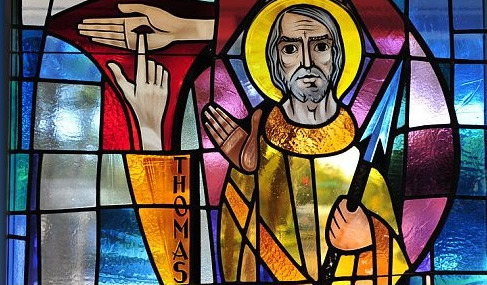
          On that first Easter night, Jesus’ disciples gathered together, except for Thomas.  He was absent.  Why he decided to join the gathering, we don’t know.  Maybe he was extremely afraid of the Jews and didn’t want to risk being arrested.  Or maybe he decided he was going to go back and pick up his old life, so why waste the time getting together.  Or maybe he decided to give up.  Jesus was dead, there was no reason to stick around.  Whatever the reason or excuse, Thomas wasn’t there with his fellow disciples, even though that’s where he needed to be. 
          Without Thomas, the other 10 gathered together and locked themselves in a room for fear of the Jews.  The locked doors and windows may have been able to keep the Jewish authorities out, but it couldn’t keep Christ out.  Miraculously, right in the middle of the room, Jesus appeared to His disciples.  Imagine this, Jesus, their crucified Lord and Teacher, the man they abandoned at the cross, was now risen, back from the dead, standing in their midst.  What thoughts must have been running through their heads?  Was Jesus going to scold them?  Was He going to chastise them for leaving Him, for denying Him, for not standing by Him in His darkest hour?  The fear the disciples felt for the Jewish authorities must have been nothing compared to the fear they must have felt now, seeing the risen Jesus. 
          But Christ didn’t come to scold and chastise, He came to give peace.  The very first thing that Jesus said was, “Peace be with you” (Jn 20:19).  These words weren’t an empty platitude or hollow encouragement.  They were words spoken by the Almighty God, the Alpha and Omega, the beginning and end.  They were performative words and did what they said.  They gave peace to the 10 and abolished their fears.  These words gave the disciples joy and gladness.  Christ wasn’t there in anger, seeking vengeance.  He was there to give His disciples peace, to quiet their fears, to forgive their sin. 
          And this is why Christ comes to us today in the Divine Service, to give you peace and forgiveness. 
          Like the disciples who came together on that night, we come together.  Every Sunday we gather together as the community of believers; and like the disciples, we come with fears.  We come with the fears of everyday normal life weighing on our minds and bodies.  How am I going to overcome this illness?  How am I going to get everything done at work and home?  How am I going to take care of the kids while dad is deployed? 
          We come with the fears of faith troubling our souls.  Like the disciples who feared the Jews, we’re afraid of others.  We live in a world that is hostile to Christ and all those who believe in Him.  We’re afraid of the persecution that might come to us, the persecution that our brothers and sisters in other countries are already suffering.  We have no idea what’s going to happen to us, to our children, our grandchildren, or our great-grandchildren.  Will there be a church for them to gather in? 
          We come with the fears of our sin, plaguing our consciences.  Just a Peter was overcome with the guilt of his triple denial, we’re overcome with the guilt of our sins, sins we commit over and over and over again.  Will God forgive me?  Can He forgive me?  Has my sin broken my family and friendships beyond repair?   These fears can be terrifying, but they’re fears that Christ’s peace overcomes; peace that He graciously gives to us in His Word and Sacrament.
          When we gather around God’s Word and Sacrament, our risen Lord comes into our midst.  As His Word is read from the lectern, Jesus is present, speaking to you, telling you all that He’s done for you.  As His Word is preached from the pulpit, Jesus is present, proclaiming His life, death, and resurrection for you, giving you faith in Him and in His cross.  When you come to this altar, Jesus is most certainly present, feeding you the Holy Supper of His very body and blood, the same body and blood that was crucified on Good Friday and rose from the grave on Easter Sunday.  With this eating and drinking, Christ strengthens your faith and gives you peace and forgiveness. 
          And that’s why it’s so important that we gather together as the Church, as the community of believers, because it’s in the Church that Christ comes to bestow His peace.
          Thomas didn’t receive Christ’s peace that first Easter night.  He neglected the gathering of the disciples.  He wasn’t present where Christ was present, and because of this, he remained in his fears, doubts, and questions.  He didn’t have his faith strengthened by the Lord’s peace.  Whatever excuse Thomas had for skipping the gathering in that room, it kept him from witnessing His risen Lord and from receiving His grace. 
          This is what happens to us when we neglect the coming together of the saints.  We’re very good at coming up with excuses for not coming to Church.  The work week was very stressful and we need that extra couple hours of sleep on Sunday morning.  The house is a disaster and the yard has grown into a forest, so we better skip church and take care of that stuff.  We’re mad at the person who sits a few pews ahead of us, and we don’t want to see them.  We’ve sinned just way too much this week and we think we’re not worthy to enter into God’s house.  We make these excuses, and hundreds of others, and we can make them convincingly, but none of them are any good. 
In fact, it’s precisely because of these excuses that we need to come together where Christ is, to receive His grace and forgiveness.   When we hear God’s Word and partake in the Sacrament of the Altar, we’re refreshed after a long week.  When we hear the Word, our focus is turned from the never-ending to-do lists of this earthly life to the everlasting life that we have in Christ.  Being in church together with those we’ve argued with, confessing our sins together and receiving Christ’s absolution together enables us to forgive each other and share Christ’s peace with one another.  Receiving Jesus’ body and blood into our mouths we receive the forgiveness of all or sin, no matter what we’ve done, and we’re made worthy to stand in God’s presence. 
When Thomas finally joined the disciples eight days later, one week after Jesus rose from the grave, he received the much needed peace of Christ.  Jesus again appeared to His disciples in the locked room and said, “Peace be with you” (Jn 20:26).  This peace was for all of them, including Thomas.  Having received this peace, Thomas’ faith was strengthened and he believed in His risen Lord. 
In our sin, we’re very skillful at making up all kinds of excuses for not coming to Church.   But when we do this, we cause great harm to ourselves.  We cut ourselves off from the body of Christ.  When we neglect the gathering around Jesus’ Word and Sacrament, we neglect Him.  We take ourselves away from the place where Jesus promises to be, the place where He graciously gives forgiveness and peace.  We can’t afford to miss this!  We need to be gathered with the rest of the faithful.  We need the forgiveness and life that Jesus gives in His Word and Sacrament.  We need to be in this room, to hear our risen Lord say, “Peace be with you.”  In Jesus’ name...Amen. 

Finally some sanity. . .

What can I say but finally we hear some sanity and we can only pray some of the more radical voices, especially in relation to transgender issues, may learn some common sense... We must stop experimenting on our children and imposing our own foibles and uncertainties upon them as though these were normal.  It is, as they say, child abuse.

The American College of Pediatricians urges educators and legislators to reject all policies that condition children to accept as normal a life of chemical and surgical impersonation of the opposite sex. Facts – not ideology – determine reality.

1. Human sexuality is an objective biological binary trait: “XY” and “XX” are genetic markers of health – not genetic markers of a disorder. The norm for human design is to be conceived either male or female. Human sexuality is binary by design with the obvious purpose being the reproduction and flourishing of our species. This principle is self-evident. The exceedingly rare disorders of sexual differentiation (DSDs), including but not limited to testicular feminization and congenital adrenal hyperplasia, are all medically identifiable deviations from the sexual binary norm, and are rightly recognized as disorders of human design. Individuals with DSDs do not constitute a third sex.

2. No one is born with a gender. Everyone is born with a biological sex. Gender (an awareness and sense of oneself as male or female) is a sociological and psychological concept; not an objective biological one. No one is born with an awareness of themselves as male or female; this awareness develops over time and, like all developmental processes, may be derailed by a child’s subjective perceptions, relationships, and adverse experiences from infancy forward. People who identify as “feeling like the opposite sex” or “somewhere in between” do not comprise a third sex. They remain biological men or biological women.

3. A person’s belief that he or she is something they are not is, at best, a sign of confused thinking. When an otherwise healthy biological boy believes he is a girl, or an otherwise healthy biological girl believes she is a boy, an objective psychological problem exists that lies in the mind not the body, and it should be treated as such. These children suffer from gender dysphoria. Gender dysphoria (GD), formerly listed as Gender Identity Disorder (GID), is a recognized mental disorder in the most recent edition of the Diagnostic and Statistical Manual of the American Psychiatric Association (DSM-V). The psychodynamic and social learning theories of GD/GID have never been disproved.

4. Puberty is not a disease and puberty-blocking hormones can be dangerous. Reversible or not, puberty- blocking hormones induce a state of disease – the absence of puberty – and inhibit growth and fertility in a previously biologically healthy child.

5. According to the DSM-V, as many as 98% of gender confused boys and 88% of gender confused girls eventually accept their biological sex after naturally passing through puberty.

6. Children who use puberty blockers to impersonate the opposite sex will require cross-sex hormones in late adolescence. Cross-sex hormones are associated with dangerous health risks including but not limited to high blood pressure, blood clots, stroke and cancer.

7. Rates of suicide are twenty times greater among adults who use cross-sex hormones and undergo sex reassignment surgery, even in Sweden which is among the most LGBQT – affirming countries. What compassionate and reasonable person would condemn young children to this fate knowing that after puberty as many as 88% of girls and 98% of boys will eventually accept reality and achieve a state of mental and physical health?

8. Conditioning children into believing a lifetime of chemical and surgical impersonation of the opposite sex is normal and healthful is child abuse. Endorsing gender discordance as normal via public education and legal policies will confuse children and parents, leading more children to present to “gender clinics” where they will be given puberty-blocking drugs. This, in turn, virtually ensures that they will “choose” a lifetime of carcinogenic and otherwise toxic cross-sex hormones, and likely consider unnecessary surgical mutilation of their healthy body parts as young adults.

Michelle A. Cretella, M.D.
President of the American College of Pediatricians

Quentin Van Meter, M.D.
Vice President of the American College of Pediatricians
Pediatric Endocrinologist

Paul McHugh, M.D.
University Distinguished Service Professor of Psychiatry at Johns Hopkins Medical School and the former psychiatrist in chief at Johns Hopkins Hospital

Monday, April 4, 2016

My students are know-nothings. . .

In what became almost a slam to the Know Nothing party, Patrick Deneen of Notre Dame University has written of the hegemony of the present and of preferences among those attending college today.  You can read it all here.  You can also read another similar perspective by Myron Magnet here.  Finally, there is one more voice of complaint; read it here.  The complaints are about those who seek not information nor training, least of all how to think, but mere affirmations of their own prejudice, self-centered world views, and whims.  A educational ship that is adrift on a sea of the moment, without anchor in the past and without a course toward a future. 

I offer this because it is a problem not merely for the university but for the parents who pay the bill, for the employers who will hire them, and for the society that will depend upon them when the challenges of the world and the issues of the day will be laid in their lap.  It is surely not an indictment of every college student but it is symptomatic of the failures not only of the students but of those who have allowed them to live in such isolation from reality.  Words worth your attention!

Christians are wrestling with a faith adrift from Scripture and tradition, morality is adrift from its anchor in God's creative will and purpose, and education is adrift from its once noble purpose of serious thought, reflective upon the past and directed toward a noble future.
My students are know-nothings.  They are exceedingly nice, pleasant, trustworthy, mostly honest, well-intentioned, and utterly decent.  But their minds are largely empty, devoid of any substantial knowledge that might be the fruits of an education in an inheritance and a gift of a previous generation.  They are the culmination of western civilization, a civilization that has forgotten its origins and aims, and as a result, has achieved near-perfect indifference about itself….

We have fallen into the bad and unquestioned habit of thinking that our educational system is broken, but it is working on all cylinders.  What our educational system aims to produce is cultural amnesia, a wholesale lack of curiosity, historyless free agents, and educational goals composed of contentless processes and unexamined buzz-words like “critical thinking,” “diversity,” “ways of knowing,” “social justice,” and “cultural competence.”  Our students are the achievement of a systemic commitment to producing individuals without a past for whom the future is a foreign country, cultureless ciphers who can live anywhere and perform any kind of work without inquiring about its purposes or ends, perfected tools for an economic system that prizes “flexibility” (geographic, interpersonal, ethical).  In such a world, possessing a culture, a history, an inheritance, a commitment to a place and particular people, specific forms of gratitude and indebtedness (rather than a generalized and deracinated commitment to “social justice”), a strong set of ethical and moral norms that assert definite limits to what one ought and ought not to do (aside from being “judgmental”) are hindrances and handicaps.  Regardless of major or course of study, the main object of modern education is to sand off remnants of any cultural or historical specificity and identity that might still stick to our students, to make them perfect company men and women for a modern polity and economy that penalizes deep commitments.  Efforts first to foster appreciation for “multi-culturalism” signaled a dedication to eviscerate any particular cultural inheritance, while the current fad of “diversity” signals thoroughgoing commitment to de-cultured and relentless homogenization.
Above all, the one overarching lesson that students receive is to understand themselves to be radically autonomous selves within a comprehensive global system with a common commitment to mutual indifference.  Our commitment to mutual indifference is what binds us together as a global people.  Any remnant of a common culture would interfere with this prime directive:  a common culture would imply that we share something thicker, an inheritance that we did not create, and a set of commitments that imply limits and particular devotions.  Ancient philosophy and practice heaped praise upon res publica – a devotion to public things, things we share together.  We have instead created the world’s first res idiotica – from the Greek word idiotes, meaning “private individual.”  Our education system excels at producing solipsistic, self-contained selves whose only public commitment is an absence of commitment to a public, a common culture, a shared history.  They are perfectly hollowed vessels, receptive and obedient, without any real obligations or devotions.  They have been taught to care passionately about their indifference, and to denounce the presence of actual diversity that threatens the security of their cocoon. They are living in a perpetual Truman Show, a world constructed yesterday that is nothing more than a set for their solipsism, without any history or trajectory.

Sunday, April 3, 2016

What happens in confession, stays in confession. . .

The seal of the confessional has long been a hallmark of confidence for those who confess their sins and receive absolution yet it has not been without its critics both inside and outside the Church.  True to form, a Louisiana law arbitrarily struck down the seal and required priests [and pastors] to violate the law in order to be true to their ordination and church.  Now a judge has come to his senses and ruled this law an unconstitutional breach of the separation of church and state and the right of religious freedom guaranteed by the Bill of Rights.  The Supremes decided to pass on this case and so it was left to Judge Mike Caldwell to bring common sense back into the convoluted dispute.  Occasionally the judicial branch gets it just right.  We often criticize when they get it wrong so here I will laud one who came down on the right side of the Constitution and just law.

A Louisiana judge has ruled unconstitutional a new state law requiring priests to report sexual abuse that is mentioned in a sacramental confession.  Judge Mike Caldwell made his ruling in a long-running and complicated case in which Father Jeff Bayhi had been directed to testify about what a young woman reportedly told him in a confession. The young woman has said that she told Father Bayhi about being molested by a member of his parish. Father Bayhi had refused to testify, citing the inviolability of the confessional seal.
Judge Caldwell ruled that the state law making priests mandated reporters of sexual abuse was unconstitutional insofar as it applied to confessions, since it violated religious freedom.

In an earlier phase of the case, the Louisiana Supreme Court had said that Father Bayhi could be required to testify, because in this case the penitent had waived the protection of the confessional seal. Church officials pointed out that the seal cannot be waived, and a priest cannot reveal the contents of a confession under any circumstances. Last year the US Supreme Court had declined to hear the case.

Saturday, April 2, 2016

A video begins the election season. . .

Click here to watch Dale Meyer in his first video comment on his nomination as one of the candidates for President of the Lutheran Church Missouri Synod.  It appears the silly season has begun in earnest for the Synod and this is one entry into the polite but honest competition for votes.  In any case, the buzz words from Meyer are joyous, winsome, laity, Lutheran schools, among others.

This is not meant as a comment upon his nomination but as a way of sorting out what will appear to be the themes that are played about among those who are nominated and those who are vying for one candidate or another.  I would suspect that this is a subtle way of identifying what are Matt Harrison's presumed weaknesses or areas where he lacks these qualities.  I am sure there will be more from all the folks.

I am disappointed but not surprised that these are the areas highlighted but cannot help to remember the serious issues facing the Synod that cannot be solved joyously, winsomely, by the laity, or in our schools without forthrightly hashing out what rite vocatus means with respect to deacons doing Word and Sacrament ministry, what our confessional standard and doctrinal statements and resolutions actually mean, whether our Synod is a loose amalgamation of those who wish to cooperate in certain areas or congregations and ministers united by a common faith and practice, how we will educate and pay for the education of our seminarians, and how we will deal with the challenges of a post-modern and more secular world around us.

In the end I hope that our people are willing to converse openly and honestly and to spend some time in serious contemplation of these issues. . . We cannot afford to pass them off to another time and another location and our Synod deserves nothing less than delegates who will give these their sincere and prayerful attention.  None of this will happen unless we also have candidates for all offices who know and confess their faith and our confessional heritage while at the same time willing to roll up the shirtsleeves to sort it all out.  That is my prayer.  I hope it is yours, as well.

Thoughts on the anonymous Christian. . .

One of the terrible conclusions drawn from the idea of the invisibility or hiddenness of the Church and our conundrum about what to do with seemingly good people who do not believe is the idea of the anonymous Christian.  It certainly appeals to us -- the idea that people are being saved by grace outside the Church -- just by being true to their conscience, without the means of Word or Sacrament to impart to them the saving work of Christ.  We all know relatively good (civil righteousness) folks whom we refuse to speak of as pagan even though they be unbelievers.  We want to believe that there are hidden Christians all around us, at least Christian in the sense that they will be saved and their good works will not be forgotten. 


Jesuit theologian Karl Rahner capitalized upon this, emphasizing conscience, natural law, and good works as evidence of a life lived within the grace of God.
"Anonymous Christianity means that a person lives in the grace of God and attains salvation outside of explicitly constituted Christianity… Let us say, a Buddhist monk… who, because he follows his conscience, attains salvation and lives in the grace of God; of him I must say that he is an anonymous Christian; if not, I would have to presuppose that there is a genuine path to salvation that really attains that goal, but that simply has nothing to do with Jesus Christ. But I cannot do that. And so, if I hold if everyone depends upon Jesus Christ for salvation, and if at the same time I hold that many live in the world who have not expressly recognized Jesus Christ, then there remains in my opinion nothing else but to take up this postulate of an anonymous Christianity." (Karl Rahner in Dialogue, p. 135)

Rahner made his peace with the idea that without Christ it was impossible to be saved; he refused to accept the corollary that those who have never heard of Jesus Christ, who had not faith in Christ, who lived outside the Church, would therefore be condemned.  Rahner ended up where many Christians end up -- longing for some way to redeem those who have rejected redemption or never heard of it.  Liberal Christians have ended up here in trying to convince Muslims and Christians that they worship the same God or that Jews will be saved via their own covenant with God outside of Christ and His atoning work.

Vatican II ended up agreeing, at least in part, with Rahner.  "Those also can attain to everlasting salvation who through no fault of their own do not know the gospel of Christ or his Church, yet sincerely seek God and, moved by grace, strive by their deeds to do his will as it is known to them through the dictates of conscience."  (Lumen Gentium)  Only those who know Christ and reject Him are rejected by God.

Obviously, this is a problem for those who hear and heed Scripture and its claim that there is no way to the Father but through Christ, that there salvation in no one else, and that one is saved by grace through faith alone.  As we have just made our way through Holy Week to the cross and from the cross to the empty tomb, it is a good time to disassociate ourselves again from the doctrine born of logic or desire rather than the mind and voice of God in His Word.  There are no honorary Christians who benefit from Christ's redemptive work by some other means than faith and trust.  Grace is universal (for us and for the whole world) but it is delivered through the Church in the means of grace and received by faith.

Anonymity is often the desire of the spiritual but not religious.  They want the idea of being saved without meeting the Savior where He has promised to be or getting mixed up with doctrine and truth.  Anonymity is the appeal of the mega churches in which one can come, watch, enjoy, cherry pick what they see and hear, and go home without commitment or confession.  Anonymity is the path we have all sought to deal with a righteous God while still having a guilty conscience (since the Fall) and yet hiding from God does not access God or the riches of His grace.

It might be worth pondering about the reverse of Rahner's "anonymous Christians" -- could it be that some who thought they were Christian are really anonymous Muslims or Buddhists or Hindi?  Do those who follow other religions or philosophies that substitute for religion look kindly upon being told that though they think they're following Buddha or Mohammed or Marx, they're actually following Jesus?

The Church is hidden in that we do not see who belongs as God sees but it is revealed among the two or three who gather in Christ's name, around the Word and Table of our Lord.  The speculation about anonymity and its potential rewards is hardly salutary but the voice of the Gospel, the splash of water in God's name, and the taste of bread that is Christ's flesh and of wine that is His blood is always salutary.  Even when we find it altogether ordinary, it is the most extraordinary means of grace that always deliver what they promise and bestow what they say and sign.  In the face of such largess, who should desire anonymity?

Friday, April 1, 2016

What it is not vs what it is. . .

We have spent much time in the last few hundred years trying desperately to decide what parts of the NT are not genuine, or at least and not authored by whom we thought and who do not say what we had thought they said.  It has become great sport for New Testament scholars to use every means possible to try and posit uncertainty about Jesus, the Christian faith, the Scriptures, and what those closest to Jesus thought.

These have varied between the moderate extreme of suggesting that some books are not authored by who claim to have written them (half the Pauline corpus, for example, is not by Paul) and the radical in which few words of Jesus are judged authentic and the New Testament is slimmed down from book to mere pamphlet.  In nearly every case the things that survive are inevitably moral, not doctrinal.

So much of academia has worked to say what the New Testament is not that even people in the pew who have never heard of source hypothosis theories or computer reviews of the linguistic, vocabulary, and stylistic clues still are somewhat uncertain about the veracity of the New Testament.  The scoffers and skeptics have won the battle for the moment and placed a goodly amount of fear in the minds and hearts of people.  What do we REALLY know about Christ and the faith that bears His name?  Ah, yes... except for the fact that spending all our capital on what it is not, forgets what it is and what it claims to be and what the earliest of Christian history attests.

It appears that even hardened hearts are being softened.  Now it seems that some of those so sure that Paul did not write what he claimed now wonder if, indeed, he did write at least some of it.  But let us now be drawn into the video game culture of New Testament criticism.  It was always more about the pursuit than the end result, more about playing with presumptions than finding objective answers, and more about the game than the reality of it all.

What we know for certain is that the New Testament was pretty much nailed down within a hundred years after Christ.  Sure, there were some books less widely known and read than others but there is no conspiracy here.  The facts are right out there in the open -- in the critical apparatus of any Nestle text and in every volume of Christian history.  What we know is far more than what we do not know.  Even unfriendly authors of history attest to the basic claims of Christianity.  The liturgical shape of the faith developed a permanent heritage and legacy of texts and truth.  The early Christians were far more confident of what they read than most NT scholars today.

It is fool's fancy to play around with the text as if it is some sinister scandal or lewd story of power, politics, and prurient interest.  The immense details of the NT and the fact that the earliest texts were surrounded by people who walked and talked with Jesus and who could have complained if a hoax or lie were being perpetrated in His name.  Christian history seems like it is an endless archaeological dig looking for clues to the real story when in reality it is dull and boring.  Things are what the NT says they are.  We have to discard the obvious to find a hint of something dark and hidden.

But that is where the media loves to operate and where we gullible goofs dare to give them credit.  The New Testament is not like the rags near the register line at Walmart.  No sireee... There is a tidbit of truth in those rags -- usually the cost sticker on the paper.  But that is not the truth about the Bible, specifically about the NT.  Truth is the commodity of NT.  St. Paul insists that if a lie is hidden there, we are of all people the most to be pitied.  Jesus insists that His Word vindicates His claims or judges Him wrong. 

Yes, it is true.  We are not dealing with a newspaper that interview twelve witnesses to a tragedy in order to sell copies of a paper to people who believe there may be fifteen sides to the story.  We are dealing with a book that has one purpose -- to tell the story of Jesus Christ, the Son of God.  The witnesses within the pages claim not what they thought or believed but what they heard and saw.  Some of them were very badly treated for their courageous stand.  Some were martyred for their insistence upon the truth, the whole truth, and nothing but the truth.

Christian, do not despair what some claim the New Testament is not.  Be encouraged by what it is.  You stand not alone but with more than billion in present company and too many more to count who went before us.  The Word of the Lord endures forever.  There is no April fools moment to wait for.  The fool says in his heart there is no God.  Nope, the Word of the Lord endures forever.  You can count on that.