Preached for the Divine Service Mid-week after Easter (John 21:1-14)
Work and food. When life gets you down, when you get thrown a curve ball, when things turn from predictable to scarey, there are couple of things you can count on to restore some balance to your life. Go to work and pour yourself into that work so that you forget what is bothering you. Turn to the comfort foods that fill your belly, make you sleepy, and, of course, make you fat. . .
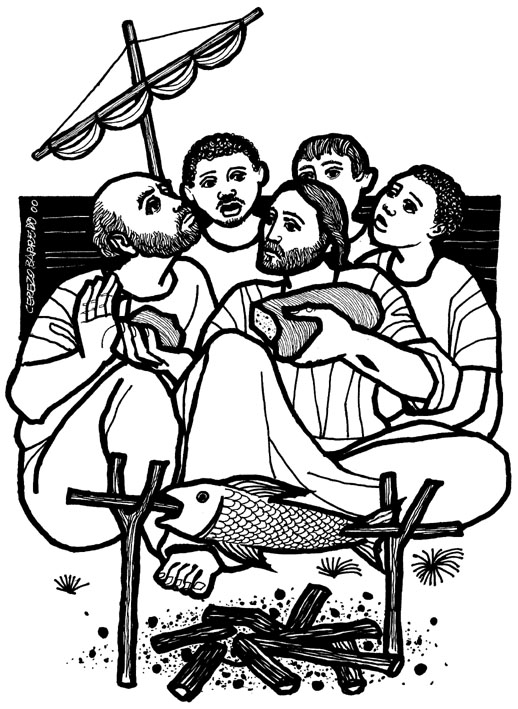
We see both of them at work in this Gospel reading. Peter has had enough stewing and fretting over Jesus dead and alive again, so he is going fishing – not recreational fishing but his first vocation, fishing for fish. The other disciples run out the door with him. Great idea! Life may be upside down but work has its own rhythm and escape.
But there was no escape. Jesus was there. And listen to what He says: Children, do you have any fish. Ouch. Children? Really? They were men, strong men, mighty fishermen. Their hands were coarse and rough. They had aged prematurely from too much heavy work. And Jesus calls them kids. Sheepishly they answer no. No fish today. Only troubles, trials, and tribulations.
Then Jesus has the audacity to tell them what to do – as if they had not already tried every trick in the book. Put the net on the other side of the boat. It was too much. Too many fish and too much to take in. Peter runs to the shore leaving the heavy net to the others. But what was Peter running to and what was he running from – could they be the same thing?
On the shore Jesus invites them to eat... He too bread, gave thanks and fed it to them with the fish. No subtly here. Upper room memories were intended. Jesus feeds them just as He directs them in their new vocation as fishers of men. Their future was not in a boat or on the sea but with Jesus – even when the mystery, the uncertainty, and the unpredictability. Jesus is everything. This was the third time that Jesus showed Himself to the disciples as the risen Lord.
So you come today. Maybe the house needs cleaning, the yard needs work, TV is calling, or perhaps the mall. It is easy to turn to our familiar haunts when life is too much to deal with. Work, play, and food. That is what comforts us. The truth is that sometimes it is just plain uncomfortable to be a Christian.
Jesus knows that. He knows us. He gives us a new vocation as His witnesses who love our neighbors as He has loved us and as people who tell others what we believe. And He feeds us. Not the ordinary bread that lasts but hours but the bread of heaven which feeds us eternal life. And He gives us the blood that cleanses us from all our sins. Our comfort does not lie in running from faith or running from Scripture or running from the Church. Our comfort, as uncomfortable as it sometimes is, lies in Christ and in the new calling of our baptismal lives and in the new food that anticipates the marriage supper of the Lamb in His kingdom which has no end.
You are right to come. The Lord’s sacramental presence in Word and meal beckons you from the ordinary routines of our lives. And the Lord’s sacramental presence in Word and meal sends us forth for the new baptismal vocation of worship, witness, service, and mercy work. This is our comfort – not escaping from the hard things of the Kingdom and the hard sayings of Jesus but facing them, confronting them, chewing on them, and digesting them.
Come, have breakfast. Amen.
Thursday, April 9, 2015
The Easter Vigil as you did not see it here. . .
This was a portion of the Easter Vigil at St. Patrick, Seattle, in 2010. And then people wonder why folks are distancing themselves from the Church -- especially men and older boys!
Plus, the architecture of the chancel is especially strange -- altar to the side as if it were a secondary piece of furniture! Weird!
Off Broadway does not belong in the Sanctuary during the Easter Vigil.
Wednesday, April 8, 2015
Watch the vocabulary. . .
In the city where I live you can choose from the 180 Church or Exit One Church or One Church among the myriad of names chosen by those on the cutting edge of modern Christianity. I suppose I should not complain but I will. Whatever happened to the use of Biblical words or the names of saints or doctrinal names -- like Grace or Faith or Resurrection or St. Paul or St. John or St. Mary or Holy Trinity... among others? Okay, so I am being trivial here. But the truth is that not only the names of our churches have veered from the vocabulary of Scripture, so have our conversations.
I have already lamented here how my own church body seems to be in love with the term entrepreneurial. We are told to be entrepreneurial pastors and churches and we give out awards for entrepreneurial leadership. Last time I checked this was a term for economics or business. I am a card carrying capitalist and I do not dislike the term but I dislike the way we have peppered our conversations with terminology borrowed not from Scripture or even Christian history and theology but other ologies or areas. The more we distance ourselves from the Biblical vocabulary, the easier it is for us to distance our faith and teaching from Biblical doctrine.
Over the past third of century as a pastor, I have heard about the need to vision cast, adopt new paradigms, write mission statements, and define core values. Such stuff consumes the bulk of the American economy. Ask any nurse, for example, how much of their time for patient care is wasted on customer relations, customer satisfaction, telling people the hospital vision statement, sharing the core values with the people in the waiting room, and filling out or asking people to fill out customer satisfaction surveys. Yes, I get that health care is a big and competitive industry but why are we saddling those who must care for patients with the burden of helping hospitals build brand loyalty, achieve high consumer preference scores, and convince them that this hospital is better at providing service that satisfies than another hospital down the block? In the same way, we as pastors are told to spend our time studying demographics, putting in good signage, writing mission statements, clarifying core values, and building an entrepreneurial sacramental ministry (whatever the heck that means). We are here to preach and teach God's Word, administer the sacraments, console the dying and grieving, call the erring to account, pray for the flock in our care, etc... but we hardly have time for that when we are so busy borrowing the latest, greatest business trends.
We ought to be concerned. We ought to be worried. We ought to be cautious about the easy way we have translated the church into a business, the ministry into entrepreneurship, the Gospel into a product, customer satisfaction into the goal, and increased market share as the purpose of our churches. We are raising generations of people who find it harder and harder to distinguish the church from business and more and more passive and high maintenance about the level of customer service they expect -- and it is not a good thing.
Some of the best sermons I have ever heard were sermons I did not like or want to hear. They drew blood, exposed my weakness, and confronted my sin in uncomfortable but essential ways. And then the drew me from myself to the arms of Jesus outstretched in suffering. Our people have been deceived by pastors who distract the church and its ministry from the Word of God, from the Gospel of Christ crucified, and from a life of sacrificial service loving God by loving our neighbors in His name.
At the same time, our people are more Biblically illiterate than ever and find it hard to distinguish truth from error, heresy from orthodoxy, and the Word of God from the ramblings of people about their feelings. The church is not a business. It not in business to satisfy people. The Church is the body of Christ and she exists to proclaim Christ's death for the forgiveness of sins to every age, people, and place until He comes in His glory. The Church will not be evaluated by people but will be judged by the Father. He will not ask if we have been successful but we will be asked if we have been faithful. Perhaps WalMart cannot afford to do business like that but the Church cannot afford to do business like WalMart.
I have already lamented here how my own church body seems to be in love with the term entrepreneurial. We are told to be entrepreneurial pastors and churches and we give out awards for entrepreneurial leadership. Last time I checked this was a term for economics or business. I am a card carrying capitalist and I do not dislike the term but I dislike the way we have peppered our conversations with terminology borrowed not from Scripture or even Christian history and theology but other ologies or areas. The more we distance ourselves from the Biblical vocabulary, the easier it is for us to distance our faith and teaching from Biblical doctrine.
Over the past third of century as a pastor, I have heard about the need to vision cast, adopt new paradigms, write mission statements, and define core values. Such stuff consumes the bulk of the American economy. Ask any nurse, for example, how much of their time for patient care is wasted on customer relations, customer satisfaction, telling people the hospital vision statement, sharing the core values with the people in the waiting room, and filling out or asking people to fill out customer satisfaction surveys. Yes, I get that health care is a big and competitive industry but why are we saddling those who must care for patients with the burden of helping hospitals build brand loyalty, achieve high consumer preference scores, and convince them that this hospital is better at providing service that satisfies than another hospital down the block? In the same way, we as pastors are told to spend our time studying demographics, putting in good signage, writing mission statements, clarifying core values, and building an entrepreneurial sacramental ministry (whatever the heck that means). We are here to preach and teach God's Word, administer the sacraments, console the dying and grieving, call the erring to account, pray for the flock in our care, etc... but we hardly have time for that when we are so busy borrowing the latest, greatest business trends.
We ought to be concerned. We ought to be worried. We ought to be cautious about the easy way we have translated the church into a business, the ministry into entrepreneurship, the Gospel into a product, customer satisfaction into the goal, and increased market share as the purpose of our churches. We are raising generations of people who find it harder and harder to distinguish the church from business and more and more passive and high maintenance about the level of customer service they expect -- and it is not a good thing.
Some of the best sermons I have ever heard were sermons I did not like or want to hear. They drew blood, exposed my weakness, and confronted my sin in uncomfortable but essential ways. And then the drew me from myself to the arms of Jesus outstretched in suffering. Our people have been deceived by pastors who distract the church and its ministry from the Word of God, from the Gospel of Christ crucified, and from a life of sacrificial service loving God by loving our neighbors in His name.
At the same time, our people are more Biblically illiterate than ever and find it hard to distinguish truth from error, heresy from orthodoxy, and the Word of God from the ramblings of people about their feelings. The church is not a business. It not in business to satisfy people. The Church is the body of Christ and she exists to proclaim Christ's death for the forgiveness of sins to every age, people, and place until He comes in His glory. The Church will not be evaluated by people but will be judged by the Father. He will not ask if we have been successful but we will be asked if we have been faithful. Perhaps WalMart cannot afford to do business like that but the Church cannot afford to do business like WalMart.
Tuesday, April 7, 2015
The decline of intact families. . . a sad prophecy
Daniel Patrick Moynihan was an enigma among politicians. He was a staunch Democrat who worked in Republican administrations, a liberal who took what today are described as conservative positions. He was prophetic but in a sad sort of way.
Fifty years ago this month, Moynihan, then a 37-year-old social scientist working in the Labor Department, wrote a report, “The Negro Family: The Case for National Action,” that was leaked in July. The crisis he discerned was that 23.6 percent of African American births were to unmarried women. Among the “tangle” of pathologies he associated with the absence of fathers was a continually renewed cohort of inadequately socialized adolescent males. This meant dangerous neighborhoods and schools where disciplining displaced teaching. He would later write: “A community that allows a large number of young men to grow up in broken families, dominated by women, never acquiring any stable relationship to male authority . . . that community asks for and gets chaos.”
Academic sensitivity enforcers and race-mongers denounced him as a racist who was “blaming the victim.” Today, 72 percent of African American children are born to single women, 48 percent of first births of all races and ethnicities are to unmarried women, and more than 3 million mothers under 30 are not living with the fathers of their children.
Read the Washington Post story recalling Pat Moynihan here...Will is correct. We have lied to ourselves and the sad truth is that now the problems of African Americans have become the problems of all of us. At the time Moynihan decried the decline of the African American family, 1 of every 4 births to that segment of our population was to an unwed mother. Now that statistic has tripled and half of all first births of all races is to an unwed mother. Intact families have become not merely a minority but an unusual option among the myriad of shapes for American families. Diversity glories in this idea of choice but in this case the children are suffering. The children are not only suffering during their childhood years but their whole adult lives are dramatically impacted by this phenomenon.
The breakdown of the family has become pandemic and it is not an African American problem but one shared by all ethnicities. Churches have reacted by strengthening the ministries provided to families but it does not replace a home in which mom and dad are both there for their children. The great lie that unhappy parents is worse on children than divorce has propagated the false notice that divorce is not bad but better than the other alternatives. As important as it is for churches to serve the families as they find them, nothing can replace the intact family. Churches have to learn to regain their voices when it comes to the sad state of broken families and wounded children. The strength of a nation lies in proportion to the weakness of its most fragile family. Churches must do more than survey the ruins and figure out how to help; churches need to take the lead in reestablishing the intact family as more than an oddity but the goal of everyone, for the sake of parents and for the good of their children!
Fifty years ago this month, Moynihan, then a 37-year-old social scientist working in the Labor Department, wrote a report, “The Negro Family: The Case for National Action,” that was leaked in July. The crisis he discerned was that 23.6 percent of African American births were to unmarried women. Among the “tangle” of pathologies he associated with the absence of fathers was a continually renewed cohort of inadequately socialized adolescent males. This meant dangerous neighborhoods and schools where disciplining displaced teaching. He would later write: “A community that allows a large number of young men to grow up in broken families, dominated by women, never acquiring any stable relationship to male authority . . . that community asks for and gets chaos.”
Academic sensitivity enforcers and race-mongers denounced him as a racist who was “blaming the victim.” Today, 72 percent of African American children are born to single women, 48 percent of first births of all races and ethnicities are to unmarried women, and more than 3 million mothers under 30 are not living with the fathers of their children.
Read the Washington Post story recalling Pat Moynihan here...Will is correct. We have lied to ourselves and the sad truth is that now the problems of African Americans have become the problems of all of us. At the time Moynihan decried the decline of the African American family, 1 of every 4 births to that segment of our population was to an unwed mother. Now that statistic has tripled and half of all first births of all races is to an unwed mother. Intact families have become not merely a minority but an unusual option among the myriad of shapes for American families. Diversity glories in this idea of choice but in this case the children are suffering. The children are not only suffering during their childhood years but their whole adult lives are dramatically impacted by this phenomenon.
The breakdown of the family has become pandemic and it is not an African American problem but one shared by all ethnicities. Churches have reacted by strengthening the ministries provided to families but it does not replace a home in which mom and dad are both there for their children. The great lie that unhappy parents is worse on children than divorce has propagated the false notice that divorce is not bad but better than the other alternatives. As important as it is for churches to serve the families as they find them, nothing can replace the intact family. Churches have to learn to regain their voices when it comes to the sad state of broken families and wounded children. The strength of a nation lies in proportion to the weakness of its most fragile family. Churches must do more than survey the ruins and figure out how to help; churches need to take the lead in reestablishing the intact family as more than an oddity but the goal of everyone, for the sake of parents and for the good of their children!
Monday, April 6, 2015
Presbyterians Take the Plunge
In case you have not heard, the Presbyterian Church USA has put both feet forward. In the past it merely allowed their pastors to officiate at same sex weddings but now it has endorsed a new definition of marriage in which two people make a commitment (without specifying who those two people are or should be).
Once again there was a lot of hugging and many tears shed by those who have fought long and hard for this moment. It is usually that way. But little ever seems to be said for those who in regret and loss acknowledge that their church body has departed from uniform and unanimous Christian history and identity. Those folks were not hugging or crying in joy. They were watching the demise of their church body and the exchange of truth and catholicity for lies and a moment of deception.
Let me say this clearly. This has nothing to do with hatred for or antagonism against homosexuals. What it does have to do with is the hubris of the moment in which people filled with pride believe that they are taking a step for justice when in reality they are surrendering the faith to a wisdom that claims to be higher than God's and to a truth that trumps God's yesterday, today, and forever Word. There is no love in deciding to ignore God's Word. No one who loves homosexuals or heterosexuals should be happy about choosing lies over truth. This is not something against homosexuals but for the divinely ordered pattern of human family. This does not mean that everything heterosexuals do is okay because they are straight. This is about the choice to ignore the reality of sin and its corruption of desire and God's order for what can only be described as selfish purpose.
If we can abruptly determine that what we think or feel or desire is more important that God's order and Word in this area, then we are not immune from other steps that will further distance us from the Lord and leave us still in our sins and still without hope for redemption. The problem here is not isolated to one decision but to a perspective which ultimately places human reason and feeling above divine revelation. That does no one any good.
The problems with modern Christianity have the same root -- deafness to the voice of God and hearts hardened by desire so that feelings are more important than anything else. Churches that refuse to countenance a change in the definition of marriage are not choosing straight over gay or the sins of the majority over the sins of the minority. They are attempting within the bounds of human frailty to exercise fidelity to the revealed will of God. Jesus died for sinners -- of all kinds, shapes, and sizes. His blood cleanses us from sin -- the darkest and deepest stains of sin. His desire is that all would be saved and come to the knowledge of the truth. Redemption is not for the good or the holy or the straight but for all sinners who come lamenting the desires of their hearts, the thoughts of their minds, the words of their lips, and the actions they have taken. Redemption makes us new -- it does not save by ignoring wrong or putting a stamp of approval on what was and has always been wrong. Straights have to face up to a history of abusing the gift of marriage, of choosing cohabitation over marriage, of sex that seems without self-control, and of a self-righteousness that judges the sins of others as greater than their own. But gays have to face up to the fact that the Bible does not, has not, and will not be reconciled to same sex marriage or to the same sins of others practiced with a same sex partner.
The easy route is to ignore the hard truth of God's Word and choose to redefine marriage as if it were just a word. The harder path is always to be faithful to the Scriptures, to speak the truth not in judgment but in love, and to insist that every and all sinners come through trust and repentance to meet the God of mercy and grace.
Once again there was a lot of hugging and many tears shed by those who have fought long and hard for this moment. It is usually that way. But little ever seems to be said for those who in regret and loss acknowledge that their church body has departed from uniform and unanimous Christian history and identity. Those folks were not hugging or crying in joy. They were watching the demise of their church body and the exchange of truth and catholicity for lies and a moment of deception.
Let me say this clearly. This has nothing to do with hatred for or antagonism against homosexuals. What it does have to do with is the hubris of the moment in which people filled with pride believe that they are taking a step for justice when in reality they are surrendering the faith to a wisdom that claims to be higher than God's and to a truth that trumps God's yesterday, today, and forever Word. There is no love in deciding to ignore God's Word. No one who loves homosexuals or heterosexuals should be happy about choosing lies over truth. This is not something against homosexuals but for the divinely ordered pattern of human family. This does not mean that everything heterosexuals do is okay because they are straight. This is about the choice to ignore the reality of sin and its corruption of desire and God's order for what can only be described as selfish purpose.
If we can abruptly determine that what we think or feel or desire is more important that God's order and Word in this area, then we are not immune from other steps that will further distance us from the Lord and leave us still in our sins and still without hope for redemption. The problem here is not isolated to one decision but to a perspective which ultimately places human reason and feeling above divine revelation. That does no one any good.
The problems with modern Christianity have the same root -- deafness to the voice of God and hearts hardened by desire so that feelings are more important than anything else. Churches that refuse to countenance a change in the definition of marriage are not choosing straight over gay or the sins of the majority over the sins of the minority. They are attempting within the bounds of human frailty to exercise fidelity to the revealed will of God. Jesus died for sinners -- of all kinds, shapes, and sizes. His blood cleanses us from sin -- the darkest and deepest stains of sin. His desire is that all would be saved and come to the knowledge of the truth. Redemption is not for the good or the holy or the straight but for all sinners who come lamenting the desires of their hearts, the thoughts of their minds, the words of their lips, and the actions they have taken. Redemption makes us new -- it does not save by ignoring wrong or putting a stamp of approval on what was and has always been wrong. Straights have to face up to a history of abusing the gift of marriage, of choosing cohabitation over marriage, of sex that seems without self-control, and of a self-righteousness that judges the sins of others as greater than their own. But gays have to face up to the fact that the Bible does not, has not, and will not be reconciled to same sex marriage or to the same sins of others practiced with a same sex partner.
The easy route is to ignore the hard truth of God's Word and choose to redefine marriage as if it were just a word. The harder path is always to be faithful to the Scriptures, to speak the truth not in judgment but in love, and to insist that every and all sinners come through trust and repentance to meet the God of mercy and grace.
Sunday, April 5, 2015
Two crosses of death, one cross of life. . .
Sermon for the Resurrection of Our Lord, preached three times on Easter Sunday, April 5, 2015.
Three crosses were planted in the earth on Good Friday. Three crosses bearing three broken bodies. It was a scene of terrible suffering. Two were eating the bitter fruit of justice. All three crosses were instruments of punishment and death. The soldiers came to break the legs of the victims as if their suffering was not enough. But it was not. Justice is not easily satisfied and its cost is more than we bargained for. We say we want justice from God but the two crosses of the thieves show us the cruel face of fairness. Their crosses were ugly and brutal, a past with no today and no tomorrow – only yesterday.
None of us wants to look there. We don’t want to see the broken body of the bitter thief who lashed out at Jesus. We don’t even want to see the body of the repentant thief. Yes, he was sorry but what difference did his regret make? He suffered and he died. It is the same for us. No matter how sorry we are, sorry does not fix it. It cannot prevent suffering or ward off death or make for happy endings to our sins.
But there was another cross there. For all His words, Jesus lay as dead as the thieves crucified on either side of Him. He died before His legs could be broken. His death was as curious as His life.
Unlike the thieves whose suffering turned people away, the cross of Christ compels people to look and even find hope in the wounds of Jesus. Joseph of Arimethea asked for the body. A few quick preparations and an unpretentious burial in a borrowed grave was all the clock had time for before the Sabbath began.
They told themselves they would return and do better by Jesus. They knew Jesus deserved more. So in the midst of their hopes and dreams dashed in bloody sweat, a big sigh, and “It is finished,” they consoled themselves with thoughts of Sunday.
Now here we are picking up the story three days later. The Sabbath is over. Nobody knows what happened to the bodies of the two thieves but everyone knows what happened to Jesus. Very early on the first day of the week, at sunrise, they went to the tomb. Loaded down with burial spices, they went for closure and comfort. Even with their broken hearts and sorrows they also wondered. Why didn’t Jesus fight His betrayal? Why didn’t He defend Himself in the trial? Why didn’t He plead for Himself and for His life?
The stone stood in their way. But when they got there the grave was open. Where Jesus had lain, a young man, and the burial cloths were left. “Don’t be afraid! You seek Jesus the Nazarene.
He is risen. He is not here. Go, tell Peter and His disciples. He has gone before you into Galilee; he will meet you.”
No one had ever gone to finish a burial to find an empty grave, an angelic greeting, and the promise of the resurrection. The women did what we all would have done. They ran for their lives – literally. In shock they realized that Jesus had kept every promise He made. In place of their terror of death came the greater terror of life – of sins forgiven, of death overcome, of liars, fornicators, murderers, thieves, and all kinds of people given new and everlasting life!
Could it be that of those three ugly crosses, one which was planted in death could become a tree of life? Could this life planted in death bear the fruit of everlasting life for you and me? Could Jesus taste the poisoned fruit of death that came by Adam to give us the fruit of life to eat? Can sinners hope for forgiveness? Can the dying hope for life?
And who could the women tell? Who would believe them? How would they explain it? What did this mean for the future? Isn’t that why we are here today? We have the same fear and trepidation about Easter. We hate death but we get it. We don’t know what to expect of life, of empty graves, and of a future death cannot touch. We cannot explain Easter. It asks us to trust in what our eyes can’t see, our hands can’t touch, and our minds can’t fathom. We are as fearful as those women who came to that grave so long ago.
If Easter is true, then life today also changes. What is important and what is not important changes. What matters and what does not matter is transformed. People have had issues with Mark’s Gospel because it ends so weird. It ends exactly right. Life is easier to get with the predictable death we hate but we have made our peace with than with a new future.
Christ is risen! The cross was supposed to be about death but now it is a tree of life. The life that Jesus surrendered on the cross became the life in which we now hope. The grave that once said “the end” now has become “the beginning.” It is good news – wonderful news and yet it challenges everything we have come to know and believe about life and death.
Christ lives – not for Himself but for guilty sinners, shameful people with pasts and secrets, wounded people with no hope of healing, and sorrowful people who long to for consolation. He is risen for dying people who carry in their bodies heart disease, cancer, alzheimers, diabetes, aids, emphysema, and every other damnable illness of these mortal bodies. He sets free the immoral, the evil, the addict, and the guilty from their sins.
The miracle is not simply that Christ lives for you but that He died for you – the Good Shepherd for His sheep, He who walks the valley of the shadow to shine the light of life. He who feeds us on the rich green pastures and gives us to drink of the still quiet waters. Christ died for you and lives for you.
It is outrageous, confusing, confounding, and it seems too good to be true. He has crushed our fears and vanquished our enemies. And here we are to feast upon the bread of heaven and to drink the cup of salvation and to praise the Crucified One who rose to grant us new life. Christ has died. Christ is risen. Christ will come again. In the name of Jesus. Amen.
Three crosses were planted in the earth on Good Friday. Three crosses bearing three broken bodies. It was a scene of terrible suffering. Two were eating the bitter fruit of justice. All three crosses were instruments of punishment and death. The soldiers came to break the legs of the victims as if their suffering was not enough. But it was not. Justice is not easily satisfied and its cost is more than we bargained for. We say we want justice from God but the two crosses of the thieves show us the cruel face of fairness. Their crosses were ugly and brutal, a past with no today and no tomorrow – only yesterday.
None of us wants to look there. We don’t want to see the broken body of the bitter thief who lashed out at Jesus. We don’t even want to see the body of the repentant thief. Yes, he was sorry but what difference did his regret make? He suffered and he died. It is the same for us. No matter how sorry we are, sorry does not fix it. It cannot prevent suffering or ward off death or make for happy endings to our sins.
But there was another cross there. For all His words, Jesus lay as dead as the thieves crucified on either side of Him. He died before His legs could be broken. His death was as curious as His life.
Unlike the thieves whose suffering turned people away, the cross of Christ compels people to look and even find hope in the wounds of Jesus. Joseph of Arimethea asked for the body. A few quick preparations and an unpretentious burial in a borrowed grave was all the clock had time for before the Sabbath began.
They told themselves they would return and do better by Jesus. They knew Jesus deserved more. So in the midst of their hopes and dreams dashed in bloody sweat, a big sigh, and “It is finished,” they consoled themselves with thoughts of Sunday.
Now here we are picking up the story three days later. The Sabbath is over. Nobody knows what happened to the bodies of the two thieves but everyone knows what happened to Jesus. Very early on the first day of the week, at sunrise, they went to the tomb. Loaded down with burial spices, they went for closure and comfort. Even with their broken hearts and sorrows they also wondered. Why didn’t Jesus fight His betrayal? Why didn’t He defend Himself in the trial? Why didn’t He plead for Himself and for His life?
The stone stood in their way. But when they got there the grave was open. Where Jesus had lain, a young man, and the burial cloths were left. “Don’t be afraid! You seek Jesus the Nazarene.
He is risen. He is not here. Go, tell Peter and His disciples. He has gone before you into Galilee; he will meet you.”
No one had ever gone to finish a burial to find an empty grave, an angelic greeting, and the promise of the resurrection. The women did what we all would have done. They ran for their lives – literally. In shock they realized that Jesus had kept every promise He made. In place of their terror of death came the greater terror of life – of sins forgiven, of death overcome, of liars, fornicators, murderers, thieves, and all kinds of people given new and everlasting life!
Could it be that of those three ugly crosses, one which was planted in death could become a tree of life? Could this life planted in death bear the fruit of everlasting life for you and me? Could Jesus taste the poisoned fruit of death that came by Adam to give us the fruit of life to eat? Can sinners hope for forgiveness? Can the dying hope for life?
And who could the women tell? Who would believe them? How would they explain it? What did this mean for the future? Isn’t that why we are here today? We have the same fear and trepidation about Easter. We hate death but we get it. We don’t know what to expect of life, of empty graves, and of a future death cannot touch. We cannot explain Easter. It asks us to trust in what our eyes can’t see, our hands can’t touch, and our minds can’t fathom. We are as fearful as those women who came to that grave so long ago.
If Easter is true, then life today also changes. What is important and what is not important changes. What matters and what does not matter is transformed. People have had issues with Mark’s Gospel because it ends so weird. It ends exactly right. Life is easier to get with the predictable death we hate but we have made our peace with than with a new future.
Christ is risen! The cross was supposed to be about death but now it is a tree of life. The life that Jesus surrendered on the cross became the life in which we now hope. The grave that once said “the end” now has become “the beginning.” It is good news – wonderful news and yet it challenges everything we have come to know and believe about life and death.
Christ lives – not for Himself but for guilty sinners, shameful people with pasts and secrets, wounded people with no hope of healing, and sorrowful people who long to for consolation. He is risen for dying people who carry in their bodies heart disease, cancer, alzheimers, diabetes, aids, emphysema, and every other damnable illness of these mortal bodies. He sets free the immoral, the evil, the addict, and the guilty from their sins.
The miracle is not simply that Christ lives for you but that He died for you – the Good Shepherd for His sheep, He who walks the valley of the shadow to shine the light of life. He who feeds us on the rich green pastures and gives us to drink of the still quiet waters. Christ died for you and lives for you.
It is outrageous, confusing, confounding, and it seems too good to be true. He has crushed our fears and vanquished our enemies. And here we are to feast upon the bread of heaven and to drink the cup of salvation and to praise the Crucified One who rose to grant us new life. Christ has died. Christ is risen. Christ will come again. In the name of Jesus. Amen.
Christ is risen! Alleluia!
[1] When the Sabbath was past, Mary Magdalene, Mary the mother of James, and Salome bought spices, so that they might go and anoint him. [2] And very early on the first day of the week, when the sun had risen, they went to the tomb. [3] And they were saying to one another, “Who will roll away the stone for us from the entrance of the tomb?” [4] And looking up, they saw that the stone had been rolled back—it was very large. [5] And entering the tomb, they saw a young man sitting on the right side, dressed in a white robe, and they were alarmed. [6] And he said to them, “Do not be alarmed. You seek Jesus of Nazareth, who was crucified. He has risen; he is not here. See the place where they laid him. [7] But go, tell his disciples and Peter that he is going before you to Galilee. There you will see him, just as he told you.” [8] And they went out and fled from the tomb, for trembling and astonishment had seized them, and they said nothing to anyone, for they were afraid. (Mark 16:1-8 ESV)
Saturday, April 4, 2015
Holy Saturday Waiting. . .
Holy Saturday is the odd day of Holy Week. It is a day when seemingly nothing happened. The Gospels are largely silent about this day, the Sabbath Day whose coming pressured the faithful to rest Jesus' body in the grave as quickly as they could. Well, I guess you could say we do know something about this day. It was a day of worship. The faithful went to church (synagogue?). They found refuge where they knew they would -- in the community of the faithful, around the Word of the Lord. Perhaps that is the first lesson of this day. Those who think that doubts or troubles or anger with pastors or parishioners will dissipate because they stay home from church find no support from the faithful long ago. They knew that the only rest anyone can find is the rest that flows from God's promise and our faith in that promise.
So they went to church. . . and they waited. We have a lot of trouble waiting for things. We are generally not very patient as people We have fast food, drive up windows, and self-check out lines because we don't want to wait. It should not surprise us that waiting is the hardest part of faith. Yet waiting is an act of faith. We do not wait as the aimless whose restless hearts live in anxiety and fear. We wait upon the Lord. We know this Lord as the one who loved us that He gave His only-begotten Son who was born in our flesh and blood to suffer and die in our place upon the cross. We are not waiting for the unknown but for that which we know in the promise of Christ.
On this day the Church has historically welcomed new people to the faith through baptism and confirmation. The dark night of Holy Saturday gives way to the bright morning of Christ's resurrection and this has been a symbolic moment rich in imagery and meaning for the newly baptized and confirmed. You might say that the whole life of the baptized is a life of waiting, of joyful expectation not complete until we close our eyes this side of glory and awaken them to see Jesus face to face. I think of my Dad who we buried only a week or so ago and of the fulfillment of the baptismal promise given to him so long ago. I think of my own wait for the blest reunion with those who have gone before, who died in Christ. I think of the restless character of the soul searching for place and belonging that is not stilled or met until we rest in Christ. Yes, whether you like it or not, Christian life involves much waiting.
Easter is not a surprise ending for us but the ending we know and for which we hope. This day is sort of like the children waiting for Christmas morning to see what gifts were brought. We wait because we know there are gifts given, blessing awaiting us, and a future prepared. Such a wait is not drudgery even when it may seem long. It is how we anticipate in this life the promise of the life to come. So wait with me. . . what is to come is beyond imagination and far beyond our expectations -- what God has prepared for those who love Him. And it all starts with an empty tomb. Shhhhhhh.... Easter is coming!
So they went to church. . . and they waited. We have a lot of trouble waiting for things. We are generally not very patient as people We have fast food, drive up windows, and self-check out lines because we don't want to wait. It should not surprise us that waiting is the hardest part of faith. Yet waiting is an act of faith. We do not wait as the aimless whose restless hearts live in anxiety and fear. We wait upon the Lord. We know this Lord as the one who loved us that He gave His only-begotten Son who was born in our flesh and blood to suffer and die in our place upon the cross. We are not waiting for the unknown but for that which we know in the promise of Christ.
On this day the Church has historically welcomed new people to the faith through baptism and confirmation. The dark night of Holy Saturday gives way to the bright morning of Christ's resurrection and this has been a symbolic moment rich in imagery and meaning for the newly baptized and confirmed. You might say that the whole life of the baptized is a life of waiting, of joyful expectation not complete until we close our eyes this side of glory and awaken them to see Jesus face to face. I think of my Dad who we buried only a week or so ago and of the fulfillment of the baptismal promise given to him so long ago. I think of my own wait for the blest reunion with those who have gone before, who died in Christ. I think of the restless character of the soul searching for place and belonging that is not stilled or met until we rest in Christ. Yes, whether you like it or not, Christian life involves much waiting.
Easter is not a surprise ending for us but the ending we know and for which we hope. This day is sort of like the children waiting for Christmas morning to see what gifts were brought. We wait because we know there are gifts given, blessing awaiting us, and a future prepared. Such a wait is not drudgery even when it may seem long. It is how we anticipate in this life the promise of the life to come. So wait with me. . . what is to come is beyond imagination and far beyond our expectations -- what God has prepared for those who love Him. And it all starts with an empty tomb. Shhhhhhh.... Easter is coming!
Friday, April 3, 2015
What kind of family?
Good Friday Noon 2015 + In the Name of Jesus. Amen
Almighty God, we beseech You graciously to behold this, Your family, for whom our Lord Jesus Christ was content to be betrayed and given up into the hands of wicked men and to suffer death upon the Cross. Amen
What an odd prayer. On Good Friday, when we admit that our sins put Jesus on the cross, we have the nerve to pray the Father to behold us, His own family, for whom Christ was content to suffer the betrayal of friends and the suffering of wicked men to the cross. Who would want to claim such a family! Disciples who run and hide when Jesus meets the cross. People who still hide our faith and find it hard to admit we are really sinners or whose sins required death to pay their guilt.
We might have trouble connecting family to the cross, but not Jesus. From the cross He spoke to blessed Mary His mother, “Woman, here is your new son.” And to John, “Here is your mother.” From that moment on they were family.
I have to admit that if I were suffering on a cross for the sins of the world, I would not be thinking of my mom or my dad or my wife or my kids. I would be thinking of me and screaming in the pain of it all. But in the midst of the wounds He wore for the world, Jesus cannot help but think of family – and not only Mary His blessed mother but those who through His death would become His brothers and His sisters by faith, His forever family of heavenly promise.
We all have relatives we would choose to forget if we could. We do not live in picture perfect families. Every one of us suffers from some measure of dysfunction. Warts and all. That is how families come. The TV shows about family all look and sound hideous with fat and weak fathers who goof up all the time and loud domineering mothers who try to manipulate everything for themselves and deceitful, conniving children who think love has a price tag on it. As much as we hate to admit it, there may be more truth in this than we care to admit. We all have our skeletons. Can Jesus love people like us?
For surely Jesus sees accurately. He is not naive or idealistic. He knows us as we are and not as He would like to think we were. He knows us as sinners. He sees us as the screwed up dads and moms and kids we are. How could God love us? But in the moment of His greatest test and torment, when He could easily disown us and turn His back on our need, He loves us. He claims us – sins and all. He loves us and saves us even at the cost of suffering and death.
We wonder “who is my brother” – especially when family means coughing up money to bail them our or vouching for those who you know will screw up again or forgive those who will only do the same thing to you as quickly as your forgive them. We wonder about our families but we need not wonder about Jesus. He is our brother. He has shown His love for us that while we were yet sinners and enemies He died for us.
Jesus asked once “Who is My brother?” He was not asking because He did not know the answer. He was asking because we do not know the answer. Jesus is our brother not because we are worthy of Him, no, He is our brother because He has chosen to love us, to die for us, and to redeem us. Here on earth love has different forms and faces. Not with God. For God so loved means that this is how God loves – in only one way – the cross.
Who is Christ’s brother? “Whoever does the will of my Father in heaven is my brother and sister,” says Jesus. What is the will of His Father in heaven? That all would be saved and come to the knowledge of Him who is the Way, the Truth, and the Life.
Jesus’ family is dysfunctional – not just His brothers who refused to believe in Him or blessed Mary who pondered and grieved for Him. You and I are the dysfunctional brothers and sisters of Jesus whom He has claimed by His death, forgiven of our sins,
and restored to the placed He has prepared for us in the family of God that is His Church.
When Jesus speaks from the cross: “Woman, behold your Son.” “Behold your mother.” He takes care not only of Mary or John but of all Marys and Johns and Larrys, too. He expends His blood in suffering to redeem us lost and broken people and make us His family the Church. The Church is not some fake family or symbolic family. The Church is the family for whom Christ died, the family that endures to eternal life. We are not family because we act like it – we squabble and whine and compete and backbite like the best of them. No we are family because we share a common life – born of the baptismal womb to everlasting life – One Lord, one faith, one baptism.
You are His own, whom He has called by name. You belong to Him. He has called you from darkness into His marvelous light, died your death that you might live, and lives to set you free. You are His family, His brothers and sisters whom He has redeemed by His precious blood. The people for whom He sets a table and feeds us to everlasting life on His flesh in bread and His blood in wine.
Christ’s death is solitary but it is not barren. As Jesus describes, His life is a single solitary seed planted in death that bears much fruit. You are that fruit – those for whom He died and by whom live as His forgiven and redeemed people by faith. He binds us together in the blood thicker than water through the water that washes with His blood. He daily forgives all sins to me and all my kin. And on the last day He will raise up me and all my fellow believers to everlasting life. There is no family greater than this. In the end it is not arrogance that claims the title family but faith that Christ means what He has said, He has accomplished what He has promised, and He can be trusted to give us what He has pledged. Amen.
Almighty God, we beseech You graciously to behold this, Your family, for whom our Lord Jesus Christ was content to be betrayed and given up into the hands of wicked men and to suffer death upon the Cross. Amen
What an odd prayer. On Good Friday, when we admit that our sins put Jesus on the cross, we have the nerve to pray the Father to behold us, His own family, for whom Christ was content to suffer the betrayal of friends and the suffering of wicked men to the cross. Who would want to claim such a family! Disciples who run and hide when Jesus meets the cross. People who still hide our faith and find it hard to admit we are really sinners or whose sins required death to pay their guilt.
We might have trouble connecting family to the cross, but not Jesus. From the cross He spoke to blessed Mary His mother, “Woman, here is your new son.” And to John, “Here is your mother.” From that moment on they were family.
I have to admit that if I were suffering on a cross for the sins of the world, I would not be thinking of my mom or my dad or my wife or my kids. I would be thinking of me and screaming in the pain of it all. But in the midst of the wounds He wore for the world, Jesus cannot help but think of family – and not only Mary His blessed mother but those who through His death would become His brothers and His sisters by faith, His forever family of heavenly promise.
We all have relatives we would choose to forget if we could. We do not live in picture perfect families. Every one of us suffers from some measure of dysfunction. Warts and all. That is how families come. The TV shows about family all look and sound hideous with fat and weak fathers who goof up all the time and loud domineering mothers who try to manipulate everything for themselves and deceitful, conniving children who think love has a price tag on it. As much as we hate to admit it, there may be more truth in this than we care to admit. We all have our skeletons. Can Jesus love people like us?
For surely Jesus sees accurately. He is not naive or idealistic. He knows us as we are and not as He would like to think we were. He knows us as sinners. He sees us as the screwed up dads and moms and kids we are. How could God love us? But in the moment of His greatest test and torment, when He could easily disown us and turn His back on our need, He loves us. He claims us – sins and all. He loves us and saves us even at the cost of suffering and death.
We wonder “who is my brother” – especially when family means coughing up money to bail them our or vouching for those who you know will screw up again or forgive those who will only do the same thing to you as quickly as your forgive them. We wonder about our families but we need not wonder about Jesus. He is our brother. He has shown His love for us that while we were yet sinners and enemies He died for us.
Jesus asked once “Who is My brother?” He was not asking because He did not know the answer. He was asking because we do not know the answer. Jesus is our brother not because we are worthy of Him, no, He is our brother because He has chosen to love us, to die for us, and to redeem us. Here on earth love has different forms and faces. Not with God. For God so loved means that this is how God loves – in only one way – the cross.
Who is Christ’s brother? “Whoever does the will of my Father in heaven is my brother and sister,” says Jesus. What is the will of His Father in heaven? That all would be saved and come to the knowledge of Him who is the Way, the Truth, and the Life.
Jesus’ family is dysfunctional – not just His brothers who refused to believe in Him or blessed Mary who pondered and grieved for Him. You and I are the dysfunctional brothers and sisters of Jesus whom He has claimed by His death, forgiven of our sins,
and restored to the placed He has prepared for us in the family of God that is His Church.
When Jesus speaks from the cross: “Woman, behold your Son.” “Behold your mother.” He takes care not only of Mary or John but of all Marys and Johns and Larrys, too. He expends His blood in suffering to redeem us lost and broken people and make us His family the Church. The Church is not some fake family or symbolic family. The Church is the family for whom Christ died, the family that endures to eternal life. We are not family because we act like it – we squabble and whine and compete and backbite like the best of them. No we are family because we share a common life – born of the baptismal womb to everlasting life – One Lord, one faith, one baptism.
You are His own, whom He has called by name. You belong to Him. He has called you from darkness into His marvelous light, died your death that you might live, and lives to set you free. You are His family, His brothers and sisters whom He has redeemed by His precious blood. The people for whom He sets a table and feeds us to everlasting life on His flesh in bread and His blood in wine.
Christ’s death is solitary but it is not barren. As Jesus describes, His life is a single solitary seed planted in death that bears much fruit. You are that fruit – those for whom He died and by whom live as His forgiven and redeemed people by faith. He binds us together in the blood thicker than water through the water that washes with His blood. He daily forgives all sins to me and all my kin. And on the last day He will raise up me and all my fellow believers to everlasting life. There is no family greater than this. In the end it is not arrogance that claims the title family but faith that Christ means what He has said, He has accomplished what He has promised, and He can be trusted to give us what He has pledged. Amen.
He was crucified. . .
John 18-19:42 (ESV)
Betrayal and Arrest of Jesus
18 When Jesus had spoken these words, he went out with his disciples across the brook Kidron, where there was a garden, which he and his disciples entered. 2 Now Judas, who betrayed him, also knew the place, for Jesus often met there with his disciples. 3 So Judas, having procured a band of soldiers and some officers from the chief priests and the Pharisees, went there with lanterns and torches and weapons. 4 Then Jesus, knowing all that would happen to him, came forward and said to them, “Whom do you seek?” 5 They answered him, “Jesus of Nazareth.” Jesus said to them, “I am he.” Judas, who betrayed him, was standing with them. 6 When Jesus said to them, “I am he,” they drew back and fell to the ground. 7 So he asked them again, “Whom do you seek?” And they said, “Jesus of Nazareth.” 8 Jesus answered, “I told you that I am he. So, if you seek me, let these men go.” 9 This was to fulfill the word that he had spoken: “Of those whom you gave me I have lost not one.” 10 Then Simon Peter, having a sword, drew it and struck the high priest's servant and cut off his right ear. (The servant's name was Malchus.) 11 So Jesus said to Peter, “Put your sword into its sheath; shall I not drink the cup that the Father has given me?”
Jesus Faces Annas and Caiaphas
12 So the band of soldiers and their captain and the officers of the Jews arrested Jesus and bound him. 13 First they led him to Annas, for he was the father-in-law of Caiaphas, who was high priest that year. 14 It was Caiaphas who had advised the Jews that it would be expedient that one man should die for the people.
Peter Denies Jesus
15 Simon Peter followed Jesus, and so did another disciple. Since that disciple was known to the high priest, he entered with Jesus into the courtyard of the high priest, 16 but Peter stood outside at the door. So the other disciple, who was known to the high priest, went out and spoke to the servant girl who kept watch at the door, and brought Peter in. 17 The servant girl at the door said to Peter, “You also are not one of this man's disciples, are you?” He said, “I am not.” 18 Now the servants and officers had made a charcoal fire, because it was cold, and they were standing and warming themselves. Peter also was with them, standing and warming himself.
The High Priest Questions Jesus
19 The high priest then questioned Jesus about his disciples and his teaching. 20 Jesus answered him, “I have spoken openly to the world. I have always taught in synagogues and in the temple, where all Jews come together. I have said nothing in secret. 21 Why do you ask me? Ask those who have heard me what I said to them; they know what I said.” 22 When he had said these things, one of the officers standing by struck Jesus with his hand, saying, “Is that how you answer the high priest?” 23 Jesus answered him, “If what I said is wrong, bear witness about the wrong; but if what I said is right, why do you strike me?” 24 Annas then sent him bound to Caiaphas the high priest.
Peter Denies Jesus Again
25 Now Simon Peter was standing and warming himself. So they said to him, “You also are not one of his disciples, are you?” He denied it and said, “I am not.” 26 One of the servants of the high priest, a relative of the man whose ear Peter had cut off, asked, “Did I not see you in the garden with him?” 27 Peter again denied it, and at once a rooster crowed.
Jesus Before Pilate
28 Then they led Jesus from the house of Caiaphas to the governor's headquarters.[f] It was early morning. They themselves did not enter the governor's headquarters, so that they would not be defiled, but could eat the Passover. 29 So Pilate went outside to them and said, “What accusation do you bring against this man?” 30 They answered him, “If this man were not doing evil, we would not have delivered him over to you.” 31 Pilate said to them, “Take him yourselves and judge him by your own law.” The Jews said to him, “It is not lawful for us to put anyone to death.” 32 This was to fulfill the word that Jesus had spoken to show by what kind of death he was going to die.
My Kingdom Is Not of This World
33 So Pilate entered his headquarters again and called Jesus and said to him, “Are you the King of the Jews?” 34 Jesus answered, “Do you say this of your own accord, or did others say it to you about me?” 35 Pilate answered, “Am I a Jew? Your own nation and the chief priests have delivered you over to me. What have you done?” 36 Jesus answered, “My kingdom is not of this world. If my kingdom were of this world, my servants would have been fighting, that I might not be delivered over to the Jews. But my kingdom is not from the world.” 37 Then Pilate said to him, “So you are a king?” Jesus answered, “You say that I am a king. For this purpose I was born and for this purpose I have come into the world—to bear witness to the truth. Everyone who is of the truth listens to my voice.” 38 Pilate said to him, “What is truth?”
After he had said this, he went back outside to the Jews and told them, “I find no guilt in him. 39 But you have a custom that I should release one man for you at the Passover. So do you want me to release to you the King of the Jews?” 40 They cried out again, “Not this man, but Barabbas!” Now Barabbas was a robber.
Jesus Delivered to Be Crucified
19 Then Pilate took Jesus and flogged him. 2 And the soldiers twisted together a crown of thorns and put it on his head and arrayed him in a purple robe. 3 They came up to him, saying, “Hail, King of the Jews!” and struck him with their hands. 4 Pilate went out again and said to them, “See, I am bringing him out to you that you may know that I find no guilt in him.” 5 So Jesus came out, wearing the crown of thorns and the purple robe. Pilate said to them, “Behold the man!” 6 When the chief priests and the officers saw him, they cried out, “Crucify him, crucify him!” Pilate said to them, “Take him yourselves and crucify him, for I find no guilt in him.” 7 The Jews answered him, “We have a law, and according to that law he ought to die because he has made himself the Son of God.” 8 When Pilate heard this statement, he was even more afraid. 9 He entered his headquarters again and said to Jesus, “Where are you from?” But Jesus gave him no answer. 10 So Pilate said to him, “You will not speak to me? Do you not know that I have authority to release you and authority to crucify you?” 11 Jesus answered him, “You would have no authority over me at all unless it had been given you from above. Therefore he who delivered me over to you has the greater sin.”
12 From then on Pilate sought to release him, but the Jews cried out, “If you release this man, you are not Caesar's friend. Everyone who makes himself a king opposes Caesar.” 13 So when Pilate heard these words, he brought Jesus out and sat down on the judgment seat at a place called The Stone Pavement, and in Aramaic Gabbatha. 14 Now it was the day of Preparation of the Passover. It was about the sixth hour. He said to the Jews, “Behold your King!” 15 They cried out, “Away with him, away with him, crucify him!” Pilate said to them, “Shall I crucify your King?” The chief priests answered, “We have no king but Caesar.” 16 So he delivered him over to them to be crucified.
The Crucifixion
So they took Jesus, 17 and he went out, bearing his own cross, to the place called The Place of a Skull, which in Aramaic is called Golgotha. 18 There they crucified him, and with him two others, one on either side, and Jesus between them. 19 Pilate also wrote an inscription and put it on the cross. It read, “Jesus of Nazareth, the King of the Jews.” 20 Many of the Jews read this inscription, for the place where Jesus was crucified was near the city, and it was written in Aramaic, in Latin, and in Greek. 21 So the chief priests of the Jews said to Pilate, “Do not write, ‘The King of the Jews,’ but rather, ‘This man said, I am King of the Jews.’” 22 Pilate answered, “What I have written I have written.”
23 When the soldiers had crucified Jesus, they took his garments and divided them into four parts, one part for each soldier; also his tunic.[k] But the tunic was seamless, woven in one piece from top to bottom, 24 so they said to one another, “Let us not tear it, but cast lots for it to see whose it shall be.” This was to fulfill the Scripture which says,
“They divided my garments among them, and for my clothing they cast lots.”
So the soldiers did these things, 25 but standing by the cross of Jesus were his mother and his mother's sister, Mary the wife of Clopas, and Mary Magdalene. 26 When Jesus saw his mother and the disciple whom he loved standing nearby, he said to his mother, “Woman, behold, your son!” 27 Then he said to the disciple, “Behold, your mother!” And from that hour the disciple took her to his own home.
The Death of Jesus
28 After this, Jesus, knowing that all was now finished, said (to fulfill the Scripture), “I thirst.” 29 A jar full of sour wine stood there, so they put a sponge full of the sour wine on a hyssop branch and held it to his mouth. 30 When Jesus had received the sour wine, he said, “It is finished,” and he bowed his head and gave up his spirit.
Jesus' Side Is Pierced
31 Since it was the day of Preparation, and so that the bodies would not remain on the cross on the Sabbath (for that Sabbath was a high day), the Jews asked Pilate that their legs might be broken and that they might be taken away. 32 So the soldiers came and broke the legs of the first, and of the other who had been crucified with him. 33 But when they came to Jesus and saw that he was already dead, they did not break his legs. 34 But one of the soldiers pierced his side with a spear, and at once there came out blood and water. 35 He who saw it has borne witness—his testimony is true, and he knows that he is telling the truth—that you also may believe. 36 For these things took place that the Scripture might be fulfilled: “Not one of his bones will be broken.” 37 And again another Scripture says, “They will look on him whom they have pierced.”
Jesus Is Buried
38 After these things Joseph of Arimathea, who was a disciple of Jesus, but secretly for fear of the Jews, asked Pilate that he might take away the body of Jesus, and Pilate gave him permission. So he came and took away his body. 39 Nicodemus also, who earlier had come to Jesus[l] by night, came bringing a mixture of myrrh and aloes, about seventy-five pounds[m] in weight. 40 So they took the body of Jesus and bound it in linen cloths with the spices, as is the burial custom of the Jews. 41 Now in the place where he was crucified there was a garden, and in the garden a new tomb in which no one had yet been laid. 42 So because of the Jewish day of Preparation, since the tomb was close at hand, they laid Jesus there.
Thursday, April 2, 2015
Is it I?
Sermon for Maundy Thursday Evening, preached on April 2, 2015.
We say it every Sunday – on the night when Jesus was betrayed, He took bread. . . as if this detail were merely a time stamp to locate when it all happened. Perhaps we think it references Judas – he was the betrayer who sold Jesus for a few easy pieces of silver after dipping bread into the dish with our Lord.
The disciples seemed in the dark about it all – except when Jesus talked about who would betray Him. Then they perked up. “Is it I?” They asked with forced voices, holding back their tears. Though Jesus draws their attention to Judas His betrayer, notice that does not reassure them, “No, its not you. You are the good disciple...” Why not? Because Jesus knew what they knew -- their betrayal would also come just as you and I betray the Lord over and over again in thought, word, and deed.
Is it I? What an honest question! In other words, it could be me. I am weak and my heart is black with sin. I am fearful and choose the easy road all the time. Is there anyone here who does not believe it could have been any one of those disciples. . . or YOU. . . or Me? Who among us has not disowned the Lord over and over again in countless ways? We have betrayed our Lord with sins, with shameful thoughts, with hateful words, and with empty hearts. Yes, we all know it could be you... or me. and it has been, too.
And, in fact it is. We are all guilty. But listen to Jesus. Just as Jesus does not give false comfort to those who know better -- no, you did not deny Me -- Jesus gives real comfort. This is My body given for you and my blood poured out for you for the forgiveness of sins. As real as our sins of denial and betrayal, so real is the forgiveness in the blood of Christ that is our drink and His flesh that is our food. Just as your guilt is yours, now Jesus has made His blood yours. And in that blood is power to cleanse the guilty. For you Jesus has shed His blood. For your sins, for your death, for your betrayal, and for your shame.
For you Christ shed His blood and now gives you this blood to drink. You are a sinner of Christ’s own redeeming. For you Christ gives His flesh as food. The bread placed upon your lips is bread for sinners, flesh that pays sin’s price, and forgiveness for the guilty. For you Christ places His cup to your lips that you might drink and be cleansed and made new.
We are too quick to point to others when look at sins. The truth is that the sins we cannot stand in others tend to be the sins of which we are most guilty. We are too quick to explain away or excuse or justify our sins as if words can minimize the guilt and shame of what we have said and thought and done. We are to quick to compare our sins to others as if somehow all of us being guilty makes none of us guilty. There is no comfort in this, no consolation that we are the best of the worst. No, comfort cannot be found where guilt remains and shame convicts. We need the One who is strong enough to overcome guilt, to steal from us our familiar and pet sins, and to cleanse our hearts.
Instead, what we need to do is to admit that it is me – I am a poor, miserable sinner. But Christ died for sinners. His blood cleanses sinners. His bread dipped in the suffering for our sins feeds us sinners and makes us whole. There is nothing here for the righteous who believe they have no sin, nothing here for the holy who believe they have kept themselves pure, and nothing here for the comparatively good -- who settle for being on the better side of the bad or the best of the worst. No, the comfort here is for sinners who know and confess, "It is I. . . " Until the day when Christ comes to drink it new in His kingdom without end, we come as sinners admitting that we are the guilty ones – while at the same time pleading the blood of Jesus in which we were cleansed, and which now we drink for forgiveness of those sins. Amen.
We say it every Sunday – on the night when Jesus was betrayed, He took bread. . . as if this detail were merely a time stamp to locate when it all happened. Perhaps we think it references Judas – he was the betrayer who sold Jesus for a few easy pieces of silver after dipping bread into the dish with our Lord.
The disciples seemed in the dark about it all – except when Jesus talked about who would betray Him. Then they perked up. “Is it I?” They asked with forced voices, holding back their tears. Though Jesus draws their attention to Judas His betrayer, notice that does not reassure them, “No, its not you. You are the good disciple...” Why not? Because Jesus knew what they knew -- their betrayal would also come just as you and I betray the Lord over and over again in thought, word, and deed.
Is it I? What an honest question! In other words, it could be me. I am weak and my heart is black with sin. I am fearful and choose the easy road all the time. Is there anyone here who does not believe it could have been any one of those disciples. . . or YOU. . . or Me? Who among us has not disowned the Lord over and over again in countless ways? We have betrayed our Lord with sins, with shameful thoughts, with hateful words, and with empty hearts. Yes, we all know it could be you... or me. and it has been, too.
And, in fact it is. We are all guilty. But listen to Jesus. Just as Jesus does not give false comfort to those who know better -- no, you did not deny Me -- Jesus gives real comfort. This is My body given for you and my blood poured out for you for the forgiveness of sins. As real as our sins of denial and betrayal, so real is the forgiveness in the blood of Christ that is our drink and His flesh that is our food. Just as your guilt is yours, now Jesus has made His blood yours. And in that blood is power to cleanse the guilty. For you Jesus has shed His blood. For your sins, for your death, for your betrayal, and for your shame.
For you Christ shed His blood and now gives you this blood to drink. You are a sinner of Christ’s own redeeming. For you Christ gives His flesh as food. The bread placed upon your lips is bread for sinners, flesh that pays sin’s price, and forgiveness for the guilty. For you Christ places His cup to your lips that you might drink and be cleansed and made new.
We are too quick to point to others when look at sins. The truth is that the sins we cannot stand in others tend to be the sins of which we are most guilty. We are too quick to explain away or excuse or justify our sins as if words can minimize the guilt and shame of what we have said and thought and done. We are to quick to compare our sins to others as if somehow all of us being guilty makes none of us guilty. There is no comfort in this, no consolation that we are the best of the worst. No, comfort cannot be found where guilt remains and shame convicts. We need the One who is strong enough to overcome guilt, to steal from us our familiar and pet sins, and to cleanse our hearts.
Instead, what we need to do is to admit that it is me – I am a poor, miserable sinner. But Christ died for sinners. His blood cleanses sinners. His bread dipped in the suffering for our sins feeds us sinners and makes us whole. There is nothing here for the righteous who believe they have no sin, nothing here for the holy who believe they have kept themselves pure, and nothing here for the comparatively good -- who settle for being on the better side of the bad or the best of the worst. No, the comfort here is for sinners who know and confess, "It is I. . . " Until the day when Christ comes to drink it new in His kingdom without end, we come as sinners admitting that we are the guilty ones – while at the same time pleading the blood of Jesus in which we were cleansed, and which now we drink for forgiveness of those sins. Amen.
Still keeping the Passover. . .
Sermon for Holy Thursday, Noon, preached on April 2, 2015.
Two weeks ago I prayed at my father’s bedside. Yes, he was old and, in the last two weeks of his life, very ill, but I am a son and I was not ready to give up my father. I prayed that the angel of death pass him by. Like Israel of old rushing their preparations to keep to God’s timetable, I took refuge in the mysteries of God’s will and His mysterious ways. Late into the evening, my father died. But the angel of death did not come. Instead the angels came to usher him into the place of everlasting light and life. He is not now dead for those who live in the Lord live even if they die and those who live and believe in Him never die.
But there is one for whom the angel of death did come. No, I am not referring to the Egyptians and their stubborn refusal to bend to the will of God. I am thinking of Jesus. No blood was painted over Him. No lamb sacrificed for His relief. No second chance would save Him. No hesitation of His will would avoid the outcome. No chance this angel of death would pass on by in search of another. Jesus came to meet the angel of death. Indeed, death would not pass from Jesus to another victim but would meet its match in the One who was born to die, for the sins of the whole world and for the death to end death’s reign.
That is the Passover meaning of this day. Christ is the Lamb of God who did not save Himself but gave Himself into death for us. He has painted us with His blood in baptism. He endured the loneliness of His Father’s rejection for us. Our sins made Him ugly and unrecognizable to the Father who loves righteousness. Jesus did not welcome the agony of this death but He did welcome the fruits that would be borne of His death for the life of the world.
This is what ties Holy Thursday and the Passover meal to Good Friday and Easter Sunday. Christ meets the angel of death and dispenses him for all who trust in His saving death and who glory in His triumphant resurrection. Hell is not a geographic place but the ultimate separation from the God who is light and life. None of us need know this darkness and terror but Jesus had to embrace it alone and fully in order to save my dad and to save us.
When Christians sing “it is not death to die” we are not singing of sentiment or of some peace we have made with death; we are singing as those for whom Christ lived and died and in whom we too shall rise with Him to our own joyful resurrection and to the blest reunion in the Marriage Supper of the Lamb that has no end.
To explain all that would happen Jesus did not write a theological treatise nor did He attempt to simplify the great and eternal matters that He was born to accomplish. Instead, He took bread, gave thanks and gave it to His disciples, saying, “Take, eat, this is My body which is given for you...” And after supper He took the cup and when he had given thanks, He gave it to them saying, “Take, drink, all of you, this is my blood of the covenant shed for you for the forgiveness of sins...” He kept the passover not with piety or prayers but with His holy self-offering of His flesh for the life of the world and His blood to cleanse all sin.
And now we keep it too. We keep it for my father and yours, for moms and children, for brothers and sisters, for friends, and neighbors, who die in the Lord. What is important here is that they do not meet the lonely death Christ endured but the death that is the tool of God to bring us from mortality to immortality, from perishable to imperishable, from an end to the beginning of all that God has prepared for those who love Him. This is what we eat, what we celebrate, what we recall, and what we anticipate in this sacred and blessed meal. . . now and in all the days until Christ comes to drink anew with us in His everlasting kingdom. For dad, for you, for me, for all the baptized, and for all who hear the Word of God and keep it with faith. Amen.
Two weeks ago I prayed at my father’s bedside. Yes, he was old and, in the last two weeks of his life, very ill, but I am a son and I was not ready to give up my father. I prayed that the angel of death pass him by. Like Israel of old rushing their preparations to keep to God’s timetable, I took refuge in the mysteries of God’s will and His mysterious ways. Late into the evening, my father died. But the angel of death did not come. Instead the angels came to usher him into the place of everlasting light and life. He is not now dead for those who live in the Lord live even if they die and those who live and believe in Him never die.
But there is one for whom the angel of death did come. No, I am not referring to the Egyptians and their stubborn refusal to bend to the will of God. I am thinking of Jesus. No blood was painted over Him. No lamb sacrificed for His relief. No second chance would save Him. No hesitation of His will would avoid the outcome. No chance this angel of death would pass on by in search of another. Jesus came to meet the angel of death. Indeed, death would not pass from Jesus to another victim but would meet its match in the One who was born to die, for the sins of the whole world and for the death to end death’s reign.
That is the Passover meaning of this day. Christ is the Lamb of God who did not save Himself but gave Himself into death for us. He has painted us with His blood in baptism. He endured the loneliness of His Father’s rejection for us. Our sins made Him ugly and unrecognizable to the Father who loves righteousness. Jesus did not welcome the agony of this death but He did welcome the fruits that would be borne of His death for the life of the world.
This is what ties Holy Thursday and the Passover meal to Good Friday and Easter Sunday. Christ meets the angel of death and dispenses him for all who trust in His saving death and who glory in His triumphant resurrection. Hell is not a geographic place but the ultimate separation from the God who is light and life. None of us need know this darkness and terror but Jesus had to embrace it alone and fully in order to save my dad and to save us.
When Christians sing “it is not death to die” we are not singing of sentiment or of some peace we have made with death; we are singing as those for whom Christ lived and died and in whom we too shall rise with Him to our own joyful resurrection and to the blest reunion in the Marriage Supper of the Lamb that has no end.
To explain all that would happen Jesus did not write a theological treatise nor did He attempt to simplify the great and eternal matters that He was born to accomplish. Instead, He took bread, gave thanks and gave it to His disciples, saying, “Take, eat, this is My body which is given for you...” And after supper He took the cup and when he had given thanks, He gave it to them saying, “Take, drink, all of you, this is my blood of the covenant shed for you for the forgiveness of sins...” He kept the passover not with piety or prayers but with His holy self-offering of His flesh for the life of the world and His blood to cleanse all sin.
And now we keep it too. We keep it for my father and yours, for moms and children, for brothers and sisters, for friends, and neighbors, who die in the Lord. What is important here is that they do not meet the lonely death Christ endured but the death that is the tool of God to bring us from mortality to immortality, from perishable to imperishable, from an end to the beginning of all that God has prepared for those who love Him. This is what we eat, what we celebrate, what we recall, and what we anticipate in this sacred and blessed meal. . . now and in all the days until Christ comes to drink anew with us in His everlasting kingdom. For dad, for you, for me, for all the baptized, and for all who hear the Word of God and keep it with faith. Amen.
An interesting perspective. . .
The grace we receive from the means of grace (the Word and the Sacraments) is Christ and His Spirit, imparting His gifts. So, yes, the grace is Christ -- whether preaching, absolving, baptizing, or communing. But to say that the means of grace are a smorgasbord in which we choose the personally preferred means is to miss Lutheran theology and its distinctives entirely.
Some have described Lutheran piety as a Word piety. Others have said we have a baptismal piety. Still others have called our piety Eucharistic. Not very many have ever suggested we have a piety built upon penance or absolution, though a case could be made when you consider how Lutherans describe the article on which the church stands or falls (justification). While people may have a preference, Lutheran piety is not what we feel or like but what our confessional documents proclaim. Therein we are clear in confessing our great love for and highest esteem for the Word preached and taught and the baptismal gift of regeneration and new life and the Eucharistic gift of eating and drinking the blood of Christ. Lutherans often say where the forgiveness of sins is, there is life and salvation. This forgiveness comes to us in several means and with it life and salvation.
On this day we recall with greatest affection and esteem, the most wonderful gift of the body and blood of Christ in this blessed Sacrament of the Altar. While others may want to pull things apart, we see them all entwined in the Divine Service. The invocation calls us to baptism and to those who wear the name of the Triune God. Apart from God's call and Spirit imparting this baptismal gift and the faith to receive it, there can be no worship at all. The Service of the Word reminds us that the Word is not merely some written record of facts but the living voice of God addressing His Church with the gifts and blessings won by His Son and imparted and received by the ministry of the Spirit. When Lutherans say "Word" we do not think primarily of people at home reading or studying their Bibles but the Word in the midst of the assembly, the Divine Service. Private devotions as well as the formal catechesis of the Church support the ministry of the Word within the Divine Service but neither compete with nor detract from, much less substitute, for the Divine Service. The Sacramental meal imparts to us the flesh of Christ for the life of the world and His blood that cleanses us from all sin. There is no sense here in which these merely duplicate one another. When we say visible Word we mean that the sacramental means are no less efficacious or effective in bestowing faith and feeding that faith than the Scriptures, the Word of God as preaching or in written form.
Sadly, too many Lutherans in the pew have developed a rather protestant piety in which the Sacraments are less important and less necessary than the Word. No Lutheran should ever be comfortable saying or believing this. We do not pick and chose from Christ's words nor do we pick and choose the means of grace that appeals to us. We receive what Christ gives. We do not disdain any of His gifts (at the risk of disdaining Him as gift and giver). We do not elevate one above the other for the work together by Christ's institution and design.
Tonight when we observe Holy Thursday (or Maundy Thursday), we do so rejoicing in the gracious God who gives us rich and extravagant gifts. He gives us His bread in the Word that proceeds from His mouth and His bread that is Christ's flesh for the life of the world and for our own life. Read John 6, read the Words of Institution, and read the sacramental teaching of St. Paul in Corinthians. If we hear this Word, then we will keep the Sacrament, esteem it with greatest reverence and awe, and rejoice in its blessing and grace by eating and drinking in faith Christ's flesh and blood, as His own words describe and teach.
Lutheran hymnals sing the Eucharistic devotion of Aquinas along with Luther's Eucharistic piety and we see no divide, no contradiction. This is Christ's body and this is His blood, given and shed for you and for me, for the forgiveness of sins, for our life and salvation. For Luther the highest esteem and reverence for the Lord's Table is to come in faith, eating and drinking the body and blood of Christ, while rejoicing that this gift and blessing and grace is "for you."
Wednesday, April 1, 2015
Don't let the facts stand in our way. . .
Never mind that 19 states have virtually the same law that Indiana just past protecting freedom of religion. . . among them such bastions of conservatism like Pennsylvania, Connecticut, and Rhode Island...
Never mind that President Clinton signed a national version of this law (check it out Hillary). . .
Never mind that the politicians and businessmen so offended by Indiana's law count China as an ally and do business with countries that really persecute gays and lesbians. . .
Never mind that few of the people who are against the law have even read it. . .
We don't need to be in possession of the facts to be morally outraged and to claim the higher ground of anti-discrimination. . . all we need is a media prone to speak before thinking and a cause that has claimed its place among the heroic fights of history (such as those who stood against racial discrimination when laws prevented people from eating or drinking from a fountain or using a restroom or voting or owning property, etc...). . .
Religious Freedom Restoration Acts first came about after the Supreme Court’s 1990 decision in Employment Division v. Smith, which “narrowed protections for the free exercise of religion.”
In response to the court’s ruling, Congress sought to restore religious freedom by passing the Religious Freedom Restoration Act of 1993, popularly known as RFRA. The legislation won unanimous support in the House, passed 97-3 in the Senate, and was signed into law by then-President Bill Clinton. Since then, in addition to Indiana, 19 states have passed their own state-level Religious Freedom Restoration Acts: Alabama, Arizona, Connecticut, Florida, Idaho, Illinois, Kansas, Kentucky, Louisiana, Mississippi, Missouri, New Mexico, Oklahoma, Pennsylvania, Rhode Island, South Carolina, Tennessee, Texas and Virginia.
Another 11 states have RFRA-like protections provided by state court decisions.
Read here for a spirited defense of the reason for this legislation or here for the suggestion that moral outrage in search of a cause has swayed those 30 something and younger. . . I have no doubt that gays and lesbians DO suffer from some discrimination but if you look at the world news you might find that the religious freedoms explicitly spelled out in the constitution are under great attack and we are on the verge of silencing religious speech when it conflicts with politically correct thinking. GLBT folks have great access to and powerful friends within the media and are in little danger of being silenced. Orthodox Christianity is not so fortunate.
David Brooks has also weighed in. . .
And here the ever reasoned voice of Robert Reno. . .
Never mind that President Clinton signed a national version of this law (check it out Hillary). . .
Never mind that the politicians and businessmen so offended by Indiana's law count China as an ally and do business with countries that really persecute gays and lesbians. . .
Never mind that few of the people who are against the law have even read it. . .
We don't need to be in possession of the facts to be morally outraged and to claim the higher ground of anti-discrimination. . . all we need is a media prone to speak before thinking and a cause that has claimed its place among the heroic fights of history (such as those who stood against racial discrimination when laws prevented people from eating or drinking from a fountain or using a restroom or voting or owning property, etc...). . .
Religious Freedom Restoration Acts first came about after the Supreme Court’s 1990 decision in Employment Division v. Smith, which “narrowed protections for the free exercise of religion.”
In response to the court’s ruling, Congress sought to restore religious freedom by passing the Religious Freedom Restoration Act of 1993, popularly known as RFRA. The legislation won unanimous support in the House, passed 97-3 in the Senate, and was signed into law by then-President Bill Clinton. Since then, in addition to Indiana, 19 states have passed their own state-level Religious Freedom Restoration Acts: Alabama, Arizona, Connecticut, Florida, Idaho, Illinois, Kansas, Kentucky, Louisiana, Mississippi, Missouri, New Mexico, Oklahoma, Pennsylvania, Rhode Island, South Carolina, Tennessee, Texas and Virginia.
Another 11 states have RFRA-like protections provided by state court decisions.
Read here for a spirited defense of the reason for this legislation or here for the suggestion that moral outrage in search of a cause has swayed those 30 something and younger. . . I have no doubt that gays and lesbians DO suffer from some discrimination but if you look at the world news you might find that the religious freedoms explicitly spelled out in the constitution are under great attack and we are on the verge of silencing religious speech when it conflicts with politically correct thinking. GLBT folks have great access to and powerful friends within the media and are in little danger of being silenced. Orthodox Christianity is not so fortunate.
David Brooks has also weighed in. . .
And here the ever reasoned voice of Robert Reno. . .
Worst in a string of bads. . .
Gene Veith has written of the newly published work of archaeologist Simcha Jacobovici entitled The Lost Gospel: Decoding the Ancient Text that Reveals Jesus’ Marriage to Mary the Magdalene
. He also notes that The Los Angeles Times called it perhaps the worst book ever written about Jesus. If true that would be saying something since there are so many bad books about Jesus. In fact, we find ourselves victims of so many bad books about Jesus that it is hard to find time to note or refute the exaggerated, invented, and extrapolated lies about Jesus that are paraded as if they had as much truth and legitimacy as the the words of the Scriptures. And it is a sad truth that too many Christians are so ambivalent or uncertain about the Word of God that they are distracted and beguiled by such fanciful works of fiction acting as if they were established fact. So, every year about Easter time we must undergo innumerable specials on TV about Jesus that spend as much time on suggestion as Scripture and we must endure new books published to undermine and deceive us from the truth once and everywhere believed to the imagination of authors who have but one purpose in mind -- to sell books and make money!
Read what Anthony Le Donne wrote: Here are some of the claims that Simcha Jacobovici and Barrie Wilson make: (1) a 6th century text that never once refers to Jesus or Mary Magdalene is secretly about Jesus, Mary, and their children; (2) the character “Joseph” named in this text represents Jesus, Apollo, Helios, Mithras, and a Roman emperor simultaneously; (3) Mary Magdalene was not Jewish and was, moreover, a priestess of Artemis; (4) when Jesus refers to the Queen of Sheba (Matt 12:42), he is speaking of Mary in code; (5) Jesus — not a peasant, but a powerful figure in the world of Roman politics — was the victim of not one but two assassination attempts, both of which he survived; (6) the Roman general Germanicus was the second threat to Jesus, but a Roman prefect named Sejanus saved him, Mary, and their children; and (7) the wine of the Last Supper symbolized Mary’s menstrual blood. As you will see below, this is only a small sampling of this book’s originality.
I will leave it to others to spend their time debunking the invention from the history -- too much to do and too little time. What I will say is this, what is the matter with Christians who are so easily undone from the truth of God's Word by the fanciful imaginings of so-called academics or experts? Wake up and smell the roses, people of God. Turn a blind eye and a deaf ear to everyone of those purveyors of lies. They will stop writing and their works will stop being published when the money dries up -- WE hold the key. If WE stop purchasing these things, talking about them, giving them undo credibility, etc... they will disappear. The money train is the reason for all of this -- and fifteen minutes of notoriety! Don't ask your pastor about the books or read the books. Read the Scriptures and ask your pastor about the Word of God. It will be salutary for you and for him and it will strengthen your faith. Why do we pay good money to be insulted by the manufactured stories of authors whose only intent is to destroy the truth? Why do we always make ourselves out to be April fools? They are not joking but their science is a joke, just like the creative interpretation which begins with a conclusion. Christians, do not be fooled!
Read what Anthony Le Donne wrote: Here are some of the claims that Simcha Jacobovici and Barrie Wilson make: (1) a 6th century text that never once refers to Jesus or Mary Magdalene is secretly about Jesus, Mary, and their children; (2) the character “Joseph” named in this text represents Jesus, Apollo, Helios, Mithras, and a Roman emperor simultaneously; (3) Mary Magdalene was not Jewish and was, moreover, a priestess of Artemis; (4) when Jesus refers to the Queen of Sheba (Matt 12:42), he is speaking of Mary in code; (5) Jesus — not a peasant, but a powerful figure in the world of Roman politics — was the victim of not one but two assassination attempts, both of which he survived; (6) the Roman general Germanicus was the second threat to Jesus, but a Roman prefect named Sejanus saved him, Mary, and their children; and (7) the wine of the Last Supper symbolized Mary’s menstrual blood. As you will see below, this is only a small sampling of this book’s originality.
I will leave it to others to spend their time debunking the invention from the history -- too much to do and too little time. What I will say is this, what is the matter with Christians who are so easily undone from the truth of God's Word by the fanciful imaginings of so-called academics or experts? Wake up and smell the roses, people of God. Turn a blind eye and a deaf ear to everyone of those purveyors of lies. They will stop writing and their works will stop being published when the money dries up -- WE hold the key. If WE stop purchasing these things, talking about them, giving them undo credibility, etc... they will disappear. The money train is the reason for all of this -- and fifteen minutes of notoriety! Don't ask your pastor about the books or read the books. Read the Scriptures and ask your pastor about the Word of God. It will be salutary for you and for him and it will strengthen your faith. Why do we pay good money to be insulted by the manufactured stories of authors whose only intent is to destroy the truth? Why do we always make ourselves out to be April fools? They are not joking but their science is a joke, just like the creative interpretation which begins with a conclusion. Christians, do not be fooled!
Tuesday, March 31, 2015
Blessed is He who comes in the Name of the Lord. . .
Sermon preached for Palm/Passion Sunday, March 29, 2015.
Today we recall how our Lord entered Jerusalem. It was the Sunday before His betrayal at the hands of Judas, before a crown of thorns was placed on His head, and before the nails would pierce His hands and feet. He entered the city as its King. No, He did not come in kingly garb as head of state nor did He enter as triumphant hero from the battlefield carrying the colors of victory. He did not enter His city for temple or castle or for accolades and thrones.
He said it. My Kingdom is not of this world. His entry into Jerusalem could not have better portrayed His words. For He was a humble King, mounted on a humble beast of burden, to the humility of betrayal, suffering, and death. He was the innocent One who died for the guilty, the victim of the scheme of His enemies, and the last person on earth whom most would claim as King. But He did this to keep the prophet’s promise and deliver His Father’s world to Him clean and holy.
The law was not made for kings and queens. At least that is what earthly kings and queens and presidents have claimed. They are above it. But not this King. King Jesus came as one who was born under the Law in order to fulfill it – even when that meant the innocent dying for the guilty, the righteous for the evil, and the Lord of life for a people captive to death. For a people like us, who refused the Law, who gave ourselves to very sin and vice, to every shame and evil, to lust and lies, to envy and thievery, to porn and pride... What kind of King would suffer for the sins of His people? For sins not His own?
This King has come for sinners such as you and I. And it is good that He came – for without Him we have no virtue and no hope of paying the mountain of debt our sins incurred. This is His story but He has made us the beneficiaries of all that He came to do. His tortured death releases us from the torture of our sin and death, from the living agony of waiting to die. His lonely suffering has forged us together in unity as a people whose common baptism into His death and whose new life born of His resurrection embrace the lonely and lost. He entered the city of His own will and desire. He is our King and He has earned the right to claim us by suffering in our place and dying for us the death that was ours to die.
Yet His Kingly love refuses to order us or compel us against our will. He woos and wins us with the love that forgives the sins of guilty sinners, that pays our every shameful debt to sin we owe, that carries every burden we refuse to bear, and that pays the ransom none of us are worth paying for. And not with silver or gold but with His holy and precious body and blood. He is King like no other. They called Him “King” as joke but the joke was on them. He is the one and only man born of woman who has the right to this title and whose life is worthy of the name above every other name by which any would be saved.
He claims no glory but the cross and He calls us to no other glory than the cross-shaped glory of that death. He does not ask for our pity but has pitied us enough to save us at the cost of Himself. He does not ask for our respect but has respected us who were like garbage to be discarded and forgotten.
He does not ask for our admiration but refuses to be idealized or His cross romanticized. He asks us only to look upon that cross and see the suffering that releases us from suffering, the death that kills death, and the life that no one could take but He willingly offers. And this cross is our glory. We are determined to know nothing but Christ and Him crucified. Lord, where else can we go? You have the words of eternal life.
Jesus calls us not to regret but repentance, not to sorrow but contrition, not to lament but to hopeful faith. This is His victory painted in blood. This is His life surrendered for the higher purpose of our own redemption. This is His love not in words but in actions that have marked history even for those who refuse to be blest by that love.
And so we come. We come to hear again the King who dies for His undeserving and rebellious subjects... to meet again in the shadow of the cross where our redemption was born... to recall again the water that cleanses us from all sin... to eat again His flesh for the life of the world and His blood shed for you and for me. So today we say and sing, as we do each Divine Service: Blessed is He who comes in the Name of the Lord. Amen.
Today we recall how our Lord entered Jerusalem. It was the Sunday before His betrayal at the hands of Judas, before a crown of thorns was placed on His head, and before the nails would pierce His hands and feet. He entered the city as its King. No, He did not come in kingly garb as head of state nor did He enter as triumphant hero from the battlefield carrying the colors of victory. He did not enter His city for temple or castle or for accolades and thrones.
He said it. My Kingdom is not of this world. His entry into Jerusalem could not have better portrayed His words. For He was a humble King, mounted on a humble beast of burden, to the humility of betrayal, suffering, and death. He was the innocent One who died for the guilty, the victim of the scheme of His enemies, and the last person on earth whom most would claim as King. But He did this to keep the prophet’s promise and deliver His Father’s world to Him clean and holy.
The law was not made for kings and queens. At least that is what earthly kings and queens and presidents have claimed. They are above it. But not this King. King Jesus came as one who was born under the Law in order to fulfill it – even when that meant the innocent dying for the guilty, the righteous for the evil, and the Lord of life for a people captive to death. For a people like us, who refused the Law, who gave ourselves to very sin and vice, to every shame and evil, to lust and lies, to envy and thievery, to porn and pride... What kind of King would suffer for the sins of His people? For sins not His own?
This King has come for sinners such as you and I. And it is good that He came – for without Him we have no virtue and no hope of paying the mountain of debt our sins incurred. This is His story but He has made us the beneficiaries of all that He came to do. His tortured death releases us from the torture of our sin and death, from the living agony of waiting to die. His lonely suffering has forged us together in unity as a people whose common baptism into His death and whose new life born of His resurrection embrace the lonely and lost. He entered the city of His own will and desire. He is our King and He has earned the right to claim us by suffering in our place and dying for us the death that was ours to die.
Yet His Kingly love refuses to order us or compel us against our will. He woos and wins us with the love that forgives the sins of guilty sinners, that pays our every shameful debt to sin we owe, that carries every burden we refuse to bear, and that pays the ransom none of us are worth paying for. And not with silver or gold but with His holy and precious body and blood. He is King like no other. They called Him “King” as joke but the joke was on them. He is the one and only man born of woman who has the right to this title and whose life is worthy of the name above every other name by which any would be saved.
He claims no glory but the cross and He calls us to no other glory than the cross-shaped glory of that death. He does not ask for our pity but has pitied us enough to save us at the cost of Himself. He does not ask for our respect but has respected us who were like garbage to be discarded and forgotten.
He does not ask for our admiration but refuses to be idealized or His cross romanticized. He asks us only to look upon that cross and see the suffering that releases us from suffering, the death that kills death, and the life that no one could take but He willingly offers. And this cross is our glory. We are determined to know nothing but Christ and Him crucified. Lord, where else can we go? You have the words of eternal life.
Jesus calls us not to regret but repentance, not to sorrow but contrition, not to lament but to hopeful faith. This is His victory painted in blood. This is His life surrendered for the higher purpose of our own redemption. This is His love not in words but in actions that have marked history even for those who refuse to be blest by that love.
And so we come. We come to hear again the King who dies for His undeserving and rebellious subjects... to meet again in the shadow of the cross where our redemption was born... to recall again the water that cleanses us from all sin... to eat again His flesh for the life of the world and His blood shed for you and for me. So today we say and sing, as we do each Divine Service: Blessed is He who comes in the Name of the Lord. Amen.
Has Protestantism run out of gas?
Last year, for the first time ever, Protestants lost their majority
status in an annual survey conducted by the Public Religion Research
Institute. Only 47 percent of America identifies as Protestant, with
rates as high as 81 percent in Mississippi and as low as 10 percent in
Utah.
In a series of some 22 maps of the US, we find the religious complexion of America charted out by states and denominations, among other things. It is an interesting story of decline that has raised the question of whether or not Protestantism has run out of gas. You can look up your own states of interest and see how it all pans out. What interests me is how the once mighty force of mainline Protestantism has become something of a toothless tiger, consumed with social advocacy in place of the Gospel, experimenting with doctrines and worship practices that are probably not Christian at all, and content more with a past than a future.
Protestantism is a mixed bag at best. There are some noble traditions with a serious past and who still bear some resemblance to a people who pay attention to God and His Word. These folks sometimes degenerate into purity cults in which it seems the main job is to prove that they are better than others. This even happens among Lutherans but it is not helpful to be skeptical or suspicious of everyone and everything. On the other hand, there are many in the mushy middle who do not like the drift of their national church but who assume that things are okay if not of that crazy stuff is in their own back yard. We have those in Lutheranism as well. It is not helpful at all to hide in the congregation even if many do for at some point in time we must either face up to what we are a part of or find a better church home. And then there are the crazies and the fringes who seem to believe that ignoring tradition and taking the Scriptures as a cue rather than the Word that endures forever is what church ought to be -- and that is exactly what they do and, in many cases, they seem to live in this crossless Christianity quite successfully (at last as the world counts it).
And then there are those who believe that diversity of doctrine and practice are no barrier to unity. These are those who think that the great impediment to Christian witness is not a lack of substance but a lack of visible unity. They harp on the divisions (which are not good) but forget that these divisions are generally the result of very different understandings of the Word of the Lord and the Gospel -- not just contentiousness. Frankly, I do not see how God is glorified by a paper thin unity which cannot suffer honest discussion of the truth.
So. . . America is not the great Protestant hope it once was (if it ever was). Whether or not that is a good thing I will leave to others. But I can tell you it makes no difference until and unless we take the Word of God seriously, until we inform and conform our confession and practice to that Word, and until we are willing to shed the threads of our tradition that conflict with what has always been believed, confessed, and taught. The redemption of Protestantism is a catholic confession, in which we are not islands of belief apart from the continent of Scripture and its witness -- clear and clearly confessed through time. The truth is that the Word of God is rather clear and not at all muddled. I would personally settle for churches that confessed without reservation and without footnote the Apostles', Nicene, and Athanasian Creeds. If such were to take place in Protestantism, there might just be some new life in the dying structures of what was once America's religious face.
In a series of some 22 maps of the US, we find the religious complexion of America charted out by states and denominations, among other things. It is an interesting story of decline that has raised the question of whether or not Protestantism has run out of gas. You can look up your own states of interest and see how it all pans out. What interests me is how the once mighty force of mainline Protestantism has become something of a toothless tiger, consumed with social advocacy in place of the Gospel, experimenting with doctrines and worship practices that are probably not Christian at all, and content more with a past than a future.
Protestantism is a mixed bag at best. There are some noble traditions with a serious past and who still bear some resemblance to a people who pay attention to God and His Word. These folks sometimes degenerate into purity cults in which it seems the main job is to prove that they are better than others. This even happens among Lutherans but it is not helpful to be skeptical or suspicious of everyone and everything. On the other hand, there are many in the mushy middle who do not like the drift of their national church but who assume that things are okay if not of that crazy stuff is in their own back yard. We have those in Lutheranism as well. It is not helpful at all to hide in the congregation even if many do for at some point in time we must either face up to what we are a part of or find a better church home. And then there are the crazies and the fringes who seem to believe that ignoring tradition and taking the Scriptures as a cue rather than the Word that endures forever is what church ought to be -- and that is exactly what they do and, in many cases, they seem to live in this crossless Christianity quite successfully (at last as the world counts it).
And then there are those who believe that diversity of doctrine and practice are no barrier to unity. These are those who think that the great impediment to Christian witness is not a lack of substance but a lack of visible unity. They harp on the divisions (which are not good) but forget that these divisions are generally the result of very different understandings of the Word of the Lord and the Gospel -- not just contentiousness. Frankly, I do not see how God is glorified by a paper thin unity which cannot suffer honest discussion of the truth.
So. . . America is not the great Protestant hope it once was (if it ever was). Whether or not that is a good thing I will leave to others. But I can tell you it makes no difference until and unless we take the Word of God seriously, until we inform and conform our confession and practice to that Word, and until we are willing to shed the threads of our tradition that conflict with what has always been believed, confessed, and taught. The redemption of Protestantism is a catholic confession, in which we are not islands of belief apart from the continent of Scripture and its witness -- clear and clearly confessed through time. The truth is that the Word of God is rather clear and not at all muddled. I would personally settle for churches that confessed without reservation and without footnote the Apostles', Nicene, and Athanasian Creeds. If such were to take place in Protestantism, there might just be some new life in the dying structures of what was once America's religious face.
Monday, March 30, 2015
Renewable energy. . . cooked birds
We always presume that we are so smart an that we can do what cannot be done. So we decry the costs of one energy source in pursuit of that which is safe and cheap and easy (sort of like sex). Everything worked fine in the test except for the fact that we cooked some birds in the process. No, I am not opposed to solar -- just to the idea that we are smarter than God or that we can find a way that is pure, righteous, and holy. We live in a sinful world, with a creation groaning in expectation of the new and eternal day, and until then we are not as smart as we think and we cannot find the pure path without cost and safe for everyone and everything. Maybe we should not stop trying but maybe we ought to surrender our hubris that we are at least as smart as God and better at figuring His creation out than He was in making it. Read about it here or check out the snippets below.
CRISPY DUCKS: SOLAR ARRAY TEST CREMATES 130 BIRDS IN ONE MORNING
Supporters of renewable energies hope that new advances in solar technology will figuratively set the world on fire, but for hundreds of birds in Nevada last month, that scenario became a literal reality. Nearly 130 birds were set alight mid-flight during tests for the new 110 megawatt solar array plant in Tonopah, Nevada.
The Crescent Dunes Solar Energy Project uses 17,500 heliostat mirrors, each the size of a garage door, to direct sunlight to a central tower rising 1,200 feet above ground level. The combined energy is transferred to molten salt held in the tower, which is circulated and produces steam to generate electricity. Excess heat is stored in the salt, allowing electricity to be generated for up to ten hours without sunlight...
On January 14th, about a third of the plant was brought online for testing. Unfortunately, about two hours into the test biologists and engineers on site began to notice “streamers” – trails of smoke and steam caused by birds flying into the field of solar radiation. Any moisture on the birds was instantly vapourised, whilst some of the birds themselves burst into flames even as they flapped away. Nearly 130 birds were killed or injured during the test...
Federal wildlife officials have begun referring to the solar arrays as “mega traps” for wildlife, despite protestations by Ivanpah officials that the streamers are floating rubbish or insects straying within the field. But biologists believe the streamers are caused by a chain of reaction, as insects attracted by the tower’s bright light in turn attract bird species.
CRISPY DUCKS: SOLAR ARRAY TEST CREMATES 130 BIRDS IN ONE MORNING
Supporters of renewable energies hope that new advances in solar technology will figuratively set the world on fire, but for hundreds of birds in Nevada last month, that scenario became a literal reality. Nearly 130 birds were set alight mid-flight during tests for the new 110 megawatt solar array plant in Tonopah, Nevada.
The Crescent Dunes Solar Energy Project uses 17,500 heliostat mirrors, each the size of a garage door, to direct sunlight to a central tower rising 1,200 feet above ground level. The combined energy is transferred to molten salt held in the tower, which is circulated and produces steam to generate electricity. Excess heat is stored in the salt, allowing electricity to be generated for up to ten hours without sunlight...
On January 14th, about a third of the plant was brought online for testing. Unfortunately, about two hours into the test biologists and engineers on site began to notice “streamers” – trails of smoke and steam caused by birds flying into the field of solar radiation. Any moisture on the birds was instantly vapourised, whilst some of the birds themselves burst into flames even as they flapped away. Nearly 130 birds were killed or injured during the test...
Federal wildlife officials have begun referring to the solar arrays as “mega traps” for wildlife, despite protestations by Ivanpah officials that the streamers are floating rubbish or insects straying within the field. But biologists believe the streamers are caused by a chain of reaction, as insects attracted by the tower’s bright light in turn attract bird species.
Sunday, March 29, 2015
From Palms and Hosannas to Crucify Him. . .
As we begin Holy Week, there is a perennial debate among Lutherans over the Sunday which was called Palm Sunday and now is called Passion Sunday. I must admit that it is a curious one for me. When I grew up the majority of Lutherans I knew had confirmation on Palm Sunday. Instead of Jesus riding in on the back of a donkey, a row or two of finely groomed young men in the first real suits and young women in their white, lacy dresses were assembled for the rite Luther loved to hate -- confirmation. So we did not hear much of Jesus entrance into Jerusalem amid palms and hosannas nor did we pay much attention to what was coming later in the week. It meant one thing to us -- no more catechism class! Yeah! The two hours on Saturday mornings sitting quietly except to repeat memory work would finally come to an end. Who could not be happy about that? It was, at least in our minds and the minds of our relieved parents who saw us finally finished, a much more important occasion than what happened in the Gospel. So maybe this has soiled my perception of the argument in favor of palms and tilted my sympathies toward the passion over the palms. I cannot say that I am objective about this but I am not without appreciation for the argument which changed the day.
Some complain that the reading of the Passion overshadows the rest of the week and renders the individual stories of Maundy Thursday and Good Friday superfluous. I disagree. We do have palms and hosannas -- where they belong in the great procession that enters Holy Week by following Jesus through the crowds to the cross. We do pay attention to the grand welcome in which the Savior came to His appointed destiny humble and mounted on a donkey. But we do this in the context of the larger outcome. Jesus did NOT come for the crowds or the accolades or the welcome. He came for the cross. In the past the palms gave us a glory moment which was not Jesus' primary glory. He came for the glory of the cross.
Yes, I agree. It is cumbersome to read the whole Passion story in one fell swoop. It is long. It taxes the skill of the reader and the listener. But such is the weight of these words that we at least once in Holy Week hear it all -- from beginning to end -- before we explore the smaller stories inside the big one. Yes, it does kill the surprise ending but the Church and those who have gathered to celebrate the day already know the surprise ending -- we know He dies and we know He rises again. This is exactly why we come. To hear it all again -- the old story retold again, not for dramatic effect, but because this IS the Gospel.
So sing All Glory, Laud, and Honor and wave the palms and shout the hosannas. But make sure that on this Sunday everyone knows where this goes -- to the cross. And don't forget to sing one of the great Lenten chorales (O Sacred Head, A Lamb Alone Goes Willingly, etc.) or one of my personal favorites, No Tramp of Soldier's Marching Feet.
Some complain that the reading of the Passion overshadows the rest of the week and renders the individual stories of Maundy Thursday and Good Friday superfluous. I disagree. We do have palms and hosannas -- where they belong in the great procession that enters Holy Week by following Jesus through the crowds to the cross. We do pay attention to the grand welcome in which the Savior came to His appointed destiny humble and mounted on a donkey. But we do this in the context of the larger outcome. Jesus did NOT come for the crowds or the accolades or the welcome. He came for the cross. In the past the palms gave us a glory moment which was not Jesus' primary glory. He came for the glory of the cross.
Yes, I agree. It is cumbersome to read the whole Passion story in one fell swoop. It is long. It taxes the skill of the reader and the listener. But such is the weight of these words that we at least once in Holy Week hear it all -- from beginning to end -- before we explore the smaller stories inside the big one. Yes, it does kill the surprise ending but the Church and those who have gathered to celebrate the day already know the surprise ending -- we know He dies and we know He rises again. This is exactly why we come. To hear it all again -- the old story retold again, not for dramatic effect, but because this IS the Gospel.
So sing All Glory, Laud, and Honor and wave the palms and shout the hosannas. But make sure that on this Sunday everyone knows where this goes -- to the cross. And don't forget to sing one of the great Lenten chorales (O Sacred Head, A Lamb Alone Goes Willingly, etc.) or one of my personal favorites, No Tramp of Soldier's Marching Feet.
Subscribe to:
Posts (Atom)