Friday, March 22, 2013

Another parable... another but more urgent call to repentance. . .

Sermon for Lent V preached on Sunday, March 17, 2013.

    Jesus wept over Jerusalem, He told stories of fruit trees without fruit and of wayward and lost sons.  All along, predicting His coming death on the cross and issuing an ever more urgent call to repentance.  No one wanted to heart about it.  Now the call to repentance is even more pointed.  It is parable of stark contrast and grave consequences.  Today we pray it may not be lost to us.  Without repentance, all that you count on as yours will be taken away.
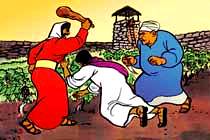
    Jesus tells a story about a vineyard.  The owner of the vineyard is the Lord.  It belongs to Him but He has given it out to tenants to manage.  The tenants here represented the Jews to whom Jesus was speaking, all the while they were plotting His death.  Remember that this was told just after Palm Sunday when the direction of Jesus' destiny was clearer than ever before.  But  before we write this off as mere history, remember that you and I are no less tenants.  We are not owners of our lives but have been bought with a price that we who live might not live for ourselves but for Him who lived for us.
    In a remarkable show of grace, the Lord sends prophets to collect what is His – not once, not twice, but three times.  These represents the prophets who spoke "thus saith the Lord" to the people of God.  A prophet's life was not worth much because the people knew how to silence those who said what the people did not want to hear.  Jesus had already lamented the Jerusalem who killed the prophets sent to them.  But the ears and hearts of the people were closed.  They would not hear and would not receive the Word of the Lord.
    Think here of the story of Lazarus and the rich man.  The rich man suffers in hell and fears for his family – just as complacent as he was.  "Send them someone, give them a chance," he pleads. But they had all they needed.  They had the Law.  They had the prophets.  Not even if someone were to rise from the dead would they be shaken from their unbelief.  We have the Law.  We have the prophets.  We have Jesus risen from death.  Are we shaken from unbelief or complacency?  Have we repented and born in our lives the fruit of repentance?
    The parable of the vineyard shows the remarkable generosity of the Lord who speaks the saving Word to His people over and over again.  Most truly and finally is this generosity shown in the flesh and blood of His very own Son.  In many and various ways God spoke to His people of old by the prophets, but now He has spoken by His Son.  Yet even the Son finds rejection, rebellion, and retribution.  Will Jesus find faith when He comes again?
    The tenants, the people of God, cannot afford to ignore this call to repentance.  They will find that the days swiftly pass until the day of mercy is over and the day of judgment is come.  God is not in the business of scaring His people from hell into heaven but neither does He hide the somber consequences of our choice to reject His claim on us.  In the parable, Jesus insists that the time for accounting has come.  The owner of the vineyard refuses to walk away from what is His.  God will not renounce His claim on us nor give up on His investment in us without a fight.  The cost of our rejection and our rebellion is judgment.  We lose all that we think is ours - eternally.
    Jesus is the stone that holds up what God is building but crushes under its weight those who reject Him.  That is the somber message we meet on our last weeks of Lent, in our journey to the cross, at this, the beginning of Passiontide.  Those hearing Jesus clearly understood what He was saying but they rejected His Word.  They refused to be tenants, refused God’s claim on them, refused His offer of mercy, and refused His call to repentance, confession, and forgiveness.  Instead they believed they had time, power, and recourse.
    Then there is this stinging word at the end of the Gospel for today.  "They pretended to be sincere..."  Surely this is our greatest temptation.  If not to boldly reject the Word of God, to play with it as if it were not powerful.  The call to faith and repentance is no pretense.  This is not about giving the Lord what He wants but about trusting hearts and changed lives by the power of the Holy Spirit.  Faith is the heart moved to repentance by the Holy Spirit.  Repentance is the anguish of confession in which we own the sins that condemn us.  Grace is the shocking generosity in which the sins we own become the property of the Lord upon the cross.  Transformed lives are the fruits of this faith and repentance taken seriously.  Create in us clean hearts, O God...  this prayer of the faithful is not pretense.
    The charge against the unrighteous is that their lives are a pretense.  They pretend to believe but reject the Lord's works and word.  They pretend to be holy but refuse the holiness that is His gift in baptism.  They pretend to be sincere but rebel against the faith and go their own way.  They pretend to trust the Lord but live on their own strength.  They pretend to belong but are strangers to the Lord's House and to the sound of His voice in His Word.  They pretend to serve the Lord but claim as their own what is rightfully His.
    This is the story of pretenders.  And the God who never pretends.  His grace is genuine.  His mercy is the real deal.  His Son has shown us this steadfast love that does not end.  He gives us His Spirit that we might pretend no more but truly believe in Him, truly repent of our sins, truly rejoice in His forgiveness, and truly show forth in our lives the good fruits of that repentance, loving God by loving our neighbor.  But Jesus cautions us.  Neither does God pretend about judgment.  So, as we enter Passiontide, the voice of the Lord calls us to pretend no more.  Let us come to the Lord and return to Him what His Son has bought and paid for by His suffering and death... and to show forth in our lives the fruits of this repentance, loving God above all things and loving our neighbors as ourselves.  Amen.

Passed on without comment... a hit from Msgr Charles Pope

We have discussed before on this blog that we live in a culture where maturity is often significantly delayed. In fact there are many in our culture who never grow up. One paradigm of our culture is to that it is fixated on teenage years. Fixation is a psychological description of a person who has not successfully navigated one of the stages of infancy or youth and thus remains stuck in the thinking and patterns of that stage, to one degree or another. Out culture’s fixation on teenage issues and attitudes is manifest in some of the following:
  1. Irrational aversion to authority
  2. Refusal to use legitimately use the authority one has
  3. Titillation and irresponsibility regarding sexuality
  4. General irresponsibility and a lack of personal accountability
  5. Demanding all of one’s rights but avoiding most of one’s responsibilities
  6. Blaming others for one’s own personal failings
  7. Being dominated by one’s emotions and carried away easily by the passions
  8. Obsession with fairness evidenced by the frequent cry, “It’s not fair!”
  9. Expecting others and government agencies to do for me what I should do for myself
  10. Aversion to instruction
  11. Irrational rejection of the wisdom of elders and tradition
  12. Obsession with being and looking young, aversion to becoming or appearing old
  13. Lack of respect for elders
  14. Obsession with having thin and young looking bodies
  15. Glorification of irresponsible teenage idols in culture.
  16. Inordinate delay of marriage, widespread preference for the single life.
I have often been accused when writing in this manner, especially by younger men that I have little idea what they really face. I do plead to being guilty of being less sensitive to the struggle of men simply because I am a man. I don’t generally like to hear men make excuses, as a man it alarms me. Men tend to tell each other to make no excuses and to “be a man.”
But I was alerted recently to two other articles on this subject. One of them is by a woman who has some good insights to the lack of male maturity today. Sometimes it takes someone on the outside to better grasp the dynamics. I think she shows a little more understanding (in both the intellectual and sympathetic sense of the word), and if it helps male readers to experience greater insight than I have to offer, I offer here an excerpt with comments by me in red:
Not so long ago, the average American man in his 20s had achieved most of the milestones of adulthood: a high-school diploma, financial independence, marriage and children. Today, most men in their 20s hang out in a novel sort of limbo, a hybrid state of semi-hormonal adolescence and responsible self-reliance. This “pre-adulthood” has much to recommend it, especially for the college-educated. So she coins a term here called “pre-adulthood.”
I have tended just to call this “extended adolescence” but her terms does capture the fact that many of the immature men (and some women too) do live away from parents and do have jobs, but otherwise are not so different from adolescents and college preppies. So her term does include a necessary distinction.
But it’s time to state what has become obvious to legions of frustrated young women: It doesn’t bring out the best in men….They are more like the kids we babysat than the dads who drove us home…..
Exactly. I have had many women tell me how tedious young men are. I usually reply that a feminized culture has largely produced them. So has a culture fixed on teen themes. Men also get mixed messages from both women and culture to the effect “Be a man, but don’t do it in a manly way…Show some leadership but get out of the way…. Many men are rightly confused, especially younger men who are some two generations removed from anything resembling a patriarchal family structure. Today matriarchy is the norm almost everywhere, and if there is even a whiff of Patriarchy it is round mocked and even punished legally. Ms Hymowitz will develop this more.
Among “pre-adults,” (again, her word for the extension of adolescence)  women are the first sex. They graduate from college in greater numbers (among Americans ages 25 to 34, 34% of women now have a bachelor’s degree but just 27% of men), and they have higher GPAs. As most professors tell it, they also have more confidence and drive. These strengths carry women through their 20s, when they are more likely than men to be in grad school and making strides in the workplace. In a number of cities, they are even out-earning their brothers and boyfriends….Their male peers often come across as aging frat boys…
Yes the feminists in our culture have long ago succeed in emasculating culture and making male proclivities almost criminal. In schools young boys who show the traditional spit and vinegar are declared ADHD and medicated. They are forbidden the rough and tumble that used to be usual fare for growing boys. Leadership and the aggression (within proper limits) that often fuels male leadership is excoriated etc. In this strange land of largely feminine run schools boys are poorly formed and it makes sense that they under-achieve. Nevertheless, despite decades of this, most feminists still claim victim status and continue to double-down on further feminizing the scene. Gone are the days when Father Flanagan caught two boys fighting and issued them boxing gloves and set the time for a proper fight between gentlemen after school.
For a long time, the poor and recent immigrants were not part of adolescent life; they went straight to work, since their families couldn’t afford the lost labor and income….today’s pre-adults have been wait-listed for adulthood. Yes this phenomenon is quite recent and rooted in western affluence and to some degree decadence.
Marketers and culture creators help to promote pre-adulthood as a lifestyle…. Precisely.
Pre-adulthood has also confounded the primordial search for a mate. It has delayed a stable sense of identity, dramatically expanded the pool of possible spouses, mystified courtship routines and helped to throw into doubt the very meaning of marriage.
In 1970, to cite just one of many numbers proving the point, nearly seven in 10 25-year-olds were married; by 2000, only one-third had reached that milestone… In 1974 there were 400,000 weddings in Catholic Parishes in the USA. In 2004 there were 199,000 weddings. Cut more than in half and it has dropped like a rock since.
It’s been an almost universal rule of civilization that girls became women simply by reaching physical maturity, but boys had to pass a test. They needed to demonstrate courage, physical prowess or mastery of the necessary skills. The goal was to prove their competence as protectors and providers. Today, however, with women moving ahead in our advanced economy, husbands and fathers are now optional, and the qualities of character men once needed to play their roles—fortitude, stoicism, courage, fidelity—are obsolete, even a little embarrassing.
George Guilder made this same point in a landmark Book Men and Marriage. Ms. Hymowitz does a remarkable job in just two sentences of describing the remarkable toll the break down of the family has had on men. Along with expansive (Mommy State) government usurping a provider role and the general feminization of culture, men are in a cauldron of confusion and obsolescence, a kind of perfect storm.
Today’s pre-adult male is like an actor in a drama in which he only knows what he shouldn’t say. He has to compete in a fierce job market, but he can’t act too bossy or self-confident. He should be sensitive but not paternalistic, smart but not cocky….
Why should they grow up? No one needs them anyway. There’s nothing they have to do. They might as well just have another beer. Wow.
The full article is here: WSJ: Where have the Good Men Gone?
The article is  Adapted from “Manning Up: How the Rise of Women Has Turned Men Into Boys” by Kay S. Hymowitz, to be published by Basic Books on March 1. Copyright © by Kay S. Hymowitz. Printed by arrangement with Basic Books Kay Hymowitz, Wall Street Journal
I realize both Ms Hymnowitz’s remarks and mine too are not without controversy, especially my remarks about the feminizing of culture. I saying this I do not mean to say there is no value in femininity, only that things have gone out of balance for men. Comments are open.

HT to Msgr Charles Pope at the Archdiocese of Washington. . . 

Progress vs Restoration. . .

Dr. Dean Wenthe, President Emeritus of Concordia Theological Seminary, Ft. Wayne, said in his paper at the 2013 Symposia, "human existence is not progress but restoration. . . "  Profound words, indeed.

We tend to think of the work of man under God as the work of improvement, both of self and of the world around him. Indeed, some churches have formally adopted this idea and have elevated the principle of love above Scripture.  So, for example, social causes that violate verses from the Bible are pushed away in favor of an over arching principle of love and acceptance that is higher than the specific word of Scripture.  There are countless ways in which we smugly sit in judgment over the past, secure in our aura of sophistication and education.  We are not the people we were.  We are better.  Our science is better, our knowledge is better, and our causes higher.  The witness and history in Scripture is cast aside as inadequate or primitive.

There is a part of us that shudders at some of the things in the Old Testament.  The whole idea of circumcision is brutish and abusive to the infant according to our modern day sensibilities.  The nature of the relationship between man and woman is embarrassing to our cultural and moral ideals today.  The miracles and worship practices of the past are often described as simplistic, even superstitious.

This is not limited to the Old Testament.  Talk to Lutherans about the worship practices from the first several centuries of Lutheranism and they are squeamish about the more prevalent use of private confession, the elevation and adoration within the Eucharist, the seriousness of Luther and early Lutherans about the Real Presence and how to deal with spills, etc..  We have progressed beyond that -- even serious and conservative folks often respond to these things in the same way.  We are beyond that.

The idea of progress is to thoroughly imbedded in our thinking and applies to so many different aspects of faith and life that we have fallen victim to our own hubris.  The work of the Kingdom is not progress but restoration, restoring to us what was lost to us in Eden.

That is perhaps the big problem we have.  We do not want restoration.  We want a better place before God and a bigger place within His Kingdom.  We have forgotten that all of creation is shaped for the benefit not of God but of man.  From light to dark, the seasons, food and vegetation -- these all exist for man and for his place within the plan and purpose of God.  Humanity is already at the center of all things and of the work of God.  Far from being diminished, man is elevated by the restoration of the purpose and plan of God.  Our life was born coram deo and was mean to be lived before God.  Our future is not progress past God's intent but the restoration of that intention in creation.  Strangely, we find this restoration limiting -- like a straight jacket.  We do not want back what we surrendered in Eden -- we want much more.  We want to be gods instead of servants of God.  We want to the the stars in the spotlight of His story and not supporting characters.

That is why redemption does not have a universal appeal.  It (I should say God) offers us something we think we have grown out of and something no longer attractive to us.  We do not want a Savior who fulfills the promise of the human creation.  Instead, we want a Savior who will show us how to fulfill the promise of our own individual and self-centered identities.  We are not content with a Christ who is the first born of all creation in whom all things are held together.  We want a Christ who helps us soar to the side of God and a God who rules through us and not over us.

In our pursuit of this progress, the old enemies of sin and death have been re-framed.  Sin is no longer the wickedness of thought, word, and deed that betrays our very humanity.  No, sin has become disorder, a therapeutic program and not an issue for redemption.  In the same way we have dealt with death by accepting it within the natural order of all things, part of the circle of life, so to speak, and something to be celebrated.  The problem is not death or life in its shadow but rather quality of life and how to live it more fully.

Progress has past the old goal of restoration and Christian progress has gone beyond the old language of repentance, redemption, and restoration and, instead, focuses upon the person, his or her desires, and those things that limit him or her from reaching his or her full potential and fulfillment.

Thursday, March 21, 2013

Cranmer. . . Thoughts on his death. . .

HT to The Continuum....  Though we Lutherans are highly indebted to Cranmer's work on the BDP, from which we borrowed liberally when translating Lutheran liturgy into English, his story is not without its own twists and turns.  It is an interesting summary of the man's move from Roman Catholicism to an Erasmus style humanistic version of Roman Catholicism to Lutheranism and finally to the Reformed position, for which Mary I held him in ultimate contempt.  Unlike historical precedent in which those who recant their heresy were spared death, Mary decided Cranmer needed to burn.  Her rejection of his recanting led to his recanting of his recanting -- if you can follow that.  So, perhaps, some of his positions were political as well as theological.  In any case, he died on March 21, 1556.  I, for one, say a silent prayer of thanks to God for him whenever I pray the wonderful language of the prayers for which he is, at least partially, responsible bequeathing to the whole church.

March 21st, which is coming up in a few days, is the 457th anniversary of Cranmer's execution in Oxford in 1556. Now, one thing I think Anglicans today are very unclear about is why Cranmer was burnt. I would not be surprised if some folks think he was burnt for wearing a Gothic Chasuble in a Fiddleback parish - which seems to be the only heresy left for some of my Affirming Catholic friends - but no, he was burnt for professing the Reformed faith. 

...it was a local influence - Nicolas Ridley - that finally moved Cranmer from the Lutheran to the Reformed position. He did so by lending Cranmer a tract by an eighth century theologian Ratramnus of Corbie, who argued that Christ was present spiritually, not corporeally, in the Eucharist. In his controversy with Gardiner (1549-1551,) Cranmer came to articulate his position as 'the True Presence' which to me reads an awful lot like the Receptionism of the next generation. Cranmer argues that Christ is present in the celebration, not the elements specifically, and that we receive the spiritual benefit, not the actual, Body and Blood of Christ when we receive Communion. 

The high watermark of Cranmer's programm of reform comes in 1552/3 when a new BCP and the Forty-two Articles are published. Both reflect a Reformed position not a million miles from that of Bucer and the Second Helvetian Confession. The Articles are less sharply Predestinarian than the writings of Calvin's followers a generation later, but their Biblical basis and Augustinian emphasis is clear. Like Bucer, he seems to have been essentially Lutheran on issues such as Baptismal Regeneration and Predestination, but on the Eucharist he joins Bucer, Bullinger, etc., as an advocate of the True Presence. The 1552 BCP's Order of the Lord's Supper gives liturgical voice to Cranmer's convictions on both the nature of the Eucharist and the nature of Justification and Sanctification by putting Communion into the middle of the Eucharist Canon.

Personal liturgical style. . .

In my reading I have come across not a few in the Roman Catholic Church, specifically the liturgical movement, who are concerned about the new Pope's personal liturgical style and wondered out loud if the advances toward reverence promoted by Benedict would be undone by a Pope who likes things simple, less formal, and more, shall we say, "personal."

Hmmmmm, does that sound like conversations that happen in Lutheran congregations when receiving a new Pastor????  Will his personal liturgical style be the same as the last guy or will we have to relearn everything all over again?  Not an unusual question at the change of occupants in the pulpit -- even when it comes to those who fill in during vacancy or vacation.

Personal liturgical style is a modern idea.  There is none in Orthodoxy where the Divine Liturgy (in any of its incarnations) is followed by all priests and bishops.  There was none in Rome until post-Vatican II attempts to make the personality of the priest more visible (when the whole notion of the leadership of the Mass is to diminish personality and draw attention to the Word and Sacrament).  There was none in Lutheranism where the form and ceremonial of the Divine Service were severely regulated by geographic jurisdiction for at least the first 200-300 years after the Reformation.  It was not until the 1960s that the personal liturgical style of the clergy began to dominate what happened on Sunday morning for Lutherans.

I, for one, have asked of those who fill in for me that they respect the tradition in this congregation (of 20 years plus) and not make the people change for their own personal whims.  While there are certain accommodations for personal expertise or ability (chanting being one example), the idea that the Divine Service be the domain of a Pastor's personal liturgical style is not only arrogant but betrays the very nature and spirit of the liturgy.

Ceremonial and liturgical custom are not matters of simple style portable with the Pastor but a reflection of the resources and state of local catechesis.  Catechesis will always result in the recovery of the fuller ceremonial envisioned and expected by our Confessions  EXCEPT where resources (music being one of them) precludes the recovery of the fuller expression anticipated and assumed by our Confessions.

The choice between Forumal Missae and the Deutsche Messe were never personal preference but the ability of the people (linguistic) and the resources of the parish (choir and organ).  We have upset the tables on this and turned it all into a matter of style which is as personal to the presider as it is the people in the pew.  Such is the worst kind of tyrrany.  Indeed, Luther was pretty sure that the fuller ceremonial and the Latin of the Formula Missae would dominate.  Sad to say, he was wrong.  The movement toward the simpler ceremonial and the substitutionary mindset of the Deutsche Messe has predominated instead -- if not in the trading of hymns or metrical versions for the ordinary then the idea that these are just parts to be chosen or omitted at will.

It is my conviction that the fuller ceremonial and the full Divine Service are the practice of a renewed confessional Lutheranism and the fruits of catechesis -- not because of the personal liturgical style of the Pastor but because this is the logical outcome of taking our Confessions and Catechism seriously.  No one is saying that a fuller liturgical expression and ceremonial will bring about renewal of Lutheran confessional identity -- the ELCA is ample proof of that -- but the reverse IS true.  A renewed Lutheran confessional identity will always and inevitably express itself liturgically -- in the recovery of the Divine Service as the chief service of the congregation and the inclusion of the full ceremonial assumed and inherent in the Confessional documents of Lutheranism.

When there is a renewed Lutheran confessional identity that does not express itself in weekly Eucharist, the fuller ceremonial and full liturgical expression of the Divine Service, and, I might add, renewal of private confession and absolution, that Lutheran identity is missing something -- somewhat like those in the Book of Acts who had not yet received the Holy Spirit.  The form is there but its practice is not yet put in place.

Looking back on the periods of Lutheran orthodoxy, on the times when Lutherans were dissatisfied with the current expression of their faith and reached back to their core confessional documents for renewal, we find liturgical renewal and the recovery of the Divine Service and a fuller ceremonial as part of the fruits of that renewal movement.  In our own day, we have seen the pendulum swing so that the folks who once were interested in worship (often considered liberal in theology) have been replaced by conservative voices for both the way we speak the faith before the world and the way that faith is lived out around the altar, font, and pulpit.

Personal liturgical style is a concession phrase to those who do not see the connection between faith confessed and faith lived out around the means of grace.  It is about time we ditched this unfortunate expression and did everything we could to remove any vestiges of the idea the "style" and "substance" are different, unconnected, and reflective of personal preference.


Wednesday, March 20, 2013

Not just a pill... an end to life. . .

You can read it all here.  It is the compelling story of a young woman who wanted to believe the purveyors of the "abortion pill" and did so... three times.  But the end of her story is the full awareness that, if not direct lies, the story of this pill skirt the truth and give you but the most shallow dip into the reality pool of what it means to take a pill and end a pregnancy.

Here are a couple of paragraphs of her story...

It was the third day when I finally had enough energy to shower. I felt so dirty and shameful that I couldn’t wait to clean myself. It was the first time I had stood for more than a minute and I was starting to feel a little bit better by then. I got about halfway through my shower when I started to bleed again. I bled so much that it clogged the drain. It was in that moment, me trying to cleanse myself from my sin of the abortion that the truth was exposed. It was the “blood clot” or the “blob of tissue” that the clinic talked about. It was my baby that was clogging the drain of the shower. I had to turn off the water, get out and clean it up myself and then I flushed it down the toilet. It was even more horrifying than it sounds. This was all done in my own home, in the family bathroom, the family shower, the home where I had to live after this experience.

The emotional pain this caused made it almost unbearable to be at home after that. I hated showering and I hated sleeping in my bed, I hated being around my family, I didn’t want to be there anymore and tried my best to avoid being home. I immediately felt a loss. I didn’t want to hear people mention the word baby, I didn’t want to see babies, the sight of a baby caused me to nearly break down. I lived in denial for a period after that trying to pretend that nothing happened and that I was ok. It was in that time that Jesus found me. At my lowest and darkest point, he drew me closer to himself. I am only able to share my story with you now because I know that he has set me free and cleansed me.

RU486 is not a simple solution to a problem. It is a horrible drug and if it is made more readily available to young girls especially they will have similar stories as mine. I hate that they say it’s safe, I hate that they say it’s simple, I hate that they don’t tell you what you will really experience, I hate that they don’t care about your heart and the emotional affects it has on you. I hate that the truth is not being told. The truth is that RU486 is murder and it is not only destroying the lives of babies, but the lives of women.

Simple... nearly painless... easy... an end to the problem of pregnancy... OR the beginning of the nightmare of what our culture of death has done to us and through us to our children...

Tuesday, March 19, 2013

Spain is anti-abortion.... no, wait, uhhhh

It seems that there is a movement against abortion in Spain.  Since there are over 110,000 abortions in Spain each year, this is not a small matter.  Just when you were all excited to think that maybe there was hope, the story turns out not to be the abortion of human children but of . . . apes.  Yes, the lives of apes are protected from conception on but not human children. . .

A group of Spanish pro-life campaigners have called for the repeal of Spain’s abortion law in response to a new law protecting the Great Apes from the moment of conception. The campaigners dressed as primates and gathered outside the headquarters of the Partido Popular – Spain’s ruling political party. The Spanish parliament recently passed a new law which protects the Great Apes from the moment of conception from abortion and foetal experimentation. But the protestors highlighted the fact that unborn humans remain unprotected from both abortion and experimentation.

You can read a report here... but you won't want to. . .

Sadly, the world is ripe for sympathy for all sorts of things, especially for the protection of animals, but has little compassion or outrage at the death of the not yet born.  This death is sanctioned and protected by law and is the only murder that law allows.


Where is God?

In my preschool chapel talks I often ask the children where God is.  Typically, they point to the sky.  God is up there somewhere.  They have no doubt about the reality of God (parents have taught them well) but they have no locus for God, no place, no presence.  Of late I have noticed a new gesture when I ask these preschoolers where God is.  Some of those preschool children point not to the sky but into their own hearts.

I believe it was John A. T. Robinson who said the God who was once somewhere, now is nowhere.  That is the sober truth we learn from our children.  We have taught them that God is a ghost in the sky, a feeling in the heart, or an idea in the mind.  In essence, we have taught that God is made up, that, if He is real, it is not the same concrete reality they have or their world has.  So it is no surprise that when they grow up a bit, they become resistant to things like church and faith.  The nowhere God has caught up with their rebellious streak and they are not content to live the shame any longer.  Perhaps teen age angst was always a faith problem but, having stripped God of any real reality, it has become a faith problem without an answer.

I do everything in my power to teach these preschoolers (as I do the youth in catechism class) that God is real and is present not in the imagination of my mind or the desire of my heart or clouds in the sky but in His Word and Sacraments.  God is there as He has promised.  He has made Himself captive to the means of grace so that we frail and weak creatures might know where He is and have access to the grace in which we stand.

The focus of even Lutheran piety is often as nebulous as what we think, feel, or makes us happy.  We seek hymns that we like to sing instead of the hymns that speak to us the Word that He spoke first to us.  I cannot tell you how many people have said to me, "Pastor, I am ashamed to tell you what my favorite hymn is...."  We point all sorts of places where we think God is but few of them are close to where God has said He is.  So the feel good stories that make the last few minutes of a newscast impact us more than the Word of the Lord or our place at His Table.  We read the evangelical authors whose inspirational tone shapes us more than the Law/Gospel of the preaching of God's Word.

Our piety ought to be focused and shaped by the means of grace.  Here is where we point.  God is here!  The God of flesh and blood, of suffering and death, of resurrection and life.  He is there in the waters of baptism that claimed us, that stole us from one kingdom to plant us in His own.  He is there in the Eucharist, the bread where faith tastes Christ's body and the wine where faith drinks His blood.  He is there in the voice of absolution that addresses us with the Word that unshackles the chains of sin, washes away its stain of guilt, and restores us as His own.

Children tell us what we have said to them.  When we speak about God as an idea, as a feeling, as a presence on the plane that does not intersect our reality, we tell them God is not real.  They beg to know where God is.  Thankfully, the liturgy points them where our witness has failed them.  Watch their eyes follow  the words and actions of the Divine Service.  They are taking seriously what we take casually.  They look to us to see if we will confirm what the words and actions of the liturgy say... sadly, the answer too often is no...

It is time for us to step up to the plate and be honest with our children.  Just maybe this honesty and conviction may help them remain when the pull of youth and the world are working against their faith.  Wouldn't it be nice if we could teach our conviction that God is where God has placed Himself... in the means of grace... a much more reliable answer than a finger pointing to the sky or a hand held over the heart.

Monday, March 18, 2013

Just caught up with this...


I like the dog better than his master. . .

A loss of holiness. . .

A common theme among a few of the speakers at the 2013 Fort Wayne Symposia was the idea of personal holiness.  There is much to cover here.  We do not talk about holiness much.  We do not lay out  holiness as either expectation or goal for ourselves or our people.  Instead, we are pretty comfortable with our weakness and frailty -- so comfortable that both our expectations and our efforts toward holiness are minimal.

I recall one speaker asking if we spoke of holiness from the pulpit, if we held up holiness as that which informs and shapes our sexual identities and practices.  In this particular area he challenged the preachers in the room to hold up holiness of life and conduct as that which is worth the effort and energy in the face of a world where desire rules over all.  Another spoke of the way we have accepted the heavy influence and power of our sex saturated culture to direct our thoughts and actions.  Even in solid, conservative churches where Scripture has its rightful place, the subject of holiness is avoided.  Those of us sitting in the audience could not help but be convicted by their words.  We have preached against abortion and pre-marital and extra-marital sex and even the GLBT agenda but largely with the no of the Law.  We have not preached theses subjects within the context of the Christian pursuit of things good, right, beautiful, truthful, and holy.

Sadly there are more churches and more pulpits urging us to happy sex lives within certain boundaries -- as if the Gospel's great concern was sexual pleasure -- than there are words or sermons calling us to be holy, to live holy, self-controlled, and pure lives.

Our sexual ethics now differ from the world's more in terms of where you place the fence of right and wrong than in the very nature of sex's gift and purpose.  A good example of this can be found in the declining rates of childbirth and the increasing rates of couples choosing to be childless.  Why do we disagree?  We have different hermeneutics.  The true scale has Scripture first, with natural law and reason next, followed by scientific reason and finally experience.  The inverted scale of modern day Christianity places experience above all things, followed by scientific truth, natural law, and, at the bottom, Scripture. Our core values are not formed from nor consistent with Scripture. 

I must say that the words spoken challenge the way we preach and teach.  We must do more than merely move boundary lines or say yes or no to specific things.  We must address that which informs our ethnics and morality.  At the root of this is the purity and holiness of Jesus.  His holiness is not for our admiration.  His holiness is, in part, to show us what holiness is.

The sad but honest truth is that our constant exposure to vulgarity and our glorification of base desire have had consequences.  They have born poisoned fruits but we continue to feast upon them seemingly without shame.  Until the Church holds up again, without compromise or adjustment, the claim of holiness and speaks forth the call to holiness of life and speech, we will continue to simply be naysayers against a people who no longer hear the word "no".  We need to articulate and speak to the world the radical voice of holiness.

Christians are not merely forgiven sinners who continue to sin.  We are a people who have died and risen to new life in Christ. We are not on our own but have been bought with a price and Christ now lives in us.  What are the consequences of this new life?  Of Christ now living in us?

Some troubling thoughts for preachers and teachers...

Sunday, March 17, 2013

Insanity. . .

Insanity – doing the same thing over and over and expecting different results....  With those words some have sought to characterize as irrelevant -- even pathetic -- the Church's work of liturgy, catechesis, and confession.  The liturgy has become for these people a failed experiment and we owe it to Christ and the world for which He died to give up the failed methods of the past.  In the same way, catechesis has been challenged by the idea that kids don't want to be there and parents no longer seem as willing to make them go.  So catechesis has been replaced by entertainment which focuses upon the already overdone focus of feeling and desire.  Instead of teaching to our youth the way of life under the cross through the means of grace we try to teach how to be happy in Jesus.  Finally, there are those who insist that what we confess is less important than the way we confess it.  For these people doctrine and truth ought to come second to love, tolerance, and acceptance.

They might all be true except for one thing.  The liturgy that we repeat is nothing more and nothing less than the means of grace in the ancient and laudable pattern of prayer and worship through which God delivers to us His Son and, with His Son, what His Son has won by His all sufficient suffering and death and life-giving resurrection.  They might be true except that catechesis has always been the way we teach the faith (note, I did not say teach knowledge of truths or facts or even impart understanding).  We teach the faith by teaching us to trust the Word of the Lord (verbal and visible) to accomplish what it promises and do what God has sent it forth to do -- to enable us to trust in Christ and, believing in Him, to have forgiveness, life, and salvation in His name.  They might be true except for one thing.  Confession begins with the premise that it is not about me or even we.  It  is about the one name under heaven and on earth by which any can or will be saved.  We confess Jesus Christ in formally worded forms of confession (the Concordia, for example) but we also confess Jesus Christ implicitly in the liturgy, the means of grace, faithfully offered as Christ commanded and received as Christ has enabled by faith.  As often as you each of this bread and drink of this cup you proclaim the Lord's death until He comes...

No, the real insanity is repeating the noble failures of the more recent past.  Our attempt to make worship more relevant by making it more about us, more captive to the moment, and more detached from the concrete of the means of grace has left the pews empty and the people still in them even less confident of Christ's presence and grace.  We have taught our youth well.  It don't matter.  And they believed us.  So they stopped going through the motions of our religious attempts at self-aggrandizement and self worship and are pursuing their own interests unhindered by the remnants of religion our unfaithfulness has left them.  Youth ministry that attempted to meet kids on the turf of what is cool, relevant, entertaining, and fun is the insanity of the past half a century or so.  They have found more entertaining entertainment than the lame mirrored activities of the world around them.

The real insanity is repeating the noble failures of the more recent past. Our belief that music with a beat that you can dance to and a casual take on God and the things of God would pack in the people have left our churches filled with drum sets, guitar cases, worship divas, and great sound systems.  But no people.  Those who come, come for fun and the fun they come for is dictated not by the Word of God but by personal preference and musical taste.  There is no substance worth having if it comes to us in a style we don't care for.  So the youth listen to the jazzed up ancient sounds of Peter, Paul, and Mary that pass for "contemporary" and they ask why?  All we can answer them is because we can and we think it is cool.

The real insanity is repeating the noble failures of the more recent past. We have segregated the Church so that families split up at the door and we all seek whatever appeals to us and then we call it "church".  Kids head to glorified baby sitting, youth head to their techno hideaways, and adults to what makes them feel good.  We get what we want, largely a dose of moralism that glorifies self and feelings, and then we all go home to go into our own rooms and do what we want.  Big buildings that look like shopping malls and plenty of Starbucks mean we must be successful -- never mind that the people coming and going are just shopping for the next, newest, coolest rreligious experience.

I have an idea.  Let's try Word and Sacrament.  Let's try being Lutheran -- really Lutheran.  Let us come to the Divine Service to meet there the Christ who forgives us, who embraces us as His very own, and who feeds us upon His body and blood.  Let us sing with the church before us the words of the faith as a people who believe this Word is God's power and His glory.  Let us teach not simply facts and events but life under the cross, trusting the Lord and living out in daily life "not my will but Thine be done."  Let us struggle with as much effort as possible to become the people God has declared us to be, living out the good news in lives of good works and godly witness.

The only insanity about this radical idea is that the promise of God is that He will accomplish His purpose, in His own time, and bring forth the success and fruits He desires.... all we need to be is faithful...  

Saturday, March 16, 2013

Depth Perception

I read this and it got me thinking (yeah, I know, it is dangerous when that happens).

One of the great blessings of the human brain can be found in its ability to take two things and make them one. We have two eyes, which means they necessarily see things differently. Look at the world with one eye open and switch to the other eye. Things appear to move. Viewing the world through one eye also makes things appear somewhat “flat.” The wonder of “stereo-scopic vision” (seeing through two eyes) lies within our brain. The brain takes two different sights and reconciles them, combining them in such a way that a new picture emerges, one that includes a perception of depth.

Let me take this idea and shift it to the discussion of worship.  Liturgical worship adds another view to the brain so that the view of self, the world around us, desire, taste, and preference can be combined to produce depth perception.  Take away the perspective of the moment and we are left with only a past.  Robbed of present and future, we live melancholy lives, regretting who we are and isolated from the time in which we live.  Take away the perspective of the past and we are left alone to the captivity of feelings, desires, taste, preference, and whim.  Robbed of the past, we are victims of our own selves and see everything through the lens of me, of now, and, most often, of impatience.

Think of it this way.  The curse of childhood is that there is no past, no memory, and so the youth without parents, grandparents, and those to connect them to the past, suffers the same mistakes over and over and over again.  The blessing of childhood is its hopefulness and focus upon the future -- a future often impatiently expected and anticipated.  Kids always want to be older than they are and are easily willing to exchange their youth for adulthood before they are ready.  The curse of old age is that there is no future but death, no hope for a tomorrow.  So the aged are often bound to a past which is over and gone, confined only to the cobwebs of memory.  It is too easy to look upon present and future with angst and fear, without the time to adapt to the future, the past becomes a comfortable retreat.

Thankfully, worship is both contemporary and traditional.  That is the genius of liturgy.  It connects us to the past and to the astonishingly rich tradition that has passed down to us from the saints.  This great tradition is a sacred deposit which is ours to pass on but also given to us with the opportunity to add the best of the moment -- not shaping or adapting that tradition so much as completing it in some small way by the faithfulness of the moment.  In text, tune, and song we commend to those to come what we have received and the best of what we have to offer.  The grace of God is always at work, fading into the background that which is unworthy and bringing to the forefront the faithful treasure of both past and present.

What we do when we abdicate to the present is to make our spiritual lives in Christ one dimensional.  There is no depth to the picture.  There is no dimension to the view.  There is no perspective at all.  Just now.  Just me.  Just feeling and desire.  As terrible as this curse is, it is equally terrible to live in captivity, even in subservience to the past.  In pursuit of a golden era of history or attempting to repristinate a yesterday which is gone, we live in isolation from the world -- a most unhealthy isolation that is born more of fear and regret than anything else.

No, Nagel has it right again.  Our Lord speaks and we listen. His Word bestows what it says. Faith that is born from what is heard acknowledges the gifts received with eager thankfulness and praise. Music is drawn into this thankfulness and praise, enlarging and elevating the adoration of our gracious giver God. 

Saying back to him what he has said to us, we repeat what is most true and sure. Most true and sure is his name, which he put upon us with the water of our Baptism. We are his. This we acknowledge at the beginning of the Divine Service. Where his name is, there is he. Before him we acknowledge that we are sinners, and we plead for forgiveness. His forgiveness is given us, and we, freed and forgiven, acclaim him as our great and gracious God as we apply to ourselves the words he has used to make himself known to us.

The rhythm of our worship is from him to us, and then from us back to him. He gives his gifts, and together we receive and extol them. We build one another up as we speak to one another in psalms, hymns, and spiritual songs. Our Lord gives us this body to eat and his blood to drink. Finally his blessing moves us out into ur calling, where his gifts have their fruition. How best to do this we may learn from his Word and from the way his Word has prompted his worship through the centuries. We are heirs of an astonishingly rich tradition. Each generation receives from those who went before and, in making that tradition of the Divine Service its own, adds what best may serve in its own day--the living heritage and something new.

The Church takes two different sights and reconciles them, combining them in such a way that a new picture emerges, one that includes a perception of depth.  So it is in worship... the best of the past becomes the living heritage of the saints in the voices, hearts, and minds of a people far removed from this yesterday and the best of the present becomes the gift and heritage of the saints to come when it, like that which we received, is noble, faithful, beautiful, and our best for His glory...

Friday, March 15, 2013

The Church has a future. . .

From Prof. John Pless:

In a very instructive essay of 1965, “The Ecumenical Challenge of the Second Vatican Council,” Hermann Sasse wisely observes: “We have been too much influenced by a certain type of sectarian Christianity which for a long time flourished in America. The sect cannot wait; it must have everything at once, for it has no future. The church can wait, for it does have a future. We Lutherans should think of that.”

The sect cannot wait; it must have everything at once, for it has no future.  The Church can wait, for it does have a future.

Those are wise and careful words from a wise and careful teacher.  Prof. Pless brings to mind this wisdom for one cause but it should be applied liberally to many causes within our church body.  We glimpse the life of the Church more as a snapshot than the full image.  We look back upon history and see mistakes, errors, faults, and failings most clearly.  The triumph of faithfulness is neither glamorous nor does it stand out from the notorious and infamous.  But hidden in the past is faithfulness.  We are not heirs of the Radical Reformation, so quick to dismiss what has been and to rebuild from start a church (that, sadly, has less continuity with the early Church and Scripture than it has deference to the momentary values of the ones who make such sweeping judgments).  The mark of the conservative character of the Lutheran Reformation is our conviction that the evangelical and catholic faith and the Church assembled around the Word and Sacraments has been and continues despite wrongs and failings.

We look today with the impatience of a child.  We want what we want and we want it now.  For those on the liberal fringe of Lutheranism this has meant a radical social agenda that equates with the Gospel and is willing to break faith with our yesterdays in order to accomplish its social justice goals.  Since it cannot await or risk the faith of the people, quotas, institutional jurisdiction, and broken rules become the tools of change.  There is no faith in the Word of God, no patience upon the Lord to enact His purpose, and no tolerance for those who disagree.

For those on the other side of Lutheranism, this has meant the quest for purity -- an obsession pursued obsessively that will leave the Church barely one congregation deep and wide.  The isolation of this church or micro synod is less a concern than its purity and agreement on all articles of faith and practice.  WELS or one of the other small Lutheran bodies is the logical outcome of those who pray only with those who pray exactly as they do or work only with those who agree with everything else before the common labor begins.  In such a church, conflict is commonplace and the focus is on error and not on the work of the Kingdom (unless you see purity as the only true work of the Kingdom).

Now, mind you, I am NOT saying that truth does not matter.  Neither am I saying that pure doctrine and consistent and faithful practice do not matter.  Finally, I am not at all suggesting that everyone should do what seems right in his own eyes.  Far from it.  I am speaking to the cause of patience and trust in the work of the Lord.  If we do believe that God is act work in the means of grace, then we must not only trust the means of grace to do His bidding and return its appointed fruit to Him, we must also be patient with His timetable.

Perhaps the wisest thing ever said to me as I prepared to begin my life as a Pastor came from Pastor Charles Evanson.  He encouraged me not to take myself too seriously -- to take the things of God seriously but not myself.  It was as if he were speaking as Sasse.  The Church was there before I was ordained and it will be there after I am long gone.  I may be tempted to believe that everything hinges upon me but I would be wrong.  It is the Lord's Church.  I am to labor faithfully within the corner of that great Kingdom where He has placed me and do faithfully what He has bidden me to do,  but it is His Word, His Spirit, and His work.  A healthy sense of patience and trust in the Lord is the key to freedom in ministry.  If you read this blog you know that I have opinions and often fall victim to the very foibles I decry here.  Yet, truth be told, I know that the Church will live on in spite of me.

The Church has a future.  The sect does not.  When we demand what we want when we want it, we act like a sect.  The Church has a future.  Not because we say so or because we believe it.  Because the Lord has said that the Church is His and the gates of hell shall not prevail against her.  God is faithful.  God will do it.  This has to be in, with, and under who we are as clergy and lay leaders of the Church and we must believe this first and foremost -- even as we labor to speak the Truth in love to the places, people, and perspectives that would shift the work of the Kingdom from the firm foundation of faithful confession, secure in the means of grace, and the faithful practice that flows from such confession.

The Church has a future.  It is this that allows me to sleep at night.  Apart from this I am allowed no life, no hobbies, no other interests, and no distractions from making sure that needs to be, is.  The Church has a future.  As long as I keep this in the forefront of my vision, it will be easier for me to remain a part of that noble future, ordained of God, and guaranteed by the Spirit.

Thursday, March 14, 2013

Too funny for words... maybe a little truth thrown in as well


Thanks for those who passed this on to me....

Living Tradition

The faithfulness to Tradition is not a loyalty to antiquity but rather the living relationship with the fullness of the Christian life. The appeal to Tradition is not so much the appeal to earlier patterns as it is an appeal to the “catholic” experienced of the Church, to the fullness of her knowledge...  The scope of Tradition cannot be established simply by historical research.  That would be a very dangerous path...  Tradition is known and understood only by belonging to the Church, through participation in her common or "catholic" life... The "Catholic Church" can also historically turn out to be the "small flock."  There are probably more "heretics" than "orthodox believers" in the actual world...  The Church is catholic because she is the Body of Christ...  
                            Georges Florovsky in Creation and Redemption, pages 37-38


I was reaching for another book when I inadvertently pulled this one down with it.  I glanced through the pages and began to read.  Good stuff.  Now I forgot which other book I had been searching for and why.  But that is the way it is.  In looking for something else, we stumble into gold.

The Church is not Catholic because she is the majority or because of a tie to the past but because this catholicity is lived out in the liturgical and sacramental life of the faithful, called, gathered, and enlightened by the living voice of God's Word, set apart by baptismal mark and new birth, and sent forth to do the work of the kingdom through the means of grace.  The smallness of the Catholic Church does not mar or detract from her catholicity since that catholicity flows from who she is and not the possession of documents from the past or historical connection (apart from the continuity of what is believed, confessed, and taught).

Either Florovsky sounds Lutheran here or Lutherans sound Orthodox.  Either way it was a great stumble onto a great quote...  An accident of grace, I call it. Wish I had more of them... more often...

Wednesday, March 13, 2013

Thoughts on hearing of the new Pope. . .

Oddly enough, where I was prior to the announcement of the new Pope, the TV blared The View, with its own odd mix of mostly off the track opinions.  Anyway, there were usual complaints about the Roman Catholic Church being behind the times, about the need to address the equality of women and gays, and the obligatory reference to clergy sex abuse.  Then there was a complaint about not having Sunday school or some place to ditch your kids during the Mass since there obviously is nothing for them in the service, with all its ups and downs, etc...  Finally there was some thought to a more egalitarian view of things.

A couple hours later when I heard a few reports on the new Pope, I heard the same mention of humility and how refreshing it would be to have a Pope who lived humbly, cooked for himself, rode the bus, and cast off all the pomp (referring of course to the Cardinal's manner in Argentina).  There was also talk about "growing" into the papacy -- translate that "moderate" views.  Anyway, my point is just that media folks really do not get much about Christianity or Roman Catholicism (even with all of the billion or so Roman Catholics).  It is no surprise, then, that they do not have a clue about Lutherans.

All in all a surprise or perhaps not.  If he was known well enough and highly regarded enough to be near selection last time (the rumor), he was clearly the frontrunner even if none of us caught it.  He is well educated, has great pastoral experience, is clearly a traditionalist in doctrine and practice, and, perhaps, like my own favorite, John XXIII, will give his own personal and pastoral dimension to the papacy during his tenure.  Humility does not mean liberal or progressive or inclined to break with the legacy of the past.  It simply means he sees beyond himself.  I am not sure the media gets that or that any of us does.  We like labels too much.

The key here for a Pope, as for any Pastor, is that the Church was there before you, and, God willing, will be there, perhaps stronger, after you leave.  None of us is but a temporary steward of the office entrusted to us.  That is both comforting and humbling.  It keeps me both relieved and concerned at the same time.  God bless him.  He will be a strong and reliable voice against abortion, against the redefinition of family so common today, and against a modernity which is so married to the moment it cannot see before or after itself.  That would be a good thing.  For Rome.  For Roman Catholics.  For us all...

Notes from a Communion Call. . .

Pastor Russ Saltzman has written a very fine piece on his own experience with a communion call to an elderly woman and of the angst that was born of the call, the conversation, and her later death.  It is a very fine piece of writing and one worthy of some discussion in the seminary classes where topics covering such situations are introduced to prospective Pastors.  You can read it all here...  Pastor Paul Gregory Alms has made this available to a wider circulation and other blogs have also passed on this account.  It is a painful but good read for Pastors who find themselves in similar shoes.

Pastor Heath Curtis has wondered why it is that the law offers us relief, if not comfort, when we face things honestly, without excuse or justification.  I, too find it strangely relieving to speak of those times when words did not come, when we felt without resource to address the painful question of another, and when exit and death find us likewise relieved.  You can read him here.

I offer a similar story, one I have told to laughter even though there is little in it that is funny (except my own foible).  Many, many years ago I had one of those difficult shut-in calls.  A husband and wife who spent most of their lives (day and night) in their chairs (hers a wheelchair and his an overstuffed chair).  Their eyes had dimmed with age and each had been left with weakness and disability.  He had trouble hearing and she could not walk.  So there they sat, he dozing in the worn out upholstery of his chair and she hunched over in her wheelchair.  Hardly anyone came to visit.  They had the company of a dog whose hair was prone to come off in your hand if you reached down to pet it and the regular visit of the meals on wheels delivery person.  But every 3-4 weeks I made the trip.

The conversation was difficult.  Neither offered much more than one word answers to my comments or questions.  I looked around their small, dark, disheveled home and found it beyond depressing.  They rarely had any news and did not react much to the news I brought as well.  Both had been pillars of the parish and had sacrificed much for the building of that congregation but now there was little life left in either of them.  I made the mistake once of scheduling the visit for late in the afternoon.  The heat was set too high, the winter day was short and darkness was soon around us, and the conversation was even more difficult that day. 

At some point I awoke, realizing to my horror that I had fallen asleep with them and there we were, snoring away for some 20 minutes.  What if someone had come and seen me!  What would they think!  What did these shut-ins think of me falling asleep!  Did they even know!  I was not so much asking questions of myself as much as expressing my shock at what I had done and the fear that someone else might know.  What to do?  Should I wake them?  Should I sneak out?  But I had not given them the Sacrament yet?  Would they remember?

I sat there waking up from my unplanned nap and chewing away at what had just happened.  I decided to wake them up (in a cowardly way) by droning on in a loud voice about this or that and asking them if they desired to receive the Sacrament.  They woke slowly and mumbled in the affirmative.  A quick liturgy and their communion and I packed up and headed home, relieved that no one seemed to be the wiser.

In the end, I fessed up to my wife who laughed (the image of us all sleeping away the darkening afternoon was funny) but inside I was dying.  I had failed myself and them, oh, yes, and the Lord.  In the shock and guilt, I attempted to figure out how to prevent it from happening again.  For the next few months I was absolutely buoyant and jovial when I arrived at their home.  I could not shut up trying to keep them informed of everything.  I was the model of wit and charm.  But under the veneer of enthusiasm was the guilt of one who hoped and prayed that they would never know.  I left relieved as usual, maybe more than usual.  Maybe you can understand.

The work of God's kingdom is often tedious.  There is no glamor.  There is no glory.  Sometimes the most you can hope for is that the people you serve do not see your faults and failings as clearly as you see your own...

Tuesday, March 12, 2013

Who is the most prodigal?

Sermon for Lent 4C, preached on Sunday, March 10, 2013.

    Called the Parable of the Prodigal Son, this story of Jesus is perhaps his most well known parable but often misunderstood.  Prodigal means wastefully extravagant.  Today we walk through the parable verse by verse.  In the end we discover that the extravagant one is not the self-indulgent son but the Father whose mercy and love never end.
    The story begins with two sons – it is not the story of one son but of two sons.  The younger was within his right to ask for a portion of the inheritance.  The historical practice of the day would have given him a third and his older brother two thirds.  But the inheritance as conditioned upon his father’s death.  In essence he was asking for his father’s death.
    He got his share but it came in property that took some time to convert into cash.  Once exchanged, he takes off for a far country – a euphemism for a Gentile land.  Having burned his bridges he has become as dead to his father as his father was to him.
    However much he got, he lost it all until he was worse than broke.  He was in a strange place with no friends and nowhere to turn.  All he had left to sell was his birthright as a son of Abraham, a Jew, and this he sold just to live.  He became a hired hand to a hog farmer.  He became an alien and stranger with no home at all; not in the far country where he had run and not at home where he couldn't return. It left him with time to think.
    What follows was a change of mind – not yet a repentance, he builds a rationale for returning.  He would be better off as a servant of his father than a servant here.  Why not go home?  What did he have to lose.  But from regret the Holy Spirit often shapes repentance.  And then he goes closer to repentance, admitting the guilt, acknowledging the sin, confessing it, accepting the consequences for his sin, pleading for mercy.  What is missing?  Could it be confident faith in his father's heart?
    Now the whole attention shifts from the minor characters to the major character in this parable, the waiting Father.  For this is truly His story.  While still far off, love goes to the sinner; the sinner does not earn the love.  Love goes before repentance and so the Father's love embraced the son before words of confession, contrition, and repentance could be said.  It is always that way.  Met with love, his repentance is no longer born of fear for his welfare or shaped in his own self-interest. His repentance is occasioned by the love of the father.  Love woos and wins the heart of the son once as good as dead. 
    Love restores what was lost.  Forgiveness is shown by the restoration of the son, not as a
servant but with full status as a son.  New clothes for new righteousness; a new ring for a new identity; and new shoes for a new path to walk.  These are the Father’s gifts to us brought near us in the water of our baptism – the clothing of Christ as our holiness, the new identity of the cross marked upon us as His own, and the new path of faith, life in Christ, and holy obedience that flows from faith.
    In the Middle East eating and who you eat with are highly significant; food is also highly symbolic in our own culture.  Even Obama invites his adversaries to eat in the White House.  So they feast for joy.  Here the food shared reflects fellowship extended – the most intimate of fellowship.  Just as our Lord sets His table before us in the presence of our enemies and bids us come and enter into His rest and refreshment.
    The dead is raised, the lost is found. . . redemption is complete;  the Father has made it so. But as one son is restored, another is about to be lost, if ever he belonged to the Father.  For the older son relinquishes his place as a son to complain that he is the servant who has earned better treatment from the father than his runaway brother; he sees redemption as something you earn while the father sees redemption as a gift and grace.  He demands justice. The Father gives mercy.
    Could this older son have been Lutheran?  What does this mean?  Not curiosity but foreboding.  He asks not because he wants to know but because he fears the answer.  He is jealous.  Faith does not resent mercy shown to others; why is he angry?  Because his brother returned or repented  or because his father showed him mercy and forgave him?  What did he resent, not the loss of his brother but the gain of his brother and the evident joy in the father's response of a party thrown to honor the occasion?  He believes his father has been wastefully extravagant with his mercy and believes justice is the better path.  Could that be you?  Or me?
    Again the father comes out to the son – the same grace shown to son who ran away is shown to the son who remained.  The Father entreats him with mercy to share in the joy.  He urges him in love but instead the angry son throws back an insult to the father – not even addressing him as father.  Only the bitterness and resentment of a heart filled with me, myself and I.  I, I, I... I served you, always did what you commanded, and I got nothing back, not even a few bucks to party hearty with my buds.  This son was already dead to the father.  He resents it all. . . he obeys not out of love or even out of duty but only for what is in it for him.  He complains.  The Father plays favorites; he demands justice even when the Father is offering him more – mercy!  The Father offers him sonship – you are with me and all I have is yours but the son is unwilling to accept the Father's love.
    Did the older son ever repent?  It does not matter; the point is that the father was the ultimate prodigal, extending extravagant mercy to both; it began with a father and no sons – unless you count one who wished him dead and one who resented him – but at the end he had the surprise of one son, the dead was restored through confession and absolution; the other remained only a slave.
    The issue here is mercy, the dramatic offering of mercy to the undeserving... love not as the reward for being good but the rescue of the lost and the new life of those dead.  This parable is the story of God’s patient, giving, and waiting love which redeems the lost and restores the fallen and engenders repentance.  What remains is to ask which son are you?  The call of God extends to all who hear His voice.  The mercy of God is the death of Christ for all sinners.  The fruit of this call is the Spirit’s worked repentance and faith in that mercy.  Come, my brothers and sisters, the waiting arms of our Father are open.  Come, the fallen, the wanderer, the weary, those who have lost their way, those distracted by the world’s allure... come, the feast is set, the welcome is here, the heavenly Father has forgiven you...  Come.  Amen!

A guest post. . .

I often read the wisdom of Msgr Charles Pope.  He is well spoken and I find myself generally echoing what he has written.  This one post I found most instructive and salutary.  Read it and see for yourself:

____________________


There is a song about the sadness of moral relativism in an unusual place: “The Greatest Hits of the Monkees.”

Some who are old enough may remember growing up with the songs of the Monkees. I confess their song “Only Shades of Gray” was not one I remember well from those days. But it is a fascinating song about moral relativism.

Some think it’s just a song about growing up. But to most it speaks of a time when things were more certain and compares it to these more modern times when it seems everything is disputed and up for grabs, no more black and white, only shades of gray.

It is all the more poignant that the song was written in the turbulent 60s and, perhaps, represented the anxiety generated by those times when just about everything was being thrown overboard.

Now I know that it is wrong to point any particular age as the “golden age.” Scripture itself warns against this: Do not say: How is it that former times were better than these? For it is not in wisdom that you speak this (Ecclesiastes 7:10). I am also aware that not everyone feels the same about the “good old days.” For some they were not all that good. We should not forget the terrible wars of the early half of the 20th Century. Further, I serve in a parish that is predominantly African American and for many of my parishioners previous days featured “Jim Crow” laws, disenfranchisement, lynching and enforced segregation.

And yet, it remains also true that some fifty years ago we had a much wider consensus on basic moral teachings and appropriate behaviors.
  1. Premarital sex was considered gravely wrong and guarded against, even if it was not perfectly observed. Remember chaperons and separate dormitory facilities?
  2. Easy divorce and remarriage was considered wrong, and it was in fact legally difficult to get divorced.
  3. Abortion was illegal
  4. And it never even entered our minds to give children in school contraceptives.
  5. There was also strong consensus against homosexual activity and the thought of homosexuals demanding to marry and being taken seriously was something that would have seemed from an episode the Twilight Zone.
  6. Families were larger and most were intact.
  7. There was also a general appreciation of the role of faith and prayer in American life.
  8. I could go on but perhaps this is enough.
Here too I can hear the objections: “We might have had those standards but we didn’t live them well…. Things went on behind the scenes, families weren’t perfect, many kids still had sex etc. etc….”

But I will respond by saying, At least we had those standards and saw them as truths to be respected. It is an extreme measure, a kind of nihilism, to say that since we do not live up to our standards perfectly we should not have them at all.

And I also know we were more wrong about some things in the past. We were more racist and less open to legitimate diversity, less concerned about pollution. But here too it is extreme to say that because we were wrong about some things in the past the whole thing should be thrown out. Why not keep the best and purify what is needed?

So here we are today, is a radically relativistic and nihilistic time where there is less and less agreement about the most basic of moral issues. And, without a common basis for discussion, such as Natural Law, or the Judeo-Christian worldview, we are left to a battle of wills, an increasing power struggle where the one who shouts the loudest, has the most money, wins an election or has the most access wins, at least for the moment.

It is what Pope Benedict has described as the “Tyranny of Relativism.” Reason and principles increasingly do not transcend political, economic and social distinctions. There are fewer and fewer shared values that every one agrees on no matter what their party or background. Public policy is rooted more in power than in right reason. We are a culture without a “cultus” i.e. without God, or even a higher truth outside ourselves to which we all look and have general agreement. Closed in ourselves and our own little world we are like crabs in a basket, fighting and clawing for the top. There is nothing we acknowledge from above to order us.

Whatever our struggles of the past, we used to agree on more. Many of those certainties have been replaced by a wide presumption that everything is just shades of gray.

Listen to the song. Don’t forget my disclaimers. I do not propose a simplistic old=good; new=bad scenario. I just write to provoke thought. Please feel free to comment. I couldn’t find a good video of the Monkees performing the song (I think copyright may be involved) so I have included a group that sings it a lot like the Monkees did. First the words, then the video.
  • When the world and I were young,
  • Just yesterday.
  • Life was such a simple game,
  • A child could play.

  • It was easy then to tell right from wrong.
  • Easy then to tell weak from strong.
  • When a man should stand and fight,
  • Or just go along.

  • Refrain:
  • But today there is no day or night
  • Today there is no dark or light.
  • Today there is no black or white,
  • Only shades of gray.

  • I remember when the answers seemed so clear
  • We had never lived with doubt or tasted fear.
  • It was easy then to tell truth from lies
  • Selling out from compromise
  • What to love and what to hate,
  • The foolish from the wise.

  • It was easy then to know what was fair
  • When to keep and when to share.
  • How much to protect your heart
  • And how much to care.