Thursday, May 17, 2018

If it ain't baroque. . .


https://42796r1ctbz645bo223zkcdl-wpengine.netdna-ssl.com/wp-content/uploads/2018/02/DQsdFOjH08E.jpgNearly everyone presumes that the Lutheran Reformation shifted the senses from the visual to the aural, from what is seen to what is heard.  It would be hard to argue against the primacy of the word, at least from the words of Luther the Reformer.  And yet this Reformation also fostered a rich tapestry of arts from music to painting to architecture.  Though the more radical voices of the Reformation of the sixteenth century were iconoclasts who insisted upon purifying the landscape of piety so that it was only aural, Luther was not among them.  Their purifying zeal tore down statue and broke glass and reduced to rubble the once great treasures of art in their churches (not in the least vestments), but not Luther. Martin Luther is falsely charged with iconoclasm and some of his theological heirs have attempted to hide or distract from the secret that he was not simply indifferent to the arts but an avid supporter.  Around the Lutheran territories after the Reformation there was not only the renewal of the spoken, preached, and written Word (sermon, catechism, prayer book,  hymnal, and Bible) but a visual culture that flourished.


The flourishing of Lutheran visual culture during the sixteenth through eighteenth centuries remains a closeted truth even among Lutherans.  From the Cranachs to the Bachs, Lutheran patrons commissioned costly image and ornamented music as well as richly decorated churches.  Look at the architecture that was left in testament to the Lutheran love of beauty in such achievements as Dresden’s Frauenkirche, built between 1726 and 1743.  Look at the altarpieces that celebrated in paint the words spoken and preached. The seeds of such a rich visual culture (the Lutheran baroque) are the direct fruit of the seeds planted by the great reformer himself.  Luther became a defender of the arts and condemned the iconoclasm of those in his age and era, calling them fanatics.  Though it could be said that Luther was taking a stand for Christian freedom in this matter, Luther understood the role and value of the right graphic to accompany the Word.  He knew the power of the beauty seen by the eye to help communicate and teach the faith. His 1534 German Bible was filled with rich and elaborate illustrations, woodcuts that gave form to the Word and even served as means of interpreting the sacred text.

This was not simply due to Luther but to the culture and fabric of the day in which the arts were not on the fringes of people's lives but more toward the center of it all.  Images became the rallying points for those who, after the Reformer's death, sought to replace the conservative Lutheran reformation for a radical one.  In city after city the cry arose from those who kept the faith in part by resisting and condemning the Calvinists who sought to undo Luther's theology by the slash and burn of the images and arts and ceremonies preserved and even encouraged.  In 1615, Berlin’s Lutheran citizens even rioted when their Calvinist rulers removed images from their city’s Cathedral.  Yet, the iconoclasts were only slowed and were not stopped.  By the time of the mid-twentieth century, American Lutherans were not only indifferent toward the visual image but downright antagonistic toward anything that contradicted form that followed function.  Lutherans began to give up their churches to stark and empty utilitarian buildings before they began to surrender their liturgy and music until Bach became a stranger to those who were his heirs.
Images were not incidental even to Pietism, a new form of Lutheran piety promulgated during the later sixteenth and seventeenth centuries by such key figures as Johann Arndt. The crucifix in particular became an important and powerful devotional image. Crucifixes were the most hated objects of the Calvinist iconoclasts and yet they were part of the essential piety in Lutheran churches and homes.  Lutherans prayed, meditated, wept before them, and were comforted by them in their last moments on earth.  At least until Lutherans became strangers to their own past.

Princes, nobles, and the burgeoning middle class openly competed for a role in adorning Lutheran visual culture with arts befitting the noble place of the Word.  In seventeenth-century Saxony, Lutheran patrons chose artists who introduced the visual idioms of the Catholic baroque into their Protestant painting and sculpture. To be sure, there were places where a Calvinist court and the prominence of Pietism held in check the ornamentation of the Lutheran baroque (Brandenburg-Prussia).  Try reading some of the history of this all in Ernst Walter Zeedon's Faith And Act - The. Survival Of Medieval Ceremonies In The Lutheran Reformation or Bodo Nischan's Prince, People, and Confession: The Second Reformation in Brandenburg, among others.  As it has oft been said, Lutherans are inheritors of an astonishingly rich tradition but we have often acted with indifference or embarrassment against it.


Wednesday, May 16, 2018

Not of the world. . .

Sermon preached for Easter 7B, the Sunday after the Ascension, on Sunday, May 13, 2018.

https://thepreachersword.files.wordpress.com/2016/03/john-1717.jpg    In a world in which religion is like icing upon a cake, it is both optional and extra.  So some people are religious and some are not – it does not really change who you are but is merely an expression of what you find meaningful or what you want.  In other words, religion, like the choice of soda you drink or the team you follow, is merely a preference.  You remain somewhat distant from your choices and you always have the freedom to change those choices when and if you want.  Religion is not a matter of who you are but of what you like.

    How strange that thinking is in comparison to the words of Jesus in His High Priestly prayer of John 17.  Our Lord begins His prayer to the Father by asking Him to keep in His name those whom the Father has given Him.  Wow.  We belong to somebody?  Is that what Paul was extrapolating when he wrote, “you are not your own; you were bought with a price, you belong to the Lord.”  We think of God being ours more than we think of us belonging to the Lord.

    Jesus prays for our unity, the same unity that Jesus manifested with His disciples by teaching them and living with them before the Father in worship and before the world in holiness of life.  He speaks of us as being weak and vulnerable.  We must be guarded and protected or we will be lost.  So strong are our enemies and so great are the many temptations we face that if we are left to our own devices we will be lost to God. 

    Why must Jesus pray the Father on behalf of you and me?  Because He is ascending to the Father and His joy will be fulfilled in His own not by a man who walks beside us but by the Word that speaks with His voice into our ears, the absolution that addresses us with the grace of forgiveness, the water that cleanses us from sin and connects us to Him, and the bread and wine that feed us His flesh and blood to sustain us to everlasting life.

    He has given us His Word, not as a substitute for His presence but as the very means of that presence.  Now there is something to think about.  The Word of Christ is not a pale imitation of Christ’s presence but His very real presence with us so that we hear Him speak to us and in that hearing we believe and in that believing are justified and in that justification are being sanctified or kept holy for when He will come again and we meet Him face to face.

    Then comes the kicker.  They are not of the world.  He is speaking of you and me.  We are not from the world; we are from God and we are now citizens of heaven and not of this world.  We may live here but our real home and our everlasting allegiance is to the eternal Lord and to the dwelling place He has prepared for you and for me.  This life and this world are a temporary address for a people whose permanent home is with the Lord.  Does that surprise you?  We too often act as if heaven is a retirement home and this is the life we want most of all.  Jesus is saying the opposite. The life we have with Him is the most real life of all.

    The most real life you have to live is not the life you live now.  For this life is brief, seventy years or eighty, as the Psalmist says, but the life we have in Christ is forever.  If you are renting a house, you do not invest all your money there because it is merely a rental.  The day will come when you will move.  Why then do we tend to treat this life as the most important life, as the place where we invest most of our energy and passion, and treat God’s life given us in baptism as if it were a hobby or a vacation home?

    You are not of the world.  Everyone who comes into our house gets the sniff test from our dog.  He knows you by smell.  He knows if you belong or if you don’t.  He is not going to eat you if you don’t belong but neither is he going to look to you for food or to be let out.  The world has its sniff test and it instinctively know we are aliens and strangers.  We do not belong here.  My dog may not attack you but the world will.  The world hates you not because of what you have done but because you do not belong.  The world hates you in the same way it hated Christ, who was not of the world, even though the world was made through Him and by Him.  As John reminds us, the world knew Him not.  And the world knows us not, except to seek to expel us, persecute us, and kill us.  Even if it may not kill our bodies, it works to kill our souls.  It wants us to sin, it teaches us to give into our whims, it lies to us about the consequences, and it loves to gloat when we succumb to its powers.

    You might think that Jesus would want us to be removed from the threats of the world and from the great temptations that lay all around us.  But that is not His prayer.  He prays that we be kept from the evil one, sanctified in the truth of His Word, and sent forth with that Word into the world.  In other words, our Lord is saying, keep the people for whom I lived and died close to you by keeping them close to the Word, both the audible Word of Scripture and the visible Word of the Sacraments.  Let me put it another way.  We are kept the Lord’s not by magic or by feelings or even by sincerity by remaining in closed proximity to the House of the Lord where His Word speaks, absolution forgives, and Communion feeds us.  Do I need to be more blunt.  Jesus is praying that we not blend into the world but remain distinctive as His people by going to Church on Sunday morning, reading Scripture, passing on the faith to our children, and living the new life Jesus gave us in our baptism.

    Somehow or other, this has become a radical thought.  The whole idea that we belong to the Lord instead of the Lord belonging to us. . . the whole idea that Church is not optional but the key means through which we abide in Christ and He in us. . . the whole idea that Christ is still present with us through the means of grace, the Word preached and taught and the Sacraments administer just as Christ instituted them.  It is radical to us but it is thoroughly normal to Jesus. 

    You are not who you were.  You do not belong to yourself or to the world.  You belong to Christ.  He paid for you with His blood on the cross.  You were joined to Him in baptism and you live in Him by faith.  In His Word He addresses you and in His absolution He restores you and in His Supper He feeds you to everlasting life.
    We are kept in His Name.  The same Name where two or three are gathered and Christ is in their midst.  The same name placed upon us in our baptism.  The only name under heaven and on earth by which any and all will be saved.  The name that sets apart bread to be the body of Christ and wine to be His blood.  That name.  Not a name to sit in our minds or even our hearts but THE name that marks the Word of God and His Sacraments and through which He works in us, for us, and through us.

    The means of grace are the tools of the Good Shepherd who knows His own and whose own know Him, who defends His sheep against their enemies, and who leads them to green pastures, still waters, and cups overflowing.  Where is Jesus?  He is not in heaven looking down on us, He is among us by His Word and Sacraments, doing for us what He has promised, keeping us as the Father has willed now and even to everlasting life.

    In but not of the world.  That is who we are.  We are the Lord’s, the first claim upon us is the one written in the blood of Christ.  The identifying mark of who we are is the name of Jesus placed upon us in our baptism.  The source of our life is His own life given for us and offered to us in this holy Supper.

    If we are salt and light, we must be in but not of the world.  If we are to be the good leaven that changes the lump, we must be in but not of the world.  If we are to endure temptation and trial, we must be in but not of the world.  If we are to keep the faith and not lose it, we must be in but not of the world.  We do this not in some magical way but simply by the means of the Word preached and taught and the Sacraments administered to us in Christ’s name. 


    On TV I watched a report on how important the bond between mother and child is -- especially over the first years.  We can be thankful that a mother's love shapes and directs us to build in us confidence and security during those pivotal years.  As a child ages, this motherly care has a profound impact upon his or her future. Certainly this gift of a mother's love is a gift from God and for our great benefit.  But if a mother's watchful care is so important to us as children, is not the presence of our Lord important to the establishment and maturation of our faith?  And Christ is here, near to us, through His Word and Sacraments to that we might grow in faith in the knowledge of His grace and in the security of His gracious presence.  He keeps us in His grasp while the world seeks to undo what His mercy has done in us and for us.

    The world values self-preservation above all, any compromise to preserve us.  But we know the way of Christ is the way of the cross, letting go of our death grip on today so that we may hold onto eternity.  We do not fear because we are not in this alone.  We are following Him whose self-emptying on the cross has won us for all eternity.  Because He has overcome the world, we do not doubt or fear.  With man it is impossible but with God all things are possible.  His investment in us is great.  His commitment to us is unlimited.  So we rejoice for this world will pass away and we shall endure or we shall pass away but we shall still endure.  We belong to the Lord. Nothing can separate us from the power of His love.

    Christ is Risen!  He is risen indeed!  Risen, Ascended, and Glorified!  Alleluia!

A European future for America?


https://3m7ajlsrzj92lfd1hu16hu7vc-wpengine.netdna-ssl.com/wp-content/uploads/2015/11/Celtic_cross_Knock_Ireland-660x350-1446530990.jpgIn a report from the European Social Survey, a high-quality, nationally representative survey using rigorous sampling methods, face-to-face interviews, and high response rates, the proportion of each country’s young adults who aren’t there in church, or who don’t even identify with a religion or denomination in even a vague way offers a sobering picture.  There are more and more of the baptized who do not attend church services and who just might never have attended.

In the 22 countries covered in the report, in some 18 of them, there are fewer than 10% of all 16-29 year-olds who attend religious services at least weekly. And in 12 of those countries, well over half of those in that age group report having ‘no religion’.   This offers up a bleak prospect for the future for those nations in Europe that were once considered the heart of Christendom.


According to this survey, 70% of UK young adults say that they have no religion – greater than any other segment of a population that as a whole is about 50% Nones. So that leaves 10% identifying as Catholic, 7% as Anglicans, 6% as Muslims, and small percentages identifying with other Christian denominations and other world religions.

You may read about in a story in the Guardian chronicling the stark decline of Christianity among Europeans age 16 to 29.  The report’s findings should not surprise anyone but that does not mean they are not shocking. In the end, they only confirm that Europe is a post-Christian civilization and that the prospects of reversing this decline are bleak indeed.

American Christianity is, without a doubt, in for a tough time in the coming decades.  We may be behind the Europeans but we are not heading in another direction.  Indeed, the proportion of Americans identifying as “nones” is less than Europe (between 20 and 25 percent) but the direction is the same and that number will grow.  The course has been set and much of the damage has already been done and yet it does not have to be.  What we see is not yet set in stone.  It is one of the futures that might be but it is not the only future that could be.

Our role and task is to be vigorous and intentional in the manner with which we pass on the faith to our children and the way we testify to the doctrine and faith that does not change.  Though the world is quick to reject the doctrinal and historical basis of the Christian faith in favor of a mere ethical formula, the faith leaves little for our children now or in the future without a doctrinal and historical base.  This is about truth and not simply about preference or feeling.  It is about the Word of the Lord that endures forever.

Tuesday, May 15, 2018

Ascension Sermons. . .

Sermon preached for Ascension Morning, Thursday, May 10, 2018, by the Rev. Larry A. Peters. 
 
https://05714042a2232aa91807ef46-qgjpdebgroop4m.netdna-ssl.com/wp-content/uploads/2017/03/ascension_boom.jpgDid you ever gaze into the heavens to figure out what clouds look like?  Or perhaps you drove through fog and found yourself enveloped by a cloud.  Or maybe somebody poked you when you were daydreaming and in a cloud.  Or your mind was clouded like fog and had trouble understanding something.  Clouds mean many different things to us but in Scripture clouds are associated with God’s presence and glory. 

In Exodus Moses wrote how the glory of God appeared as a cloud while Aaron spoke.  Later a cloud was the signal of God’s presence in giving the law to God’s people.  And then there was the pillar of cloud by day through which God led His people to the promised land.  Remember the bright cloud that overshadowed Peter, James, and John when Jesus was transfigured.  At the end of all the ages, Jesus says you will see the Son of Man coming on the clouds of heaven with power and great glory.  So it should not surprise us that Jesus at His ascension is taken up into the clouds until His visage is seen no more.

We may think of clouds as mysteries that are what we make of them but not this cloud.  Jesus has not departed from His people but certainly the mode of His presence has been changed.  We are not left with a question mark but with a new sentence and it ends with a resounding exclamation point.  Christ has placed the mystery of His presence among us and He Himself has defined that mystery.  The water that bestows life in Baptism is Jesus.  The voice that speaks in the Word is Jesus.  The bread and wine that He feeds us with His flesh and blood is Jesus.  We do not have to define Him or do something to make Him present but simply to recognize Him where He has promised to be.

He comes to us not from another place but as the Son of God who has fulfilled the saving purpose of the Father and acts from the right hand of the Father to make known this saving Gospel and teach our fearful hearts to trust in Him and rejoice in His presence.  Ascension Day is not about where Jesus has gone but how He comes to us still and ever fulfills the promise of Emmanuel, God with us.  And it is not about mysteries we must crack but the mystery we own by faith and honor with the worship of hearts, minds, hands, voices, and, most of all, faith.

Instead of wondering IF God is present, Jesus ascends through the clouds – the Old and New Testament signs of God’s glory and presence.  He is still at work finishing His new creation and bringing to their fullness all things in Him.  He does so not as the absent Lord who is away from us but as the God who is always present where His Word speaks, His water washes, and His body and blood feeds.  God has not given Christ into the clouds to figure out or define what they mean but because these are the signs and symbols of His power and might, His glory and strength. 

Jesus has no more challenges.  His power is above all.  His glory cannot be hidden or diminished.  His purpose is not unknown but profoundly revealed.  Everyone who calls on the Lord will be saved.  That is the Pentecost message that gives birth to the Church by the gift of the Spirit.  And the Church is where the Word and Sacraments of the Lord are and the Word and Sacraments bestow Christ and His gifts upon His waiting people.

We long for the glory of God and for the unfolding of the mysteries of God but these will not come by gazing into the skies.  “Why do you stand here looking at the sky” asks the angels to the disciples.  In other words, like the promise of Jesus before His resurrection to go into Galilee and He will be there, the angel calls upon the disciples to remember what Christ has promised.  We would do well to do exactly the same thing.

Christ is here and His glory and His power.  He speaks through His Word.  He makes disciples through His baptismal water.  He absolves His own that their consciences might be clear.  And He feeds us heavenly food – His flesh for the life of the world and His blood that cleanses us from all our sin.  So all that is left for us it to believe what He has promised, thank Him for His gifts and mercies, serve Him as His own people doing what He has called us to do, and giving Him the obedience of faith that delights in His Word and Will and walks in His ways.  We are not in the business of cloud gazing but in doing the Lord's bidding -- in faith, worship, witness, and service.

Even what you see is not all there shall be.  So do not get too attached to the present moment.  Because you are the people of His promise.  And when the time is right, the clouds will come and unfold again to show forth the eternal glory of the Father in His Son and a new heavens and earth will emerge so that you will be one with saints who have gone before and Christ will be all in all forevermore.  Until that day, simply believe.  

Sermon for Ascension Evening, preached on Thursday, May 10, 2018, by the Rev. Daniel M. Ulrich
https://www.calendardate.com/images/ascension_day.jpg          We confess it every Sunday, whether it’s in the Apostles’ Creed or the Nicene.  We say Jesus Christ our Lord, “ascended into heaven and sits at the right hand of God.”  Our readings for this evening testify to this truth of the faith.  Both in his Gospel and in Acts, Luke tells us what happened on that first Ascension Day; and St. Paul explains what Jesus’ ascension means.  After God the Father raised Jesus from the dead, He “seated him at his right hand in the heavenly places, far above all rule and authority and power and dominion, and above every name that is named, not only in this age, but also in the one to come” (Eph 1:20-21).  When Jesus ascended, He went to the right hand of God, but that doesn’t mean He’s left us, His people, alone here on earth.  In fact, it means the opposite, for from the right hand of God, Christ is always with us.  He’s with us in worship and He’s with us in witness. 
          Being at the right hand of God doesn’t mean Jesus is confined to a chair next to the Father in a heavenly throne room.  The right hand of God isn’t only a place...it’s also a position.  The right hand man of a king is a man of power and authority.  He speaks for the king and the people listen.  They understand this man is the king’s man and disobedience to him is disobedience to the king. 
Christ Jesus, the Son of God, is the right hand man of God.  He has the full authority of the Father.  Like St. Paul says, He has rule and authority and power and dominion above everyone and everything.  His name is the name that’s above all names, the name at which every knee should bow, in heaven and on earth and under the earth (Phil 2:10).  Christ has the full authority of the Father.  He’s our Lord, He’s our King, and He’s always with us. 
This is Jesus’ very promise.  He said, “All authority in heaven and on earth has been given to me...And behold, I am with you always, to the end of the age” (Mt 28:18-20). 
Before Christ’s ascension, before His time of exultation, Jesus was in a state of humility, that is, even though He was fully God and possessed all the divine attributes of God: His omniscience, His omnipotence, His omnipresence, He didn’t fully use them.  He set these things aside, so that He could suffer and die on the cross, so that He could be that sacrifice that redeems you and me from sin and death.  With that price paid, God the Father glorified Christ by raising Him from the dead and placing Him at His right hand.  Now, in this exaltation, Christ fully uses all of His omniscience, all of His omnipotence, all of His omnipresence, being present with us today, and every day, for our salvation.
          It’s telling to see what the disciples did and where they went after Christ’s ascension.  At first, they stood on the mountain looking up, hoping to keep our Lord in their sight a little bit longer; but then two angels appeared to them.  They reminded them that Jesus hadn’t left for good.  Christ would return from heaven in the same way He went up to heaven.  Hearing this the disciples worshiped Jesus and returned to Jerusalem with great joy and were continually in the temple blessing God (Lk 24:52-53).  The first thing they did after Christ’s ascension was worship Him, and then, they witnessed to Him. 
Our Lord is present in worship.  He’s present where His Word is read and preached.  He’s present where His forgiveness is proclaimed.  And He’s present in His Sacraments. 
Too often we confuse worship as what we do for God.  We think of it as our praise, as our prayers, as our acts of showing reverence and honor to God.  This is very much a part of worship, but that’s not where it begins.  Worship begins with God coming to us to give us His gifts of forgiveness, life, and salvation.
When we think of worship as something we first do, we form it to look like what we want.  If it’s my praise, it should fit my preference.  But that’s not how worship is seen in Scripture.  When we look at the Old Testament and all the rules and laws that governed the construction of the Tabernacle and Temple and all of the sacrifices that happened there, these things weren’t designed by the people.  God gave them these instructions, not to be hard or burdensome, but to graciously bring them into His Holy presence.  
As sinners, God’s people couldn’t come into His holy presence on their own.  There are numerous examples in Scripture where people tired and it didn’t end well for them.  In order to come into God’s presence, one must first be made clean.  They must be made holy.  This was the reason for all the sacrifices of old...and this is the reason for Christ’s sacrifice for you.
We can’t come into God’s presence because of our sin; so God came to us in His Son, Jesus Christ, the Lamb of God who takes away the sin of the world.  By His shed blood on the cross you’re cleansed from your sin.  You’re made holy and you can stand in God’s presence.
In worship, in the Divine Service, our Lord comes to you, delivering to you that very forgiveness of sins that you need in order to be in His presence.  Christ comes to you in the Words of Absolution spoken by the pastor.  Jesus is there forgiving you your sins.  As the words of the Gospel are read, Christ is coming to you, proclaiming what He’s done for you.  Jesus is there, announcing the Good News of His sacrifice for you.  And in the Lord’s Supper, Christ comes to you.  Jesus is physically there, giving you His body and blood under the bread and wine to eat and to drink for the forgiveness of sins.  In worship, our Lord comes to us, to give us His gifts, and in response to this, we worship Him.  We sing His praises; we offer Him prayers of thanksgiving; and we proclaim in joy what He’s done for us.  In all these, we bless the Lord.  And in this blessing, we are a witness for Christ to others. 
The disciples didn’t worship by themselves after the ascension.  They went back to the Temple, to the place where God’s people met in worship, and they announced the Good News of Christ there.  In the place of sacrifice that pointed to Christ’s final sacrifice, the disciples witness to Jesus, and He was there.  Likewise, Christ is there as we proclaim His excellencies. 
We’re not alone in worship.  We worship with God’s people, together under the same roof and in the same pews.  As we bless the Lord, others hear us.  We witness to Him, and Christ is there.  Where His word is shared and the Gospel is announced, there He is.  Whenever we share our faith with others, whether it be here in worship, or outside these walls, Christ is there.  He’s there speaking His Word, and in the Word the Holy Spirit is working, working to produce and strengthen faith in others. 
Our Lord ascended and is at the right hand of God, but we don’t go searching for Him by looking up into heaven. Our Savior is with us, here on earth. In His exaltation, from the right hand of God, Jesus is present in worship; He’s present in our witness. He comes to us in His Word and Sacraments, giving to us the forgiveness of sins that He won on the cross. So like the disciples, we return with joy. We go back home, we go to work, we go to the store, and we come back to worship with joy, because our Lord is with us here, and everywhere we go. In Jesus name...Amen.

A Joke. . .


It is a poor joke to say or think that Lutheranism is in danger due to those seeking to restore ceremonies and rituals that long ago have dropped out of common usage.  It is a poor joke to suggest that Lutherans are in danger of violating the Lord's words in Matthew 6 against practicing your piety before men.  Honestly, how can people in good conscience speak or think this way?


https://pics.me.me/it-doesnt-matter-how-many-sundays-you-sit-in-church-17819754.png“Beware of practicing your righteousness before other people in order to be seen by them, for then you will have no reward from your Father who is in heaven," said our Lord against those who had ONLY an external piety.  But this is from the same Jesus who said not one word against the ceremonies or rituals themselves nor who ever countenanced abandoning the worship of the synagogue or temple.  This is from the same Jesus who insisted that it was not the outward piety that was the problem but the lack of inward piety, namely faith.  For our Lord was not advocating a choice but both faith in the heart and the heart of faith that shapes the way one lives.

I am so very tired of the memes on Facebook and all the other social media that suggest that God is more pleased by people who love their neighbors than by people who go to church.  Really?  Is God really offering you a choice?  It is a ridiculous statement to say that how you treat people is what really matters -- unless you believe in works righteousness and have a hierarchy of works to make that judgment.

Ash Wednesday brings out the predictable complaints of those who think ashes on the forehead endangers your faith and the faith by promoting an external piety.  Add this to those who think that in general church is optional but not essential to being a good Christian and you have makings of some of the goofiest stuff parading as Christian thought.

Our Lord never offers us a choice between a deeply private and individual religion and a public and communal one.  He does not encourage the competition between external and internal piety.  He does not offer by word or example any support for those who see the church as something unnecessary to the practice of the faith.  He does not ever diminish the requirements of worship mandated by God in the Old Testament.  He does not ever suggest that the worship of the new covenant should eschew the ceremonies and rituals that were so prominent in the Old Testament.  In fact, some Christians make God out to be schizophrenic -- at one moment in time requiring ceremonial and ritualistic worship right down to the smallest detail and at another time insisting that none of this matters but only the sincerity of the heart.  

The shape of faithful Christianity and true Lutheranism is not a choice between public and private, individual and congregation, plain or ceremonial piety and worship but about both.  Our Lord has endowed us with a rich legacy of symbolism, ceremonies, rituals, and external piety for our benefit and the same Lord continues to call us to faith that trusts in the saving work of Christ alone.  Only the foolish try to pit one against the other.  In fact, every complaint the Lord has about piety is directed against those who make it a choice.  There is something inherently wrong about a piety so deeply personal and interior that it is not visible to others and something inherently wrong about a piety that is only external and not deeply personal and interior as well.  The very gift of sacraments is itself a contradiction of those who think that private and invisible piety is what our Lord has in mind.

But this goofiness persists.  And so it must be answered from time to time.  Even so, it is a tiresome debate that seems to make personal preference the primary criteria for what pleases God and private faith the only true faith.  So much for good works, huh.  So, here is my suggestion.  Read the Old and New Testament and tell me where God tells you to make the choice and to choose a private religion for a public one, an individual piety for a communal life together around the Word and Table of the Lord.  Then explain to me why the Lord at one point could be so specific in the details of what was worship pleasing to Him and then later on leave it up to what feels good to the individual.  The law was fulfilled, not abolished, after all.  Jesus does not abolish the Temple but becomes the Temple.  And so also is the goofiness that pits Spirit and Truth against external ceremony and ritual.  If that is truth, the Israel was worshiping shallowly and yet this seems to be pleasing to God -- at least until Jesus when God went 180 and changed His mind. . . again.

The liturgy of Revelation that we anticipate on earth is symbolically rich as well as vividly offering the fullness of what is being signed.  It is the Temple cleansed, Christ the Temple and the Lamb, priest and victim.  Are we simply supposed to imagine this in our minds but worship like Amish on Sunday mornings?  Yet that is exactly how some people think.  This is not purely or even essentially preference at all but the richest of ceremonial traditions wedded to the faithful preached Word.  Let's not choose.  Let's have it all!!!


Monday, May 14, 2018

Pew Study - Married, Living Together, Divorced... by Denomination

http://assets.pewresearch.org/wp-content/uploads/sites/12/2018/03/19103327/FT_18.03.19_marriageReligion.png
Wow.  Surprises and no surprise.   Generally Christians choose marriage and do not have a high number of single adults divorced, widowed, or living together.  One should have been able to predict that in most cases.  What is a surprise is that some churches clearly do not reflect their gender identity  image.  The ELCA which presumes to be all about diversity and in which voices agitate all the time against heteroism, monogamy, and the primacy of marriage, well, it looks pretty traditional on the shape of it (at least back in 2014).  On the other hand, what is concerning is that predominately Black churches appear struggling both with marriage and divorce but also have a very high number of singles -- virtually the same as the number of married among the AME.  Perhaps some of the statistics indicating that gay and lesbians are choosing marriage (some say about 60%) also contributes toward the numbers in those churches that affirm same sex marriage.

The highest numbers in the single adults (never married) category go to Muslim, Agnostic, and Atheists at 40-45% with the Buddhist not far behind at 37%.   Some of those groups have more never been marrieds than currently married.  Now that is something to think about.  If you nave nothing to do for a week, you might peruse the whole study.  You can find a summary here.  Or read the whole 200+ pages here.

Perhaps the greatest problem in all of this is the fact that the non-denominational evangelicals are not singled out.  It would be interested to see where the folks in this group fall.

Sunday, May 13, 2018

Marriage delayed but often still chosen. . .


https://aifs.gov.au/sites/default/files/styles/front_page_slider/public/family-facts-and-figures-marraige.png?itok=dpaDNhd7It turns out that a wedding is no longer the first step into adulthood that it once was.  Instead it has become, too often, the last step or mark of adulthood -- delayed and postponed if entered at all.  Some remarkable statistics show that married couples now make up less than half of all households.  Compare that to when I group up, in the 1950s, when married couples made up 78 percent of all households. Could it be that this has something to do with the precipitous decline of churches?


Marriage is key to the Church.  That is not a choice made by choices but the shape of religion and its impact upon the life of Christians and their homes.  It would be nearly impossible to read the Bible and come away from it thinking that God or the Judeo-Christian tradition was indifferent to marriage and family.  Indeed, we have always realized that the strength of our churches is tied to the strength of our families and the strength of the families has been the focus of what happens in the Church.  This does not mean that singles have no place there, it means that in Church as well as in the world, the single estate was not a chosen state for life but a transitional one toward the ultimate goal of a spouse and a home.  It is this that has changed as well as the delayed entrance into marriage.

Marriage is no longer one of the first steps of adulthood.  Children born to mother and father who are also husband and wife to each other is no longer one of the first destinations of those who marry.  The landscape has changed.  All of this for churches that tend to still reflect the priority of marriage over the single life and who are still fairly wedded to the idea that singleness is not a destination but a pass through estate on the way to the real destination of spouse, family, children, and home.

The fight for same sex marriage has been a fight to enter the same estate as heterosexuals.  When the Supreme Court decision (Obergefell v. Hodges in 2015) legalized gay marriage across the nation, it was found that within two years of that decision, some 61 percent of same-sex couples who had been cohabiting got married (at least according to a set of surveys by Gallup).  Being able to marry and choosing to marry are two different things yet it shows that among many in the gay and lesbian community marriage remains a destination.  It is certainly a delayed one, for the age of first marriage among this group is not all that much different from different-sex couples.

According to the Census Bureau, the median age of first marriage (the age at which half of all marriages occur) was 27.4 for women and 29.5 for men in 2017. That’s higher than at any time since the Census began keeping records in 1890.  Say in 1950 a young couple usually got married first, then moved in together, then started their adult roles as workers or homemakers, and then had children, today it is more typical that they begin their careers, live together with one or more partners, and delay their marriage until other things have fallen into place for them -- the caveat being that fewer and fewer are seeing children as essential and more and more of them are choosing one child if they choose to have children at all.

Compare this to Norway where the median age at first marriage is an astounding 39 for men and 38 for women, according to a recent estimate—six to eight years higher than the median age at first childbirth.  Sweden is not far behind with 17% of first marriages happening when the couple has already had two children.  Both of these are coming from regions in which the birth rate is very low.  Yet the message is clear:  a wedding is the final brick put in place to finally complete the building of the family and not, as had been typical, one of the first.

America is long past the time when a husband and wife united in labor and raised children to help work the family farm. Today, marriage still seems to operate best when parents pool their incomes and invest in their children.  That said, the focus on the children has changed.  Both gay and straight  people first live together in cohabiting relationships, delay marriage, and , when they finally do choose marriage, end up choosing it less frequently than their parents’ generation did.

It is no wonder that the statistics are changing for churches.  We have fewer married people, fewer children to baptize, catechize and confirm, and fewer younger folks in the pews.  It may not be that we are doing a terrible job at reaching people as much as the people we are reaching are heading in different directions.  It is surely a moral divergence we must face but it is also a practical problem.  The number of young families having children is shrinking and we are all competing for a piece of the same pie.

Happy Mother's Day!

Saturday, May 12, 2018

Good natured ribbing. . .


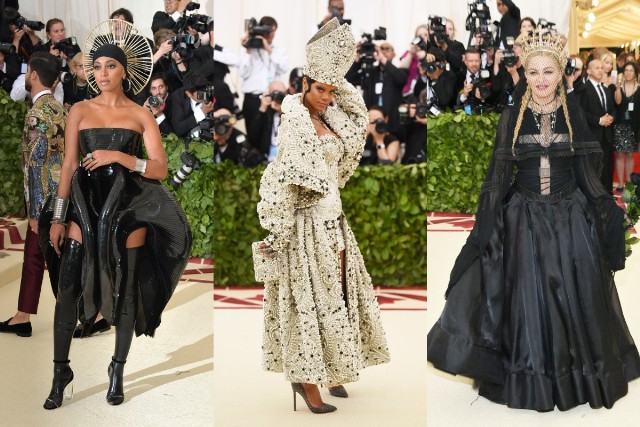
https://static.spin.com/files/2018/05/met-gala-2018-red-carpet-musicians-rihanna-madonna-solange-1525746819-640x427.jpgThe dust up over Met exhibit “Heavenly Bodies: Fashion and the Catholic Imagination” has confused many since it both mocked the subject and displayed the art -- all with the institutional blessing from Catholics  — Cardinal Timothy Dolan opening the museum exhibit and the Sistine Chapel Choir performed for it.  Some cannot figure out why Christians have such thin skins and cannot take a little good-natured ribbing and others cannot figure out why Christians put up with impiety and mockery at things very serious indeed.  Ross Douthat put it this way: When a living faith gets treated like a museum piece, it’s hard for its adherents to know whether to treat the moment as an opportunity for outreach or for outrage.


Christians are not thin skinned.  We are not prone to offense.  In fact, just the opposite.  We allow too much in the name of good-natured fun about things that are not fun but serious -- the kind of life and death serious.  Seeing people dressed up in the fashion of the church through the ages but doing so not so much to inform and surely not to honor but to steal this art from the Church and deprive it of its sacred connection is an outrage.  Muslims would be offended and would make their offense known by threat but Christians are supposed to roll over and play dead.  It all makes me wonder. . .


Perhaps it would be acceptable if there was respect for the institutions of the church or for its doctrine or even some sense of reverence for its practice.   But there is not.  The people in the exhibit and certainly the media stars who wore the vestments of the church as mere costumes did not respect the institutions of the church or even allow legitimacy for its doctrine.  They certainly had no reverence for its practice.  In fact, they are the very voices who seek to silence the voice of the faith anywhere except behind the closed doors of the church.  In the end Cardinal Dolan looked the fool for poking fun at his own church and the Sistine Choir performed as if its words and song had no basis in faith or truth but was merely artistic expression.  And therein lies the problem.  The stuff treated as art and fashion and imagination was never conceived of or used in that way.  It is not art or even beauty for the sake of beauty but the holy things of the most holy Divine Service.

Holiness is not something in fashion now.  We do not take off our shoes before God or even bother to come before Him in the clothing of repentance.  We flaunt our sins and dare the Lord to do something about it.  We confuse His patience with a lack of interest or concern or power on His part.  We betray His mercy and treat as nothing that which is most precious.  All of this too often happens right in the Church -- within the Divine Service.  So it is no wonder that others will take their cue from those within and make fun of it all from the outside.  Strangely, we find no contradiction here and those, like me, who complain about it all are seen to be narrow minded, judgmental, busybodies.

BTW Reverence is not stiff or rigid and holiness is not an act.  Reverence is when what we believe in our hearts and confess with our lips informs, shapes, and directs what we do.  So if you were going to hit the comment button to tell me I am too rigid or formal, that is NOT what this is about at all.

Lutheran School of Theology and Gender/Sexuality. . .

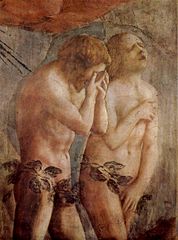
Naked & Unashamed Statement Summary(Written by the LSTC Gender and Sexuality Coalition, 2016)
https://upload.wikimedia.org/wikipedia/commons/thumb/1/13/Masaccio_Adam_and_Eve_detail.jpg/178px-Masaccio_Adam_and_Eve_detail.jpg 
Foundations

As a coalition for Gender and Sexual Justice in our church, the ELCA, we are calling for justice in the regulating of socially acceptable intimate relationalities. We are ELCA Lutherans, ordained and lay leaders, rostered and unrostered, seminarians and theologians, in candidacy and outside of candidacy, participating in the life of the church and leading the people of God in our journey following Jesus. We take seriously the Word of God as revealed in the scriptures and the traditions of the church in living out the Christian faith in various cultural contexts.

The plethora of stories we hear in our conversations demonstrate that life and liberty are being oppressed in the pressure for church leaders to be in marital relationships, or otherwise abstain from all sexual intimacy. The common good of both parishioners and church leaders would benefit from the freedom to be in a variety of healthy relationships, and to hold each other mutually accountable to ensuring that these relationships are life-giving for all involved, including the larger communities.


“An important way that Christians carry out their citizenship is through participation in voluntary associations and movements, both religious and secular. At times, these groups may serve a prophetic function as they protest particular evils, question unexamined assumptions, challenge unjust or immoral practices, and organize for structural changes in the work place, local community, and wider world.” (Church in Society: A Lutheran Perspective 5) We as a coalition for Gender and Sexual Justice have come together voluntarily to do this work of issue raising, protest, and organizing for change in the ELCA.

Abbreviations:
CS Church in Society: A Lutheran Perspective
DGD Definitions and Guidelines for Discipline
HS Human Sexuality: Gift and Trust
V&E Vision and Expectations for Ordained Ministers

ELCA Documents and Problematic Sexuality in the Church

The documents listed above are being used to perpetuate a pressure for leaders in the ELCA to be married, and to additionally conform to oppressive relational and sexual standards set by our church that are often in contrast with our values and lived experience.
  • The expectations surrounding “chastity” purport an ethic of works-based righteousness, positing that certain practices of our sexuality make us a better steward of our pastoral call.
  • Singlehood and non-sexual relationships are undervalued by the overemphasis and limited definitions of marriage and family.
  • The recent inclusion of same-gender relationships in HS, V&E, and DGD still utilizes heteronormative language that sets narrow expectations of what an acceptable committed relationship looks like.
  • V&E and DGD have created a culture of shame in our community, one that manifests itself in both our experience with candidacy committees and among our cohorts. This culture sits in juxtaposition to our current context, politically, economically, scientifically, and medically.
Relational Theology and Sexual Ethic
  • We as Lutherans believe in an incarnational God, whose presence sanctifies flesh and allows us to see sexuality as a “gift and trust,” not a sinful curse we need to control.
  • Theological and ethical arguments that prioritize purity and chastity are in contradiction with our incarnational and baptismal theology.
  • Defining “bad” sex should not be done using theologies of purity. Assessments of good or bad Christian relationality should not be evaluated based on the presence or absence of sexuality, but on healthy power dynamics.
  • There should be no blanket pastoral model of cultural expectations, but instead contextual ministries. The ELCA already practices contextual matchmaking of leaders with their communities under the guidance of the Holy Spirit, and expectations of sexuality should function within this system.
  • We maintain a healthy respect for marriage, without elevating it to the level of sacrament and seeing it as a necessary means of grace. Marriage is one form of committed and intimate relationality, and not the default setting for every relationship.
Conclusion
  • We call for a moral deliberation and discernment process as described in CS initiated in the ELCA where V&E, DGD, and HS are evaluated based on an expanded theology and ethic of Christian relationality. Specific changes we would like to see include:
  • No longer privileging marriage as the only acceptable form of sexual relationality
  • Updating ELCA policies to reflect marriage equality in the United States
  • Editing out language that perpetuates heteronormativity and sexual oppression
  • CS states that moral deliberation in the church is done by gathering a diverse group of people, including “those who feel and suffer with the issue; those whose interests or security are at stake” (6). In light of this, we call for individuals in our coalition to be participants in this process as representatives who are affected by these policies.
This summary is intended to be an introduction to our position. The full statement, which expands on each of these points, should be referred to for clarification and deeper understanding of our stance.

If you can stomach it, take a gander. . . here. . . 


________________________________________

My Comments:

It is clear that the Seminaries of the ELCA are neck deep into the cutting edge of sex and gender issues and they are not only leading the way for the whole denomination but forming pastors under this perspective.  It is also clear that this has become a cause from which there is no turning back.  The ELCA refuses to be rescued by Scripture or the Lutheran confessional tradition.  The ELCA has long acknowledged moving past the prohibitions and ethic of the Scriptures with regard to sex, gender, and marriage and has claimed that the Gospel mitigates against the witness of the Scriptures.  The ELCA has chosen to disconnect itself from its own predecessor bodies and to distance itself from anyone and everyone who refuses this path.  In this respect, the ELCA is clearly following the lead of the churches of Sweden, Norway, Denmark, Germany, etc...  In the end this is not simply about sex, it is about the Word of God, about our continuity with the Word and the faithful who have confessed it before us, about the voice of that Word to address us today.  It is also about our confession and ultimately the ELCA has chosen to acknowledge those Lutheran Confessions only in so far as they can be manipulated to support its present course and insists that it is not bound to the exegesis of the Confessions or to their teachings that conflict with its chosen course.  In the end, it is about a church which has lost its moorings to anything greater than a snapshot of the moment and the feelings, desires, reason, and wills of those in that moment.  For that, we are all the poorer.  The world will judge all Lutherans for the positions of the ELCA and it is increasingly more difficult to stand behind the name Lutheran while attempting to distinguish between the few who disagree with the statement and its perspective and the many who have come to define this as the Gospel itself.

If  you want to know who runs the show in the ELCA, or at least at ULS, read this and don't skip reading the comments because they are more eye opening than the open letter. . .