Just found this program on the Organ of Notre Dame. . .
Monday, May 13, 2019


Sunday, May 12, 2019
Luther the Mariologist. . .

The one who wrote that sentence is Dave Armstrong and you can read the rest of his words here. I expect that this will fire off a storm of comments, complaints that this is from the early Luther and not the later Luther or that he disowned his comments in some secret Gnostic Luther text or that we should not follow Luther blindly (except when he can be employed to support your opinion du jour).
So because I have nothing better to do than to stir up trouble, I would suggest that the author is being very fair to Luther and that most Lutherans today would reject most of what Luther wrote of the Blessed Virgin. It is the sad truth that modern day Lutherans define Lutheranism less by Luther or the Lutheran Symbols than by what their pastor taught them when they were confirmed (especially those confirmed before 1960). We are subject to the misconceptions of Luther only because we tend to proof text using Luther's words more than read his words directly and know the man and his piety as well as his faith.
The irony should not be lost, however, that much of Luther is foreign to modern day Lutherans because we think he stood as prophetic figure for individual faith, for the judgment of reason over the Word of God, was determined to begin a new church, tolerated the Sacraments but elevated the Word and individual faith over all, and was uncomfortable about talking of the Blessed Virgin Mary -- none of which are true except in our own minds.
But I have said enough. Read the article at the National Catholic Register and have at it all you who think Luther was and his kin should be closer to Baptists than Roman Catholics.
Saturday, May 11, 2019
The breath is gone. . .

After visiting several Churches in France, including Notre Dame, Mark Steyn was struck by their emptiness: “One gets the sense that a living, breathing faith is just becoming, actually, a museum, an art gallery, a storage facility.” The cathedrals of Europe are truly magnificent and awe-inspiring, but the awe is for achievements that we no longer seem capable of because we lack the requisite faith.The truth is that Notre Dame today has evolved as a building for good and for ill. It was a wreck for a time, used for a time as a market, and has been rebuilt and adapted many times before the fire. When it was used by Napoleon for his coronation, it was said the service had to be cut short because of the stench of rotting food and animal waste was overwhelming. Some today commented on how fitting it was that the vault fell on top of the terrible Vatican II altar placed at the apse and their hope that this structure could not be replaced and certainly not within 5 years (when Paris will hold an Olympics and welcome many tourists). Could we be in danger of resorting a building's form apart from its function?
Buildings are wonderful things and to all our ability we who inhabit them are shaped by them even as we shape them. When it comes to their use in the Church, these buildings have an even higher calling to express both the beauty and mystery of the Divine and to give good shape to the space whose primary purpose is the preaching of the Word and the administration of the Sacraments. Yet no beauty remains when the building becomes a historical relic to something that was but is no more. There is no nobility left when its space becomes a hallmark of national identity devoid of its sacred identity as a house of prayer. There is tragedy greater than the value of all it holds when it becomes a museum or gallery and it ceases to live and breathe with the Spirit and heartbeat of faith.
Yes, buildings are symbols but they are relics unless what they symbolize lives within their walls. Yes, buildings are treasures but when they treasure something surrendered to unbelief by the majority of those around her, their treasure tarnishes. Yes, buildings are examples but when they become tourist sites more than houses of prayer they are no different than ancient spaces once sacred but now thoroughly secular. Yes, buildings are achievements but when they speak more to the men who built them than they do the purpose for which they were constructed, their spires no longer point to God.
Let me be clear, I am not opposed to restoring Notre Dame and hope that it will happen. But more than this, I long for the restoration of orthodox Christianity to Europe. Where Lutherans are strong or a minuscule minority, where Roman Catholics are vibrant or a faded memory, Europe begs to be seen as a mission field for a culture and a people who once knew God but have now found Him optional at best and foolish at worst. If Notre Dame is rebuilt, let this structure be restored as the cornerstone of a renewal movement designed to do nothing less than bring back the faith as well.
Pretty incredible cell phone footage from inside #NotreDameCathedral today pic.twitter.com/CHSeBxer2v— Pablo Kay (@pablo_kay) April 16, 2019
Friday, May 10, 2019
Style goes out of style. . .
Strangely enough, there were those who looked at our then hymnals, The Lutheran Hymnal (1941) and then new Lutheran Worship (1982) and labeled these "high brow," that is, high culture, German culture, and the music high baroque. The first point is that this judgment would come as a great surprise to those who put these worship books together, to musicologists, and the Bach family who was being yoked to the form of chant and hymns in both hymnals. No one in their right mind who knew anything about liturgy and music would have said that the family LCMS form of the Common Service and its music were high brow or high culture or that they were German or Baroque. Both TLH and LW were captive to their own times, included more English hymns than Lutheran chorales, and, outside of preserving the mass order, they were hardly a repristination of a golden era in Lutheranism. Both books were ground breaking in their own ways but for different purposes and different outcomes. Now, with Lutheran Service Book (2006), it is still a misnomer to label our worship forms, hymns, and music high brow, high culture, German, or Baroque. Just because you might find a Thee or Thou somewhere in the text does not mean the whole thing resembles Bach and Leipzig in the 1700s.
What we too often forget is that the problem of style is that it goes out of style. Sometimes it fades more quickly than others (think here some of the hymn accompaniments of LW) and sometimes it lingers around longer. The worship books mentioned were deliberate attempts to be deliberate and not avant garde (though some refuse to believe this) and all of them succeeded in preserving as well as offering things new. But that has never been enough for those who beat the drum of style divorced from substance. Their pursuit of style is born of the conviction that style is neutral in value to embody the words and works of worship and equally suitable for the confession of doctrine and praying of that doctrine that is worship. They would change forms much more rapidly than we change hymnals and make local changes that might make it hard for some from one area of the church to even recognize the forms used elsewhere -- all the while presuming that the people leading the worship and those in the pews are adept at recognizing, appreciating, and celebrating the doctrinal consistency (while it is largely retained outside the liturgical order and assembly) as enough to give unity to the churches.
Of course there will be change but the Church cannot be cleaning out her wardrobe of liturgical forms, hymn texts, and music the way people follow fashion or fill their closets to reflect the current taste (or size of their body). We have no resources to constantly reinvent ourselves on Sunday morning and this would consume our energy and attention the way the evangelical style congregations consume budget with technology, worship staff, copyright fees, and a constant hunt for the new, different, and contemporary. Yes, take a look at the budgets of those whose worship spaces are warehouses of screens, stages, audio and visual technology, and the liturgy of what is new. These budgets consume many staff and much money trying to keep up with the pace of change. In contrast, the so-called traditional churches find it hard to scrape together a few bucks to pay an organist, money for a decent instrument, and a new parament every generation or so. Where will it end? How current and how new is enough to be in style? What happens when members of the same family or age group find different styles appealing? In the end, style becomes a terrible burden upon those who must reinvent themselves for their ever elusive goal of relevance and friendship with culture.
Not to mention the fact that some styles are not simply styles but do carry their own baggage along with them. It is not possible to embrace every style without adaptation to make it suitable for worship -- adaptation that would mask the style and make it unrecognizable to those to whom it is supposed to appeal! What happens when the style around us grows increasingly vulgar or ugly or intolerant or personal? What happens when we marry the spirit of the age and it turns out that the spouse we have chosen is opposed to or incapable of communicating the sacred mystery? Again, where do we find the resources to accomplish such careful and judicious review of what is new and different, relevant and friendly? And how does this work more than one parish and one pastor wide and deep? Where is the episcope of ecclesiastical supervision supposed to play into this and how does this stretch the very fabric of our unity and common life as a church?
The very appealing thing about style is its weakness -- style goes out of style. And that is one rather non-theological reason why it is a fool's errand to try and remake the church on Sunday morning to reflect the pace of change and what is in style now.
Thursday, May 9, 2019
Fear of growing old. . .

There are many who would applaud Francis and who believe that this is the calling of the faithful today -- to rescue the Church from tradition, from the voices of the past, from the saints who have gone before, and from being your grandfather's Church. Even Lutherans hear this mantra. Times change, people change, the world changes and so must the Church. The worst sin of all is to admit that we have never done that before. Or so it would seem. In our culture that adores youth and works to hide or mask age and esteem, we want our children to be adults and as adults we want to be children. The hoary head is fixed with a box of colorant.
In reality, it is a good thing that the Church hears the voice of those who went before, is slow to change, is seeming aloof from change and chance, and speaks with a voice common to every time and place the unchanging message of salvation in Christ alone. It is not because we fear youth or things new but because we are bound to a timeless truth, expressed through the ages, and delivered to us as a sacred deposit to be guarded as well as put to use in our own time. The truth is that the present has not been sifted through time and review and so it is raw and untested. The voices of today may indeed be relevant and urgent but without discernment and the esteem of the faithful over the ages, the voices speak merely of and to the moment.
It is surely a good thing that many things have come and gone, the things that were thought at the moment to be transforming and profound have proven to be lame and goofy. Think of hymns and how time itself and the voices of the faithful over time have sifted through the body of hymnody to preserve the profound and to forget those unworthy of our voices. It is not fool proof. Some stuff is retained that does not deserve to endure but it is a good thing over all that we are not bound up in this particular moment in time and that we are not captive to the voices of this moment.
And there is another thing. The Church was not established by Christ nor placed upon this earth by God to be a listening post. The Church is God's voice speaking through the voices of preacher and teacher, parent and friend, clergy and lay the timeless truth of Christ crucified and risen. The Church is not some fact finding mission from God to figured out what is going on in the hearts of the people now but place where God dwells in His Word and Sacraments and where the unchanging Gospel of the Christ yesterday, today, and forever the same bestows forgiveness, life, and salvation to those who will receive this gift by the power of the Holy Spirit.
As one who has been at too many Bible studies where the question went around the room what do YOU think it says or who has been to too many meetings where, absent the facts, we stare into each others faces while asking what do YOU think we ought to do, it is clear the Church does not lack for input from the faithful but too often lacks from the input of the Spirit and Word of God. It is not because God is unwilling but because we are preoccupied with ourselves. No, Pope Francis is very wrong here. The Church does not need to be forever young by the judgment of relevance from and the input of youth. The Church is forever young because she is the outpost of the timeless Gospel with the power to absolve the faithful from their sinful past and to bestow upon the faithful the gift of a future death cannot overcome. This is what she speaks and this voice must be heard or sin will condemn and death will reign while God seeks to save and resurrect.
Wednesday, May 8, 2019
Hard cases make good laws???

Nearly every physician admits that there is hardly ever a case in which an abortion is necessary for the physical health of the mother and many suggest that the circumstances when the health of the mother is most at risk lie during childbirth itself. Yet this is used so often as a way of challenging those who insist abortion is wrong. In other words, the extreme case of the physical health of the mother is used to define the ordinary approach to abortion and therefore abortion ought to be legal, easily accessible, safe, and, most of all, free.
In other cases, the extreme is cited to challenge the ancient practice of close(d) communion. In reality there are only rare instances when the sacrament is offered in an emergency and most of the situations are about preference or convenience. Nonetheless, the argument is raised about the instance, no matter how rare, in which urgency and discretion violate the strict rule of close(d) communion and this is used to justify no boundaries to the Lord's Table whatsoever-- at least none beyond the conscience of the individual deciding whether or not to commune. Again, it is a case of an extreme case being used to define regular practice.
Missouri faced this in 1989 when we decided to fudge a bit on Augustana XIV and regularize the exceptions and make it possible ordinarily for non-ordained to do what only the ordained had done. No one can deny the history of exception and exceptional case and yet this was turned upon its head to become the new rule by which every case was an exception and every case was extreme. The Synod ended up regularizing what had been rare and exceptional and it became a burden upon our church body that finally was resolved in 2016.
Those who appeal to a non-liturgical face for Lutheranism often cite the oddity in history or the exception along the way when the liturgy was abridged or even invented for the sake of a rather unusual situation. Then they proceed to suggest that this extreme has become the justification to regularly and uniformly have as a legitimate option the abandonment of our liturgical tradition in favor of a liturgy du jour in which little is ordinary and everything exceptional. Even Luther approached things differently, offering the Deutsche Messe as an alternative where Latin was no longer feasible or where circumstance required a less elegant option than the Formula Missae. Luther himself was loathe to offer something to the church lest it become the rule. So without something, each jurisdiction looked around and worked out something loosely based on Luther's example. This gave rise to the idea that it did not matter and everything was possible. Maybe not right away but later on the exception became the rule until the liturgy itself was considered adiaphora and Sunday morning became a free for all (at least for some)
Progressivism insists that extremes are fertile ground for new rules or laws and it shows itself in everything from morality to who communes to who presides to what Lutherans look like on Sunday morning. Of course, Lutherans are not alone in suffering the government of the church by extreme case but we are not immune from it either. It is high time we stopped using extreme cases to make ordinary rules and laws. We are all the poorer for it.
Tuesday, May 7, 2019
In Christ everything is different. . .

In Luke 5 and Matthew 14 we have another fishing story. This one happened before the resurrection of Jesus. The one we heard today happened after the resurrection of Jesus. In the first one St. Peter is fearful and Jesus ends up calling him to be a fisher of men. In both the disciples have fished all night with nothing to show for it all and Jesus tells them where to fish and they come up with enough fish to sink the boat. We heard that account in February and it was a good sermon, as I recall, since I preached it. This story, though different, has the same center – the center of it all is Jesus.
Simon Peter found himself filled with questions and fears. Who wouldn’t? Jesus had died and now appeared risen from the dead twice. What to make of it all? So he did what he had done a million times before. Perhaps we would have sought out comfort food, St. Peter returned to the comfort of his first vocation. He went fishing. Since a goodly number of the disciples found themselves in the same boat, literally, they went along. It was a long night and again the nets were empty. They had nothing to show for their efforts. To make matters worse, Jesus stood on the shore and asked them if they had any food. Nothing makes a bad night of fishing worse than somebody asking to see your catch.
In both, Jesus intercedes. Though He is a carpenter by trade, it did not stop Him from offering fishing advice. Put the net on the other side of the boat – like they had not thought of this. Any fool knows one side of the boat should not matter yet it did because Jesus was the one directing them. John, the disciple whom Jesus loved, knew it was the Lord and let Peter know. Peter slipped on his outer garment and plunged into the sea to get to Jesus. The rest of the disciples had to drag to the shore the nets filled with fish and eventually they took some of those fish, put them on the fire, and ate their fill.
In the first account, Peter did not want to be near Jesus at all. Depart from me, Jesus, for I am a sinful man, he said. But in this case, Peter jumped into the water and left behind the boat, the fish, and the disciples to be the first to get to Jesus. So what changed? The resurrection had changed everything. It changed how they saw Jesus and it changed how they saw themselves. The resurrection drew them and they came because their sins had been forgiven and they had been set right with God in Christ.
The risen Christ has changed not only the future but the past and the present. Nothing can ever be the same again. Once our sins have been forgiven and death has been overcome, everything has been transformed. Today we find ourselves in the same place as the disciples of old. Easter has come and gone. The sins that distanced us from God have been forgiven and the death we feared has been overcome. We want to be near Jesus. That is what Sunday is all about.
This is now the third time Jesus showed up unannounced and where his disciples least expected. For the third time Jesus showed His disciples that He was Himself, death had ended and sin had been overcome. Though the end of the story has a different conclusion, the meaning is quite the same. Will you be My fisher of men? Is now phrased differently: Do you love Me? Feed My sheep. Jesus is all business. No small talk here. The business of the Kingdom is first and foremost. Simon Peter knows Jesus has been crucified and risen, that his sins have been forgiven, and that his death has been answered by Jesus’ resurrection. Now Peter will be sent to those who do not yet know, so that through this wondrous knowledge, they too may live new lives.
Peter had been in charge of his life until Jesus came along. He had plans and dreams and it was relatively normal. When Jesus entered the picture, everything changed. Peter had a new vocation and there would be danger and even martyrdom in Peter’s future. But Peter was not to fear. For the death that awaited him was not the end of him or even his defeat but his death would glorify God. Death has been put under Jesus feet and He rests His feet upon this enemy as well. The last enemy to be overcome is death and now it is done. Even death will become a tool for glory in the hands of God, the means through which we past with Christ to our own joyful resurrection. Without death to fear, we can be busy with the things of life that matter.
You and I have plans and dreams, some big and some relatively routine. But our lives are no longer our own. Our past has been swallowed up into Jesus’ death, our present has been transformed by the new birth of baptism, and our future directed to the goal and purpose of Christ and His eternal kingdom. Nothing is the same.
That which steals away our hope, our confidence, and our purpose is life – life with all its burdens, distractions, and joys. The devil uses these cares and concerns of life and the things this life treasures most of all to take our eyes off the prize and back on ourselves. The devil’s ploy is to turn our gaze away from Christ and on to ourselves, the world in this moment, and all the things of this world. He works to make us love these more than the rich and glorious treasures Christ has so lovingly given – the forgiveness of sins, everlasting life, and salvation. The problem we face is not simply seeing our future directed but understanding that the past and present are also transformed. Everything that is wrapped up in the moment is now wrapped up in Christ and the goal of our lives is to love Christ more than these and follow Him to the future He has prepared.
Christ’s resurrection changes everything. It is not simply that we shall not be laid down into the dust of death and God is going to do something about it. It is that in Christ we shall not die, but have already passed with Christ through death to the life that death cannot end. Eternal life does not begin in us when we die. Eternal life is our baptismal gift and we live this gift today before we live it eternally. The resurrection of Christ changes everything. Nothing is the same. This is the truth that we wrestle with everyday. What does the Gospel matter? It changes everything or it changes nothing.
Perhaps Peter should have been more fearful of Jesus after Easter than he was of Jesus before Easter, when meeting Jesus while fishing caused him to tell Jesus to leave him alone. Perhaps we should be somewhat solemn given the news of Christ’s resurrection. For what changes is not something that happens after we die, but our past and right now. For now we live by faith but soon we shall see face to face all that risen Savior has prepared.
The worst thing that can happen to us is that we end Easter’s message with a yawn and simply go back to the old ways we do things, we think of things, and that order our lives. There is no yesterday to go back to. The past has been swallowed up in Christ, complete with all our sin. The present cannot satisfy a people who have been given the taste of eternity. We do not wait for this day to begin but we live in that day now, now by faith and soon by sight. We are not looking for the end times but live in them right now. Christ’s resurrection of the dead has signaled the end of everything. The past is gone with our sins and death is undone. We live in anticipation of that eternal future which Christ’s resurrection has made possible.
Nowhere is that more clear than here. Here is the foretaste of the feast to come. Here in the crucified and risen body and blood of Christ, we are fed not for the moment but eternity. Here in this blessed communion is hidden our everlasting future. We taste it by faith now but soon we shall see Him face to face, just as He is, and the transformation He has begun in us will be complete. Do you love this more than today? Do you love it more than yesterday? Do you love this future and will settle for nothing less that the full promise of Christ and His resurrection? It was never Jesus who was in doubt. It was always Peter who needed to discern that future and grasp it by faith and follow Jesus into it. . . and so do we.
Christ is risen. He is risen indeed. Alleluia. Alleluia.
Do not give in to despair. . .

Yes, the Church is fragile and weak, like those within her. Yes, her ministers are flawed people. Yes, the pews are not as full. Yes, the finances are a mess. Yes to all of these and still Christ is risen, sin is forgiven, we belong to God, and death is undone. Yes, the world is a mess threatening ever more toward total chaos. Yes, our leaders embarrass us, our tax dollars are wasted, our economy is tenuous, our lives under threat, our commutes long and arduous, and our jobs a struggle. Yes to all of these and Christ is still risen, we await a greater city, the blessed rest of the faithful, the new heavens and the new earth.
The lesson of Easter is less the surprise that Jesus is risen. He said He would rise, instructed His disciples to meet Him in Galilee, and opened the Scriptures so that we would see this coming. No, the real surprise here is that the disciples who followed Him and appeared so dense were transformed by the Easter message into a dynamo powered by the Spirit to speak, to tell, to preach, and to teach what they had only days before feared even to mention. These were nobodies who now are hall of famers in the sacred temples of the living God. And we are among them. Despair may be our constant threat but it cannot win. Christ is risen and with Him we too shall rise!
And still nobodies stand before altars and pledge themselves to each other as brides as the Church is bride of Christ and grooms as Christ is bridegroom. Still the Lord graces their lives with children and the hope of love is fulfilled. Still this mom and dad bring their children to the waters of baptism that they may know the eternal love that has redeemed them as well as the temporal love that forms their home. Still these parents fold the hands of their sons and daughters and teach them to pray in the darkness and to rise every day in the light of Christ. Still they put the catechism into their hands and teach them its truths to know and pray as the shape of their lives in Christ. Still families gather in darkened churches with candles singing Silent Night and solemnly approach the altar with ashes to sign the inward repentance and wave their branches of palm while singing Hosanna and somberly sing O Sacred Head Now Wounded before rejoicing with Alleluias restored until the Spirit from on high reverses Babel and joins many voices into one, confessing and praising the Triune God.
We do this as Easter people, set free and transformed by the fruits of a death and the death that died -- all for us. Despair may be our constant struggle and our greatest temptation but it has no legitimate place among us. We are Easter people. Easter is not just a season of the Church Year but a mindset, a perspective, and a shape of life. Sin has been forgiven, guilt no more chains us to our shame, life is not random but directed toward a goal, and death is no more the prison from which there is no escape. Think about that today.
Monday, May 6, 2019
Hypocrisy. . .
Honestly, I would love to suggest that the Christian could act with the kind of integrity that would allow them the freedom to vote only for those whose political and theological stands are consistent with their own. That would essentially disenfranchise Christians from the political process and create the larger issue of an absence of people of faith in the choosing of the leaders whom the process has set before us as the choices on election day. Perhaps in primaries it might be easier to be consistent but in the general election, when the choices have been set, we do not always have the liberty to select people whose character and faith are consistent with our own. This is hardly hypocrisy. It is reality.
Sadly, we live in such fractured political times that the good people we would love to elect have largely chosen not to run, not to subject themselves or their families to the scrutiny and feeding frenzy of media -- not for a short time but for as long as two years (witness the numbers of Democrats already turning us away from today and onto November 2020). The tragic fact is that we have structured such a system and such an environment when wise men and women who have made some mistake in their past and learned from it are automatically ineligible to run, when every slip of the tongue ends up causing blood in the water of social media, when parties no longer mean that much and the cult of personality reigns, when special interests dominate, when it is presumed that anyone can only represent his or her own demographic, and when the great issues before us (protection of life is one great example) are buried under a mountain of tweets and sound bytes. If Christians wait for the right candidate who has moral credibility and theological integrity that appeals to them, they will be sitting out the election process for a long time.
There is hypocrisy, to be sure, but it is less the creedal and moral norms that Christians bring with them to the ballot box than progressivism and liberalism parading as open and positive when their ideas are marketed within a politics of division and their conversations open only to those who agree with them. Long ago Christians of all colors have learned that the choices before them may not appeal to their faith or to their morality but they are the lesser evil or have the most chance of protecting the Christians' rights to believe, speak, and practice their faith.
Sunday, May 5, 2019
Whither thou goest. . .

The experts in liturgical renewal insisted that this flowery language not only impeded the understanding of the hearer but was preventing those outside the Church from hearing and understanding the faith. Liturgical renewal of the language of worship was then promoted as an apologetic and mission exercise. By bringing the language of the home, street, and workplace into the liturgy, people would feel more at home, would hear more readily, and understand more quickly the love of their God, Creator and Redeemer. Has it proven true?
I am probably biased in this since when we use Divine Service Three (the mostly TLH page 15 rite) I find myself slipping into the old Thees and Thous that have been expunged in favor of the generic "you". I also find myself slipping back into the old words of the Te Deum (when Thou tookest upon Thee to deliver man) and the Venite (In His hand are the deep places of the earth). Words may mask clear understanding if understanding is the primary goal but words also elevate both the speech and the experience if the primary function of the liturgy is not education but incarnational, that is, to deliver the mystery of salvation through the means of grace.
In essence, we have decided that the lowest common denominator is best. Target a third grade reading level, if you will. But in doing so we have, as one author put it reduced the language of our sacred rites into the equivalent of a spoonful of pureed carrots and the role of the presider as coaxer of the reluctant (“Here comes the choochoo!”). We have, in essence, forgotten the wisdom of Scripture reminding us that we cannot nurse at the breast forever but must grow up to eat solid food. The liturgy is just this solid food (and at the same time mostly direct or paraphrased verses from Scripture both said and sung).
Furthermore, has our drive toward user friendly worship, bland architecture, and basic language resulted in fuller pews and a more convinced and confident church? You look around and tell me that this is so. Instead we have pandered to every whim of culture in trying to make the faith palatable and the liturgy plain only to find our people more secularized than ever, living not in the center of the faith with its profound Sunday rhythms but hearkening more toward the beat of the world and its music, themes, and priorities. I suspect that our rejection of the lofty language that befits the grand mystery of Christ and His saving presence has, in fact, played a decisive role – though certainly not an exclusive one – in the constant drift of people out of our churches, of men into anything but our seminaries, and the respect for the Church as the House of God as little more than public space. As Peter touches, what is it that we are trying to “understand” in our rites? Mystery.
I well remember when the English translation was changed so that in the Creed the people confessed Christ consubstantial with the Father. The cries went out that nobody understood that word. But who fully understands or is able to comprehend what that means that Christ is of one substance or consubstantial with the Father. The Creed was never meant to explain but to confess the faith and the liturgy was never a tool for education (though certainly it does teach) but the people of God praying back to the Father what He has spoken to them. A certain Norman Nagel wisely crafted just this idea in the introduction to the hymnal Lutheran Worship but I fear his words and the whole idea have gotten lost and now it has become difficult, even near impossible, to restore what has been lost.
The house of God is not a lecture hall and the pulpit is not the place where the professor speaks. The house of God is where His Word and Sacraments are, where the mystery of salvation is delivered to be received by faith and trusted by the heart, and where the pastor or priest preaches the Word of God so that God's people might respond with joy and thanksgiving and might bear the fruit of good works in their lives.
Saturday, May 4, 2019
Threat Cannot Make the Church Relent. . .

The state cannot make us surrender ourselves over the threat of taxes. This is what we grant to them by our own choice to give up the faith to preserve our status quo. The state cannot make us do anything but it can make it difficult for us to be faithful in our identity and practice of the faith. And if it is difficult, so be it. Jesus did not promise us a rose garden but warned us against those who would threaten us, who would persecute us, and who would say all sorts of things against us falsely on His account. It would seem to me that this is less threat than test. Are we up to it? That is the question every age and generation faces -- whether the test is poverty or prosperity. In either case, it brings with it the temptation to preserve ourselves by surrendering what it is that we believe, confess and teach.
In the same way, no government can compel a pastor to break the seal of the confessional. They can threaten and imprison, fine and trouble the pastor for holding to the seal of the confessional but they cannot compel him to break the seal. He acts on his own if he breaks the seal and surrenders faithfulness at the altar of expedience. That is our Achilles Heel. Not the power of the government to tell us what we must do or else but our own fear and our surrender of ourselves to the power of that fear. If the state ends up against us and makes it nearly impossible for us to do what we have been called to do, that does not allow us the right or privilege to surrender ourselves to the will of the state. So, unlike many, I do not worry about California or any other state compelling a pastor to break the seal of the confessional for any cause. What I do worry about is my own resolve and the resolve of those like me to maintain our faithfulness even under threat. After all, there are so many pastors who daily face threats far more real and profound than I might possibly face. Who would I be to surrender to the power of fear rather than to endure the trials and tribulations of faithfulness when they have maintained faithfulness under far worse conditions?
A few years ago I watched the terrible spectacle of the Christians beheaded by agents of ISIS. I am sure you saw them as well. They made a great impact upon me. These were common and ordinary folk -- moms, dads, and children -- who under extraordinary threat showed extraordinary faithfulness and integrity. I am sure that such will never happen here -- at least in the foreseeable future. Yet I am also sure that Christians will face increasing threats to their free exercise of religion and that some of these will surely require us to choose between resistance and the consequences and the easy way. It is my hope that I will not relent to the power of fear and the threats of the state and that there will be many more who will stand together in the same conviction and with equal courage. Yet I do not know this. This is my conviction. What I do know is that the Lord will not abandon me or any who under threat, persecution, or slander remain faithful to Him and to His Word.
Friday, May 3, 2019
Guardians but not inventors. . .

Apostolic succession is supposed to be a guard against heresy and apostasy but in reality there has been no guarantee that bishops as a structure or office are themselves any guarantee of orthodoxy of doctrine and practice. Anglicans have certainly preserved the office and all its ceremony but that has not done much to preserve catholicity and orthodoxy within Anglicanism. Rome has found its own failures and failings in the sexual abuse scandal, in the Cardinal Danneels and hia own failure in Belgium and the German bishops and the shell of a church they have passed on to those who follow them. Even Orthodoxy has had some clingers and the episcopal structure has not prevented a Western oriented Orthodoxy among some or the confusion of a Western Rite that lives side by side the Eastern Rite.
Lutherans have had the same problem. There are those who are ordained to preserve the faith by their faithful exercise of the ministry of the Word and the Sacraments who have, for all intents and purposes, set aside the means of grace in view of man-made programs that essentially bypass the instruments by which the Lord establishes and preserves the faith for questionable pursuits that tend to elevate culture and preference over the Word of the Lord that endures forever. Certainly we saw this unfold in the ELCA when, by their own admission, they set aside Lutheran and catholic belief and practice to embrace the GLBTQ agenda. Less obvious but still as pernicious is when adiaphora becomes the cover for abandoning the Divine Service and when the pursuit of relevance is placed above the liturgical identity that more completely reflects the doctrine believed and confessed.
Thursday, May 2, 2019
From House Party to Formal Dinner. . .

I wish I knew whether conclusion guided study or study led to conclusions. In this case, it seems that the conclusions were imposed upon the evidence. While we do not have specific histories, we do have a rather complete written record. In every case, from the Apostolic Constitutions to the Didache to the earliest Christian writers individually, the unmistakable conclusion is that order was not a late concern but one of the earliest (witness St. Paul's own liturgical directions in his epistles). It also appears that form was not imposed upon freedom but the freedom of the early liturgy was revealed in common forms and common words that showed a profound respect for unity not only in doctrine but in practice. Nowhere is this more true than in the shape of what has been considered the first uniquely churchly structure, the excavated 3rd century house church in Dura-Europos (located in what is now Syria).
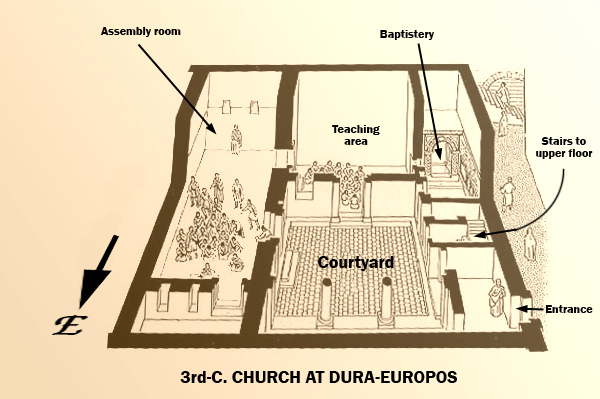
Far from folks sitting around in a circle singing folk songs, the form of this building implies an Eastern facing posture and clearly defined roles and areas to define the solemnity of the liturgy and the Divine Service. A document reflective of the time makes it clear what is going on in this space:
Now, in your gatherings, in the holy Church, convene yourselves modestly in places of the brethren, as you will, in a manner pleasing and ordered with care. Let the place of the priests be separated in a part of the house that faces east. In the midst of them is placed the bishop’s chair, and with him let the priests be seated. Likewise, and in another section let the lay men be seated facing east. For thus it is proper: that the priests sit with the bishop in a part of the house to the east and after them the lay men and the lay women, and when you stand to pray, the ecclesial leaders rise first, and after them the lay men, and again, then the women. Now, you ought to face to east to pray for, as you know, scripture has it, Give praise to God who ascends above the highest heavens to the east.
Now, of the deacons, one always stands by the Eucharistic oblations and the others stand outside the door watching those who enter, and afterwards, when you offer let them together minister in the church.And if there is one to be found who is not sitting in his place let the deacon who is within, rebuke him, and make him to rise and sit in his fitting place … also, in the church the young ones ought to sit separately, if there is a place, if not let them stand. Those of more advanced age should sit separately; the boys should sit separately or their fathers and mothers should take them and stand; and let the young girls sit separately, if there is really not a place, let them stand behind the women; let the young who are married and have little children stand separately, the older women and widows should sit separately.
And a deacon should see that each one who enters gets to his place, and that none of these sits in an inappropriate place. Likewise, the deacon ought to see that there are none who whisper or sleep or laugh or nod off.
For in the Church it is necessary to have discipline, sober vigilance, and attentive ear to the Word of the Lord. (Look here for more. . .)
 It was impossible for the ancient Church to go from the disciplined order of the Temple and
 synagogue to some sort of free for all. Indeed, St. Paul is adamant that God is a God of order and not of chaos and that disorder is an affront to God and a detriment to the life of God's people and their place as the recipients of His beneficial grace in the Word and Sacraments. So how goofy is it that we have enshrined this false idea under the guise of liturgical scholarship and give legitimacy to what the early Church worked tirelessly to avoid! For where there is such liturgical confusion and disorderly gatherings, the work of the Lord is overcome by the will, desire, preference, and purpose of people. That is exactly what has happened. Either we have dictated a clericalism in which the pastor serves as chief MC and director to bring purpose out of chaos on Sunday morning or else we have made such chaos holy and insisted this is what God wants. How anyone can read through the Old Testament and follow the liturgical practice of Jesus Himself and come to such a conclusion is a great mystery indeed. Order has been a primary concern, along with faithfulness, from the get go. Once we dismiss the mythology of some camp meal around a fire while folk songs are sung, then perhaps we will begin to get back to where we need to be in a mature conversation about what the shape of that liturgy is and should be.
Wednesday, May 1, 2019
Thematic lectionary. . .

While it might seem to be a vast improvement over the three year lectionary, I am not so sure about this direction. In essence, the proposal is to remove every vestige of the lectio continua and to choose readings that coordinate more obviously. In other words, the Gospel will drive the choices of the lessons, the revision of the collects, and all the other propers. It is not hard to see the benefit of structuring the propers in this way. After all, we live in a sound bite world in which everything important can be said in 140 characters. Why not revise the lectionary so that all three readings can be summarized by a single tweet, the theme reduced to a common thread so blunt and clear that nearly everyone can figure it out. If only it were possible to control the preacher and the sermon in this way so that the whole of the changeable parts of the Divine Service could be said in one short, pithy phrase.
The WELS blog updating the state of the new hymnal put it this way: Thematic Sundays are a chief feature of the new lectionary. For example, rather than a series of continual readings through an epistle, the second reading will fit the theme for each Sunday. Again, I get the point and can even see some justification for it all but in the end I find it all a little too neat and tidy -- a little too controlling. It is as if we want to tame God's Word by giving it a thematic structure, sort of a modern version of the old Nave's Topical Bible for the lectionary crowd. It will certainly make for easy work in preparing the homily when the pericopes all speak with one voice a common and obvious theme.
Perhaps the next thing will be to work up a thematic treatment of the hymnody.as well.
Perhaps you are surprised that I should be so concerned since I do believe that the lectionary ought to be driven by the Gospel reading and I do see the value in seamless approach to Sunday morning. But I fear we have taken it too far and taken the work away from those preparing the sermon and planning the service as if they were inept or unconcerned about it. The truth is that while there is a thematic thread already (and in the historic series that preceded the changes), there is not one exclusive theme. Indeed, there is a richness of options inherent in the structure of the Old Testament, Epistle, and Gospel readings that cannot be reduced to a simple thematic phrase -- nor should it be. So I am concerned about what this penchant for unity will do to the church at worship and to the faithful as they head home from Sunday morning. I am inclined to say that it should not be so easy or so obvious. I am not trying to be smug about the efforts of our relatives in Wisconsin. I am raising a larger question about the direction of this liturgical progress and the shape of our future as revision and change come to the lectionary. I wonder if there are others who agree.
Tuesday, April 30, 2019
Christ's peace here. . .

Alleluia! Christ is risen! He is risen indeed! Alleluia!
Peace is something we all want
in our lives, but we rarely find it.
What we wouldn’t give for some peace and quiet in our ever changing,
constantly moving, always on the go lives.
What we wouldn’t give for some peace from all the social conflicts and
politics unrest, from all our struggles at work, from all the shouting at
home. Peace seems to be absent in our
world, nowhere to be find. But it’s not
absent. It’s here. Christ’s peace is right here, in His Word and
Sacrament, for you.
The disciples were without peace on Good Friday. Their Lord was gone. The One they’d followed for three years, the
One they left everything for, was gone.
Their Teacher whom they lived with and saw perform all sorts of
miracles, He was gone; dead. He was
betrayed by Judas into the hands of His enemies, and He was betrayed by all the
rest when they ran away after His arrest.
Peter betrayed Christ when he outright denied knowing our Lord, even
though just a few short hours before he promised he’d follow Jesus wherever He
went, even to the point of dying for Christ (Jn 13:37).
The disciples were without peace on Saturday, not knowing what would
happen to them. As they quietly kept the
Sabbath, their future was uncertain.
They were without peace on that first Easter Sunday, afraid and
confused, not knowing what happened to the body of the Lord. Peter and John saw the empty tomb, but they
still didn’t understand the Scripture.
That night, they all gathered in a locked room because they feared the
Jews. Would the Jewish religious
authorities come looking for them? Would
they be arrested and beaten, accused of stealing Jesus’ body. Would they be handed over to the Romans to be
crucified like Christ? Just imagine the
angst and anxiety the disciples felt.
And then, out of nowhere, Christ appeared in their midst.
The first words out of Christ’s mouth were exactly the words His
disciples needed: “Peace be with you” (Jn 20:19). These words weren’t hollow encouragement or
tentative assurance. These words gave
exactly what they said. The Lord His
peace, peace of the forgiveness of sins.
The disciples needed this peace, this forgiveness. They’d abandoned their Lord. They denied knowing Him. They didn’t believed His resurrection
promises. But with Christ’s words, that
guilt was taken away. He was there to
give them peace. He was there to send
them out, so that they too could speak peace giving words of forgiveness.
On that first Easter night, all
the disciples knew the peace of forgiveness and the joy of the risen Lord,
except for one...Thomas. Thomas wasn’t
there with the other 10. We don’t know
why or where he was, but he didn’t see our resurrected Lord. He didn’t hear His forgiving and peace giving
words...and when they others told him about Christ’s resurrection, He refused
to believe. He wanted physical proof,
hard evidence.
So the next Sunday, again, they all gathered in a locked room. And again, our risen Lord appeared to them. And again He said: “Peace be with you” (Jn
20:26). Then He turned to Thomas and
told him to put his fingers into the nail holes of His hands and to put his
hand into His pierced side. Immediately,
with words of faith, Thomas confessed, “My Lord and my God!” (Jn 20:28).
Jesus appeared with peace and
forgiveness for His disciples, men who’d abandoned Him, men who’d doubted
His. And we do the same.
Like the disciples, like Peter, we abandon the Lord in interest of
self-preservation. We hide our faith
when it’s not beneficial to show it: in the hallways of school, at the water
cooler at work. When our faith causes us
to be an outcast or social pariah, we deny it.
We abandon the Lord when we look for peace in other places: in our bank
accounts, in our social status, in the governments and laws of this world. We abandon our Lord and the holy living He’s
called us to when we give in to the temptations of our sinful flesh and the world.
Like Thomas, we doubt the Lord and promises. Instead of hearing and believing the words of
Scripture, we want to see physical evidence.
We demand God give us the proof of miracles. We want Him to give us personal assurances on
our own terms instead of trusting the Word He’s spoken to all. We want to be the deciders of our faith, what
we can believe and what we won’t believe.
We want to pick and choose the truths of Scripture.
In all of this, we think we’ll find peace. Peter sought peace in his denial, thinking it
would save his life, but it only brought guilt and shame. Thomas sought the peace of physical proof,
but the Lord says: “Blessed are those who have not seen and yet have
believed” (Jn 20:29). Our sin, our
abandonment, our doubting, it doesn’t bring peace. It brings death. But the Lord has overcome your death and
brings you peace, right here, today.
Just as our Lord came to His disciples in that locked room, He comes
to you here. In His Word and His
Sacrament and He says “Peace be with you.”
This peace is the forgiveness of your sins. As you confess your abandonment and doubt,
the Lord answers with His absolution, spoken by His pastors. These men, like the disciples, Christ sends
out to forgive the sins of repentant sinners.
And after that absolution is spoken, the pastor says, “The peace of
the Lord be with.”
Christ’s peace comes to you in His Holy Supper. As you eat and drink the Lord’s body and
blood, He gives you the peace won with His death and resurrection. You receive forgiveness, life, and salvation. After words of our Lord are spoken, the
pastor raises the host and the cup and proclaims, “The peace of the Lord be
with you always.” And then again,
after you’ve communed, you’re dismissed with these words, “The body &
blood of our Lord Jesus Christ strengthen and preserve you in body and soul to
life everlasting. Depart in peace.”
In these things, in the Word and Sacrament of our Lord, you are given
His peace. This peace is a constant,
always here. Here you receive the
forgiveness of sins. Here you receive
everlasting life. Here, in His
sanctuary, there’s peace from all the craziness, chaos, and turmoil of our
sinful world. This peace is a peace the
world cannot give. This peace is
everlasting and it overcomes all sin and death.
It overcomes your sin and your death.
Christ gave His peace to His disciples after they abandoned and denied
Him. Christ gave His peace to Thomas
when he doubted the Lord’s resurrection.
And Christ gives you His peace through His Word and Sacrament. This peace is the forgiveness of sins. This peace is the assurance of life. This peace is your promised salvation.
Alleluia! Christ is risen! He is risen indeed! Alleluia!
Subscribe to:
Posts (Atom)