Tuesday, March 14, 2023

The water that is everything. . .

Sermon for the Third Sunday in Lent (A), preached on Sunday, March 12, 2023.

Water was once something that defined everything.  Clarksville was founded because of its place at the junction of two rivers.  Wells were the center of villages. A water source defined the routes through deserts and prairies.  Lewis and Clark moved along a path of waterways to the West.  We hardly think of it now.  The Romans taught us that water could be brought into cities and now a drought is the only time we think about this precious resource.

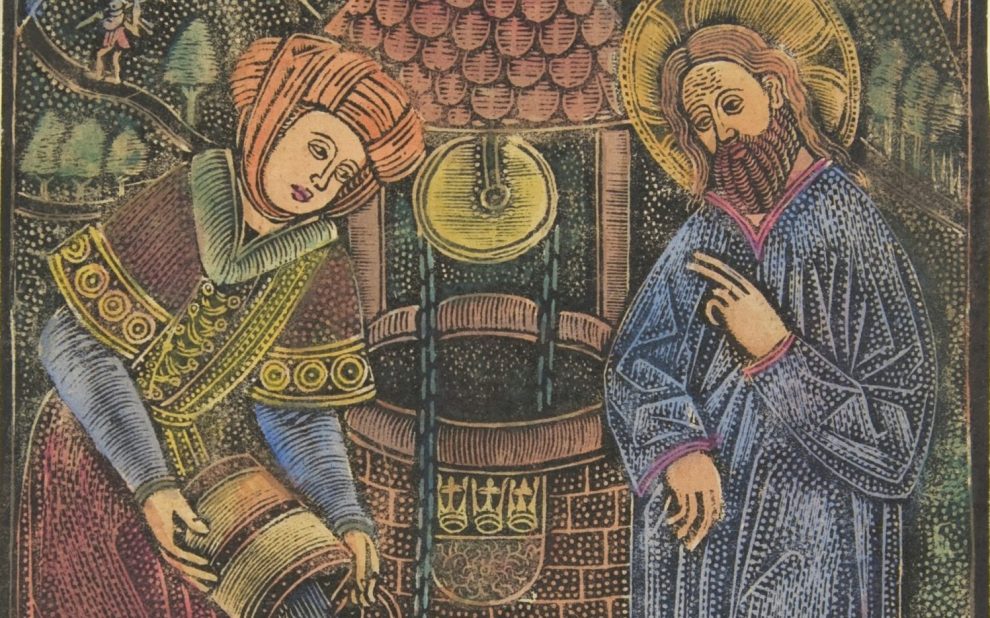
So it was in Samaria where life circled the water source.  Jacob bought land from Shechem and dug a well there so he and his household could live there.  Long after Jacob was gone, the well continued to supply the people living there.  Sychar is gone but Tel Balata remains, near Mount Gerizim, the tombs of Rachel and Joseph, and the Oak of Mamre.  Tradition has named the Samaritan woman in our Gospel and the Orthodox built a church over the well in 380 AD and named it for her, St. Photinia, in Russian Svetlana, which means enlightened one.  It remains on the West Bank.

Jesus does nothing by accident.  Thirst might have driven you or me to a well but Jesus was thirsty for souls for the kingdom of God.  He waited at Jacob’s Well for the disciples who had gone into town for provisions.  It was about the sixth hour.  In the noon day heat He waited.  A Samaritan woman came, the woman Jesus had been waiting for.  Samaritans and Jews had nothing to do with each other.  This Samaritan woman came for water in the heat of the day when it was unlikely others would be there.  But Jesus was.

The Lord did the unthinkable – He asked the woman for a drink.  It was not simply impolite but would have rendered Jesus ritually unclean to have touched a cup that she touched.  It was not about the cup, however.  He told her she should have asked Him who He was, recognized Him as the gift of God even a Samaritan would have known about, but she did not.  Then comes the hook.  Jesus said that He could give her living water but she reminds Him that He has no bucket to dip deeply into the earth to pull up any water.  Was He going to dig a new well like Jacob?

Finally Jesus confronts her.  The water of every well can only quench the thirst for a brief time until it returns again but I give water that quenches thirst forevermore.   It is the same type of comparison Jesus made with the Jews over the manna Moses gave them in the wilderness.  They ate and were hungry again and they died but Jesus gave the bread that filled them with eternal life so that they might never die.

The woman takes the hook.  “Sir give me this water that I may never thirst nor have to carry water again.”  But before this can happen, Jesus calls the woman of faith to repentance.  She has had many men and none were husbands.  Now she knows for sure that this is not only about water.  But the subject of her sin is uncomfortable so she changes the subject.  Gerazim or Jerusalem?  Samaritan or Jew?  Who is right?

“The hour is coming and is now here,” says Jesus, “when true worshipers will worship the Father in spirit and in truth.”  Now she knows.  He is talking about Messiah.  But is He Messiah?  Jesus removes all doubt.  “I am He.”  The water jar is no longer of interest to her and she runs into the town telling them the Christ has come and they ran out to Jesus to be enlightened by His Word to salvation and eternal life.

What has this to do with us?  First of all let us do away the idea that every religion has bit and pieces of the truth.  Jesus does not acknowledge parts but insists upon the fullness and the fullness is in Christ where Jew and Samaritan and Gentile meet the truth and are enlightened by the Spirit to worship the Father in spirit and in truth and to be saved for everlasting life.  Jesus does not give Himself in bits and pieces but in the fullness.  That fullness enables the true worship of faith, faith formed by the Spirit and called into being by the truth.  The water is not symbolic unless Jesus is merely a symbol.  It is the means of grace.

In this passage baptism is prefigured – not the baptism of repentance for the forgiveness of sins which John had done and which continued all along as Jesus fulfilled His public ministry but the new baptism in which the Spirit and fire come in the water that lives and gives life.  You do not come to this baptismal water but the water has come to you.  It comes in the Christ who fulfill all things for us and for our salvation and who ushers in the only path to the Father by which sinners have access to God.  It comes by way of the Spirit who opens our hearts to receive Him who is the Gift of God, the long promised Messiah.  It comes in water unlike every other water because the Word and power of God work in this water for new and everlasting life.

The Jew and the Samaritan and the Gentile become one in this water – water that breaks down all barriers and bestows unity with the Father through the Son by the power of the Holy Spirit.  This unity cleans up what separates us from this holy God by forgiving our sins and taking away their guilt and punishment.  This unity does not choose one side or the other but transcends all divisions with the Truth that is not bits and pieces which we add together to find the whole but the fullness of all that God is and has done for us and our salvation.

Water still defines everything.  Not wells or rivers or springs but baptismal water. Here in water the Gift of God is given even to those who know not who that gift is. It comes by way of the Spirit who breaks down the barriers of our hearts and cleans the cobwebs of our minds so that we may see Jesus, confess Him as the Christ, and be born in Him in baptism for eternal life.  

Those who practice believers baptism insist that the water does nothing but point to Jesus and we do it all – repent, decide, choose, and believe.  What utter hogwash!  The God who made us now requires help from us to save us?  Who are we kidding?  You do not earn a gift.  Christ is the gift of God giving the gifts He has won for us – forgiveness, life, and salvation.  The Spirit is the work of God who opens our stubborn hearts to what God has done and gives us the voice to say “Amen” to that work.  It is the Trinity working in the one work of our salvation, repairing the breech between God and man, uniting every earthly division in the confession of one Christ for the one people of God, through the agency of the Spirit who calls, gathers, enlightens, and sanctifies us.

True worship is not about sincerity on our part or about us being really into it or us feeling like we are getting a lot out of it.  True worship is the only worship – the worship made possible by Christ in the means of grace, worked by the Spirit and not by human will or desire, to bring us to the Father that we might be His own now and live with Him forevermore.  Quite a bit for a noonday conversation at Jacob’s well and even for a Sunday encounter in the Divine Service.  In the Holy Name of Jesus.  Amen.

The goals of liturgical reform...

If I had to put a frame of reference around what I consider to be the legitimate and laudable goals of a true and authentic liturgical movement, it might look like the following list.  While some of those have certainly coalesced around the form of the liturgical movement as we have seen it, others remain yet to be pursued and still others have been contradicted by what the modern liturgical movement put in place.  It is a common truth that the modern liturgical movement ended up being driven by scholarship and located in academia but the impetus for and the earlier manifestation of that movement was largely parish centered for pastoral goals.

The most basic aim of any true liturgical movement is to enrich the spiritual life of the baptized and this is first done not by tinkering with rites or ritual but by the recovery of the idea that faith is formed from and nourished by the Divine Service.  In our age, the restoration of this has been hindered and distracted by the availability of popular media (both internet and print) that posits the spiritual life of the individual in the individual, the individual's preferences, and what the individual finds meaningful.  In the end this not only devalues what happens in the gathered assembly around the Word and Table of the Lord but detracts from the Word and Sacraments themselves in favor of things sentimental, emotional, and experiential.  The objective gift of the means of grace embodied within the Divine Service is generally less interesting and less important to the individual than the individual pursuits of meaning and relevance.  The Church was never optional but became optional to the point where now online and in person are hardly seen as different.

With this restoration of the Divine Service as the source and summit of our faith and lives in Christ, the corollary is the realization that the Church is our mother in the faith, having given the faith birth in the womb of the font and nurtured our faith through the weekly rhythm of Word and Supper.  The notion of a private faith or an individualized faith is a late and modern invention to replace our dependence upon the means of grace and the Spirit to create and sustain faith in us.  There is practically little difference between the individualize faith practiced even by Christians within a liturgical tradition and the decision based faith of the evangelical tradition.  The true liturgical movement reminds us that we need the Divine Service for it is therein that the Word continues to grow us in Christ and Christ in us and the Eucharist feeds us here the bread of heaven and the cup of salvation as foretaste of the eternal feast to come.

As noted by the abysmal statistics of how many and how often the typical Lutheran attends the Divine Service, it is clear that while forms may have been restored, a weekly Eucharist more the norm than it was, the ordinary faith of our people is neither dependent upon or tied to the Divine Service.  Our practice is better but our piety still lacks its focus and ground divinely supplied by the gift of the sacramental Word and the Eucharistic mystery received.  When it becomes routine to number and define membership not by who is together around the Word and Table of the Lord but by names on a roll and to count as members whose who have not darkened the door of God's House for years, it is clear that the aim of the true liturgical movement remains unrealized.  Look at the roster of any Lutheran parish or jurisdiction and you see how ordinary this extraordinary circumstance has become.

When the modern liturgical movement become enamored by rites and history instead of the pastoral goals named earlier, it provided the perfect storm for that movement to go off the rails.  In its pursuit of a more pristine and early rite, it forgot who the people were and what the Divine Service was for.  In its goal of reform, it instituted a rupture in the organic and deliberate development of the rite and left people behind in a hermeneutic of discontinuity that harmed rather than helped the original pastoral aims of the movement.  Contrary to those who would mark every accomplishment of the modern liturgical movement as tainted or prone to error, its primary problem and its incomplete conclusion resulted from forgetting that the rite does not exist in a vacuum but as the place where people are called, gathered, enlightened, and sanctified by the Spirit to be God's own and live under Him now and forever.  Private confession, the recovery of a baptismal identity and vocation, and the restoration of virtue and good works were all hindered by this focus on rite and ritual over purpose and meaning. 

Stay tuned for more....

Monday, March 13, 2023

We need the Law. . .

Sermon preached for the Sixth Sunday after the Epiphany (A), on Sunday, February 12, 2023.

When Adam and Eve were confronted in Eden, they did not argue that what they did was not wrong.  Sure, Adam blamed Eve, Eve blamed the serpent and so put the blame right back on God but neither of them could say that they had not broken God’s command.  What Adam and Eve did not do in Eden, we have learned to do.  When caught in things that are wrong, we not only blame others for our sin but we argue with God that the command either did not apply or it was not a good command.  This we have turned into high art with all kinds of unsavory thoughts, words, and deeds.  We have become the people God lamented – who ignore His law only to do what is right in their own eyes.

Jesus insists over and over again it is not His work or purpose to abolish the Law or to silence the prophets who call sinners to repentance.  Yet we Christians have worked very hard to distance God’s law from grace and to live as if it were all good as long as it is consensual and done in moderation.  We have decided that the problem lies with the law and the voices of those whom God has sent to square our lives according to that law.

The problem does not lie with the law or the voices calling us to repentance.  Yes, the law promised life but because we could not keep it, it was a promised unfulfilled.  The Law was and in not bad but we are constrained already by sin so  deep within our desires and wills.  Sin led us to jump at the chance to fulfill the law with all the vigor and enthusiasm of a people making a New Year’s resolution to lose weight or exercise more.  But as soon as sin saw how hard it was, we lost interest in keeping the law and began work to undermine it and justify ourselves.

Just as the Tree of the Knowledge of Good and Evil was not evil in itself – indeed Adam and Eve saw that the fruit was good and pleasing to eat.  It was the aftertaste  that spoiled it all.  So also the law is good and wise because it comes from the holy mouth of the holy Lord and reflects His perfect wisdom and will.  Sin could not change the commandment itself but sin changed the people who living under that law.  And those under that law, worked to change the law so that it was manageable and twisted it until it pointed not to God but to us.

So also those who warn us are not the problem.  The doctor who warns you about the consequences of your unhealthy behavior is not to blame when it happens.  When St. Paul writes in Romans 5 that death reigned from Adam to Moses, he tells us something we often forget.  He could have said death reigned from Adam to Jesus but he did not.  That means that the law given through Moses was not the cause of our death.  Sin was.  What the law was and is remains a sign of God’s grace.  When the law is given through Moses, the prophet begins with a profound statement that is in itself a promise.  “I am the Lord your God.”  It should have been obvious to the Jews whom He had brought through the waters of the Red Sea and on whom He had placed His name through the burning bush.  But it wasn’t.  Chafing under the law, they had forgotten that their God was a God of promise.

The law is not evil but good.  It kills, yes, but it also gives life.  It bestows upon no people a standing as God’s people and gives them a land, a kingdom, and an inheritances.  This law will endure when the grass of the fields are gone; when heaven and earth have passed away, the Word of the Lord shall remain, perfect and holy.  How we see the law changes in Christ but the law does not.  To those who have not been covered with Christ’s righteousness it only accuses.  Nobody wants the pointy finger of the law aimed at them and so God attached the promise of a righteousness that came not from our keeping the law but Christ keeping it for us.

But with the statement of God “I am the Lord your God” we meet mercy for the sinner and grace for those who stand under the law and its accusation.  Whatever Israel did in breaking the law, God provided a path to forgiveness and restoration. The Day of Atonement placed Israel’s sin upon the sacrificial lamb and the scape goat with a view to His Son who would become both for us.  Here is grace to forgive every sin with the blood of Christ, to rescue those who deserve nothing of His kindness, and to welcome the prodigal son home to the father who still claimed the sinner as his own.

So now remains, what shall we do with this law?  Shall we silence its accusation by renaming what is sin?  Shall we simply ignore its voice in the hope that it will finally shut up?  Shall we argue that because we are redeemed we have no need of nor do we want the law anymore?  Shall we try to make evil what God spoke for our good?  Or shall we not simply bask in God’s love and mercy to forgive us and work to become the people the law describes?  The law will always accuse but to those who live in Christ by baptism and faith, it has nothing more to condemn.  All our sins have been removed from us as far as the east is from the west and what was scarlet has been washed whiter than snow.  In this way the law points to Jesus.


Yet the law remains for us because we still need direction through this sinful world.  We need to know what is right and wrong, good and evil, of God and of the devil.  We need to have an objective voice to guide us through this world of darkness and not simply our own feelings or desires.  We need to be protected not only from the evil out there but the evil in our hearts trying to undo what Christ has done in us and for us.  We still need a light for our path and a lamp to shine before every step we take.  And in this way, the law still points us to Jesus.

It is the most glorious thing that God welcomes sinners and forgives them.  It is the power to rescue a people who have no reason for God’s rescue except His great love.  But we cannot and dare not turn this rescue into the cause to remain in the sins that would bind us and the familiar paths of evil that would corrupt what God has made holy and pure.  Our witness to the world is not the freedom to do as we choose but the self-discipline and self-control of those who hearts now belong to the Lord and with them our wills and desires.

The world loves to point at our sin and say we are no better than they are.  The world is correct.  Our righteousness is still rags apart from Christ.  But our witness to the world is that we know a better God, a God of mercy who takes away all our sin and whose mercy insists upon speaking the guiding word of His law to show us what a holy life looks like and the power of the Spirit to keep us on that narrow way.

Of course.  Christians get caught up in sexual temptation and sin, divorce, steal, lie, dishonor, and bring shame upon themselves.  Of course, the blood of Christ still cleanses sinners and the grace of Christ restores those who fall who come in contrition and repentance.  But let it not be that we know the ways of sin better than the ways of God, that we willingly enter into sin rather than fight against it, that we strive for the flesh instead of the Spirit, and that we do not care about sin anymore rather than knowing how evil sin is and working to avoid it at all costs.

The Lord saves you.  He is your God and your Savior.  He is also your Guide and the Light to show the path that leaders to everlasting life.  Stay on that path.  Hear the law of God guiding your way, warning you when veer off the path, accusing you when you sin, and pointing you to Christ your salvation and your righteousness.  That is the shape of your life now.  In the holy name of Jesus.  Amen.

Sunday, March 12, 2023

Not an ideology. . .

It is pretty clear that what claims to be woke is not science or fact or truth but an ideology.  The phenomenon that appears to be recent is, in reality, not new at all.  It has its roots at least a hundred years ago and probably further back than that.  Although we did not begin hearing about it until 15-20 years ago, the whole mess is repackaged cultural Marxism.  What was once almost exclusively the domain of academia, eventually pervaded entertainment,, business, politics, and culture as effectively as it had taken the reins of education.  Wokism claims to pursue freedom from the oppressive institutions of white male hegemony but it is its own prison and oppression.  What claims to be liberating is actually a force for the destruction of anything and everything that came before it.  It is an ideology of deconstruction that has disruption as its primary agenda.  The joke of it all (which makes none of us laugh) is that it offers an illusion of progress in a world in which everyone matters, everyone's truth is honored, and everyone is guaranteed justice.  But it is a pseudo science that cannot deliver on its promise and masks its failure in the right of everyone to be angry in an endless supply of victims.

The tragedy is that well-meaning parents offer up their sons and daughters to the gods of education who have nothing but disdain for the views and values of the parents and who presume the right to turn our children against everything we stand for -- all the while we pay them for the privilege of being abused.  The whole educational enterprise in America is touched by this lie -- from the preschools that prepare our children to be liberated for diversity, equity, and justice to the universities that were once the only places you could find this ideology.  Then, in the midst of it all, we are told by these merchants of destruction that their reality is beyond real, their truth beyond truth, and their experience beyond history.  They make it out to be a battle of ideologies into which we Christians are merely frustrated and bitter because our ideology is no longer in vogue.  But that is the point.  Ours is not ideology.  Ours is not pseudo science.  Ours is not a relative truth that lives only in the half reality of an individual mind.  Ours is a faith that does not ask us to pin our future to an imagination but a reality of promise and fulfillment that is built upon history and fact.

Christians have to stop acting like all we have is an ideology -- no different from or better than any other ideology.  We do not have our truth to challenge their truth but the only real truth that ever did or could exist.  We give to the world not an improved feeling but fact, not a localized truth but a once for all truth, not an experience but a mystery once hidden and now revealed with power to rescue us to eternal life.  Reality is not what we choose but what has chosen us not for destruction but for life.  Where this starts is in the home as we teach our children well and build one another up in this hope.  But we are not given only the refuge of the home.  We stand our ground before the lies because we are armed not with an ideology but the only truth that matters.  We have evidence to support this reality and facts to provide us with a firm and objective foundation for our identity and for our lives.  This hope is not a mere matter of words to be said but transformative lives, manifesting an eternal righteousness right here in time.  But none of this will happen as long as we are content to live our lives in comparison to the world instead of Christ and His yesterday, today, and forever Word.  It may not seem like it is much in comparison to the woke captivity of our vaunted institutions, history, intellect, and truth but all we need to do to resist the lies is the truth.  God has promised that this Word of truth will not return empty but will accomplish His purpose -- even if we cannot see with our eyes any headway or chart any progress.  So stand up and stand firm.  What you struggle against is not flesh and blood but the demonic and yet one little Word can fell him.

Saturday, March 11, 2023

A few thoughts on a Christian university. . .

For a long time the idea of a Christian university has morphed into a curriculum not much different from their secular counterparts and with some additions to those regular offerings, including a chapel on campus.  That is pretty much the path taken by the Concordias of our own university system.  They are much like their secular counterparts except that they offer church work preparation, a smattering of religious classes open to or perhaps one or two required of all students.  Now we are finding that the old model may not be enough for these Christian universities to stand out from the crowd. 

On the other hand, those universities that have followed the more classical model of education have fared better, finding a place to flourish when the overall student population of colleges and universities has declined significantly (12-15%!).  Take a gander at such schools as Thomas Aquinas College (Massachusetts), Benedictine College (Kansas), University of Dallas, Florida’s Ave Maria University, and, of course, Michigan’s Hillsdale College.  They are making headway in a crowded field by being distinctive, even significantly different than the rest of the pack.  Hillsdale's applications were up 53%.  

All I am saying is that when a church school, from preschool to university, offers a relatively secular program with religious additions, we find it hard to compete and to justify the higher cost.  But when we offer something that is distinctive from the beginning, especially a curriculum in which faith permeates everything, we have something to offer the world and something to justify the higher overall cost of education.

As has been said before, the numbers of bodies available continues to decline even as the competition ramps up for the 18 year old headed to university.  We have already done a fine job of saturating the market with our online masters so we cannot depend upon that program to continue to prop up our schools.  There must be something to justify the small, faith based school and its higher cost.  So, if we are to compete, we must offer something that is not being offered other places -- not in the state schools, the public universities, and the also rans of church schools now acting rather independently.  I would suggest that by becoming more we will also find more students and that more looks more and more like a classical curriculum for every school from preschool to university.  Our days of chasing educational fads and accommodating the political trends of the day and expecting folks to come are pretty much over.  Either we will live or die by being more true to our theological and confessional selves or we will have little reason to survive even if we do succeed.

Friday, March 10, 2023

With apologies. . .

Though C. S. Lewis did not quite say it this way in Mere Christianity, I think it still works.  So, with apologies to Lewis, I am putting it out here.  If you don't listen to [Scripture and the orthodox church fathers], it does not mean that you have no ideas of God, only that you will have the wrong ideas of God.

It is amazing how many folks who seldom bother to open the cover of their Bible, who have not been in church for a zillion years, and who either cannot recall or never went through catechesis think that they have a definitive knowledge and understanding of God.  I am sure every pastor hears it and everyone else reads it on social media.  My God would never say this or do that.  How secure they are in their shallow understanding or complete misunderstanding of the Christian faith!  Yes, I know that in America we have a right to our own opinions, no matter how foolish, stupid, or wrong they might be.  There must also be a right to share your opinions with anyone and everyone you encounter.  At least, that is how it seems.

We live in an age of your truth and mine as if there was not one truth or a truth to span the ages.  We live in an era of presumption and that presumption is that we do not need any instruction or guidance to know anything and everything.  It is quite literally the incarnation of that old TV commercial which said "I am not a surgeon but I did stay in a Holiday Inn Express last night."  Apparently, everybody has stayed in a Holiday Inn Express last time.

C. S. Lewis is spot on.  We can all have our opinions but outside the realm of Scripture and the living tradition of creed and confession, we have only opinions and not fact and truth.  But fact and truth are in short quantity all over the place.  Religion, specifically Christianity, is not alone in elevating thought to fact and opinion to truth but if you are wrong elsewhere it may not steal eternity out from under you.  In the Christian faith, it is precisely eternity that is at stake.  You can think what you want to think but why would you think that your uninformed opinion has as much validity as what Scripture says and creed confesses.

Okay, I feel better now.  Tune in tomorrow for a more reasoned meandering opinion.

Thursday, March 9, 2023

A little family conflict. . .

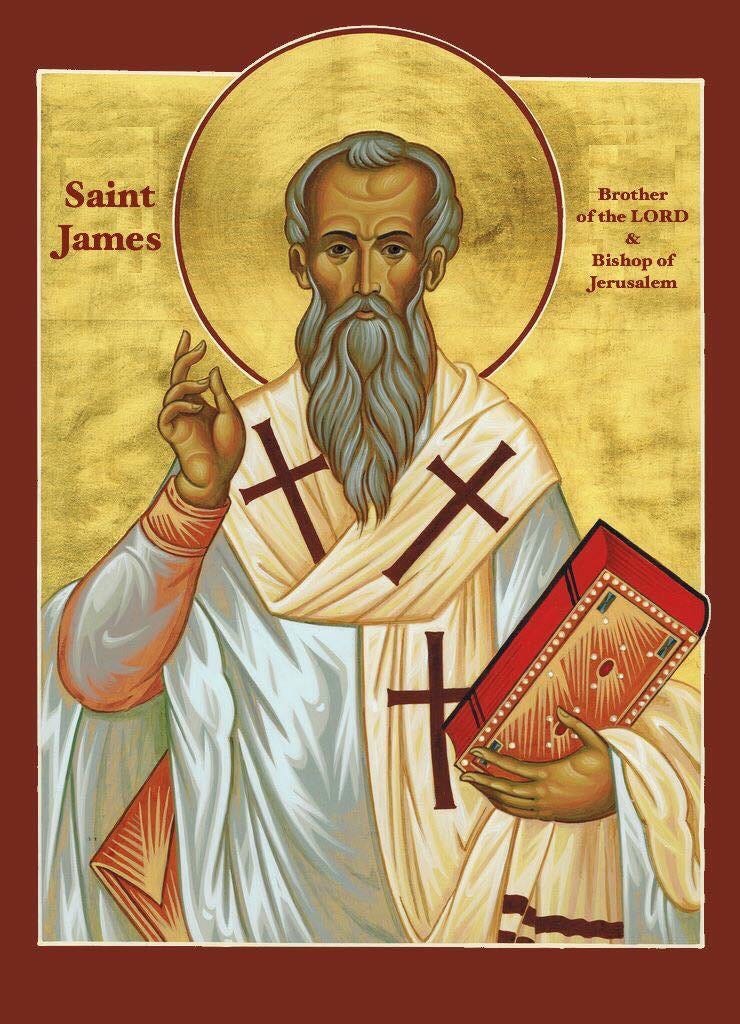
The role of St. James of Jerusalem in attesting to the events of Christ's death and resurrection should not be minimized.  After all, the family into which our Lord was born was a normal family -- complete with all their ordinary family conflicts.  Outside of Joseph and Mary who had the word of the angels to aid their faith, the rest of those among Jesus' greater family had only their own observation and probable resentment that their brother was the Son of God.  It was not simply a bit of childish jealousy but followed Jesus into His public ministry when He and His siblings were mature.  So if there was anyone who would be in a position to question the reality of Christ's death and resurrection, it would have been James -- inclined from the beginning to doubt rather than believe the claims of Jesus.  So when James ends up being a pastor and bishop and the authoritative voice at the Council of Jerusalem, it provides the most profound and solemn attestation of those claims of Jesus and the testimony of those who witnessed both.

I must admit that I grow weary of the charge that Christianity rests not upon fact or history but faith -- blind faith at that.  It is the worst of lies and it creates doubt in the hearts and minds of the faithful.  We let the smug talking heads of academia and erudition to tell us that the Bible is a book of myth and legend, that few of the facts of Scripture correlate with any real history, and that none of it matters because, after all, we take it all by faith (sort of like a grain of salt).  What a foolish lie we have been fed and what fools we are to believe it or to worry about it.  Among the more than 500 witnesses was someone who lived in the same household, did not believe the claims of the Lord, and who ended up believing and becoming one of the most important leaders of the early church.  This James knew that Jesus had not died a symbolic death but one as real as death can be.  This James knew that Jesus was not raised a spirit or a ghost but real flesh and blood -- though glorified.  This James who lived with the fact of Jesus in flesh was not going to surrender his integrity and his future for a myth or a legend but only for the real crucified and risen Savior.

My friends, faith is not a pie in the sky when you die.  It is not a made up truth for fearful or superstitious people who feel like the need to believe something.  We have not only a solid written record of eyewitnesses but a faith that has been scrutinized with more intensity than just about anything else in this life.  We also have a faith that does not ask you to swallow a whale of a tale but to listen, hear, and the Holy Spirit will teach your fearful and stubborn heart to believe, trust, and rejoice in promise given and promise kept in Christ Jesus.  His life embodies our hope -- a hope that is built not on an imagination but a death more real than any other death and a life more real that any other life.  Let us learn from James to believe without fear and confess with courage the fact of our salvation in Christ crucified and risen.

Wednesday, March 8, 2023

Reading from right to left. . .

Hebrew, as you may know, writes and reads from right to left and not the left to write order of English.  Perhaps it is a silly observation but perhaps that little clue ought to suggest something more than a linguistic phenomenon.  Perhaps that is the direction of God's work and His Word.

Most of us all think that prophecy points to what is to come.  After all, that is the point of prophecy, isn't is?   All the stories of the Old Testament point forward to what is to come, right?  So Abraham's almost sacrifice of Isaac prefigures the Father's offering of His one and only Son, right?  Or do we have it backwards?

Could it be that Christ orders not only what comes after Him but all that has come before?  After all, He was appointed Savior before the foundation of the world and before any sin had been committed.  His marriage to the Church was not some that came after Adam and Eve but actually preceded them and the marriage of man and woman.  

Could it be that we have read it all wrong?  It is not the events of the past that shape the future but the future (from our perspective, anyway) that orders the past?  The pre-incarnate Christ is the incarnate Christ.  Before God made everything and even before God made anything, Christ knew and consented to become the Savior of man and his world.  Christ is not an option exercised by God when everything else was tried and failed, Christ was and is the plan of God from before the beginning of all that is.

Sin has disordered God's order so that it seems like God approaches everything the way we do -- trial and error.  But our Lord was never a back up plan in case the Law did not save us.  Christ was always the first and only plan of salvation for you and me and any and all who will be saved.  The order of creation and the order of redemption are not different orders but the same order from the same mind and heart of God.  It gave us a past we did not want and stole from us a future we desired but it did more.  Sin made it appear that God was as inept as we are, trying things out as we might be to try and fix our messes.  

It is not God who sees as we see but we who cannot see as God sees.  When Job was asked where he was when God set the heavens and earth in place, he had no answer.  But the Word was there.  Wisdom was there.  God reads from the right to the left, the future He has appointed defines the past.  God wrote the future before we lived the past -- grace upon grace, to be sure.

When he established the heavens, I was there,
when he drew a circle on the face of the deep,
28when he made firm the skies above,
when he established the fountains of the deep,
29when he assigned to the sea its limit,
so that the waters might not transgress his command,
when he marked out the foundations of the earth,  30then I was beside him, like a master worker;
and I was daily his delight,
rejoicing before him always,
31rejoicing in his inhabited world
and delighting in the human race.
  Proverbs 8:27-31

The kerygma of Christianity is the announcement of the future not as what might or will happen but what God has already set in place and faith apprehends this future as even more secure and trustworthy than what we know of our past or live in our present.  Quite literally, all theology is Christology -- all that God has hidden is revealed in Christ, even the hidden face of God we see in Christ so that we can confess with confidence beholding the crucified Lord -- I have seen the Father!

Tuesday, March 7, 2023

When Christ is lifted up. . .

Sermon for the Second Sunday in Lent (A), preached on Sunday, March 5, 2023.

John F. Kennedy gambled everything on a war called the Bay of Pigs.  If it worked, Cuba would be an ally.  If he lost, America looked like a fool.  When it all went bad, the President responded, “Victory has a thousand fathers but defeat is an orphan.”  He was only repeating the wisdom of Tacitus who said “victory is claimed by all, failure belongs to one alone.”  

We think that God would work best through great victories that inspire not only jealousy but ownership.  If God would just give us what we want from time to time, more of us would be loyal to Him.  So when Jesus speaks of being lifted up, we think He is talking about His coming again in glory.  Surely every heart would be melted by the image of a victorious Jesus riding into the world on chariots of fire heralded by trumpets and followed by legions of angel warriors.  But that is not what Jesus is talking about.

His lifting up will not be in glory but in suffering.  It is the appeal of His love driven to put Himself in our place upon the cross that will woo and win the heart of sinners.  His lifting up is not the final victory that ends the world but the final end to the reign of sin and the tyranny of death restores you and me and the whole world back to the God we left of our own free will.

Jesus had every opportunity to be the bread king and give the world what they want but when the people were ready to claim Him as king, He shrunk away toward the cross.  We tell people over and over again how good God is in the hope and expectation that they will learn to agree with us and see how God satisfies their every desire. What fools we are.  For God does not come as the mighty to be served but the mighty to serve the sinner even when that service means suffering and death upon a cross.  God’s goodness is not the reason we believe but because we believe we know and confess His goodness.

We all love that passage – John 3:16.  For God sooooooo loved the world, that He gave His only begotten Son that whosoever believes in Him should not perish but have everlasting life.  Except that is not what it says.  The soooooo in that passage is not emphasizing how much God’s loves us but how that love is shown.  He could have demanded or condemned or compelled or bought us off.  But He did none of these.  What He purchased with His death were sins we refused to give up.

It is so sad that we have sentimentalized God’s love and turned His obedience into a victory lap where we can all meet Him in the winner’s circle at the end and claim part of the winnings as our own.  That is not what Jesus is saying or doing.  When the Son of Man is lifted up is Jesus saying I will die for you to set you free from a death you choose.  I did not come to condemn you but to save you.

The victor has many friends but the defeated is alone.  Think how that saying is fulfilled when all of those who followed Jesus including His closest disciples ran away from the cross in fear.  What they thought was the end, Jesus knew was the beginning.  Yet in order to know the victory of the end, you must know the suffering of the cross.  That is what we do every Lent.  We walk to the place where Jesus is lifted up so that He might draw all people unto Himself.  That place is the cross.  

Let me put it bluntly.  We think the way to win over people is to avoid talking about sin or acknowledging death.  We think that the way to win people for the Lord is to portray Him as some sugar daddy who pays so you can continue your sinful habits or Santa who says a mean talk about lumps of coal but who relents and gives everybody what they want at the end.  We think that if we have a God who respects our privacy, who allows us to live by our feelings rather than His facts, we will win friends for Jesus.  Well, how has that worked?  The gospel of accommodation is emptying churches faster than COVID did.

The cross offends not because Jesus condemns us but because since Eden we have preferred the comfortable lies to the uncomfortable truth.  Jesus is lifted up on the cross not because this is the way He chose but because it is only by the cross that we could be saved.  He wins over the hearts of people not with vain promises appealing to their self-interest but by the love that forgives, restores, heals, and gives peace to pass understanding.  The cross saves because here alone do we see the power of God’s love for us.  

Sin is a doctrine that needs no proof.  Read the newspaper.  Watch the TV.  Go to a movie.  Look into the mirror of your soul.  Yet it is sin that we dispute.  Jesus did not have to die.  Sin needs no proof but we reject it all the time.  We deny that our desires are wrong, that evil flourishes, and that we need help to fix what is wrong with us.  God’s love should not have to be proven to us and yet we reject the cross and ask God for other signs to prove He loves us, cares for us, and is on our side.  That is why faith is never a matter of a choice or a decision and always the work of the Holy Spirit.  That is why faith is never the logical outcome but the irrational trust in what is promised over what is seen.  That is why the cross is the means by which any who will be saved, shall be saved.

Nicodemus could not figure it out.  Who can?  But the Gospel is not given to us to comprehend or explain.  The cross is given to us to believe.  Where the cross is lifted up and Jesus on that cross, faith is born or nurtured or sustained.  It is that simple.  There are countless reasons why we should not believe in God or trust in Him and there is only one reason why we should.  It is the cross.  It is the Savior lifted high upon that cross.  At the last, when our journey finds its end, we will no more be troubled by questions or the quest to unpack God's mind.  Then we will learn to be content knowing that the Lamb who was slain has paid the awful price for our sin and because of His work of love in suffering and death, we will have everything that sin gave up in Eden and more.

“For God so loved the world, that he gave his only Son, that whoever believes in him should not perish but have eternal life. For God did not send his Son into the world to condemn the world, but in order that the world might be saved through him.”  And when the Son is lifted up, He will draw all things unto Himself.  But most importantly, He will draw you and me.    In the Holy Name of Jesus.  Amen.

Being the Holy Fool. . .

For a good measure of Christian history, the church has struggled to become something she is not.  It would be laudable if the goal were holiness but instead the goal has too often been to become like the world around her.  The world has kingdoms; the church becomes a kingdom.  The world has kings and ruler; the church creates a monarchical office out of the bishop and calls him pope.  The world exercises dominion and power; the church rules by the same (threat, force, etc.).  The world values money; the church becomes a financial player.  The world seeks entrance to the halls of power and influence; the church seeks to be accepted at the table of nations and influence the affairs of the nations.  The world seats the power brokers in grand estates; the church houses her bishops in regal splendor.  I could go on.  I do not need to enumerate more.  You get the picture.

Now it would be easy to point the finger at Rome or the Patriarch and say this is not the problem of those who claim to be heirs of the Reformation.  It would also be a lie.  Whether you live in the permanent revival tents of the mega churches or the sprawling complexes of the mainline or you dominate the airwaves and kingdom of podcasts or simply post a video of your service, there is hidden in us the same not so secret desire to be a player and to be recognized by those around us as a people and a church to be reckoned with.  We judge success by the same barometers of business and industry, nation and empire -- the census and the revenue.  All the things the world insists are wise and important are the temptations of church -- yesterday, today, and the future.  Worse than temptation, these things will be our undoing.  The pursuit of worldly goals and values betrays the essential values of faithfulness and fidelity that are the hallmarks of the true church.  Like individuals, the church is tempted to sell her soul for a few hits on a web page, a few more social media followers, and bigger stats.

    This is how one should regard us, as servants of Christ and stewards of the mysteries of God. Moreover, it is required of stewards that they be found trustworthy. But with me it is a very small thing that I should be judged by you or by any human court. In fact, I do not even judge myself. I am not aware of anything against myself, but I am not thereby acquitted. It is the Lord who judges me. Therefore do not pronounce judgment before the time, before the Lord comes, who will bring to light the things now hidden in darkness and will disclose the purposes of the heart. Then each one will receive his commendation from God.

    I have applied all these things to myself and Apollos for your benefit, brothers, that you may learn by us not to go beyond what is written, that none of you may be puffed up in favor of one against another. For who sees anything different in you? What do you have that you did not receive? If then you received it, why do you boast as if you did not receive it?

    Already you have all you want! Already you have become rich! Without us you have become kings! And would that you did reign, so that we might share the rule with you! For I think that God has exhibited us apostles as last of all, like men sentenced to death, because we have become a spectacle to the world, to angels, and to men. We are fools for Christ’s sake, but you are wise in Christ. We are weak, but you are strong. You are held in honor, but we in disrepute. To the present hour we hunger and thirst, we are poorly dressed and buffeted and homeless, and we labor, working with our own hands. When reviled, we bless; when persecuted, we endure; when slandered, we entreat. We have become, and are still, like the scum of the world, the refuse of all things
.  1 Corinthians 4:1–13

What St. Paul says, we do not want.  We want respect and acceptance and we do not desire to become the sum of the world or the refuse of all things.  So the equal temptation for pastor and people, district and diocese, bishop and pope, congregation and parish -- whatever the name or identity, we fear becoming the holy fools of God's intent and we would trade our souls to become the people and players the world respects, hears, and obeys.  This is our desire and this is our downfall.   

Monday, March 6, 2023

Bigger than the Church. . .

Curiously, a video produced to announce and give credence to the candidacy of the Rev. Dr. Pat Ferry, lately of Concordia University - Mequon, WI, is making the rounds.  Even more curiously, the good doctor describes the university he ran as a much bigger operation than the Lutheran Church Missouri Synod.  It has, according to the candidate, a bigger budget, more employees, and a more complex operation.  Are we to conclude then that running the Synod would be a breeze compared to his previous gig?

What is put forth on this video is precisely the problem.  When the individual parts of Synod are esteemed to be bigger than Synod itself, well, we have a problem.  He is certainly not the first nor will he be the last to presume that managing the good fleet Missouri is not as demanding as managing its individual boats.  Perhaps there is truth to this on one level.  Corporate Missouri is a relatively lean operation (its detractors notwithstanding).  Long gone are the days when all the cubicles were filled with people.  The downsizing was part of the goal of the 2010 restructuring and it succeeded in reducing payroll.  I am constantly amazed as how much our small crew actually accomplishes and wish more folks would come to that conclusion.  That said, Synod as a whole is not simply corporate Synod.

What Pat Ferry and so many others seem to miss is that the structure we chose is not an amalgamation of distinct and independent parts or an association of largely autonomous divisions but one Synod.  Now, you may debate the wisdom of this set up but you cannot deny it.  It has been the hallmark of Missouri since its inception.  Districts are not component parts of Synod but Synod in that place.  Congregations are the only units of this body with any degree of independence and even that is the freedom to structure and fund how they choose but not the freedom to remain in Synod and confess differently.  Certainly the colleges and universities are not and were never created to function independently.  We set them up for a specific purpose and even though that purpose, the training of church workers, has been swallowed up by many programs and non-Lutheran students, none of them were envisioned to be independent operations.  If it gets to the point when Synod decides that is how it should be, then Synod will make that decision but the universities are not free to choose for themselves their relationship to Synod.  Furthermore, the agencies we create to aid in our mission (LCEF, LCMS Foundation, Concordia Plans, Lutheran Federal Credit Union, Concordia Publishing House, and everything else) may seem to tower over corporate Synod in size and scope but they are not free and independent agencies to decide how they want to serve those who set them up in the first place.  Sadly, we seem to forget that from time to time.  If the good Synod decides that another relationship or arrangement better suits the Synod, that is a decision for the Synod to make.  Until then, these individual agencies and the divisions we call Districts are bound to live within the existing arrangements and to honor the existing relationship.  

So the problem here is perception.  Apparently there are those vying for leadership in our church body who believe that the leader of Synod is but the leader of an incorporated entity and not the leader of our church, congregations, and all our agencies.  That kind of thinking will surely get us into trouble, more trouble than we are in now.  For what it is worth, it would seem that anyone who desires to be elected to leadership in our Synod should know what that leadership entails.  I would suggest that the ecclesiastical oversight which is the essence of that leadership is more complex and broader in scope than the management of the financial, staff, and properties of a single university or of them all combined.

Sunday, March 5, 2023

Looking for error. . .

One of the side effects of controversy is that we look for error more than we look for that with which we may agree.  Given that there is no shortage of dispute and angry discussion in the world, it should not surprise us when the same rancor is found within the Church.  In fact, social media has done as much harm to the unity of the faithful as it has the unity of people in their nation and neighborhoods.  The exaggerated statements of dispute tend to be passed along and stir up plenty more views than a careful and reasoned assessment.  That is surely what we struggle against now.

On the one hand there are the politics of the season.  This is an election year in the LCMS and there has been a history of politicking on both sides.  Sometimes it is merely a matter of posturing but other times it ends up brushing up against the 8th Commandment (if not violating it out of hand!).  Instead of debating, it tends to be easier to paint our opponents in the worst possible terms.  There are those who routinely refer to those elected in offensive language that gathers notice but actually works against their point.  I hope and pray every election season that we can forego such characterizations designed not to build up or repair but to tear down and injure.  We can have differing opinions without painting our opponents as demons.

On the other hand, there are the politics of confession.  I am concerned by the idea that we must agree with an author in all points before we will listen to that author on any point.  The recent dust up over a book published by our Synod through its publishing house is case in point.  Some of the arguments against the book were over who the authors are as much as over what the authors said.  Again, it seems that the opponents were not only looking for error with a fine tooth comb but arguing that if something could be better stated, it must be.  I am reminded that the good is not the enemy of the perfect.  It is certainly  dangerous to hold everything we say and do up to this principle.  Doctrinal review is not charged with editing for such purpose but to make sure that what has been written is not wrong.  I wonder now many things would not pass muster if they held up the printing press because something could have been better said?  Certainly Luther himself was not enamored with everything he said or wrote and regularly suggested that most of his writings should be burned (though the list of things to be saved changed from time to time).  Every pastor is self-aware of sermons that did not say things wrong but could surely have said them better.  I know I am.  Preacher's regret is not simply what you should have said that you did not but more what you could have said more clearly but did not.

Anyone who reads this blog knows that I have my own issues with our church leaders, especially District Presidents, and yet I am mindful of the fact that no church bodies are as rigorous or reactive as the LCMS is when something has been gotten wrong.  Indeed, the Synod President held up distribution of the book cited above so that a further review could be made.  Many of the critics were not pleased either by the withdrawal or its return to active sale.  The reality is that the process worked.  A second review was made of the material some found objectionable and the Synod President decided that it is not error to have said things less clearly than you might have said them.  We have simply stopped keeping score of the egregious errors tolerated and approved by the ELCA, the Episcopal Church, and a host of other denominations.  They are too many to keep track of.  Missouri is not without our problems but we are certainly doing a more credible job of confronting them than any other denomination (including Rome!).

I put up a meme once that showed a pastor shaking hands at the door of his parish after worship.  In his mind were the hours he has put into preparing a sermon, Bible study, and worship planning.  But the words out of the mouth of the parishioner were a complaint about how hot or cold it was in the Sanctuary.  If you look for error you will always find it.  There is nothing we could not have said or thought or done better.  At the same time, you should not simply be looking for error but for that you might and should endorse and commend.  I fear we have all forgotten that part of it.  Instead of encouraging where we can, we seem intent upon warning or condemning where we might.  We are certainly the poorer for it.  Unless we have to say it, maybe we need to learn to simply shut up.  And if we must say it, maybe we need to look as much as how we say things as what we say.  Unless we are seeking praise from an echo chamber, we all could find things we would have said differently.  That does not make them wrong.  If we do not love our neighbor enough to be charitable, maybe we ought to love God enough to be kind in our criticism.

Saturday, March 4, 2023

Is it still true. . .

“The faith preached by the Apostles, attested by the Martyrs, embodied in the Creeds, expounded by the Fathers.”   This is what C. S. Lewis called the “solid center” of Christianity.  There was a time in which I heartily agreed with Lewis and saw it with my own eyes.  

The differences between the Augustana Lutheran congregation in my home town and the Missouri Lutheran congregation in the country were small though esteemed to be great.  The laugh of my parents was when one of those Swedish boys asked the German pastor if his daughter might accompany him to a youth event in the basement of his Lutheran church.  The German pastor said he would rather allow his daughter to visit hell.  Doctrinally there was not the huge gulf then (1940s) as there is today but the differences were thought to be substantial.  The solid center was present though not judged not sufficient for even a polite relationship.

Today the differences between those same congregations is substantial though the relationship is much more polite, even friendly.  In fact, there are those who find it hard to think that the differences in faith and practice are not great enough to continue to divide the churches.  Strange, isn't it, that the solid center of the past was then unrecognized has been replaced by a great gulf that is now no impediment to unity.

In the past the great ecumenical vision was hastened on by the vision of a real unity, or at least enough unity to allow more than a mere cooperation of externals.  They were heady days in which the boundaries of the past were being moved, sure that enough conversation and cooperation could remove the bitter condemnations of the past and open the doors to new future.  When that did not occur, it was decided that the divisions need not be reconciled but could be allowed to exist and were no real barrier to the unity which was sought.  Reconciled diversity became the accepted substitute for honest unity.

Now we find Lutherans more divided than ever, the numbers of Lutheran jurisdictions increasing as they also decline, and others mirroring the same pattern.  The disunited Methodists and the splintered Presbyterians multiply denominations without increasing members.  The Southern Baptists found their own cracks in the foundation.  Rome finds it easier to close churches than to fill them.  We have trouble finding a solid center within the very fabric of our own traditions much less the broader fabric of Christianity.  We are as Christians less confident in a supreme being, in His stewardship of creation, in the historicity of Biblical people and events, in the accuracy of the words or deeds of Jesus, or in their meaning or import.  It is precisely the faith preached by the Apostles, attested by the Martyrs, embodied in the Creeds, expounded by the Fathers we no longer share. Our solid center has become fluid and uncertain even as our desire to repair the divisions of the past grows.  It is the sad state of real ecumenism that has given way to one without substance.

Friday, March 3, 2023

Seeing heresy everywhere. . .

Someone sent me a link to something called Lotuseaters from the UK only to find these conservative Roman Catholic lay commenters were talking about the Lutheran Church Missouri Synod.  This on top of the countless tweets and retweets and blog posts that have created quite a stir with respect to a book published by the Synod.  But it is not only or simply about the book.  The furor has gone well past even the ordinary haunts of the Lutherans and the disaffected Lutherans to be picked up by folks who actually believe that the LCMS is only about a day and a half behind the ELCA in caving into the culture, diversity, equity, inclusion, and every other woke and CRT proposition known to man.  We have become a spectacle.  We thought we might be a stodgy conservative largely Midwestern church body but now it appears we have found our fifteen minutes of fame and suffered before the eyes of the guardians of orthodoxy on the internet.

On top of that, the whole thing has gotten mixed up in everything from misogeny to racism.  The President of the LCMS was compelled to disavow such things publicly with a letter.  To some it was the desperate act of a politician, to others it was a desperate attempt to distance us from some of the more extreme voices, and to others it was a brave stand in a world which is more in love with soundbites than reasoned paragraphs.

What is someone to think?  According to the accusers, Missouri is corrupt, her leaders are corrupt, her doctrine is corrupt, and her practice is corrupt.  Though some might admit that Missouri is the last best hope of orthodox Lutheranism in America, there are others who warn she is a leaky ship not likely to make it back to port in tact.  Such is the state of the storm and the state of affairs on the good ship Missouri.  If you believe the critics, that is.  

Let me begin by saying that there is little possibility for clarity with all the shouting going on.  Nobody is listening to anybody except the people who back up your own preformed opinion.  It is a house on fire while no one is looking for a fire hose.  That is precisely the problem with our age.  We not only lack leaders of substance and consequence who can tell us to be quiet and listen, we refuse to pay attention to them if they do say anything.  The same political divisions and suspicions that are making it hard for even good people to govern are intruding into the Church until there is hardly any difference between the sacred and secular voices of outrage and condemnation.  Where there is heat, there must be fire.  But without someone to manage the fire, the flames may well consume the good with the bad.

We have become a cranky people who are deeply suspicious and intolerant.  Some of the voices out there insist that they are speaking with candor and with love but it is hard to hear the love amid the sheer delight at tearing things down.  I know we have problems as a church body.  I know our leaders are not perfect.  But I challenge you to find another church out there that is as concerned about truth and as willing to work for a full and common truth confessed before the world. We fought a battle for our lives over the issue of the truthfulness of God's Word.  We saw once venerable institutions brought to rubble only to rebuild them from nothing.  We are a church body with the great expectation that our leaders are theologians and not simply managers of an institution.  We are a church body with a structure that preserves and encourages the role and responsibility of the local congregation and their pastor to preach, teach, and give witness to the faith confessed and the hope within us.  We are a church without contempt for either the laity or the clergy -- at least we were until some of this tried to pit us against each other.  We are a church where our publishing house actually publishes theology and not little self-help books of Christianity which make it seem like Christianity is a DIY religion.  We are a church where pastors are formed not only in the theology of what we believe but in the faithful practice.  We are a church that loves the Gospel without reading it as license to do what is pleasing in your own eyes.  We are a church that is known the world over for what we believe instead of for what we do not.  You look and tell me a better place to be?

We have got to stop crying out that the roof is falling every time we have honest disagreements about what is being said or how it is being said.  The internet is at its worst when it functions as an inquisition tribunal to air out our disputes and make sure that self-righteousness always wins.  We will not be able to carry out the mission before us if we see heresy everywhere and then battle it out with a hundred words or less in quote or comment (often out of context).  Scripture pleads for us to come and reason together.  I am not talking about compromising our core truths but about talking honestly together before we tell the world Missouri is dead or woke or whatever.  I fear the meme is not the friend of truth but may very well be its executioner.  Not everything is worthless because somebody else said it or because the wrong person said or because they did not say it as you would have said it.  Christianity has enough enemies outside who seek to destroy it without those on the inside tearing it down from within.  The whole business has already occupied too many of the conversations within my parish -- much less the internet and the world.  We need to be more careful both about the tactics and the tenor of our commentary.

Thursday, March 2, 2023

Indispensable. . .

The time is coming ever closer when I will surrender my stewardship as senior pastor of this congregation to another.  The full retirement will be postponed for a time as I support my successor until another associate may be called but it is the day is nearer rather than farther away.  Some have probably wished for this moment and some dreaded the day.  I was never sure which side I was on but I am learning to make my peace with it.  As someone once said, the cemeteries are full of people who thought they were indispensable.  I do not believe that I am essential nor do I believe I am indispensable.  But before the day comes when all is passed onto my successor, I do have one duty.  I must prepare God's people for my retirement and prepare them to receive the pastor who follows me.  This is an essential duty and one indispensable but one to seldom taken seriously.

It is strange how we expect God's people to adjust and accept another pastor as if this were something automatic and perfunctory.  I have never understood the idea of a pastor simply packing up and leaving and the people left holding the bag, trying to figure out what comes next.  Pastors are not simply employees or nameless, faceless people to their congregations.  We expect our congregations to highly esteem the office and to give to the one who bears that office not simply the respect but the affection for his divinely appointed role and identity.  We encourage longevity because we believe that it is good for both the pastor and his family and the congregation not to have a revolving door to the parsonage and study.  So when that day comes and the Lord moves the pastor to another part of His kingdom or his tenure leads to retirement, the people who have come to honor and esteem their pastor lose a dear and trusted counselor, leader, and, most importantly, shepherd.

Not a few congregations have suffered from a bad transition, when all was left to chance and the presumption of what cannot be presumed.  If a pastor has invested himself in the people given into his care, he should at least allow that affection and fealty to help them in the transition to another shepherd.  Perhaps the most important aspect of this aspect of his stewardship of the office is to guide them to know who they are as a congregation, what is their confession, and what things should not change and what need and desire improvement.  For the liturgical congregation, this is an especially important task.  We live in a time when it is not presumed that pastors share the same understanding of worship.  Indeed, I have witnessed the many times when a liturgical congregation, which has been taught to admire and esteem the liturgy and the means of grace as do our Confessions, calls a pastor who views worship as a program to fill the pews or reflect the preferences of the moment.   This is not simply about pastoral style, an undefinable term we use all the time, but about confessional and liturgical integrity.

So if I have any integrity, it will be shown by my willingness to help them know themselves and thus be prepared to call and accept the one who will begin his stewardship of the office when mine ends.  To that end, we spent the first six months of the call process doing just that -- trying to figure out who we are as a congregation and what we confess and how we live out this confession.  Although I supported this effort, the call committee did a fine job of working this through and came up with a document that is clear, honest, and informative.  It not only tells them what they need to know in order to call a pastor but what that pastor needs to know as he considers that call.  And that illustrates the value of this process.  For as much as this helps and aids the parish to reflect upon my long tenure here, it helps the one who will follow me to know what he needs to know in order to give this call the faithful consideration he should and it will give him the information he needs to consider where he turns his attention when he begins.

Honestly, most of the stuff provided by the district is not helpful.  It asks for statistics and descriptions of things that inform but do not aid in understanding.  Furthermore, the information on the SET and PIF provided by the District is equally unhelpful.  It gives answers to questions no one is asking and does not help us to know the man, only a few of his answers to questions others decided were important or relevant.  Apparently our church body believes that this is what parishes need to guide them in the call process.  But how does a congregation review questions and answers on papers it is not even given to own when even those questions and answers have little to do with the situation at hand or the concerns of the congregation?  A good Circuit Visitor will help but even then it is much to ask from someone who has his own parish to consider and doubtless other vacancies and congregations.  No, what is needed is not more questions or answers but prayerful conversation by those who know the men and know the congregations.  Absent that, it is left to the pastor as his final duty to help the congregation through this -- not to pick and choose his successor but to help the process with the pastoral wisdom and prayerful consideration that ensures a fruitful transition.  And that is my goal now.

Wednesday, March 1, 2023

Banging my cymbal. . .

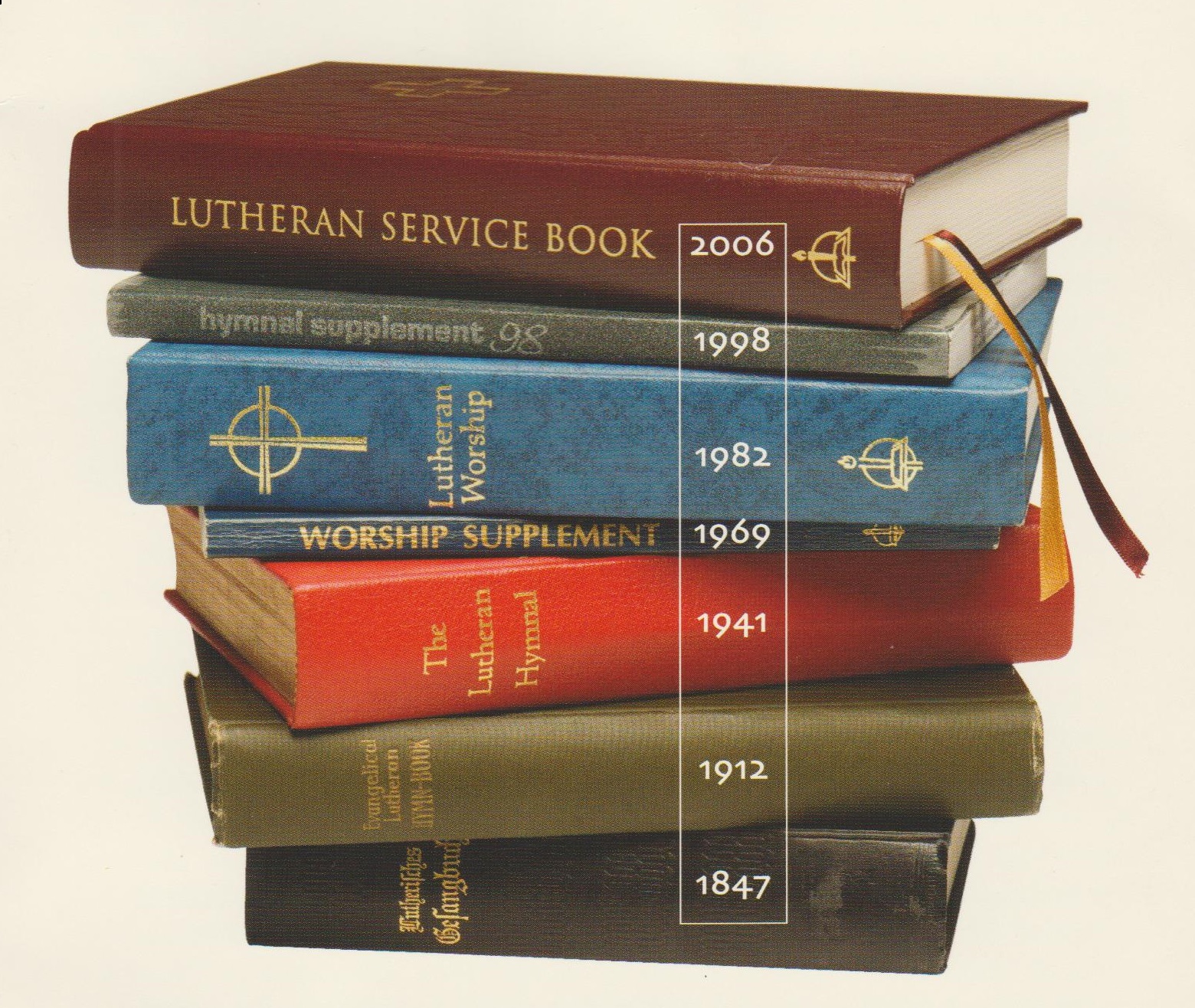
Hymnals among Lutherans have defined the faith in a powerful way for as long as those hymnals were in use and even beyond their lifespan. Work on The Lutheran Hymnal began in 1929 and it was published in 1941.  Initially, there were those who did not think it an advance in the English liturgical future of our Synod.  Eventually it attained an iconic status, helped along by a conflict in Synod and a later hymnal that did not become beloved to very many.  When it came time to create a successor to Lutheran Worship, it was clear from the beginning that even forty years later, TLH cast a long shadow.  Now we find ourselves some 17 years after Lutheran Service Book has almost attained the level of acceptance of TLH, although not quite dearly loved.  It appears that the Synod has little interest in preparing another hymnal but it takes a decade or more of solid work to put together a credible worship book.  If we do not begin soon, the lifespan of TLH might be challenged by LSB.  It is not that we need the novelty, but we do need to take stock of things, review the lessons learned from putting together LSB and from its usage in congregations large and small.

Why bother?  Pastor Mark Surburg offers a hint of the reason.  

While LCMS members today assume that the Nunc Dimittis will be used as a post-communion canticle, it arrived very late in general usage in the synod.  As one would expect, Church Liturgy - the 1881 English translation of Walther’s German agenda (1856) – did not include it.  However, the Evangelical Lutheran Hymn-Book (1889) which was the LCMS’s first English hymnal, did have the Nunc Dimittis (we see here the influence of the Common Service). The Nunc Dimittis has appeared in every LCMS order of service since then. It entered into common usage through The Lutheran Hymnal (1941), which adopted the Common Service (1888). For more details on this history, see Lutheran Service Book: Companion to the Services, 635-636.

In other words, within a generation or so, the Lutheran Church Missouri Synod went from seeing the Nunc Dimittis as novelty to one of the most esteemed parts of the ordinary.  While there is no dispute that this change was salutary, even logical and laudable, it does show how quickly changes become normative.  If for this reason only, it is worth our time and energy to undertake a serious and careful review of LSB and to consider its successor or at least the timing of that book so that we will not be found unprepared.  It may be that we decide officially to wait a little longer and that is fine but it may also be that we realize that there are things that could and should be changed, even improved.  Books do not last forever.  In my own parish we have already replaced some books due to the simple wear and tear of regular use.   If we wait much longer, the worn copies of LSB will be replaced with new copies of the same book and make congregations even more reluctant to think about a new worship book.  

When the time came to consider a replacement with LW, a group of scholars and pastors and interested parties met to discuss what it might be and if then was the right time.  At least that should happen now.  The principal voices behind LSB are still here teaching at the seminaries and, though some sterling voices for Lutheran liturgical integrity have passed, new ones will be found.  At least it is worth our consideration.  Just a few things for us to consider. . . as we walk through another Lent.

Tuesday, February 28, 2023

Sunday affairs. . .

There was a time when Sunday was only to be a day of worship.  Now it would seem that Sunday is the only day to worship -- God lets you have every other day to do as you please.  Of course, if I were to be more precise, it is not Sunday the day but an hour or two in the morning, sufficiently late so that you do not have get up early and bother your sleep schedule and sufficiently early so that you still have plenty of time in the day to do as you please.  It must seem ironic that this complaint comes from a fellow who most folks think works only one day a week and has plenty of time for himself.  Nevertheless, the direction of time seems to be Sundays only (even for feast days) except when one of the principals falls on a Sunday and, like I saw in the South, the Sunday of Christmas Day saw churches close so that folks could spend the holiday with their families.  Ah, the irony of it all.

The truth is that even the only on Sunday idea has changed to only on some Sundays and not all that often either.  Our devotion to God apparently can be satisfactorily reduced to one Sunday out of the month.  The new normal for regular attendance seems to be moving rather significantly in that direction.  In the congregation I serve, the total Sunday attendance is divided up three ways.  First, there are those folks who are always there and if they miss you know something is wrong.  They are often on the older side but not always.  We have such families in the 20s and 30s who exhibit the same profound devotion to being in the Lord's House on he Lord's Day.  The next third are those who come twice a month at least and sometimes three times.  It is not the same crowd on each Sunday but represents those whose hour has come on that particular Sunday.  Again, this segment is made up of a variety of age groups.  The last group is made up of those who attend once a month or less.  This section of the attendees looks very different every Sunday.  In fact, you cannot predict who these folks will be.  It is always a surprise.

If you accounted for those too ill to attend, the homebound, and those who travel for work or pleasure and are out of town, we could certainly fill up nearly every seat in the nave and be forced to add another service or even two to accommodate the crowd.  That is, if everyone attended every Sunday as their normal habit we would have to add services.  But it is highly unlikely that will happen.  In fact, the larger the congregation is, the more likely to see a big gap between membership and attendance.  I had the occasion to look up a rather large parish of our church body and it listed the official numbers of some 3,000 members and an average Sunday attendance of a little more than 300.  Ouch.  On the other hand, it often holds true that small congregations have a higher percentage of their members in worship on a typical Sunday.

I guess what I am saying is that the future of both the frequency of attendance of those who belong and the percentage of those who belong who attend is headed in the same direction and it is not good.  Though we live in a time when we have more personal and leisure time than at any other point in history, Sunday is the only day for worship but not only for worship and not even primarily so -- remember, I am talking about Christian people who belong to a church!  Rome has holy days of obligation and yet its percentage of members in worship is hardly better and typically worse than most Lutheran congregations (though not quite as bad, perhaps, as the congregation I named above!).  It is not a rule that needs to be fixed but hearts so that they may desire being in God's house, receiving His gifts, and responding with thanks and praise.  Apparently we are not all or always glad when they said to me, I will go to the House of the Lord.  Again, this is not a complaint about a statistic but the spiritual health and welfare of those who by their own claim insist that they belong to the Lord.  

Monday, February 27, 2023

I hate. . .

Sermon for the First Sunday in Lent (A), preached on Sunday, February 26, 2023.

The devil always tempts by presuming to offer us something better than what God would give.  It has been that way since Eden.  The serpent came to Eve appealing not to some sick joy of being bad and getting away with evil but with the ultimate good.  What did God say?  Eve, weren’t you listening?  God did not say what you think He said.  God really said that you will be like God.  So the best way to obey God is to disobey Him.

In the same way the devil meets Jesus in the wilderness.  Jesus knows what He is called by God to do and it will involve miraculous bread for hungry people.  So the devil asks the hungry Jesus simply to do for Himself what He will do for others.  Command the stones to be bread and eat your fill.  You will feel better.

The devil brings Jesus to the height of the pinnacle of the Temple and tells Him to dive off trusting that God will send His angels to save Him.  You know the cross lies ahead; don’t you want to know that God will be with you there?  So try it out here.  Jump off and God will save you.  He said He would.  Won’t you feel better knowing that God will catch you when you fall?

Finally the devil makes it easy.  Get down on your knees in private before me and I will give you every public part of this world and its glory.  Jesus, it costs you nothing to give into me in secret and you gain everything for this one small price.  The end justifies the means.  Won’t you feel better having won the world and all things without suffering the agony of the cross or dying the death of a sinner?

By now we are all wondering why Jesus did not simply give in.  After all, we do. We give into evil by doing for ourselves what we do for others.  You have to love yourself before you can love anybody else, right?  We ask God for signs all the time – little hints to know that He is with us and on our side.  Is it too much to ask for a sign even though we gather before the cross, the greatest sign of all?  We are the kings and queens of shortcuts and ends justifying the means.  It started as a quick and easy good but it has progressed to a quick and easy righteousness.  As long as we are on God’s side for the big things, it will not matter if we succumb to the little temptations, right?  No reasonable person could disagree.  The way the devil frames temptation it seems like the right thing to do to follow the devil’s path instead of God’s – the devil seems more reasonable than God.

Three times in your life with your voice or the voice of your family, you have said just the opposite.  When you were baptized, your family and parish spoke with you and for you.  I renounce the devil.  I renounce his works.  I renounce his ways.  You said it again when you were confirmed and when you joined the Church – so three times you have renounced the devil, his works, and his ways.

Sometimes we are embarrassed by talk of the devil.  Sometimes we treat the devil as if his problem were merely being misunderstood.  Maybe your mom or dad or Sunday school teacher told you it is always wrong to hate.  But they are wrong.  For you are not simply saying the devil is bad.  Each of those three times you are confessing before your fellow believers and before the world:  I HATE THE DEVIL.... I HATE EVIL....

Let’s put it bluntly.  This is what each of us confesses:  I hate the devil.  I hate his lying ways.  I hate his lying words. I hate his lying works.  I hate the devil and I hate evil.  I hate all the pleasures he promises that make me feel worse.  I hate the short cuts that end up being dead  ends.  I hate the desires that well up in me and seem impossible to stop or end.  I hate the thoughts I cannot control but make me relieved no one can read my mind. I hate them all.  Because I love Jesus.

The hate you have for the devil and for evil is not manifested in words of rejection but in the refusal to walk in the ways of evil – to lie, to cheat, to murder, to gossip, to commit adultery, to fornicate, to separate sex from love and love from sex, to speak with vulgar words as if they enhanced your character, and to dishonor those whom God has set as watchers at your gate and in your lives.  The devil will try to make it seem like disobedience is obedience, like evil is righteousness, and like sin is faithfulness.  You know better.  Renounce them.  Hate them.  Refuse to have nothing to do with the works of the flesh, the sinful desires of the heart, the affections of men rather than God, and what works in the moment but not forever.

Proverbs says:  “The fear of the Lord is hatred of evil.”  The Psalmist says:  “O you who love the Lord, hate evil!”  Jesus says:   “If anyone comes to me and does not hate his own father and mother and wife and children and brothers and sisters, yes, and even his own life, he cannot be my disciple.” We cannot treat the devil or evil as if it were myth or legend or a joke.  We cannot treat the evils of this world as if they could be enjoyed without a cost to your soul.  We cannot say we love God without at the same time hating all that is not of God.

If we say we have fellowship with him while we walk in darkness, we lie and do not practice the truth.  But if we walk in the light, as he is in the light, we have fellowship with one another, and the blood of Jesus his Son cleanses us from all sin.  If we say we have no sin, we deceive ourselves, and the truth is not in us.  If we confess our sins, he is faithful and just to forgive us our sins and to cleanse us from all unrighteousness. If we say we have not sinned, we make God a liar, and his word is not in us...

Temptation is not what God will do to us.  His goal is never to distance us from His grace or raise doubts in our minds or fear in our hearts.  That is always the devil’s doing.  But the devil is a great scammer – using the words of God to deceive and packing up evil to look good.  My friends, you cannot love God and be indifferent to evil.  Hate evil.  Hate the devil.  Love the Lord with all your heart, soul, body, and mind.  The devil cannot save but can only extend his misery to you but God saves by taking on the full misery of your sin and its death so that you might be forgiven and live forevermore.  In the midst of temptation there is only one refuge, the Word of God, and the Word of God teaches us to hate evil and love good.  God help us to do just that.  In the Holy Name of Jesus.  Amen.

Dealing with the age. . .

There is a charge often laid at the feet of conservatives.  The claim is that conservatives have a closed mind, offering up yesterday's answers to the questions of today and tomorrow.  As with any stereotype, there is some truth in it but seldom the truth that the detractor means.  The answers held up from yesterday are not simply answers but values and a framework in which to see the challenges of the present and the future within the veil of what gives us nobility and identity.  If this is true in politics, it is even more true of Christianity.  For the answers we offer to the issues and conflicts of the day and the days following are not merely our answers but God's answers.  They arise from the Word of the Lord that endures forever and the faithful witness of those who have believed and confessed this truth before us.  They represent our voices with theirs in an unending chorus of faith, witness, and hope before a world which is in love with all things new.  Finally, they are not simply a conclusion from the past but the redemption that happened once in time for all time.  

So our detractors would insist that the Church not be wedded to any doctrine but freedom which may acknowledge the past or the Scriptures but is not wedded to them and certainly allows the Christian to define and decide upon his or her own truth.  They would let Christians deal openly with the questions of the age and leave them to their own conclusions in a liberty which allows every voice except the past and God's voice to have a say.  But this is a failure to acknowledge the most basic truth of Scripture and the most basic confession of God.  We are bound to the moment but He is not.  We live a life defined by years but His is eternity.  We know what we experience or have been taught but He knows all.  We judge by our self-interest and His is the love that comes to serve and to save.  In the end, the voice of the Church is the only thing keeping man from irrelevance and from being so captive to the spirit of the moment that his life is only a wisp of wind and a breath that disappears as soon as it is born.

This is the meaning of the Word of God and all the characterizations of grass that withers and flowers that fade against the backdrop the steadfast love of the Lord that is manifest in time but timeless.  What a shame it is that so many churches have decided that they must listen to the voices of the age and move their sails to captive the wind of the moment.  It will surely move them along but ever closer to that which is here and gone and ever further from that once for all redemptive death and life-giving resurrection that bestows eternity upon the temporary.  What we offer the world is not our opinion or our feelings or our experience but that which is not ours at all -- but God's way, truth, and life.  The world may not listen but it is the only voice that redeems and bestows the eternal upon any and all who confess the holy name of Jesus by the Spirit's prompting.  In the end, the Word of God and the voice of catholic tradition can never keep us from dealing openly with the questions of the age but are the only way to meet those questions with anything more than a "what if."  We are all the blind poking around life as if we thought we saw clearly but Christ is the only one who opens our eyes and gives us to see with His own vision what is true, what is good, what is righteous, what is beautiful, and what is eternal.  If this is captivity, I would trade it any day of the week for an unfettered freedom that can nothing for sure and everything only in part.