Saturday, August 15, 2015

A little too clever by half. . .

Among all the changes in the fabric of American culture and society, the SCOTUS decision on same sex marriage only represents the fact that we as Americans think we are too clever and this is itself a serious fault and failing.  It is not unique to us for we certainly follow the mold of modernity in presuming for ourselves that we know better than those who have gone before us and know better than the God who made us.  But we are less careful about saying that and less self-conscious of its arrogance today than ever before.

In 1 Corinthians, St. Paul writes:  I will destroy the wisdom of the wise and the cleverness of the clever. . .  These are words of judgment more against us and our time than any other time in history.  Even Christians believe that creations was given us to improve and not to use faithfully, that God's act in making all things was to give us raw material to us in our self-appointed role in remaking what He has made.  While this is certainly true in the callous way we have raped and pillaged the earth without care for the damage we have done or the glory of God, it is even more true in our intellectual presumption that we know better than nature, than God, and than those who went before us.

We have taken reproduction and turned it into a technology that is designed to put us into control.  We will decide if and when sex has the capacity for children -- not God and not even nature.  We will control the genetic shape and make up of the child we choose to create -- not God and not even nature.  We will decide when to have children and when not -- not God and not even nature.  We have taken the miracle from our humanity and turned it into the sterile room of a technology center in which techs tinker to produce super babies immune from all our foibles except our arrogance.

We have taken marriage the turned it into a fundamental right in which we decide when and who we will marry and when and who we will divorce.  Within a day of SCOTUS casting aside all state laws to prevent same sex marriage, Tennessee, one of the hold outs, had its first same sex couple file for divorce.  Are we surprised?  No.  Are we shamed?  Not in the least.  Marriage is for no nobler purpose than my happiness and I will decide when it begins and when it ends.  That is the way we defined marriage long before the courts or politicians decided to amend its parameters.  Marriage is not about sacrificial or long suffering love  but about the whim of pleasure that comes and goes and with it the spouse.  It is strange that anyone still wants to enter the quaintness of a marriage given that sex, children, and pleasure have long since been emptied from marriage and made available to any and all who want it -- safe, without commitment, without responsibility, and without trouble.  Except that we as a nation are more despondent and depressed than any generation before us.  Why?

We have made the measure of a life well lived its happiness and so the move is more and more to allow any and all who decide that they have too much of life to end it quickly and painlessly with the aid of a physician whose first call was once to do no harm.  Is there anyone who has not grown weary of life's troubles and trials, its disappointments and despair, its sorrows and struggles?  Our responsibility to neighbor has shifted from the help of those in need to the hastening of a death we now call sweet so that they can find release and we can get on with our lives without having to worry about them. In fact, it is better to kill the unborn rather than subject them to a life of unhappiness where they are neither wanted as we think they should be or have the chance of a proper, emancipated, and sophisticated life.

Of all the sins we have committed the most troublesome is our arrogance and cleverness.  It is this lie that the SCOTUS adopted into law.  We know what we want, what is best for us, and what will make the lives of others better.  We think we can outsmart God, outsmart disease, outsmart marriage, outsmart family, and outsmart death.  How is it working?  We do not really care.  Victimhood is our obsession so if it is not working out well, we can glory in our misery and find somebody to blame (ultimately God) for our unhappiness.  It is this that we must first confess to God and it is this that we must learn to repent or God will turn us over to our false and empty wisdom and allow our deceptive and fake cleverness to stand.  Even though it may now be enshrined into laws that shame us before God, we must first learned to be shamed by them before anything might improve.

But understand this, that in the last days there will come times of great trouble. For people will be lovers of self, lovers of money, proud, arrogant, abusive, disobedient to their parents, ungrateful, unholy, heartless, unappeasable, slanderous, without self-control, brutal, not loving good, treacherous, reckless, swollen with conceit, lovers of pleasure rather than lovers of God, having the appearance of godliness, but denying its power … so these men also oppose the truth, men corrupted in mind and disqualified regarding the faith … But as for you, continue in what you have learned and have firmly believed, knowing from whom you learned it and how from childhood you have been acquainted with the sacred writings, which are able to make you wise for salvation through faith in Christ Jesus (2 Tim 3:1-8; 14-15).

Friday, August 14, 2015

Who do we think we are?

When the Augsburg Confession speaks of the church in Article VII, it does not speak in sectarian terms nor does it speak as if this confession were merely true for the church in part.  The AC does not conceive of a church which is but a fraction of the whole or of doctrine which is true for only part of the church or of practices which are true for some.  The AC speaks of the one, holy, catholic and apostolic church -- the church established by Christ, built upon the foundation of the apostles and prophets, with Christ Himself the chief cornerstone.  The Lutheran confessors could not contemplate a particular church but only the one church -- identified by her marks as the living body of Christ, the flock of the one Good Shepherd, the temple of living stones, and the bride of Christ, her eternal Bridegroom.

Today we do not always think or speak or act in those terms.  We have abandoned the catholic in favor of the local.  We have come to believe the romance of a generic church and a generic Christianity in which we are but one of many flavors, one part of a larger whole, and one expression of which there is a variety.  We are Western, Lutheran, and Missouri Synod Christians.  At some point, we gave into the mythology that it was either prideful or arrogant or even impossible to speak in different terms, of more than our own particular identity or our own group identifiable by local marks more than the catholic marks of the church.

Of even greater concern is the fact that many among us no longer wanted to be nor intended to be the church that is catholic in doctrine and in practice.  We became content to be Lutherans of the Missouri variety.  We did not presume to speak for more than our little corner of Christendom.  We saw everything locally.  The history and witness of those who went before us became optional (even our own more particular history since the Reformation).  Since we could not conceive of predicting the reality of the church to come, we lived quite comfortably within the moment. 

So for mission and worship, for education and service, we have contented ourselves with what works instead of what is eternal, with what appeals to our reason or our feelings instead of what glorifies God, and what seems relevant to the moment instead of what is right for eternity.  We do surely honor the past but more in terms of legacy than a voice that impacts on what we think or do today.  We listen in theory to yesterday but we do not give much weight to the voices of our fathers in the faith.  We aim for the future but we do not commend much to those who are to come except our own experimentation and the call to develop your own paradigms of belief, praise, and service.  We talk as much about our fears and anxieties as we do our confidence and we run around rearranging everything for the sake of the newest and latest trend.  We treat worship as something which the people worshiping must find useful, meaningful, or helpful but act as if God were indifferent to what we wanted to do on Sunday morning.  At some point in time Lutherans stopped thinking of their Confessions and themselves in terms of the one, holy, catholic and apostolic church.  And so we are not.

I am NOT speaking in terms of ours being the only people who are saved.  What I am speaking of is the identity, weight, gravitas of church that is the living witness of the past and the down payment of the future, the church not of me but of the apostles and prophets, and the church that dares to act as the church that was and is and is to come.

So we speak of missions in which nearly everything is negotiable for the sake of the almighty statistical growth goals but then are content to fill them with people who are foreigners to the liturgy, strangers to the creeds, aliens to the Confessions, and uncomfortable with ceremony.  We bring people to Jesus but fail to bring them to the Word and Sacraments where Christ is accessible to us and through whom we receive Christ and His gifts.  We treat worship as if it were a program and that the worship of the Holy Trinity were not a worthy end in and of itself.  We search for things we think more noble but they are in reality more trivial than the means of grace.  We bring people to Jesus but speak not of how we are to worship Him, encounter Him in the means of grace to which He has attached His promise, and leave them victims of their feelings hot or cold.  Such worship is casual and so the faith ends up being casual as well -- the defining character of all we do being not its dogmatic content but our own sincerity.

Do our people expect to encounter the Lord in all His glory on Sunday morning or are they expecting and satisfied with a logical exposition for a sermon and a hymn somewhat familiar to their mind?  Do they meet the yesterday, today, and forever Lord in the fullness of His saving presence to us and for us or are they content with a piece of the faith, a smidgeon of the church, and a tidbit of God's divine presence?  Do our people listen with the promise of Jesus echoing in their ears ("He who hears you, hears Me") or do they pause from their distracts only when it is funny, entertaining, or works practically to help them get what they want out of life?  Do our people see in the Sacrament of the Altar Christ in His flesh as our food and in His blood as our drink or do they content themselves to recall Jesus and leave happy with a memory or a virtual reality in which no real food of heaven is given and no real cup of salvation drunk?

The way our Confessions speak of the Church needs to be heard again -- who we intend to be.  I am worried less today about the temptation to presume that the folks around you constitute the fullness of the church and those who are saved than I worry that we neither expect to see or experience anything more than a group extension of our desires.  That is now how Lutherans once spoke or acted.

Thursday, August 13, 2015

The soft underbelly of American Christianity. . .

The terrible reality of many American churches is that their survival depends upon their tax exemption.  Many congregations would have to close their doors or be unable to afford a resident pastor if they had to pay the property taxes on their facilities, their federal tax exemption, and sales taxes on their purchases.  Many denominations would be hard pressed to maintain the larger properties of colleges, universities, and headquarters if they government suddenly decided to disallow their property, federal income tax, and sales tax exemptions.  But it is within the right of the government to do.  This exemption is privilege and not legal right.

In the 1983 Bob Jones University case, the court ruled that a school could lose tax-exempt status if its policies violated “fundamental national public policy.” Since then the Bob Jones reasoning has not been extended to other kinds of discrimination, but that does not mean it couldn't be.  I do not have much fear against losing the privileged status of churches with regard to taxes for any reason EXCEPT for the enforcement of social policy.

The sad fact is that we have grown fat and lazy on the tax exempt diet that has allowed us to indulge ourselves and presume that this privilege is a guaranteed right.  We have not been faithful stewards and so the incomes of many congregations, many church institutions, and the national offices of our denominations have hit hard times.  Christians no longer are bound by the tithe in legalistic terms but this freedom has left us lazy and weak.  Christians give upon average 2-3% of their incomes -- we have abused the freedom to do less instead of more.  And so congregations, church institutions, and denominational offices and programs have been forced to cut back, to find other funding sources, and to depend upon both the tax exemptions and federal money we can use as much as possible to do the social work we do.  It has not served us well because we have been left weak and vulnerable to the threat and whim of a government which seems poised to enforce social policy even while protecting the right of worship.

According to a piece in TIME:

The federal revenue acts of 1909, 1913, and 1917 exempted nonprofits from the corporate excise and income taxes at the same time that they allowed people to deduct charitable contributions from their incomes. In other words, they gave tax-free status to the income of, and to the income donated to, nonprofits. Since then, state and local laws nearly everywhere have exempted nonprofits from all, or most, property tax and state income tax. This system of tax exemptions and deductions took shape partly during World War I, when it was feared that the new income tax, with top rates as high as 77%, might choke off charitable giving.

We must admit that we have become addicted to the state and federal tax exemptions and have not been as faithful in our giving or our stewardship of the many resources churches have accumulated and now we may find ourselves victims of our own self-indulgence.  While I am not at all advocating that we succumb to those who wish to strip such exemptions and take away tax benefits for religious contributions, I do not believe we should let ourselves be vulnerable to the pressure.  We need to shore up our giving habits, dispose of properties we do not need, and become leaner but stronger fiscal entities.  For years the federal government has influenced us by the offering of federal, state, and local dollars in support of things deemed beneficial but non-sectarian.  We ended almost all hospital sponsorship, closed orphanages and adoption agencies, and adapted religious programs to remove religious content in order to hold on to this money too long.  If we believe it is good to do and an expression of witness and mercy inherent to our Christian identity, we Christians need to carry the full freight of it all so that if and when the government takes back some of the privilege, we will not be rendered helpless and powerless to continue.  This is not the best face of Christianity -- weak, vulnerable, and dependent upon the whims of government to protect our tax exemptions, our religious property exemptions, and the tax benefit for charitable giving.

Wednesday, August 12, 2015

Keeping the Wrong Statistics. . .

We are enamored with facts and figures.  We publish books to tell us the biggest this or the smallest that, the most of this and the least of that. . .  We give a certain notoriety to people who can bake the biggest pizza in the world or eat the most hot dogs.  It is, perhaps, our penchant for the moment since we know death can take our lives from us at any time.  So we gravitate for comfort to statistics. . . who has the most number of Facebook friends.  It is too easy for us to  become victims of our fears and to find both comfort and security in numbers.

The Church is no less tempted by such things.  We hear all the time about how many people churches worship (what an odd expression, really) or how many dollars supported the work of the kingdom in that place (even though the bulk of them might be spent on creature comforts for the folks already there).  Pastor are also easily intimidated by the almighty reign of numbers to define success, worth, and value.  How many of us mumble our numbers out when someone asks how large is the congregation we serve?  We have learned to be comforted by big numbers, intimidated by size, shamed by small numbers, and marginalized by our diminutive statistics.

Before I go on, I must say one thing.  I am in no way suggesting that lazy pastors and self-centered parishes are justified in failing to be anything less than robust in their witness and generous in their service to those beyond the pale of the Sunday attendance.  No one ought to be comfortable behind locked doors, facing a shrinking congregation, while refusing to carry the Word and work of the kingdom to those not yet of that kingdom.  If we do all we are able to do and the church does not grow, fine.  But if we have done nothing except wait for God to produce a miracle, then we should not be commended for choosing to bide our time while unmistakable opportunities to speak boldly God's Word of rescue and act compassionately on behalf of those in need have passed us by.

That said, the success of the Church and of the particular parish and its pastor are not testified simply in numbers.  Christ has never promised nor suggested that the Church would eventually dominate the world.  Just the opposite, Jesus wondered if He would find faith on earth when He comes in His glory.  As tempting and as easy as numbers and statistics are to define our success and give us value in what we do, we dare not allow only these to define us.

In fact, if these are the only statistics we keep, we are keeping the wrong statistics.  The whole nature of the renewed sense of visitation in the Lutheran Church Missouri Synod is born of the painful realization that the health and life of a parish and its pastor cannot be adequately ascertained by comparing last year with this year in worship attendance, baptisms, confirmations, income, etc...  Too often by the time attendance and money indicate problems, another indicator has already been sounding an alarm.  You find this out not by filling our forms and emailing them to an office; you find this out only by knowing the parish and its pastor.  You find this out by faithful visitation.  Parishes and pastors need to be transparent in what is being believed, confessed, and taught, how the work of the kingdom is approached and accomplished, whether or not the heart of the people and the heart of the whole congregation lie in the Word and Table of the Lord, whether people are being called to repentance and faithfully absolved, and whether or not the vocation of the baptized is being vigorously and intentionally encouraged.

If the only thing we know about our parishes is how many people were in church this week and last year at this same time, how many baptisms and confirmations have taken place, and how much money has come in through the offering plate, we do not know our parishes very well.  If the only statistics we keep are the ones easy to define and chart, then we are keeping the wrong statistics. 

Tuesday, August 11, 2015

Drawn to the Bread

Sermon for Pentecost 11, Proper 14B, preached by Pastor Daniel Ulrich on Sunday, August 9, 2015.

    There are several things that are essential to life, and bread is one of them.  We need food to survive.  It’s one of the most basic of necessities.  We can’t function unless we give our bodies the energy and nutrients it needs.  When we don’t eat we get tired and lethargic.  We become sick and weak.  And if this continues for a long period of time our body starts to shut down until finally, we die from starvation.
    We all know that bread is needed for a strong physical life.  But it is also needed for a strong spiritual life.  Just as with our bodies, we must feed our spirit with the proper food.  If we don’t give it the nutrients it needs, it too will become weak and will die.
    But what is this food that our spirit needs?  What bread is required for a healthy spiritual life?  Jesus tells us that He is this food.  He is the bread of life that comes from heaven.  Listen to what He says, “I am the bread of life; whoever comes to me shall not hunger, and whoever believes in me shall never thirst….For this is the will of my Father, that everyone who looks on the Son and believes in him should have eternal life, and I will raise him up on the last day….I am the living bread that came down from heaven.  If anyone eats of this bread, he will live forever.  And that bread that I will give for the life of the world is my flesh” (Jn 6:35, 40, 51).
    Jesus is the food we need for life.  He promises that whoever believes in Him, whoever has faith in Him will not go hungry or thirsty.  Their souls will be satisfied forever, constantly fed and nourished with His grace and mercy.  Those who partake of Christ’s flesh, those who trust and rely on His sacrifice on the cross, those who receive the forgiveness of sins through His Sacrament, they will have everlasting life.  What great and wonderful news!  Could this get any better?  Yes, yes it does! This everlasting life isn’t just spiritual.  It’s also physical!  Christ promises 3 times in our Gospel reading today that He will raise up all who believe in Him on the last day (Jn 6:39, 40, 44).
    As believers, we will live forever in perfect physical bodies, raised up on the last day when Christ comes to judge the living and the dead.  Yes, it is true, that we’ll experience death here on earth before that day comes.  But this physical death is only temporary.  It won’t last.  Jesus conquered death with His death and resurrection.  Death has lost all its power.  Because Christ has risen from the dead, all of us who have fed on Him, who’ve trusted in Him, will be raised and will physically live with our Savior for eternity.  Praise God for this wonderful promise and gift!
       These words of Jesus in John 6 are fantastic words, a promise that brings much comfort and joy.  But they are also hard words.  They are words that don’t quite make sense, words that can be difficult to believe.
    The people who heard Jesus speak these words that day were really confused, especially Jesus’ opponents.  We are told that “the Jews grumbled about [Jesus] because he said, ‘I am the bread that came down from heaven’” (Jn 6:41).    They couldn’t understand Jesus’ words, nor did they want to.  They questioned Him.  Not His claim to be bread, but that He said He came from heaven.  How could Jesus say this when they all knew who His parents were(Jn 6:42)?  They were offended at Jesus’ claim because they knew Jesus was saying He was God, and this was blasphemous to their ears.
    Jesus answered these protests by saying, “Do not grumble among yourselves.  No one can come to me unless the Father who sent me draws him” (Jn 6:43b-44a).  The Jews couldn’t believe Jesus’ words on their own.  In order to believe, Christ said they had to be drawn to Him by the Father.  Even though they heard Jesus’ words first hand, they couldn’t believe.  Even though the people saw Jesus and His miracles in person, they couldn’t believe (Jn 6:38).  Faith in Christ was not of their own doing.
    And neither is our faith in Christ.  Like the people who heard Jesus’ words that day, we are unable to believe in Jesus on our own.  We are unable to come to Him by ourselves.  We confess this in the Creed every week when we say, “I believe in the Holy Spirit.”  In the Small Catechism, we learn what this confession means.  It means that we humbly confess we cannot by our own reason or strength believe in Jesus Christ, our Lord, or come to Him.  It means we confess that the Holy Spirit is the one who has called us by the Gospel enlightened us with His gifts, sanctifies and keeps us in the true faith.
    On our own we can do none of this because we are sinful through and through.  We are dead in our sin; all we can do is sin.  Our sin has darkened and hardened our hearts and minds.  It has cast a shadow over our understanding and separated us from God.  In the Epistle reading, Paul encouraged the Ephesian church to walk in the new life they were given, and not in their old life as unbelieving Gentiles.  He writes, “[The Gentiles] are darkened in their understanding, alienated from the life of God because of the ignorance that is in them, do to their hardness of heart”  (Eph 4:18).  This is how we are in our sin.  In our sin we are ignorant of God’s grace towards us for Christ’s sake.  We are stuck in our sin, unable to come to Jesus to feed on Him, unable to trust in Him.
    In our opening hymn today, Blessed Jesus, at Your Word, we sung about this.  We proclaimed to one another that we are in the darkness of sin, unable to see the truth about Jesus.  Listen again to what we sang in stanza two,

All our knowledge, sense, and sight
Lie in deepest darkness shrouded
Till Your Spirit breaks our night
With the beams of truth unclouded.
You alone to God can win us;
You must work all good within us.

     In our sinful selves, we are left without the ability to come to Christ, to feed on Him and receive the everlasting life He promises.  We just can’t do it, no matter how hard we try.  We can’t decide to believe or trust in Christ.  We must be drawn to Him; we must be given to Him by the Father.
    And this is exactly what Jesus tells us.  At least 4 times Jesus says that those who believe in Him are given to Him by the Father.  Listen again, “All that the Father gives me will come to me, and whoever comes to me I will never cast out….And this is the will of him who sent me, that I should lose nothing of all that he has given me, but raise it up on the last day….No one can come to me unless the Father who sent me draws him….Everyone who has heard and learned from the Father comes to me,” (Jn 6:37, 39, 44, 45).
    Those who believe in Jesus, those who come to Him, are those whom God has drawn.  But how does He do this?  He does this by giving us the gift of faith, created through the proclamation of His Word and the washing of His Baptism.
    God’s Word is a creative word.  In the beginning it created the heavens and the earth, and it has created faith in you.  In this Word, spoken by pastors, parents, teachers, and friends, God that Father has taught you.  He has taught you about His self-sacrificing love, shown to you in Jesus and His cross, where your Savior paid for your sin.  In your Baptism God washed your sin away and the Spirit gave you faith, faith that sees your Savior.  With this faith, you eat of the bread of life, you are given to Him, and He will never let you go.  You will be with Him, nourished and sustained, for eternity!
    Left to ourselves, we aren’t capable of coming to Jesus.  We aren’t able to partake of the bread of life.  So thanks be to God that He has sent the bread of life in the flesh to us.  Praise be to God the Father that He has drawn us to Christ and given us saving faith in Him, so that we may have everlasting life.  In Jesus’ name...Amen.


Tridbit from WWII - Shipboard Mass

I have often shared photos and videos from military chaplains conducting liturgical services and here is one forwarded to me by a reader.  It is a Navy chaplain, conducting a Shrove Tuesday mass, Feb. 12, 1945, aboard LST-782 off the coast of Iwo Jima, Japan.


Interesting!


Good News! The Reformation is over! Says Francis

From the Catholic Herald:

Somewhere in Pope Francis’s office is a document that could alter the course of Christian history. It declares an end to hostilities between Catholics and Evangelicals and says the two traditions are now “united in mission because we are declaring the same Gospel”. The Holy Father is thinking of signing the text in 2017, the 500th anniversary of the Reformation, alongside Evangelical leaders representing roughly one in four Christians in the world today.

Francis is convinced that the Reformation is already over. He believes it ended in 1999, the year the Catholic Church and the Lutheran World Federation issued a joint declaration on justification, the doctrine at the heart of Luther’s protest.

The German firebrand had accused the Catholic Church of teaching that man was saved by faith and good works, rather than “by faith alone”. 

In 1999, after extensive talks, Catholic and Lutheran theologians concluded that the two communions now shared “a common understanding of our justification by God’s grace through faith in Christ”.

There are certainly many who wish that Luther's protest was, indeed, over.  It appears Francis is one of them.  It appears he has decided to arbitrarily end the protest from his side of things.  As Pope, Francis has shown a propensity to punt in theological disputes. Unlike Benedict XVI, Francis does not speak so much theologically as he does practically and pastorally.  So he is more inclined to defer to others the great theological divide and declare hostilities ended while leaving it to the the theologians to figure out what this means.

Francis hasn’t given any public sign of whether he will sign the declaration. But he has taken steps that seem to prepare the ground for it. Days after his friend’s death he became the first pope to visit a Pentecostal church, offering an apology for Catholic persecution of the movement in Italy. Last month he asked forgiveness of the Waldensians, a communion regarded as the world’s oldest Evangelical church.

Any spouse who has declared to husband or wife that their argument is now over and resolved knows the danger of declaring something that has yet to be agreed upon.  Francis may or may not decide to try to take the wind from the Protestant sails and declare the Reformation done and the warring parties reconciled but Protestantism is not homogenous and the true heirs of the Reformation (Confessional Lutherans) do not exactly fit into those ready to say it is done.  I personally do not see how this would actually have much impact upon the LCMS or Protestants in general.  A few will applaud.  Some will get angry.  Most will continue as if the Pope had said or done nothing relevant to them at all.

As one who wishes the Reformation were over, I can hardly believe that the issues on which Luther and his heirs stood could ever be resolved by papal fiat.  They were not trivial or superficial but go to the heart and core of what the Gospel is.  The JDDJ concord ended up less with a reconciled doctrine of justification than an agreement to words on a page while Rome continued to write out indulgences and Lutherans quietly continued to stick by the term anti-Christ for any and all who refuse justification by grace through faith alone.

Francis may wish to end everything with a few generous gestures and his own personal declaration that hostilities are over but the great divide is too great for most Protestants and too deep for Confessional Lutherans to be papered over and then punted to others to figure out what this means. 

Monday, August 10, 2015

Whom do we trust?

"The case against Science is straightforward: much of the scientific literature, perhaps half, may simply be untrue. Afflicted by studies with small sample sizes, tiny effects, invalid exploratory analyses and flagrant conflicts of interest, together with an obsession for pursuing fashionable trends of dubious importance, Science has taken a turn towards darkness ... The apparent endemicity of bad research behaviour is alarming. In their quest for telling a compelling story, scientists too often sculpt data to fit their preferred theory of the world. Or they retrofit hypotheses to fit their data. Journal editors deserve their fair share of criticism too. We aid and abet the worst behaviours. Our acquiescence to the impact factor fuels an unhealthy competition to win a place in a select few jornals. Our love of 'significance' pollutes the literature with many a statistical fairytale ... Universities are in a perpetual struggle for money and talent, endpoints that foster reductive metrics, such as high-impact publication ... and individual scientists, including their most senior leaders, do little to alter a research culture that occasionally veers close to misconduct."  According to the Editor in Chief of the Lancet. . . 

We live in an age in which science is oft equated with truth, reliable truth that is not opinion or mythology or dream.  One of the fruits of the global warming debate has been the troublesome chinks in the armor of scientific truth that have raised serious questions about what we can believe regarding the conclusions that come from academic science and of the reliability of the research and studies that support those conclusions.  I am not a scientist.  I do not have a crystal ball to see which science is trustworthy and which is a sham.  Like most of the rest of the folks, I am guided by my own intuition and by my fear and suspicion that some or perhaps even much of what is promulgated as scientific truth is unreliable.  So, where do you go and whom do you trust?

Ours is both a skeptical age in which authorities are inherently viewed with suspicion and yet it is a time in which we have built a house of cards on the conclusions of some science without many alternatives.  We have tinkered with crops and their genes in pursuit of a godless world that we can control and now we are unsure whether the outcome is salutary or trustworthy.  We have pulled huge amounts of water from the ground and pumped other liquids into the ground to the point where water tables are dropping, water quality is not what we counted upon, and earthquakes are showing up in places that hardly knew them.  We have invested in new medicines that we believe are effective but we know are expensive and a litany of ads from shyster lawyers tells us to call them if we took this med or that. Whom do we trust?

Perhaps the biggest problem we have is a crisis of confidence.  We do not believe in our institutions.  We do not believe our politicians.  We do not believe our religions.  We do not believe in science.  Whom do we trust?  The only thing left to trust are our feelings.  Here is where we find ourselves -- suspicious of everything except our desires.  Satan's ultimate purpose was not merely to distance us from God but to bring us into the captivity of desire, sure that nothing else and no one else is trustworthy except the little voice inside of us that tells us what we want (for the moment).

But there is one more thing.  We have taken up the cause of victimhood so we are never responsible for what we say or do if it turns out bad and we have made offense the highest wrong.  It is as if we have glorified our feelings to the point where we look for reasons to be offended, for people to blame (to justify our innocence and our victimhood), and embarked on the cause of cultural cleansing so that the real sins of our yesterdays are removed from memory and no longer warn us but our bruised egos and feelings remain.

Popes spend precious credibility on science that may or may not be true.  Children learn from an early age that Scripture is mythology or subjective truth barely worth more than myth or legend.  Adults tell ourselves and our children to trust our hearts.  Repent.  Believe the Gospel.  This is our only answer. There is but one voice who has not disappointed us and one truth that remains yesterday, today, and forever the same.  That is Jesus Christ and Him crucified.  Wisdom!  Attend! 

Sunday, August 9, 2015

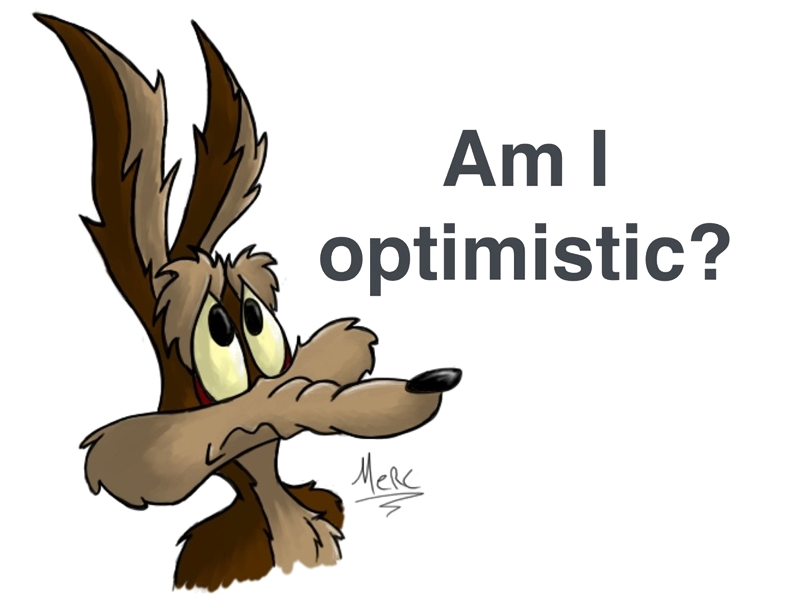
Optimist or pessimist. . .

What was the difference?

There are those who would insist I must be a pessimist.  They read my complaints and presume that that is all I do -- complain -- and that my curmudgeonly perspective sees everything as bad.  On a bad day, perhaps they are correct in their assessment.  On the other hand, I am indebted to no pristine moment in the past nor do I believe that it would have been better to have been born at another time and in another place.  This is where God has put me.  I have no choice but neither am I merely resigned to His choice.

For men it is impossible but with God all things are possible.  If believing that is optimism, then I am an optimist.  While I truly believe that the challenges facing Christians are many and great, I am also mindful of the promise that Greater is He who is in you than he who is in the world.  This does not mean that God has some plan hidden in our messes that He is bringing to pass.  What it does mean is that God's Church is His and He will not abandon her nor neglect her.  We daily and regretfully present to Him our messes and our failures but He is not bound by them or confined by them.  Though we have confused our calling, God is not confused about His.

I am a pessimist when I read every new plan and paradigm as the latest and greatest thing to rescue the Church and accomplish God's saving purpose.  I am a pessimist against every person who presumes to be the Church's savior.  I am a pessimist against modernity parading as the new work of the Spirit.  I am a pessimist against the Pollyannas who think everything will work itself out in the end with or without us. 

But I am an optimist because I believe the Word of God does what it promises.  I am an optimist who is confident the splash of water is the hand of God making a new Christian.  I am an optimist who believes that the Spirit is at work in the means of grace and that this is how God builds, sustains, and endures His Church against her enemies.  I am an optimist who is in awe of the flesh of Christ and His blood given and shed for us once and now present to us in the Blessed Sacrament.  I am an optimist who cannot quite contain himself on Sunday morning that anyone was here much less the many whom the Spirit has called and gathered around the Word and Table of the Lord.  I am an optimist who believes that if I can contain my sinful desire to control all things, God will accomplish His purpose even through me.  I am an optimist who believes that the Church was here before I came and, God willing and by faithfully administering the means of grace, she will be here for the next pastor who follows me.  I am an optimist who knows that God has given us all the resources we need even though we are always short of money (not because God is stingy but because our wallets remain the hardest part of us to convert).

Christians are often considered optimists because we feed the poor without making a dent in poverty, we show mercy to the suffering but there seems no shortage of pain, and we preach the eternal Gospel to those who cannot hear it for the noise of the moment.  And we do so without growing weary of well-doing -- not because of our own character virtues but because we know God has called,, gathered, enlightened, and sanctified us. . . and if us, He will continue to call others.

Maybe it is not optimism.  Maybe it is faith.  Without it I do not know how I could rise from the bed in the morning or rest at night.  I don't know how I could do what I do over and over again expecting new result and not go crazy.  I don't know how I could look in the mirror and expect God to work through such a pathetic excuse for a child of God I am.  I don't know how I could see my way through the maze of the present with all its temptations, trials, and troubles and know that if I die and when I die, I will rise with Christ to new and everlasting life.  Maybe it is not a matter of optimism but faith.  I guess I feel like Peter who said Lord, where else can we do?  You alone have the words of eternal life...  If I read those words rightly, Peter was not making a bold statement of faith but expressing what I express every day -- I would love to find another way but there is no other that leads to everlasting life.  I would love a god who defers to my reason and fulfills my wishes but I have only the God who has loved me to death on the cross. I literally have no other place to go. . . and neither do you.  But do not be resigned to this as if it were a bad thing, it is the best there is!


I am optimist in one sense; that God has given us nothing less than His best to save us and delivers up this treasure every Sunday in the Divine Service... so if we will respond with voices raised in songs of praise, grateful spirit in joy, trusting hearts in His gracious will, ears that hear His voice, and wills that follow His lead, it is the best there can be until we see into glory.  Sometimes I have to remind others about this.  All the time I have to remind myself.  Lord, I believe. . . Help Thou my unbelief!

Saturday, August 8, 2015

Without conviction. . .

Tolerance is not only a virtue in modern day culture but the minimum expected of those who are part of that culture.  Perhaps it could be said that more than tolerance is both expected and demanded -- and that is approval.  It is not enough to live and let live; it is generally assumed by many that nothing less than full and enthusiastic acceptance will do.

So, for example, there are those who believe that anything less than the full and enthusiastic support of the GLBT agenda is not enough.  I know of people and have acquaintances who have said bluntly that they believe that mere tolerance of their homosexuality is not enough.  You cannot love me and not affirm who I am, as it was put to a friend of mine by his own brother.  If you love me, you will be at my wedding and happy for me and stand with me, said a daughter of a friend when she introduced her lesbian lover.  This may be one of the most visible areas testing our resolve but it is not the only one.

You can transfer this same understanding of tolerance, the glorification of diversity, and the lack of any real objective truth to a whole host of issues and challenges.  Indeed, the issue facing Christianity today is not simply where you stand but whether you stand at all.  Liberal theology has raised questions in our mind about the truth, trustworthiness, and message of Scripture.  Liberal psychology has just about explained away most sins so that they are mere matters of choices -- different choices -- made under unique circumstances.  Liberal churches say the words of the creeds without necessarily meaning what is said.  Liberalism has left us with nothing solid except tolerance, openness to that which is new and different, and a captivity to the moment that has forgotten history and refuses to pass on anything of substance to the future.

Churches that presume to hold to their confessions are routinely labelled as narrow, rigid, uncaring, etc...  Theologians who confess catholic doctrine are called repristination theologians who can only mimic what has already been said.  People in the pew who expect that their pastors and teachers believe what they say are told to grow up and get with the times.  So it is no wonder that we have taught our children that everything is negotiable, everything is open for debate, everything is subject to redefinition, and everything is what you think it to be.  And many of them, including the children of Christians, have learned this only too well.

Will we risk being labelled as narrow and judgmental for standing upon truth and for truth that remains the same and does not change?  That is the dilemma facing us now more than ever.  While some might express it in terms of the Spirit doing new things (in conflict even with the Word the Spirit said endures forever), others have simply abandoned explanation to accept what is as if it had always been.  In Rome, in Wittenberg, in Geneva, and in Constantinople, the issue is the same.  Do we accommodate culture or transcend it with the Truth that is Christ that endures forever?  Do we change to keep up with what is relevant, where people are at, or what is new and different OR do we hold on to the catholic doctrine and practice that does not change?  Do we use words as symbols or do we speak them for what they mean?  Do we describe Scripture as mythology with eternal lessons or as fact and truth that is not affected by our faith or our unbelief?

No, this is not a call to be rude or impolite or harsh.  What we are being called to do and to say is that which is yesterday, today, and forever the same.  Where Scripture is believed not simply as true historical record but as the performative and efficacious Word that does what it says.  Where creed is confessed as the same living and powerful truth that once overcame an adversarial culture, extended a missionary presence beyond borders, and witnessed against heretic and heresy.  Where liturgy is not merely the work of a people in remembrance but the means of grace for the God of time and history to enter the moment with His gracious gifts.  Where mercy is not what we do but who we are as we see in Christ who is the mercy of God incarnate..  Where the nicest thing we can do is to proclaim Christ to those who do not know Him and infuse our children with the knowledge of their Savior's saving grace before they have a chance to choose, and where we are content with no one and no place where Christ remains unknown.

If the price of tolerance is our conviction, then it is a price too high for us to pay.

Friday, August 7, 2015

Too true. . .


HT Byzantine, TX

Bible study problems???

The problems with Bible study.  Yes, you heard me right.  Bible studies are certainly good and salutary things but they can also be problematic.  The problem is not with the Scripture being studied but with the way it is studied and the leadership of the group or its lack of leadership.

I am not saying that only a pastor can lead a Bible study but the leadership of a Bible study requires that the person leading be trained and supervised.  Even pastors are supervised (we have a whole system of doctrinal supervision in our church body).  So it should not offend to suggest that others leading Bible study should also be supervised.

Perhaps one of the biggest issues with Bible studies is the lack of clear and solid leadership.  Clearly maturity, experience in the faith, and character contribute to good and faithful leadership but those who attend should also be able to expect that the leader is well versed in Scripture, in the doctrine of the Lutheran Church (at least through the Small Catechism) and is able not only to lead but to answer questions and deal with disputes over the issues that arise within Bible study.  The worst kind of Bible study is a rudderless group in which no one can speak to what is good and right and true.  It leaves those studying to the prison of their own reason and feelings and these, we already, know are not necessarily reliable.

When Bible studies include people of different confessions, it is even more important to have good and faithful leadership.  The lack of theological consensus can leave the group without answers to the questions before them or with answers that conflict with what we say we believe, confess, and teach.  Bible studies that end up as a free for all are unhealthy spiritually and dangerous to our confidence in and our unity in the Scriptures.

Bible studies that are really self-help groups subordinate the purpose of Scripture.  In the same way, group counseling sessions that masquerade as Bible studies create confusion among those looking for thus saith the Lord answers and turn the Bible into a psychology textbook God never meant it to be.  Scripture certainly speaks to our wounds but it is given to us that we might know Jesus Christ and Him crucified as Savior from our sins and the Giver of everlasting life.  When this becomes secondary, the Bible study and those in it are in trouble.

Bible study groups have no guarantee of confidentiality and, while they may be places where we can share things, no group is fully immune from telling tales out of school, so to speak.  It is dangerous when Bible study groups presume to provide pastoral counseling or even therapeutic aid when there is no pastor there.


Bible studies that thrive on the pursuit of the strange and trivial also violate Scripture's clear purpose -- these things are written that you may know that Jesus is the Christ and that by believing in Him you may have eternal life.  Speculative studies in which no clear answer is given or some other answer is given except Jesus Christ fail in their primary purpose.


People go to Bible study in part because they want answers, answers they can trust, and answers with more certainty than opinions or feelings.  They deserve credible leadership, trained leaders who are well versed in Scripture and the doctrine of the faith, and people who will direct them to faithful sources of counseling when they need or desire it.  Anything less and the Bible study group can become ripe for doing more harm than good.  Part of that harm is treating Scripture as if it were a book of secret wisdom to unpack or as if its wisdom were mere common sense and not the revelation of God’s one and only Son, who suffered for our sin and died our death so that He might raise us to life now and eternally.

Bible study is a good thing but make sure you are going to a Bible study where the leadership is capable, the confession of faith clear, the supervision in place, and the goal to know Jesus Christ and Him crucified!

Thursday, August 6, 2015

A good reminder. . .

If same-sex marriage comes to America, it will not be because Americans asked for it.  In the last 15 years the question was put to the people in nearly every state of the union. Even in liberal states like California, even on ballots in purely democratic primaries, the people voted overwhelmingly to keep the definition of marriage unchanged.

Cathy Ruse, JD, former Chief Counsel of the Subcommittee of the Constitution in U.S. House of Representatives, is Senior Fellow for Legal Studies at the Family Research Council, has written a somber reminder that the tidal wave of approval for same sex marriage is a tool of the media and the court system in America and that if it were left to the voters, marriage would not be redefined.  You can read her here.


We live in an age where the wrong opinion on same-sex marriage can cost you your job or your business. Where the wrong answer to a reporter’s hypothetical question can bring death threats. It’s a wonder anyone would tell a stranger on the phone what his views are on marriage.  But in the privacy of the voting booth, you are free from the bullies — free to consider what marriage means. And what children really need.

She is absolutely correct in pointing out the public consequences of deviating from the politically correct position on the issue of same sex marriage.  In fact, my own blog was singled out, charged with hate speech, and reported because a reader found opposition to same sex marriage offensive and believed the comments of a few folks on this blog to be mirrors of my own position.  The bullying in this debate is clearly NOT from the side that wants to preserve an understanding of marriage as old as time itself.


When historians write about the politics of marriage during the first American decade of the twenty-first century, here is what they will write:

  • That Nebraskans always considered marriage to be the union of one man and one woman but in the year 2000 they voted overwhelmingly to make that definition the official law of their state. 
  • And in 2004 Arkansans made man-woman marriage the official law of their state. And Georgians did too. And Kentuckians.
  • That Michiganders voted to protect the man-woman definition of marriage within their borders. As did North Dakotans, within theirs. And Oklahomans. And Ohioans. And Utahns. And Louisianans within theirs. 
  • That in 2005 Texans voted to keep marriage in the Lone Star State a man-woman institution. As did Coloradans in their state in 2006. And Idahoans in theirs. And South Carolinians. And South Dakotans. And Tennesseans. 
  • That in 2008 Floridians made man-woman marriage the official law of the Sunshine State. And Arizonans made it the law of the Grand Canyon State. And Californians made it the law of the Golden State.
  • They will write that in 2009 Mainers made man-woman marriage the official law of their land. 
  • And in 2012 North Carolinians made it the law of theirs. 
Historians with an ounce of integrity will report that by this year 50 million Americans had stepped into voting booths from coast to coast and cast votes to keep the definition of marriage unchanged.

The votes were counted and they tallied up a viewpoint to retain the traditional definition of marriage.  That has proven too much for those who believe that change must happen.  If it cannot happen in the minds of people alone with their consciences in a voting booth, then it will happen by other means.


And then they will write that in 2013 a federal judge struck down the law that Utahns had passed to keep marriage a man-woman institution.

And in 2014 a judge struck down the law passed by the people of Oklahoma. And another struck down the law passed by the people of Virginia. Another, by the people of Texas. Another, by the people of Michigan.

hey will write that a handful of federal judges struck down the laws passed by the people of Ohio, of Arkansas, of Idaho. And another handful struck down the laws voted in by the people of Oregon, of Pennsylvania, of Wisconsin, of Colorado and of Florida.

But this is folly. We know that historians will not write it this way.  Instead they will speak of a “shift in American attitudes.” They will use phrases like “tidal wave” and “sea change.” They will ruminate on how rapidly Americans embraced the new paradigm.  But of course this is an illusion. All that can really be said is that a handful of liberal judges embraced it. And then imposed it on the rest of us.

And then in 2015, the SCOTUS decided on behalf of all of us that something will be the law of the land that was never envisioned by the constitution or the bill of rights. 

What we face in America is a rerun of the 1973 abortion decision in which judicial activism decided that conscience of the people and the will of those people expressed through the ballot box was not enough, was not fast enough, and was not reliable enough to entrust a decision that the liberal elite believed must be made.  Just as that decision divided America while some 40 million children were disposed off as if they were nothing, so are we the victims of a judicial activism that imposed the untried values of a liberal elite upon a people whose elective will and votes have consistently said otherwise.  The cultural divide in America will be further strengthened by such lack of judicial restraint and this is no small threat to our future as a people whose common values unite us over economic, cultural, and racial divisions.

Quite apart from the religious consequences of this change, the cultural divide that has been cemented in place by the SCOTUS and by judicial activists intent upon imposing upon us their own will, purpose, and desire will test the very fabric of our unity.  Some are not sure that unity as a nation will survive. 

Wednesday, August 5, 2015

Sad but avoidable. . .

One more high profile resignation has shocked the megachurch community of star churches with equally well known star preachers and teachers.  This time it is Tullian Tchividjian who resigned from his pulpit at Coral Ridge Presbyterian after marital difficulties that included an affair on the part of his wife and himself.  We all well know the fall of Mark Driscoll (for another moral failure) and in Florida alone three high profile pastors of three high profile megachurches have resigned for moral failure.  Once honored as pastor of one of America's "10 healthiest churches" David Loveless resigned after confessing that he committed adultery three years ago.  In the past six months, two other pastors, Summit Church's Isaac Hunter and The Gathering Place's Sam Hinn (brother of Benny Hinn) also resigned.  Last year Calvary Chapel Fort Lauderdale's popular founder and leader, Pastor Bob Coy, also resigned due to moral failure.  Add this among the list of megachurches whose very existence has been threatened by succession issues when the popular founder retires, resigns, or dies.  The news is not good for megachurches dealing with problems with life after their pastors got in trouble.

For Lutherans the Tullian Tchividjian resignation is a bit more close to home.  He came to Coral Ridge Presbyterian Church after a self-indulgent young adulthood that found him back in the Christian faith.  Coral Ridge was looking to polish up its star after the death of found D. James Kennedy had left the congregation in decline.  Tchividjian was restoring some of that luster but not without controversy.  Some Coral Ridge folks tried to oust him and he himself acknowledged that he was changing.  Having hit upon the Lutheran distinction of Law and Gospel and sounding almost Lutheran, he went through a public breakup with The Evangelical Coalition and became a star to many Lutherans (a featured speaker a short while ago at Concordia Seminary, St. Louis).

In any case, the problems of the pastoral ministry are many, the temptations great, and the life rather lonely (despite the appearance of many friends).  All of this combines to create an environment ripe for moral failure under even the best of circumstances much less for the average pastor who has no celebrity following.  My point in all of this is that no matter how sad this news is, it was avoidable.  The problem for us today is that we dare not deny our desires and even in the church it is hard for people (and pastors) to say "no" to their wants or to practice the lonely discipline of self-denial.

A key question for the churches will be what to do with folks like these whose moral failures seem to have disqualified them from serving as pastor.  Once in the LCMS such moral failure was an automatic path out the door of the parish and the roster.  Today many remain and not only those who have been found "innocent" parties in such situations.  On the one hand, the policies and decisions of the churches have been dictated fear of legal liability, by insurance programs, and by the inability to know what to do with such folks should they truly repent.  In the LCMS I am told that moral failure (a euphemism for a variety of sexual sins) has become an automatic dismissal.  So what role does forgiveness have in all of this?  And if the church exercised the same no tolerance policy then as we often do today would we have ever had people like Augustine?

I must admit that I have no answers here.  I know, as do all pastors who acknowledge their sinfulness, that I am unworthy of the office.  My own sins of thought and word and deed are a weight upon my own soul and push me to find refuge in Christ's healing wounds.  As Luther put it: I am, indeed, unworthy of the office and ministry in which I am to make known Thy glory and to nurture and to serve this congregation.  And again:  Oh, Lord God, Thou hast made me a pastor and teacher in the Church. Thou seest how unfit I am to administer rightly this great and responsible Office; and had I been without Thy aid and counsel I would surely have ruined it all long ago.
Oh, Lord God, Thou hast made me a pastor and teacher in the Church. Thou seest how unfit I am to administer rightly this great and responsible Office; and had I been without Thy aid and counsel I would surely have ruined it all long ago. - See more at: http://pastoralmeanderings.blogspot.com/2012/07/anniversary-day.html#sthash.e30erqXq.dpuf

I am ever so glad that I am not called upon to make such decisions for the larger church over pastors caught in moral failure.  I am also comforted in my own flawed service to the Lord that He takes my mistakes and forgives them and reminds me in my successes that it was not me but His grace and power that made it happen.  Yet no pastor worth his salt ever thinks such ruin cannot happen to him.  It is always sad when this happens, it is most always avoidable, but it requires of us to do what is against our sinful nature -- deny ourselves, take up our cross and follow Jesus.  God help us to do that -- pastor and pew sitter alike!

Tuesday, August 4, 2015

Fast food vs eternal lfood. . .

Sermon for Pentecost 10, Proper 12B, preached on Sunday, August 2, 2015.

    Lets be honest.  People come to church for all the wrong reasons.  But they are still here.  It is no different today than it was in the Gospel for today. We are told about a crowd that took after Jesus but not because of His teaching or who He was. They came because Jesus had fed them once and now they wanted more easy bread.  Imagine then the nerve of Jesus to set up a food pantry for one people in one place and then leaving before everyone got their share of the miracle!!
    Jesus challenged them.  You did not come because a sign brought you faith; you came because you filled your belly once and wanted more.  So what do you want?  Bread for your belly or the bread of the Kingdom that gives eternal life?  It is a hard question.  We don’t like choices.  Miracle bread sounds good but we need to feed these bodies, too.  Even manna can grow old.  What ARE you seeking from Jesus?!
    Jesus insists He is no bread king.  He is no Burger King; He has not come to replace the labor and work assigned to us in creation through which we feed our bellies and care for the needs of this life.  No, Jesus has come to bestow the bread our labors cannot earn and our works cannot provide.  He is the King of eternal food that gives eternal life.  It sounds good but is it what we seek, what we want?
    Too many of us want Jesus to relieve us of the burdens of mortal life that sin imposed upon us.  We want easier lives and easier bread. We want leisure instead of work and a happy life instead of one filled with struggles.  But Jesus has not come to make our lives easier.  He has come to give us what our labors cannot provide – the bread of heaven that gives eternal life. Is this what you seek?
    Jesus has not come to show us a short cut to happiness or prosperity or easy bread.  He has come to work salvation for sinners who cannot atone for their sins and who have only work and labor and death in their future.  Jesus has come to bring pleasure eternal, as we sing, and not a short cut around the ordinary demands and requirements of life and work.
    Jesus identifies Himself as the very bread of God that comes down from heaven and gives life to the world.  This is an impossible statement to comprehend and only faith empowered by the Holy Spirit can enable us to trust in this amazing promise.  The Kingdom of God is not reasonable or rational.  It does not fit the expectations of sinners or conform to the dreams of the wise and intelligent.  It is accessible only by faith.
    Our Lord gave manna every day and still the people whined and complained.  It does not matter if it is miracle bread – how many ways can you prepare manna until you tire of it?  But Jesus offers us something better than manna.
    Feed upon His flesh and you will hunger no more.  There is but one bread that feeds body AND soul, that sustains us for today and bestows upon us eternity.  This is His bread, His flesh for the life of the world and given for YOU.  Do this as My remembrance, says the Lord.
    Drink His blood and you thirst no more.  There is but one source to refresh mortal bodies with eternal refreshment.  This is Christ’s blood shed for you and now your drink that forgives your sins and imparts to us eternal life. Is this the cup you seek?
    We are not so sure.  Sin has corrupted our thinking and our desires so that we choose fast food over the bread of eternal life. Without the Spirit we will seek only fast food.  But guided by the Spirit, we kneel before the Lord praying, “Give us this bread always...”  We have the same duty assigned to us in creation (even though it became a struggle after sin changed the landscape of this mortal life).  Jesus has not come to take from us this duty but to give us what we cannot get anywhere else or provide for ourselves no matter how hard we worked – the bread of heaven for eternal life.
    Like the crowds of old, we come to Him seeking easy bread and easy lives but Christ has the bread that nourishes us to eternal life – His flesh and His blood given and shed for you for the forgiveness of your sins.  We struggle because our sinful natures instinctively choose fast food but God has given us His Holy Spirit so that we may seek the eternal that only Christ can give.  Only faith leads us here.
    People come to church for a million reasons and many of them not good.  Thanks be to God that they come.  That you come.  For Christ meets you here and opens your heart by His Spirit, that you might receive with faith that which you cannot get except from Him.  And more, He opens your hearts that you may desire this bread above all others -- His flesh for the life of the world and His blood that cleanses us from all sins.  We who came for one bread go home with the surprise of another bread more than we ever expected.  Thanks be to God.  Amen.

Common Core -- will it produce a nation of technocrats?

Let me begin by saying I believe in a classical liberal arts education, from elementary to college.  I believe time spent in the great classics of literature to be time well spent.  I believe that reading to broaden one's perspective as well as for beauty is at least as important as reading for information on how to do something.  I believe that modern works are often avant guarde but I fear that too much of what is read by our students has little staying power.  So it comes with great fear and trepidation that I read of Common Core's movement toward non-fiction and away from fiction.  Worse than this is that the move does not offer the student the work of our best non-fiction authors but mostly technocrats.  In other words, non-fiction is not quite accurate.  More and more of the reading will draw from what the Common Core standards specify “seminal U.S. documents of historical and literary significance.”  While this may include the more lofty and noble of those writings, it will also include everything from Supreme Court opinions to blog posts to speeches to news stories, etc...  What we might call informational reading has replaced reading for interest, culture, values, and story.

The sad truth is that we read more and more bits and pieces of even the greatest literature and less and less of the whole novel, play, or story.  Our nation is poised to institutionalize this for our children.  My greatest fear is that it will only hasten the development of a nation of technocrats, where information has value only by its current usefulness to us, and where how we write or speak becomes secondary to what we say.  Perhaps I am worrying that I will be out of a job?  Well, I am old and won't be around to see how this works out in a generation or two.  But I hope I will be remembered by encouraging people to write well and to read broadly!  Nothing can be worse than reading only things which with you know you agree!

Monday, August 3, 2015

Something for everyone. . .

Pope Francis, writing on environmental issues, has something for everyone.  On the one hand, he will be loved by the green folks for advocating the immorality of wasteful consumption, the denial of clean drinking water, the exploitation of the poor, the use of air conditioning, the slowness of the governments to act, the acceptance of the science behind global warning, among other things.  On the other hand, he refuses to countenance population reducing ideas (from abortion to euthanasia), challenges the decline of the family, refuses to bow before the grand deity of technology, and refutes the adoption of the modern cultural ideas of sexuality and same sex marriage.  It is a long and expansive document (too long) and quite pessimistic in tone. He solemnly warns of global warming, insist that man is responsible, and believes sweeping changes are required on every level of government and life in order to save the earth.

But Francis is not speaking merely to the world.  The bulk of his address seems to be aimed at those who will probably never read more than a snippet of his grand, sprawling encyclical.  Individuals are his focus.  He does not believe that some mighty one world authority nor recycling efforts will fix what is, for Francis, a spiritual crisis as much as an ecological one.

All in all I am not sure what to make of this encyclical in terms of its take on its subject.  Perhaps the best of Francis words are his rejection of the idea that this is merely a problem to be addressed and solved.  Life is not a series of problems to be resolved and such a focus is not really living at all.  At the same time, Francis does not let us off the hook for our personal accountability for the problems and our personal responsibility to bequeath to our children a world less tainted by our excess and abuse.  In the end, though, it would seem to Francis that his version of ecology almost requires a Christian mindset.  That being the case, what is being asked of the reader is more than the practical adoption of some theses for a better stewardship of the earth.  Rather, Francis seems to be asking for a wholesale conversion of spirit and values to conform to Christianity.  That may give his words more authenticity in the minds of some but it will surely distance his words from influencing others.

All of this only points out how hard it is for churches to address the science and technology of our world with a call to repentance and faith.  I can think of no one who has broached this subject with much success.  So in that respect Francis is no worse and perhaps somewhat better at the task than some of the others who have gone before him.  Whether his encyclical will be remembered or forgotten, only time will tell.

What I can point out are some of the things now institutionalized for the Roman Catholic Church within the encyclical that, while not part of the major thrust of what was said, are profound changes nonetheless.

  • Francis implies that people have a relationship with the earth -- something not different from their relationship with God and with their neighbor and that the Genesis account is “symbolic and narrative,” not literal;  "The creation accounts in the book of Genesis contain, in their own symbolic and narrative language, profound teachings about human existence and its historical reality. They suggest that human life is grounded in three fundamental and closely intertwined relationships: with God, with our neighbor and with the earth itself.”  Thus the Pope has institutionalized the liberal theology that discounts fact and history over myth and story.
  • Francis rejects any notion that human beings have “dominion” over nature;  “Our ‘dominion’ over the universe should be understood more properly in the sense of responsible stewardship.”  and “The Bible has no place for a tyrannical anthropocentrism unconcerned for other creatures.”  In other words, Francis sees dominion exclusively in terms of stewardship and rejects any and all ideas that man is above nature or acts as lord of creation in the stead of God.  Dominion to Francis means preservation.
  • Francis seems to advocate a “mystical nature panentheism.”  “The universe unfolds in God, who fills it completely. Hence, there is a mystical meaning to be found in a leaf, in a mountain trail, in a dewdrop, in a poor person’s face. The ideal is not only to pass from the exterior to the interior to discover the action of God in the soul, but also to discover God in all things.”  It is as if the Pope has read the script from Avatar or Lord of the Rings and made nature somehow more noble and pure in its expression of the Creator's will and purpose than mankind has.  
This encyclical is primarily a teaching document, primarily a theology text, and yet, surprisingly, it even includes a footnote to the words of Sufi mystic Ali al-Khawas.  Something for everyone!  Only 15% of the  encyclical’s 184 pages are devoted to technical or scientific address; the rest is theology and the theology expressed therein now institutionalizes the liberal perspective on creation, on the relationship between man and nature, and the divinity inherent in all things created.

BTW if you disagree with me, you can read anyone or all of the following who also think they know what the Pope really said or should have said or could have said...

Sunday, August 2, 2015

Is digital worship real worship?

I will admit that I use the internet.  I have a Facebook page.  I do Instagram.  My church has a web site. I carry a smart phone.  I am not sure I would ever be confused with a techie but I do publish my sermons on this blog and I do peruse the digital offerings of many different and diverse sources.  I Skype and use Google Meeting.  That said, I am definitely against the confusion of the real with the digital.  This is especially true in the area of worship.

I was reading a blog post about digital worship and read a clear, cogent, and calm argument why digital worship is real worship but the author is just plain wrong.  There is no such thing as a digital substitute for the Sacraments or a digital version of worship or a virtual church that satisfies either Scripture or the Confessions.

Millennials in particular like to romp in the digital playground — they read Scripture on their phones, check out a church’s website before they visit, watch online videos about faith and/or spirituality, search for spiritual content online, and even “go” to worship via live stream services (FUN FACT: Young married couples [ages 24-34] who recently moved to a new town will watch a live streamed service six times on average before visiting a church physically).  Should your church service go digital? Should you live stream your worship and encourage people to “attend” online? Will something vital be lost? Will something valuable be gained?

 I do not have a problem with reading the Bible on my phone (or the catechism for that matter) and I can see using the hymnal on tablet format (especially for those who find it hard to hold a weighty hymnal) but this is not nearly the same thing as going to worship via live streaming services.  Remember here the question here is not whether this is possible or easy or even cheap but whether it is worship.  I watch worship services on line but it is not the same as being there.  I cannot receive the body of Christ digitally nor can I experience the fellowship of the faithful online.  I can hear a sermon but it is not the same as hearing it in the company of the faithful and in the context of the Divine Service in which I will receive the flesh and blood of Christ.


There are valid concerns about digital worship, but the practical and positive consequences for live streaming worship far outweigh the “good problems” you will have to face. And when you consider that the average cost of live streaming is cheaper than a typical monthly cell phone bill, you can begin to see how offering live streaming just makes sense (and “cents” for that matter, as well).  

Special events (seminary call service) and special circumstances (the home bound) lend themselves to live streaming but the benefit is not the same as being there and the digital experience is not the equivalent of the live.  We need to be careful here.  Worship is by nature inconvenient.  Anytime I stop thinking about myself and focus elsewhere it is inconvenient to my sinful nature.  Worship is by nature sacrificial but what is the sacrifice of remaining in my bathrobe and tuning in and out of the video and audio content of a service in which I am not participating?  There is no equivalence between personal and digital choices of the same event. 

Saturday, August 1, 2015

The Great Mystery. . .

Fr. Richard John Neuhaus spoke once of the greatest of all mysteries "the Lord who made the whole universe would commend Himself to my hands [the hands of the priest]."  Of course, it is not only a great mystery but a most humbling act that those who distribute in their hands the very flesh of Christ as food and His blood as drink are completely unworthy of their service on the Lord's behalf.  No one but the dullest of all pastors would fail to consider this on Sunday morning.  It is this profound humility of God that is the occasion of both our greatest joy and our own cause for humility.  "Who am I that God should.." Exodus 3:11 and 1 Samuel 7:18.  That is the great mystery of the mass and the greatest of all graces that every pastor worth his salt should never lose sight of as he presides at the Lord's Table.

But it does not end there.  For as much as the Lord who made the whole universe would commend Himself to my hands, how much more so that He would give Himself to me as my food, His flesh for the life of the world and His blood that cleanses me from all sin?  That is the great mystery of the communicant who comes to kneel at the altar and who finds there God whose majesty is His humility for us and our salvation.  This humility generates its own humble response of faith.  At the heart of the faithful communion is always the awesome grace of God and our faith driven response:  “My Lord, I am not worthy that you should enter under my roof, but only say in a word and my boy will be healed.”  [Matthew 8:8] While this language may feel uncomfortably distant when juxtaposed to the incredible intimacy of Holy Communion, it is exactly the right perspective of faith that just before Christ comes to us we acknowledge the greatness of His grace that He visits the unworthy, saves the undeserving, forgives the sinner, makes His homes with us, and declares us what we are not -- worthy.  

In Holy Communion we receive something far more incredible than an impromptu dose of grace, but the visitation of our Lord, host and victim, whose meal it is and yet who gives Himself in food to us.  When priest/pastor and communicant lose sight of this divine paradox of the humility of God who gives Himself to us unworthy sinners, then the supper becomes mere snack, the symbolism more important than the substance, and the feeling more significant than Giver and Gift.  Pray, brothers and sisters, that this never happens.

Who am I that the Lord should come to me and come under the roof of my humanity and suffer and die in my place and now give me His flesh and blood as my true and essential food?