Wednesday, February 15, 2017

The wrong kind of apologetics. . .

Apologetics is supposed to be a defense of the faith.  It is for some, however, an apology for the faith, an "I'm sorry" Christianity goes against your reason, your science, your desire, or your purpose but just maybe you ought to pause before ditching it entirely...  We need defenders of the faith who will engage the skeptics, agnostics, and atheists of the world.  We do not need apologists who agree that Christianity does not seem plausible or reasonable or relevant in our scientific world but believe anyway.

Andy Stanley has been a phenomenon since he was a little boy.  The son of famous Southern Baptist pastor and onetime denomination leader Charles Stanley, he has had an on and off again relationship with his dad, his dad's theology, and his dad's church.  It led to a very public split and Andy starting his own mega franchise (without the Southern Baptist logo).  His dad was and is a fairly predictable and reliable Southern Baptist.  Andy, not so much so.  In fact, Andy has determined to craft a Christianity in which Scripture and the Virgin Birth, among other things, need not be impediments for those who find Scripture not credible and the Virgin Birth, well, kooky.  Therein lies the rub.

“So I need you to listen really, really carefully and the reason is this: Perhaps you were taught, as I was taught, ‘Jesus loves me. This I know’ – and let’s all  finish it together – ‘for the Bible tells me so.’ This is where our trouble began. . . ”  so preached Andy in August of this year.  It was followed up by a Dec. 4 Christmas themed sermon in which he reached, among other things “In fact, you should know that Christianity doesn’t hinge on the truth or even the stories around the birth of Jesus. It really hinges on the resurrection of Jesus.”

I understand what Stanley is trying to do but he is not doing his skeptical hearers any favor.  Peeling back layers of the faith to get at the core of what must be believed is never a process that has an ending point.  The whole rise of religious skepticism that became normative in the late 20th century was surely no more than an attempt to do what Stanley was doing -- deal with the contradictions between "science" and faith, reason and faith.  The problem was that an opening never remains the small hole intended to allow the skeptic in and nearly always becomes a giant means of escape in which the tenets of orthodox Christianity begin disappearing from creed and confession until there is nothing left but a spiritual Jesus endeavoring to make people spiritual (without being religious).

Apologetics is surely not my area of expertise but it is the call of duty for ever pastor.  Christianity is under siege in the university and among the elites, to be sure, but the faith is under no less of an assault by folks on Main Street as well.  This is exactly where the parish pastor lives -- defending the truth of Scripture and the claims of creed and confession to a people for whom "Thus saith the Lord" is no longer enough.  We do this best not by abandoning the Scriptures nor by admitting that there is a conflict between the "spiritual" truth of the Bible and the "real" truth of science.  This is merely a rabbit hole that leads away from the faith and into a wonderland in which reason is presumed to be the most secure and reliable truth of all.  No good is served for the faith or the faithful by peeling away the layers of the incredible to get to the core.  Christianity is by nature incredible to the ordinary human mind -- apart from the work of the Spirit.  Foolishness is always the judgement of the world against the Wisdom of God -- especially when that Wisdom is made flesh of a Virgin by the Holy Spirit to carry the weight of the world's sin into His death and rise with the hope of the resurrection to new and everlasting life!

Stanley is surely winsome and he has all the tools to make his case convincing.  And I am sympathetic to his point.  "If the Bible goes, so goes our faith. . ."  We do face a danger of a Biblicism which bolsters the faith by treating the faith as something fragile that must be protected instead of a sturdy truth that can and does confront the emptiness of the world.  That, however, is a position that has been retreating from churches and people for a very long time.  It has been replaced with a far more nefarious enemy.  This enemy says that perhaps, maybe even probably, much of the Scripture is not true (Jericho's walls did not fall, the sea did not part, the six days were euphemisms for long epochs of history and evolution, the Virgin Birth is pious myth, etc...).  That does not matter, says the enemy.  Spiritual truth remains. 

Our bones will remain in the ground but we will live a spiritual life.  Jesus was born of a woman who could have been a young woman raped by a soldier or the victim of a insincere boyfriend, most of the miraculous stories of the Bible are myths -- but do not despair, we will rise and live like Jesus and with Jesus in some spiritualized version of life.  Andy Stanley is not the first to suggest that there is a division between the credible truths of the faith that must be believed and the whole of the Scriptures which can be taken with a grain of salt.  But he is no apologist in the classic sense of that term.  His is the house of cards that offers little or nothing to those who would gladly strip away layers of myth to get at what might be real.

Faith is not bolstered by those willing to admit that the Word of God is legend or myth or fabrication or even that the Bible is both words of man (which may not be true) and Word of God (which probably is).  Lutherans are not Biblicists and our faith is not a weak and fragile truth that must be protected at all costs.  We know a Word of God which is powerful and efficacious.  Its power lies not in that it is true (which it is) but in that it is the breath of God, the voice of God, and power of God to deliver what He has done to a people living in rags of unrighteousness and ashes of death.  Our people need defenders of the truth and not negotiators will to admit the enemy's most powerful lies.  Stanley thinks he knows what he is doing but he has tossed out the baby with the bathwater and eventually nothing will be left to preach but the here and now (aka Joel Osteen).  That is not Christianity and that is no faith worth settling for. . .

Tuesday, February 14, 2017

All men are liars. . .

Sermon for Epiphany 6A, preached on Sunday, February 12, 2017.

All men are liars. It is not just that men lie, lie sometimes, or lie often, but they are liars; lies are not their occasional companions but their lifelong friends.  It is not my judgment; God says it in Psalm 116.  Before I get an amen from the women here, lying is equal opportunity.  All women and even children are liars. Even pastors.  I am a liar, too.  The lies I have told you are bad but I have told worse to myself.  But nothing can compare to the lies I have told God.  Don’t be so shocked.  You know the truth of it.  Because you are also a liar.  And the lies condemn us.  Big lies.  Small lies.  White lies.  Evil lies.  They all damn us.  Don’t hide in lies.  Cling to the truth.

You, me, and all of us are liars.  That is what sin has done to us.  Sin has turned us into liars.  The greatest of those lies is that we deny our sins.  Oh, sure, we gladly admit we are not perfect but we also believe we are no worse than others and better than many.  And our sins are not that bad.  If we did sin, these sins are not big ones or bad ones.  They are just sins -- common, ordinary, garden variety.  If we tried hard enough, we could shake those sins and make up for them.  Maybe someday we will.  At least those are the lies we tell ourselves, others, and God.

Someday we will give up those sins.  The pet sins that we commit without thinking, the accidental sins that really don’t count, and the enjoyable sins that ought not to be called sins at all.  Such are the lies we tell ourselves, we tell others, and we tell God.

Our lies are not only in our denials but in our justification of those sins, our excuses for sinning, and our protests that surely others are far worse than we are.  There is no comfort in lies and no safety, either.  Our lies are like a house of cards ever waiting to make our lives come crashing down.  Yet sin has so stained our reason and our instincts that we will do anything to protect our lies – even running from the light and the truth.

Jesus confronts our lies.  “You have heard it said. . . But I say to you!”  You can murder with words.  Don’t bring a gift to the altar without reconciling with your brother.  Don’t run from your debts and obligations but face up to them and do what is right.  Don’t think that your thoughts are secret for the Lord knows the lust in your heart and in your eyes before it turns into adultery.  Don’t presume that sin lives on the outside of your lives and you can hide from evil – the evil that condemns you hides in your own hearts and minds.  Don’t trade your marriage for dreams presuming that your happiness justifies it all.  Don’t swear before God because it only confirms the lies in your heart.

Our God is a God of truth.  He strips away the layers of our lives until truth condemns us.  He exposes what we hide, remembers what we forget, and silences all our protests.  But He does not do so to condemn or to ridicule us.  No, my friends, our Lord Jesus rats us out so that His mercy can save us, His truth rescue us, and His blood cleanse us -- wretched liars and sinners though we are.  Jesus has not come to tell the well they are fine or to pat the righteous on their backs.  No, He has come for sinners, cutting through the smokescreen of our lies so that He might rescue us, His blood pay for our sin, and His death end our captivity to death. 

Sunday morning is truth time for liars.  Grace comes for sinners.  Mercy comes for those who are unworthy.  Righteousness clothes the wicked.  That is the message of the cross.  That is the redemption born of a holy Savior who dies for sinners.  And that is what the Spirit is coaxing into your reluctant hearts. 

So lay down your false pride.  Jesus gives us the true humility of repentance and faith.  Forget the useless competition of which lies are worse or better and confess them all.  Repent to your God.  Repent to your brother and sister. Repent to the Lord who knows all the evil hiding in you and repent to those who have no idea what lives in your heart.  It is hard and it is humiliating but there is no cover in lies and no future.  Only the blood of Christ can save us and only the righteousness of Christ can cover up our sin.

Christ has born your shame and your sin.  Jesus stood alone on the cross while all humanity hid in the shadows.  Alone and wounded on the cross it seemed safe to us to hide in our lies.  But His cross means you are not alone. You have hope for something better than a relative righteous which says you may be better than some.  His cross shines light on you to save you.  And now there is something better than lies to hold onto – the truth!  You have Christ and Him crucified.  He is your hope and your redemption.  He has has been planted in you by baptism.  The old and comfortable ways ways of sin are even now, by the power of the Spirit, giving way to the new ways of life in the Kingdom of God, living in the truth.

Since the Law cannot condemn you in Christ, it has become the lamp to your feet and the light to your path that God intends.  Since Christ lives in you, He is even now teaching you to love the light, to seek what is good and right, and to do them not out of fear but out of love.  Because you are not who you were, and even though you are not yet who you shall be, you are His, bought with a price and His own possession to walk in Him and glorify God with your good works.  And in Him you learn in the Spirit to leave behind the ways of anger, lust, jealousy, greed, pride, and hypocrisy that Jesus condemns so clearly and so completely.

You were born into lies and you learned to lie with the best of them but you have been born again into the truth that is Christ Jesus.  He is your truth and His truth  rescues, redeems, restores, and renews.  Lies shield us from grace but the truth has salvation big enough for us all.  Christ knows all our lies and loves us still.  And now, by the power of the Holy Spirit, we have come to know Christ and to love the truth and live in it.

In the name of Jesus. Amen.

Dreams worth sacrifice. . .

Just after Christmas my wife and I ventured into a theater to watch Rogue One.  It was 39 years ago, on a date, that we say the first film of the Star Wars franchise and walked away as people who have never seen anything like it before.  We felt very much the same after Rogue One.  We gasped when the hooded figure turned around in the end of the movie -- only days after Carrie Fisher died suddenly and then her mother Debbie Reynolds.  Our eyes were not dry for the scenes that gave visual shape to what were words across the screen at the beginning of that first Star Wars movie so long ago.  It is a profound legacy for all those who worked on the films and for the story George Lucas created that will become part of the very fabric of our identity for a very long time to come. 

Hidden in that movie is a hard truth.  Dreams are wonderful things but dreams require the sacrifice of those who are determined that the dreams are worth it.  These movies offer no magical short cut to the hopeful future.  They insist upon taking the viewer through defeat, loss, suffering, and even death upon the way.  It is not a sacrifice of the mind but of the heart and body and life.  The scars are carried along (like the mechanical hand of Luke).  This genre of literature and film is always one ripe with applications to faith, to the battle with evil, to the temptation of darkness, and to the triumph of light at the hands of a messianic figure who saves at great personal cost.  I think sci-fi is instructive and intuitively adaptable as a medium for Christians. 

I will not quickly forget the wonder I felt when I read C. S. Lewis' The Space Trilogy or The Chronicles of Narnia (too quickly written off as children's literature!).  I think it is a good thing when our children read such novels or view such movies.  They are fun but they remind us of honor and integrity as virtues of the faithful, of the struggle and sacrifice that the fight against evil requires, of the personal cost we must endure, of the force beyond us (God Himself) who holds the key to our victory, and of the promised future in the life to come.  They draw attention to the Savior who must do for the whole world what none can do alone and what all of them cannot do together.  I am not at all suggesting that the Christian Gospel is fiction but that this genre of fiction is particularly friendly to the fact and truth of Jesus Christ.

We have reduced nobility to an antiquated virtue and we have left ourselves without an idea of virtue or the stories of the saints to encourage us toward such virtue.  We have come up with a love that is fragile and weak and fickle -- unable to forgive the sins of those whom you love and unwilling to sacrifice to make it work when the loved disappoints the lover.  We have lived too much in the moment of romance that briefly shows itself and indulges itself but cannot sustain the love when tragedy and sorrow come near.  It is no wonder we do not get God or His love.  We think love means being nice and getting something out of it and we stand in confused awe before love that dies for the dream and turns the hope into reality.  It is this wonder which is missing from too much of our lives.

We kneel down at the manger and are content to ooh and aah at a baby without seeing in this infant flesh the face of God and prostrating before the awe-full mystery.  We pack away Christmas as if it were ornaments and gifts and have no wonder left to meet the sinless Son of God in the dirty water of the Jordan meant for sinners who have heard the call to repentance.  We treat the miracles of the season of Epiphany as if they were isolated and random acts of kindness and not the revelation of the God who delivers up His own Son to be our Savior.  So when we get to the Transfiguration, we are just as confused as the disciples who thought it possible to remain in the clouds instead of heading down into the valley of the shadow.  And then when Lent leads us step by step to the cross, we shudder to think that it could have all been about this -- Love was born to suffer and die!  And like Mary Magdalene was want to hug Jesus and go back home to the old ways and expectations of life while Jesus is burning into our hearts what Love has done and how there is no more yesterday but only the today that anticipates an eternal tomorrow.

On this Valentine's Day we celebrate love and yet too many of us have absolutely no idea what love really is.  Men tend to think that a little gift and some nice words will ensure that we are lucky at the end of the evening and women think that a little gift and some nice words are probably the best they can hope for.  No wonder the stats on marriage are so dismal.  Love was born to suffer and die for the unworthy and undeserving, those still enemies of the Lover.  When we learn this and strive to manifest a glimpse of this love between husband and wife, then perhaps we will also learn that life is more than a moment and sacrifice worth the dream.

Monday, February 13, 2017

Solid food. . .

For everyone who partakes only of milk is unskilled in the word of righteousness, for he is a babe. But solid food belongs to those who are of full age, that is, those who by reason of use have their senses exercised to discern both good and evil. (Heb 5:13-14)

But I, brothers, could not address you as spiritual people, but as people of the flesh, as infants in Christ. I fed you with milk, not solid food, for you were not ready for it. And even now you are not yet ready, for you are still of the flesh. For while there is jealousy and strife among you, are you not of the flesh and behaving only in a human way? (Cor 3:1-3)

Scripture says not everyone is ready for “solid food.” Few of us would admit that this verse is talking about us.  It is always others who not ready for solid food, for the deeper truths, for the secret knowledge.  That is the thing about knowledge.  Knowledge separates us.  That is why we love secrets.  Some of us know them and most of do not.  To be in the know is what we want.  Insider knowledge that is limited to a few is our goal.  We want to be on ten inside of the circle, so to speak.

We approach Scripture in the same way.  We think it is filled with secrets.  We want to know the secrets but they are no longer valuable if everyone knows them.  Knowledge is what sets us apart from others.  We like the dream of knowledge being equally applied so that all know all -- but the reality is not like the dream.  It is the dream of gnosticism that temps us all.   

The problem is that we tend to treat knowledge as something that does not necessarily affect us.  We have grown accustomed to the wisdom of the internet that seems unlimited and we have learned to mine its secrets and information more to answer our curiosity than to give us something to use.  That has become the same way we approach the Word of God.  We are curious but we tend to treat the information itself as the end.  It is information but it does not necessarily direct us in any way.  We want to know because we want to know not because we have an idea what to do with the knowledge.  Too much of what we call Bible study is the pursuit of information before which we are passive.  It does not even inform much less direct us.

I am not at all suggesting that it is better to be in the dark, not to know.  That said, it is better to know what we know well than to know very little about very much.  That is why Luther wrote the catechism.  It was written so that we would know what we know well -- so well it would become a part of us, inform who we are, and direct what we do.  The sad reality is that we treat the catechism as if it were child's play and we presume that we are ready for the solid food of the Word.  But unless we know well the catechism, we are not well equipped for the Word.  It sounds like a sacrilege to say this but it is true.  We are not all ready for solid food.  We are all ready the catechism.  Let us begin there and make sure we master it well.  It will serve us well as we prepare to feast upon the solid food.

Sunday, February 12, 2017

The appeal of prayer. . .

Prayer is a wonderful gift but used wrongly it is actually a curse.  I have written before of those churches without sacraments and of the temptation to turn prayer into a sacrament.  That is not the only temptation.  Though prayer is to proceed from confidence in God's grace, the truth is that some of our prayers proceed from just the opposite.  We have no confidence in God's grace so we must attempt to manipulate, direct, and control Him.  Without the assurance that God knows what is best for us and without confidence that God will do what is best, prayer is like wrangling a reluctant God into giving to us what we want but what He does not want to give.

It shows up in what we pray, what we say.  It seems spiritual maturity to think that the Our Father that our Lord taught us is a nice enough prayer but it cannot possibly cover all the bases of what we think we need, what we want, and how to get God to deliver these things to us.  Yet the opposite is true.  The Our Father is not some child's prayer which we will grow out of and be able to pray better on our own.  No indeed.  The Our Father is both starting point and ending point in prayer.  We pray it both to learn what it is what we need, what we ought to want, and how we know that God will deliver this to us according to His promise AND to pray what we have learned.  In the same way, the simple prayer "Lord, have mercy" is much more profound and has great depth even though our human wisdom seems to think simplistic.

We presume that spiritual maturity leads us past the "simple" words of Jesus and allows us to pray our own, deeper words.  We presume that the Our Father is a good starting point but once we attain a certain level of spiritual maturity we grow beyond the Lord's words and grow into our own.  What an arrogant presumption!

I recall once being asked by a person involved in the Charismatic Movement if I did not want to know more, to attain a deeper level of maturity, if I did not believe that there was something more than what I knew, if I did not want to communicate directly with God, spirit to Spirit.  In my youth I knew instinctively of the dangerous desire to go beyond what God Himself had provided.  It was not wisdom but good catechesis that led me to say "no" to the prospect of moving beyond the Word of God and the Sacraments and into some mysterious level of spiritual reality.  Now about 36 years later, I see the wisdom of denying and rejecting what appeared to be spiritual immaturity to those who wanted to explore beyond the seemingly rudimentary means of grace.  The same is true of prayer.

It may seem the mark of spiritual maturity to pray on a deeper, more mature level than the Our Father but this is the deceptive voice of the sinful self still presuming to know better than God.  We dare not follow this voice or we will be led from the rich and lush garden of God's promises in Word and Sacrament into the desert of idolatry and pride.  Of course we can and should pray other prayers in addition to the Our Father but the Our Father is font and source of these prayers.  In addition, these prayers always lead us back to what Jesus taught us to pray.  The line in that priceless treasure that stands out in this regard is "Thy will be done."  Just as we pray as Jesus taught, in the faith that leads us to believe, trust, and count on God's good and gracious will, so do our prayers strengthen our conviction that God's good and gracious will is all we need.  We are not settling for anything when we pray as Jesus taught but we are expressing as best we are able on earth the fullness of the divine confidence we see expressed in everything Jesus said and did -- right up to His death once for all on the cross.

Do not get caught up in the appearance of spiritual maturity which is, in reality, immaturity.  The Our Father is both where we start and where we return.  To pray as Jesus taught is not simply to mouth the words He said but to believe those words with all our heart, body, mind, and strength.  As we pray the Spirit works to lead us to the place where Jesus is, to full confidence in the good and gracious will of our Father in heave.  Do not be intimidated.  Prayer is not a riddle.  Neither is prayer a ladder to ascend.  It is simply faith at work.

Saturday, February 11, 2017

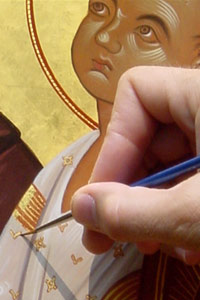
Art that is written. . .

Apparently some among the Orthodox are in a war of words over what exactly iconography means.  The words, in Greek eikonographia and in Slavonic ikonopisanie, speak in broader terms than simply writing (any manner of depicting, really) but there is merit to the idea of icon writing.  Icons are not simply art.  Indeed, the religious art of the West is not merely art.  This is not the kind of art that appeals to taste or preference but to the thing itself being depicted.  This is art that is words that do not have alphabet but form and shape.  It is a good thing to remember.  This art is not for appreciation but to speak the Word to us, to address us with the Word spoken not with voice or pen but with paint and brush.

Like it or not, the art in service to the Church has a nobler purpose than to appeal to taste or preference.  It's purpose is much more than an appeal to feelings or sentiment.  It exists to represent in form what the Word says.  The artist may use all of his or her creative skills in the process but in the end it is not about the artist either.  It is about the Word depicted.  In this respect it is appropriate -- even better -- to speak of such art in the Church being written rather than simply painted.  For it is all about the Word.

Icons make this even more clear since the artist does not attempt to represent the figures in a photographic manner or to be accurate or proportional.  The artist here understands that it is not about how real the image looks but about the Word being depicted.  For this reason, modern art does not really work in service to the Word.  We don't need to see what the artist saw or felt but what the Word says.  Sure the artist is involved and his talent and skill is part of the process but the success of religious art comes not in our awe at the artist but our faith kindled, instructed, and encouraged.

The blank canvas of so many churches almost suggests that we have nothing to say EXCEPT in words that are spoken.  On the other hand, the rich imagery of stained glass, carving, metal work, painting, etc... insists that not only do we have something to say but what we say is not limited only to the benefit of the ear but also visual, taste, texture, and smell.  This is not invented by us to explain why we have art but is essential to the Gospel itself.  Sacraments are visible Word -- they convey to the eye, the touch, the nose, and the mouth the Word that also comes to us by the ear.  Sacramental theology is by nature a theology that expects and even demands art.

Lutherans have always been people who understood the role of art and music with preaching and teaching.  We are the Church of Johann Gottfried Walter, of Johann Pachelbel, of Johann Sebastian Bach.  But we are also the Church of Albrecht Durer and the Cranachs.  We are incarnational and because we are incarnational, we are sacramental; because we are sacramental, we employ the full resources of art and music in service to the Word.  There is a deep and abiding connection here which too many Lutherans fail to see and leave the whole thing up to personal appeal, taste, and preference.  If that is all that religious art is, then by all means leave it in the museum.  But because it is not merely an appeal to taste, preference, and feelings, religious art is not a maybe but a must have for us Lutherans.

Friday, February 10, 2017

The prison of the temporary. . .


http://img-aws.ehowcdn.com/300x200/s3.amazonaws.com/cme_public_images/www_ehow_com/i.ehow.com/images/a07/rf/d4/tithes-offerings-800x800.jpgThere was surely a gasp among the people of Israel.  David, coming near the end of his reign and life, had stood before the people and with him, Solomon, his son and successor.  David had wanted to build a house for God but it was not given to him.  Nevertheless, that did not keep David from designating the treasury of Israel and his own personal fortune for the cause that eluded him.  He acknowledged that Solomon was young and inexperienced and would need the help of the people of God even with the help of the Lord Himself.  Then David prayed:

“Blessed are you, O Lord, the God of Israel our father, forever and ever. [11] Yours, O Lord, is the greatness and the power and the glory and the victory and the majesty, for all that is in the heavens and in the earth is yours. Yours is the kingdom, O Lord, and you are exalted as head above all. [12] Both riches and honor come from you, and you rule over all. In your hand are power and might, and in your hand it is to make great and to give strength to all. [13] And now we thank you, our God, and praise your glorious name.

[14] “But who am I, and what is my people, that we should be able thus to offer willingly? For all things come from you, and of your own have we given you. [15] For we are strangers before you and sojourners, as all our fathers were. Our days on the earth are like a shadow, and there is no abiding. [16] O Lord our God, all this abundance that we have provided for building you a house for your holy name comes from your hand and is all your own. [17] I know, my God, that you test the heart and have pleasure in uprightness. In the uprightness of my heart I have freely offered all these things, and now I have seen your people, who are present here, offering freely and joyously to you. [18] O Lord, the God of Abraham, Isaac, and Israel, our fathers, keep forever such purposes and thoughts in the hearts of your people, and direct their hearts toward you. [19] Grant to Solomon my son a whole heart that he may keep your commandments, your testimonies, and your statutes, performing all, and that he may build the palace for which I have made provision.”   (1 Chronicles 29:10-19 ESV)
And then David died, Solomon sitting in his place upon the throne, to fulfill what David did not live to see -- the building of the Temple.

It is strange that our temporary nature more typically moves us not to give but to spend what we have in pursuit of bucket lists, wishes, dreams, and things designed to give us a full and rich life (or at least the illusion of one).  David was confronted with his death, with the fragile character of this mortal life, and it moved him not for himself but for the Lord and for the Temple that would live on until it was replaced by the Temple of Christ's own incarnate flesh.  The people of God followed his lead and they gave without regret or fear or hesitation.
[20] Then David said to all the assembly, “Bless the Lord your God.” And all the assembly blessed the Lord, the God of their fathers, and bowed their heads and paid homage to the Lord and to the king. [21] And they offered sacrifices to the Lord, and on the next day offered burnt offerings to the Lord, 1,000 bulls, 1,000 rams, and 1,000 lambs, with their drink offerings, and sacrifices in abundance for all Israel. [22] And they ate and drank before the Lord on that day with great gladness. (1 Chronicles 29:20-22a)
Giving problems are seldom problems with a lack of resources (think of the widow and her mite).  Giving problems are always faith problems.  We do not believe.  We do not believe that God will supply our need.  We do not believe that the future prepared for us will be greater than the one we can fashion for ourselves with money, dreams, and time.  We do not believe that the life God has prepared for us can make us forget what we will leave behind upon this earth (and so we are determined to leave nothing behind).

If our resources belong to the Lord, if they can are temporary in the face of His eternity, then what keeps us from giving generously, willingly, cheerfully, and regularly to the cause of the Church, toward the work of the Kingdom, and to accomplish eternal purpose with temporal resources?  It appears to me that giving, as always, is a faith issue and not a monetary one.  When we begin to learn this, just perhaps we may find our way out of the prison of self and things to serve the Lord with all our mind, body, strength, will, and resources!


Thursday, February 9, 2017

A wonderful life. . .

If you are a regular reader of this blog, you need to know that I am no saint (at least by any reasonable human estimation).  I brood and gripe and lament too much.  I am too absorbed in myself and in the pastoral vocation (and my wife and family have certainly suffered more than me from this affliction).  I am proud and arrogant and too quick to judge.  I am hard to live with and hard on the people who work with me and for me.  I use that pronoun I too much.  I could go on but I suspect you get the picture.

One of the privileges of the pastoral office is that I meet people in the unlikely places of their best and worst moments -- from weddings to baptisms to funerals and everything in between.  Like every pastor, I have witnessed those who curse the darkness while refusing the Light.  I have met those who find a dark cloud around every silver lining.  The whining regularly bend my ear and I have learned to bristle when someone assures me that he or she is a Christian, but. . .  Yet there are those whom God has sent to shame my sinful heart and instruct me in the ways of peace and contentment.

Like Blanche Devareaux said in A Streetcar Named Desire, "Whoever you are, I have always depended on the kindness of strangers."  Unlike the Tennessee Williams iconic character, the kindness upon which I have depended came not from strangers but from those who have lived near to me -- whose words and lives have regularly intersected my own.  They stand like beacons of sense amid my senseless complaints, like towers of grace amid my bumbling bitterness, and like refuges of mercy for unworthy and undeserving sinners like me.

My maternal grandmother lived a very hard life.  Her mother died when she had just entered her teenage years and left her to care for a grieving husband and father and a little girl who would never know another mother.  She married a good man who came from a hard home in which the father regularly intimidated his children -- even well into adulthood!  She lived through the dust bowl years and the Great Depression.  She cared for her father to the end of his life, sharing her home and time with him without question.  She suffered breast cancer and a heart attack before succumbing to death.  I could go on.  You get the picture.  You might expect her to be bitter but she was nothing like that.  She was just the opposite.  She was ever grateful for the joys she knew in life, cherished the best moments and forgot and forgave the worst of times.  She was a godly woman of faith who seldom dared to speak anything but good about others and about whom no one could speak badly.  She believed that life was wonderful, made wonderful in every circumstance by the gracious God who had delivered up His only Son.  She filled her day with hymns hummed, sang, played on her old upright piano, or prayed in her mind.

When her heart gave out, she was at the hospital with my mom and my brother.  I was thirty hours away serving as a pastor in the Catskills of New York.  When the call came I wanted to be with her, to soak in just one more little bit of her courage and kindness, compassion and grace.  I did not make it.  She prayed the Our Father with my mom and my brother and whispered that she had enjoyed a wonderful life and then she feel asleep in the arms of her Savior -- to awaken in blest reunion with her own mother, her husband (my grandpa), and a host of those whom she had buried along the way.  

Her words were a lie from every human estimation of such sentiment -- it was NOT a wonderful life.  But her faithful heart saw beyond circumstance, disappointment, and sorrow and she spoke truthfully when she said "I had a wonderful life..."  There is not a day in my life I do not pray for her faith and disposition to color my own black and white and gray.  She was one of the five smooth stones I carried to battle my own demons and darkness.  Though she has been dead for many years, she is still with me.

My mother-in-law was cut from the same cloth as my grandmother.  She grew up in hard times and was left a widow with four young children when her husband died suddenly.  She made do when things were scarce, when money was tight, and when sorrows tested her faith.  She married a man with five children of his own whose grief and loss of their own mother to breast cancer was still tender and hurting.  It was a trial by fire to unite these two families with their wounds and grief, their anger and hurt, but she was patient and she persevered.  She married my father-in-law the same year my wife and I married.  Now my wife has known her longer than she knew her own mother and she has been the only mother-in-law I have known, the only grandmother on that side of the family that my kids have known.  When things were supposed to be golden and retirement filled with time for what you wanted, my father-in-law began his journey with Alzheimers (one he shared with his brothers).  They watched together as one by one the memories left them strangers to the people closest to them -- all the while knowing what they witnessed would happen to them.  When my father-in-law was buried, we looked down a row and over a stone or two to see the tombstone of her first husband and remembered the circle of her grief.  She has watched her siblings suffer and die and just turned 90.  While she was with us, she saw a trinket in a store where my daughter works.  It said "It's a wonderful life."  She picked it up and smiled.  "And it IS!"

It was not a wonderful life by our judgment but this woman saw through the pain and into the heart of God.  It was a wonderful life.  It is a wonderful life.  She had made it wonderful by forgetting and forgiving the pain and the people who caused it and the hurts caused by no one and she was content with her family, her memories, her hope, and her faith.  I marvel at her kindness and wish I had some of it.  I am amazed at her grace under pressure and her hopeful heart and wish I could be more like that.  She has lived a long life with much pain and many sorrows and yet she chooses still to live each day in confidence of a gracious future in the arms of God -- one so strong that it has softened and rounded the rough edges of her yesterdays so that she can remember the good better than the bad.

I am not my grandmother and I am not my mother-in-law.  But their gracious lives have intersected my own to teach me to aspire to the faith and kindness I have known through them.  I hope that there are people like these two women in your life.  Maybe we cannot be like them, but that should not keep us from trying.  In hope, in love, and in faith. . . it is a wonderful life.  We talk about the moment when she saw that line (obvious reference to the movie) and we smile.  Lord, teach me to have this kind of heart and this kind of faith.

Wednesday, February 8, 2017

Epiphany and a Pair of Doxas. . .

Lutherans are not very good at systematic theology.  I am afraid our theology is sort of like my desktop.  It is a mess -- a mess of contractions and paradoxes that we make little attempt to reconcile or resolve.  But that is the theology of Scripture.  God does not give us neat little packages, all sorted out and wrapped and adorned with ribbon.  God gives us glimpses that tempt the reason but do not conform to it.  He manifests Himself not in the expected but in the surprise of what does not fit, what seems out of place, and what we must deem impossible.

If you want neat and tidy theology, better track down a good Calvinist Church (if you can find a real Calvinist anymore).  Or even dally a bit with St. Thomas Aquinas.  But in Luther and those who walk with him you will not find God all wrapped up in a box.  We live with the pain of contraction and conflict, with paradoxes that provide us with the δόξα (glory) God alone defines and delivers. 

The word paradox comes from the Greek para (beside, off to the side, or above) and dokein (to think or to seem). You may notice that doxa or glory is not far from this.  In fact, doxa proceeds from the root of dokein.  A paradox is that which is  “off to the side” or "beside" the reasonable, normal, or expected way of seeing, understanding, and thinking of the thing. To Job of old God spoke to all humanity.  "My ways are not your ways..."  "My ways are beyond you..."  "Who do you think you are?  Where were you to advise Me when I laid the foundation of the world..."  Theology which is true to God's self-disclosure and faithful to His Word will face many paradoxes in which He has placed (hidden) Himself and His glory.  God's ways, His purpose, and His will defies all our wisdom and understanding.  We are the folly of those who presume to be wise and who judge the wisdom of God to be foolish.  God is filled with the surprise of mercy that comes wrapped up in the contradiction of God made flesh, the righteous for the wicked, the holy for the unclean, the innocent for the guilty, the sinless for the sinful, the Word of life for those who chose death. . .  That does not mean to say that God is irrational or schizophrenic but that He acts outside the box of our prediction and control, apart from our expectations, but is consistent in mercy and grace.

Some of our Christmas hymns and carols have captured this well.  The great exchange of the Son of God for the sinful creation is surely front and center in all of this but John's Gospel leaves us with the stark reality of the Word made flesh, through whom all things came to be, which neither recognized its Lord nor welcomed Him who came to display the glory of God in mercy for unworthy and undeserving.  All of Epiphany reveals this.  Magi who do not belong and yet bring gifts of faith and worship. . . Jordan's river where John meets Jesus amid the hesitation of his own certainty that Jesus does not belong there with the sinners. . . The Lamb of God who walks on two feet and calls the most unlikely of disciples to follow Him. . . The Lord of creation who makes fishermen into fishers of men. . . The Beatitudes who speak of the Blessed but do not say if it is Jesus or us. . . The Light and Salt that shines and preserves. . . the Law and Prophets not abrogated but fulfilled in the flesh and blood of God incarnate. . . Reconciliation which is more urgent than sacrificial offering. . . And Love which refuses retribution and chooses mercy. . .

Truly as St. Paul has said, this is not a wisdom of this age or of the earthly wise but a secret and hidden, paradoxical wisdom of God, decreed before the ages and made known in the flesh and blood of the Son of God.  Nature does not lead us here and reason does not make sense of it all.  The doxa of this paradox is known only by faith prompted by the Spirit.  Systematic theology is sort of like a cleaning lady who tries to straighten up God's mess.  The Lord does not ask us to help Him out in this way but merely to believe in Him as He has made Himself known.

Tuesday, February 7, 2017

Let your good works shine!

Sermon for Epiphany 5A, preached on Sunday, February 5, 2017, by the Rev. Daniel M. Ulrich.

In Christ’s day, the scribes and the Pharisees were believed to be the most righteous of all the people.  They were those really really good guys in the church.  They knew the Scriptures and followed God’s Laws, living outward godly lives, doing what they were supposed to do and not doing what they weren’t supposed to do.  They were the faithful of the faithful, the truly righteous ones of God.  Certainly they would enter heaven...or would they?

At the end of the Gospel reading Jesus said, “For I tell you, unless your righteousness exceeds that of the scribes and Pharisees, you will never enter the kingdom of heaven” (Mt 5:20).  These words of our Lord say that not even the seemingly great righteousness of the scribes and Pharisees is enough to earn heaven.  In order to work your way inside those gates, your righteousness has to exceed theirs, it has to be greater.  But how?  The scribes and the Pharisees were the most righteous.  They devoted their whole lives to God, studying His Word; trying to fulfill His Law.  Who can do more?  Who can be saved?  Only One.  Christ Jesus Himself. 

Christ’s righteousness is the only exceeding righteousness because He’s the only One who is righteous, free from guilt.  The scribes and Pharisees appeared to be righteous, but they weren’t.  They were still guilty of transgressing against God’s Law, if not in deed, then in word, and if not in word, then in thought.  No one is righteous; all have sinned and fallen short of the glory of God (Rm 3:23) because all of us are sinners, born with original sin, that fatal character flaw that affects everything we think, say, and do.

But Christ Jesus, He has no sin, original or actual.  He’s the perfect Son of God, righteous, free from guilt.  He fulfilled God’s Law, accomplishing all of it, being completely obedient to the Father’s will. 

Jesus said, “Do not think that I have come to abolish the Law or Prophets; I have not come to abolish them but to fulfill them” (Mt 5:17).  Christ actively accomplished every iota and dot of the Law, every letter.  He fulfilled all of its requirements.  He was circumcised on the eighth day and presented to God at the Temple after 40 days.  He observed all the required feasts and festivals.  He kept all of the 10 Commandments, not just outwardly, but also in His heart.  He was baptized by John to fulfill all righteousness and He withstood all of Satan’s temptations.  Christ was perfect, doing everything that the scribes and Pharisees couldn’t, doing everything that you and I can’t because of our sin.  

Christ was righteous, but His righteousness extends beyond what He did, it also includes what He endured, dying on the cross for the sins of the world.  This is what Scripture is all about, this is what the Law and Prophets are about, Jesus Christ, the Son of God, born to die for your sins. 

It wasn’t an easy thing for Jesus to die on the cross.  In the Garden we see our Savior struggling in prayer: “My Father, if it be possible, let this cup pass from me; nevertheless, not as I will, but as you will” (Mt 26:39).  Christ knew what was coming; the torture and torment He’d endure, and yet He endure it because that was the Father’s will.

Christ could’ve easily saved Himself from the cross.  He could’ve come down from that tree or prevented His arrest, but He didn’t.  He remained obedient, He remained righteous, not for His sake, but for yours. 

Christ went to the cross on your behalf, for your salvation.  You’re not righteous, you’re guilty, you’re a sinner and you deserve the sentence of death.  That’s justice.  But God, in His love and mercy, has saved you from that death sentence by giving up His Son in your place.  In the great exchange, Christ takes your guilt and sin and gives you His righteousness.  When the Father looks at you He sees His Son’s righteousness. 

This is a free gift.  There’s nothing you do to earn it.  Instead, you receive it...you receive it by grace through God’s Word and Sacraments.  You receive it in your Baptism.

In those waters, your guilty Old Adam is drowned, and the Lord raises up a new creation, a new man having been given the righteousness of Christ.  That’s what the white “garment” we give the newly baptized represents, that they’ve been clothed with Christ’s righteousness, the righteousness that exceeds that of the scribes and Pharisees.  Having received this great righteousness, in faith, you have the confident hope of the kingdom of heaven....But that’s not the end of Christ’s righteousness.   

Thanks be to God that He has graciously given you His Son’s righteousness, but we don’t keep this hidden.  We don’t receive this gift and then wait to enter the kingdom of heaven.  No, we’re called to let the light of Jesus’ righteousness shine in the world. 

Jesus said, “You are the light of the world.  A city set on a hill cannot be hidden.  Nor do people light a lamp and put it under a basket, but on a stand and it gives light to all in the house.  In the same way, let your light shine before others, so that they may see your good works and give glory to your Father who is heaven” (Mt 5:14-16). 

Christ calls you to be a light of good works, to be the city on the hill that others look to.  You’re to be righteous just as your Savior is righteous.  You’re to live out His righteousness, fulfilling God’s Law, performing acts of love and service to your neighbor.

You do this by obeying the 10 Commandments, by fulfilling your vocations.  As parents, you live out Christ’s righteousness as you care for your children, providing them with their physical needs and raising them up in the faith.  Children, you live out Christ’s righteousness as you honor your parents and others in authority, obeying them.  As citizens we live out Christ’s righteousness as we care for those in our community who are in need, as we obey the laws of the land, and as we speak well of everyone, treating all with the love of God.  You’ve been given Christ’s righteousness, so show it. 

People look at what we do.  They say actions speak louder than words, so we proclaim Christ’s love and righteousness by doing what we’ve been created to do, serving our neighbor.  We do good works not for our benefit, not even for God’s benefit, but for our neighbors’.  And in these good works, we proclaim Christ. 

Our actions are a confession of faith.  Everything we do should rightly point to our Savior showing forth His righteousness and love. We shouldn’t be a stumbling block to those outside the faith.  We shouldn’t give them a reason to deny our Savior because of our actions.  Everything we do should speak well of our Lord.  Good works do that, obeying God’s 10 Commandments does this.  And our Lord promises that when others witness these works, they’ll give glory to God. 

There’s only One whose righteousness exceeds that of the scribes and Pharisees, and that’s Jesus Christ your Savior.  He lived the perfect life that you and I can’t and He sacrificed this life on the cross for the forgiveness of your sins.  All this He did so that in your Baptism you would be given His righteousness.  When you stand before God in faith, trusting in your Savior, you’re covered with Christ’s righteousness, declared not guilty.  This righteousness is the light you’re called to shine forth today through your good works, through your acts of love and service towards your neighbor.  CHRIST’S RIGHTEOUSNESS IS THE ONLY EXCEEDING RIGHTEOUSNESS AND YOU’VE RECEIVED THIS RIGHTEOUSNESS...SO SHOW IT!

The smell of God. . .

All of us grew up with not only the sights and sounds of home but also the smell.  I can well recall the smell of home, of familiar foods cooking, of the familiar cleaning products used by my mother, and of the smell of my family at work and play.  I am sure that you have not only sights and sounds of home in your mind but also the smell.

We are not long from the last days of Christmas and before that Thanksgiving and each of those holidays are replete with sights, sounds, and, of course, smells.  It nearly kills me to smell the turkey roasting, a pumpkin pie baking, and all the other familiar and telltale scents of Thanksgiving.  At Christmas the sweet smells of cookies baking, of candies making, and of the Christmas day ham are a very important part of the whole identity of Christmas.

I watched as a child how animals identity each other by scent.  Who among us has not witnessed the ritual of two dogs meeting on the street?  Even people have smells.  We recognize the familiar scent of perfumes, colognes, and after shaves.  Even the soaps that we use mark us.

Not all scents are pleasant.  Some are odors.  They stink.  I imagine that the scent of God incarnate of the Virgin was not some sweet or clean smell of a hospital but the earthy stink of the farm, of farm animals, of hay, and of excrement.  Growing up on a farm I remember an uncle calling it the smell of money.  We knew better.  It was the stink of pig and cow manure (though that was not the word we used).  My wife grew up in the city and she found the smell of farm and ranch something less than welcome when we drove through the odorous cloud.  Jesus was born amid the unpleasant but ordinary stink of a stable -- the very scent of a world filled with the manure of sin and its death.  That was Jesus' first experience of humanity -- the pungent odor of hay, grain, animals, and manure.

So what does God smell like?  If you ask most folks, they would probably say coffee.  God smells like coffee.  After all, that is the predominant scent of most congregations on Sunday morning.  The coffee pots are prepared and plugged in and the pleasant aroma of our favorite brew begins to make its way throughout the building.  Or perhaps there is a pot luck and the lasagna in the oven or a tuna and noodle casserole gives the house of God a different scent.  But that is not the smell of God.  It is our smell.  The smell of what we want to eat and drink.

Perhaps it is the smell of Easter Sunday with all the lilies and the almost over bearing odor of flowers.  Some find it very pleasant, indeed, but others do not welcome the smell of those flowers.  It is a bit like an overbearing odor of too much perfume or cologne -- what might have been pleasant became obnoxious when too much entered the nostrils.  So does God only smell once a year?

For the people of Israel throughout the centuries the smell of God was the smell of incense -- the scent prescribed by the God who ordered what kind of incense to be burned, where it would be burned, and when it would be burned.  This was the smell that Zechariah associated with God when he went mute while serving in the Temple.  This is still the smell of heaven according to the Revelation of St. John the Divine.  But for many folks, for too many, incense is not what they associate with the smell of God or His sacred space.  I wonder if it is not to our poverty that the smells we associate with God and His house are more the scents of ourselves, our foods and drinks, and the flowers we connect with a particular holy day.  Wouldn't it be better to connect the smell of God with the smell that has marked His presence nearly since the beginning of time?

Lutherans have a problem with this.  Not all, but most Lutherans act as if incense were toxic to them and their idea of God.  Some couch it in language of health issues and dangers but I suspect that most of it (nearly all of it) is actually a matter of preference.  I had a woman tell me once that it made her gasp at the odor of the wine when the elements were uncovered during the Offertory.  She was not suggesting this was pleasing but too much for her to take in.  Could it be that this is exactly what we feel about incense?  Too much!!  But why is this?  Why do we feel more comfortable with our smells than with the scent of God that was decreed by the Lord Himself?

Could the problem lie with us?  Could it be that liking our own smells and feeling comfortable with the scents we choose is another way that sin has manifest its stubborn will against the Lord?  Rejecting incense may be a health issue for a few but for most of us we just plain don't like the idea that the space is God's, the agenda is God's, and the grace is God's.  We prefer to ask Jesus to come and be our guest but we are still uncomfortable with the fact that we are His guests, standing on the sacred ground of His domain, and there only because mercy has invited us, the unworthy. 

I think God smells like frankincense.  I have come to associate this with God's sacred space and His gracious presence.  I did not make this association, He did.  He designed the smell that would and should be associated with Him.  It is as one and the same time the fearful smell of a place where we must be bidden and wherein we are always guests and also the comfortable smell of the place where we know God dwells, where mercy rules, where grace is delivered, and where the Most High has become incarnate for us and our salvation.  What about you?

Monday, February 6, 2017

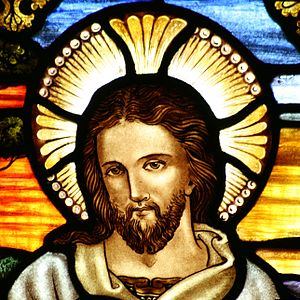
When the halo began to disappear. . .

From Peter Burfeind in The Federalist. . . 

Art has always been a harbinger of historical trends, especially in the West. As declining religion gave way to proxies—political religions, new-age kookery, myopic scientism, and sacralized hedonism—art heralded the way.

If you’re surprised at how we ended up in the philosophical rabbit hole we live in today, you haven’t been paying attention to the licentious parade of agitprop, erotica, and narcissistic art populating the artistic imagination for the past 60 years. It’s not unrelated that an Impressionistic movement fuzzifying the borders of objective reality birthed a reaction 200 years later in Donald Trump’s beautiful wall.

This being so, examining the history of western art yields fruitful cultural self-reflection. So let’s do a little thought experiment on the man of the hour, Jesus, focusing on his gravitational pull on culture and art, as a philosophical totem signaling an attitude toward reality. What did artistic renderings of him mean for culture and subsequent history? And what did the loss of halos on Jesus portend for western history?
The halo, borrowed from pagan art, endowed a subject with divinity. Early Christian iconographers haloed Christ to affirm his divinity, as the “Logos made flesh.” The concept of Logos is critical, because arguably the loss of a logo-centric cosmic architecture explains the decline of the West. How so?

The Greek word Logos means word, reason, or rationality. Logos is the basis of communication, by which two people commune with an objective quantum of conceptual stuff. Logoi (words) are what exist in an objective, material world of distinct and defined things, and Logos is their animating principle. In your mind, as your thoughts go from one communicable concept defined by clear, objective parameters (and a name) to the next, Logos is at work.

Logos is arguably the secret sauce of the West, leading to its quest for universal and objective truths that are accessible to all peoples equally, through the medium of human language. Logos trumps opinion, culture, myth, tradition, and idiosyncrasy. Logos is how reality can be knowable and communicable.
Our age, however, posits the ultimate plasticity and un-communicableness (save through math) of reality. Atoms and void alone are real and work in their weird ways to generate an ever-changing cosmos of evolving beings. As the deconstructionists taught us, any pretense to eternality is nothing more than human projection. Any culture, custom, or ethic is as valid as it is idiosyncratic. This pierces everything Logos stands for.

In this matrix comes Christ, declared by his followers to be the incarnate Logos, the primary, eternal Word through which all other beings come into being. With Christ’s resurrection and session to God’s right hand, a new reality is in play: something has defeated flux. Christ’s advent planted a rallying flag for subsequent Western thought: Here within the boundaries of this man’s flesh and blood is the very communication of Eternal Truth into our world. In this ever-changing world of flux, there is one material thing (the flesh and blood Jesus) that cannot and will not change. This sets the foundation for seeking fixed truth as such, as well as the premise for multiple cultures to communicate mutually accessible truths.
It is a good essay and speaks profoundly of the connection between the values of the heart and the values painted upon canvas or carved upon wood.  If you, like me, long for the days when the halo mattered as an expression of the creative will subservient to the Divine Revelation, then perhaps this is just for you.  But the halo has not merely disappeared from art, it has disappeared from life.

We live in an age when vulgarity is the norm.  Our speech is not lofty or noble but earthy for the sake of being earthy -- without an ounce of eloquence intended.  We watch televisions that spend more time on the benefits of a little blue pill to make sex possible whenever you desire -- while at the same time warning of an erection that lasts for more than four hours.  We are reminded of the unpleasant odor of the "devil's donuts" you leave in the toilet and of an oily scent that can confine the stench to under the toilet lid.  We hear the F-bomb so often that it has lost nearly all the shock value it once had and people keep searching for even more deplorable words.  Locker room talk has become so mainstream that public figures regularly revert to it without repercussion (except for Billy Bush).  The halo disappeared from art and from us.  We put on the horns of the devil and delight in flaunting our freedom to debase ourselves.

Like Burfeind I bemoan the stark, ugliness of art that tries to offend rather than uplift but as much as it is missing from art, the absence of the halo from the ordinary life of those who claim to be spiritual (if not religious) is even more noticeable.  When did we begin to think that the best use of freedom was to draw attention to the basest and crudest aspects of our lives?  When did we forget the notion of shame or embarrassment?  When did we begin to think that striving for good is not a worthwhile endeavor?  The cleverness we presume is nothing more than the immaturity of a small child who has learned to cuss and swear like the older kids and who thinks this is what makes you big.

I am no fan of pastors with salty vocabularies -- not because I am a prude but because I think it is childish and worse, wrong!  I am no fan of art that brings us down to our most basic and animalistic desires.  I am no fan of movies that exploit sex because they lack real dialogue, plot, camera work, or character development.  I am no fan of commercials that push products designed to exploit our ability to act from mere desire rather than virtue.  It is not because I am a prude or think myself better than anyone else.  I know my weakness and do not need encouragement in this area.  I do, however, need people wearing a halo around me and I do need to be urged toward holiness of speech, conduct, and life.  Once you could count on art to do that.  Once you could even count on Grandma to encourage this.  Now it seems we like rolling in the mud more than trying to stay clean.

Sunday, February 5, 2017

Speaking in an incomprehensible language. . .

Those of you who know me know that N. T. Wright is not a favorite of mine, nor is the whole idea of a new perspective on St. Paul (translation:  we got him wrong all along!).  That said, I was directed by a couple of friends to an article N. T. Wright wrote on The Puzzle of Christmas.  It is a perspective not unlike my Christmas Morning homily in which I reminded us that John placed the Incarnation within a cosmic setting bigger than Bethlehem even though Bethlehem is a part of it.  The point being that we still struggle with the Incarnation and we have too quickly turned the whole thing into some sad, sentimental birthday party or an occasion for seasonal niceness.

John is saying two things simultaneously in his prologue (two hundred things, actually, but I'll concentrate on two): first, that the Incarnation of the eternal Word was the event for which the whole of creation had been waiting all along; second, that creation and even the people God were quite unready for this event.. . That is the puzzle of Christmas. John's prologue is designed to stay in the mind and heart throughout the subsequent story. Never again in the Gospel of John is Jesus referred to as "the Word," but we are meant to look at each scene - the call of the first disciples, the changing of water into wine, the confrontation with Pilate, the Crucifixion, and the Resurrection - and think to ourselves: This is what it looks like when the Word becomes flesh. Or, if you like: Look at this man of flesh and learn to see the living God.
Wright is on to something.  God has framed everything we know about God into the face of the Word made flesh.  Apart from Him there is nothing of God we can know that benefits our salvation.  Ours is not to comprehend what God has done but to meet Him there, believe against what we see, and trust what seems unbelievable.  The Word made flesh is not some way of explaining who God is or what He has done but the jarring and shocking act of God to enter and redefine everything we thought we knew about Him and about our own lives.  The greatest danger we can do to this Gospel is to toy with it, trivialize it, sentimentalize it, moralize it, or turn it into truth propositions meant for us to comprehend.  In John's own words this Gospel is like a hammer breaking into pieces the false god of our estimation and imagination and leaving us awestruck by the thing which was never supposed to be -- God in flesh!

We have gotten entirely too comfortable with John 's prologue and entirely too casual with God coming into our world in our flesh and blood.  The incarnation is not comfortable or casual.  It is just the opposite.  It is the radical and unexpected truth that shakes up every other truth.  The liberal penchant for emphasizing what we do not know has left us smug in our skepticism of the Scriptures and left us with mere morality as the central focus of it all.  It is as if God were doing all of this merely to make us into nicer, more polite, and kinder people.  On the other hand, there are those who have left us shackled by our need to comprehend, understand, predict, and therefore control God.  This may sound like orthodoxy but if we know God only to figure Him out and get one step ahead of Him we are just as blind as those who will not see.

We have gone to Church expecting little and coming away with the little with which we have allowed ourselves to be satisfied.  We toss God a bone of our time in a busy season or our tears at the familiar carols but we have remained aloof and distant from the reality of which John writes.  As Wright has put it:  Jesus was born into a world where everyone was deaf and blind to him.  And we are still deaf and blind to Him.  Unless the Spirit draws us, we remain intent upon chiseling the mystery down to size so that our minds can wrap around it and our wills defeat it.  But to those who receive Him still, He gives power to become the sons of inheritance and the eternal children of God.  Not the wise or the smart or the successful or the happy, necessarily, but the children of God born not of flesh nor of the will or lust of a man but of the Spirit of God.

We meet Him in the scandal of Word that does what it says, of water that cleans inside and not simply externally, of life that death cannot overcome, and of bread which is His flesh and wine His blood.  We meet Him in the hard word of His Word that refuses to be simple but is mysteriously grasped by the child.  We meet Him in the center of defeat and death where we surrender not only our failures but our successes to the one mercy that redeems them both.  We meet Him not as equals in intellect or power but as creatures to our creative Word that first spoke us into being and became enfleshed for our salvation.   God help us!  We have turned Jesus into an idea and His flesh into a bedtime story!
 

Saturday, February 4, 2017

Programming our people to death. . .

When I first came to this parish I felt very lonely.  Coming from a parish abuzz with activity -- from a preschool to Bible studies -- there seemed to be nothing going on here except on Sunday.  I was determined to change that.  That certainly did change.  Now 24 years later, this parish is filled to overflowing with activity (even to the point when calendars collide and people vie for the same space in a building of 40,000 square feet! 

The old expression is to be careful what you pray for -- God just might give it to you.  Now I wonder.  Is a busy building the best barometer of our parish's health, life, and success?  I wonder if the many programs (other than catechetical, Bible study, and worship) don't end up inadvertently working against the mission of the church?

Could it be that we are teaching the people to treat worship as if it were merely another program?  Could it be that by creating a busy building, all the busy-ness ends up looking the same to the people?  Could it be that this creates the very kind of consumer environment that works against the radical call to discipleship that is inherent in the Gospel?  Could it be that we have taught the people to treat the church as if it were a supplier of services instead of a beacon of light?  Could it be that our people be getting mixed messages from us -- the programs which compete with the centrality of our life together around the Word and Table of the Lord?  Could it be that worship has become merely one of many programs from which our client consumers pick and choose (as if they were all equally good or important or urgent)?

24 years ago I made a pot of coffee and drank all of it every day of the week -- not very many came to the building between Sundays.  Now the coffee machine is at work every day as people come and go and grab a cup of Joe on their way.  But has the church become a coffee stop?  Have the people come for services we provide but not to meet the crucified and risen Savior where He has promised to be (in the means of grace)?  In my dark moments I fear the worst.  We are busier but not better -- a hub of activity but without a central focus of font, pulpit, and altar in our life together.  Everything we do is worthwhile and none of it directly conflicts with the Gospel but does it compete with it?

Perhaps I am not the best one to judge it all but it will be judged.  God will surely judge whether or not we have created busy hives of activity that have not translated well into a selfless life of devotion to the Lord, commitment to His Gospel, and service to the neighbor.  But it is still worth considering as we define what makes a congregation healthy and successful.  And maybe it would be good for us to review everything we do with a view toward seeing if the busyness has become the business and the means of grace merely a sideline. . .

Just some random meandering thoughts of a pastor who perhaps thinks too much. . . or not enough.

Friday, February 3, 2017

A great start to 2017. . .

Writing in The Federalist, Joy Pullmann has alerted us to the goal of government -- to raise the children for those they believe will raise disadvantaged children.  Of course, the liberal bent is to find a government solution to every problem.  We all know that.  The intention may be honorable but the result is not.  Government was not created to become nanny to our children or to step in and take over where the government believes children will be raised with disadvantage.

Hillary Clinton was, in my view, unfairly castigated when she said it takes a village to raise a child.  It does.  But the village is not the replacement for the parents.  In other words, part of the problem is that we have no real sense of community in our neighborhoods and no one takes responsibility when the parents are not around.  It becomes a police issue, a welfare issue, a court issue, or a DHS issue.  It does take a village but not to the exclusion or replacement of a stable home of mom, dad, and children.  Just as the village is not a replacement for the parents, neither is the government a replacement for a two-parent family, a mom and a dad, their children, and their extended family around them.

Growing up in a small town, my parents warned me that they would take my teacher's side in every dispute, trust the words of the townsfolk over my explanations, and that they expected the village (it really was -- 700 people!) to be their eyes and ears over me when they were not around.  My brother and I knew this from the get go and I can well recall the times when the village came to my aid, warned me of my behavior, and reported back to my parents when I went astray.  Maybe we cannot go back to a small town atmosphere for all our children but we can hold up the same model for neighborhood and extended family.  Nothing beats personal responsibility!


That said, ceding to the government what is the domain and the responsibility of parents, family, neighbors, and the village (in whatever form that may take) does not offer much promise of solving the problem.  We have thrown so many billions at the problem since Lyndon Johnson declared a war against poverty and yet the poor we have with us still.  I am not saying government should be the enemy of the home but at least its ally and certainly not its replacement.
Government preschool programs typically have little effect on needy children because they begin too late, says economist James Heckman and colleagues in a new paper (PDF) funded by government preschool advocates. So he says there’s good reason to start public “school” as early as eight weeks after birth for at-risk children — which typically designates those born into low-income and unmarried parents. In other words, he thinks we need a new welfare program run by Donald J. Trump.

Most government spending on education-themed programs for small children is targeted at those age four and older, which is too late to affect crucial language development, Heckman noted to The Atlantic, despite the preschool lobby’s long use of his research to urge these same programs. That’s his explanation for the failures of these programs after 50 years of drastic expansion across the country. None of the promises of massive social benefits after passing government early childhood programs have made their way into reality. In fact, the most recent research shows mass early childhood programs have even made more kids hate learning and commit more crimes. So, from preschoolers on to babies!

“If you look at disadvantaged children you’ll find that they’re getting about a third or a fourth as many words per hour as more advantaged children,” he told NPR. “The environments are fundamentally different. Over the lifetime, their young childhood — a period of say 0 to 5 — you’re getting a millions of words deficit between those who are advantaged and those who aren’t advantaged. That essentially is one way to close the gap. By literally reading to the child, by encouraging the child.”
While I believe it is a great thing for churches to step in with preschools (my parish has a very large and successful one) and day care for children, these are always supplemental to the primary place where children are raised, cared for, nurtured, and supported -- the home!  Perhaps we ought to begin with less intention upon replacing defective parents and paying attention to equipping those parents (who are often themselves the victims of a single parent family where one shouldered the full burden of wage earner, parent, launderer, maid, cook, tutor, and role model).  That is where we start -- by reminding the children that parenting needs both mom and dad pulling the weight together (as divinely intended) and where we can support, supplement, and equip them (in the neighborhood, village, or government), then we have done something good.  Replacing them is not the solution to anything.  The children deserve and God intended for them to have a mother and father working together to fulfill the sacred trust bestowed upon them with the gift of a child.

Thursday, February 2, 2017

It all works together or nothing really works. . .

The then Cardinal Josef Ratzinger once wrote: “How we attend to liturgy determines the fate of the faith and the Church.” At first it seems an audacious statement of exaggeration. It might seem that the liturgy is but a small piece of the larger puzzle of orthodoxy, evangelization, and catechesis.  But seemingly little things often have profound consequences.

How can the Church teach rightly when she cannot pray rightly?  How can the Church evangelize rightly when she cannot teach rightly?  How can the Church pray rightly when she cannot believe rightly?  These are fully connected and integrated and when one suffers, like Paul's analogy of the body, all suffer.

What are we bringing people to if we have no clear identity, confession, and practice of the means of grace where Christ is present with the fullness of His death won gifts?  What are we doing but going through the motions if ceremonies are not born of faith confessed and doctrine believed?  What are we teaching if we have no confidence in the truth of what is believed and why are we teaching if we do not believe the Spirit acts through the Word to accomplish His saving purpose?  Why do we live with a schizophrenia of attention and concern for right doctrine and then act as if anything goes (as long as we are sincere) on Sunday morning.


But the center of it all is the liturgy, what happens on the Lord's day, in the Lord's house, around the Lord's Word and the Lord's Table.  The liturgy is font and source and it is also the goal and summit.  Everything we do flows from this gathering of the faith at the Lord's bidding and anything worthy that we do returns right from whence it has come.

Ratzinger got it right as Cardinal and as Pope.  We Lutherans have been saying this for nearly 500 years.  The liturgical identity of the Church is not a burden or command laid upon people as condition of their salvation but it is the means by which they are assured that this faith is true, this faith is catholic, and this faith is apostolic.  The problem in Rome is that it only found out what harm undoing a worship tradition can do when it was already done.  The problem in Lutheranism is that we toy with the worship tradition of our Confessions as if it were not serious business and we have inadvertently (or perhaps deliberately) adopted a stance toward Sunday morning that has allowed us to hide behind the face of Protestantism or evangelicalism (what we think works or people want) that has effectively communicated to our people that the what of worship is personal preference and that doctrine can be kept in theory but practice may vary.  No matter who you think said it, we Lutherans are living proof of it.  In theory, theory and practice are the same. In practice, they are not. Or, to use the idiom of the marketplace, your mileage may vary depending upon actual conditions.

Until we learn that protecting dogma is not enough if we keep it to ourselves and forget who we are on Sunday morning, pure doctrine is worthless.  Until we learn that we have nothing to tell others unless we have doctrinal integrity and worship integrity consistent with that doctrine, we have nothing to say to them.  Until we learn that the liturgy may be perfect but unless we believe what it says and meet Christ with faith where He has promised to be, we are doing nothing.  It all works together or nothing really works.  That is what lex orandi lex credendi means.

Wednesday, February 1, 2017

Second thoughts about a practical education. . .


http://listdose.co/wp-content/uploads/2013/09/improves-skills.pngEveryone from seminary students to tech school students complains that their education was not practical enough.  This joins the growing chorus of folks who look at the high cost of university education, the degree inflation that seems to reduce the value of that education annually, and the growing term it seems to take for students to graduate and then wonder if it is worth it all.  Not to mention the numbers of students who complain that their education is boring and the professors who complain their students are not motivated.  It seems at all levels educators and students are saying that some students do not belong in college and would be better served by being given a more practical and useful training to help them get a job.  Of course, businesses are also complaining that the schools are not preparing their students with an education practical enough to equip them with the workable and marketable skills that business and industry prize.  


I have no doubt that all the common complaints are true.  That said, I would also suggest the radical idea that education exists to do something more noble than help people find a job and make a buck.  If that is all that we are looking to accomplish in high schools, trade schools, colleges, and universities, then it is no longer worthy of being called an education.

Just because an individual will work on a factory line somewhere or ends up picking up garbage or cleaning up our messes or fixing our plumbing or wiring problems does not mean that this person is unworthy of an education and deserves to be ignorant.  In fact, just the opposite.  Life, culture, democracy, and vocation expects and, I believe, demands education.  The farm worker joins the university professor and lawyer and MBA in making critical judgements, casting ballots, serving the community, and raising children (arguably the most important of all).  We live in a complex world of news and fake news, of conflicting opinions about what is good and right for us as a society, of truth and falsehood in religion, and so many more critical issues.  Everyone needs more than technical training but a good and well-rounded education in history, literature, math, science, and the arts.

Education is not merely the impartation of life skills appreciated in the marketplace and translatable into dollars and cents  Education has classically involved the larger questions of life -- where did I come from, who am I here, and how then shall I live.  It is not the domain of the new and novel but the familiarity with the old that gives us help in answering these vexing questions.  Part of our modern problem is not only that education is treated as entertainment (hence the complaint that it is boring) but also that it has no real value greater than a job and a pay check.

Mothers and fathers need to be able to read to their children both for fun and information and to help them learn to love reading.  It is not primarily a self-serving task ($ and a job) but to open up the minds of their children and to open them up to a world larger than the moment, more than what they can observe for themselves, and deeper than the feelings and whims of that moment.  Husbands and wives cast ballots for the common good of society and for those who lead our government at all levels and so far, at least, ballots are not restricted to those who pay attention to history, civics class, and morality.  This privilege is not reserved for those with the greatest education nor should it be but that does not mean that democracy works when education is treated merely as preparation for work.

Once, all those in school were required to master basic competence in such areas as literature and communication, in reading and writing, in history and the arts, and in math and science.  The high school I attended did not distinguish between those headed for trade schools and universities.  Not all of them got As or Bs but then that was when a C still meant competence.  Once the masses were expected to read something more than the comics and advice columnists.  When I look back at curriculums for eighth grade students a hundred years ago I begin to understand why we have allowed the media to tell us what to think and to judge candidates by a 30 second soundbite.

So whether you will end up working on the engine of my car or as a physician to heal my body or somewhere in between, education is essential.  Doctors are not trained for one specific illness or procedure but are required to master a general medical competency before specializing.  My father was an electrician and plumber but he was well read and came by his opinions after investigating the options.  As true and necessary as this is for the world, it is even more essential in the church.  Our itching ears naturally lead us astray from the pattern of sound doctrine of which St. Paul spoke but we need not encourage it by failing to know doctrine and the catechism and to be unfamiliar with the voice of the Good Shepherd in His Word.  No, education is needed for all no matter where or how you end up and earn a living.  This was Luther's plea for general education and its cause has not diminished in our age either.