Monday, December 18, 2017

What he should have said. . .

Have you ever encountered a saying attributed to someone you admire only to find out that this person did not say it, or perhaps anything remotely like it?  What a bummer!

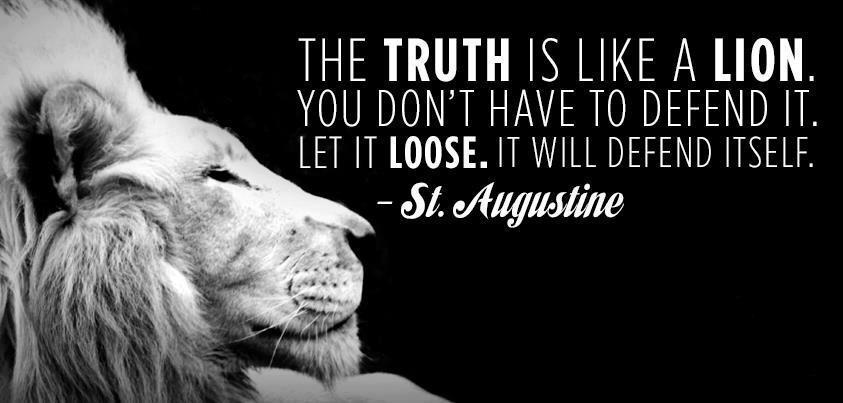
Most folks insist that St. Augustine did say The truth is like a lion; you don't have to defend it. Let it loose and it will defend itself.  But I cannot find it and better scholars than I have tried and failed to find it within Augustine's many words.  He could have said it but he probably didn't.  Surprise then when I find that Charles Haddon Spurgeon said something very close:  "The Word of God is like a lion. You don’t have to defend a lion. All you have to do is let the lion loose, and the lion will defend itself.”  Oh well. . . I am going to proceed with the assumption that Augustine could have said it and probably should have and just might have, even if the esteemed English Particular Baptist preacher of the 19th century did say it -- if only because as a Lutheran I am more wedded to Augustine of Hippo than I am to Spurgeon.

Too often we as Christians proceed with the idea that the truth we believe and confess is fragile, weak, and powerless.  We circle wagons around it and filter it out to the world.  We treat the Word of God as if it were filled with contradictions, half-truths, and untruths that, if people found out, would render our witness weak and vulnerable.  So the end result is that we are more comfortable talking about what we think God said than what He did say, what we feel about what He has said, and what God means (as if His Word is either obtuse or unreliable).  No wonder our witness has seemed shallow and without great effect.

We believe the Word of the Lord endures forever.  Why?  Because God said it.  God said it over and over again.  We will not endure forever and neither will human institutions we erect.  We cannot even pass on monuments and memorials to our children and grandchildren without someone second guessing us and then tearing down what we have set up.  But the point here is that if we pass on the Word of God to our children, we are passing on to them an eternal Word that does not change and that always accomplishes its purpose so that its words are a promise.

When we say, for example, train up a child in the way he should go and he will not depart from it, we are attesting to the power of the Word to speak into the heart and mind of the child long after he has grown up, rejected it, and walked away from its promise.  No one can run from that which God has planted within them.  They may still and may always reject it and refuse to believe it but it will stand in them and, on judgment day, will eventually stand against them.  In the same way, when we speak the Word of God to our children, we are speaking to them the efficacious Word that does what it says and bestows that of which it speaks.  Feelings fail and promises may be broken but failed and broken person who has this Word spoken into their minds has a place to which he or she may return where forgiveness restores.

We may think that the Word of Truth is not capable of withstanding scrutiny but the reality is that God does not need us to defend Him against His detractors.  Vengeance is His.  Time is on His side.  All naysayers will die (just like the believers) and in the awakening of the day of accountability God will have His last word.  We do not need to defend the Scriptures as much as speak them.  We do not need to reconcile every seeming contradiction or explain away everything that confounds our reason.  The Word of the Lord, like His ways, are as far above us as He is.  Yet He has granted His Holy Spirit to work through that Word so that faith comes by hearing (not by comprehending) the mystery of God who graciously saves.  His Spirit will bring reluctant and confused hearts to faith according to His own will.  The elect will not miss even one whom God has appointed.  God's time and purpose and power are all on His side.

We may fear that His Word is not enough to address friends, family, and those around us where we live and work.  We may fear that we need to add something or even provide some sort of gimmick to make faith easier on an unbelieving world but we were there once and for the sake of the Word and promise of God and the work of the Spirit, have we not believed?  But in the end, we only contribute to the false idea that God is helpless to meet the world without us intervening on His behalf.  And I am convinced that this is one of the reasons why our evangelization efforts have not been more fruitful.  We are too often our own worst enemies.  We need to take God at His Word, not only for us and our salvation but for the sake of the waiting world, for the sake of children entrusted to our care, and for the sake of the Kingdom.  God is no toothless lion.  He is fierce.  His Word is a sword.  It cuts both ways.  Let it speak and believe what it says and loan your voices so it can speak to those not yet of the Kingdom.  If we have done all of this and our churches still decline, then it is God's responsibility.  But if we have not done this and our churches decline, then we shall be held accountable.

Sunday, December 17, 2017

Perhaps not a fan. . .

So Pope Francis went to Lund, official representatives of both Lutherans and Roman Catholics are positively fawning all over each other at the 500th Anniversary of the 95 Theses, and some are already talking about intercommunion.  Right?  Well, apparently not everyone got the memo.

One Roman Catholic blogger is pushing another way to celebrate the Anniversary.  He is pushing a book that is not so kind to Luther.  In fact, the subtitle to the book says it bluntly:  “Half a Millennium of Total Depravity (1517-2017): A Critique of Luther’s Impact in the Year of His ‘Catholic’ Apotheosis”.  According to his own estimation:  In other words, this is not an unqualified “RAH! RAH! FOR THE REFORMATION!”

While I am not one to buy all that much into some nice words exchanged by some Lutherans who are probably not all that Lutheran and by a Roman Catholic Pope some suggest is not all that Catholic, it is not a little disconcerting that old straw men are being addressed instead of the real issues that divide.  Luther may be to blame for much but the disintegration of the Church, State, and Society cannot all be lumped upon him and the Reformation.  Luther and His progeny are certainly guilty of taking the medieval Mass literally and squaring this Sacrament against the Scriptures and the early Church.  Luther and His progeny are certainly guilty of looking at the common corruption of the clergy and the institutions of the Church and calling both for repentance and renewal.  Luther and His progeny are certainly guilty of restoring the bright and shining gemstone of God's treasure in His Church, the Gospel, to preaching and teaching.  Luther and His progeny are certainly guilty of agitating for the Word to be read, known, and prayed by a people who can read it and reflect upon it.  Luther and His progeny are certainly guilty of many things in the great split that gave birth to Protestantism and Rome is, as well.  That said, the wholesale destruction of the Christian West is putting too much on Luther and not enough on the institutions that reacted to him and excommunicated him.  For that, there is plenty of blame to go around!

Saturday, December 16, 2017

So which is better?

We live in an age intent upon separating form from content, style from substance, and rite from belief.  Books have been written on that subjects with some of those words in their titles.  Plenty of toner and ink has been spent on papers devoted to passionately pleading for one or the other and more digital ink than can be counted (is my own blog an exception?). 

On one hand we have churches like the Church of England or the Anglicans, as they are wont to be called, who have more faithfully preserved the form but not so much the content.  Go into any Anglican Church of any jurisdiction or theological bent and you will generally find the liturgy done well, whether high, broad, or low church.  Ceremonies matter, if at least in form if not content, and, like the royal weddings and funerals and coronations, the Anglicans have fully mastered the art of the form.  Yet we often complain that the form is just form.  That these same Anglicans seem intent upon doing things in conflict with how they pray.  Having preserved a catholic liturgical tradition and having bishops seems not to have slowed their detour into heresy and apostasy.  It is downright painful to see them unable to condemn, much less discipline, those who stick it in the eye of Christian orthodoxy.

On the other hand, Lutherans of the Missouri stripe love to talk about how they are free to craft forms however they choose for Sunday morning while claiming to maintain a higher loyalty to content.  In Missouri there are those who act, speak, and sing like evangelicals and the big box non-denominational churches on Sunday morning and yet who claim with equal vigor to believe, confess, and teach as real Lutherans.  Part of this real Lutheranism is the refusal to be told what they must do and with it is the false etymology of adiaphora which has come to mean "anything goes."  Officially and unofficially we are told that Missourians retain a higher degree of doctrinal homogeneity than nearly any other branch of Lutheranism and the key to this is knowing how to walk the narrow line between form and content, evangelical style and Lutheran substance.  Of course, we know that this is hardly the case.  The harsh reality is that Missouri has virtual fellowships within the fellowship -- people who would not think of going to one of those anything goes congregations and those who would die rather than open a hymnal in one of the other kind of congregations.  Yet on paper we are all happily loving each other while each is doing what seems right in his or her own eyes.

A few months ago I was at a wedding reception gabbing with my favorite curmudgeon (the Rev. Dr. 
David Scaer) and the topic was about just this subject.  Which IS better?  Is it better hold onto content while failing to have an identifiable form to orthodoxy or is it better to hold on to liturgical integrity even when some of the people (or, in some cases, most) leading that rite cannot speak the words (or sing them) and believe them?  For the early part of my pastoral ministry I had thought that the Missourian compromise of free form with established content was as good as it was going to get.  After all, this same landscape made it impossible for someone to come into the parish I served and say "no chasuble, no chanting, no bowing, no elevation, etc... Mr. Peters."  However, I have been uncomfortable with what the outcome of our so-called preservation of content within the context of free form has got us.  Dr. Scaer is certainly not so sure about that conventional wisdom.  And therein lies the rub.  Which IS better?

I suppose it is better from the leaders point of view to have the pastors and those who lead Sunday morning fully invested in what they are doing, believing and practicing consistently.  But I am not at all sure this is the best for the people in the pew or for the children growing up in our churches.  In fact, I am more and more of the opinion that our indifference to form and our slavish investment in content (more theory than practice) has left us a church confused, divided, and suspicious.  You can go nearly everywhere you want and an Anglican congregation will worship like an Anglican church (even though the sermon may very well make you wince).  Yet the people in the pews have the faith preserved in the rite if not in the mind of the priest leading it and that is not a bad thing.  The faith is always there in the hymnal or prayerbook and does not need to reinvented.  It just needs to be used. 

In contrast, go into a Lutheran congregation which has had a praise band, screens, contemporary Christian music, and not used the hymnal or the historic liturgy for some time and it means reinventing that parish to return to sacred hymnody, the liturgy, and the book.  Changing them back means starting over, literally. And so most parishes never go back.  They end up having too much invested in what they are doing now.  To tell you the truth, I am about sick and tired of hearing pastors tell me that they personally are edified by the great hymns of the faith and the liturgy but they must put their personal preference on the back burner for the sake of winning the masses to Jesus with forms that are, in effect, at odds with our Confessional identity.

Dr. Scaer knows it only too well.  The kinds of choices we are making are not wise and they are not without consequence.  Surrendering the Divine Service and the great hymns of the faith on Sunday morning means changing what is believed in the pews.  So, if you ask me, I would rather keep the faith of those in the pews consistent through our use of the catholic forms preserved in our hymnal (even with added ceremonial optional to that liturgical minimum) rather settle for a theoretical faith that has no real orthodox practice.  For the sake of the people in the pew and the faith preserved to the baptized, it is better to use the right rite than it is to discard the rite for our right to do what we deem preferable or effective.  It is easier to reclaim a lost Lutheranism by reminding them of what we have said and sung on Sunday morning for as long as anyone can remember than it is to take down the screens, ditch the pop Gospel music, put on vestments, and haul out the hymnals and then say, "Hey folks, this is really who we were all the time."

Friday, December 15, 2017

Too much. . .

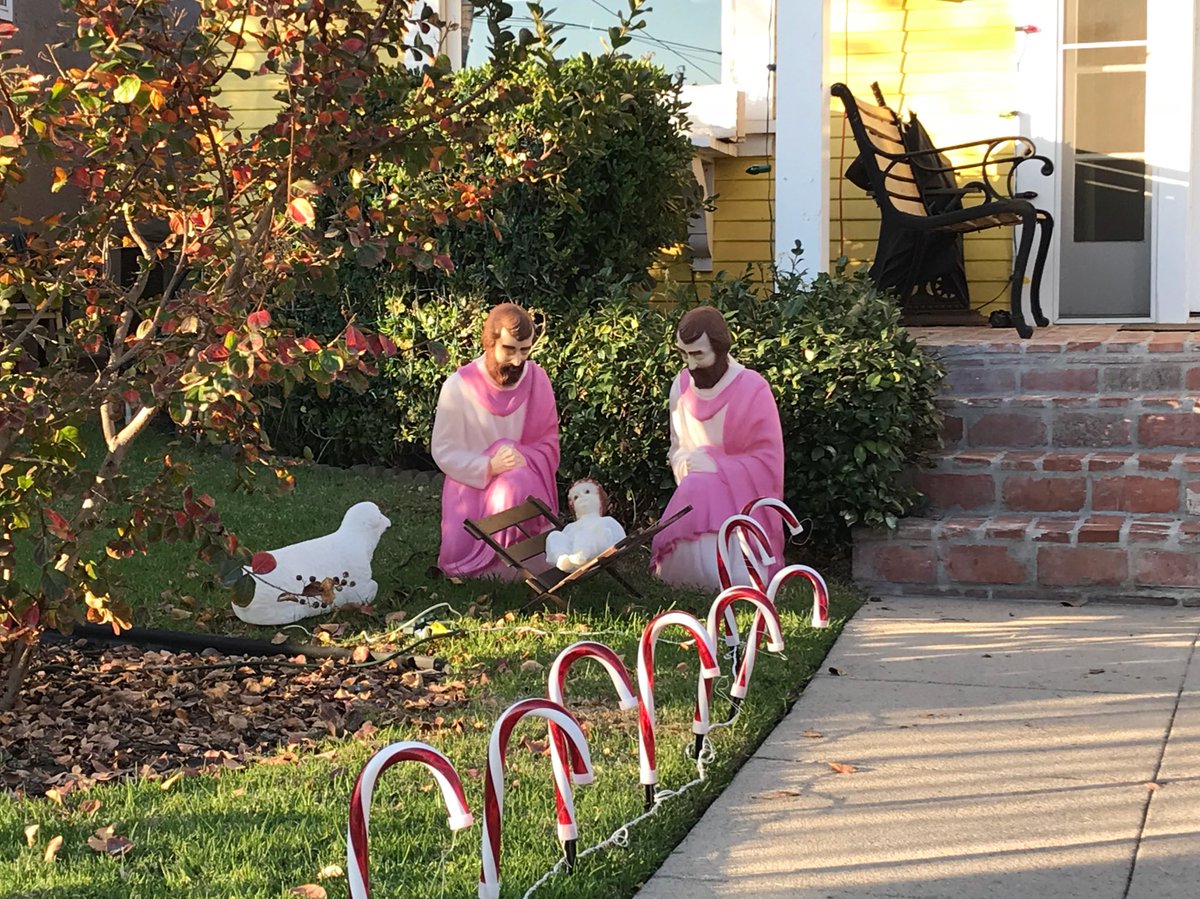
Have you decorated yet for Christmas?  Here are some ideas. . .

At least it emphasizes the miraculous nature of the conception and birth. . .

Doncha just love Joseph(s) in pink?


Pick your choice -- two Joes or two Marys. . .


Oh, well. . . I guess this is what happens when the SCTOUS decides that a creche is no longer a religious symbol. . . it becomes a political one. . .

An atheist asking some of the right questions. . .

Camille Paglia considers herself transgender, is a liberal Democrat, does not believe in God, and one of America's fearless writers when it comes to confronting the politically correct.  She is not the kind of person you warm to but as you listen to her scathing critiques on a variety of subjects, you find out that she is relentless in cutting through the baloney in pursuit of real truth.  Pantheon has just published a collection of some of her essays on sex, gender, and feminism, under the title Free Women, Free Men.  She is raw and blunt and takes no prisoners.  But underneath it all is a skepticism about current accepted wisdom and truth that is honest.
Read more of her here.   Allow me to quote her here with regard to transgender: 

Feminists have clashed with transgender activists much more publicly in the United Kingdom than here. For example, two years ago there was an acrimonious organized campaign, including a petition with 3,000 claimed signatures, to cancel a lecture by Germaine Greer at Cardiff University because of her "offensive" views of transgenderism. Greer, a literary scholar who was one of the great pioneers of second-wave feminism, has always denied that men who have undergone sex-reassignment surgery are actually "women." Her Cardiff lecture (on "Women and Power" in the twentieth century) eventually went forward, under heavy security.

And in 2014, Gender Hurts, a book by radical Australian feminist Sheila Jeffreys, created a heated controversy in the United Kingdom. Jeffreys identifies transsexualism with misogyny and describes it as a form of "mutilation." She and her feminist allies encountered prolonged difficulties in securing a London speaking venue because of threats and agitation by transgender activists. Finally, Conway Hall was made available: Jeffrey's forceful, detailed lecture there in July of last year is fully available on YouTube. In it she argues among other things, that the pharmaceutical industry, having lost income when routine estrogen therapy for menopausal women was abandoned because of its health risks, has been promoting the relatively new idea of transgenderism in order to create a permanent class of customers who will need to take prescribed hormones for life.

Although I describe myself as transgender (I was donning flamboyant male costumes from early childhood on), I am highly skeptical about the current transgender wave, which I think has been produced by far more complicated psychological and sociological factors than current gender discourse allows. Furthermore, I condemn the escalating prescription of puberty blockers (whose long-term effects are unknown) for children. I regard this practice as a criminal violation of human rights.

It is certainly ironic how liberals who posture as defenders of science when it comes to global warming (a sentimental myth unsupported by evidence) flee all reference to biology when it comes to gender. Biology has been programmatically excluded from women's studies and gender studies programs for almost 50 years now. Thus very few current gender studies professors and theorists, here and abroad, are intellectually or scientifically prepared to teach their subjects.

The cold biological truth is that sex changes are impossible. Every single cell of the human body remains coded with one's birth gender for life. Intersex ambiguities can occur, but they are developmental anomalies that represent a tiny proportion of all human births.

In a democracy, everyone, no matter how nonconformist or eccentric, should be free from harassment and abuse. But at the same time, no one deserves special rights, protections, or privileges on the basis of their eccentricity. The categories "trans-man" and "trans-woman" are highly accurate and deserving of respect. But like Germaine Greer and Sheila Jeffreys, I reject state-sponsored coercion to call someone a "woman" or a "man" simply on the basis of his or her subjective feeling about it.
All of this then begs the question of why the media, why progressives, and why some of the most politically elite in America are pushing a point of view which cannot stand up to scrutiny.  If someone who does not believe in God, who considers themselves transgender, and who is an unabashed liberal politically can poke holes through the fog that is transgender, why do we find it so hard to stand up for what we believe, teach, and confess -- that God made them male and female?

Thursday, December 14, 2017

Like a cancer. . .

Some in Rome are complaining about the caustic atmosphere within the church, especially on the subject of Amoris Laetitia and also regarding the olive branch seemingly offered by Fr. Joseph Martin, SJ, to the GLBTQ community.  The filial criticism, petitions, and dubia sent to Pope Francis as well as the progressive wing and its attempt to make some sort of rapprochement with the gay community have certainly stirred the pot but part of the reason for all the controversy is that there has not been an open discussion, much less debate, over these issues.  The criticisms, it is said, have become like a cancer in the church.

Perhaps these folks should spend time in the Missouri Synod.  We know a little something of public controversy.  We have not always played by the rules of decorum in theological debates. While I would agree that personal criticism and caricature can, indeed, be caustic and destructive, like a cancer upon the church, public debate and an open conversation on the things which divide us can be exactly what we need as a church body.  Nevertheless, such debate needs to happen openly and not clandestinely.  It also needs to have the sanction of the church so that it is not simply a peripheral conversation but a primary dialogue.

When the ELCA began to change the face of Lutheranism, it did not happen within an open forum but behind closed doors.  A quota system virtually ensured that the greatest minds of that communion would not be part of the debate, at least not directly.  The voice of that church's own confessions and congregations was virtually unheard except in the fringes.  When it was finally an open debate, the players had already begun to change practice before the doctrine and dogma had even been subject to  debate.  This happened already with the ordination of women long before it happened about same sex marriage and its related issues.  Scripture was not heard, the Confessions were ignored, history was forgotten, and the radical nature of the path chosen was minimized until victory was assured.

I  have no idea how this will play out between the so-called progressives in Rome and the traditionalists.  I do know that Francis is not helping things by keeping a lid on things at the same time he is keeping quiet about where he stands and what future he intends.  I am convinced that the enhanced communications of our technological age could work for that debate but in order for that to happen the principals would have to own their positions and let the conversation play out.

Within Missouri we have yet to have a formal conversation about the things that divide us.  What is the Confessional expectation with respect to what happens on Sunday morning?  Are those Confessions merely descriptive of that time or do they prescribe what is Lutheran and proscribe against what is not?  What does adiaphora really mean and how do we deal with things called adiaphora?  What is ecclesiastical supervision and how does it work out in the life of our church body?  What are the limits of our embrace of culture before the tension against the faith always the same becomes untenable?  How do we best confess our faith, live out that faith within the means of grace, and pass on that faith to others in the best Lutheran tradition and for the best consequence?  What is the Ministry and who should be the Ministers of the Church (also addressing issues of pastoral formation)?  These are real questions for us and we would all be better served by addressing them together instead merely having the debate in pointed publications, on blog sites and through unofficial gatherings.  Note, I am NOT saying that these should not be used as venues for part of this debate but they cannot carry the full weight of the discussion that needs to happen.

For Missouri, in particular, I would also warn against trying to find by-law solutions to theological problems.  Our constitution and by-laws are not unimportant but the great issues we are facing cannot be resolved simply by tinkering with by-laws every three years.  Again, I am all for careful review and revision of our by-laws and even constitution, where warranted.  But this is not a substitute for dealing with the profound and serious theological issues before us.  It has been good for our church to put out semi-official position statements like we did with a book on the ordination of women and now a new one on closed communion.  We need to talk about these books and their content on every level within the structures of the church.  These significant issues and others beg an open debate and an honest conversation.  This kind of conversation is not cancerous but healing.  And the answers will most certainly lie not with what we think or feel or desire but with what Scripture teaches, what is the creedal, confessional, and catholic perspective, and whether or not we are willing to be normed by the Scriptural witness and the catholic tradition.

Wednesday, December 13, 2017

Out of sync with the times. . .

Sermon for Advent 2B, preached on Sunday, December 10, 2017.

    In the Margaret Thatcher movie “Iron Lady” she is old and ailing and the doctor asks her how she feels.  She doesn’t want to talk about feelings but about thoughts and ideas.  She laments an age when people care more about feelings than thoughts or ideas.  She is out of place in her own time.

    John the Forerunner was out of place in his time.  He still is.  We still wince to hear him.  John is shockingly blunt and cuts to the heart.  He does not care about our feelings.  He comes to call us to repentance, to confront us with our sin and God’s mercy and he does not shy away from the consequences of failing to repent.  He does not presume anything for himself but defers to Him whose way He prepares, the One who is Mightier than he.

    John shows up without regard to fashion or comfort.  He wears the prophetic clothing of camel’s hair.  His leather belt and his diet of locusts and wild honey stand him apart from the people around him.  He comes not as one who is like them but who is completely other, who stands apart and out of step with the world so to be in step with God.

    His job is not to comfort anyone with the kind of comfort we expect -- a pat on the back and lies about how everything will be okay.  No, he comes to stir up trouble by calling the people to repentance.  He will not let them live in the lie of their sins nor will he let them be occupied with feelings.  The Messenger of the Lord is on His way.  You better prepare for Him.  His words speak truth and nothing less than the truth prepares people for God.

    Whatever happened to preaching like John?  We tend to like pastors and churches that are in sync with us and our lives.  We want pastors to tell us how to enjoy our lives and get what we want and we want churches with comfortable seats and foot tapping music and drink holders to put our Starbucks.  We run after whatever is new or different in everything from restaurants to religion.  Our churches have become pale echos of society and we follow culture more than God.  It is no wonder that we are closing churches every day.

    John did not come to appease our feelings or to encourage our itching ears.  He did not  come with fake comfort that ignores divine judgment.  He did not come to get all religions to coexist or to dilute the doctrine of the Scriptures.  He did not come to inspire but to call a world to account.  The wages of sin is death.  The only answer is repentance and baptism. 

    The miracle is, of course, that people listened.  John was out of synch with his age and with the religious leaders of his day but the people who heard him knew he was telling the truth.  They had tried lying to their consciences, running from their sins, and calling their sins normal and even good.  The same stuff we have tried in our own age to dismiss the warning bells of judgment and draw our attention from God to us.
   
    Faithfulness to God never comes without a cost.  John would end up in prison and without a head.  And those who hear and heed his call will also suffer in a world at odds with God and at odds with His Word.  Do not let anyone tell you that you can have your best life now and do whatever you desire and on the last day stand confidently before the throne of judgment.  Do not give in to the tyranny of feelings as a substitute for the truth that saves.

    Yet John was not preaching for himself.  He was preparing the way for the Mighty One who is not simply Lord and Judge but Savior and Redeemer.  Unlike John’s baptism of repentance, the Mighty Jesus will give you THE baptism of water and the Word, in which the Spirit works to forgive you your sins and bring you to faith.

    Jesus comes as Savior and Redeemer, to put Himself in your place, to wear the stain of your sin, to suffer for you the punishment for that sin, and to die to make atonement for that sin.  Jesus comes to purify what is tainted, to repair what is broken, to heal what is sick, and to give life to what is dead.  We are talking about you and me. 

    In THE baptism of Jesus, what is already dead in trespasses and sin is killed so that Jesus may make it new.  He makes you new by connecting you to His cross and empty tomb there in that water.  He takes His Church and cleanses her with water and the Word so that she may be a fit bride for Himself, the Bridegroom.  He does this so that when He comes again, we will be ready, kept blameless by our life fed and nourished in the Word of the Lord and at the Table of the Lord.

    We work so hard not to offend people with the Word of God.  We work so hard to make faith more about feelings than about truth.  We work so hard to make the Church normal and ordinary, about as threatening or shocking as the mall where we shop.  Then we lament the fact that the Church seems weak and our faith is absent when trials and troubles come our way.  What is wrong?

    What is wrong is that preachers have abandoned the call to repentance to the world and have failed in their duty to encourage the people of God to live out their new baptismal lives.  You in the pews have scratched your itching ears not with the Word of God but with every new gimmick and evangelical author who claims something new.  And we have all exchanged the mighty hymns of old for the passing songs of the moment that sound good but say nothing at all.

    You are not who you were.  You have heard the call of the Lord in His Word and you have been washed in the blood of Christ in your baptism.  You are not who you were.  You have been made new.  You do not belong to yourself, you belong to Christ.  The goal of your life is not to be happy but to be holy.  The place where you live out this new life is at home where husbands love their wives as Christ loved the Church and where wives respect their husbands as God’s man in the home. 

    The place where you live out this new life is at work where you work for the glory of the Lord more than money or the recognition of your employer or your peers.  The place where you live out this new life is in your neighborhood where you love your neighbor as Christ has loved you.  And this new life you live as people who are not at home here in this world but at home with the Lord, fully prepared to suffer persecution if that is what must be in order to be faithfully.  Knowing with confidence that he who is faithful unto death will receive the crown of everlasting life.

    John’s voice is still needed in a world whose ears are closed to God but who burn at everything new or cool or designed to bring a sentimental tear to your eye.  John’s voice is still needed for a Church in which repentance has become a dirty word and we have come to think that just as it is God’s job to forgive, it is our job to give him sins to forgive.  John’s voice is still needed in a world for a world no longer looking for Jesus or expecting Him to come as He has promised to bring all things to their consummation.

    Dear people of God.  Repent and believe the Gospel.  Remember who you are as the baptized children of God.  Rejoice in the promise that is yours.  Resolve by the grace of God to live within the realm of this grace.  Return to the Word of the Lord every Sunday in the Divine Service and daily in your piety and prayers.  Receive the Holy Sacrament of the Altar believing and rejoicing in the Lamb of God who takes away your sin and the sin of the whole world.  Let this be the mark of our identity and Word we preach to the world.  For the Mighty One is coming again and just as we need to be ready to receive Him, we have been called to ready the world with the voice of His Word.  Amen

Oblation or Communion. . .

The Lutheran Reformation was never a denial of the great and profound character of the Sacrament as Scripture told and the Church affirmed through the ages but rather the distortion of the Sacrament that denied its sacramental nature and turned it into something else first and only secondarily eating and drinking for the forgiveness of sins.  So when the Lutherans insisted that the Mass was and is first of all a meal, this was not a denial of the Eucharistic sacrifice inherent in this blessed Sacrament but a denial that its primary purpose and character was sacrificial.  Rome insisted that it could not be as much a meal as an oblation, that is, eating and drinking the body of Christ and His blood for the forgiveness of sins was even as much a meal as a sacrifice. For Rome it was and is foremost a sacrifice from which we are allowed to partake of the victim, though this partaking was not necessary or even essential to the Sacrament.  And thus Trent insisted it was a sacrifice that could be a meal but not a meal that could be a sacrifice.

Rome was adamant that the Mass was not a reenactment of the Last Supper and in this the Lutherans concur that we are not primarily or secondarily trying to reenact what Jesus did when, on the night of His betrayal, He took bread and the cup.  Here Lutherans stand against most Protestants who see the Sacrament as a remembrance without receiving the thing signed.  Lutherans insist that by this Sacrament God makes present of the once for all oblation of the Son of God on the Cross on Good Friday not as a reenactment. Lutherans are falsely lumped in with those Protestants who speak only of table and not of altar.  Yet Lutherans insist that the Body and Blood of Christ are given to eat and drink first and foremost and not to be sacramentally sacrificed.  So the great divide for Lutherans is that the eating and drinking comes first and the Eucharistic sacrifice is engendered by this communion -- to the exclusion of the character of this Sacrament as an oblation. It is for good reason that Lutherans and the Church of the Council of Trent remain apart when Trent insists upon defining the Mass either exclusively or even primarily a sacrifice before that Sacrament is ever spoken of or used as food and remedy.

From the Council of Trent:
And forasmuch as in this divine sacrifice which is celebrated in the Mass, that same Christ is contained and immolated in an unbloody manner, who once offered Himself in a bloody manner on the altar of the cross, the holy Synod teaches that this sacrifice is truly propitiatory and that by means thereof this is effected: that we obtain mercy, and find grace in seasonable aid, if we draw nigh unto God, contrite and penitent, with a sincere heart and upright faith, with fear and reverence. … Wherefore, not only for the sins, punishments, satisfactions, and other necessities of the faithful who are living, but also for those who are departed in Christ, and who are not as yet fully purified, is it rightly offered, agreeably to a tradition of the apostles. (Sess. 22, ch. 2)

Tuesday, December 12, 2017

Unnatural church growth. . .

Not long ago in the LCMS, there were howls of laughter when President Harrison pointed out the rate of decline in the LCMS with the decline of the birthrate. noting pointedly that the decline almost exactly matches the membership decline in our church body, state by state and district by district.  Howls of laughter came from the enlightened corners of the Synod who could hardly get their words out -- "Harrison hopes to reverse church decline with more babies."  

Why the ignorance of it all!!!!  We are in decline because of the music we sing or the music we no longer sing.  We are in decline because of the way our pastors preach or don't preach.  We are in decline because we do or do not use the hymnal.  We are in decline because we are not relevant or because we are too relevant.  We are in decline because our worship is boring or because it is too creative.  About the only thing it seems folks can agree upon is that we are in decline probably because of the failure of our leaders.

But the evidence is there.  Our rate of decline matches pretty well the decline in the birthrate wherever it is that we go in the Synod.  We are not in decline only because we are not having babies, we are in the decline because our families are weak and vulnerable, because we are not confident of what we believe and how we live out that faith, and because we are not raising up generations of children (just like nearly every denomination in the USA).

George Hawley’s Demography, Culture, and the Decline Of America’s Christian Denominations notes:
“In those denominations where large families remain common, the future looks bright. Among other denominations where later marriages and small families are the norm, and have been the norm for a generation or more, it is unclear whether they will have a future at all.”
Our lack of babies is not a joke.  It is descriptive of the problems marriage is in within the fabric of our common life within this culture.  Fewer folks are getting married and fewer folks are having children (married or not).  While the answer is not simply to get rid of birth control, the reality is that not having children is not a result of the environment or biology but of choice, pure and simple choice.  We do not have because we do not want children.   No this is not the only problem but it is symptomatic of the other problems that have left us somewhat in a crisis mode when it comes to children and family.

According to Hawley, there are three major factors that determine and make possible an individual  denomination's viability: the personal commitment of its individual members, racial/ethnic diversity, and natural growth (uhhhh, we call this having babies).

Babies or the lack of them is a sign of a larger problem not always as easily identified as a home without kids or a marriage, for that matter.  Christianity has from the get go been a family friendly group.  The loss of the family is not simply a changing cultural or social mores,  It is the weakness of the family and its consequences for a church defined early on as family friendly.  When marriage is on the decline, so are the churches.  When children are no longer central to marriage, we have a problem.  When the numbers of children chosen corresponds to the lowest common denominator, the church will suffer.  Though everyone knows this, we seldom speak of it out loud.  It is an inconvenient truth in a world of choice, where fetuses are disposable, where only perfect children are tolerated, and where marriage is the place where my own happiness comes first.  It is an inconvenient truth in a world where we are no longer sure what it means to be man or woman and where we are not sure children, if they are good, are not a goodness best served up in smaller numbers.  Yes, it is about children but it is first about the desire to marry, the culture in which cohabitation is becoming the norm, where children are disposable, where reproductive technology promises fewer but better children, and where churches find themselves mirroring the vacuous platitudes of political correctness more than proclaiming the Word of the Lord endures forever.

According to the 2014 General Social Survey (GSS), the number of Americans who identify themselves as Christian has dropped below 75 percent (from about 90 percent 40 or 50 years ago) and where the fastest growing denomination are the nones (20% and growing) who either claim no religion or a hodgepodge religion of their own making with a laisse faire God.  One of ever four  Americans never go to church (up from 10 % in 1972) and less than a majority, 43% attend at least once a month (down a fifth).  Among those who do attend regularly, one out of every four is over 65  and less than an eighth are people under 30. Christians are losing all quarters but especially the young and the college educated in all racial groups.  It is not only about babies but it surely is about them!

Monday, December 11, 2017

Sunday, December 10, 2017

Because she endures. . .

I will admit to being fascinated by the foibles of leaders in history, especially the history of Christianity.  You know, The Tudors and its manipulation of the Church by Henry in pursuit of a male heir or The Borgias and its sordid portrayal of one of the most unworthy candidates to be called Pope.  But it was that way long before Christ was incarnate.  The patriarchs and kings of old were not the mighty men of God we often presume them to be.  They were sinners.  They were unworthy of the grace of God.  But don't stop there!  Luther was no saint.  Everyday Lutherans are happy we are not bound to his every ill-fated word.  He was a sinner just like the Pope he railed against.

History is full of people who had little to offer the Church except their faults and failings.  To some these are an embarrassment to Christianity.  Some inside the Church feel much like Gandhi who liked Jesus but not so much Christians.  We feel the constant need to apologize for the sins of those who have served as our leaders.  I am not saying we should laud them but can even the sins of our fallen leaders stop the Kingdom of God?  I wonder if it is not exactly the fact that the Church survives and even flourishes with such unworthy and undeserving leaders that is her very strength.

Is it not because the many unworthy, undeserving, flawed, failed, and worldly men who have served the Church have not destroyed her that proves she must be of God?  Recall the wisdom of wise, old Gamaliel.  Acts 5: 
But a Pharisee in the council named Gamaliel, a teacher of the law, respected by all the people, stood up and ordered the men to be put outside for a short time. Then he said to them, ‘Fellow-Israelites, consider carefully what you propose to do to these men. For some time ago Theudas rose up, claiming to be somebody, and a number of men, about four hundred, joined him; but he was killed, and all who followed him were dispersed and disappeared. After him Judas the Galilean rose up at the time of the census and got people to follow him; he also perished, and all who followed him were scattered. So in the present case, I tell you, keep away from these men and let them alone; because if this plan or this undertaking is of human origin, it will fail; but if it is of God, you will not be able to overthrow them—in that case you may even be found fighting against God!’ 
If it is of human origin it will fail but if it is of God you will not be able to overthrow them.  Ahhh.  Therein lies the miracle.  Men have tried to destroy the Church not from the outside but from within.  Men of not of noble character or faith but destructive and divisive individuals.  These were not the good who tried but failed in pursuit of godliness but those who played religion like a role and who lived the contradiction of their words and deeds.  The Church should have been dead a long time ago -- simply by virtue of those who led her poorly, whose sins were all too apparent, and who either believed too little in God or too much in themselves or both.  But she carries on.  The Church carries on.  In cultures deemed friendly or in cultures where faith was an enemy to be imprisoned, the Church has continued.  If we cannot laud the sacrificial and wise work of her leaders, then who can we credit for the cross being raised in age after age?  Except the Lord. 

The faith has been threatened by competing religions.  It has been coerced by those who attempted to use it as a tool for ungodly end.  It has been ridiculed in the halls of science.  It has been banned by oppressive regimes.  It has been outlawed by unjust laws.  It has been constrained by tempered freedoms.  It has been challenged by critics.  It has been betrayed by those who claim the faith.  And still she endures.  People have been predicting the end of the Church for generations and this is the the Way that refuses to be killed and refuses to die.  It is not for lack of trying but for the purpose and plan of God alone.

Despair if you will.  I do sometimes, perhaps too often.  But I am not the savior of the Church nor are you.  God does not depend upon you to do anything to prevent the faith from becoming a memory in a world without nostalgia.  God will keep her.  God will keep you.  The times will seem dark and the cause will seem hopeless but it has before and it will again until God dawns the eternal day.  So repent and then rejoice that the Church belongs to God and so do you and He has decreed from His throne on high that no one and nothing can destroy her nor wrest the kingdom from you.  She belongs to Him and will be preserved until the heavenly nuptials at the end of time and you will be kept holy and blameless through the blood of Christ.  The Kingdom His remaineth.

Saturday, December 9, 2017

Simple liturgy. . .

There are those among Lutherans who have a definite preference for a simpler liturgy, devoid of  more elaborate and elegant ceremonial.  The richer ceremonial is often laid at the door of Rome and, to be sure, Rome may have contributed some to it.  But the reality is that the most elaborate ceremonial comes not from Rome but from Constantinople.  Both in architecture and form, the liturgical norm of the Eastern Church is on the whole much richer in ceremonial and ritual than even some of the more elaborate counterparts in the West.

As Luther himself noted from personal experience, the monastic tradition of liturgy was simpler though not simple, and provided a marked contrast to the more elaborate forms and practices of a courtly setting.  It is then somewhat surprising that the modern liturgical movement is born within the monastic tradition of Rome and spread from there to all liturgical churches.  The liturgical movement was, in effect, providing the larger church with the forms preserved within the confines of the monastic tradition.
 
While it is not entirely fair to say that monastic liturgy was simple or universally simpler, it is true to say that on the whole it was simpler than the Baroque liturgies and than the liturgical settings of courtly life.  But the liturgical movement began less with a reform to the mass than to the restoration of the daily offices typically absent from the life of most people outside the monastery or convent.  Until modern times, these monastic communities retained the richness of the daily office and, though ritually ordered, they offered a picture of consistency, tranquility, dignity, and simplicity so often lacking in the chaotic shape of modern life.  Monastic life flourished at the same time as the liturgical movement was coming into its own and the influence of liturgical scholars was being felt beyond the confines of a cloistered life, prior to 1950 or so.

Simplicity and tradition are not opposites nor do they compete.  In fact, the monastic heritage of simplicity was thoroughly traditional even as it lived side by side the more elaborate settings of cathedral and court.  Surely it is true that the aristocratic excesses of the Baroque era contributed to the grandeur and elaborate character of the mass, especially in cathedral and courtly setting and yet this seemed not at all to threaten the simpler setting of the monastic community anymore than the monastic life competed with the more elaborate settings.

In other words, it is not a choice.  And this is true for Lutheranism no less than for Rome. As Luther envisioned Latin being retained in urban settings, living side by side the German Mass in the vernacular, so must simpler forms live side by side the more elaborate settings in our own day.  Yet that is exactly the problem.  No one insists that it is a betrayal of Lutheran identity to follow the form with a simpler ceremonial in rural Nebraska, for example, yet there is no shortage of folks who insist that the settings where musical resources and a more elaborate ceremonial are employed are not fully Lutheran.  That is the problem we face today.

We live in an era of liturgical reductionism -- how little of the liturgy and how little ceremonial can we get away with and still be true to our Lutheran identity?  What a foolish place to begin.  The hymnal, to be sure, presents a starting point but surely not an ending point.  As long as the ceremonies are authentic and do not contradict the Gospel, Lutherans have always insisted the simplicity is not our primary liturgical principle but rather our reluctance, without boundaries, to choose one over the other or to pit one against the other.  This is the real meaning of adiaphora.

Our Confessions quoted approvingly both the liturgical tradition of the East and its doctrine and fathers.  They did so even knowing that the Byzantine Divine Liturgy simply overflows with rich imagery, profound gesture, and deep ceremony.  The Byzantines, it seems, did not succumb to the idea that there is a preference between the richer or simpler forms or one is more authentic than they other.  They have resisted the cultural move toward minimalism, utilitarianism, and egalitarianism that have surely had profound influence over Western society, culture, and religion.


Nevertheless, we find ourselves at a time when a liturgical folk turn up their noses at the wholesale adoption of evangelical forms for confessional reasons and those who see liturgy as better simple, plain, and basic insist that this is Lutheranism drawn to its logical conclusion.  They are not the same.  Just as monastic life preserved the tradition, so must simpler liturgy preserve the tradition today.  A more elaborate ceremonial should not threaten the places where it is not possible or authentic and neither should a simpler liturgical setting dismiss those who have retained the once common and familiar shapes of our liturgical piety.  Strangely enough, we live at a time when the hymnal is seen as the fullest liturgical expression that must adopted in small bites while the more elaborate ceremonial once normative among Lutherans is rejected out of hand as a betrayal of that hymnal and suggestive of Roman sympathy.  What fools we have become! 

A liturgical parish like mine does not threaten the parish a couple of hours down the road that has no organist, speaks most of the liturgy, sings fewer hymns, and observes the rubrics without elaboration.  Maybe I am wrong but I find few voices insisting that every Lutheran parish must employ all the ritual and ceremonial of our tradition to be authentically Lutheran.  I do find many voices in our church body insisting that the Lutheran parishes who do employ the richer liturgical and ceremonial aspects of our tradition to be less than Lutheran.  As once the simpler tradition of the monastery lived side by side the more elaborate one of cathedral and court,  so must Lutherans learn to do the same.  Note, however, that I have said nothing to encourage those who have thrown out the baby with the bath water and whose Sunday morning worship bears little or no resemblance to the forms resident in our hymnals and agendas.  That, my friends, is a different fish to fry.

Friday, December 8, 2017

What's good for business is good for the world. . .

Charles Erwin Wilson was an American engineer and businessman. From 1953-1957, he was President Eisenhower's Secretary of Defense.  His nickname was "Engine Charlie", something he earned in his previously career with General Motors.  As CEO of GM, he once famously remarked, "What is good for GM, is good for America."  Half a century ago, globalism was born -- not in the halls of Congress or the parliaments or legislative houses of any country but in a corporate boardroom.

Globalism is more than anything else an economic philosophy, a means to level the playing field and make it possible for corporations to compete globally and not simply nationally or regionally.  Sure there are those who believe in a world government, some foolish enough to believe the United Nations just might evolve into something of that sort.  But the reality is that governments and international organizations of governments are secondary to the pulse of big business and to the economic realities of money and more money.  The European Union is a corporate union less of nations and peoples than of the desire to create a huge market in the belief that a commonly strong economy and a free marketplace will be the engine for social change and progress.

It is no secret that the path of globalism has been paved with trade agreements.  From NAFTA to the TransPacific Trade Partnership, globalism's future is being written not in common values or goals but in fair playing fields which will allow business to prosper without governmental interference.  Perhaps I am stating the obvious or maybe I am wrong.  I have been wrong before.  But my concerns about globalism have to do with just this aspect of it all.  We are being told that what is good for business is good for the world.  As a capitalist, I favor a free market economy but as a Christian I am not ready to cede the high ground of moral authority to the boardrooms of the global business community.

If the Church is a voice of conscience in the neighborhoods and even in the legislative arenas of the world, then the Church must also be a moral voice and serve as a conscience to business.  The weakness of globalism is that its leaders may not be easily identified nor accessible and are certainly not accountable to ballot box.  To be clear, I am not suggesting some deep, dark conspiracy theory.  I am not suggesting that this economic globalism is nefarious or demonic.  I am merely pointing out that such forces looking for peace and open economies that are behind globalism are probably not  guided by altruistic principles and we cannot depend upon their leaders being moral voices or even willing to consider higher values than profit.  While the ballot box may not be effective in reining in our elected public servants, the opportunity is at least there.

Thursday, December 7, 2017

Do people become more religious as they age?

It is often said that people become more religious as they age.  I was often told that it did not matter if we lost them in the teens or early 20s.  They would be back to marry.  After marriage, they would be back to bring their children to baptism and raise them in the faith through confirmation.  And then when they became empty nesters and were looking for something to fill their days, they would be back.  It turns out that this conventional wisdom, perhaps applicable in another age, is not pertinent to the moment.

According to this table, worship attendance by religion and generation shows that Roman Catholics have actually kept their mass attendance relatively consistent.  In other words, if they did attend mass regularly when they were young, it would continue.  If they did not, they would not begin the new habit.

Among Christians, non-Roman Catholics, it shows a slight increase among some generations and a bit more among others but not a wholesale reversal of past habits.  One wonders how these statistics might break down among the mainline Protestants, the Evangelicals, and people like the Missouri Synod Lutherans who do not fit those categories all that well.  The older generation did show some increase, perhaps most dramatically among the Silent Generation.  Boomers, less so.   Gen-X about the same.  Millenials, even less.

The old thinking that marriage, responsibility, children, and the changing seasons of life were windows of opportunity to reclaim the lost is not entirely discredited for out time but it certainly shows that our people have found it easy to close those windows and keep on with what had been their practice.  In other words, the Church cannot just sit and wait for people to return.  We need to engage them where they are.  This does not mean making church less like church to win them over.  Deception is always a lie and taking on a persona at odds with our creed and confession is doomed to fail.  This does not mean diluting the faith until there is nothing left to believe.  People will not be drawn to one dimensional caricatures of the faith that are not deeply rooted and grounded in Scripture and history.  This does not mean the old way of standing before front doors ready to ask where they would be if they died tonight.  Fear of hell is not the motivator it once was.  It does mean having confidence that the Word of the Lord will not return to Him empty handed and speaking this Word boldly and compassionately to a world waiting for real hope.

We have a powerful Word, a living voice with which to address all manner and conditions of people and their lives.  Why have we so little confidence in that Word?  We presume that mirroring good business practices is more powerful than the Holy Spirit working through the means of grace.  We act as if gimmicks will substitute for real, authentic, faithful Biblical preaching and teaching.  We are looking for quick fixes in a world which marches to the click of the clock but lives to the fullness of God's ripe and fruitful fullness.  We judge with our eyes instead of by faith, ready to surrender our creed and confession in order to pack the pews and presume we are doing the right things by judging the results.

At home and in the neighborhoods where we live, we speak and live out the Gospel.  That is our witness.  There is no supplement needed to the voice of God spoken with lips or shown in life.  We come together in the Lord's House to hear His Word and receive His food and this proclaims the Lord's death until He comes as well.  We love not because it gets us anything or because it is easy but because He first loved us.  We are not timid but we are humble and draw attention not to ourselves and always to Jesus.  We stand as light posts in the darkness pointing to the Lamb of God who takes away the sins of the world -- knowing that no clear conscience is created by excusing, dismissing, or normalizing sin.  And where we do this, faithful to the Lord in confession and vocation, God will bring the fruit He desires.  The elect will be awakened unto faith and those who refuse the cover of the blood of Christ will know what they are rejecting.  It never was "if you build it, they will come" but neither was it ever supposed to be "this is your church and your mission, make it work."  The sooner we realize this the more energy and time we will have for the real work of the Kingdom.

Wednesday, December 6, 2017

Discarding the burdensome. . .

You have heard all the buzz about the elimination of Down's Syndrome babies through abortion.  Now it is the elimination of Alzheimer's patients at the other end of life. We hear of Quebec, which has legalized euthanasia is legal, that 72 percent of caregivers favor permitting Alzheimer’s patients to be euthanized (even without evidence the afflicted person ever requested euthanasia). If the patient signaled in writing a request for euthanasia if he or she were incompetent, 91 percent of caregivers approved of euthanasia.  In this Quebec is not far behind the Netherlands. Remember that the Netherlands is where an elderly Alzheimer’s patient was held down by her family fighting the lethal injection but Dutch authorities found that the homicide was permissible, since “the doctor acted in good faith.”

The same people in favor of this are also pro-choice.  Except that they take the choice out of it for Down's Syndrome babies and Alzheimer's patients.  They reserve to themselves the choice made on behalf of those they deem to be too costly to care for or to have lives not worth living.  The suffering of many Alzheimer's patients is less a burden that they bear and more a burden born by the care-giver.  So the choice is made by those who find caring for someone with such disability to be an unfair burden.

I am not at all disputing the cost and burden the care-givers bear. Caring for Down's Syndrome children and adults as well as those suffering from Alzheimer's is, indeed, exhausting both physically as well as mentally.  I know this from family members who have suffered Alzheimer's.  That said, when and how do we decided when the burden of caring for such patients becomes too much to bear?  How much inconvenience, cost, and duty is too much?  Who gets to make the decision?  

This is hard enough when one has a moral compass tuned to the objective values of God who is the Giver of life.  What about when one is making a moral decision on no moral basis greater than "I find it too much responsibility or sacrifice from me?"

Tuesday, December 5, 2017

“Hosanna! Come Lord Jesus.”

Sermon for Advent 1B, preached by the Rev. Daniel M. Ulrich on Sunday, December 3, 2017.

“[T]hose who went before and those who followed [Jesus] were shouting, ‘Hosanna!  Blessed is he who comes in the name of the Lord!  Blessed is the coming kingdom of our Father David!  Hosanna in the highest’” (Mk 1:9-10).
    The first Sunday in Advent always feels like a confusion of time.  We want to look forward to Jesus’ coming at His birth and yet the Epistle reading looks forward to His coming on the Last Day.  Instead of hearing about Jesus’ birth, we hear about His entry into Jerusalem to die.  On this one Sunday we contemplate three periods of time: past, present and future; and yet in each one, the prayer of the faithful, our prayer, is the same: Hosanna! Come Lord Jesus!
    When Jesus rode into Jerusalem He was greeted with the word “hosanna.”  The people shouted and sang it as praise; they proclaimed blessings on Christ.  They welcomed their Savior in the most appropriate way possible because the word “hosanna” means “save us, we pray.”  The people called out to the Lord for salvation God promised to give them.
    From the very beginning, God promised to send His Savior, the seed of the woman who would crush Satan’s head (Gen 3:15).  The sin and death he brought into the world, the sin and death we still suffer from, our sin and our death, all would be overcome by the Messiah and He would give us His righteousness, life, and salvation. 
    God repeated this promise throughout the centuries.  He proclaimed it through words and signs.  He sent prophets like Isaiah and Zechariah to speak it.  Zechariah announced “Rejoice greatly, O daughter of Zion.  Shout aloud O daughter of Jerusalem.  Behold your king is coming to you; righteous and having salvation is he, humble and mounted on a donkey, on a colt, the foal of a donkey” (Zech 9:9).  Christ was fulfilling this specific prophecy as He rode into Jerusalem to the shouts of the people.  And on that Friday, He would answer their prayer of hosanna.  On Good Friday, Christ was going to save them, to save you, with His death, for salvation only comes through Christ’s death. 
    This too was foretold of in the beginning.  When God promised that the seed of the woman would crush Satan’s head, He also said the Messiah would be struck   He would suffer.  God showed this truth through the sacrifices of old. 
    When God made clothes for our first parents, it required a sacrifice, blood had to be spilt.  At the first Passover in Egypt, a lamb had to be sacrificed and its blood painted on the doorposts in order to spare the people inside the angel of death.  And at the Tabernacle and then the temple, sacrifices were made to atone for the people’s sins.  All of this was God ordained to show how He would save His people...through the sacrificial death of His Son. 
    God answered His people’s prayer for salvation.  Christ answered the cries of hosanna when He was born to die.  The Son of God became man.  Born to the Virgin Mary, He is the Seed of the woman.  He came as a child, grew and lived the perfect life that you and I can’t so that He could sacrifice His life on the cross, dying for your sin, for your forgiveness, so that you’d be freed from sin and death and have everlasting life.  This life and salvation you have now.
    Just as the people on Palm Sunday shouted “hosanna,” we pray it now.  We pray “save us now.”  We pray “come Lord Jesus, come and give to us Your salvation.”
    This is something that we literally do every Sunday in the service of the Sacrament.  In the Sanctus, in the song Holy, Holy, Holy, we sing “Hosanna, hosanna, hosanna in the highest.  Blessed is He, blessed is He, blessed is He that cometh in the name of the Lord.  Hosanna, hosanna, hosanna in the highest.”  In this song we are singing “Save us, we pray.  Come to us today and give us your salvation.”  This prayerful song your Savior answers without delay. 
    Christ comes to you today and He gives you salvation.  He comes in His Word and Sacraments.  He’s present in His means of grace, delivering to you His forgiveness, life, and salvation. 
    The forgiveness Christ won on the cross on Good Friday is yours today.  You’ve received it in the waters of Baptism.  You’ve received it in the words of Absolution spoken by God’s pastors.  And you receive it in the Lord’s Supper as you eat and drink the body and blood that Christ sacrificed for you.  And with this forgiveness comes life and salvation.
    Forgiveness removes the guilt of your sin and with it the death that comes because of your sin.  With the guilt of sin and its death removed by Christ, you receive His gifts of life and salvation.  These are yours by grace, freely given to you.  These are yours right now, and you’ll see them in full when Christ comes again on the Last Day at His second coming. 
    We pray for this second coming.  We pray: “Hosanna! Save us now.  Come Lord Jesus.”  We pray this way because although we have life and salvation, we don’t see it in full.  Instead, we see sin.  We see all sorts of pain and suffering.  We see death.  With faith we rightly want our Savior to come and take us away from this, away from this valley of sorrow to be with Him in heaven.
    This is the now and not yet reality of our salvation in Christ.  Everlasting life and salvation are ours now, at this very moment.  But this life isn’t fully seen.    But even in the midst of sin and death, the promise of Christ’s second coming is a certain and true as the promise of His first coming. 
    Christ achieved your salvation by coming to you and dying on the cross.  This salvation will be fully seen at His second coming.  And as you and I wait for that day, our Lord continues to come to us in His Word and Sacrament, sustaining us in faith. 
    We live in the now and not yet, the time between our Lord’s first and second coming.  During this time our constant prayer is the same as those on the first Palm Sunday.  We pray “Hosanna! Come Lord Jesus!”  And our Lord answers this prayer.  He answered it first in His incarnation, coming to us in the flesh so that He could die for our salvation.  He answers it now, coming to us in His Word and Sacrament, giving us His forgiveness, life, and salvation.  And He will answer it again when He comes to us at the last, fully revealing His salvation.  In Jesus’ name...Amen.  

Medieval Monastic Life in England. . .

Interesting. . .


Monday, December 4, 2017

Owning the fringes. . .


Picture
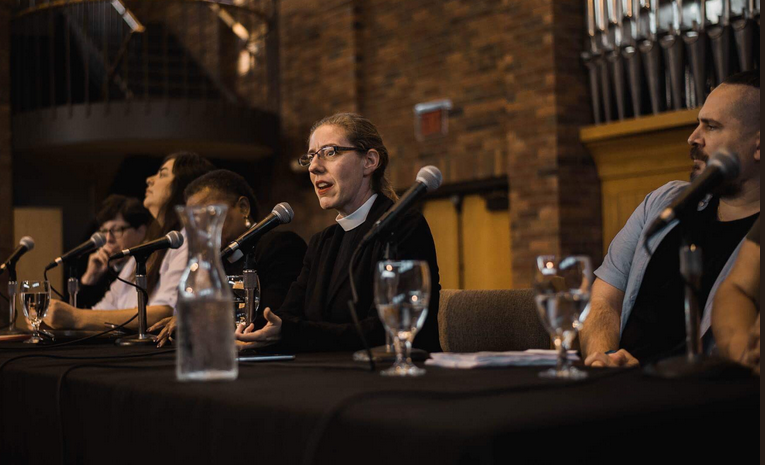
ELCA Presiding Bishop Eaton delivered a lecture and then participated on a forum with some of the folks nearly everyone would describe as the extreme fringe of the ELCA.

She took part in the September 22, 2017, Augsburg University’s annual Christensen Symposium. The first half of the symposium was an "Address by Bishop Eaton" and the second half was "#DecolonizeLutheranism Community Panel with Bishop Eaton."

So what is #DecolonizeLutheranism?
They are some of the most extreme and radical ELCA leaders around.  They included:
  • "Jessica Davis, Christian Educator and #decolonizeLutheranism Chaplain. 
  • Rev. Lura Groen, Pastor and #decolonizeLutheranism Chaplain
  • Francisco Herrera, Ph. D candidate at LSTC and Convener of #decolonizeLutheranism" (see here)
A little more about these folks can be found here.   ELCA Rev. Lura Groen is trying to start mission which she has named “St. Jezebel's Church.” (see here)   She is the author of some of the strangest stuff on the fringes of the ELCA.  She wrote "a Liturgical Proclamation of Queer Holiness." (see here) Things like:

"May the Mighty One dance Her fierce dance on all the walls of injustice.
May the Strong, Proud Mama keep all Her babies safe.
May the Femme of all Femmes paint us in beauty.
May the Seductive One change our hearts.
May the Love of the Universe wiggle Her wide hips at you, and wrap Her thighs around you.
May the Promiscuous One make love to you, 

And may She rock your world." (see here)
 
Jessica Davis signed the ​"Naked & Unashamed Statement" which charged the ELCA with oppression against GLBTQ people.  "We are ELCA Lutherans…The plethora of stories we hear in our conversations demonstrate that life and liberty are being oppressed in the pressure for church leaders to be in marital relationships, or otherwise abstain from all sexual intimacy. The common good of both parishioners and church leaders would benefit from the freedom to be in a variety of healthy relationships…”  And she would like to see marriage no longer "privileged" as the acceptable form of "sexual relationality" and she wants all language that "perpetuates heteronormativity and sexual oppression” removed from the church.  (see here)

Francisco Herrera is perhaps even more radical.  He has been quoted saying such things as  it is the "deepest, darkest dreams of so many" ELCA members to kill black people (see here);  "...if the God that we serve would condemn such gorgeous souls to eternal torment, let that God stand accursed — and you with him!" (see here); and "God is a woman… who loves us, who desires us, who wants to make love to us, who longs for us in a perfumed garden, eagerly waiting to give herself to us with passion and abandon.” (see here)

So what does it mean that the Presiding Bishop of the ELCA sits with such folks on a panel?  It means she embraces them as part of the ELCA fold, it legitimizes their complaints, and presents them as acceptable to the mainstream of the ELCA.  In other words, she does just what I have complained about.  She refuses to marginalize these people and their points of view and so dilutes and diminishes the witness of the ELCA and erodes its Lutheran-ness.  This is the the way those on the fringe have changed the direction the Evangelical Lutheran Church in America, effectively hijacking the church from those thought to be in the mainstream in the small towns and villages throughout the Midwest.  Why are they not complaining?  That is the great mystery.  When will these folks (many of whom live in my home town and are salt of the earth kind of people) wise up, rise up, and fight (or, if they are not going to fight, leave the remnants of a nobler past being squandered on foolishness, heresy, and apostasy.


UPDATE. . . A Transgender Service at Luther Seminary (ELCA). . .


Sunday, December 3, 2017

Maria durch ein Dornwald ging


As Advent begins, listen to this beautiful German carol 'Maria durch ein Dornwald ging'. Decorated with a literary motif, thorns blossom into roses as Mary carries the Christ Child under her heart.

Leading Worship Is No big deal. . .


https://i.pinimg.com/originals/8b/35/39/8b353920a63933ae4257339f6b85b6d5.jpgWhen I was in seminary, shortly after the death of Luther (laugh here), issues of worship were not considered all that important.  Maybe that is not quite right.  They were not consider difficult issues requiring much education.  So everything that might fall under the heading of worship was wrapped up into one class.  The Divine Service (history and conduct of), the Occasional Services (from baptism to funeral to suffrages to confirmation etc...), the daily offices, rubrics, the Church Year (history and practice of), hymnody (history, theology, and music), vestments (history and practice), role of the choir, choral music, Lutheran liturgical theology, and everything else was lumped together in a single class.  To be fair, it was assumed (and we all know what happens when you assume) that you would learn the practice also through field work and on vicarage (internship) from your supervising pastor (oft called your bishop) and from your own experience as a Lutheran in the pews growing up.


The reality was that little was learned except just enough not to be automatically seen as a fool and a clod who had never been in the chancel before.  All of this was, of course, in the midst of a worship upheaval never before seen in the life of Christians (Roman Catholics and Lutherans especially).  The mass in the vernacular had just been introduced, the three-year lectionary just produced, and the work was getting serious on a common hymnal for all Lutherans in America (the dream, anyway).  The LCMS was on the verge of ditching its The Lutheran Hymnal which was nearly universally used since 1941 in the Synod and the precursor bodies of the ELCA were ready to ditch their Service Book and Hymnal which they had produced in 1958 in part to hasten mergers.  At the time Lutherans were actually pretty much on the same page liturgically, all using the Common Service of 1888 with relatively small differences (save for the Eucharistic Prayer option of SBH).  Yet this was not seen as a time to add any more instruction or time for seminarians to learn how to lead God's people in worship and prayer.

But that is how it has generally been in Lutheranism.  We have assumed more about worship than we have taught.  Worship was not even a subject in my catechesis as a youth preparing for confirmation more than 50 years ago.  Why have we been so reticent to give worship place in the catechesis of youth and adults in the parish and seminarians being trained for the pastoral ministry?  I wonder. . .

Could it be that we really did consciously assume that people got this by being on one side or the other of the altar rail for a time?  Or is there a more pernicious and dangerous assumption behind our lack of training to lay and clergy?  Could it be that have assumed this is no big deal?  I fear that this is the real skeleton in our closet.  We Lutherans have assumed that worship is not rocket science and anybody with half a wit can figure out how to plan and lead it.  We insist that doctrine and Biblical theology must be carefully taught but worship can be easily learned and homiletics is largely learning by experience.  This is perhaps the reason why we really do not understand what adiaphora means even though we banter about the word all the time.  And we really do not get the consequences of our Confessional hesitance to be too specific about what ceremonies, rituals, church usages, or rites must be kept.  The false assumption that has and still haunts us is the unmistakable presumption that this is not difficult, not something requiring too much of our attention, and, therefore, not all that important.

I am convinced that our Lutheran fathers would not approve of our assumptions or our failure to be deliberate in teaching liturgical theology, history, practice, etc...  Luther's own reticence to make too many changes was a conservative approach.  Nothing needed to be changed unless it must be changed.  The Gospel was not a liberation from history or liturgy but a restoration of the core and center of what the liturgical service was.  In fact, I am convinced that much of the confusion and carelessness in our churches today is born of our failure to attend worship and to give it its rightful place both in catechesis and the training of pastors.  It is no coincidence that when I remind us of our liturgical history of form and practice I receive a barrage of complaints against sacerdotalism, Romanism, chancel prancing, chanting, vestments, and the like as if these were foreign to our Lutheran identity and alien to the mission of the Kingdom preached and taught.  Too many of us, whether evangelical in style or traditional, prefer no rules, rubrics, or rights and wrongs than to standards of practice and a uniformity of theology of the Divine Service.  Until we resolve this and become at ease with who we are liturgically, doctrinal unity will not bind us together either.  Until we begin talking about this in catechesis and training our pastors to be as well equipped in the chancel as they are in other places, we will remain a church divided and worship wars will continue to be fought among us.

Saturday, December 2, 2017

Eucharistic Real Presence: Luther’s Magnificent Defense

From Dave Armstrong. . .

. . . [Martin Luther] believed in the Real Presence, although he denied transubstantiation and rejected the Sacrifice of the Mass. Luther (according to his nominalistic, anti-Scholastic leanings) didn’t want to speculate about metaphysics and how the bread and wine became the Body and Blood of Christ. He simply believed in the miracles of the literal presence of Jesus’ Body and Blood “alongside” the bread and wine (consubstantiation). In this respect, his position was similar to the Eastern Orthodox one.
Interesting. . .

Friday, December 1, 2017

Just enough. . .

The world today has left us enamored with minimums.  All across the world we approach things from the vantage point of how little should be required of us and how little we should be responsible for -- and it affects church as well as every other aspect of our life.

We have Roman Catholics who view doctrine and practice as a grand buffet from which they pick and choose the things desirable, meaningful, and reasonable to them.  We have Lutherans always looking over their shoulders at the next best way to grow or be the church and they want to know how far they can push the envelope and still be Lutheran.  Congregations look at the liturgical resources of denominational hymnals as starting points and then adapt and adjust what is there until they find what feels right to them (often dealing with music issues and the availability or affordability of accompaniment options).  Christians of all stripes look at the shape of the world around them and wonder how much the faith can be adapted to the changing landscape and still be Christian (especially with respect to marriage, family, cohabitation, GLBTQ, and other challenges to Judeo-Christian morality and teaching).

Reinhold Niebuhr and his descriptions of the various ways church and culture relate remain an urgent question and a source of dispute for us today.  How much can or should Christianity concede to modern culture?  Some are willing to surrender a great deal -- even to the point where Christian distinctives fade almost completely away.  But what we end up with us not merely what one described as the "dull incoherence of liberal Protestantism."  It is the complete surrender of our identity and the exchange of eternal truth for one expected to change as rapidly and as dynamically as circumstances warrant.  On the other hand, there are those who hunker down, refusing to surrender an inch and making every hill the one to die on. Underneath it all is the lost question of how the Church converts the modern world, the power of the Word to call us out and set us apart, the promise of persecution and suffering that accompany the call to faithfulness, and the confidence that God is the One at work and the guarantor both that the Church will survive and people will hear and believe.  Instead, the Church is too often viewed as a fragile institution that must change or die or one that must be protected from all change or it will die.

Since I am Lutheran, I will frame it in those terms.  What do we gain by a Lutheranism that wants to be just enough Lutheran in piety, catechesis, and mission as one can be and still be Lutheran?  The people whom we gain from that perspective are not Lutheran, do not feel comfortable with Lutheranism, and will not remain Lutheran once they leave that congregation.  The Lutheran Church that supports such cutting edge missions divides itself, creating a schism over personal preference in music and worship "style" and a fellowship within a fellowship not really in fellowship with the Church.  Lutheranism becomes theoretical -- an idea without a face or place in which it is lived out within the context of worship, teaching, and preaching.

On the one hand, we Lutherans are boxed in by those who want to Lutheran in theory but in practice free to worship in ways they think will pack them in and on the other hand by those who look Lutheran on Sunday morning but no longer have confidence in the Biblical Word or its doctrine expressed in liturgy and creed (preserving a form but without a content).  I am not even thinking about denominations here but tensions within those denominations.  How far can we stretch the fabric without tearing asunder our name, identity, and confession?

Some continually frame the tensions within our church body within the parameters of mission minded people vs maintenance minded folks.  There are those who ridicule the pop contemporary music and those who make fun of so-called impossible to sing German melodies.  There are those who mock the evangelical in his uniform of t-shirt, open shirt, jeans or khakis, and obligatory facial hair (5 o'clock shadow or beard) and those who snidely call vestments dresses.  And then there are those who insist, none of it matters as it is all adiaphora (wrongly translating that to mean anything goes).  In the end, however, the fatal flaw in all of this is why anyone would want to be anything less than the Lutheran our Confessions claim us to be?  Why shoot for Lutheran lite in practice or in doctrine?  Why strive for minimums instead of maximums?  Why do just enough instead of more than enough?

Which reminds me.  The biggest thing I have against the new Luther docu-drama is the title.  Luther is not the idea that changed the world and Lutheranism is not an idea.  But I have trouble convincing even Lutherans of this.