Monday, August 15, 2022

Couldn't have said it better and not even as good...

“Smells, BELLS, and Yells”…oh my

William Weedon 

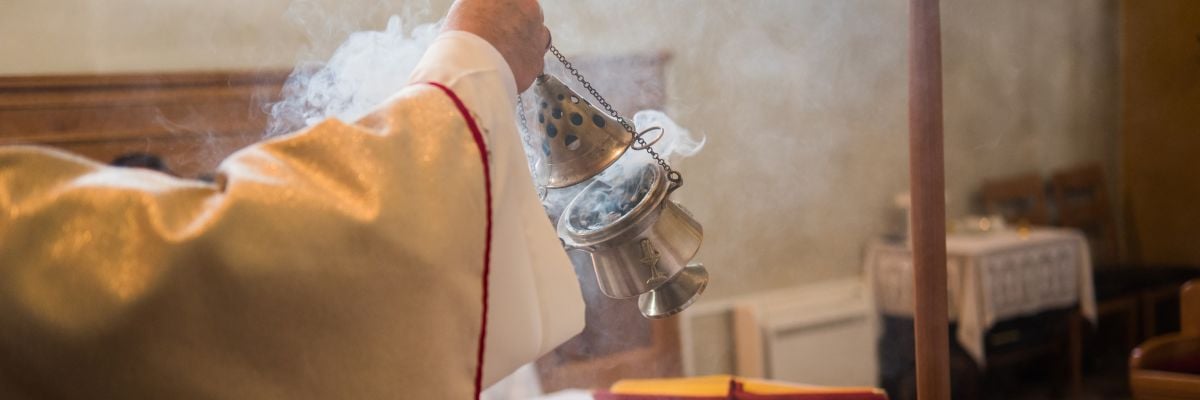
That’s usually the derogatory way of referring to a given pastor’s or parish’s appreciation for three specific church ceremonies: incense, the use of a sanctus or sacring bell, and chanting. On the second item in the list, it may indeed come as a surprise to many modern day Lutherans to learn that our spiritual forebears frequently retained the use of the sacring bell during the consecration, the chanting of the Words of Institution, in the Divine Service.

I am not exactly sure when the sacring bell began to be used, but it has biblical precedents. We might recall that in the Old Testament, the garment of the high priest had bells on it (cf. Ex. 28:33-35). It “tinkled” when he was performing his service. So when our great High Priest, Jesus Christ, comes among His own to serve them His body and His blood, it might have been almost instinctive for bells to be likewise sounded.

Luther said of this custom: "The priest's elevation of the sacrament together with the ringing of the bells, has no other purpose than to remind us of the words of Christ. It is as if the priest and the bell-ringer were saying to us all, 'Listen, you Christians, and see, and take and eat, take and drink, etc.’" AE 42:173,4. To the great Reformer, clearly, the bells chief function was to focus attention on the Words of Institution, (which words, recall, were recited sub voce in the Roman rite at the time). In the Lutheran service they are trumpeted forth and are to be pronounced laut und deutlich.

The south German, Musculus, relates his experience of the way the Saxons worshipped at the Mass he attended in Wittenberg during the meeting that produced the Wittenberg Concord in 1536: “The communion followed, which the minister began with the Lord’s Prayer sung in German. Then he sang the words of the supper, and these in German with his back turned toward the people, first those of the bread, which, when the words had been offered, he then elevated to the sounding of bells; likewise with the chalice, which he also elevated to the sounding of bells.” (Worship Wars in Early Lutheranism, p. 195).

Walter Zeeden, in his wonderful monograph Faith and Act: The Survival of Medieval Ceremonies in the Lutheran Reformation (1:100f.) specifically notes the continuation of the bells during the elevation (p. 33) among the ceremonies that Lutherans had a tendency to keep from earlier centuries in various places.

Still, one largely searches in vain for any specific mention of this ceremony’s survival in the Church Orders. Yet the very words of the Augustana about how we celebrate the Mass would lead one to expect it: “Nearly all the usual ceremonies also are preserved”(AC XXIV:2); a protestation repeated in Apology XXIV:1.

Given that, we shouldn’t be surprised by the long continuance of the custom, as witnessed by Christian Gerber in his Church Ceremonies of Saxony. Even though clearly no fan of the custom, he writes of it: “At the Consecration a small bell is rung somewhat loudly, first at the blessing of the bread, then at the blessing of the wine. This ringing has surely been retained from the Papacy. As to its purpose, that I don’t know.…” This was published in 1732, so you can see the bells persisted for quite some time in many places in Saxony, though their use as described by Luther had apparently been forgotten. (A translation of portions of Gerber’s work is available here in English: http://www.luthermem.org/wp-content/uploads/2015/07/history-of-church-ceremonies-in-saxony-bengtson.pdf)

Several modern “recreations” of Lutheran Masses include the bell at the consecration. You can hear it, for instance, in Paul McCreesh’s Bach Epiphany Mass, ringing out precisely as the words in German corresponding to “this is My body” and “My blood” are sung.

I assume, but cannot be sure, that Johann Gerhard has reference to the sacring bell when he wrote of ceremonies that, in his opinion, served little to no purpose for edification, mentioning specifically: “the priest’s lifting up the chasuble and ringing a bell under it” (see A Comprehensive Explanation of Holy Baptism and the Lord’s Supper, p. 477). However, I think the fact that he mentions it at all serves as a witness to the practice’s continuance in certain areas.

Dr. Piepkorn in his little monograph Conduct of the Service, notes: “It was anciently customary to ring the bell in the church tower a total of seven strokes, the first at the beginning of the consecration, three strokes at the consecration of the hosts, and three more at the consecration of the chalice. Later, with the multiplication of masses, hand bells were substituted. The widespread custom in the Church of the Augsburg Confession of ringing the church bell during the singing of the Our Father is a survival of this ancient custom, transferred to another element in the Service after the custom of a celebration of Holy Communion every Sunday and major Holy Day unhappily fell into desuetude.” (p. 28)

Thus, the use of bells during the consecration is a free ceremony that has Luther’s approbation, is evidenced in Lutheran practice throughout the age of Orthodoxy, and particularly in Saxony, which is the primary heritage of our Synod, and serves to invite the attention of the people to those most beautiful and important words: “My body…My blood…for you, for the remission of sins.” That Rome also rings bells during the consecration should deter us no more from this practice than from praying the Lord’s Prayer (after all, Roman Christians do that as well!).

Grant then, O God, Your will be done,
That, when the church bells are ringing,
Many in saving faith may come
Where Christ His message is bringing:
“I know My own; My own know Me.
You, not the world, My face shall see.
My peace I leave with you. Amen.”


Sunday, August 14, 2022

What should catechesis do?

As someone who had not taught catechism class to youth for seven years and now finds himself back in that role, I have more questions than I once had over what catechesis can or should do.  As I have said before, when I went through catechism class more than half a century ago, the main object was to memorize the catechism.  It was explained in class (2 hours on a Saturday morning for two years) but the explanation was more a reiteration of what had been memorized and a review of the Bible passages listed in the Catechism (1941 version) than it was designed to impart understanding.  It culminated in the storied question and answer period before the congregation (six in my class so plenty of answers and Bible passages to memorize!).  It was as if the whole purpose was to regurgitate what I had memorized at the appropriate moment.  I do not blame anyone for this -- it was the same for my dad and his dad before him.  But I did begin my pastoral work with the desire to impart something more than just knowledge -- knowledge being not a bad start.

Through the nearly 40 years I taught every year, I had mixed success.  Some youth from solid church families seemed to dig into the catechism with questions and observations that were remarkably profound but the majority sat and listened as I had done before them.  I do not discount the good of memorization or of listening to the text explained and I am sure many of them continue to be shaped by and with the catechesis that took place in those classes.  What must be admitted, however, is that those who remain active in the Christian faith (particularly the Lutherans) were aided not simply by what I did in that class but by the example of their parents (and grandparents) and solid foundation of the faith in the home.  I am hesitant to take much credit for anything in their catechesis or in their continued life within the Church.

If knowledge is the thing, the later age for catechesis seems more and more questionable.  Would we not want to impart this knowledge as young as possible so that these same youth have a solid foundation on which to endure the turbulent teenage years -- especially in view of how much change and how fast change has come for all of us but particularly for youth?  In Luther's day, youth catechesis was in the home and the examination took place before the pastor and youth were admitted to the Sacrament much earlier than is probably typical among us today.  That said, when you are trying to impart understanding of often abstract concepts, a later age brings with it a certain measure of maturity in thought that aids that goal.

In the end, the biggest problem I see is not with the Catechism (although I do not believe we solve anything by making the book longer and longer).  The biggest problem lies with what is going on in the youth and the home.  Nearly everything that influences the life of our youth has a competing vision of what is good and right and salutary.  Nearly everything that equips our youth to define themselves and their place in the world is born of a competing worldview in direct conflict with the Scripture and the faith.  Nearly everything in their lives puts faith as one of many influences and values and not the primary influence or value.  It seems to me that this is where catechesis for our youth has to begin.  We can impart all the knowledge in the world to them but until they see themselves and the world around them through the lens of Scripture and faith defines their answers, we have merely compartmentalized Christianity as one of many influences upon them.  This leaves them to choose which fits which part of their lives and which they use to meet the challenges, questions, and issues they face within those lives.

It seems to me that perhaps we may have to forego some of the knowledge in order to begin with something that helps them know and confess a Biblical, Christian, and Lutheran worldview or else we will continue to lose so many of those who might have been raised in the Church but were never really defined by their faith.  In this endeavor, the creed takes on an even more strategic role as the confession of this worldview and not simply of their individual faith.  And those are some of my thoughts as I get back into the role of exclusive teacher of the catechism to our youth once again. . .


Saturday, August 13, 2022

The dead live. . .

In our maudlin pursuit of the dead but without the hope and confidence of the resurrection to eternal life in Christ, it appears there is no end to what we will do to have technology substitute for the Crucified and Risen Lord.

By now you have heard that Amazon has revealed an experimental Alexa feature that allows the AI assistant to mimic the voices of users’ dead relatives.  While this might be merely an odd curiosity for the adult, it is a particular danger to the child.  The company demoed the feature at its annual MARS conference, showing a video in which a child asks Alexa to read a bedtime story in the voice of his dead grandmother.  So to the child, hearing grandma speak through Alexa, grandma lives not by divine will and purpose but by the mystery of technology that lives in a box.  “As you saw in this experience, instead of Alexa’s voice reading the book, it’s the kid’s grandma’s voice,” said Rohit Prasad, Amazon’s head scientist for Alexa AI. Prasad introduced the clip by saying that adding “human attributes” to AI systems was increasingly important “in these times of the ongoing pandemic, when so many of us have lost someone we love.”  “While AI can’t eliminate that pain of loss, it can definitely make their memories last,” said Prasad.  

Well, isn't that just wonderful.  The loss of loved ones is appeased and broken hearts repaired through algorithms and computer chips that give us what we really want -- not a genuine eternal life but the appearance of still being among us in some vague spiritual, technological manner.  Once again we have proved how foolish we are to trade the reality that God offers in Christ for a sham and a fake truth that can console our feelings for the moment but offers nothing really to hold onto for tomorrow.

Friday, August 12, 2022

No accidents. . .

Accidents are unintended -- whether the sound of metal with the crash of a car or the food that inadvertently gets altered by the addition or omission of an ingredient from the recipe.  Some accidents are pleasant -- like when you stumble upon a wonderful restaurant behind a less than inviting building facade.  Some are terrible -- like when a gun goes off without intent and a body stiffens in pain.  In between are a thousand other variations of good and bad.  But they are all accidents.  Nobody saw it coming until it was there.

A life is no accident -- at least to God.  While we may be surprised when a sexual encounter results in pregnancy, we should not be.  Though sometimes parents speak of an unplanned pregnancy as an accident, it is not.  Life is not ours to control, not ours to create, and not ours to prevent.  It is the domain of God.  I think we have forgotten that.  We have coined terms that make it seem like life is within our reach -- an extension of our technological skill in the realm of reproduction.  It sounds so scientific but the words that we use from everything from in vitro to abort make it seem like it is controllable and we can be in charge.  That is the lie we have taught ourselves -- life is an accident and we can deal with this accident the way we might deal with any accident.  We can fix it so that it never happened or deal with it on its own terms.  What fools we have been.  Life is not an accident.

No human being is an accident, no conception a surprise or inconvenience to God -- though we might describe it as such from our perspective.  God is not some spectator who watches us decide, define, and delineate life.  The promise of sex is not revealed in pleasure but in the potential for life -- a potential we defer to God to define.  For the great mystery of life is that He knows what we do not.  He knows us before anyone else does.  He loves us when we were not even known to our mother or father.  That is the message of the great prophet:  Before I ever formed you in the womb I knew you (Jer 1:4).  The Lord created our being, knit us together in our mother’s womb, and breathed into us the breath of life.   When we give thanks to God for all the wonder of our being, only then can we begin to discover the full measure of this mystery.  He know our soul and body before we know ourselves.  He wrote into us all that we would be before we knew it.  We can have no secret from Him.  All of this is a wonder worthy of our meditation and appreciation and it begets a reverence for life that is profound.  Read Psalm 139. 

It is often a mystery to us why human life is conceived for some or at some times and not for others or at other times.  Hidden in that mystery is the realization that not every child in the womb is welcome, why some are born into terrible circumstance, poverty, disability, disadvantage, or unwanted.  To admit that the answer lies within the domain of sin does not make it logical to us or reason our way out of the pain of it all.  Faith is not built upon nice, neat little answers but upon the mystery revered and honored and believed.  We want to make it all simple and plain, logical and reasonable.  We want to believe that life can be controlled, prevented, or make possible at will.  To believe these things is to admit a lie which does nothing to honor life but everything to diminish it and turn it into something cheap.  Life is not cheap.  Not the child who miscarries in the womb and not the child who is killed in that same womb for the sake of inconvenience.  Life is precious.  We will not build anything lasting or good by diminishing life or by treating it as if it were nothing special.  It will only come back on us when our own lives can no longer be judged worth living or in pain we would do anything to keep from living another day.  The only surrender that matters is the one that trusts in the Word of the Lord and judges life not by what we see or want or desire but by God's will and purpose.

Thursday, August 11, 2022

A fond misrecollection...

People of my age often long for those days when on Palm Sunday the confirmands rode in to be conferred their communicant status.  These were days of girls in white dresses and boys in their first manly suits, with flowers and Bibles and big family gatherings.  To get there you had to undergo the rigorous questioning (take all the questions and answers and Bible passages and divvy them among the number of confirmands -- in my case 6).  But once there on folding chairs in the front of the chancel, you had no thoughts of Jesus on a donkey or palms waved or hosannas shouted.  You just wanted to make it through without shaming your family or peeing your pants (which I did barely).

So when the lectionary was revised in the 1970s and Palmarum became the Sunday of the Passion, many wondered why and complained miserably about the loss of Palm Sunday.  So many questions have arisen concerning the reading of the Passion on Palm Sunday -- the seeming preempting of Holy Week and stealing the focus away from the big days of Maundy Thursday and Good Friday.  Does the lengthy Passion reading somehow detract from or infringe upon Palm Sunday?  Whose idea was it to make the Passion the Gospel for Palm Sunday and why was the Passion moved to Palm Sunday?  Except it wasn't.  It was not an invention or a novelty or a creative maneuver of the liturgical movement at all.  Far from being some recent innovation of the Vatican II crowd mirrored by Lutherans or some attempt to make up for the waning attendance of the Lenten Services (themselves sort of an extended Holy Week), the reading of the Passion on the Sunday before Easter turns out to be an ancient custom -- one observed almost universally by the Western Church as far back as the fifth century (Jerome c. 471)!  How about that.

In two of the oldest surviving lectionaries of the West, those of Würzburg (c. 700) and Murbach (c. 800), the Passion according to St. Matthew is prescribed, with no mention whatsoever of the Palm Sunday Gospel, or even a mention of palms in the name of the Sunday. What is mixed, historically, are the ceremonies and practices of the Palm Sunday side.  The overwhelming majority of the last 1300 years supports the reading (or, more properly, singing) of the (St. Matthew) Passion as the Gospel on Palm Sunday.

Fair warning for those planning ahead for Palm Sunday/Passion Sunday next year.

Thanks to the good work of two Lutherans on the Lutheran Missal Project for the research from which this column is in debt:  and  

Wednesday, August 10, 2022

The life they will never get to lead. . .

A while back on GetReligion was a story about a story of a Texas teenage girl who gave birth to twins.  At 17, the apparently got pregnant on the first or second date, ignored the warning sign of missed periods, and ended up unable to terminate her pregnancy due to the Texas abortion law.   In the article it said she loved her babies but grieved the life she will now never get to lead -- the carefree life of a teenager without children.  GetReligion pointed out that there was no mention of the choice made to have sex in the first place, to have sex without contraception, or to ignore the signs of pregnancy along the way -- only the choice of Texas to deprive this girl of her right to kill the children in her womb and how that right was taken from her and will be taken away from many others if Roe is overturned.

The poignant line was about the life she will never get to lead because it was stolen from her by the anti-abortion forces.  That line has become the byword of our modern era.  We have become a culture of victims who take and are not forced to take responsibility for our choices.  In addition we do not  dare to admit or acknowledge that this life is not one of justice or fairness or equity that can be enforced with laws that require us to have second chances to have a new hand of cards dealt to us when we do not like the cards we are holding.  It is a childish -- almost infantile -- perspective on life, liberty, and law.  But it is increasingly the way we as a society look at things.

Many churches have given into this view of things.  They have taken up the cause of rights owed and due, of actions devoid of consequences, and of second chances to change your mind.  Whether sex or gender, marriage or divorce, children or not, education or career, we are a people who not only desire but demand the freedom to live aloof from having to accept any real consequences for our choices.  We also insist that we be allowed as many choices as we want along the way -- but choices empty of responsibility and accountability.  We have a life we believe we are owed or deserve and anything that impedes that life and the happiness we attach to it must be subject to change.

In another generation the pregnant teen's story would not have been told so sympathetically but today such a story is a poster child for the way we look at things.  There were choices made all along the way -- to have sex, to have sex without contraception -- but the expectation was that there was always a do over that would erase the unpleasant and inconvenient consequences of those choices.  Is it any different for any other aspect of our lives?  We have taken up the mantra of the life we deserve or are owed in so many different settings and we have taken up shaping the law to fit this slogan of opportunity without responsibility, choice without accountability, and happiness at any and all cost.  In the meantime, we have treated the child in the womb as if the child were nothing but cells to be trashed when we deem the child inconvenient, unwelcome, a burden too great, or an impediment to our plans.  But that is the way we treat marriage and parenthood in general, the way we approach work and labor, and the way we look to and look at the government.

Quite apart from a philosophical difference, this view is incompatible with Christianity.  It is alien to the Scriptures and renders Christ the unwitting fool for His suffering on behalf of a people who do not think their wrongs are sin, that sin in need of no Savior, and their death anything but the natural point in a great circle of life.  Is it no wonder that Christianity is having a rough go of it today.  Either we define sin out of the equation, ignore repentance, and turn the Messiah into a therapist, life-coach, inspirational speaker, or motivator, or we face the world with the Law no one acknowledges and the Savior no one thinks they need. 

All of this is because we have come to believe that we have a life we are owed, a life we had planned and laid out, and a life to pursue happiness, self-expression, and freedom from any consequences to the choices we make.  How do you make sense of this world and tailor your Gospel to it?  You don't.  You simply preach Christ and Him crucified and leave the rest to the Spirit.  You do not have to rescue teen-aged boys and girls from the ordinary outcome of their actions or any one else for that matter.  For what it is worth, forgiveness from God does not insulate us from the consequences or outcomes of the sinful choices we make -- at least for this life.  Our salvation lies not in the hope and promise of a today without trouble but an eternal tomorrow lived out within the context this present moment -- the already but not yet tension that belongs to those in but not of the world.

Tuesday, August 9, 2022

Mere intellectual consent. . .

Though I grew up in an age when faith was often described as an intellectual consent to a series of truth propositions, I am more and more convinced that faith suffers even as much when we make it merely an intellectual activity as it does when we consign it merely to the realm of feelings or emotion.  I do not believe it is possible to reason someone into the Kingdom of God anymore than it is possible to feel your way into the Kingdom.

We live in a world in which we think reason has come to dominate.  At one point that might have been true.  For now, emotion is giving reason a good run for its money.  Though we want faith to fit neatly into a reasoned box that appeals to our intellect and solves all the riddles, we are left with a faith that requires trust from hearts incapable of rendering such trust.  Thus the Spirit must intervene through the agency (primarily) of the Word.  On the other hand, we might want faith to tie up all the loose ends of our feelings in such a way that it solves for us the problem of happiness.  The problem here is that our feelings are not a secure ground for anything -- not even self-love much less the love for another and not even close for love of God.  Faith does not appeal to either reason or to the feelings of the heart.  It goes further than any human wants to go and it is formed, led, and brought to maturity by the Spirit alone (working through the means of grace).

Our creation in the image of God has alternately been described as the endowment of reason and feeling.  There may be something to this but even more than these is the bestowal of the eternal, the transcendent, as the pivotal factor of human existence.  We look around us at the world in which we live and we look in the mirror to see ourselves and what we look for is not simply what is there, but that to which it points.  It is the common condition of humanity that we search for meaning in what we see and what we feel.  Not simply explanation or understanding, but the transcendent meaning is the ultimate pursuit of our nobility, distorted by sin but not completely erased.  

I recall a line from an old movie in which a cyclops was enlisted to help in the cause of saving the world.  He had only one eye, the movie script said, because in a bargain with the evil spirits he traded away one eye in order to see the future.  It was a terrible deal.  The only future he could see was his own death.  That is exactly what happened in Eden.  Man traded away the eternal for the future assigned to him by his act of rebellion and the consequence of that terrible eating.  Our reason searches for the eternal and our feelings long to rest in the promise of the everlasting but to no avail.  We see only our death and with it we are left with despair and crippling fear and anxiety.  That is, until the Holy Spirit builds within us faith to see without eyes and feel without hearts the wondrous mystery of what God has done to deliver us from our own choice.

Awe, wonder, reverence, and mystery are all the gift of faith by the Holy Spirit and without the Spirit we are left with puzzles to be solved, questions that seek answers, a homey atmosphere to let it all hang out, and a reasoned path to happiness.  The Lord has given to the Church the means of grace that all are transcendent -- they are the efficacious symbols that deliver what they sign but they also point beyond themselves (even as they fulfill the markers of the past).  What God gives us in faith is what we lost in Eden -- true transcendence.  It comes in the transcendent One who is God in flesh -- as the Athanasian Creed puts it, not by the conversion of the divinity into flesh, but by the assumption of the humanity into
God.
  What is true of the Lord is also true of those whom the Lord gives the new birth of water and the Spirit.  Christ is not simply the One who knows the transcendent but who makes the transcendent known to us.  The end of us is not the God who fills and fixes the earthly but the mortal who put on immortality and the new heaven and the new earth that has no end.  

It is not simply truth that is our pursuit but the truth that saves, that delivers the mortal to immortality, and that gives to those living in the shadow of death the life death cannot overcome.  It is the transcendent that we lost and the transcendent that Christ restores and with it a vision bigger than Eden and greater than any flesh and blood could hope or dream except the Spirit imagine it for us.

Monday, August 8, 2022

The problem. . .

It is not uncommon for those who recall a bygone age to suggest that the problems in America began when we banished God from the public school.  A nice sentiment but is this an accurate location of the problem?  I don't think so.  God in the classroom is not the Gospel but the Law; it is the God of personal responsibility and accountability, of natural law, of creative order, and of consequences.  To say we banished God from the classroom is not quite as accurate as we ceased to speak of the responsibility and accountability that accompanies liberty, of the natural law that is common to all people regardless of faith, of the creative order that is found everywhere and not simply among Christian people, and of the consequences for disobedience.  Instead, the schools began to speak in glowing terms of possibility and potential, rights and privileges, victimization and blame (on others) for the ills of life and society.  That is what changed.  You can summarize it all by saying God was given the boot but it was more than God that disappeared from our schools.

That said, the core of the problem is not the secularization of the secular world.  Yes, God has always been there -- whether we put Him there or not.  He is always there because His creative power brought forth all things and still preserves them.   Our recognition certainly benefits us but we cannot make Him be where He does not will to be nor can we prevent Him from where He wills.  I wish it were as simple as restoring God to the classroom.  It is not.  The ills that befall us today are not the poisoned fruits of our banishment of God from the public school.  They are the result of the secularization of the Church.  It was an ill-considered and ill-advised marriage of culture and the Church that existed more in our imagination than in reality.  Sure, there were times in the past when the aims and purposes of the Church and the state coalesced into one but it was an accident and not some deliberate union of two distinct and separate realms.  That was true when we thought culture and society more friendly to the Church and God's purposes but it is just as true today when we harbor no such illusions.

The Church began at one point to take a decidedly more friendly view of culture and society.  It was not an honest appraisal and engagement as might have been done but a move to accommodate the culture at the expense of doctrine, truth, and the integrity of the Church.  It certainly began by listening to the voices outside the Kingdom but it did not end there.  Eventually, the voices outside became the only voices that were heard and the Church learned to adjust what is believed and confessed in view of what the world believed or was thought would tolerate.  With that in mind, the change or die doomsday prophets looked into their crystal balls and saw that unless we adapted ourselves to the changing truths of the moment, we would not long survive.  In desperation, survival often means that we give up what is most important over the long haul because of what we think is most urgent in the moment.

Of course, we have to do something.  But what?  What fruits have been born of the age of accommodation?  The Church has not even slowed our decline much less reversed it.  The churches which have been most proactive in adjusting belief and re-creating worship to fit the times have emptied at a faster rate than those who changed as little as possible.  The challenge ahead of us does not lie with trying to figure out where the world is headed and to get there on time or even a moment ahead.  The call before us is to remain vigilant and faithful -- allowing the Word of God to define the mission and empower that mission.  The problem with much of Christianity is that there is nothing left of that Word to hold onto, much less empower and equip a mission.  Our missionary task is not to accompany the world in its ever changing view of sexuality, gender, climate change, social justice, and the like.  Our missionary task is to proclaim the eternal Gospel, faithful to the Scriptures, and with a hermeneutic of continuity that insists we are just as much our grandfather's church as we are the church of his grandchildren.  That is only because our anchor is in Christ.

Whether you are looking at Rome or Wittenberg or anywhere else, the great temptation has been to dilute the sacred with the secular, to mimic the sounds of the world's music, beat, and lyrics, and to erase the distinctions once so well known to us of being the set apart, the holy, and the righteous people of God.  The allure of this has caused us literally to lose our souls.  The Church has become a sad and pathetic echo of what the world has already moved beyond.  A day late and a dollar short, the Church has deposited hope not in Christ and the power of His death and resurrection but in our own efforts to build a perfect kingdom here on earth.  Nevermind that our version of a perfect kingdom bears little real resemblance to the perfect, whole, and complete of Christ's righteous, ours by baptism and faith.

If we have done so poorly for God by abandoning His Word and truth, perhaps the only future worth securing will be to renew our lives by restoring His Word as the voice of truth and the saving voice of God addressing us with the good news of salvation.  Whether you are talking about the shifting values that leave us disconnected and off anchor from the clear and unadulterated truth of the past or the changing shape of our life together, change has brought its own death.  When we deconstructed the Gospel, we also weakened the very structures on which the Church is built.  Now that it is poised to tumble to the ground, the Lord calls to us and insists it did not have to be this way.  

The way forward is not to repaint the cross and renovate the marks of suffering to make the love of God more palatable and tolerable for a people loathe to admit to be sinners.  Instead, the way forward is to begin right there -- with examination and confession, food for along the way, and the will and desire to be faithful unto death.  Modern civilization has been on its last legs for hundreds of years and we have become tone death to the sound of our own defeat and doom.  What has contributed to the decline of the world has been the sad reality that the Church has also been in decline -- and not simply in numbers but in faithfulness to the Scriptures and to the God of the cross and empty tomb.  The secularization we ought to be worried about is that one happening in church, on Sunday morning, through sermons that fail to use the vocabulary of the cross or address us with the eternal Gospel and substitute the kind of feel good, therapeutic deism, and pop psychology that appeals to the flesh but is death to the spirit.

We thought for too long that if we were out of step with the world around us, nobody would bother with the Church.  What happened is that we did such a good job of being in tune with the world that there was no compelling reason for anyone to give us a second look.  Only the vain enjoy the echo of their own voices and that is what we gave them -- a faint echo instead of the sword of God's Word.  In order to save the patient, we killed it and the Church has been on life support ever since.  Of course we are out of step with the world.  That is how Christ intended us to be.  We speak the Gospel of the set apart to set apart those who by the Spirit's power will hear and believe.  This Church will never die but the Church we created to listen and fall in line with the world is dead already.

I am frankly sick and tired of hearing that we live in a post-modern world or that it is not and should not be your grandfather's church or that we have to learn new tricks or fade away.  It is time to try a radically new path -- faithfulness.  Not the old faithfulness of ideas alone but the radical faithfulness of lives that show forth our status as the set apart, worship that is other worldly instead of this worldly, a righteousness which is not simply spoken about but lived, and love that is not the weak tolerance of the silent but the prophetic warning that without repentance there is only death.  Once we have tried that and failed, then the outcome lies in God's hands.  But if we have failed to be faithful, the blame should rightfully fall where it belongs -- on a people who lost faith with God and abandoned him as readily as Adam and Eve once did in Eden.  Calvary is not an idea of love but the most vivid and concrete expression of love.  It bears its fruit in us with the lives born anew of baptismal water, hearts moved to repentance and faith, and lives fed and nourished on the today's bread of eternal life in the Eucharist.

Consider the raven. . .

Sermon for the Ninth Sunday after Pentecost, Proper 14C, preached on Sunday, August 7, 2022.

Jesus had just told the parable of the rich man who filled his barns and then died before he could enjoy his abundance.  We would call it a tragedy.  Like those who retire and then die before they could spend their IRAs or all the money paid into Social Security.  It was shocking for Jesus to say.  But those words were directed to the great crowd.  Even though the Gospel for today begins with an “And,” the words are directed more narrowly to His apostles.  It is the same theme but now pointed toward His inner circle.  “Therefore, I tell you not to be anxious about this things of life; for life is more than food and the body more than clothing.”  You might think Jesus would give His disciples a break but He is even more pointed to them.  It might seem like Jesus is preaching to the choir.  Or is He?

Could Jesus be addressing the very core and center of our identity?  How do you see yourself and how do you see God?  Note how Jesus begins.  Consider the ravens.  Well, lets do that.  To the Jew the raven was the most detestable of birds.  It was the bird Noah sent forth first from the ark – large, black, carnivorous and voracious, it was a scavenger who preyed on death.   According to Leviticus the raven was unfit for consumption, detestable, an abomination among birds.  Think of the vultures we see feasting upon road kill. What a shocking place to start talking about your value to God or how you value His care! That’s Jesus’ example.

The eyes of all look to You, O Lord, and you give them their food at the proper time.  You open Your hand and satisfy the desires of every living thing, says the Psalmist.  God feeds the creatures we care nothing of and even these detestable birds who do nothing to provide for themselves.  These birds have no barns or fields.  And if God feeds them and cares for their needs, what about you?  Are you not more valuable to God than these?  What about Elijah who is cared for by detestable ravens who brought him bread and meat at God’s command?

“O men of little faith!”  Who me?  I’m in Church on Sunday – surely the Lord is not talking about me?  The truth is that He is talking about you and about me.  We act so much like the world in stewing and fretting over things that we know are but a passing thing and that God will provide.  We worry ourselves silly about things that we readily admit are not eternal.  We are fearful before things that can do nothing to us except steal our lives in anxiety and depression.  Where IS our treasure?  Where are our hearts?

The Father has chosen to give us the Kingdom – the Kingdom that cost Jesus His life in suffering and His death upon the cross.  But God has given us this gift with out cost.  It is free to us though it cost Jesus everything.  How does that affect who we are and how we live?  Again, it is not simply what Jesus did, but what our Lord continues to do – daily and richly forgiving us our sins, providing us with all the needs of this body and life, and delivering to us everlasting life.

In case the disciples could not answer or we did not know how to respond, Jesus tells us the answer.  If God is caring for you, the same God who gave You His only Son, then you have been set free from the prison of worry and the jail of despair.  Sell your possessions!  Give alms to those in need!  Rejoice in the moneybags that do not wear out, that hold a heavenly treasure that will never fail you, that moth and rust cannot destroy and no thief can break in and steal.  If your treasure is there, you have everything and if you have everything but do not have the treasure of God’s grace in Christ, then you have nothing at all.

So how do you see yourself?  Are you like the rest of the world, competing for the scarce things of life and fighting for necessities of life?  Or are you a child of God who has been given all things in Christ Jesus and are still being kept and nurtured with mercies new every morning?  The world likes to judge Christians by their behavior and enjoys pointing out that Christians are not without sin.  But is not the real mark of Christian faith that we are not attached to or driven by the things of this world but live with such confidence in our eternal future that today we are free?  To the disciples Jesus does not say “You above all people should be without sin.”  No, but Jesus does say, “You of all people should not anxious about your life or the things you need for the Lord who cares for least will care for you.”

Where your treasure is, there will your heart be also.  Where your heart is, there is your treasure.  It works both ways.  What we value most in life will that which guides and governs our daily lives and how we live our daily lives is a reflection of what we value most in life.  For the Christian, there should not be a disconnect between the way we live Monday through Saturday and the way we live on Sunday morning.  Keep seeking and focusing on the Kingdom of God and God will care for you with all things needful now.  In other words, if God who has not spared His only Son to be your Savior, will He not care for you in the daily needs of this life?  Christians are not to stand out from the world as the holy aloof from sinners but they are to stand out as a people are not consumed by this life.
God knows your needs.  He is not blind to the realities of this daily life and to that which we need for this body and for every day.  He gives to the unclean raven and the momentary flower of the grass all the attention they need.  He will continue to care for YOU.  This pervades everything in Christian life.  Think here of the dismissal in communion.  The body and blood of our Lord Jesus Christ strengthen and preserve you BODY and soul to life everlasting.  That is why we depart in peace.  God is not merely concerned for your spiritual well being but the whole of our lives – including food for the body, clothing we wear, the shelter of our homes, the families in which we live, and all things.  If heaven is secure, today will be too.

Now to be sure, Jesus is not preaching some kind of prosperity gospel here that guarantees we will have everything we want.  But He is promising that our lives and our needs are neither hidden to Him nor indifferent to Him.  There are plenty of Christians who live in poverty.  Our Lord is not promising us the fulfillment of our dreams but rather telling not to be consumed by the material things of this life. Possessions, experiences, happiness, money, and security are all mammon of a people whose trust is in this life and in themselves and in their things rather than God.  Seek that treasure which cannot be taken from you and trust the Lord to know your needs and to provide for them.

How is it that we have a God who moves heaven and earth to save us and then squander our days in anxiety, fear, and worry?  God does not live in our imagination but amid the realities of this life – all our needs of body and soul.  He has not saved us for eternity only to ignore us in our daily needs.  The God whom we know in Jesus is the God who has made and preserves all things and who has worked all things for our eternal good in Christ Jesus, forgiving our sins and forging a path through death to everlasting life.  So, it really comes down to this.  Do we believe Him?  If we do, then let us rest our anxious and troubled hearts and minds in His grace knowing that the God who has given us the kingdom will gives us all things needful for this life.  And knowing this, let us be free to be generous to those in need, generous in the support of this Gospel here in this church and in mission throughout the world, not because there is a need but because God is gracious.  In the holy name of Jesus, Amen.

Sunday, August 7, 2022

The problem of diversity in worship. . .

Curiously, diversity in worship practices seems to become an issue only when it involves the use of ancient practices no longer currently in common use.  Curious because there seems to be no real effort to restrain worship practices which depart from official forms by omitting them in part or in whole but there is a different approach to those who restore what was once the Church's forms and practices but have fallen in disuse.  This appears to be something in common with Rome and Missouri.

Pope Francis insists that diversity in worship -- at least the diversity of the Latin Mass along with the Novus Ordo is something not to be tolerated.  It is quite clear that it has been his personal goal to prevent any increase in the usage of the older form and, indeed, to decrease its offering where it has been permitted.  Apparently the company of bishops seems to agree since the vast majority have fallen in step to withdraw permissions once granted for the Latin Mass to be used and to prevent new permissions from being granted.  It is not a secret.  The Pope has made many headlines in undoing what Benedict XVI offered and insisting that there cannot be two rites or two forms of the rite (something historically untrue).

At the same time, the Pope has endorsed both bishops and, in some cases, priests, who have departed from the words of the Novus Ordo and transformed the character of that mass into something radically different from what Paul VI might have imagined.  The reverence that once characterized every mass has been replaced by a folksy casual atmosphere in which God is an old friend and the Church a comfortable family room.  One need only look over the internet to find egregious examples of the violation of both the form and the rubrics of the Novus Ordo -- not only permitted but celebrated as the natural evolution of what was supposedly begun in Vatican II.  This has been accompanied by the various social issues and causes that would allow two gay dads to speak at a Father's Day mass -- with the approval of the priest, the cardinal archbishop, and, it would seem, the Pope himself.  So the mass has become a stepping stone for the introduction of many and various changes of the once clear and immovable moral conscience of the Church.

Missouri is nothing like Rome.  We have no pope and some would insist we have no bishops (at least in name but we certainly do in responsibility!).  We have, it would seem, no real mechanism at all to insist upon or require or even counsel a pastor and his parish to follow the published ordo of our Synod or even to use doctrinally pure agendas, hymnals, and liturgies -- even though this would seem to be one of the reasons for organizing the Lutheran Church Missouri Synod in the first place.  What we do have, of course, are District Presidents and organized or not so organized groups advocating for this or that.

District Presidents seem on the whole unable or unwilling to address the diversity of worship practices among those who have abandoned the hymnal or the Divine Service or omit enough of it so that it is hardly recognizable anymore.  It has become the accepted norm that if you want, you can depart from our historic practice with impunity.  This even was true of those who decided that Jesus could be remotely tuned in with online or some other form of communion practice in our pandemic (though not the first time this showed up).  It is normal in our church body to tolerate and even laud those who experiment in worship by moving away from the hymnal, the liturgy, and our historic practice and to condemn as unacceptable deviation those who restore the ceremonies of our past.

The same District Presidents have much to say about genuflecting at the creed or consecration, chanting, Eucharistic vestments, sanctus bells, incense, and all sorts of other things -- historic but not ordinary today.  They would, if they could, prevent them and eradicate them and many have made no secret of their desire to replace the pastors who do them with pastors who will not.  In the middle of everything, the parishes sometimes can seem like pawns in the worship wars of Missouri.  Look at the comments on this blog anytime I mention some of those things!  The vehemence of many of the comments is reserved more for those who restore than for those who omit from the Divine Service and what does that say about us?

Organized groups in Synod both promote and condemn liturgical practice.  They are all over the place.  Some insist that the return to the golden era of The Lutheran Hymnal and page 15 is the best hope for Missouri.  Others insist that every hymnal has outlived its usefulness and replace books with screens and the liturgy with invented forms more culture friendly.  I will admit that I am an odd duck.  I do not disdain some of the fruits of the liturgical movement even as I readily use the form that I grew up with in that old blue book.  I find myself out of step with many of the groups because we use the form in the hymnal, with restored ceremonies and practices of our past, faithfully, reverently, and confidently -- knowing that here God is among us doing what He has promised.  We do not choose between liturgy or preaching but put them together in the seamless fabric of lection, liturgy, and life with God.

Incidentally, I would suggest that those who would charge that pastors restoring such practices want the limelight or love the spotlight on them are more invisible in the ceremonies of old than the pastors who have eschewed the liturgy for an entertainment and variety hour or those who follow the form in the book but who constantly ad lib (We make our beginning in the name of...) or who give directions like a liturgical GPS as if our people were stupid and could not read.

Below is a Roman Catholic example of the diversity allowed -- perhaps not even as diverse as is the Sunday practice of the LCMS, among other Lutherans, on Sunday morning.

Saturday, August 6, 2022

To listen or to speak. . .

Apparently the Holy Father says that he wants the Church to be a listening Church.  Of course, he is speaking of Rome but he is not without his echos in the rest of Christendom.  He may just be playing catch up behind those who have listened so hard and so long that they have forgotten to be voices.  That is the terrible dilemma facing Christendom today -- do we listen or do we speak because you cannot do both at the same time.  Of course, we have to listen but that is the problem is to whom do we listen?  Pope Francis is not talking about listening to God.  Neither do the liberals and progressives on all other sides of Christendom talk about listening to God.  They are instead talking about listening to people -- to those inside the Church and those outside.  The focus of the ear has been turned from God above to the people around us and the only remaining voice of too many Christians is a faint echo of what those people are saying.

A few months ago we celebrated Pentecost, the birthday of the Church, as it has been called.  In the Collect and in the readings we prayed for what we heard -- for a spirit of boldness, for the truth the Spirit would make known, and for courage in the face of a world for whom Christ died but still unfriendly to His cause.  The holy boldness of apostolic voices was once the hallmark of the Church and her ministry.  Now we have become a timid Church and a hesitant people served by accommodating ministers.  The truth that was once honored by the blood of martyrs has become an embarrassment to us and we are ashamed of the God.  So we listen to the voices around us and have become deaf to the voice of God.

The Church of the early fathers was a Church born of and focused upon the Word of God.  The Church has claimed that allegiance ever since although with varying degrees of sincerity.  The Reformation was born of the voice of Scripture -- a living voice not of commands but of promise.  That is why we listen.  The voices around us complain and commiserate but the voice of God gives forgiveness to the sinner, hope to the despairing, and life to the dead.  The voices around us can speak with great detail and precision of the feelings that pass the moment and the desires that well up from within and the wants that cannot be constrained but in those voices is the only death.  It is the smiling death of a people sure they are getting what they want but still death.  The only purpose of the Church is to speak -- the prophetic voice of prophets who have learned from the Spirit to know the voice of their Shepherd and who have been emboldened by the Spirit to herald His voice among the people.

While there are some great preachers among the priests of Rome, Rome is hardly known as a preaching church.  The Reformation was a preaching movement but too many of her preachers have surrendered the pulpit for the couch and the Gospel for therapeutic deism.  We can listen all day and be the most listening Church of all but unless we are listening to the Word of God and proclaiming what it is that He has said, we are in the same darkness as the world.  God knows the hearts of men, the thoughts of men, and the works of men.  He does not need His agents to listen and tell Him what they have heard.  He needs His messengers to repeat what He has said and end the reign of darkness and the captivity of sin and the hopeless end of death.  It might be too late for Pope Francis but it is not too late for us to learn anew this ancient wisdom.

Friday, August 5, 2022

Reaping the harvest...

When I was in the log cabin seminary so long ago, we had at least three homiletics courses -- preaching, for those for whom homiletics is an unfamiliar word.  That included the use of preaching textbookss (in my case one by H. Grady Davis, among others).  It involved a bit of reading sermons.  It required practice preaching with the class and the instructor as both the hearers and evaluators.  Then, after vicarage, there was a final review and update.  It was all well and good because preaching is important.  Incidentally, although most vicars tend to preach a dozen or fifteen times a year, my own circumstance required me to preach at least 3 times a week.  Some vicars are on their own in parishes without pastors and they preach at least weekly.  Some come back to the sem for their final year with more experience than others.  But every new pastor enters the parish with the daunting task of regular preaching to the same people over a long period of time.  Good preaching requires good preparation.

Why is it that we do not believe the same thing about worship?  In my day, only one class on worship was required with other electives possible.  I hope it is better but I doubt if more than two classes are required and the curriculums now hold out few opportunities to plug in electives.  Could it be that some of the crisis we face in terms of what happens on Sunday morning is due to the lack of preparation given to the seminarians?  By this I mean the lack of understanding of the theology of worship as well as the liturgical forms themselves.  It seems too easy to be deceived into making worship a program with a purpose and an end like any other program and therefore manipulated toward the goals desired.  It should be that the theology of worship supplied in seminary would raise the needed and legitimate questions for such a pursuit.  Unfortunately, that is not quite true.  Even when the hymnal is used and the traditional forms employed, this is not quite a full affirmation of the tie between what is believed and confessed and how it is practiced than it is a routine inherited and continued but left largely without much explanation.

Most of the worship books used are older (Luther Reed's classic volumes among many others) but the book put out to accompany Lutheran Worship came out late and is already out of print.  Now, a full 16 years after the introduction of Lutheran Service Book we finally have a text to use to train those who will not only lead the Divine Service but also explain and teach it to those in the pew.  It is way past time for us to have a solid Lutheran textbook introducing liturgical theology and way past time to expect at least as many on worship in the seminary as there are for preaching.  This fruits of our shallow preparation have come back to roost in our Synod in the diversity of liturgical practice that too frequently have no real connection to what is believed or confessed.  We have effectively devolved into a personal preference mentality in which the liturgy is merely one of many different but legitimate choices.  On top of that, many have judged the hymnal more as a boundary to prevent additional ceremonies or liturgical practices instead of a minimal expectation of a Lutheran worshiper of a Divine Service in a Lutheran parish.  So we have a maximum beyond which one is discouraged from going while at the same time refusing to let the hymnal be the minimal expectation of someone coming to worship in the LCMS.

Of course, the modeling of worship is vitally important and this is why the chapel is the beating heart of a seminary campus and one of the reasons the online cannot replace the residential training of our clergy.  What our seminarians see on a daily basis in their gathering around the Word and Table of the Lord is itself an informal method of training and equipping them for their own task.  As important as this is, it should not be expected to replace formal academic preparation.  I received the same amount of training for counseling as I did for worship (required courses) when I was in seminary -- yet I am not a counselor or therapist and never will be but I am and will always be a presider and preacher (at least until death or retirement!).   If our Synod is to make real  headway here, we need to reconsider how we equip our pastors to lead God's people in the Divine Service as well as how we train them for the preaching task.

Thursday, August 4, 2022

Eucharistic hospitality?

According to reports in the media, a Muslim politician and at least one Protestant politician have received the Eucharistic at Masses celebrated by bishops during a multi-day Catholic event in Germany.  The same event, held on May 25-29, also reportedly barred organizers of the German March for Life from having a booth as an exhibitor.   The Federal Association for Life is the group that oversees the March for Life in Berlin. When applying for a stand at the Katholikentag, the organization was reportedly told by organizers that they were “unable to determine that your organization is clearly Christian.” The Katholikentag (“Catholics Day”) is a biannual event organized by the local diocese together with the Central Committee of German Catholics, a lay organization supported by the German bishops’ conference -- the organizers of which seemed to have no problem welcoming a Muslim to the Eucharist and at least one prominent Protestant politician (Thomas de Maizière, a former defense minister and interior minister who served in German Chancellor Angela Merkel’s Cabinet for 12 years, was seen receiving the Eucharist from the hand of Bishop Bätzing).  Bätzing has repeatedly expressed qualified support for intercommunion with Protestants, telling journalists in February 2021 that it was necessary to respect the “personal decision of conscience” of those seeking to receive Communion.  Bätzing's position had already received a formal response and rejection from the Congregation for the Doctrine of the Faith (CDF) in September 2020.

So what do we say?  If this is the path of Synodality and the direction of Francis' reform, Rome is in a decidedly worse position than many had thought.  But we already knew that there were voices to say, along with some Lutheran voices today, that the job of the Church is to welcome and it is up to the individual to decide what they believe about the Sacrament and whether they choose to communion or not.  Sadly, Rome is mirroring all that is wrong with Protestantism on this point and all that is problematic with Lutheranism as well.  We appear to stand for nothing more than personal choice, personal preference, and personal truth.  When that happens the heart of the Gospel is reduced to something even less than myth and legend -- at least these usually have some fact upon which their larger truth is built.  Here there is no truth -- only that which each individual defines and holds as their own.

Sadly, I can see many Lutherans rushing to the defense of such a claim and such a position.  After all, the ELCA long ago decided that sharing the Eucharist was hardly more than offering coffee and donuts and therefore it did not matter what the people communing believed or if they believed something in common.  The welcome was more than what it was they were welcoming people to eat and drink.  That is pretty much where things sit in the evolution of a Sacrament once esteemed not simply as the last testament of our Lord but His very gift of Himself to be received by the baptized who live in repentance and faith.  I get it.  We have been so reticent to keep the altar rail for those with a common faith who come in baptism and repentance that it makes it hard now to justify excluding anyone.  How strange it is that we are more concerned with what those outside the faith might think of us than we are what God thinks about how we steward His mysteries.  How odd it is that in one place a bishop restricts a politician from receiving the Sacrament and in another part of the world a Muslim is communed.

Wednesday, August 3, 2022

Until the changes are permanent. . .

According to his own statements, Pope Francis hopes to remain as pontiff until the changes he is making are permanent.  Interesting.  Most of the changes he is making represent a distinct departure from the past and from his own predecessors.  But that has not stopped him from attempting to move Rome away from that past and from the former occupants of the papal chair.  Curious, though, is the idea that if he stays a few more years, the changes will be permanent.  That is a dangerous assumption for him to make.  The changes he has put in place represent a short-term change against what had been in place for many centuries.  How can you make something permanent in the brief span of his pontificate -- especially in relation to the longer tenure of the things he is trying to change?

I am not without sympathy for his intent.  In fact, I hope to do something of the same thing.  Having come to a congregation in which Holy Communion was occasional, private confession was never spoken about, and Lutherans were envisioned as a conservative Protestant group with a peculiar worship style, I hope that I am here long enough for these to be forgotten and disavowed.  But the difference between us is that I am trying to renew what has always been Lutheran confessional and liturgical identity while he is attempting to distance Rome from its past.  There is a difference.

There are those who constantly flood my mail with comments when I post something about this evangelical catholic commitment to doctrine and practice (as the Augustana sets forth).  They would rather see Lutheran identity as an evolving one in which the more catholic version of the Reformation era has moved past this to a less catholic face for Lutheranism -- particularly one I have sometimes characterized as bronze age.  This identity is happy to replace private confession permanently with the general absolution of Sunday morning (or even a simple declaration of grace) and to vest like the Reformed in their academic gowns and to have the Sacrament quarterly.  This identity sees the practices of the earliest days, retained more or less in different geographic areas of Lutheranism, as alien to the true spirit of the Lutheranism (which seems to be less is more when it comes to ceremony, ritual, and church usage).  For the life of me I cannot understand why anyone would choose this aberration as normative over the more catholic ceremonial unless preference is really all that matters here.

My point is this -- and I think it fits for Rome as well.  Either what we do on Sunday morning reflects our confession or our confession does not affect what we do.  The surest way for us to end up with a meaningless faith is to insist that what we do does not matter and thus the faith becomes theoretical rather than practical.  For Rome this means alienating the shape of the liturgy from the past because the new liturgy really does represent a change in faith -- this seems to be something upon which both Francis and his more conservative critics are agreed.  Francis seems intent upon trying to make the two incompatible and cement the reform that represents a different chapter in their future than you could read in their past.  

I fear Lutherans might be tempted to the same thing.  If what we do on Sunday morning does not shape or norm or define what we do on Sunday morning, then the faith is really merely an idea -- it lives in the head but not the heart or hands.  Those who reject drinking from the well of evangelicalism insist that if you change the liturgy (or ditch it entirely), that is a change in doctrine and faith.  What you do on Sunday morning matters.  No, we cannot bind someone's salvation to things Scripture does not require but we must admit that what happens in too many Lutheran parishes on Sunday morning requires a very selective reading of the Augustana.  I think that down deep it does not matter what side of the worship wars you are on, you know this.

Back to the point, the restoration of what we have abandoned is not simply liturgical and can never be.  It represents a return to the central core of our claims in the Augustana -- namely, that we are the true catholics, that the faith we confess is the same faith as the apostles, that the faith we confess (and our reform) represents not a departure from the early church and their councils but their continuation, and that foundational principle (justification by grace through faith) is not simply a truth to be confessed but a pattern of worship to be lived.  Therefore, the restoration of liturgical practices not uniformly practiced today or in the more recent generations of our churches but solidly among the Lutheran identity of our earlier days represents not innovation but recovery -- a recovery that is not novelty but the reclamation of that identity.

Tuesday, August 2, 2022

Bronze Age Missourians. . .

There are those who take offense when I use the term bronze age Missourians.  They are probably correct to note that this is not a positive label.  But I think that many do not understand with how I have used that term.  So maybe it is time to explain it.

By bronze age Missourians, I mean those whose understanding of the faith and whose practice was shaped by what many in Missouri call our heyday -- the 1910s-1940s.  Those were the days when we were growing as a Synod, had an abundance of men training to be pastors, had many parochial schools, had many women and men training to be called teachers, and we were mostly in the same lane when it came to doctrine and practice (especially worship).  Those are the things that folks miss in the uncertain days like today when we are not growing, when our parishes are getting smaller, when we are short of men in Seminary and both women and men in training to be teachers, when we are closing schools instead of opening them, when we are not united in doctrine or in practice (especially worship).  I get that.  Believe you me, I wish we had some of that back as well.

When I mean, however, is that however good the times were for us, we were not exactly the best Lutherans when it comes to the markers laid out by the Augustana.  We had abolished the Mass.  Most of our parishes had the Sacrament only quarterly and we can all agree that it had long ago stopped being the center of our focus for the Divine Service or our individual piety.  We had abolished private confession.  There was hardly a passing reference to it in the edition of Luther's Small Catechism used at the time.  Our pastors and our parishes were islands, distant from their community and neighbors -- more known for their isolation than for their connection.  We did not emphasize our baptismal identity but focused more on a faith that gave intellectual assent to propositions (or proof texts) from the Scriptures.  We were out of touch with our past and presumed it was as monolithic as we were at the time.  We defined the faith more by what we were against than what we were for -- never a good thing.  We were deeply suspicious of other Christians and held our Roman Catholic neighbors in deep contempt.  We ran our congregations like democratic institutions -- voting on matters that were in the domain of the Pastor and the Word of God and then insisting we were not.

We thought we knew what Luther looked like and what Lutherans were but we had barely scratched the Book of Concord or looked beyond our own experience growing up to define such things.  Luther wore a black Geneva gown, had the Sacrament quarterly, tossed out private confession (along with the Book of James), told us that German was the perfect language for academic theology, and that it was better to have no piety at all than an external one.  None of this is true, of course.  I grew up with an great extended family which was formed in such a time.  My father questioned me but never questioned the pastor who confirmed him.  It was only when I got him the handy tool of the Readers Edition of the Book of Concord that he read outside the lines.  At first he did not believe this was what we confessed and then began to be angry.  He had been taught that to come to the Sacrament was a solemn ordeal centered in the confession of our sins more than the communication of their forgiveness.  Like him, I experienced a new birth of Lutheranism much more positive than my catechetical upbringing as I began to read, learn, and be taught in preparation for the pastoral ministry.  Unlike some of the people in my age group, I was not rebelling against the music or the reverence or the doctrine but that we had passed on a glimpse of Lutheranism that was not authentic to the bigger picture and then had declared it to be the only true Lutheranism.

While some might insist that my view of such things is skewed by my own experience, I have found many commonalities on the East Coast, in the South, and throughout the Mid-West where I have lived, studied, and served.  I am not condemning the people -- they were taught as their pastors taught them.  What I am condemning is the idea that Lutheranism in its past and its best form for the future looks like snapshot of those times.  We were certainly not Lutheran lite but we were Lutherans with blinders on -- blinders to our own catholic perspective as the Augustana puts it and to what we were really reforming.  Why is it that Luther and the Lutherans of the first couple of hundred years were willing to keep what the Lutherans of that period would fight and die to prevent?  When did the half mass that ended at the offering become the norm for a Church that had insisted we celebrate the Lord's Supper every Lord's Day and every other day people desire to receive it?  When did a sense of liturgical minimalism define how we saw not only the Divine Service but even the shape of our individual piety?

If the contemporary worship movement has spawned confusion and distorted our Lutheran identity, then so has the myth that Lutherans everywhere and always have looked like the bronze age Missourians of our past.  This is not a matter of choosing one or the other.  This is about the rediscovery of the vibrant, careful, and catholic Confessions of our Church.  It is about seeing the hymnal as a minimal Sunday morning expression of what it means to be Lutheran while also affirming that there is a rich history of ceremony that adds to the basic rubrics of the Divine Service as it has been published among us.  It is about a personal and individual piety that is not me 'n Jesus against the world or the Bible as inspirational sentiment but about my life no longer mine as it is born of baptismal water, of a vocation and not simply a secular life with a Sunday morning component, and of the Eucharist as the heart and center of our weekly gathering.  It is about the Scriptures not as book of facts or ideas but the living voice of God who still speaks and addresses us with the words of life -- words that do not have truth because we give them truth or meaning because we define them but efficacious words that do what they say every time they speak.  It is about a worldview shaped by our baptismal life in Christ fed, nourished, and directed by the Word and the Eucharist -- and not simply a more religious or conservative version of what happens outside the Church.  It is about being able to affirm what we confess and not simply negate the wrongs in our culture, society, and nation.  

For example, can any Lutheran actually say why marriage is so important, why marriage between a man and a woman is so important, and why children are so important -- instead of simply saying why divorce and cohabitation are bad or marriage should not be redefined for other genders and sexual preferences or why to have or not have children is a private decision for the couple to make and to practice by any means of birth control?  If we cannot affirm the positive in God's order, how dare we speak at all!  And this goes for much of the faith.  If being Lutheran only matters in terms of what we are not (not Baptists or Roman Catholics), something is wrong.  I grew up on the tail of the bronze age and I did not know why we worshiped as we did, why the family was the shape of the home, community, and the church, whether the Bible was an encyclopedia of knowledge or a book of rules for living or faith propositions to be believed.  I knew I was Lutheran but did not know how to explain my Lutheranism except that I was not something else.  That is what failed us from that era.  Perhaps it did not matter as profoundly as it matters today that we could not answer these questions but I can tell you this, Missouri will not find renewal in trying to return to the earlier decades of the twentieth century anymore than she will find renewal trying to keep up with the rapid pace of change we find today.

If you are offended by my comments, I am sorry.  I hope you are challenged by them to look deeper and give answer in a positive sense to the hope that is in you and to the shape of your life together around the Word and Table of the Lord and individually as you live out what it means to be a baptized child of God.

Monday, August 1, 2022

Half empty, half full. . .

Sermon for the Eighth Sunday after Pentecost, Proper 13C, preached on Sunday, July 31, 2022.

I sometimes tell people that being a pastor is a walk in the park.  And they smile because they think I work only on Sundays so it must be true.  The only problem is that the walk in the park is in Jurassic Park!  Just when you stop to gaze at the beauty, a T-Rex bends down to eat you.  But that is true of every job, every family, and everything.  There is always something to diminish your joy.  The key lies not in focusing on the distraction but on the treasure of God’s grace.  As long as Adam and Eve desired what God desired, they did not notice the tree or want its fruit.

We live in a half full, half empty world.  And it seems we spend most of our time arguing about whether it is half full or half empty.  That is the power of envy.  Even if we might agree that all of the seven deadly sins are the worst, I fear that envy truly is the worst sin.  Envy steals our every joy and refuses to allow any moment of pleasure or satisfaction at what we have.  The reality, however, is that we are constantly comparing our lives, our possessions, our wealth, our looks, our size, our reputations, and our identities to others.  A few of us might see the glass half full but the instinct in the Christian heart is to lament what is not there.  Surely the devil is behind this because he delights in making us miserable.

The answer to envy is not a fuller glass; it is to be grateful.  Gratitude is God’s gift to the restless heart, the wandering eye, and the glass half empty.  Contentment is not the blessing of those who have much, it is the choice of a heart moved by the Spirit.  And with that we muddle into some of Jesus’ most famous words.  “A man’s life does not consist in what he possesses,” says the Lord.  No, indeed, a man’s life consists of being possessed of an awareness of God’s rich mercy, the recognition that we did nothing to merit or earn any of it, and the delight not simply in the gift but in God the giver.

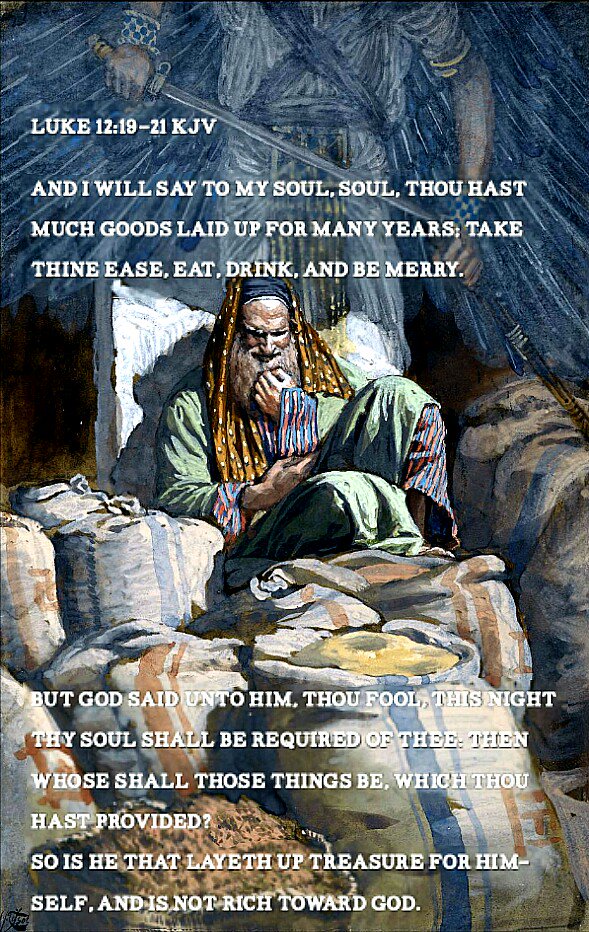
Jesus makes His point with the tale of an envious and successful farmer.  This man swallowed the lie that he was in large and in charge, that he earned everything he had, and that his things would make him happy.  He bought into the lie that he was responsible for his success and that he deserved it.  He swallowed the bait of envy hook, line, and sinker.  His walk in the park turned into Jurassic Park.  As quick as it all came together, God pulled his life apart.  His time was up before he could take joy in those things he worked so hard to accumulate.  In the end, his soul was required – remember how Jesus says to worry more about the soul than the body?


Apparently this man did not get the message. None of us get it.  Life does not consist on accumulating the most of anything or in the claim to have done it your way.  In the end, the things that were so important never seem to be enough.  The more we have, the more there is for us to want.  You cannot store up the moments or money of life until that perfect moment when you spend it all.  You are not blessed by your things but by the God who gives tem to us.

The down side in all of this is that in order for you to own what is yours, you have to ready to give it all away.  As long as you are on the prowl for more of anything, what you have will never be enough to satisfy your want.  Whether you are on Fortune’s list of richest or homeless or somewhere in between, a grateful heart begins by ending your preoccupation with what you don’t have.  That happens by giving up your claim on them so that they can give up their claim on you.  The point of this is not poverty but to have a heart empty enough that God can fill it,

It seems so hard to live off the grid of money, possessions, experiences, and stuff but it is not quite as hard as we would make it out to be.  Greed consumes and envy leads to despair.  Before we can learn contentment, we must stop trying to fill the glass.  It does not matter if the glass has a dollar sign on it or a popularity poll or the face of your children or grandchildren or as many experiences, trips, travel, sports, person expression, and memories as you can, stop filling the glass.  Stop comparing yourself to anything else.  It is all the devil’s lie.  Every job is a park with dinoceras, every family disfunctional, every bank account not enough, every closet too small. . .  Stop trying to fill the glass.  Let the Lord fill you with an abundance of His mercy and grace.  Focus on the eternal and the things you lack or want or are jealous of will diminish and your peace will grow.

No man can add to their length of their days.  No present life is worth giving up eternity.  No woman worth losing your soul and no man worth the lies he might tell you.  Your joy begins with gratitude and that gratitude comes from being possessed – not possessing.  Your body is a temple of the Holy Spirit. You were bought with a price.  You belong to the Lord who paid for you with His blood.  Your future is not yours to define but God’s to give.  The Holy Spirit has taken you over by Water and Word. Redeemed by Christ for life in Christ, you are rich.  Your treasure cannot be consumed by moth or diminished by inflation or decay into dust.  Your treasure lies in Christ, is given you from Christ, and belongs you as long as your are Christ’s by baptism and faith.


This world’s claim on you and its allure is fleeting.  Christ’s claim is eternal.  The devil will tell you how poor you are but do not believe him.  You are rich toward God.  This world may insist that your glass is half empty but Christ has filled you.  This world tempts you with uncertainty but God offers you true certainty through the blood of His Son.  You do not need to satisfy every desire to be happy or to fill your mind with memories to have lived your life well.  God has set you free of this sad world of discontent, misery, envy, and jealousy.  Do not surrender yourselves to it anymore.  

When we say with Scripture: “You brought nothing into this world. You will take nothing out of it” this is not some depressing fact to make us humble.  Instead it is how you are released from the chains of your prison and help you see that if you have Christ, you have everything and you have it forever. Giving up all things gains all things. That is the lesson of the Cross.

So, let us turn away from envy and its fear of not having what we want and turn to Christ who has given us eternity.  The Lord will require our souls from us – either through the promise of baptism and its gift of new and everlasting life or on the day of judgment when our secret wants will be revealed and condemned.  If we insist upon possessing everything, we will end up with nothing.  But possessed by the Lord by baptism and faith, we have every true and lasting treasure forever.

Sin has made every life a walk in Jurrasic Park and desire has been our undoing from the get go.  But God will not share you.  Do not think that God is satisfied with only a piece of you or that you can be saved by holding onto only a piece of God.  You can have only one master – not God and money or God and experiences or God and accomplishment or God and entertainment. No matter what you say, you are possessed with what you love.  Better to be a slave watching the door in the Lord’s House than to own a tattered tent in a world that is passing away.

In the Holy Name of Jesus.  Amen.

Adaptation. . .

In my long experience of life so far, I have learned that typically we adapt ourselves to the pace of things coming at us.  The faster they come, the faster we work.  The slower we come, the slower they work.  When everything happens at once, the adrenaline kicks in and we slip into high gear.  There is only one problem with this.  We cannot sustain this over the long haul -- especially if the pace of things continues to increase.  At some point in time, there will be a cost to be born by our adaptation to the pace at which things happen around us and to us.

Strangely in all of this, God's time is usually slow.  We are drowning, where is God to save us?  We are chocking on the changes being thrust upon us, where is God with some rest and respite?  We are moving as fast as we can and still falling behind, where is God to put the brakes on things so that we can catch up?  Inevitably we end up conflicted.  The pace of life seems to be something we can do nothing about and God's slowness to keep up only makes it harder and harder on us.  At some point, I guess, we need to do something else.

For most of my ministry the pace has continued to increase.  Now, without an second pastor and with a goodly number of long-time staff gone, the pace is maddening.  It is as if the world has found my weakness and is trying to exploit it with all that it has to throw at me.  I will admit to being more harried than usual but the strangest thing to me is that I am not as conflicted by things as I thought I would be and sometimes think I should be.  Perhaps it has finally sunk into me that God's good will shall be done whether I want it or not.  Like Luther taught us, we pray in this petition that God's will might be done among us.  Right now that means refusing to surrender to the dizzying pace of things in the world and trying to keep one foot on the brake or the entire train of my life and work will go cruising off the tracks into the canyon.

I suspect I am not alone.  We are in conflict more and more over the pace of things around us which we believe cannot change and God's refusal to act upon the world's timetable.  It is nothing new.  How many times did the enemies of Jesus have Him set up and ready to be seized but Jesus walked through the crowds or something else happened and Jesus slipped away.  Our Lord refused to let the world define His schedule.  He set His face to go to Jerusalem and meet His saving destiny upon the cross but He did so on HIS schedule.  Could it be that the Church should begin to unschedule so many things that have crept up on our calendar -- things good and salutary except for the fact that they cause us more upset, conflict, and fear than the good they are designed to do?  I suspect I am also not alone in wondering if we need to clear the calendars to make sure the one thing needful is seen, understood, and applied in our daily lives.  Otherwise we are simply letting the world define us and what we ought to be doing instead of God showing us what must be done and what our time is given to us to do.

If people want to do them, fine.  But from time to time I wonder if it is not good to review our calendars and decide whether we must do them.  After my mother's death, I noticed that the pace of my little home town in Nebraska was calmer than what I was accustomed to.  Even the calendar on the church bulletin was thinner.  That is not a bad thing.  Maybe we ought to learn how to do it.  There are probably more Marthas in this world than Marys -- more people stressed by the many things that could be, should be, or might be done than focused on the one thing needful.  So hold one another accountable lest the world keep increasing the speed until we crash and cry out to God, Lord, where were You?  God is where He always is.  We are the ones who are moving so fast we have lost our bearings.

Teach me, O Lord, not to hold on to life too tightly.  Teach me to hold it lightly; not carelessly, but lightly, easily.  Teach me to take it as a gift, to enjoy and cherish while I have it, and to let go gracefully and thankfully when the time comes.  For the gift is great, but the Giver greater still.  You are the Giver, O Lord, and in You is the life that never dies; through Jesus Christ, our Lord.  Amen