Thursday, July 15, 2010

Remembering Those Who Have Gone Before...

I took a few moments to think about some of those who have died in Christ over the past year, some of them remembered at the Synod Convention.  The man who laid hands on me and set me apart with Word and prayer died just weeks ago -- The Rev. Eldor Meyer.  It started a whole flood of thoughts about the many, the mighty, and the mostly forgotten who have served the Lord so faithfully and now are gone.  From there it went to the vast number of folks in this church body from the time I was old enough to know or remember to the present day.  Truly we are surrounded by such a great cloud of witnesses that it is hard not to be encouraged -- no matter what the present circumstances of the Church are.

Sometimes it is easy to believe that the sun rises and sets upon us and upon this time and this moment.  It is easy to believe that everything hinges upon this day and the decisions of this day.  But remembering the saints of long ago and those of yesterday reminds us that for all that hits the news, there are faithful folk loving and serving the Lord faithfully, doing His bidding, and prospering His kingdom at every time, in every place.

These saintly folks are first of all sinners just like you and just like me.  They served within the framework of their own faults and failings.  Their stature does not need to be enlarged beyond their reality.  For this is how God has chosen to build His Church and do the work of His Kingdom -- not through the perfect but through the forgiven, charting success not by numbers but by faithfulness.

While I do not intend to diminish or take anything away from those who serve the Church in visible positions of prominence, I do desire to raise up those who serve the Lord faithfully and fruitfully but largely hidden from the view of most.  It happens in parishes and places off the map and too obscure to be well known.  It happens through those who serve with a formal call and through those whose only call is their baptism.  It happens on Sunday mornings and throughout the week, mostly anonymous but well known to the Lord of the Church.

If Missouri will prosper as a church body, it will be more because of the faithfulness of those unsung saints who labored in our past and still work today in obscurity and anonymity.  It will be through the patient and untiring efforts of ordinary Pastors and folks in the pew, on the plains or in the city, who faithfully steward the resources God has supplied, witness to the good news of Jesus, pray fervently, and love deeply.

I am thrilled that the new President of the LCMS comes from a background of mercy work as well as theological acumen, with a pastoral heart as well as an administrative gift, with the ability to laugh and cry as well as sound, objective judgment.  I hope that he makes us feel good again about this hidden work of the Lord that is still the means through which God builds His kingdom.  I pray that instead of tearing down things small or marginal, things ordinary or routine, we learn to raise up the work and workers of the Lord.  I hope and pray for a real renewed sense of vocation (both of the called and those baptized) that this work is important though often hidden, the arena of God as much as any other, and the place where God still provides and expects the best that we have.

In my humble opinion, if the new leaders of our Synod can inspire and encourage this work and these workers who operate off the radar screens of those who delight in size, innovation, and creativity, then our church body will be renewed from the bottom up.  And this is, I believe, the most important work that those newly elected leaders can undertake.  Sure, there will be questions and issues relating to actions taken at this convention, to a new structure to be fleshed out and implemented, to old problems still with us and new ones just on the horizon... there will be the press of meetings and the need for messages here, there, and everywhere.  But under it all and through it all, we need to renew the work and renew the workers who labor unnoticed and without fanfare to do God's bidding and be His Church day in and day out, around an altar, a font, and a pulpit, where grace is found, grace feeds, grace defines, and grace accomplishes its Divine purpose. 

Wednesday, July 14, 2010

Not so fast.... Not so fast...

I remember the candidate who said on his election, "Elections are easy; it is governing that is hard."  For all the cheering that went up in certain camps throughout this church body, I would offer the somber reminder.  Elections are easy; governing is much more difficult.

In order for this election to mean something, we as the Pastors and parishes of the LCMS must agree to be led.  That is a tall order.  We are a contentious bunch.  We each see things from our own vantage points and assume we know it all.  We love to paint it all into matters of clear confession when somethings are much more complex.  We talk about Synod but we keep our dollars close to home because whether they are our guys or their guys -- they are still bureaucrats (Barry had money problems just like Kieschnick).  We love a good speech or sermon but then we get on the planes and had home to do what we have always done (secure in the knowledge that our congregationalism means nobody can tell us we are wrong).

So I would urge a cautious optimism at best.  We may have a new President of Synod, but we are the same old Pastors and parishes, set in our ways, certain that "my" way is the best way, and about as hard to lead as cats are to herd.  I sensed a moment of grace when Pastor Chuck Mueller took a moment after the election to honor the new President's election.  But today we will be winding our way through a myriad of motions, by-law changes, and other elections.  We still have a Synodical budget crisis.  We still have Ablaze and Fan into Flame baking in the oven but not yet done.  We still have the odd circumstance of laymen authorized for Word AND Sacrament ministry.  We still have 30 something individually tailored deacon programs out there.  We still have different ideas of table fellowship, faithful worship, and appropriate methods of outreach to sort out.

Elections are easy.  Leadership and governance are much more difficult.  So before we party, let us pray.  Before we gloat, let us confess.  Before we predict a bold new future, let us pull up our sleeves to sort out the issues and meet before the cross.  Before we talk about some prophetic moment, let us affirm our willingness to be rebuked, corrected, reproved, and edified (and not just our neighbor's).  Then, perhaps, we may actually see some of the promise of this moment realized.  Every week we pray for the man who presides in Synod, for our Bishop, and for our Pastors.  Let us start there so that we all know their names and carry them in our hearts close to God for the good work they will do, the mistakes they will make that we should forgive, and the honest disagreement that will continue among us.

Tuesday, July 13, 2010

Additional VPs Elected...

Second—Fifth Vice Presidents

Second Vice President
John C. Wohlrabe, Jr. is elected with the majority vote on the second ballot of election for second vice-president of The Lutheran Church—Missouri Synod.
Third Vice President
Paul L. Maier is elected with the majority vote on the second ballot of election for third vice-president of The Lutheran Church—Missouri Synod.
Fourth Vice President
Daniel Preus is elected with the majority vote on the second ballot of election for fourth vice-president of The Lutheran Church—Missouri Synod.
Fifth Vice President
Scott R. Murray is elected with the majority vote on the third ballot of election for fifth vice-president of The Lutheran Church—Missouri Synod.

Herb Mueller Elected...

First Vice-President

Rev. Herbert C. Mueller, Jr.
Elected with the majority vote on the Tuesday ballot of election for first vice-president of The Lutheran Church—Missouri Synod. 
 
Final Ballot
Mueller 631
Diekelman 339
Preus 82
Schulz 81
Schrank 64

Matt Harrison Elected...

President 

The Rev. Matthew C. Harrison
Elected with the majority vote on the Tuesday ballot of election for president of The Lutheran Church—Missouri Synod.
Final Ballot
Harrison 643
Kieschnick 527
Mueller 8
Fickenscher 5
Gard 1

Simple Majority or Consensus

Twice in my 30 years as a Pastor we have undertaking the major effort of a building program.  I benefited from the wisdom of others who had gone through the experience.  One, in particular, told me that it might be the wisest, smartest, thing to do but if there is not a real consensus within the congregation to do it, put it off and build the consensus.  At first I thought it was foolish advice.  Majority rules, right?  But he was absolutely correct.  We waited until there was consensus (notice -- I did not say unanimity but consensus).  There were people who objected the vast majority were behind it and many of the rest were willing to trust the decision of the large majority.  Both projects flourished and have been a blessing in many more ways than simply providing space.

As I heard of the close votes (generally 51-52% for and 48-489% against) most of the restructuring proposals that passed the Synod Convention, I am struck by that advice given to me so long ago... and the stark contrast to the actions take to radically reshape the LC-MS structure.  At this point I am not debating the pros or cons of the options presented, only questioning how the narrow majority will play out in the life of an already contentious church body.

I am no guru of the future and I have no crystal ball.  These BRTFSSG might be the best thing for Missouri since immigration.  They may be the very thing to kick start our Synod away from internal interests and on to the mission at large.  They may save a ton of money and streamline decision making.  They may give congregations an even greater influence on the direction of the church as a whole.  They may cure cancer and find the lost ark.  But they will continue to be cause for division and stick in the craw of the people of this church body if they are adopted by such a slim majority of one or two percent -- in effect 40 or so votes out of 1200 possible!

Some complain about the US Senate and its rule requirements of a majority of 60% to give legislation a go (even though actual adoption may only require a simple majority).  I like it.  I get nervous when things move too quickly or without a broader consensus.  51% may be right in the decision but wrong for the country as a whole.  The same can be said for the Church.

We would have never built a building or called a Pastor (or other church worker) or purchased stained glass or a pipe organ or changed the time of the worship service on the basis of 51%.  Why does our church body believe that a simply majority is enough for changing the structure of our denomination, transforming elected service boards and commissions into two commissions appointed  by the Synod President, merging the functions of all our boards and commissions into those two groups, electing vice-presidents regionally, and making the first vice president essentially a running mate?

Missouri is contentious.  We all know that.  Some of the conservatives are narrow minded people for whom no one is above suspicion except themselves.  Some of the moderates are willing to do whatever they want or desire and resent that Synod means walking together or being concerned about consistency of doctrine and practice.  So what will happen to our already contentious Synod when such radical changes are adopted by the slimmest of majorities?

You got it.  More contentiousness... more division... more bitterness... more politicking... more polarization... and more distraction from the work of the Synod what we joined together to accomplish...  I am not in Houston and I do not know what I can do but pray... but I urge you to pray with me that we do not end up with simple majority decisions that rip the heart and soul from who we are as a church body.  It is too late to turn back the clock but it is never too late to slow down the timetable and suggest that maybe we need to think about the impact of HOW we are making these decisions as well as what decisions we are making...

Monday, July 12, 2010

Technology in Worship -- Benefit and Drawbacks

As I sat in our nice air conditioned sanctuary yesterday, listening to sounds amplified by a modern PA system, thinking about the cds of the services to be distributed on Monday morning, with the sounds of the majesty of a 65 rank pipe organ and the ivories of a concert grand dancing in my ears, I thought for a moment of the technological advances that we take for granted every day in the Church.  But I also thought for a moment on the question of whether they are all of equal merit or benefit to the Church.

I seriously doubt whether anyone (and we have our share of Luddites in the LCMS) would disdain such things as central heat and air conditioning, or systems to make the voice sound loud and clear in everyone's ear, but there are other advances that have made their way into the Church with less of a welcome.  We all cringe at the myriad of wild and unusual cell phone rings that seem to go off at all the wrong times in worship.  (I recall a story in which a preacher said he would love to know what the sound of Revelation's heavenly chorus was like -- when a cell phone went off to the tune of "Take me out to the ball game" -- and paused and said, "Now I know...")  But these are not the only advances to be considered.

An app for the I-Pad which provides the Roman Missal has been greeted with less than wild enthusiasm.  The thought of people choosing an app for a tablet computer or phone instead of a hymnal or missalette gives you the very weird picture of pew filled with people watching a screen with ear bugs hanging off their heads.  Ugh!

At the LCMS Convention in Houston a TV screen was embedded in the altar.  It had to be a very unfortunate choice and appears to have made technology both the deity and the means of grace.  I was not there to see how it was used but the image of that screen in the altar is a most unpleasant wedding of technology and worship -- at least in my viewpoint.

The ever present screens presenting everything from sermon notes on PowerPoint to the images that go with what was happening in the service (instead of stained glass) to a fully orchestrated video presentation to a dancing dot over the words of the songs being sung... and I could go on...  Well, I am not sure what to make of it all.  I disdain the idea that the Pastor or worship leader controls the experience by means of the video or images (that are often the only visual graphics or art in the building).  It reeks of manipulation.  I do not like that we have become slaves to video so that we must have our minds spoon fed with images instead of allowing the Word to paint those images upon the canvas of our minds and hearts.  I resent the idea that the only way modern people can relate to God is through the technology that shapes and defines too much of modern life (turning worship from an encounter with God in the means of grace to another YouTube video).

Before anyone accuses me of being anti-technology, let me make a few points.  I do blog. I have several computers.  I do use PowerPoint.  I am a fan of YouTube.  BUT... the place of technology is as much an issue as the technology itself.

When Bach played the pipe organ, that instrument was one of the most complicated mechanical devices of the age and represented some of the heights of technology for his day.  The technology was nearly invisible and the music was center stage.  Today's technology is not so invisible and seems to not only demand something from us, but shape how we see things.  When technology becomes its own object or distraction, then its place in worship should rightfully be questioned.  It is exactly like the music that gets in the way of the text.  Worship is not about the experience or the aesthetic, but about the Word (and visible Words or Sacraments) through Christ comes to us, bestows upon us His gifts, and imparts to us the Spirit that we might receive those gifts with faith).

I must confess that we all are in love with our technology but this love affair has not brought with it the kind of critical review that is needful to the Church.  One of the purposes of this post is to ask the question -- which technology is bad for worship as well as acknowledging those which may be useful.  It is not just a matter of how it is used.  It is not like the judicious use of certain technology is salutary and other usages are not.  It is not merely a matter of degree here.  For example, I am not talking simply about the usage of screens or their placement, but what does this technology do to change worship?  What does it do to the worshiper and what does it do to the Word?  What is the end result of such technology?

There was a time when it was thought that electronic media would completely replace publishing.  It has not happened.  Though some said the publishing of a hymnal might one day be obsolete (even with respect to LSB and 2006), we have seen that this is not the case.  The question is then whether this day will come or whether we should allow it to come?

St. Paul's advice is good.  Not all things possible are beneficial.  No more pointed wisdom needs to be said as the Church wrestles with this issue of how much technology is good and how much is bad in worship.

Sunday, July 11, 2010

Historical Documents, Historical Baggage or Living Identity

For most Reformation churches, their confessions no longer have any normative authority.  They are relegated to the status of historical documents.  So, for example, the Episcopal Church sees the 39 Articles not as living confession but as historical documents that are related to who the Church is today but certainly not normative for that church body.  In the same way, the Westminster Confession has lost its normative voice for Presbyterians and the Reformed of a Calvinist stripe.  The Heidelberg Catechism has likewise become merely an historical document, part of a church's past but not its present.

For some within these traditions, this has gone a step further.  The confessions of the past are not only historical documents but historical baggage.  Like the old, worn suitcases sitting in the attic, they have become outmoded, irrelevant, and are seen as baggage best discarded.  Oh, sure, you can remember them as history but they are antithetical to whom the church today has become.  Not only are they cast aside, but what they contain has been cast aside and has become descriptive only of what was and not what is.  Even if this has not functionally happened by resolution, it has happened by the way these church bodies make decisions and the criteria used to implement choices which are in clear conflict with their doctrinal positions of the past.

Even though this has not yet happened for Lutheranism, we are certainly in danger of this happening among us as well.  We have certainly not gone very far down the passageway of making the Concordia an historical document, but some Lutherans seem to be heading in that direction.  In the ELCA we noted how the decisions were made to allow, in effect, a new definition of marriage and to allow for gay and lesbian clergy in PALMS.  The ELCA recognized that it was departing from the established position of the Lutheran Church and chose to follow this path anyway.  In some respects, it was more honest to recognize this departure from Lutheran practice and catholic tradition than to see it somehow justified or approved in history.  Many were heard to delight in the "new thing" God was doing under the power of the "Gospel."

In Missouri we see a different track.  Here the question comes down to the separation of substance (doctrine) from style (practice) and this has become the new shibboleth for those who are trying to quick start a seeming reluctant Missouri to growth in numbers.  No one in Missouri is saying that the Confessions should be discarded.  No one in Missouri is saying that these Confessions should be ignored.  In essence what many in Missouri are saying is that the Confession can be maintained with a broader diversity of practice in the areas of communion fellowship, what happens on Sunday morning, methods of outreach, evangelism, and stewardship, and a vague Lutheran identity in new mission starts.  Over and over we hear from them that the Confessions were not written with a modern day situation in mind and that these Confessions allow a diversity of practice that does not break or divide the fellowship.

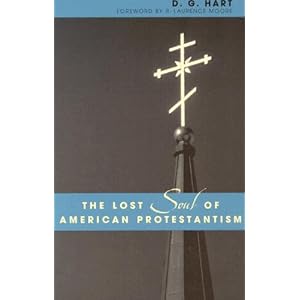
Read the excellent book called The Lost Soul of American Protestantism by D. G. Hart to see how he tracks this movement among Protestants and how it might go for Lutherans as well.  When our Confessions are no longer normative, when they no longer speak to practice as well as doctrine, we risk being unhooked from our identity and we unleash a host of alternatives to what has been without any real mechanism to reclaim our identity or the authority of those Confessions.  Some have described this as Museum Confessions.

Clearly Lutheranism will soon have to come to terms with this.  Will our Confessions be something we pay lip service to or will they continue to be the formative and definitive confessional identity for us as Lutheran Christians?  For many, this choice was already made in Minneapolis for the ELCA.  For Missouri, it may well be one of the consequences of choices made in Houston that, while not directly stating such, will effectively turn aside the voice of our Confessions to shape and define what we believe, teach, and confess, and how we live it out in parish practice....

Saturday, July 10, 2010

The Convention Begins...

Well, the drama has begun in Houston.  It may not have the news value of what is happening among the Presbyterians in Minneapolis, but it is surely a pivotal moment in Missouri's history.  I am not speaking primarily of whom will be elected President for the next several years -- that will indeed have its own ripple effect down the pike.  What I am referring to are the proposals for restructuring that will centralize and make more efficient the governing process and the administrative oversight and implementation of the Synod's vast array of programs and agencies, boards and commissions.  As I have posted before, I am not so sure that efficiency is the measure that we should use to decide how best to structure our church body and how to govern her.

The key issues before us remain not on the agenda -- at least not directly.  We will not be discussing the things that have lit up discussion boards and conversations over coffee.  We need to decided what the heart and soul of Missouri is -- what we say on paper (Confession) or how we do it in the parish (practice).  We need to decide whether all our talk about the Confessions is lip service or are those Confessions where we form our identity and what shapes how we live it out.  We need to decide if we are broad enough to include LakePointe and The Alley AND Redeemer and Zion (Ft. Wayne & Detroit) or whether there is a line of division that is so deep we cannot bridge it in one church body.  We need to decide if Leucke's neat division of style and substance is possible or faithful and if we will shape who we are by this dichotomy.  We need to decide what to do about failing and dying congregations and whether TCN and the latest growth methodology from generic Christianity will fit us or whether this renewal comes from the altar, font, and pulpit (the liturgy, which by Confession is the Word and Sacraments).  We need to decide what functions belong to Synod, what to District, and what to congregation -- as well as what we can do and what we cannot do (for lack of funds, need, or timing).  We need to decide if we need larger Districts more uniform in size or smaller Districts more uniform in size so that we can walk together on the same path and walk more effectively.

These issues will not be talked about on the convention floor but you can bet they will be talked about over lunch, over a beer in the off hours, in the hallways and hotel rooms, on cellphones, and on line.  Would that we could discuss them directly but that is seldom possible today.  Instead we will decide them by deciding WHO will be elected, by WHAT structural changes are made to implement the consequences of these choices, and by HOW we will shape the decision making process.

So for now we wait... wait for news from the floor, wait for the votes to be taken, wait for the ballots to be counted, and wait to figure out what is will mean and how it will play out in the future.  While I may or may not be hopeful about what happens in Houston, my confidence lies not in what we do in church conventions but in the places where people gather every week around the Word and Table of the Lord.  My hope is founded upon the promise of God who never reneges on His promises.  I am not ready to write off Missouri or to nitpick at everything I do not like -- we need to be positive people and not simply against things.  I am not naive enough to believe that Houston will not matter or to believe that it will make all the difference.  Missouri's road to redemption and faithfulness leads through small towns and big cities, suburban neighborhoods and rural farms and the congregations there where God's people gather around His means of grace.  It is here where we need to rediscover who we are and live out confidently this faith with practices consistent with that confession.  It is here where this confessional and liturgical renewal will bear the fruit on the Circuit, District, and finally on Synod level. 

We have done a good job with the Seminaries and both of them have fine and faithful teachers, now we need to make sure that the academic ideal is not some ivory tower dream.  Lutheranism was never really an academic domain but the practical place where people are called, gathered, enlightened, and sanctified according to God's own plan through the Word and Sacraments and the Pastoral Office that brings these gifts to God's people.  Lutheranism has never been a clerical or hierarchical group but a vocational one -- one vocation within the community of faith and one vocation within the workplace, homes, neighborhoods, schools, and world -- that complement and support each other toward the ultimate goal of bringing Christ to the nations and the nations to the Church...

Friday, July 9, 2010

We Don't Know What We Have

One of the great tendencies among Lutherans is to minimize what we have and over value what we see around us.  We simply do not realize what treasure we have in our Symbols, hymnody, liturgy, and theological tradition.  And the sad truth of it all is that we have shopped in the religious marketplace to see what others have, borrowing things that are foreign to our confessional identity and confusing that identity both within our congregations and people and outside as we related to the community around us.

In the last post I pointed how we as Lutherans have taken up with those who talk about faith without realizing or making clear that we are speaking about a very different understanding of faith.  We use the same word but do not mean the same thing -- at least not in our Confessions, although it might be said that the more we use this term among those who mean something different, the less sure we are about our meaning.

When we speak of faith, we are speaking of trust.  This is not how most Christians define faith.  They would say faith is knowledge, understanding, and assent.  So in infant baptism the issue is less with baptism than it is with faith.  They basically say that infants and small children are incapable of faith.  We Lutherans have tended to apologize or backtrack on our understanding of faith to the point where we, in effect, deny that infants and small children are capable of it.  Clearly Jesus is more confident about the faith of these little ones who believe in Me than we are.  But there are some among us who continue to speak of decisions for Jesus or to treat faith as if it were a moment of clarity and understanding instead of the trust that Scripture speaks of.  When we enter the ecumenical conversation without defining our terms we tend to blend in and lose our identity among those who think otherwise and leave our people confused -- as if Lutherans were merely evangelicals who worship a little differently.

When we speak of grace, Lutherans speak from the vantage point of the places where this grace is made accessible to us.  We do not so much speak of grace in general as we speak of the means of grace where Christ comes to us with His Spirit to bestow upon us all His gifts.  Grace and the means of grace are like both sides of the same coin.  Yet the sad truth is that more and more we speak of grace without including in this conversation the means of grace (the Word and the Sacraments).  When we do this, we sound like generic Protestants talking about a God who inhabits our feelings and our reason more than the water that gives new birth, the voice that releases us from sin and its guilt, the Word that addresses us with salvation, and the bread and wine that are Christ's body and blood.  For Lutherans, grace is not a concept but the reality of baptism, absolution, Eucharist and the living Word.  We tend to act as if these things were incidental to our identity instead of integral to our confession and life as Lutheran Christians.  In consequence, other Christians see us as generic Protestants who hang on to an outdated liturgical practice that can (and should) be ditched as irrelevant and out of step with our modern world (and so many Lutherans have come to the same conclusion).

When we speak of Scripture, we seem to have a natural affinity with those who affirm that Scripture is without error.  Yet by adopting the inerrancy terminology of the fundamentalists and by identifying with their arguments we mask the fact that we do not see God's Word as they do.  We do not believe that God's Word is a book of rules or information that must be guarded against assault but the living voice of God which does what it promises and accomplishes what it purposes.  We believe that God's Word is truthful not because of some mechanical process of inspiration or some sacred protection down through the ages but because God speaks only truth and does not lie.  His Word is the means by which He works and this truth of God and from God is the powerful truth that does not speak about forgiveness but forgives, that does not speak about salvation but saves, and that does not speak about new life but bestows that new life.  I find it shameful that somehow we have been lumped together with fundamentalism when the Scripture we are speaking of and the what it does are in conflict with the way fundamentalists see the Word.  In effect we confuse our people and those around us by sounding as if we were fundamentalists locked into a liturgical tradition that is like excess baggage which might and should be jettisoned. 

I could go on and on.  My point is this.  We are not like Protestants or evangelicals or fundamentalists.  We are Lutheran.  At one point in our history we believed that this was the faithful and catholic identity once hidden in Rome's inventions and now restored by a movement born of God's reforming power.  Now we act as if the Reformation did not go far enough and the Radical Reformers were right after all.  Now we act as if our liturgical practice did not flow from our Confessional identity but was foreign to it or extraneous to this identity (and, therefore, optional).  Now we shop in the religious marketplace for ideas because we have lost touch with our own identity or lost confidence in the means of grace to accomplish God's purpose among us.  We leave our people with a piety shaped by TV preachers, radio Christian contemporary music, and Bible studies that draw us away from instead of back to the liturgy and then we wonder why they are drifting away.

We do not know what we have.... and when we realize it, we treat it as an embarrassment instead of our strength... for Lutheranism to be reborn, we must re-discover who we are, what treasure we have, and how that is lived out in the wonderful dynamic of the Word and Sacrament setting of Sunday morning...

Thursday, July 8, 2010

Catching Up on My Reading...

While putting a book away, an older periodical dropped off the shelf.  When I picked it up to return it to its place, I saw the title of an article that I had not yet read (thanks to those who put their table of contents on the cover).  It was "Why Luther Is Not Quite Protestant" by Phillip Cary (of Eastern University) and it is from the Fall 2005 issue of Pro Ecclesia.  I started reading it and I am glad I did.  You may check it out here if you do not subscribe to this journal.

I am not going to post all of the article here.  Suffice it to say that Cary examines the logic of faith in a sacramental promise.  In other words, he spends his time comparing and contrasting the role of faith and the promises of God that form the means of grace.  He sees in Luther something not quite in keeping with the way Protestants generally see things.  This is the catholic Luther (the only real Luther) who does not make faith itself the primary foundation upon which conversion, baptismal regeneration, absolution, and the Lord's Supper are based.  According to Cary this is, at least in part, the reason why there is "no revivalist tradition native to Lutheranism" and why the revivalist tradition of Protestantism is foreign to Lutheran understanding of the working of God and the faith that apprehends His work.

For Protestants (read this Calvinists, especially), the certainty of salvation rests upon faith.  Cary has put it this way:  Whoever believes in Christ is saved (major premise); I believe in Christ (minor premise); therefore, I am saved (conclusion).  But for Luther it did not work this way.  For Luther, justification does not require either a conversion experience or a decision.  These are acts of the will that detract from Christ and His work.  The minor premise in all of Luther's approach is "Christ never lies but only tells the truth" - not "I believe..."

So for Luther the certainty rests not on MY faith but on CHRIST and His Word/Promise:  It looks like this, according to Cary:  Christ said "I baptize you in the name of the Father and of the Son and of the Holy Spirit" (major premise); Christ never lies but always tells the truth (minor premise); therefore, I am baptized (I have new life in Christ, I am saved, etc.) -- conclusion.

The sacramental Word is wholly external.  There is a great difference between having faith in Christ and depending upon that faith for your new life, justification, and salvation.  The efficacy is in the sacramental Word and not in the faith itself.  This is key to Luther and the key difference between Lutherans and the Protestants.


This is especially pointed when it comes to sacramental absolution.  Calvin thought it wise and good pastoral practice to offer private absolution but not as a sacramental act.  Instead, Calvin saw this as a conditional statement -- conditional upon faith in Christ -- but for Luther this is the unconditional Word of Christ that does what it promises.

Calvin:     Christ promises absolution to those who believe in Him.

                I believe in Christ.
                I am absolved of all my sins.

Luther:     Christ says "I absolve you of all your sins in the Name of the
                        Father and of the Son and of the Holy Spirit."
                Christ never lies but always tells the truth.
                I am absolved of all my sins.

For Luther, to NOT believe in this absolution is to call Christ a liar while for Calvin the priest can never say these words unconditionally and the absolved must posit his assurance in his or her faith to know that he or she is forgiven.

We could go on and on.... in the end, Cary sees Luther's understanding of justification tied to sacramental piety -- a very catholic understanding, indeed.  While there is much to consider in this article, it does highlight the issues within the LCMS about borrowing from those whose revivalist traditions are in direct conflict with our understanding of the means of grace and the efficacy of Christ's Word and promise.  It goes to the heart of what takes place on Sunday morning and to the nature of what should be sung as the hymns or songs of the faithful.  It challenges those who use the language or vocabulary of Protestantism to speak to those outside the Church and the duplicity of a witness which says one thing and means something other (or maybe not, if, indeed, those who do this have lost touch with the efficacy of Christ's Word and promise as the minor premise of this sacramental piety and liturgical life).

I highly commend the article for your reading. . .

Wednesday, July 7, 2010

The Ten Worst Hymns...

With apologies to those who have used this tool before, I might dip my toe into the water to see what comes up...  I read from Joe Carter the ten worst hymns (from a decidedly Roman Catholic perspective) and noted that on his list almost all were modern hymns, mostly by Marty Haugen and David Joncas (who might be considered two of the most successful of the modern Roman Catholic composers/authors).

The first problem we encounter with such a list has to do with the criteria.  Are they bad because they are hard to sing, because they sound terrible, because they espouse false doctrine, because they trivialize what is profound and turn truth into something banal and ordinary, or because they lack substance?  The list I might write up would change depending upon the criteria chosen.  Some of the hymns I would choose are bad because no one can sing them, some are bad because their melody and text are an embarrassment of badness.  Some of them I might choose teach against the creeds and catholic faith or take something noble and make it casual and ordinary or trivialize the faith so that it scandalizes God and His people.

So I am proposing that we limit the criteria a bit.  We all have hymns we just don't like.  Let us forgo the mention of those unappealing to us and concentrate instead upon those that clearly are unworthy of the Church -- those which speak unfaithfully the truth of God's Word, those which lack any substance and make commonplace the wondrous Christian faith, and those which scandalize the faith because of their particularity or or even lack of religious or Scriptural reference.

Remember that the hymn is not simply a song but, because it speaks the Word, a means of the means of grace.  I am being careful in this statement.  While I do not want to say that hymns are the same as Scripture, they are another form of preaching the Word.  Not every hymn qualifies for this; that is why we acknowledge that some hymns are simply unworthy of the Church -- they do not proclaim the Word or speak the faith.  They may not at all be heretical but their unworthiness lies rather at the door of what they fail to say (or sing).

So let us confine ourselves to hymns that are clearly meant for Christian usage and target those which are unworthy of the Church either because of their content or because they lack sufficient content (doctrinal and Scriptural). So go at it and contribute your offering to the list of the worst in hymns...  I will attempt to stand back and see what happens...

Tuesday, July 6, 2010

Do good to all in Christ's Name!

Sermon Preached on Sunday, 4 July 2010, Pentecost 6, Proper 9C).
    Fourth of July on Sunday is not a typical occurrence but mixing church and state is – especially near patriotic holidays.  Today you will hear no sermon glorying in America or our history but the challenge of living as Christians in a nation with such rich blessings of freedom and resources.
    All across America there are sermons being preached about the special nation and history we have in this country.  We delight in telling the story of American uniqueness and well we should.  But not in Church.  When patriotic pageantry takes the focus off from the work of Christ for all people, we are in great danger.  Christians must do more than merely remember the past.  We must consider what our role is in the present. We do this realizing that the things we count as blessing have come as an expense to others.  We are but 6% of the world's people, we consume a vastly disproportionate share of all the world's resources.  And to further acknowledge how we have failed to appreciate the responsibility that accompanies such abundance, we acknowledge the sad fact that our people consume more than 60% of the world's illegal drugs.  
    As Christians living in a free society with such abundant resources and riches, we have a holy obligation to live wisely and faithfully.  Today we heard St. Paul urge us to do good to all people, as we have opportunity.  How well have we utilized such rich blessings for this purpose?
    Clearly we do not lack opportunity.  God has provided us with great riches – not only in terms of physical blessings but a heritage of liberty and freedom.  We do not lack the ability – God has seen to that.  Though we are tempted to put off good for others until we have enough, we must ask ourselves if we can afford to put off doing good until we need or want for nothing more.  After all, the poorest American is still wealthy by world standards and most of us are not poor.  Even though we may hide behind the designation middle class, it still means we have enough.  Clearly we have the time – more time for leisure, for our techno toys, and vegging our in front of the TV.  So what would God have us do with all of these blessings?  Clearly with these resources, comes responsibility to use them wisely and consistently with the Gospel.
    But what is the good that we are called to do?  This is often where we as Christians fail our calling.  We act as if the good that God would have us do is some deep, dark, mystery to be unpacked.  In the Epistle, we heard St. Paul urge: Let us not grow weary of doing good, for in due season we will reap if we do not give up, so then as we have opportunity let us do good to everyone – especially to those who are of the household of faith.  What is that good but the good that God has done toward us?
    In Christ God raised up the poor with the riches of an abundant grace that supplied forgiveness for our all our sins and the means to healing the disease of death that sin brought upon us.  You and I are called by God to raise up the poor as God has raised us up in Christ.  We do this first of all by sharing the Gospel of Jesus Christ with those around us.  What God has so richly supplied to us in Christ, we dare not fail to supply to others through words of witness and actions of service.
    In Christ God set free the captive, bound in sin and bound for death.  All around us is a world of people and next door to us in our own nation are half the population still held in sin's captivity and death.  If liberty is so precious for this life and freedom worth dying for today, is not the precious liberty of everlasting life and our freedom from Satan and his power of death not worth living for today?  God has given us this good in Christ so we can give it to others.  This is our call to do good by speaking Christ to all held captive in sin and its death.  What God has done for us in Christ becomes our word of hope and our gift to those around us.
    The old expression is that you cannot see the forest for the trees.  Certainly what God has given us in Christ is perspective.  We who are so tempted to judge everything by the moment are given the vision of eternity to help us see the forest while surrounded by the trees.  We live in a world consumed by the moment.  Is perspective not what our nation and our world need – the perspective of eternity?  We are only free to live today out fully because we live in confidence of our eternal tomorrow in Christ.  All around us we see people whose daily lives are lived out in despair and sorrow because all they see are their pains, their wounds, and themselves.  We as Christian people have the gift of perspective in Christ and this too is what we share.
    For us as Christian people today is mercy's moment.  Every day is mercy's moment – the opportunity to be people of God's good will toward all those around us, sharing with them the mercy that has made us whole.  God has given us much in this nation.  As Christians living in such a land of abundance and freedom, we can either exploit God's gifts for ourselves or we can use those gifts to proclaim Jesus Christ, to raise up the poor an needy, release the captive, and give an eternal perspective to the things of this tiny moment.
    As Christians we have been given these rich resources and blessed gifts in order to bring the eternal cross to bear in this present moment.  We come today in confession that we have lived too much as if God did not matter and we mattered most.  Let us not squander either the resources or the moment God has provided us to do eternal good in His name right now by sharing Jesus Christ, speaking the cross, serving the sick and the poor, and raising up eternity.
    St. Paul bids us to boast in Christ in all we are and all we do.  This is not a new law that lays a burden on us but the opportunity to live out freely the immortal values of God's kingdom in this very moment.  Every moment is pregnant with opportunity and if we do good and share Christ, God has promised to bring forth the fruit of life in all our labors.
    So when you head home today to celebrate this national holiday, consider that we as Christians owe something more to our country than patriotism.  We owe the people around us and the Lord who has called us to use wisely, to use for the good of others, and for the extension of God’s kingdom all that richness of the freedom and resources which God has so wonderfully supplied us.  God help us in this holy task that we may not simply be freed from but freed for living out without fear or limitation the fullness our baptismal vocation in this blessed land.  Amen.

A Pass-A-Long...

Below is a link to an audio file (and you can find a written transcript on the Issues, Etc. website) of the show "Profiles in LCMS Presidential Leadership." 

It's not polemical. They talk about LCMS Presidents: Walther, Wyneken, Pfotenhauer, Preus and Barry. The guests were Pastors: Martin Noland, Larry Rast, John Wohlrabe, Paul Zimmerman and Ken Schurb.   The theme is the need for LCMS Presidents to have a theological mind and a pastoral heart.

An Anniversary Day. . .

On a blistering hot summer afternoon, in a white clapboard building in a corn field on the plains of Nebraska, a full church gathered to set apart a young man for the Office of the Holy Ministry.  A son of the congregation was the guest preacher and a classmate of the young man to be ordained was part of the assembled clergy.  At the appropriate moment, the young man vested in a white alb and cincture knelt before the bishop as he said:

    I ordain and consecrate thee a minister of Christ’s holy catholic church....

The congregation presented the vestments to accompany the office – a red chasuble and stole (the money for these a gift of the congregation and the sewing the gift of his beloved wife).  Wearing the yoke of his office, he pronounced his first benediction as a Pastor of the Church and then all went downstairs to eat (as we always do when something is celebrated in the life of the Church).

Some of the folks present had known this young man since his birth.  Some had held him in his arms.  Others had known him more recently.  A few met him for the first time that afternoon.  But it was the culmination of many years of his education as well as the encouragement and support of a people who had seen a number of their young people seek full-time service to the Lord in His Church.  This parish had supported this young man with money for his education, with prayers for him in the journey to this moment, and with a willingness to listen to the first, rough sermons.  There were many gifts given at this ordination and one particular is still unforgettable -- a quilt with twelve panels of embroidered with scenes from the Gospel (rest in peace, Mathilda). 

That young man would leave the little prairie church and head a thousand more miles away to the Catskill Mountains of New York where he would be set apart again into a particular parish.  In his installation to serve a parish that had waited two years for a Pastor, a full congregation came out to see what kind of Pastor God was giving them. Walking out in the woods before the service, the bishop had brought in an old pine branch, stripped it of its bark, and handed it to the young man saying:

    Shepherd the flock of God which the Holy Spirit has placed under your care...
And so began the ministry of but one of so many Pastors who were set apart in 1980 by Word and prayer and given responsibility to exercise the Ministry of the Word and Sacraments for the care and building up of the members of the Church of Jesus Christ committed to them.  This one was named Larry Peters and today is the 30th anniversary of the day when hands were laid and an office committed to me.

I can hardly believe it has been so long.  It seems like yesterday.  I still feel like that brash young man who hid his uncertainties and fears with a veneer of confidence.  When I look into a mirror I see him still – impetuous, foolish, bold, and self-assured.  If time has taught me anything it is that I was exactly that – foolish and naive and wanting to run where brave dare only tiptoe.  But God was there in the form of a congregation where my boldness would be well tested, where a faithful bishop would give good counsel, and a forgiving people would allow me the opportunity to learn from my many mistakes.

The world is a very different place since that day so long ago. The challenges have changed with the landscape.  New York became Tennessee.  A small town gave way to a bustling small city.  But God’s Word is forever the same and His grace does not change.  A changeless Christ in a changing world gives us an anchor to hold on to amid the unstoppable pace of change around us.

Each day in my office I look at the ordination certificate signed by Ronald F. Fink, a photo of me kneeling with hands extended, diplomas from the two colleges and one seminary I attended, a crucifix, a carving of the symbol of the office of the keys, and Luther's ordination prayer:

O, Lord God,
    Thou hast made me a pastor and teacher in the Church.
    Thou seest how unfit I am 
       to administer rightly this great and responsible Office;
       and had I been without Thy aid and counsel 
       I would surely have ruined it all long ago.
Therefore, do I invoke Thee.
   How gladly do I desire to yield and consecrate 
      my heart and mouth to this ministry!
      I desire to teach the congregation.
      I, too, desire ever to learn and keep Thy Word 
          my constant companion, and to meditate thereupon earnestly.
   Use me as Thy instrument in Thy service,
      Only do not Thou forsake me,
           for if I am left to myself, 
          I will certainly bring it all to destruction. Amen.

And every day I am reminded of what a privilege I have to serve in the Name of Christ in the Office of Minister of His Word and Sacraments for the benefit and blessing of His people and the upbuilding of His Church in this place.  Within the limitations of my human frailty and sinfulness, I pray God to grant every success, not for me or my glory, but for the glory of His holy Name.  Te Deum Laudamus!

Monday, July 5, 2010

Reports of My Death Were Greatly Exaggerated...

Those of you who know me know that my relationship with my own church body is a love/hate relationship and I would suspect that most Christians have a similar relationship with their denomination (if they belong to one).  There are many things I lament about Missouri and yet there are many things I rejoice over within the LCMS.  It was not long ago that some began saying that age of denominations, like the age of dinosaurs, is coming to an end.  They would suggest that a grand realignment is poised to take place that would render denominations superfluous or irrelevant to future forms of Christianity.

Some folks have already jumped on that bandwagon.  I know some Lutherans who have opted for an independent congregation or one of the mini-denominations that are but a few congregations wide.  There are those who continue to suggest that now is the time to abandon the good ship Missouri even as some in the ELCA are bailing out of their boat.  I would maintain that there is a radical difference between bailing from a ship whose confession is solid but whose practice is not vs a ship whose confession is broken and whose practice is all over the place.  But that is for another post...

My point is that denominations are not dead and in fact they continue to provide the same benefits that they have always provided to congregations and Pastors.  They provide connections for people to learn and grow.  They provide access to resources consistent with their confession.  They provide a place to work in common what none could do alone (the truth is that the vast majority of ALL mission plants are done by denominations!).  They provide a bedrock against a cracking and shifting theological foundation.  They provide an identity which is not limited to one zip code.

Sure, we can all lament that there have been foolish programs which squandered precious resources, strange decisions made by folks not fully accountable to the church at large, unwillingness to reign in practices that stretch the limits of what it means to belong to the fellowship/synod/denomination...  I am sure that readers can provide a host of examples to support these.  BUT... at the very same time, when we work together we can accomplish far more than each of us working alone or several of us working in very small associations.

Ed Stetzer (a Baptist) has written a piece in Christianity Today (June 2010 called "Life In Those Old Bones") and I highly recommend it.  A parishioner gave me the issue to read and I can echo many of his points.  He is writing from a very different perspective (SBC vs LCMS -- though some in liberal groups assume that all "conservatives" are alike).  That said, he has come to the same conclusion.  Denominations are not dead.

He rehearses the tendency toward non-denominational identities that seem to dominate the landscape (the Willow Creeks and Lakewood Churches of Hybels and Osteen, for example).  But the truth is that more teaching, learning, growing, sending, worshiping, and service goes out through congregations in denominations than all the non-denominationals combined.

So for those who are ready to wash their hands of Missouri, I would say, step back for a moment and think about this.  We have two very fine seminaries and faculties (I am naturally prejudiced toward Ft. Wayne).  We have some very fine colleges (I say this though all the Synodical schools I attended have been closed for many years).  We have a wonderful publishing house (and I would give credit to Paul McCain among others for the robust efforts to bring new and old resources to print).  We have a great hymnal and a host of attendant resources that multiply this hymnal's greatness (again, thanks to Paul Grime and Jon Vieker, among others).  We have a deep and vibrant confessional identity and affinity (more than in nearly any other denominations).  We have people who lead us in exemplary works of compassion and care (Matt Harrison and John Nunes), mission planting, witness, and church music.  We are not dead -- our gait has slowed down and we may have wandered around the path a bit, but these are fixable.

The Lutheran Church Missouri Synod will survive this current debate and the key here is to separate our potshots from the things that work to the things that need to be fixed.  We need to be careful about the way we talk about our church body and not to let the needful criticism of those things that are not good tear down or scar those things that are working just fine.  We need to make sure that we do not demean the many who labor out of the limelight and do faithful and important work on our behalf just because we disagree with some.  We need to overcome the fear that acknowledging and confronting our problems will not weaken us but ultimately strengthen us.  We need to work to make sure that the way we confront our problems is credible, loving, and working toward solutions (instead of simply creating misery and offering endless complaint).


Missouri is not dead but we may kill her trying to make her better.  Let us be careful how we do this, preserving what is good and salutary and changing what is inconsistent with our Confessions and identity.

Sunday, July 4, 2010

Thoughts Upon Teaching Children and Entertaining Adults

I believe it was Harry Wendt who said that Jesus taught the adults and blessed the children, but we in the Church today teach the children (Sunday school, catechism class, VBS, etc.) and bless the adults (I would say entertain).  I am not certain when it was the the role of children in worship became one of entertaining adults.  It could not have been that long ago (there was a time when children really were seen but not heard).  At some point, however, it is true that the Church's ministry shifted to a child oriented ministry.  Sunday school is a little more than 200 years old and still going (perhaps not as strong as it once was).  We take the children into rooms and teach them about Scripture, teach them about Jesus, and acquaint them with the main Bible stories of both Old and New Testaments.  We take time out near middle school and devote a couple of years (more or less) to teaching the catechism and the faith in a topical way (the Six Chief Parts -- at least most Lutherans do).  Then we decided that it would be nice to have a children's sermon -- something cute and on their level that made us all warm and fuzzy.  Some places have children's church which is not so much a scaled down Divine Service as it is a weekly VBS fun, craft, music, and lesson time.  We have children's ministers and DCE's whose job description is largely built around child and youth ministry.  We do a lot for kids, alright.

But... when it comes to adults, we often let them be.  If they come to Church on Sunday morning, we offer them some variation on the Divine Service (although it is often difficult to include much of contemporary worship in this category).  We often have a Bible class or classes scheduled but in few parishes do the majority of people stay.  So somewhere along the way we figured that immersing kids in Church will keep them active, knowledgeable, faithful adults.  Well, that last part has not panned out so well... some of those who like statistics suggest that Lutherans tend to lose half of those confirmed.  I don't know how accurate it is or not but sounds close to the truth.

Maybe we need to rethink all the attention given to the kids and the lack of attention given to forming the faith in adults.  About the only real record of Jesus' dealing with children is His blessing of children and touching them.  He raised a few, healed a few, but mostly blessed them.  In contrast to that we have a great wealth of information on Jesus' conversations with, encounters with, sermons/classes to adults on adult subjects. 

We are told by so many well meaning folks that children are the Church of tomorrow.  Baloney.  They are part of the Church today and we can and must deal with them as part of today's Church.  That said, we must do something about the expectation that the Church's primary ministry is to children.  Perhaps if we spent a bit more time with the adults, raised our expectations of the adults, we might find that what we do with children carries on better as they grow up in adults.  Clearly what we are doing with adults is not working throughout the Synod.  Even giving them music they would listen to on the radio has done little real good except shifting around the same mostly churched people.  Statistics tell us that the rate of adult conversion is not substantially higher for congregations who have sold their souls to the culture of the day than it is for those hopelessly stuck in the past (with respect to worship, anyway).

Maybe we ought to do better than teaching the children so that they can bless the adults with cute, sweet, adorable moments and music.  Maybe we ought to listen to Harry and teach more and expect more from the adults in the pews -- and just maybe there might be more of them and they might see their relationship to the children of the Church differently....   just maybe....

Saturday, July 3, 2010

The Perfect Church for Those Who Do Not Like Church

I have often heard the joke about the guy who told the Pastor he did not like organized religion and the Pastor who responded, "Well, then you will love Grace Lutheran Church because it is the most disorganized religion I know..."  At times I think that answer is very true of my own parish -- and sometimes I even long for a little of that German fetish for order and occasionally I would like some of that Scandinavian resesrve.  But that aside, we often hear of congregations that proudly maintain that they are the perfect Church for those who do not like Church.  In other words, if the Church is what is keeping you from becoming Christian, then join our Church because we are less like Church than others...

It strikes me as a bit of a red herring.  The Church is often blamed as the reason why Christians are not in Church or belong to a Church.  The list of reasons is endless.... I don't like the way of worship, I don't like the music, I don't like the unfriendliness (cliquishness, coldness, aloofness, you fill in the blank), I don't like vestments, I don't like the Pastor, I don't like the building, I don't like being around people, I don't like being with hypocritical  people (better head to a one man island there, fella)...  The sins of the Church are many and much as been made about how these sins keep interested folks away from the Church and the faith.  Is that so?

It strikes me that those churches that claim to be less like Church and more like what people want who do not like Church are not only less like Church but less like, well, Christian.  In so many of these Churches the message of Jesus Christ and Him crucified has given way to a here and now faith in which God acts to assist or assure me in my quest for a better today (everything from getting off addictions to getting on the success track and from being a better person to having a better spouse, family, and job.  Did Jesus die so that I might be a better husband or wife, parent or child, worker or employer?  Did Jesus die so that I might be happier, healthier, wealthier, find more pleasure, etc.?

No, Jesus did not die for these... He died for sin that marked us for death and left us without hope to know the God who made us or the life that was His intention in creation.  He died to rescue us -- lost not only to Him but to each other and ourselves.  He died to pay the cost of our redemption with the currency of His body and blood, laid down in the ultimate sacrifice for a people who were content in their misery of sin and death.  He died to inhabit the cold emptiness of death and its tomb so that we would never find death our end but the portal through which we pass with Christ to our own joyful resurrection and life.

Yes, the fruits of this faith do work to transform me so that I become the one God has called me to be (by baptism and faith).  It is the Spirit's work that the manifestation of Christ's gifts and grace, received with the Spirit's help of faith, will assist me in this life but pleasure and self-realization are not mentioned as the goals of Christian life.  In fact Jesus is blunt about the struggles of living a life that is at odds with the life the world holds up and living against the stream of a world set against God and His ways.  The point is not that Jesus says "Follow Me and be miserable" but "Follow Me and you will become like Me..."  That likeness means love for the poor and the burdened, compassion for the hurting, sacrificial love that puts others before self... and it is true these will help us at home, at work, and in the community where we live... but not to ease our way -- no, in many ways Christian faith complicates the way we live.

The sins of the Church are many and some of them create a tension that works against what we are to be as a community of faith gathered around the Word and Sacraments.  But these sins are not the big problem we have in making headway in the world.  It is the faith itself which is so at odds with the values, choices, and desires of the world that is the stumbling block that trips up so many new folks.  Churches may change the faith and change the worship and change the ambiance of the building and its people to make it more American, more mall-like, more trendy, more techno, more user friendly (translate that spectator friendly)... but in the end the result is that those who do not like the Church end up with no real Church at all.  When the Church is defined by cool video, contemporary music, an edgy atmosphere, a relevant preacher, and great spectator value... instead of the Eucharistic assembly in which the Word and Table occupy the central place, where life flows from the font where it was first given, where absolution's voice sets us free to enter this holy place, where the sermon speaks Christ crucified, where music connects us to the Christ of the Gospels and the Church through the ages... then by what measure can this gathering be called Church at all?

The Church may not help but what hinders the success of the Gospel IS the Gospel -- so at odds with the path and values of the world and so different from the pep talks the world desires from religion.  Jesus did not promise the Church an easy task but rather that if the Church faithfully spoke the Gospel, He would work through that proclamation to call, gather, enlighten and sanctify a people unto Himself, the elect of the Lord in whom is His delight.  Because we know nothing of the heart and only a little of the exterior of a person's life, we have no choice but to speak and display Jesus Christ to those in our family, friends, neighborhood, workplace, school, etc... for the one thing we know about God's will is that He wills that all come to faith and be saved through the merits of Jesus Christ.  Our election is our comfort but no excuse for failing to proclaim the Gospel faithfully in every place God has put us.  Proclaiming the Gospel means also bringing those to whom the Gospel has been proclaimed to the Church (remember the old slogan "Bringing Christ to the Nations and that Nations to the Church?"). 

Let us work to correct the sins of the Church that would become the excuses used why some will not become part of her but let us not be deceived -- these sins are not the big problem but the Gospel so radically at odds with the world's values, desires, and expectations.  For what distance is there for one to travel if by the Spirit's prompting they learn to say "Jesus Christ is Lord" and are showed where their Lord is accessible in the Word and Sacraments of the Church?

Friday, July 2, 2010

Liturgical Life in Leipzig and Clarksville


Having spent a week teaching JS Bach -- the Man, the Faith, and the Music, it was interesting to see the looks on people's faces when I described the liturgical life in Leipzig in the eighteenth century.  They were in shock at a Sunday morning that began with the Matins bell at 5:30 am and concluded at lunch time.  At 7 am were a motet, hymns, cantata, hour of sermon, perhaps more cantata, and then the Divine Service (Eucharistic vestments, chanting in Latin and German, more choral music, and perhaps even incense.  Then a catechism service in the early afternoon and Vespers late in the afternoon.  It is no wonder that Bach's mind worked like a Lutheran choralebuch.  Jarsoslav Pelikan in his Bach among the Theolgians said that unlike Vivaldi, the four seasons for Bach were the Advent/Christmas/Epiphany cycle, Lent/Easter, and finally Pentecost/Trinitytide.  Sundays and weekdays were nothing but Church and music for the Bach family.

How different it is for most Lutheran families today.  On Sunday we live by the ever popular 59 minute, 59 second time requirement into which we must fit our religious obligation, 45 minutes for Sunday school, a few minutes for chat and we are back to what we want to do.  During the week we may drop off a kid for catechism class but that pretty much fills the bill for us.  I am not saying that this is what people want but it is surely what we settle for.  Our lives are filled with work and leisure and only slightly touched by faith.  A radical difference between life in Leipzig and life in Clarksville for a typical Lutheran family.

When Lutheran do listen to religious music today it is generally the generic contemporary Christian music of radio or cd.  Seldom do Lutherans listen to the Lutheran chorales or even the great common core of Christian hymnody.  Hardly ever do Lutherans listen to the choral music of the Church.  In effect, there is little that is Lutheran or that Bach would recognize in the music that fills our life through radio, satellite radio, cd, mp3 player, etc... No, our liturgical life is pretty much Sunday only and the only Lutheran music we hear is on Sunday morning (unless we attend a congregation that does not use hymns of the great Lutheran authors and composers  - new or old OR we attend a congregation that uses CCM or praise music).  In effect, the culture of our lives is a culture distant from and even, perhaps, antagonistic to our Lutheran Confessional identity.

My point here is not to condemn or judge.  Scan the radio -- where can you find a station that plays Lutheran music?  Go into Borders and see how big the selection of liturgical, choral, or hymnic cds is - pitiful.  Sure we might browse Amazon but you kinda hafta know a name or something to find Lutheran music on Amazon to find what is offered -- sadly, most of them are out of print and only available used.  No, it is not because the opportunity is there and they do not take advantage of it -- it is because the opportunity is lost to us as Lutherans.  This is very sad.

I remember getting the Manz lps and then upgrading to cassettes and finally to cds.  I played the records until they were literally worn out and the cassette tapes were so stretched that the sound was distorted.  I still listen to churchly music all day long.  I find myself stopping work in my study and listening to what is playing and find my faith strengthened the uplifted.  I drive down the road singing out loud what I hear through the car stereo.  If I had an Ipod, I know what it would be filled with...

When I was a child we had a couple of hymnals in our house and a piano and the two went together like peanut butter and jelly.  It was common then to have a hymnal in the home and a piano and for the music of the Church to play in the music of the home.  But not so often today.

So I would encourage you to listen to the music of the Church.  You can get all Bach's music on cd for about a hundred dollars (and Handel and Haydn and Brahms and Mendellssohn, and Mozart....).  There are some very find cds on the music of Luther and Lutherans and hymn and church music for the seasons (get it at Concordia Publishing House).  There are also very find hymn collections on cd (The English Hymn is a great one).  If what we listen to different from Sunday morning, doesn't it stand to reason it only helps Sunday morning be distant from daily life?  Bach missed the internet, electricity, the Chinese buffet, the automobile, and the Ipod... but, upon relfection, what we miss from his Sunday morning and daily life may be the greater loss to bemoan... really!

What are the seasons of your life?  Spring, Summer, Fall & Winter.... or youth, young adulthood, middle age, golden years.... or Advent/Christmas/Epiphany, Lent/Easter, Pentecost/Trinitytide?

Thursday, July 1, 2010

Fear and Guilt as Motivation in the Church

Every parent knows that the threat of punishment and the fear of getting caught is one of the fences that keep our children on the straight and narrow.  It is the helpful and protective function of the Law at work through our conscience.  Every parents has substituted guilt for this fear of punishment at one time or another.  Sometimes a parent can shame a child into doing the right thing.  Again, this is the powerful force of the Law at work.

I am not justifying this nor am I suggesting that this kind of discipline is the best or even good parenting.  But there is not a parent alive who has not resorted to it at one time or another.  Why?  Because the Law works.  Fear works.  Shame works.  Guilt works.  It works quickly.  It may not be able to change the desire of the heart, but it can sure shape up errant behavior in the snap of a finger (or a belt or the stripping away of privileges or some other punishment feared or guilt exploited).

The sad truth is that too often we use the same motivators in the Church.  Now I am not suggesting that we should not have boundaries.  I am not saying that at all.  What I am suggesting is that the motivation of fear, the fear of getting caught, the threat of punishment, the shame of exposure, and the guilt of failure are not the motivation and means for outreach, mission, or maintaining the fellowship.  Oh, to be sure, we have often used these for such purposes but when we do so we taint our godly purpose and we also taint the result so that it is neither godly nor god pleasing.

Many years ago I recall listening to a passionate speak on behalf of the cause of missions in the Missouri Synod.  He began with a question.  Why has it taken so long for Jesus to return in His glory?  What could be keeping Him?  The answer was ME.  Jesus said He would return when the Gospel had been proclaimed to all people.  Since I have not done enough in mission, since I have not shared Jesus enough, since I have not given enough money to missions, since I have not welcomed the stranger to my own congregation, since I did not speak to my neighbor as I might, since I did not correct the false information that my co-worker had about who Jesus is... well, I am the primary reason it is taking so long for Jesus to come... I have not done my part to achieve the larger goal of proclaiming the Gospel to all the ends of the earth.

It was a powerful address, well prepared and well delivered.  He was passionate and articulate.  I was uncomfortable and guilty.  He had nailed me.  I was standing in Jesus' way and needed to get with the program....  BUT... it was the wrong message and the wrong motivation for mission.  The speaker was passionate and articulate and he was wrong.  We do not share the Gospel out of fear, guilt, or threat.  We share the Gospel because of the positive nature of what Jesus had done for us and our desire for all people to be so blessed with His gift of grace and the faith born of the Holy Spirit to rejoice in that gift.

The Church is being told by many voices from many quarters that we cannot be your grandfather's church in this modern era, that we cannot simply do what we have always done, that we must embrace change in order to remain relevant and able to accomplish our mission, and that we must be ready to sacrifice anything and everything that stands in the way of this mission.  We need to stop spending money on pipe organs and church buildings, stop using hymns and hymnals that do not speak in the modern idiom, stop being so concerned for pure doctrine, stop learning about Jesus and start following Jesus... BECAUSE every day thousands die without Jesus.... when we could have done something to prevent them going to hell...

Bishop BoGiertz of Sweden once took on the subject of Liturgy and Spiritual Awakening.  You can read it HERE.  He disarms the myth that liturgy and awakening (revival) are enemies or compete with each other.  He reminds us that awakening exists to lead people into the liturgy and that liturgy is where the people of God are equipped for His service, witness, and proclamation.

What moves us to mission, what motivates our support for missions, what calls us to pray for missions, and what equips us to be missionaries is not the power of fear or guilt but the grace of God pure and simple.  We are saved by grace through faith and it is our great delight to bring the means of grace (through which God works) to those around us.  This is not a burdensome duty but the privilege and delight of grace, grace, and only grace. 

I do not come to worship because it is the obligation of the commandment but because it is the delight of grace to meet the Savior where He has promised to be (Word and Sacrament) and receive His gifts (forgiveness, life, and salvation) by faith.  We cannot scare people into worship or shame them.  What we can do is proclaim the Word of God through which the Spirit works to create faith and empower repentance.  The Word we proclaim is the Gospel word -- the Word of the Cross and Empty Tomb.  We speak this Word in confidence that God will accomplish His purpose through the Word proclaimed.  We honor the Lord when faith results because conversion is His power and not ours.  We do not judge the effectiveness of His Word by results seen with our eyes or counted on our fingers but by His own trustworthiness and faithfulness (remembering that some plant, some tend, and others see the harvest).  We are not discouraged in this because things do not go as we want but we do work to make sure as little of us stands in the way of the Gospel as can be so that the focus and the proclamation is on Christ only.

We give to missions because of the great comfort we have received through the Gospel of our own sins forgiven, lives reborn in baptism, and faith nurtured and fed at the Table of our Lord and we want, by the grace and wisdom of God, that all would know with us such joy and blessed grace.  We welcome the stranger because we were once that stranger until God called, gathered, sanctified, and enlightened us and we were made members of His Church, the Body of Christ.  We give to missions because we understand the resources that God has made available to us in this life are still His and that their greatest glory is in the work of His kingdom (within the home and family. within the Church and congregation, and within the scope of the entire world).

So I appeal to us as Lutherans to get off the guilt wagon or the fear train and to return to being the people of the Good News we are in our Confessions.  It is not for us to know the mystery of God's working in order that we might manage it better or manipulate it for our ends but to faithfully do what we can do with the confidence that God will supply the fruit in its own good season.  It is not for us to count success but to be successful by being faithful, knowing that God's will is good and gracious (nothing to fear).

Just this morning I was shown a link to a well written paper that approaches this same idea from a different perspective and it is worthy of your consideration.  Listen to some of the wisdom of good Pastor Heath Curtis HERE to be edified and encouraged in your faith and good works as a Christian.  It is not guilt or fear that should be moving us... not the threat of being a hindrance to Jesus' early return glory... but the free gift of grace in Christ... it is this that turns the duty into delight, the burden into freedom, and the obligation into joy.