Tuesday, February 23, 2021

Watch what he does not what he says. . .

The devout President Biden has certainly flexed his Roman Catholic wings in pursuit of what must be the most Roman Catholic cabinet on record but they mirror his own conflict with his church's teachings.

When Biden announced that he was naming Dr. Richard (or “Rachel”) Levine as Assistant HHS Secretary, Fr. James Martin, often sympathetic with the GLBTQ+ cause, was happy with the choice, calling the appointment “a historic step forward in the recognition of the dignity of tPerhe transgender person” -- in spite of the fact that in 2019 the Vatican issued a sweeping denunciation of so-called gender theory.  Not to mention that as one of his first acts in office, President Joe Biden signed an executive order to interpret sex discrimination in federal law to include sexual orientation and gender identity -- a move that will dramatically impact high school and college sports, the privacy of single-sex bathrooms, faith-based organizations that are government grantees or contractors, and whether employees may face retaliation for voicing “discriminatory” religious beliefs.

While Rome was at odds with the policy of the Trump administration regarding the death penalty, the numbers of those put to death for their crimes on state and federal level is extremely small while the death penalty enacted against the hundreds of thousands of children killed in the womb every year makes the COVID numbers look small.

Perhaps Trump was a less moral man than Biden on the outside and certainly his Christianity was not something to be taken for granted, but his positions did more to protect life, religious freedom, traditional views of gender, and so many other doctrinal positions of the Roman Catholic Church than Biden has done in his first month in office.  While I am not commending Biden, Rome, or Trump, I am saying that you need to watch what a President does instead of what he says to find out the mettle of the man.

Monday, February 22, 2021

From mentor to professor to. . .


The path to becoming a pastor has changed over the years.  It moved from a man being mentored both in teaching and in practice to an academic model in which instruction happens from those not regularly placed in the service of the Word and Sacrament to the people of God.  Some decry this and some do not.  I am doing neither.  What I am about is how the attempt is made even in academic setting to provide the practical setting in which what is learned is practiced.  In my own church's structure, the pastor comes to seminary with a bachelor's degree (a requirement we have adopted in obedience to the credentialing agency that oversees the seminary).  Indeed, there is a strict limit on the numbers of students who might be admitted without some sort of bachelor's degree.  The nature of that degree and its instruction is less important than the fact that the man has it.  Most of the classes are in academic settings, taught by professors who have the requisite terminal degrees required of that self-same organization.  It is even a requirement that those degrees be obtained from a diversity of institutions and not the fruit of internally generated doctoral programs.  There is logic in this though it does not always produce its intended effect.

As good as these orderly provisions are, our seminaries understand that the academic setting alone is not sufficient to produce pastors for the Church.  So there are programs to supplement the classroom.  One of these is field work.  The idea here is that as a man learns theology in the classroom he will also learn how that theology is practiced in the life of the Church by watching and participating in a congregational setting (perhaps with additional time spent in hospital visitation and nursing home pastoral care).  While this is a good thing, it is hard to regulate and hard to duplicate.  Some students enjoy a rich and deep experience at the hand of a wise mentor.  I was privileged to receive such mentoring at the hands of Pastor Charles J. Evanson at Redeemer Lutheran Church in Ft. Wayne.  With several others, I served as deacon at the Divine Service, taught Sunday school, visited the sick and shut in of the parish, and sat for Saturday mornings of conversation that continue to resonate in my mind.  But I know others who did little more than read a lesson here and there and watch from afar.

The second tier of practical instruction is what is called colloquially vicarage.  Borrowed from another setting, the term has come to mean a year of tutelage on site in a congregation away from the seminary and under the care of an experienced pastor in a congregation that should afford a decent introduction to parish life.  My own vicarage took place in a then very large congregation on Long Island.  I was alone, the pastor having passed away on the very day I received the assignment.  Just as the vicar before me served alone after his death, so I began my service there alone.  Months would pass before a called pastor would be installed.  Both of us learned to swim or drown, preaching four or five services per week, handling sick and shut in visitation, teaching catechism to several hundred students, and literally acting like a pastor -- all in a congregation with some 900 in worship weekly and 650 in Sunday school!  In addition, I oversaw the installation of a pipe-electronic organ, served as regular organist for one service each week, and helped put together a working membership list from notes that showed the majority of information was in the former pastor's mind and not on paper.  It was a baptism by fire.  I had a wise and caring bishop (Ronald Fink of the Atlantic District), a watchful neighbor (Henry Koepchen), and wise and experienced parish leaders to help me.  Not all vicars have such a vicarage and that is a good thing!  But too many of them do not benefit from a full integration into the life of the parish, the decision making process of a pastor, or by watching and partnering in the actual work of the Kingdom.  

The third tier that provides a practical view of the academic life taught in the classroom happens in the chapel.  At the seminary I attended and even more today the chapel is the literal center of the campus and campus life.  Around the font, altar, and pulpit, the seminary community is a real community of God's people -- fed and nourished daily on the Word and at least weekly in the Eucharist.  Although I do not have the depth of experience at St. Louis as I do with Ft. Wayne, I do not believe that the chapel is quite the focus of the seminary campus and life there.  That is a tragedy.  For the daily and weekly services of the chapel provide not only the daily sustenance of the faithful but model good preaching and faithful and rich worship.  In this way, the chapel with the parish offer a model of what should be and could be in every parish.  Those sent forth into the pastoral ministry bring this model of good practice with them and, as they are able, help to raise the sights of the parish and, if needed, correct what is deficient.  Instead, the campus life in St. Louis tends to model a variety of practices, some less salutary than others and some that give nod to those whose practice in worship tends toward the evangelical more than the classical Lutheran.  It is a distinction with a difference and it tends to show in the ways that graduates from the two institutions lead their people in worship and prayer.
When our model works, it works because the professors are not simply professors but pastoral
individuals who have not forgotten their life in the parish.  When our model works, field work is the substantial embedding of the student in the life of a local congregation under the wise and careful leadership of its pastor.  When our model works, the vicarage partners the student with the fuller life of the parish -- under the steady hand of the pastor as they function much like a deacon would.  When our model works, the chapel is not simply the visible center but the beating heart of the campus and what happens there epitomizes the best of Lutheran preaching, worship, music, and prayer.  But it all depends upon many things working.  That is our weakness.

The ancient practice of the minor offices was the replacement both for much of the academic work and other arenas of mentoring to shape the man into a priest, pastor, and father for God's people.  If we ever were of a mind to reduce the time spent on a seminary campus, then we should consider restoring the minor orders so that we do not steal what is needed both for those desiring to be pastors of the Church and the parishes to whom they will provide pastoral leadership and care.  It may well be possible in many instances to replace in class academic instruction with online (though I remain unconvinced they are the same) but without effective pastors to guide, teach, instruct, and nurture the practice, we may unintentionally leave the pastors without the formation they need and parishes without effective pastors.  And the first place this will show is in practice.

Sunday, February 21, 2021

A little humor. . .

As a student preparing to be a pastor, I had the good fortune to mentor under the now sainted pastor, Charles J. Evanson.  He taught me many things but most of all this:  Don't take yourself too seriously; take the work of the Kingdom seriously but not yourself.  I am deeply indebted to him for this wisdom.  He understood that seriousness can often get in the way of things and that humor was not a distraction but a gift from God.  Seriousness does not see through but only at things.  Those without a sense of humor, especially a self-deprecating sense of humor, can often stumble over every word or sentence.  They can miss the forest for the trees.  On the other hand, a sense of humor sees through things.  It does not make light of the things of God but it never confuses this seriousness with the way we see ourselves.  To be spiritual is to have a sense of humor, to see through things, especially the hard and hurtful things of this life.

My father and his father before him were easy going individuals.  They were not prone to anger and were sometimes rather goofy.  They knew their own limits and were comfortable in their own skin.  Neither was a fool and both were wise beyond their years but they did not lose their sense of humor -- especially about themselves.  I must admit that I often found this sense of humor frustrating.  As any product of the 1950s and 1960s, I was a rebel convinced both that the world needed a revolution and I was revolutionary.  I lament now the hours I spent trying to convince my father that I knew what I was talking about.  His patience and good humor may have been lost to me at the time but I have learned to appreciate them better now than I did as a youth.

Pastor Evanson and my father and grandfather went through difficult times.  They did not despair in those hard times but endured.  They endured by the grace of God but they learned not to dwell on the troubles they faced or to focus on the scars they bore from the struggles they endured.  Instead, they took most seriously the Word of the Lord and His promises.  I watched my father in his devotional time every morning.  He regularly prayed the Portals of Prayer appointed for the day, read in the Bible, read through the Lutheran Confessions, and prayed.  It was a slow and deliberate process, not to be rushed.  Though the day might present him with many challenges, it was not to be faced without this grounding in God's Word and a rehearsal of His promises.  These would be taken seriously but the trials he faced and his own demeanor were not taken so seriously.

Though some reading this blog might presume from my occasional rants (okay, more than occasional), that I am a rather bleak and somber fellow.  Those who know me, know that this is not really the case.  I enjoy a good joke and enjoy being the subject of a good joke.  If there is one thing I have learned from God's Word and faithful figures in my life, it is that the world and the Church were there before you came along and probably will be after you leave.  Though you are not the savior of either, Christ is.  So be faithful and endure, trusting the Lord and trying not to bring harm to either through your own words and actions.  But even then, the gracious and merciful Lord forgives and restores.

I wish I had learned sooner the wisdom of their witness -- take the things of God seriously but not yourself!  It could have saved me much angst.  But perhaps that is the key.  We must all learn this wisdom and sometimes it takes some time to grow into this grace.  But it will not deter me from encouraging others to learn what I was taught.  Humor, especially self-deprecating humor, is a gift from God and helps us understand what is truly important and what is to be taken most seriously.

Saturday, February 20, 2021

A damn good job. . .


“I went to church the other day to free my soul from sin;
I was looking for the preacher, but the preacher wasn’t in.
The sexton then assured me that there’d be no use in waiting,
“The preacher’s gone away,” he said, “to do some demonstrating.”
I asked for the assistant — the next in line would do.
“Sorry,” said the sexton, “he’s demonstrating, too.”
“Well, what I want to know,” I said, “and I’ll make myself quite clear,
While they’re off demonstrating, who’s running things down here?
“Who’s taking care of sinners?  Who’s leading us in prayer?
Who’s feeding all the lost sheep that wander by right here?
Who’s baptizing the babies? and, another thing,” I said,
“Who’s looking out for the sick folks and blessing all the dead?”
The sexton was a wise old man with a twinkle in his eye;
He looked at me and scratched his head, and this was his reply:
“Son, what I’m going to say to you might strike you kinda odd,
But since no one’s here to help you, put your question up to God.”
So I asked Him all these things last night when I bent my knee to prayer,
“O Lord,” I prayed, “please tell me, who’s running things down here?”
The Lord sent down an angel — it was enough to make me sob —
When the angel said, “The devil, and he’s doing a darn good job.”

Actions speak louder than words. . .

An older friend asked me the other day what had happened to the Church.  He was a man who had lived through the Great Depression and World War.  These were threats larger than a shortage of toilet paper or social accommodations to public life.  You could not escape these by hunkering down in the home or by a vaccine.  He spoke of the witness we gave to those outside the Church and to those new to the faith by our quickness to shut down and admit that worship online is as salutary as in-person and that nothing we do as a Church is as important as the preservation of this mortal life and our good health.  The occasion for his disgust was the vote by 90% of our Synod congregations to delay the Synod convention a year.  His upset was not really about the vote but was largely directed to pastors and our elected leaders in the Church.  By the way, his wife is still planning to attend the national Lutheran Women's Missionary League convention in Lexington, Kentucky this same year that it is too dangerous for LCMS Districts to meet.  I admit that I not only sympathized with him but found his concerns spot on.  COVID has taught us some bad lessons, held us captive to fear, tempted us to believe what our enemies said about us, and left us with the idea that being safe at all costs is worth the cost of being safe.

At what point did we forget that virtual by definition is not real?  Who can survive on virtual food or live healthy with virtual exercise or pay their bills with virtual money?  So when did we decide that virtual preaching and virtual Sacraments and even virtual ashes were the same as real, their benefits as salutary and their blessing the same as hearing the Word in person and eating and drinking with your mouth the flesh and blood of Christ?  But we have given the impression to the world that these are the same, there is no compelling reason to get together.  We work online, we learn online, we order our food online, why on earth would people not get the impression that worshiping online is different?  WE, the Church, have given this impression -- if not in words, then in action.  And then we wring our hands and lament that the people are not returning to Church, tithes and offerings are down, and it is too dangerous to do the Lord's work.

This has not been the Church's finest hour.  We have let the government characterize what we do and we have failed to make a compelling reason to disagree with that assessment.  We have too quickly rushed to less than real and salutary substitutes for being together in the Word and at the Table of the Lord (from drive by worship to the endless video that has profited camera sales and the bottom line of increased band width suppliers as much as it has the Church).  It is time this Lent to repent of how we have failed the Church, failed the Lord of the Church, and failed the work of the Church.  It is time this Lent to restore the integrity, soul, courage, and determination of the leaders to be godly leaders and of the people to be godly people belonging to the Lord and living for His will and glory.  It is time this Lent to take back the cause and restore the voice of the Church in proclaiming to the world that your best life is not now and your best work is not preserving the status quo -- what do we gain if we win the whole world and lose our very souls!  It is time this Lent to admit that life was never safe, that we have real enemies who are gloating over the weakness of the Church, her leaders, and her servants, and that our most real life is the one Christ died and rose to give.

In the end the decision to delay a convention one more year may not be such a big deal but it will end up costing us far more than the $300K to $1M we will lose in contracts signed.  In the end, all of these little decisions we make to accommodate our fear and overall concern for safety will reap benefits we may not like when the next threat appears or when we find that COVID will not depart from our vocabulary for years or the next inconvenience causes us to remember how we admitted that what we do is not all that important and is not worth the risk.  We have enough problems without having learned COVID lessons -- lessons that may seem perfectly logical in the short run but are toxic to our existence and to our cause in the long term.  What we have learned from this pandemic will not be unlearned in the near future.  In the meantime, the Lord is waiting to forgive us, to give strength to our wearied minds and hearts, and to renew us body and soul for the crosses we will and must bear and for the work He has given us to do.  

Return to the Lord your God, for He gracious and merciful, slow to anger and abounding in steadfast love.

Friday, February 19, 2021

The role of leaders. . .

Everyone knows the story of how the Americans wanted to make George Washington their king.  Though he demurred, not a few presidents have sought out the power if not the pomp.  Their are many complaints about the Trump penchant for the limelight, somewhat like an actor craves the stage, but we have seen the regal power of the presidency in Biden, who in his first month issued as many executive orders as some recent presidents did in a year or even a term!  The presidential search for power has only increased over the years -- in part due to the divisions in Congress and the decline of party power and the rise of individual personalities.  Sometimes you wonder if everyone in Congress is not positioning themselves for a possible presidential run.

Of course, all of this pales in comparison to the way leaders work in business and industry.  CEOs earn so many times the annual average compensation of other employees that it is almost impossible to comprehend.  Yet they claim they earn it.  Business watchers and investors seem to agree that one single personality can make or break a business and such a successful leader is worth every dollar, perk, stock options,and golden parachutes given to them.  Are they?  In fear, the boardrooms of America seem inclined to go along with the cult of personality rather than hold in check the power and compensation of these larger than life leaders.

Media stars have always been larger than life.  From the era when publicists were able to kill damaging news or headlines and prop up images that bore little resemblance to reality to the present day when it seem every entertainer has learned the lesson that there is no such thing as bad publicity, we have worshiped our stars.  It has been said that the right name will make a movie profitable, sell songs that would not have sold otherwise, and make a style trend popular.  Maybe we are so desperate for kings that we will make royalty of those whom we adore.

It is not untrue that this has been a problem in religion as well.  Though we have seen the rise and fall of megachurch stars, it does not seem likely that the star power will diminish.  Some churches have made a cult following of their pastors who appear in cameos on Sunday morning but do not actually minister to their people.  Some are too busy writing books to make even more money to build even bigger houses and live larger than real life.  Protestants have turned this kind of leadership into a style and there are all sorts of organizations with the promise of turning you into a leader who your people will follow anywhere and everywhere.  Even Roman Catholics have had media stars -- Archbishop Fulton Sheen and Bishop Barron come to mind.  Perhaps the current Pope is a wannabe pop star.

The question under all of this is whether such leaders are helpful or beneficial.  I will let the voters decide about politicians and presidents but I am deeply concerned about an imperial presidency -- whether we approve of it or not.  I suppose I cannot do much about the exorbitant salaries paid to CEOs and the inequity applied to workers often viewed as liabilities to the success of the business instead of assets.  I have no power to reduce the unbelievable money paid to sports, music, and screen stars -- I already do not follow sports or watch movies or buy songs.  But I might be able to warn the Church against following the lead of politics, business, sports, and entertainment.  We are not well served by turning into royalty those to whom we entrust leadership in the Church.  It gravitates against everything Jesus says about servanthood and everything He warns against among those who lord it over one another.

Let me be clear.  We need to respect those who serve us in God's name.  We owe them ages that will enable them to serve us without distraction or divided loyalty.  We must know the Word well enough to recognize both their faithfulness and when they waver from the truth that endures forever.  We should listen to them for when they address us with God's Word, God is speaking to us.  But pastors are not and should not be like media stars or business moguls or kingly royalty.

Thursday, February 18, 2021

Where your treasure is. . .

Sermon for Ash Wednesday, evening service, preached on Ash Wednesday, February 17, 2021.

    Love is a word central to the Scriptures.  In love God created all things for Himself. Love is the fulfilling of the Law, love for God above all things and love for neighbor as self.  John 3:16 speaks of how God so loved the world that He gave His only begotten Son.  St. Paul speaks eloquently of love in 1st Corinthians – faith, hope, and love which abide but love is the greatest.  The fallacy in all of this is that love has become mere emotion, a feeling for the moment that neither lasts nor changes who we are.  So love has become something weak and fragile.  If you love me, you will not judge me.  If you love me, you will accept me as I am.  But this is not love and it is certainly not the beating heart of Christianity.

    The love that Scripture speaks of is anything but weak.  It is strong – strong enough to confront sin and strong enough to forgive that sin.  Love is not a many splendored thing nor is it a warm feeling.  Love is the saving will and purpose of God, established before the world began.  Before the stars were set in the sky or the sun shone down upon the earth and it brought forth plants or the animals were created or God breathed into the dust of His hand to fashion man, God knew.  He knew that to love enough to create was to love enough to redeem His lost creation.  He knew that to love the world would mean entering it with all its limitations, carrying its wounds in the flesh of His own Son, dying the death that came with man’s choice to sin, and rising to rescue the objects of His love forevermore.

    For the Christian, love is not simply love.  It is love that forgives.  Love that restores.  Love that rescues.  Love that redeems.  Love that pays the cost, the full price of redemption.  So every time you read love, read into that love forgiveness and the cost of that forgiveness born by Christ for you and me.  Love is not the beating heart of Christianity – forgiveness is.  The Lord has not dealt with us according to our sins but according to His mercy.  When we take inventory of our lives, when we acknowledge our sins, when we confess the sins of thought, word, and deed, and when we beg the Lord’s mercy, God is not forcing us to see how bad we are but confronting us with the power of His love – love that forgives the sins of the unworthy and undeserving of mercy.  God’s love is not some generic thing but the specific love that forgives sins.

    Faith means so many things to us.  We treasure so many things when we treasure faith.  We treasure the connections we have with God and with each other, the presence of God and of brothers and sisters in faith in the worst moments of our lives, a purpose and direction for our existence, inspiration for life or self-improvement, encouragement in time of struggle, and an order to a life which is so disordered and chaotic.

They say that people come to church for a thousand different reasons.  But the center of it all is love strong enough to confront us with our sins and love strong enough to forgive those sins.  Our greatest treasure is forgiveness.  It is not merely the hoop we must jump through to get better things, it is the greatest gift of God.  Only through faith can we learn to value this forgiveness for what it is and see in this forgiveness the power of love.  Only faith sees that this is the beating heart of Christianity and through faith this forgiveness becomes the beating heart of the Christian.

    On Ash Wednesday we come face to face with this.  Do not lay up for yourselves treasures on earth where moth and rust destroy or thieves break in and steal.  Your piety is not about the appearance of righteousness before men and your reward is not what others think of you.  Your piety is not about good works done for the esteem of others.  Your prayers are not prayed so that others may see you praying.  Your fast is not for others to notice.  The core and center of your relationship with God is in sin confessed and forgiven by the blood of Jesus.  If this is not the treasure you value most, there is nothing else God has for you.  For the center of the faith is forgiveness and the most valuable treasure God can give us it the gift love won upon the cross.

    Such love is not safe.  It cost Jesus everything on the cross.  It is free to us but it does not come without consequences.  To love God above all things is to cost yourself the privilege of self-indulgence which cares nothing of right or wrong.  To love God above all things costs you the esteem of a world which not only does not understand but dismisses such love as foolish.  To love God above all things costs us the requirement that we live by faith and not by sight, by faith and not be logic or reason, and by faith and not by emotion or desire.

    We live in a world which loves today more than eternity.  I warn you.  Ashes are not safe.  Church is not safe.  Faith is not safe.  And love is not safe.  CS Lewis put it this way:  “Aslan is a lion- the Lion, the great Lion." "Ooh" said Susan. "I'd thought he was a man. Is he-quite safe? I shall feel rather nervous about meeting a lion"..."Safe?" said Mr Beaver ..."Who said anything about safe? 'Course he isn't safe. But he's good. He's the King, I tell you.”   We are not here today because it is safe but because the Lord is good and there is no good better than to be in His presence, even if that means owning our sins and acknowledging our mortality.

    So tonight we wear our ashes and admit.  What tore us from God was sin, what keeps us from God is sin, what stains our souls is sin, and what causes death is sin.  Yet those ashes are in the shape of a cross reminding us that there is an answer for sin.  The Lord is gracious and merciful, slow to anger, and abounding in steadfast love.  By this love we are forgiven.  In this love we live as a people of hope.  Through this love we are even now being redeemed and sanctified.  This love has provided us a future that not even death can steal.  This is our treasure, the core and center of our Christian hope, and the shape of our Christianity identity.  For our sake, He made Him to be sin who know no sin, so that in Him we might become the righteousness of God.  Amen.

Ridiculous. . .

My local NPR station has ditched its classical channel and switched it to alternative music.  Apparently there were not enough old people left who love Bach, Beethoven, Mozart, etc...  It is a bonehead move and they will no more get a listen from me in my vehicle or elsewhere.  But the part that sticks out is the logic of it all.  They claim that the music they are now playing did not have a venue before.  Whaaaaat????

According to the latest statistics, the number of new songs that entered the digital world to be played on radio stations (old technology), Spotify, iTunes, and all the newer venues now available was 4 million.  And that was in 2018.  I know this is true because a NPR story said so.  In other words, we live in a time when more music enters the world to be heard by more ears than at any other time in history --- except classical music which is disappearing from those same venues.  You can tune into my complaint when my own church body decided to sell its premier classical station in St. Louis.  Bonehead move.  All of the moves to take classical off the air are bonehead moves.

Do we actually think that the kind of strange sounds that sometimes pass for alternative music will endure while the giants of classical music will fade from memory?  Are you kidding me?  We have classic rock but not classical music.  We have music stations narrowed down to the decade on Sirius but no classical (except the one that repeats the same playlist).  So I guess you now know why I ditched Sirius also.  Gimme a break.  The logic of it all defies reason.

And while I am at it, let me complain about the symphonies that play all kinds of new music and repeat the same old classical warhorses over and over again.  It is like refusing to do anymore than dip your finger into the grand pool of great classical music in order to focus only on the most popular and then deciding that some idiot holding one note for 32 years will somehow endure as a great piece of music while Mozart disappears from our musical conscience.  Really?

So now you know what got in my craw over the last few months.  I wish I could say I felt better after this rant but I don't.  Perhaps it is all a conspiracy for me to ditch my old car in favor of one that play the music on my phone.  Well, I don't have music on my phone.  I do have an old iPod and I do use that from time to time but I refuse to believe I am the only one to lament the disappearance of classical music from the radio.

Wednesday, February 17, 2021

Is there a substitute for ashes?

Apparently the social media are abuzz with concerns about what to do with this day.  We are suddenly frozen in fear over how to have an Ash Wednesday with safe ashes.  So some will smear the ashes with a Q-tip and others will sprinkle them on the forehead and others will wear gloves and perhaps a few will use stickers self-applied.  Others will ditch the ashes altogether -- adiaphora after all.  But some, at least a few, will do what we have always done even in the face of COVID.  Because ashes are never safe.  Not when pandemic is far from our imagination or when it is the only thing on our minds.  Ashes are always a mark of the fragility of our lives because of sin and the brief life with all its uncertainties that is our portion, our great inheritance from Adam and Eve and their time in the blessed garden.  Ashes are testament to the sins we have added to this inheritance -- enough sin to make Adam's pale in comparison.  Ashes are never safe.

There is no substitute for ashes.  Not because we cannot come up with something to replace them but because ashes and repentance are the only fit response of a people confronted with all that is wrong around them and in them.  So we come on the Wednesday called Ash Wednesday, to start a season of repentance in which we set aside the Alleluia of Easter's joy for a time and put on the solemn purple of mourning over our sin.  Ash Wednesday is black with sin and death that no one can wash away except the Lord.  In the midst of this awful darkness, a cross is shaped by the thumb of the minister (substituting for the hand of God).  In the darkness of sin and in the shadow of death, there is hope.  Christ came to wear the mark of our sin and to suffer in our place upon the cross and to die the death that was ours to die.  He did this for us that hope may be planted among us -- hope of repentance created by the Spirit, of the forgiveness of our sins by the blood of Christ, of lives rescued from the devil's domain for God alone, and of graves that must cough up the dead because Christ is raised.

No, you do not have to receive the ashes.  It is, as so many love to remind us, adiaphora -- something which cannot be commanded because no Word of God demands it.  But it is a noble custom lived out in the Church through the ages.  In time of plague and pandemic, we are reminded even more of how fragile life is, of the damage done to God's noble creation by sin's brutal destruction, and of the despair of a people who know the pain but cannot find the cure.  In time of plague and pandemic, we are drawn even more to Him who has the remedy -- the One who wore our fragile flesh precisely so that He might die and who suffered as the Innocent for the guilty and who died for the sins of the whole world and for yours and mine.  Ashes are never safe just as confession is never easy nor pleasing.  But hidden in the
ashes is the hope of Christ as they are marked upon us in the shape of a cross.  And hidden in confession is the hope of Christ as forgiveness seals the conversation and holds our sins in prison so that we prisoners may be set free.

So come, my friends, not in fear but in hope.  Bidden by the Spirit calling through the Word, confess your sins and acknowledge your weakness to repair what they have broken, and God will answer your heartfelt words with heaven sent healing, forgiveness, grace, and mercy.  

Remember that you are dust and unto dust you shall return.

Tuesday, February 16, 2021

The veil is lifted. . .

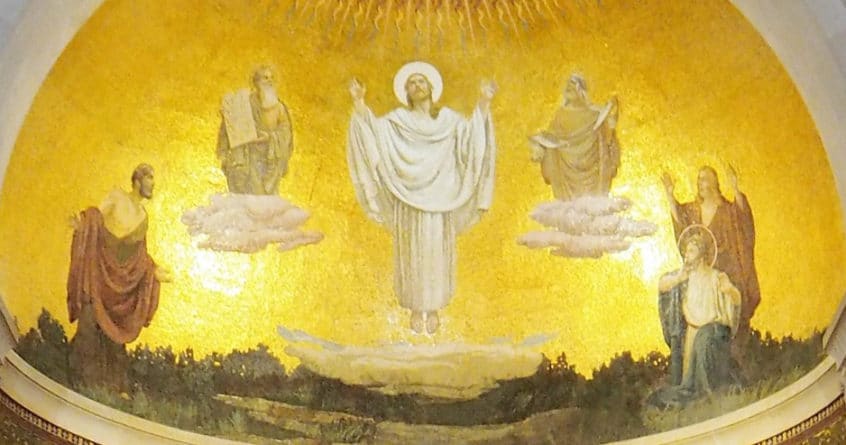
Sermon for the Transfiguration of Our Lord, preached on Sunday, February 14, 2021.

    It is strange to think that Moses, such a giant figure of faith in the history of all of God’s people and in the story of Christ, died in obscurity.  If you read Deuteronomy 34, you find few details.  The Lord commands Moses to come up on Mt. Nebo.  This is just across the Jordan from Jericho.  The end of Israel’s long journey is within sight.  In the distance there it’s the promised land.  But Moses will go no further.  He will not enter into that land of promise.  There, as God had foretold, he would die.  Perhaps the greatest figure in Israel’s history dies alone in a foreign land without a grave marked for people to visit.  A strangely quiet and mysterious end for a man who had walked with God and talked with God whose face had beheld God’s glory.

    On the other hand, Elijah’s last moments were straight out of a Hollywood script.  His life was certainly a mysterious one and he was a larger than life figure right up to the blink of an eye when he was gone.  Elisha was with him, his student and his successor. He was not ready to let go of Elisha, not ready to take over the mantle of the great prophet.  Elijah headed to Jericho and as he crossed the waters he cast his cloak upon the water so that they could pass over.  And then the whirlwind was about to come and swallow up the prophet.  Elisha asked for a double portion of the prophet’s spirit but it would not come unless he was faithful to watch until God’s glory had come.  And then it happened.  Chariots of fire, horses of fire, and Elijah was gone, swallowed up by the glory of God.

    Both of their stories might have but a memory – until Jesus ascends the mountain of His glory, transfigured before Peter, James, and John, until He shone with God’s glory. And there in that glory was Moses raised from his forgotten grave to point to Jesus.  And there in that glory was Elijah, come back from the chariots and the face of God to point to Jesus.  For the glory of God is not a place and it is not an experience.  The glory of God is Jesus.  There in Christ we encounter the true glory of God.  Here is the saving glory of the God who loves you who are unworthy of that love.  Who comes as one of you so that you might be one with Him.  Who saves you not by the whisk of a wand but by the pain of the cross.  Who loves not in words but in the mighty deed by which we and all who are saved are rescued from sin and redeemed from its death. 

    There in this holy conversation between the one who delivered the Law to God’s people and the one who delivered the hope of the Gospel to those same people, the three apostles stood.  They were terrified and did not know what to say.  Peter knew only that he would rather stay there than to descend the mountain and go back to Jesus’ talk of betrayal, suffering, and death.  Nobody was paying any attention to Peter; only to Jesus.
There in the cloud was the fearful glory of God but even such fearful glory was better than suffering, better than fear, and better than the cross.  Just when they thought there might be a chance of avoiding what Jesus had been talking about, the voice tells them to listen to Jesus.  Listen to the voice of Jesus speaking of betrayal, of suffering that would redeem the world, of death upon a cross, and upon the life that death could not contain.

    In that moment, the Father was commanding them not to be distracted by thoughts of glory but to follow Jesus for Jesus knew where He was going.  And then everyone was gone.  Moses returned to the mystery of a giant life and an unmarked grave.  Elijah returned to mystery of a life swallowed up by God.  And there was Jesus.  Only Jesus.  No more talk of tents or thoughts of staying high in the clouds.  Only the command to listen and the voice of Jesus to lead them where He must go to save them and all of us.

    It is clear that Moses did not live and die to make a name for himself but to point to the Word from whom the Law came and to the Word made flesh who would keep that Law for us and for the whole world.  It is clear that Elijah did not live for whirlwinds of glory and chariots and horsemen of fire but for the glory of God manifest in the Savior, born of Mary, for the suffering of the cross.  The testimony of the Law and the Prophets points not to our best lives for God to reward but to the gift of God in the Son whom the Father sent to keep the Law and fulfill the word of the prophets once for all.

    It is as if God was pointing Peter, James, and John to the center of history in the God-man.  Jesus is that center of everything that was, that is, and that is to come.  And the voice that told them “This is My beloved Son; listen to Him,” was speaking not to the three disciples who were there but to everyone.  Jesus is not simply the center of history but the center of our history, the One in whom we shall be saved and the only One who can deliver to us life that death cannot overcome.  Listen to Him is the call to hear and hearing to believe and believing to live in Christ.  God may not be well pleased with your sin but He is pleased to deliver to you a Savior who forgives your sin with His own blood.  God may not be pleased by the way you run away from Him but He has run to you, embraced your sin and death as His own, and saved you before you even knew to ask for His help.

    Dear people, loved by God, we are a sinful people with eyes that see everything but Jesus, with ears that hear everything but the Word of God, and with hearts that believe everything but the promise of God.  Sin has done a pretty good job of corrupting our hearts and minds.  But God has restored our vision, unstopped our deaf ears, and broken down the barriers of our hearts.  All the Law and the prophets point to Jesus and the Holy Spirit living in you by baptism, is right now pointing you to Jesus.
Jesus is the only thing that matters.  Moses lived and died and appeared on the mountain to point to Jesus.  Elijah lived and was swept up in a whirlwind of fire and glory into God’s presence only to point to Jesus.  The Church exists to point to Jesus.  Look and listen.  God’s glory is not some unimaginable power or mystery but the love that saved you while you were yet sinners and His enemies and the love which counts Christ’s obedience and holiness as your own and the love which cleanses us from every spot and stain of sin and marks us for heaven.

    Your life may seem like a mystery but it is not.  God knows your coming and going.  Where you came from is not important.  Where you are going is. And the One who saves you from your past and delivers to you the future you did not even know you had, He is the center and focus of your life.  Your struggle is to keep your eyes upon Jesus amid all the distractions around you and to listen to His Word amid all the cacophony of sounds crying for your attention.  You come down the mountain but the Lord comes down with you.  He is with you in the valley and in the shadow of death and He will raise you up to be with Him forevermore.

    Our nation is divided, living under the threat of pandemic, with economic uncertainty, opposed to marriage and family, and without protection for the sacredness of life.  You are caught in the midst of it and at times it seems all you can see and hear.  And the Holy Spirit is pointing you to see Jesus, to grasp hold of His promise, and to endure all that comes in the strength and grace of God.

    Moses still points to the Law and through the Law to the Jesus who keeps its command to be holy.  Elijah still voices the prophecy which has been fulfilled in every way by Jesus.  The voice of God still calls us to listen to Jesus.  The glory of Jesus is where He has promised it to be – not in earthly kingdoms or might but in the water marked with God’s name, the absolution that forgives our sins, the voice of God in the mouth of the preacher, and the food of God in bread that is Christ’s body and wine that is His blood.  The mountain is not some geographical place in Palestine but where the Lord is, and the mountain is right here, in the means of grace and among a people gathered by its invitation to see the face of God.  Be strong and see by faith what you eyes do not and listen with ears of faith to the Savior who is your eternal hope.  Amen.

Thoughts on progress. . .

Progress is something we all hope for.  We yearn to make headway against the ills of the world, against the forces of evil, and against all that inhibits happiness and fulfillment.  We want to be able to look ahead and see where we are going and to look back and make sure we are not still where we began.  In this, the GPS devices we use to find our way are so helpful.  They show where we are, where we came from, and how far it is toward our destination.  More than this, they show that we are moving ahead.

Would that such a GPS might be able to track our progress as people, the growth of humanity against the inhumanity that is all too human.  Would that we could chart and check our progress in the faith and of the faith in pursuit of its God-appointed destiny.  But this is not quite so easy as one might think.  Instead we find that progress is not some arrow angling upward but a series of zigs and zags, ups and downs, forwards and backwards.

For the Christian, progress should mean that we are always changing the world to fit the vision,  In reality, either the world seems to change us or instead we are always changing the vision to better fit the world around us.  Holiness is not exactly rampant among us -- even among Christians!  Righteousness continues to be rare.  The shape of our Christian lives is not onward and upward but often hard to chart at all.  Too often we find ourselves not simply stagnant but regressing toward the very evils we abhor.  So great is the lure of the comfortable ruts of our sinful ways that we find ourselves following them more than fighting to chart a new course.

While this is certainly true of us as individuals, it is even true of churches themselves.  For example, progressive Christianity is not at all progressive in the sense of becoming more like the people God would have us to be but more like the people around us.  From social mores to morality to the sense of what it means to be just, progressive Christianity and its churches have more fully embraced the leading and guiding wisdom of the world than the vision of God in Scripture.  Even more so, the very words and vision of God have become offensive to such progressives and the very enemy of their purpose.  How odd it is for us to presume to know better than God!  And this is from those who claim to be His own and not from the presumption of a world which desires nothing of God or His wisdom.

You can see this in the cause of life -- we have made progress in some respects but at the same time it would seem that growing protections for the unborn are making way, our culture is embracing the idea that people have the right and even the duty to decide for themselves and for those who cannot decide for themselves when life is no longer worth living and the humane thing to do is to put them out of their misery.  But you can also apply it to the very central institutions of marriage and family -- more fragile and frail now than ever before.  And when we find ourselves confronted with a president whose personal morality is less than we hope but whose causes parallel the protection of life and the prevention of the persecution of orthodox Christianity.  Or when we think a decent man but find that his positions violate the most basic truths of Scripture.

Chesterton is not the first but he said it most succinctly:  “Once abolish the God, and the government becomes the God.”  In light of this, Scripture warns us against trusting in princes or earthly kingdoms.  What ills trouble us have their remedy in Christ.  Apart from Christ, we become idol worshipers of whatever government or leader we believe can improve our present moment.  Progress we can see is our goal but it is also our Achilles' heel.  We live not by sight but by faith.  We do the good God has given us to do but do not chart our progress, leaving that to the Lord to see, evaluate, and reward.  When we come to Him, we come not as a sinful people progressing upward but always as sinners whose only confidence is a merciful God who forgives our sins.

Monday, February 15, 2021

I miss cartoons and fantasy. . .

Fantasy games have come down to shooting games in which death is the goal and cartoons have become the sterile domain of the politically correct. That is not what they once were. Once fables and cartoons were the places where our imagination flourished. It is not that anyone believed that the Road Runner was true or that the fables of knights fighting dragons were true. They were not fools. But these were the subtle domains in which truth did exist -- not as the forced truths of the guardians of thought but as the sages of old who reminded us of the wisdom too easily forgotten.

It was Chesterton who said “Fairy tales are more than true — not because they tell us dragons exist, but because they tell us dragons can be beaten.” That is the distinction we have forgotten. The old books that both acknowledged the harsh reality of our world while also raising up figures heroic in their own way have given way to literature that is bleak, hopeless, and miserable. We have no heroes anymore. We have no righteous causes. We have no white hats. It is no wonder that the cartoons of today mostly fall flat. They do not inspire but are the tedious and didactic domains of those determined to make us reject the past, disbelieve religion, and silence every voice but that which is sanctioned by the powers that be. I am sad about this. You should be as well.

Movies and television have become agents of this modern penchant for despair, for plots that go nowhere, and for characters more identified for their flaws than anything else. It is not surprising that the very characters we thought we liked as the movie or series began end up being the ones we cannot stand by the time it is over. The resolution is always the same. Religion is false, the past is evil, and the only future worth having is the egalitarian one in which everything from gender to family must be re-invented, purified from its supposed corruption. 

What are the lessons we learn from such fables, fantasies, cartoons, movies, and TV shows? We learn that there is nothing that is essential good, no cause worth giving up your all, no reality bigger than your desire, and no truth with the power to overcome feeling. What a shame! We have turned not simply against the past but ourselves and created a path which does not move forward but circles around our whims. Christianity taught the world to hope. Those against Christianity cannot stand hope. Instead, they defer to the experts who know better than anyone what we need, where the fences need to be placed upon the freedom of thought and speech, and what it is that must govern the nature of our relationships. We have seen these forces at work in the media for a long time. Now we see them at work in social media -- telling us what we can and cannot say. Pretty soon we will be taught that thinking itself is too dangerous to be left to the novice and our children will find every ounce of imagination stolen from them. Or maybe we already have.

Sunday, February 14, 2021

Blind see. . .

Sermon for Quinquagesmia, preached on Thursday, February 11, 2021.

The blind leading the blind.  We do not know what we do not know.  A little bit of knowledge is a dangerous thing.  We are blind – we can see just enough to make us dangerous – not simply to others but especially to ourselves.  As St. Paul wrote to the Corinthians, we see through the mirror dimly, through a fog.  That does not mean we see nothing.  It means that see some things clearly and other things not at all.  The problem here is that what we see makes us think we see everything while if we knew what we did not see, we would know we are blind.  We see what we see clearly but we do not see everything and things we do not see can be a bigger problem than what we see clearly is a benefit.

That is a problem.  It is a problem for someone trying to make sense of statistics – whether they are economic statistics trying to tell us where we are now and where the future is headed or they are CDC statistics designed to convey the state of COVID affairs today.  We can see that statistics well enough but we do not always know what they mean.  We are dangerous because we do not know what we do not know and so we speak as experts on things we do not know well.

But the problem is made worse when it comes to the things of God.  We read the Scriptures and we know well enough what the words say but we do not know what they mean.  We read words, familiar words to us, but they convey the eternal truths of God and when we read those words out of their context they become dangerous to us – as dangerous as a child who knows what knives are supposed to do but does not know what they can do in the wrong hands.  A child can understand Jesus died for them but the danger is that children believe the Scriptures are child’s play.  And that threatens not only our existence today but our eternal life in Christ.

You have heard it said on TV:  Do not try this at home.  But we do.  We do not know what we do not know and so we presume to know enough.  This is the knowledge that makes us so dangerous – to Scripture, in witness, and to our selves.  That is why God appointed them apostles and prophets and still trains up pastors in the way they should go so that God’s people will get it right and not wrong.  Some times even pastors screw up and that is why God hold’s them to a higher standard than He does others.  But that is also why God has given us pastors – to proclaim the mystery of God with conviction and with clarity that many may be saved.

In the beginning of the Gospel Jesus foretells His death for a third time.  Come on boys, we are heading to Jerusalem where the Word of the prophets will come true.  I will be betrayed, mocked, spat upon, whipped, and killed.  And on the third day I will rise again.  That is what Jesus says.  But as Scripture tells us, “they understood none of these things.”  The words they knew; the Gospel they did not.  They thought they knew everything but in terms of the cross, they knew nothing.

So Jesus heals a blind man.  Again, they knew what they saw but they did not understand it or how it happened or even why it happened.  They did not know what they did not know.  They needed Jesus – not simply to heal the sight of a blind man but to overcomes the blindness of sin that covers our eyes and fogs up our minds, deceiving us with what we do know and what we do not know that we do not know.  We see through the mirror dimly.  Perhaps not even as much as the disciples saw and not as much as blind Bartimaeus saw when he cried out to the Son of David for mercy and healing.  

We open the Bible and suddenly a passage jumps out at us and we are like blind Bartimaeus, drunk with our sight we presume we see everything.  But we do not know what we do not know.  We forget that we see through the mirror dimly.  Our eyesight is limited.  It must be corrected and completed.  We need faith, for we see most clearly not by sight but by faith, trusting in what our minds cannot comprehend and our hearts fear – the surprise of God’s grace, mercy, and favor.

We see through the cross.  Jesus began this passage with the prediction of the cross, of His suffering and death, and of His resurrection.  The cross is the lens through which our eyes may see and our minds understand God.  The cross tells us what cannot know except through the cross – that God so loved the world that He gave His only begotten Son into death, that we might believe in Him and have life in His name.  But even the cross does not tell us everything.  It does not explain why some believe and some do not, why some are healed and others are not, when our Lord will return in His glory, and who we will be numbered with on high.  But the cross tells us the one thing we need to know about all of these – they come from and through Jesus’ suffering and death and resurrection.  Trust in Him.

My friends, we need to be careful.  We must be guarded and kept by God in this faith.  Not only are we threatened by enemies out there but by the weakness in here – the blindness to our limitations, our deafness to His voice, and our stupidity to His wisdom.  We are blind.  Even redeemed in Christ, we do not see everything clearly.  What we see is the cross.  


And when we see the cross, we see all that we need to see.  Your faith has made you well.  Your sins are forgiven and your lost life is rescued and redirected to the goal of the Kingdom of God.  And you realize that you do not know everything.  But not knowing everything does not mean you do not know the one thing needful.  In fact, when we as the blind because of sin see Jesus, we see what God intends us to see.  We see what God wants us to see.  We see what we need to see to be saved and we see what we need to trust Him for until we are fully and finally saved and in His presence on high forevermore.  

This whole thing is about faith, about living by faith, seeing by faith, and trusting this faith to everlasting life.  Amen.

Not a few institutions are unhealthy. . .

On this day traditionally devoted to romance and love, it might be offensive to bring up the sad reality of the unhealthy state of our cultural and societal institutions.  Yet that is exactly what we must do.  Very few of our cultural and social institutions are healthy.  Almost all are broken or wounded.

While we might want to lament and therefore blame bad laws and political policies for these failures, the laws and policies have followed rather than led the way of the corrosion and decay of the social and cultural institutions.  Every law passed in the last 60 years and nearly every judicial decision that has had to do in one way or another with sex, marriage, and family has struck a blow at the very institutions that the law thought it was preserving.  With short sighted vision we have judged the past faulty and set forth to repair and replace what we thought were failing institutions and instead have undermined and contributed to the very destruction of those institutions and relationships.

We have ended up robbing our children of their childhood and placing upon them the burden of adult sized decisions -- not about what they want to be when they grow up but the existential questions of their very identity.  What child is prepared to decide the parameters of their identity, sexuality, and future and what child would choose to focus upon these questions in place of having fun, learning about the world around them, and playing?  Only the child whose life has been hijacked by adults who live with such anxiety about their own lives they insist upon sharing the weight of their own uncertainties with the children they were supposed to protect.

As a parent and a father, I have struggled with the consequences of our social tinkering.  Wondering where my daughter would find a good man and if my sons would be the good men who would fulfill God's design for marriage and the family.  That is the problem.  Men do not grow up untended from boyhood but taught, nurtured, and guided into adulthood.  In the same way, girls do not naturally become women without the same teaching, nurture, and guidance.  That is the second most important gift we give to our children (after faith).

Look around you.  Romance has been replaced with shallow relationships of sex or deception or control.  Families are foundering upon the impossible demands placed upon them without the direction of God's Word and the strength of the home to pass on to the child what he or she will need to become a real adult.  Competition has taken over the nature of our relationships and independence means we neither seek nor desire what marriage truly offers.  Friendship has become a victim of subtle or overt sexual play.  Children have been robbed of their childhood.  Children have become an accessory to those who wish them and a burden to those who think their lives better without them.  It is no wonder that the pews are filled with gray hair.  The empty and failing social and cultural institutions among us have been gutted by our anxious ridden lives and by our pursuit of a pure past and a sanitized present.  And it could be exactly because we have neglected to raise boys to be husbands and fathers and girls to be wives and mothers.  You reap what you sow says the Scriptures.  While it could be an aspirational statement, it has become for us the condemnation of our failure.  Happy Valentine's Day!

Saturday, February 13, 2021

Memory can be a burden. . .

Among my family there are those last years of life were marked by the ravages of Alzheimers, stealing their memories from them until their children become strangers.  Oddly enough, they lived in the shadows of a deeper memory from childhood.  Nothing can be quite as disheartening to the process of grief and loss than the toll such diseases take not only upon the one who suffers with it but upon the loved ones who also suffer with this loss.

That said, as terrible as the loss of memory can be, the inability to forget can also be a terrible burden.  When the mind remembers every disappointment, hurt, and pain of life, family, and friendship, it is a poison to the heart and a fog that prevents the joys of life from being enjoyed.  Nothing contributes to the burden of such memories more than an inability or an unwillingness to forgive.  We tend to think that forgiveness is for the person whose words or deeds have wounded us but it is less for the one who needs to be forgiven than it is for the one who forgives.

Our hearts and lives live in the prison of such memories.  When we cannot look on those whom we love without recalling how their words or actions have hurt us at one time or another or often, we live the shadow of a life and not in its fullness.  When we find ourselves embittered by those memories, we are held captive to them.  Sometimes there is the desire to forget but no ability and sometimes it is either more convenient or more comfortable to us to live in the misery of that remembrance than to let go of the hurts through the healing power of forgiveness.

Though feelings and emotion enters in, forgiveness is not based on such feelings or emotions.  It is an act of the will -- a choice to forgive.  We make the decision to forgive.  That choice may be influenced and guided by our feelings and emotion but it is ultimately not emotional at all.  It is reasoned and deliberate.  When we make the decision to let go of the past, our thoughts, feelings, and emotions enter into this but it is a decision and choice of the will.  In this our feelings and emotions can help but they can also hinder this choice.

When St. Paul teaches us to “Bless those who persecute you” (Rom. 12:14), he is not being a Polly Anna and diminishing our hurts or suggesting that we cover up those hurts with a paper face.  No, indeed.  St. Paul is calling on us to heal ourselves by blessing those who have hurt us.  Forgiveness does not let the sinner off the hook but counters the power of sin with a greater power.  Just as Jesus does not diminish the depth or wound of our sin but acknowledges it and then pays for that sin with something worth even more than our hurtful desires, words, and deeds -- His own blood!  

When we pray "forgive us our trespasses as we forgive those who trespass against us" we are connecting the healing power of His own blood to our own lives.  It becomes either the force to move us to the choice to forgive others or it will become the barrier that prevents us from the clear conscience that is His gift of forgiveness.

It is said that St. Therese of Avila wrote that “The only thing we will thank God for when we get to Heaven will be our crosses.” Imagine that.  The things we curse and the burdens we bear today will become the occasions for our gratitude.  Why?  Because through them God worked in us by His grace to kill the old man already dead in trespasses and sin and to bring forth the new person created in Christ Jesus for righteousness, peace, and joy.  In the same way St. Rose of Lima remarked that “Apart from the cross, there is no other ladder by which we may get to Heaven.”  In this she not means not only the cross of Christ by which we are saved by a cross shaped life in which Christ live in us and through us His mercy and grace -- primarily through the way we meet and endure the persecutions, terrors, threats, fears, and, yes, hurts of this mortal life.

So I encourage you to consider the hurtful memories that have become your torment and your prison and to extend Christ's forgiveness to those who have hurt you.  Do it not for their sake but for the sake of Christ and, ultimately, so that you will be free.  Pray for those who have hurt you -- not the prayer of pride that asks them to know and feel the pain they have caused but the humble prayer of faith that pleads for God to bring them to repentance and to know the healing power of His forgiveness that they may be set free as well.

To praise God in all things, as St. Paul encourages, is not to rejoice in want or pain but to acknowledge these in the face of something far greater.  God's healing grace is that pearl of great price and that treasure hidden in a field.  Rejoice in this gift and in the grace in which you stand and God will see your mind and heart and will to forgive others and redeem memory from its ransom of bitterness and hate.  Only then can memory again be a gift and a blessing.  Cleansed by the healing power of Christ, what we remember and who we remember become rich and pleasant journeys into yesterday from which we return thankful and at peace.  Think about this on the way to St. Valentine's Day.

Friday, February 12, 2021

The threat to business as usual. . .

One of the things that was put on hiatus during the Trump administration but will surely be brought back during the Biden/Harris administration is the crack that was developed between church and church agencies.  Here I am thinking in particular of the congregation where worship takes place (what nearly all consider a protected right under the First Amendment) and other things the churches do  that does not necessarily include or require.  Colleges and universities owned by churches, social service agencies, charitable agencies, hospitals, nursing homes, and the like have historically all been operated by churches as part of the self-understanding of their purpose.  In the post-Trump era, these will be scrutinized and it is likely that they will not be seen as essential to the church's mission and become areas in which the government will exert its influence over these churchly institutions.

All of this will create considerable problems for conservative churches wishing to maintain the integrity of their confession in all aspects of their work.  In particular, my own church body is wrestling with what to do with and how to administer our historic colleges and universities.  We have already found it impossible to keep two schools open and their closing has created wounds and worries throughout our church body.  Now we are looking at the future and trying to predict how it will be possible to maintain these schools as confessional colleges and universities whose mission is wholly consistent with our own mission and purpose.  We have a school in California where the government continues to threaten church schools by withholding state grant money from those schools who resist the efforts of the state to be inclusive of all areas of social justice and gender equality.  We have other schools already competing with state schools which have free or nearly free tuition.  We have schools whose primary mission has changed over the last 50 years and who serve primarily non-Lutherans and non-LCMS Lutherans.  How do continue to keep these schools viable and yet at the same time keep their confessional integrity consistent with our own?  All the while we fear the day when the government will not provide educational loans or loan guarantees as long as those schools fail to comply with the progressive vision of rights and privileges.

Roman Catholics know exactly what this is about since their own social service agencies have largely been locked out of such work as adoption, foster care, etc... because they will not place children in the homes of gay couples.  Roman Catholics look at their own schools and universities and wonder if or how these schools may be called Roman Catholic while tolerating or even encouraging a diversity of views from students and faculty that contradict their own catechism and faith.  Roman Catholic hospitals may not only be forced to pay for reproductive services for their employees but also to offer abortions and other reproductive services in conflict with the their own teachings and faith.  

The only people who are not looking at this direction with some fear are those churches whose larger work is already aligned with and reflective of the progressive and liberal agenda gearing up steam within the early days of this presidential administration.  These same churches have already reshaped their doctrine and practice to be consistent with the social justice and gender identity movements.  It is no big deal for their agencies to follow the lead of the churches which have established and nominally supported and retained ties with them.  They welcome their alignment with the government and society at the same time the few but large conservative churches fear it.

I can see why the government wants churches to shed their umbrella over all the things they do and restrict its constitutional guarantees to its most basic identity -- people gathered in a place for worship.  I can also see why the churches want to retain the agencies with which they also practice the work of the church in addition to worship.  But what I can also see is that both are not compatible and that we are destined to see larger conflicts over the horizon.

Thursday, February 11, 2021

Change of heart. . .

With the election of a president and vice-president committed to retaining the fullest measure of abortion access possible, the once cherished dream of the Supreme Court overturning Roe v Wade may no longer be the end result we should seek.  Biden and Harris have indicated that that they wish to codify the 1973 decision into law so that the SCOTUS may be not be free to overturn the provision and end the reign of sanctioned murder that has continued unabated for nearly 50 years.  While fight to limit access to abortion may be facing an uncertain path forward, the goal should be less to provide a court approved restriction of the previous court found right than it should be the pursuit of a change of heart across the population that would make abortion ‘unthinkable.’

For a long time there was such progress.  Indeed, it could be said that we would not be where we were right now if the attitude of Americans had not changed significantly.  Yet our progress in that change seems to have stagnated and we have not progressed in our effort to obtain a universal consensus against abortion.  Clearly what is in the best interest in the cause for life is not simply a change in the law but a change in the views of the people as a whole toward the life of the unborn.  This also is necessary when it comes to protections of life at the other end of the spectrum -- something that is under great assault as well.  Furthermore, it appears that many people hold the inconsistent opinion that even if the life of the unborn should be protected, provision should be made for either the individual or family and medical professionals to assist in the end of life for those whose life is no longer believed to be worth living.  The value of life is then rendered a relative value.  This is not only in opposition to the cause of life but a contradiction in terms.  It points out where our education and appeal has not been effective enough.  For the nature of the task before us as pro-life advocates is to ensure that no matter what the law or court states, the minds of the people will hold all life sacred and will find it morally reprehensible to end any life from the womb to its natural end.

Finally, it is clear that the ordinary protections of life have not extended to the other aspects of the pro-life cause -- the use of aborted remains in the pursuit of medicines, vaccines, or treatment.  There seems to be more approval given to this than there is to abortion itself yet the two cannot be so easily disconnected.  Again, the goal that lies before us is not to obtain legal or judicial protection but to change the minds of the people, all ages, so that every aspect of the pro-life cause has uniform understanding and agreement.  Until this is accomplished, it will remain a battleground on many fronts and many battlefields in which progress may be obtained for one aspect of the protection of life but lost in another.  Brothers and sisters in Christ, we need to change not only minds but hearts if ever the cause of life is to be secured for our nation and our society.


Wednesday, February 10, 2021

Jesus Munchables. . .

So apparently someone I know went to an LCMS church and ended up with a hermetically sealed cracker crumb and something that did not quite seem like wine but appeared to be more like strong grape juice and they called it Holy Communion.  Quite apart from the theology of it all, there is the question of what befits the very flesh and blood of Christ.  As much as some complain about plastic individual cups, this is even worse.  It is a discardable version of the coffee creamer style sealed cups only with a bit of something that appears to be bread with something else that is either wine or Welch's -- who knows.

It may not be a big deal for us -- we are good with paper plates at Thanksgiving and disposable silverware at the wedding and plastic wine and champagne glasses to welcome in the New Year.  We are humble people.  We are casual.  But the somber reality is that God is not so casual nor is God humble.  God is God -- even when He is the incarnate Son of the Father or the God who gives Himself in bread which is His body and wine which is His blood.  We may not be so fussy but God is not so casual as we think we are and the Lord deserves and rightly expects something more from us.

I am not saying that God will only fulfill His sacramental promise if the ciborium is sterling silver or the chalice is adored with gold and jewels.  What I am saying is that if we have the ability, why would we not offer the Lord our best for His glory?  And if we do offer the Lord anything less than our best, what does that say about us and our faith?

I am not at all suggesting that the Lord's presence is conditioned by the precious nature of their containers but I am suggesting that there is something wrong with us when we are content to seal things in inexpensive plastic and call it good before the Lord.  Quite apart from anything else, we should not be content to offer the Lord such things as these and presume that these are worthy containers for the Body and Blood of Christ.  Faith compels us to offer our best for His glory.  It needed to be said.