Sunday, September 15, 2013

What would Jesus think?

A recently closed church property belonging to the Episcopal Diocese of Connecticut will soon be leased to a local Muslim group as part of an interfaith partnership.

The Diocese recently announced the creation of the partnership that provides the Farmington Valley American Muslim Center with facilities used by the former Christ Episcopal Church of Avon.
Dr. Khamis Abu-Hasaballah, president of the FVAMC, told The Christian Post that they are "thrilled" by the interfaith partnership and plan to move into the Avon property soon.

"We hope to move in in the coming weeks. Since we're leasing the facility, we're keeping the modifications to the bare minimum needed to accommodate our activities," said Abu-Hasaballah. "The facility has been de-consecrated by the bishop and the altar removed. We are also relocating some pews to free up enough space for Muslim congregational prayers."

From:  The Christian Post


Makes me so happy... what about you?  I bet Jesus is just thrilled, too!  Don't you? 

Right cannot wait. . .

When I was a young Pastor I was told over and over again, Don't be too quick too change anything when you are new in the parish...  I am sure it is the same advice peddled to inexperienced Pastors still by well meaning individuals.  I am not a good listener to such advice.  I did not take it well.

From the moment I got into my first parish, now 33 years ago, the folks knew I was not like the last guy.  I wore a chasuble.  I chanted.  I bowed.  I even genuflected.  I brought my own chalice when there was none.  I did not joke around about the worship service.  From the get go, they knew I was different.  What they did not know was that this difference was not supposed to be the oddity but the normal face of Lutheranism.  It took nearly 13 years to teach them that these things were not about preference but about the practice that is consistent with the faith confessed.  I have been gone from that parish for nearly 21 years and yet they still know that God uses the voice of the Pastor in the absolution and sermon, that rituals are actions that speak the faith without words, that the Eucharist is the ordinary expectation of every Sunday morning, and that the liturgy is the song of the faithful speaking to God what He has already spoken to us.

From the moment I got into my second (and current) parish, now nearly 21 years ago, the folks knew I was different.  I have spent the last couple of decades teaching them that the different I am is not personal preference or style but the practice that honors and flows from the Lutheran Confessions.  They have come to know that Lutheranism is not a theory without a form but a form and a piety with words and actions.  Oh, to be sure, many things can and do vary from place to place but the rhythm of God speaking and our response, God giving and our receiving, God sending and our going out with His gifts and Spirit -- these do not change.  The page numbers have changed.  Perhaps a few things are more elaborate than in other places, but we are who we are because we are Lutheran.  Period.

I have long been suspicious of Pastors who inherit less than Lutheran practices and then continue them while trying to teach them past the errors or failings.  If the doctor gives you the wrong medicine, you do not take the rest of the pills until they are gone.  You stop and take what is right.  I do NOT believe that you should change without also teaching or that you can ever reach a point where you stop teaching.  The faith is always and ever but one generation from oblivion.  We teach and teach and teach again (call it catechesis or whatever but the instruction in the Word of God and in our own Confessions must never end or even pause).

Restoring practices in harmony with the faith confessed (even if only confessed as the doctrinal standard in the constitution) is the lot of nearly every Pastor.  I suspect that there are places where previous Pastors have already done the heavy lifting in this regard but I also suspect that one should not presume too much.  The work of the Kingdom is not some to do list wherein we can check off things and do something else.  The work of the Pastor is largely repetitive work -- what we do, we do over and over and over again and NOT because we don't know better but because the means of grace are the means of the Kingdom and nothing else.

Right cannot wait.  Now, I am not suggesting that you run over your people with a bulldozer.  Surely I do not need to say this caveat but I will anyhow.  Right cannot wait but we speak the truth in love.  We do not spend time blaming the wrongs of the past or the people who did them.  We do not waste time trying to reason everything in such a way that no will will dispute it.  The worst tyranny of the congregation is "that is not how it was done where I came from, was confirmed, grew up, etc..."  There will always be people who insist that their experience of Lutheranism is the defining one.  I would not even say that about where I am and what we do here -- even after 21 years!  Every day is a constant striving after the goal for the individual through repentance and for the renewal of the Church through constant catechesis.  The past is not given to us on a platter but must be regularly reclaimed just as our Confession is not truth once confessed bur truth always and ever being confessed.

So Pastors new to the ministry or to the congregation, I would say right cannot wait.  At the same time I would say preach and teach consistent to the right you practice even as you practice consistent to the right you believe and confess.  Do so in love.  Prove yourself by loving your people as Christ's baptized people over whom He has placed you as shepherd.  They will listen.  They will hear.  And they will follow.  Because of the last point, make darn sure that you are not leading them astray.

Saturday, September 14, 2013

What happens when need is replaced by something else...

At some point in time we stopped talking about the NEED to go to church, to receive the Sacrament, to witness God's mercy to those who do not know it, to bring your children up in the faith starting with baptism, and to steward God's gifts guided by faith...  We stopped talking about the NEED of the Christian to do these things we began trying to make the DOING of these things attractive.  When we did this we automatically made it appear that asking them to worship on Sunday morning, to receive the Sacrament of the Altar regularly (weekly at minimum), to raise your children in the faith, to witness the Gospel in word and action, and to faithfully steward God's gifts was a burden.  When we stopped appealing to the fact that these things are the right things to do, we began trying to make these things appealing, winsome, and rewarding to those who did them.

We NEED to be in Church.  Worship is not an optional extra but the basic and essential part of the self-discipline of Christian life.  It matters not whether worship is exciting, fun, rewarding, etc...  Worship is needed.  I need it.  I need to hear the voice of the Pastor absolving me.  I need the counsel of God's Word preached to me (the full counsel of Law and Gospel).  I need to commune, to eat the Body of Christ and to drink His blood.  I need the koinonia of the Lord's house, people, and table.  This has nothing to do with pleasing the Pastor or bolstering weak statistics or any personal self-serving desire or want.  It has everything to do with NEED.  I must have it.  Or.... I will die.  Christ's life will wither in me until I am a shell of a person, empty of life, of forgiveness, of hope, and of grace.

When I was a child, my mother called us to the table to eat.  It was no invitation.  It was a command.  It was not to please her but for my own sake.  I could not be left to my own devices as to whether or not I wanted to, had something better to do, or would grab something on my own later.  I had to be there.  Jesus is not some passive character who waits for us to awaken to who He is and what He brings.  He calls us.  He sends forth His Spirit through His Word.  He seeks us out to bring us together with those who also share His name by baptism and who believe in Him.  He draws us to Himself -- not for Him or His vanity or His pleasure -- but because we need Him.  He gives us what we need or we will DIE!

I am sick and tired of trying to convince people it is worth it to them to come, trying to impress them with what could happen if they did, or trying to make it so special they will want to come.  If it is not enough that Christ is here with His gifts that we NEED or we will DIE, what can I do or say that would be more than this urgent cause to lead them to come.  Either I have to be there or it does not matter anymore.  For if I no longer feel the need to be present around the Word and Table of the Lord, is there any faith left in me?  Any of Christ left in me? 

I fear that we have given in and made relevance and reward new categories for being in the Divine Service and have turned the whole thing on end.  I have often complained of those who missed worship and then asked "Did anything special happen?"  Only to be told, "Nah, same old, same old."  Really?  We have to make it "special" to convince people it is worth going?  No.  We need to be there, we must be there.  That is the reason.  Nothing less.  I must be there and receive His gifts of grace... or I will DIE!  (Maybe not instantaneously but the long, drawn out, death of those who do not even realize they are dying!)

Friday, September 13, 2013

A gaping hole...

It is a common and seldom challenged assertion that the news media does not get religion.  I wish that there were a remedial course in religious history and thought to inform many otherwise fine reporters so that the gaping hole in covering religion were filled.  Absent that, we have enjoyed the fine reporting of a very small but exceptional crew of religion writers.  Locally, I have enjoyed, respectfully disagreed upon occasion, and found fascinating the writing on religion of Bob Smietana at the Gannett family of newspapers, though attached to The Tennessean.  As of August 30 this year, Smietana has left to join Ed Stetzer at Lifeway Research.  But he is not alone among the many larger names doing religious reporting who have left newspapers either of their own volition or at the behest of their editors.  It is a sad day, indeed, and we will long miss those who have not only reported on the major stories in religion but unpacked some of the history, telling the tales of our religious past and present, as well as giving the religious dimensions to modern day news events.  We are not better off by having them leave and, it seems, many of them will not be followed by a successor.  This means, it appears, that again the media have misread things in their determination that religious reporting does not matter or is not important.

Here is what The Tennessean said:

He’s covered snake-handling preachers and mosque arson, lawbreaking charities and babies named Messiah. He’s introduced us to the guy who quit his job over 666 and the clergyman who says God doesn’t care if you smoke weed. And now I’m sad to announce that Bob Smietana will be leaving The Tennessean and taking his talents elsewhere. Bob has been our religion writer since 2007 and has been racking up awards all the way through – claiming first place just last month in the Tennessee Press Association contest for both feature writing (the snake handlers story) and best personal column, for his first-person account of his battle with diabetes. He has broken news both locally and nationally with his key connections on a passion-topic beat. He’ll be going across the railroad tracks to LifeWay, where he will be writing about research on church and cultural trends for Facts and Trends magazine. His last day with us will be Aug. 30. Please join me in wishing Bob well. We will miss him greatly. – Lisa Green

Trying to be something you are not...

My parents oft dashed my delusions of grandeur by saying "you have champagne tastes on beer money."  When that did not work, they would tell the most embarrassing stories about me.  It is a tactic they still do.  I do not blame them, in fact, I find myself following their example with my own children.  It can easily be mistaken as merely the delight of seeing someone squirm on the hot seat but it is truly the voice of wisdom reminding me to be who I am.  I thank God for those who still bring me painfully down to earth when my ego inflates me.

It seems to me that we live in a time when being something you are not is epidemic.  Men act like children or adolescents in our modern world.  They eschew responsibility and seem addicted to the past pursuits of their pubescent lives -- thinking that drinking craft beer, wearing brand name clothing, buying top brands of latest technology, and dominating World of Warcraft or some other video game is the same triumph as loving a wife, parenting a children, going to work everyday, caring for the home, protecting the family, and being the spiritual leader of that family.  The world needs men to be men.  Nothing more and nothing less.

Women act as if not needing anyone is the greatest achievement of all.  The modern day ideal is the self-sufficient woman who has career first, maybe a kid (with the help of a sperm donor but not a man), economic success, freedom to live as she chooses, and who makes all her own decisions.  She complains that men are not men today but she does not need or want a man so she is content to play with boys as toys.  She has become as hard, emotionally distant, and brutally conniving to get what she wants as were the stereotypical men she hates but she does not see it.  She farms off her children to day care and indulges them.  The world needs women to be women.  Nothing more and nothing less.

The Church fears that being the Church is either out of style, irrelevant, or not fun and so the Church acts like she is not the Church.  She eschews the things of God to be prophets of pleasure and self-fulfillment, she teaches self-help instead of the Word of God, and she worships at the same god of happiness as the folks around her.  She chooses to act as an orphan even though she has a family, a lineage, and a history.  She listens to polls like politicians but she has no time to listen to the voice of God in His Word.  She mimics the skeptic's mind about the things of God, Scripture, and tradition but has bought into the fad truths of identity defined by sexuality, of values that shift with the sands of time, and of a today that defines hope as optimism, eternity as the time you wait to get what you want, and heaven as your best life now.  The world needs the Church to be the Church.  Nothing more and nothing less.

I could go on...  You get the drift.  We need men man enough to repent and kneel before Him who was incarnate to bring new life to those captive to death.  We need men who are man enough to show up on Sunday morning to meet the God whose gifts are forgiveness, life, and salvation, in, with, and under the preacher's voice, the splash of water, and the taste of bread and wine.  We need women willing be women, to show the nobility of a submission borne of love, to extend love and care to their children as a holy calling noble and pure, and to make the home a center of faith, hope, and love.  We need women and men who live joyfully in the interdependence of lives made one in which God blesses this creative love with children who are raised in the Church to know the Lord.  But... first we will need the Church to be the Church.  Not some marriage between what we want to be and who we are but the Church.  Not some Champale that promises to bridge two very different things but who we are.

We are trying too hard to be what we are not.  How much harder can it be to be what we are?  The Church is not a self-help group or a personal affirmation society or the provider of interesting entertainment.  The Church is the body of Christ for the sake of the head who is Christ.  When our teaching, congregational life, and worship remember this, the fortunes of a Church living in fear will be transformed.  When we call men to Christ-like love as the men God has called them to be, women will delight in responding to that love with their own love and then the family will be set free from the tyranny of desire and pleasure to be the domain of the Lord.  We have gotten where we are trying to be what we are not.  What have we achieved?  An empty shell of a structure of church and home so filled with problems that believe the prophets of doom who tell us we are dead.  If we were who we are, we would know better.  God's creative order has not been set aside but His people redeemed to live within the holy estates with contentment and peace.  God's Church will endure and the gates of hell shall not prevail.   

Thursday, September 12, 2013

Chastity is not simply physical. . .

In several conversations I found that for most folks, celibacy and chastity constitute pretty much the same thing.  I find that curious.  Although I presume that chastity will result in a celibate life, I do not at all think of being chaste as primarily a sexual thing.  I think of it as a matter of the heart.  To live a chaste and pure life has profound implications upon matters of sex but it goes well beyond physical things.

The word "chaste" comes from the Latin castus meaning "pure". Though it has always included sexual purity, the virtue we call chastity has come to be more associated with abstention from unlawful sexual intercourse when it entered the English language in the mid 1200s than the Latin root implies.

To be chaste does not mean to enter into a duty imposed against the will.  There is no virtue in keeping a rule that one does not believe to be good and true.  Chastity has to do with the heart, with reason, with the will, and with desire.  It is the exercise of self-control for a higher purpose.  It begins with desire and when chastity works well, the whole of the person is in united in this virtue to do what is good, right, and true.

It is not just that sex within marriage is lawful.  Sex within marriage is to be chaste and pure just as those outside of marriage are called to purity of heart and life.  It is here that we seem to have grown confused.  The presumption is that whatever a husband and wife choose to do sexually is pure because it is lawful, that is, within the bounds of marriage.  Such a presumption is indeed false.  What is lawful is not always what is beneficial or good.  Indeed, that is the point.  What marks sexual purity within marriage has been replaced by sexual license that too often mirrors the distorted values and purposes of the world.  There is no goodness in this.  The Church is not merely concerned for what which is lawful.  The counsel of the Word and the witness of the Church has always been for that which is chaste, that is, pure.  This is the counsel of Ephesians 5 and its call to Christ-like love that creates holy respect.  The Church's moral teaching is not about rules broken or kept but about the purity of love, desire, and life.

There are those who would suggest that opening marriage to homosexuals will encourage such purity but it is intrinsically impossible for this to take place.  Purity is not some principle.  It is the shape or order of relationships within creation and one of the fruits of redemption is learning again to find contentment and peace within that creative order for it reflects God's holy design and purpose.  If anything what the Church fears is that abdication of the creative will of God in marriage will permanently change both the nature of marriage and what is means to love.  Sadly, the Church has done much to encourage the false understanding of purity by making the concern legality.  In addition, the wink and nod the Church has given of late to the heterosexuals who cohabit have created the issue of justice.  Our witness to the world is not merely "no" to this sexual behavior or that.  Our witness to the world is purity of heart, the chaste love that is learned from God in Christ, in which self and desire do not control or define us.

Sadly we have told ourselves and our children, if you cannot be chaste, be cautious.  When we do this we automatically assign the higher morality to caution than to purity.  True love waits but the emphasis is not upon the wait; it is upon the true (pure) love.  Surely we will fail what Christ has shown to us but love does not abandon us to even our failures.  Love redeems us, forgives us, and restores us that we might sin no more.  It is this last phrase that we seem to have forgotten.  We are forgiven only to erase any remnant of guilty feelings we might have and to assure us that we can do what we want as long as seek forgiveness afterwards.  Our antinomian character flaw has led us down a twisted path that offers us little that is comforting or good.  It is as if we Christians can only understand freedom in terms of a life of Rumschpringe or perpetual adolescence. 

I think it is high time that we reclaim the fuller meaning of chastity.  It is not merely about refraining from sexual activity or intercourse.  It is about the desire of the heart, the heart created a new in baptism, so that Christ may live in us.  Love is not license and we do not suspend the call to purity simply because a piece of paper makes the relationship legal in the eyes of the law.  We proclaim a sacramental love which, though not sacrament per se, is sacramental in that it always points to the blessed union betwixt Christ and His Church, a union of purity, love, and desire.  We have been redeemed body and soul; the transformation of the mind and shaping of the desire of the heart bear fruit in the set apart life.  This is what we need to preach and teach.  We have said "no" often enough that people know where we stand.  It is high time we began saying "yes" to the noble endeavor of Christian life, rooted in baptism, understood as vocation, and manifest as those who are in but not of the world.

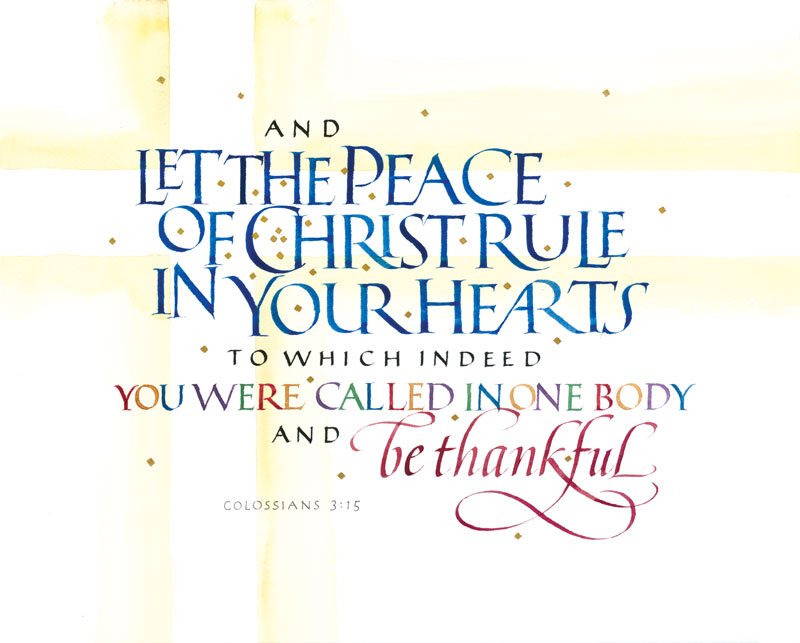
Colossians 3:12-17 (ESV)

12 Put on then, as God's chosen ones, holy and beloved, compassionate hearts, kindness, humility, meekness, and patience, 13 bearing with one another and, if one has a complaint against another, forgiving each other; as the Lord has forgiven you, so you also must forgive. 14 And above all these put on love, which binds everything together in perfect harmony. 15 And let the peace of Christ rule in your hearts, to which indeed you were called in one body. And be thankful. 16 Let the word of Christ dwell in you richly, teaching and admonishing one another in all wisdom, singing psalms and hymns and spiritual songs, with thankfulness in your hearts to God. 17 And whatever you do, in word or deed, do everything in the name of the Lord Jesus, giving thanks to God the Father through him.

Wednesday, September 11, 2013

May He bring to completion what He began in us...

Sermon for Pentecost 16, Proper 18C, preached on Sunday, September 8, 2013.

    In 1884 Sarah Winchester began construction of a house in Southern California.  It was to be under construction for 38 years.  The construction ended only because Sarah Winchester died.  She believed that if she ceased construction, she would die.  Instead she died and construction ceased.  And the house was left unfinished.
    Sometimes we think of our lives as unfinished endeavors.  We have our bucket lists of things we hope to do or accomplish.  We often find it hard to deal with hopes and dreams which will not be met.  Perhaps there is a part of us that thinks our lives will not end as long as we are working toward some future goal.
    The Gospel reading for today about counting the cost of building sometimes is used to put the burden back upon us, as if Jesus has given us a good foundation and now it is up to us to build something worthy and good on it.  But do you think that Christ has invested the holy and precious resources of His flesh crucified and His blood shed just so we can screw it up?  Our lives are indeed foundations but not foundations on which we build to please God for this is nothing but a religion of human work.  Our lives are foundations on which Christ builds us into the people we were declared to be in our baptism – the religion of grace.  He brings to completion what He began.  It is not our endeavor but His work in us, with us, and for us.  How easy it is to forget this.
    A 2005 movie based on a novel by Mark Spragg had the title "An Unfinished Life."  It might be a description of our own lives.  People trying to put back together the pieces when sorrow and struggle take their toll.  We search for meaning and satisfaction in a lot of places.  In our work, in our families, in our hobbies, in our dreams...  We direct our lives as if they were movies and we Christians often direct the Lord as if He were merely a cast member in our script of characters.  We presume that our lives are what we make of them, that we direct and build them.  
    So it is not unusual for even Christians to take our comfort in destinations, in achievements, in the self-improvements we think we have made, in our successes, and in the pleasure we obtain from these things.  The problem is that you cannot direct your lives.  You cannot control what happens to you – only how you respond to it.  You cannot build your life as you want it to be.  There are too many others competing for the same things.  For us to direct and build our lives is a recipe for disappointment.
    But we forget the most important fact:  we are Christians.  We are a people whose lives died in the waters of our baptism.  God raised us up new people from the waters of that baptism.  We are not who we were anymore.  We may not be yet who we shall become but we are not who we were.  We belong to Him.  Our lives are not blank canvases for us to fill but the foundations on which He builds us, directs us, and leads us to our appointed goals.
    Our lives are the unfinished foundations on which Christ, the builder, the potter (as in Isaiah), finishes us.  Faith begins and ends in Christ.  As an old missionary saying often quoted by my family said “What's yours will pass, what's Christ's will last," borrowing one hundred year old lines from a poem by C. T. Studd.  Counting the cost of completing the building is not surveying to see if we have the resources to bring what God began to completion.  No, it means living by faith.  We trust the Lord especially for what we do not see, cannot understand, and cannot control. We give up to Christ not some uncertain work but that which is already His.  We do not finish our unfinished lives in the hope that they are found worthy by God.  We know that Christ completes us, that He will make us into something lasting and worthy.
    It is not that we are something passive.  We are not.  But the realm of our activity is primarily keeping close to Christ who works in us.  We come to Church.  We hear His Word.  We confess our sins.  We receive His forgiveness. We eat at His table His body and blood. We are close to Him.  We are close to Him so that He may complete us.  We are His workmanship.  We are not the builders of our lives or the directors of our stories but the ones whom God builds and directs for His purpose and for His glory.  That is why the end of our lives is always worthy.  Because we were begun in Christ and we end in Christ.
    Do you remember how we end our confession and absolution each week?  May He who began this good work within you bring it to completion on the day of our Lord Jesus Christ.  It is Philippians 1:6.  That is the perspective of faith on our lives.  Our lives are from Him and move to Him.  In between it is not left up to us but Christ is at work in us by His Word and Sacraments.  We are unfinished lives not because we have things to do but because Christ is still at work in us and through us by the Spirit.
    We are here each week before His throne of grace for just this reason.  Christ is here.  Through the means of grace His Spirit works in us and through us.  In Word and Sacrament He works to bring forth in us what He began in us by baptism, what lives in us by faith, and what He has prepared for us.  That is why we speak of Christian life as a calling or vocation.  God is working in us, for us, through us.  We have this confidence not because we see the progress but because we trust His Word.  He will not abandon us – not even to ourselves.
    What is Christ's will last... what is ours will pass.  Apart from Christ nothing is eternal.  Apart from Christ it is chaff to be burned, dust to blow away, manure that has only its stink.  For this reason St. Paul is confident of His future and begs us to learn such confidence in faith, trusting the Lord alone.  Far be it from me to boast except in Christ in whom I have been crucified to the world the world to me, dead to sin and alive to Christ.  Who can have such confidence except those who know Christ is the builder.  In faith we pray that Christ may continue and bring to completion what He has begun in us.  Amen.

News on the university front. . .

Cracks in the plaster. . .
  • Georgetown University's new insurance policy was announced by a university-wide email blast from the school president himself, effectively declaring that the school health plan will now cover all the condoms and birth control pills necessary to let GU co-eds be as sexually active as they want to be. Quoted from another blogger but confirmed by a Sandra Fluke in other news media. . .
  • In "One Table, Many Theologies" (World magazine, July 19, 2013) we read: Like a reed bending in the wind, the post-Richard Mouw administration of Fuller Theological Seminary is bending over, shall we say backwards, to open its doors to an LGBT student group.
So, let me get it right... we have a crack in the Roman Catholic University resistance to the Obama Care requirements that church owned and faith identified institutions of higher education must comply with the mandates of birth control and abortion?

And, the once flagship of evangelical seminaries, Fuller, has decided to reach out in a small way to the GLBT community?  Fuller is the institution of choice among many of the Missouri Synod progressives of the  church growth and contemporary worship crowds.  Could this mean that this might change either the preoccupation of some in the LCMS for this institution or change the opinions of some within the LCMS toward the GLBT agenda?  We already have such groups on the Valpo campus.  What does this mean for the Valparaiso University and Concordia Seminary - St. Louis  connection?  There are undoubtedly pressures upon Missouri's campuses to allow such groups.  The changes would certainly not come through the front door but drift in from a side or back entrance -- both insurance and student GLBT groups.  These have both been commonplace among ELCA campuses for many years.  Wait and see...


Tuesday, September 10, 2013

Heaven is populated entirely by forgiven sinners...

At about 3 pm on Thursday, September 5, Father Robert Farrar Capon died and entered his eternal reward.  His preaching has been both a mine from which I have dug many treasures as well as a jewel of what it means to creatively and faithfully speak the Gospel.  I highly recommend him to those just beginning as well as those well into their lives behind a pulpit.

Robert Farrar Capon (1925-2013) was an Episcopal priest, noted preacher, and author of works on faith, preaching, and food. A lifelong New Yorker, he was for almost thirty years parish priest in Port Jefferson, New York. In 1965, he published his first book, Bed and Board, and in 1977 he left parish to write full-time. He authored a total of twenty books, including Between Noon and Three, The Supper of the Lamb, Genesis: The Movie, and a trilogy on Jesus’ parables: The Parables of Grace, The Parables of the Kingdom, and The Parables of Judgment.  Capon described himself in the introduction to one of his books as an “old-fashioned high churchman and a Thomist to boot.” Perhaps he is primarily known for his theme of the is the radical grace of God.

“We are free; and free above all from the messes we have made of our own lives.”

 “Once dead, we are out from under all the blame-harrows and guilt-spreaders forever.”

 "The sad truth of our fallen condition is that we don't want anything to do with a system of salvation that works by grace through faith."

"If after 2000years we are not perfectly certain we are supposed to be preaching that Jesus died and rose again, then we had best file for bankruptcy..."

"At its root, therefore, the Gospel is immoral, not moral: it lets scoundrels in free for nothing."

"God says in Jesus...that he's junked that whole order in which bookkeeping was king and made a new one in which forgiveness reigns supreme." 

“He saves losers and only losers. He raises the dead and only the dead."

“A pastor can’t take grace too far. That is, not unless he claims that sin doesn’t matter…It matters to me, the sinner.”

"Every time it [grace] is rediscovered, we send in an army of moralizers, backwaterers, and scholasticizers to get us clear of it"

“The shepherd loses the sheep and acts out of his own goodness to alleviate his own loss.  The finding, the saving, are all in his hands—the sheep do nothing but get lost. It’s all grace.”

"Jesus came to call sinners, not the pseudo-righteous; he came to raise the dead, not to buy drinks for the marginally alive."

“In the Mystery of Christ’s death, he drops all the rotten works in the world down the black hole of his own forgetting”

“You have to see the Bible as one complete story, with redemption in Christ as the underlying theme and plot"

"Come then; leap upon these mountains, skip upon these hills and heights of earth. The road to Heaven does not run from the world, but through it. The longest [Supper] of all is no discontinuation of these sessions here, but a lifting of them all by priestly love. It is a place for men, not ghosts — for the risen gorgeousness of the New Earth and for the glorious earthiness of the True Jerusalem...Eat well then. Between our love and His Priesthood, He makes all things new, Our Last Home will be home indeed"

Hope that gets you going!

Beautiful Music... Powerful Words...

Even before we call on Thy name 
To ask Thee, O God,
When we seek for the words to glorify Thee, 
Thou hearest our prayer;
Unceasing love, O unceasing love,
Surpassing all we know.
Glory to the Father,
And to the Son,
And to the Holy Spirit.

Even with darkness sealing us in,
We breathe Thy name,
And through all the days that follow so fast,
We trust in Thee;
Endless Thy grace, O endless Thy grace,
Beyond all mortal dream.
Both now and forever,
And unto ages of ages.  Amen.

Text by Michael Dennis Browne
Music: Stephen Paulus


Monday, September 9, 2013

An example of the Muslim Mob desecrating a Coptic Church

Nevermind that Coptic Christians were present in the Middle East long before Mohammed was born.

Nevermind that Coptic Christians have been the victims of Islamic violence over the centuries.

The cause of the Copts remains an untold, unreported story and our government, ever so concerned about offending Muslims, has raised only the faintest of objections.

At least. . .

Richard John Neuhaus' Freedom for Ministry remains my favorite of all his books.  It was written nearly 35 years ago when the cusp of youthful idealism had met the catholic soul of the man and come to some measure both of peace and wisdom.  It was written as I was about to begin my journey as a Lutheran Pastor and I first read it back in 1979 (though I cannot for the life of me recall what I did with that copy of the book).  If Neuhaus found then a certain awkwardness about Christian ministry that seemed not accidental but essential, how much more true it is today.  In a phrase, he spoke of Pastors as ambassadors of a "disputed sovereignty"; I think that statement is even more applicable to the situation in which most clergy find themselves today than it was some 35 years ago.

Neuhaus found worship central both to the pastoral identity and to the pastoral vocation.  Here he as both the worship life of the Pastor and the pastoral calling as priest of Word and Sacraments to the priestly people of God.  He observes that while worship is not the sum total of Christian faith and life, it is at least the minimal discipline of the Christian.  As a Pastor I find myself both in full agreement with RJN and as an apologist for that point of view with even Lutheran people who seem to find worship optional to the exercise of a Christian faith.  How can this be?  Have we become so individualistic in our understanding of faith and so skeptical of the communal nature both of the life we were created for and the life to which we were redeemed?

I hear all the time from the occasionally delinquent as well as the long term lapsed that I should not presume that they have fallen from the faith merely because they have been absent from the gathering of God's baptized people on the Lord's Day in the Lord's House, around the Lord's Word and Table.  No, I am told, this is a false assumption and one which I dare not presume to make.  Yet this is the same Lutheranism in which Dr. Martin's minimum of 4 times a year was considered the least of the koinonia of church life lest we presume they do not believe and despise the Word and Sacrament of the Lord.  What began as a minimal threshold of faithfulness ended up marking generations of Lutherans as the level of participation that was good, right, and salutary.

RJN is absolutely right.  Place in worship does not equate perfectly to living faith but it is the minimal discipline of the Christian.  While it is surely true that failure to be together with the people of the Lord around His Word and Supper may not mean that faith is dead, how can this absence from the communal life of the baptized around the pure preaching of the Gospel and right administration of the sacraments be a marker of Christian vitality and trust?

The abysmal worship statistics of a third of the rolls actually in church on a Sunday morning is due largely to the fact that we do not say it clearly or loudly or often enough.  Worship may not be everything there is to faith but it is the something that marks you as a Christ both from within and without the Church.  There is always the felicitous inconsistency that despite all evidence to the contrary, faith is alive in a person absent from the worship life of God's people but if such faith cannot muster enough faithfulness to be where the Lord has placed His name, His Word, and His flesh and blood, what are we to think of such faith?

The sermon we call the Book of Hebrews says it pointedly.  Do not neglect the meeting together as some do.  In other words, go to church.  Be attentive to the voice of the Word.  Remember the baptism in which you died the old life to rise the new person in Christ.  Repent of your sins and believe the forgiveness mediated through the voice of the Pastor in absolution.  Renew your faith through the blessed food of Christs body and blood.  Return to the world as a witness to the Light and not as one who feels most at home in the shadows of its darkness.  Rejoice in the hope that is within you so that you may give good answer when you are questioned by those who do not yet know Christ.  Endure the struggles in the knowledge that he who has the eternal victory can survive the next few minutes, hours, and days.  Do the good works that proceed from the new heart Christ has placed in you, delighting in the things of God, the work of God, and the will of God for the sake of your neighbor.  Worship is not everything but neither is it nothing.  How can the Christian life flow rich and full within us without having its source in the Word and Sacrament?  How long can faith live in us without the rich and blessed food of the means of grace to sustain it and us?

At least worship.  It is the minimal discipline of the Christian.  Not its sum total but surely its significant beginning.

Sunday, September 8, 2013

Life begins when I say it does... (as long as the *I* is the woman who is pregnant)...

MSNBC host Melissa Harris Perry says that human life doesn’t begin at conception. Instead, it begins, the MSNBC host contends, when the parents think it begins — not when science says it does.  “When a pregnancy is wanted . . . it is easy to think of the bump as a baby,” Harris-Perry said.  But when pregnancy is not wanted, that bump is not a baby or a life.  What is it?  Could it be a problem to be solved, a parasite to be excised?

We live everyday with the lie that says words mean what I want them to mean, things are what I want them to be, and no one can tell me anything different.  Our truth has many faces and we care not which of them is authentic, genuine, and real.  We live in the mythology of me.  Having lied to ourselves, to our consciences, and to each other for so long, we no longer recognize the absurdity of what we believe, think, and say.

So that bump in a woman's tummy is just a bump until she defines it.  That is the premise the underlies the pro-choice position today.  Though it is covered with a thin veneer of self-righteous talk about choice and a woman's right and the desire for children to be wanted, underneath it all is the bald faced lie that nothing is anything until we say it is.  Those opposed to the pro-life movement find it impossible to believe that "it" is a child until we say it is.  They do not so much think of abortion as ending a life as much as they believe there is no real life there until it is recognized and given rights.

What is most frightening to me and to many is that we are already on the other end of the spectrum with such language.  When it comes to the life of the aged, frail, infirm, and disabled, we are just as ready to say that this is not life at all.  If you do not live the life of the ideal, then you (or your family or society) have the right to end an existence which, to this point of view, has really ceased to be a life.  The nursing homes are filled with such folks.  If you are capable, suicide is not merely your option but your duty to prevent your life from burdening your family or your community.  If you are incapable, then someone needs to step and do for you what you should have done for yourself (euthanasia).

To protect the life of the unborn is to protect and defend the sacred nature of all life.  It is to insist that productivity, desire, and presumption must not be allowed to define what life is for all people and not just for those waiting birth.  It is to insist that life has such a high value that it cannot be left to the individual to assign its worth.  We fight not simply for the unborn thought surely for them.  We fight for the aged, the infirm, and the disabled.  We fight for ourselves.

"When I use a word,' Humpty Dumpty said in rather a scornful tone, 'it means just what I choose it to mean — neither more nor less."  We have left our children a rather sad and insecure legacy.  Burdened with our skepticism and doubts, we have taught them that nothing is true until and unless you say it is.  Morality has no conviction -- only relative values amid myriads of choice.  Truth has no foundation -- only the shifting sand of your opinion and the drifting current of your feelings.  In the end this is not even about abortion but about the insecurity of self which is held up by an illusion that passes as reality, lies that parade as truth.  How can anyone be certain of anything in life when there is nothing more solid on which to stand that what I think or feel at this moment?

The Church has a marvelous opportunity here but we begin with a handicap.  We begin precisely where the conclusions of our modern age end.  We begin with a Word that not only means what it says but does what it says.  Inerrancy is great but it is a glass half full without efficacy.  The Word of the Lord is not only truth nor primarily truth but it is the truth that does what is promises and accomplish what is purposes.  It is not merely factual but facts the impart a new reality -- one in which the eyes are compromised and trust must see, by the aid of the Spirit, what remains hidden to the naked eye.  We begin with a handicap but we begin -- not because we have to begin here but because the Spirit is at work in this Word and He will bless and prosper our speaking so that it will return to Him who sent it with the fruits it has appointed.  When God speaks, words not only have meaning, they mean the same, yesterday, today, and forever.  When God speaks, His Word acts for us, for our salvation, and even for our faith.

Saturday, September 7, 2013

New Liturgical Artist

I met a new liturgical artist at the LCMS Convention.  His name is Philip Perschbacher and his work shows great promise.  I was particularly impressed with some of the work commissioned by congregations and photos of some renovation work he directed.

You can visit his website here or visit his blog here.

I publicize young liturgical artists because we need to support them and encourage them.  We also need to employ them.  Lutheran churches are often a visual desert, empty of any images to speak another language to the hearer.  This is not a fitting legacy to the great Lutheran artists and rich liturgical art of past Lutheran churches.  We have forsaken more than the full Lutheran confessional identity; we have also forsaken the Lutheran liturgical identity with buildings bland and empty.  Less is decidedly not more. 

Often you encounter Lutheran buildings built in the 1950s-1960s in
which the liturgical furniture looks like it was purchased at the Danish Modern Church Supply Store.  The look is dated and draws undue attention to itself.  In contrast to this, good liturgical art speaks of that which it signifies, added visual depth to the spoken Word and the liturgical acts that take place within its pale.  Lutheran buildings of the 1960s -1970s tend to be bizarrely shaped making the space conform to its ethos instead of supporting the assembly gathered around the Word and Sacraments.  They compete with forms too large and abrupt to make us feel at home in the space which should invite us into the home God has made for us and with us by His grace.  Those Lutheran structures of the 1980s and beyond tend to mirror the style and ambiance of the marketplace, shopping mall, or other generic assembly space.  Too often they are cheap and forgettable spaces that diminish the
liturgical reality we encounter when Christ comes to His people in the preaching of the Gospel, the splash of living water, and the taste of bread and wine.  Often such structures can be salvageable if a skilled liturgical artist leads us and guides us to what mirrors the faith we gather to hear, feel, and taste through the means of grace. 

Philip Perschbacher is a young talent who should be taken seriously and whose gift can assist the liturgical space so that we can reclaim our heritage of art that accompanies and speaks the Word. 

Look him up!

Friday, September 6, 2013

You can't get this other places. . .

HT to Chris Esget for finding and passing this on...

Many folks attend church to atone for sins and ask for forgiveness, but few expect to be called out and insulted in front of the entire congregation. Members of the Immanuel Baptist Church in Skiatook, Okla., found themselves the subject of a mid-sermon tirade by preacher Jim Standridge. Caught on video, the fired-up man of God personally insulted churchgoers for otherwise minor indiscretions like dozing off and poor attendance, shouting at one man, "You're one of the sorriest church members I have! You're not worth 15 cents!" Although his anger may seem shocking, Standridge claims he's received emails and letters of support from all over the country.

My favorite line is when he says to those embarrassed by his words and tone in the presence of many new folks or visitors: "He may never come back, well, he ain't here now!"  Not far behind is when he points out the man engaged to a woman, saying "Your one of the sorriest church members I have; you're not worth 15 cents!"  I could go on...  The point is that this "law" preaching is not the faithful proclamation of the Law to convict and pierce the soul but the vindictive and angry law used merely as a weapon to put people in their places so that the rightness of the preacher is emphasized.  The preacher thinks that they have trouble in the video room but I wonder if they might not have a little problem in the pulpit as well....

And then I remember those people who have left a Lutheran Church where the Gospel is purely preached and the sacraments rightly administered but the Pastor or somebody else looked at them askew or forgot to greet them or they were not being fed... Maybe those folks should visit Skiatook, Oklahoma.  Perhaps they would enjoy it when the preacher's wrath were visited on others... until it turned on them.  Why some people will sit for this and others will reject the Law and Gospel rightly distinguished and purely preached is beyond me...

Thursday, September 5, 2013

The IRS has spoken. . .

Scandals notwithstanding, when the IRS decides something, it becomes the new standard, the new law, that which preempts everything else.

All legally married same-sex couples will be recognized for federal tax purposes no matter what state they live in, the Internal Revenue Service and the Treasury Department announced Thursday in a change that will affect numerous couples in states that have not permitted gay marriage.
The change in policy follows the Supreme Court’s decision in June overturning a key provision of the Defense of Marriage Act that barred the federal government from recognizing same-sex marriages for purposes such as insurance benefits, immigration and tax filings.
The new approach “provides access to benefits, responsibilities and protections under federal tax law that all Americans deserve,” Treasury Secretary Jacob J. Lew said in a statement. “This ruling also assures legally married same-sex couples that they can move freely throughout the country knowing that their federal filing status will not change.”

LATimes

A couple of decades ago when the Missouri Synod was looking at nomenclature for ordained Pastors and commissioned teachers, DCEs, etc., it was the legalese of the IRS and their requirements that led us to define clergy as Ministers of Religion, with the sub-category of either ordained or commissioned.  Theology does not carry much weight before the IRS but to make sure that the precious housing exemption was retained, theological language gave way to the legalese and bureaucratic language of IRS rules.  So it has been for more than a couple of decades and so it is now enshrined in the Agenda of the Lutheran Service Book.

Now an understanding of much greater proportion has been handed down from on high.  It does not matter what states think or say (or religions for that matter) the government will honor the marriage of gays and lesbians anywhere and give them full rights of marital filing status.  In other words, the IRS has again decided what will be.  Once the IRS decides, it does not take long before it becomes the norm.  What no President can do with a single stroke of a pen and what even Congress would have trouble doing and what the Supreme Court may fear doing (what with the smooth sailing after Roe v. Wade), the IRS has done.

In Christ Alone is not in alone in being rejected...

In his 1934 book, The Kingdom of God in America, H. Richard Niebuhr depicted the creed of liberal Protestant theology, which was called “modernism” in those days, in these famous words: "A God without wrath brought man without sin into a kingdom without judgment through the ministrations of a Christ without a cross." Niebuhr was no fundamentalist, but he knew what he was talking about. So did Dietrich Bonhoeffer when he named the kind of mainline religion he encountered in 1930s America: Protestantismus ohne Reformation, “Protestantism without the Reformation.”

With these words, Timothy George points us to a hymn rejected by the Presbyterian Church USA's rejection of a hymn text not because it is poor poetry (that could not be said) or because it was empty of content (though many of its genre can rightfully be accused of this) but because the authors would not allow the committee to exchange the pointed, Biblical language of the text with something more innocuous. 

As some of you may already know, I am not fond of most modern contemporary Christian music. Typically, the praise chorus style is shallow and superficial, preferring to sing seven trite and man-centered words seventy times seven rather than seventy words that expound the full Biblical content of the faith.  Though I am still not a great fan, I grudgingly admit that In Christ Alone can be criticized for some things but not for lack of serious and solid Biblical content.

Sin, judgment, cross, even Christ have become problematic terms in much contemporary theological discourse, but nothing so irritates and confounds as the idea of divine wrath. Recently, the wrath of God became a point of controversy in the decision of the Presbyterian Committee on Congregational Song to exclude from its new hymnal the much-loved song "In Christ Alone" by Keith Getty and Stuart Townend.  The Committee wanted to include this song because it is being sung in many churches, Presbyterian and otherwise, but they could not abide this line from the third stanza: "Till on that cross as Jesus died/the wrath of God was satisfied." For this they wanted to substitute: "…as Jesus died/the love of God was magnified." The authors of the hymn insisted on the original wording, and the Committee voted nine to six that "In Christ Alone" would not be among the eight hundred or so items in their new hymnal. . .


Indeed, in his brilliant essay, “The Wrath of God as an Aspect of the Love of God,” British scholar Tony Lane explains that "the love of God implies his wrath. Without his wrath God simply does not love in the sense that the Bible portrays his love." God's love is not sentimental; it is holy. It is tender, but not squishy.  It involves not only compassion, kindness, and mercy beyond measure (what the New Testament calls grace) but also indignation against injustice and unremitting opposition to all that is evil.


Even though you can't find "In Christ Alone" in the new Presbyterian hymnal, you won't have any trouble hearing it sung in numerous churches all over the world. In fact, you can listen to it right now by clicking this link. Keith Getty and his wife Kristyn belong to a new breed of contemporary hymnists who want their music to reflect the reality of a full-sized God, the awesome God of holiness and love.

As I said, I remain a fan of the solid content and faithful character of historic hymnody and I believe that the great Lutheran chorales and their authors have taught us how to sing God's praise best, but I find it hard to fault the content of the hymn In Christ Alone.  You read for yourself.  It is a shame when we have no room in our hymnals for hymns such as these though I find it sadly predictable how hard the modern mind finds the Biblical imagery of God's wrath.  Perhaps it is more true that we have not rejected the hymn as much as we have rejected the God of Scripture.  If for that reason alone, now is time for the Church to come to repentance and confess our greater love for self than for the God whom we know in Christ Jesus by His Word!

In Christ alone my hope is found;
He is my light, my strength, my song;
This cornerstone, this solid ground,
Firm through the fiercest drought and storm.
What heights of love, what depths of peace,
When fears are stilled, when strivings cease!
My comforter, my all in all—
Here in the love of Christ I stand.


In Christ alone, Who took on flesh,
Fullness of God in helpless babe!
This gift of love and righteousness,
Scorned by the ones He came to save.
Till on that cross as Jesus died,
The wrath of God was satisfied;
For ev’ry sin on Him was laid—
Here in the death of Christ I live.


There in the ground His body lay,
Light of the world by darkness slain;
Then bursting forth in glorious day,
Up from the grave He rose again!
And as He stands in victory,
Sin’s curse has lost its grip on me;
For I am His and He is mine—
Bought with the precious blood of Christ.


No guilt in life, no fear in death—
This is the pow’r of Christ in me;
From life’s first cry to final breath,
Jesus commands my destiny.
No pow’r of hell, no scheme of man,
Can ever pluck me from His hand;
Till He returns or calls me home—
Here in the pow’r of Christ I’ll stand.


“In Christ Alone”
Words and Music by Keith Getty & Stuart Townend
Copyright © 2001 Kingsway Thankyou Music


Wednesday, September 4, 2013

My eyes are not raised too high. . .

Sermon for Pentecost 15, Proper 17C, preached on Sunday, September 1, 2013.

    I hardly ever preach on the Psalm.  Today, however, the words of the Psalm seem to cry out to be heard as the voice of faith and honest humility.  They frame the lessons for the day and offer us an inviting context for our lives – one in which the fruit of faith is calm, peace, and quiet for our souls.  That is something sorely needed in our world of upset, change, and fear.
    Psalm 131: O Lord, my heart is not lifted up; my eyes are not raised too high; I do not occupy myself with things too great and too marvelous for me. But I have calmed and quieted my soul, like a weaned child with its mother; like a weaned child is my soul within me. O Israel, hope in the Lord from this time forth and forevermore.
    That is exactly the perspective of faith.  My eyes are not raised too high.  In other words, I do not live with grand illusions about me or grand expectations of me, what I can do, or my life.  It is not that we have low expectations but that we know ourselves, we know the world, and, most of all, we know Christ.
     I think most of us live our lives in the domain of the routine and ordinary.  We deal with ups and downs, with advances and set backs, with hope and disappointment every day.  We do not presume ourselves to be the wise or powerful who understand the great issues of the day or who have the solutions for what ails the world.  We are humble people, trying to find a way through the mine fields of life, hoping for a little happiness, and some level of comfort.  And that is exactly the humility of faith.
    We do not seek greatness as much as we seek peace.  We do not seek accomplishment or immortality through our achievements as much as we seek an honest hope to carry us through the hard times and a real comfort to aid us in our sorrows.  We are people who live in the middle of the country, in the middle class, amid mid-level expectations and mid-level achievements.  But in all of this there is peace for our souls, the rich peace of God’s grace and the trust that receives it.
    The Psalmist says "I calm and quiet my soul with hope in the Lord... Sadly, the great problems of our lives are often treated with self-medication – sleeping pills, pain relievers, medicines for our anxieties, prescriptions for our depression... Our pillboxes are full but our hearts are empty of real peace, real quiet, and real calm.  Where can we go to find it?
    The Psalmist directs us not to the therapist who hears us talk or the doctor with the ever ready prescription pad but to the Lord.  Ours is a God of hope.  Not the pie in the sky kind of hope but real hope.  Not a distant hope which will be yours someday but today's hope amid today's problems, challenges, and issues.
    In the midst of illness, injustice, death, family, work, and the ever present bad news around us, Christ is our peace.  Now I know you were expecting me to say that but listen.  Words do not acclaim Christ our peace.  Christ is our peace because of what He has done.  He has made peace with our heavenly Father through His blood, He has forged peace with death by the triumph of His resurrection, He has declared peace for sinners by the forgiveness of our sins...  Christ is our peace not in a sentimental or emotional way but in the concrete of His life offered, His blood shed, His resurrection to new and eternal life.
    Christ is our peace.  Not in the sense of a temporary peace that lasts for a moment but in an eternal sense.  Sadly, we too often define peace in terms of the absence of conflict, trouble, or upset instead of the presence of the positive peace of which Scripture speaks.  So if we get through one day of trouble, we think we have accomplished something great.  But if we got through that day, was it not because God's grace and favor are ours in Christ our Savior?  Endurance is victory and yet even endurance is not our accomplishment.  It is God's gift that yesterday gives way to tomorrow, that we endured, persevered, and carried through.  We were and are anchored in the powerful peace of His death for our sins and His life for our resurrection.
    Our peace does not come from the world, not from our dreams fulfilled or from getting what we want or having somebody stroke our feelings.  Such a weak and fragile peace is of little value in a world where we are constantly tempted, constantly tried, and constantly tested.  No, Christ is our peace, the peace of love strong enough to suffer in our place and a life sturdy enough on which to carry the weight of all our sins and disappointments.  Christ is our peace.
    Nowhere does that hit home more than in forgiveness.  Our lives are framed with forgiveness.  We were born into new life through forgiveness in baptism.  We will die clothed in the forgiveness Christ won for us.  Each day is framed with forgiveness.  We rise up in the morning with our past sins washed and cleansed in Christ – a future that is not limited or defined by our failures.  We go to bed with the days sins washed and cleansed in Christ – peace in the heart for peaceful rest.
    While growing up we often gathered around the dinner table to pontificate on the problems of the world and how things ought to be.  My dad often ended his observation by saying, "But then what do I know..."  I once thought it was his way of inviting us to affirm that his way was the best.  Now I have learned it was faith speaking.  He knew his limitations and was pointing us as well as himself from that which is inconsequential to that which is eternal, the one thing needful, to the present and powerful peace Christ has forged through His blood.  In the midst of everything, one word abides – the word mercy spoken not with lips but with a life offered for us, in our place, to end the terror and reign of sin and its death forevermore.
     The Book of Proverbs which we heard from today contains uncommon common sense about humility, disputes with others, and conflict.  Today we also heard Hebrews urge us to love – to love God, love your spouse, love your children, love your neighbor, love the stranger in your midst, and love even those who govern you.  Jesus in the Gospel urges us not to think more highly of ourselves than we ought.  Only faith can teach such love and it is born first of the confidence that Christ is our peace.  Those who seek their peace from Him will not be rocked by the storms of change, but held secure in the anchor of His grace.
    Christ is enough.  Christ is sufficient.  If we stand in Him, we stand.  Without Him, we fall.  The humility of faith says, faith believes, and faith trusts in Christ alone.  No matter what I might think, my life is not the domain of the high and mighty but of the routine and ordinary.   When I die, wikipedia will not pass on my life to those to come.  But Christ will.   The world's problems are not my burden but Christ’s.  I live now where I live and Christ lives in me and what I do in Him will endure.  Today is my challenge.  Living today in Christ.  Christ for me, Christ with me, Christ in me.  Christ is our peace.  Christ is enough.  It matters not whether the world esteems us great or our lives show evidence of worldly success.  We live in Christ.  In Him we  endure, we persevere, we carry on... today, tomorrow, and to eternity.  This is the humility of faith.  Amen.

I'd rather go to hell than. . .


Scandalous words and actions seem rather commonplace among some who wear the name Episcopal or Anglican.  Surely it is not fair to paint with a broad brush, but the homosexuality issue has galvanized those in favor and those opposed within the Anglican Communion.  Though not particularly known as a theological conservative, retired Anglican Archbishop Desmond Tutu has generally spoken out someone calmly amid some of the Anglican storms.  Now his words have stirred up a tempest.  You judge.

South Africa’s iconic retired archbishop, Desmond Tutu, said [a month ago] that if he had his pick, he’d go to hell before heading to a heaven that condemned homosexuality as sin. “I would not worship a God who is homophobic and that is how deeply I feel about this,” he said, by way of denouncing religions that discriminate against gays, in Agence France-Presse….He added, AFP reported: “I would refuse to go to a homophobic heaven. No, I would say sorry, I mean I would much rather go to the other place.”

You can read the full story here or here. In Africa, homosexual acts are considered criminal behavior in 38 countries and Christians of nearly all persuasions are fairly united in their rejection of the gay and lesbian agenda for society and for the church.  Tutu considers this the full equivalent of the anti-apartheid struggle of the past and this has been welcomed in the West while rejected by many among his African peers. 
When US President Barack Obama visited Senegal in June, he urged African nations to decriminalize homosexual acts.But he was publicly rebuffed by President Macky Sall of Senegal while the pair stood together at a podium. President Sall said Senegal was not ready to make the step and other African faith leaders including Kenyan Catholic Cardinal John Njue also rejected Obama's comments.  

My point is not the political angle but the pumped up rhetoric of Tutu.  It is shocking enough for a Christian figure to suggest that hell were preferable to a heaven faithful to the Word of the Lord and the consistent Christian witness in history with regard to homosexual acts.  In addition, it is an incendiary statement to lump all those opposed to gay marriage and the full gay liberation agenda with homophobes.  Is it not possible to be against the implications of full equality with respect to marriage and family for homosexuals and not be homophobic?  Apparently in the eyes of Tutu and many who agree with him, the answer is clearly "no."  By using that label for all his opponents on this issue, Tutu has lumped together most of his African brothers and sisters as well as no less that the Roman Catholic Church as "homophobic".  In addition, Arbp Tutu has also brought sexuality into heaven as if sex were an issue for the kingdom without night or death.  Was it not Jesus who suggested that they are neither married nor given in marriage in heaven?  So how can homophobia be a category in the life that has transcended earthly categories in order to fill all in all with Christ and the fullness of the divine life won for us by His death and resurrection?  

Finally, the whole thing is stained by the idea of personal truth that trumps Scripture and tradition.  Tutu has said I would not worship a God who is homophobic and that is how deeply I feel about this.  For Tutu, his view of the world overshadows the Word of the Lord that reveals God to us.  In doing so he shows himself the consummate modernist, a skeptic of the revealed truth of Scripture and an advocate of the progressive truth rooted and grounded in nothing more than personal, popular, and cultural opinion and trend.  Some people accord themselves well in retirement and others diminish themselves.  Tutu has certainly diminished his star among all those who take the Word of the Lord seriously.


Tuesday, September 3, 2013

Decently and in good order. . .

Perhaps it is my Germanic background but this phrase is one of my favorite tidbits of Scripture.  That all things may be done decently and in good order is the will and command of St. Paul to the Church.  We have used this passage to justify our long and often tedious constitutions and by-laws that govern and order our life together in congregation, district, and synod.  We have used these words to explain the liturgy, here meaning liturgy in terms of a page number and rubrics that tell us what we are to do, what we may do, and when all these things fit together.  But I wonder if we really understand what Paul means here.

God is not obsessive compulsive as I often am.  He is not a neatnik.  He does not desire order for the sake of order.  God is not German (a shock to many of us with German ancestry, I know).  When Scripture calls us to order, it is a call to specific order.  God’s order.  The Lord is not telling us that it does not matter what we do or how we do it as long as we do this in an organized and not chaotic manner.  The Lord is telling us that He has an order for the things of earth and His Kingdom.  It is HIS order that we are called to follow.

Creation is ordered even though it is no longer orderly.  God had plan and purpose that was realized in what He made, as very good as it was.  God created man in creation, ordered His life within creation and in relationship to Him, and ordered the estate of marriage and its resulting family.  Man and woman are ordered and not simply slightly different versions of a generic human being (the lie of modern day culture).  Even though we feel into disorder in the Fall and with the advent of sin, the order of God was by no means set aside.  It is with the advent of the new man, Jesus, that God restores to us the potential to live within this order.  This is surely what Luther means in the catechism when he says that we should live under Him and then describes this ordered life in the Table of Duties.

Look into the New Testament and it may seem on the surface that things were spontaneous and haphazard but this is a fallacy.  God has an order to things.  Volunteers do not do well with Jesus.  Jesus calls people and does not issue a call for volunteers.  As some have said before, Jesus does not call the equipped but equips those whom He calls.  God has a time for things.  What seems sudden and even abrupt is God’s deliberate time (sometimes ploddingly slow to us).  Jesus faces enemies all throughout His ministry but “His hour is not yet come;” so He walks through His enemies or simply disappears into the crowd until the day when He chooses to face those who come for HiJesus extends His time and order even after His ascension.  He tells His disciples to remain in the city until the Spirit comes to bestow power from on high.  Even their waiting is ordered and not simply their going forth.  When disorder threatens the Church over a dispute between Judaizers and those who welcomed Gentiles without impediment, James rose to speak order to the confusion and it was considered not a personal opinion but order from God.

When the apostles found themselves overwhelmed with mercy work and the proclamation of the Gospel, the Church ordered a solution with deacons to assist them.  This was not seen as a simple emergency solution but an ordering of this ministry for now and for the future.  When Timothy was set apart for the Pastoral Office, it was ordered to mirror our Lord’s own Easter Eve ordination of the apostles with laying on of hands, the prayer for the Spirit, and the conferral of the authority of Jesus’ name and Jesus’ Word.

I challenge those who think decency and order are merely in contrast to disorder, confusion, chaos, or anarchy.  The order that is at work in the Church is the order of God, His order for His purpose in His time.  What we seek is not an order to rein in people or control them but an order which reflects God’s will and purpose, for the sake of the Gospel, and to the glory of Jesus Christ.  This is why we do things orderly and decently.  It is not the fruit of an obsessive compulsive disorder or a desire to exercise control but to reflect God’s order in all that we do as the Church of God.m.

The ministry is not some human arrangement.  The priesthood of all believers (always a corporate term for the Church) is not the priestly order of one to assume for himself or herself.  No, God has ordered the ministry of the Word and Sacraments not as a caste but as an order within His creative and redemptive will and purpose.  The Church exercises the priesthood of all believers when one man is prepared, examined, called, and ordained into this office.  This is not for convenience or because it might be messy if everyone did it but an order.  It conveys no indelible character or chrism but confers the authority of the Church to be exercised by a specific individual in a specific place.

God is a God of order and this order flows both from His creative will and purpose AND from His redemptive will and purpose.  They do not compete and one does not abrogate the other.  In fact, His redeeming grace opens to us the door to know and begin to live within the creative order -- something lost to us when we were sinners and enemies, distant from Him and the knowledge of who we are and what we are to be.  It is order that is behind the idea of baptismal vocation.  Our lives are not some random happenstance of choices but either an rebellion against who we were created to be or a submission to that purpose given to us as one of the manifold gifts of baptism.

The liturgy is an order -- not some rule for rule's sake but an order through which God imparts faith, nurtures this faith, and equips the faithful through the means of grace.  When we see the liturgy as a human tradition or rule imposed by the Church, we miss the fact, as Nagel often says, who drives the verbs.  It might be good to see the whole of the idea of decently and in good order as God continuing to drive the verbs, in the world around us and within the veil of His Church.

Just thinkin.... and you know how dangerous that can be!

Monday, September 2, 2013

Counting the cost of health care for church workers...

Unless you have had your head in the sand, you know about the ever rising costs of health care benefits provided for full-time employees and called personnel of the congregations.  As our congregation approaches a new fiscal year, we find ourselves confronted with a 12.5% increase in a health care premium already well in excess of $22,000.00.  I do not blame those who administer our church’s health care plans.  I do not blame the congregations who wrestle with these high cost benefits and chafe under the weight of these high costs.  I do not blame those covered by the church’s health insurance plans who complain that many things are NOT covered and the deductibles the responsibility of the workers that often increase as congregations try to find ways to contain the high cost of health insurance.

We all know that our nation is right now embroiled in a controversy over one solution which claimed to address these rising costs but which seems to be either to complex to administer or itself too expensive for us to afford.  The so-called Obamacare solution may have one unintended effect for churches and church agencies.  That is the possibility that congregations and agencies of the churches who once offered health insurance may choose to offer none, pay the nominal fine imposed by Obamacare, and leave the workers to the health insurance exchanges to find coverage for themselves and their families.

I have no solutions.  I am only pointing out how real this issue is for the local congregation and small church agency.  Speaking personally, the cost of my health insurance alone is nearly twice what my first salary and health insurance together cost.  It is not that I believe the congregation or church agency should avoid providing health insurance for lay and called workers.  I believe they should, that it is their duty.  It is not that I believe I am owed something which most of the folks in the pews do not have.  I believe that all of us should have equal access to reasonable cost health insurance plans and that employers should bear the brunt of the cost.

What I do know is that this single issue and cost is responsible for driving a number decisions on the parish level and goes to the heart of staffing choices in the parish and church agencies.  What I do know is that this cost contributes to the low salaries paid to many church workers and to the growth of congregations unable to afford a full-time Pastor.

What I also know is that our giving in the congregation and our support of worthy agencies of the church is also not what it should be.  We struggle not always because the resources are not available but simply because they are not offered, not given, not placed in the plates on Sunday morning, and not returned to the Lord.  We have chosen not to fund the Church by withholding what should be given cheerfully and gratefully.  This is also a significant contributing factor to the high cost of benefits and its ripple effects upon the work of the Kingdom and the workers of the Kingdom whom the congregation calls and employs.

Most folks do not think about the cost of their benefits.  As employees, they expect health insurance, life insurance, 401K, and other benefits.  Even when employees pay part of the cost of these benefits, it is a much smaller portion of the total cost than most folks ever imagine.  A worker who pays $200-300 per month as his or her share of the health care premium is paying only a very small portion of the total cost of that benefit.  This is a hidden fact that, at least in the congregational budget, cannot be hidden from view.  It is downright shocking to people to realize what the real cost of health insurance is.  Yes, maybe the church policies are a bit higher because their pool is smaller but it is not all that much different from the average per worker cost in secular settings.  In the end we are all feeling the pain.

I say to those in the congregation that I know of no Pastor or church worker who does not feel the pain of it all.  I say to all Pastors and church workers that I know of no congregations who do not feel they could and should do better.  I say to all who think the government alone is going to fix this problem, do not count your chickens before the eggs are hatched.  This will continue to be a big factor and thorn in the flesh for both workers and congregations.  Pray brothers and sisters... pray.

Sunday, September 1, 2013

Talking about Talking

The pace of change in the Church is glacially slow.  This is frustrating to many and a source of great consternation to those within and without.  I am regularly among those who alternate between a complaint at how slow things are moving for the changes I want made and how relieved I am when the pace of change is slow for those things I do not want to change.  Many have given up on the process and believe the Church is stymied from growth because it is slow to change.  I wonder if the reason the Church remains to exist is due to this very deliberate pace of change.

Often before substantial measures may be dealt with, the whole process begins simply with the invitation to begin a conversation.  In other words, we begin by talking about talking.  You may laugh but talking about talking is not a small step.  When the old Synodical Conference fell apart, both the WELS and ELS said that they would keep talking to Missouri but that conversation never really took place until recently.  None of us believes that the old unity once enjoyed by the Synodical Conference will be quickly or easily recovered – and not primarily because of the reticence of Missouri.

Years of distance, fear, and suspicion have made it hard for all sides to know where to begin.  So we begin simply with a conversation about conversing.  Talk is not cheap.  Sometimes it costs us not only the effort to form the words but the rekindling of a desire to listen as well as speak.

Think how division becomes institutionalized in families where hurt, suspicion, mistrust, and distance keep those related by blood from living together as a family.  So this happens in the same way on a larger scale for church bodies.  If we can understand how this happens within the human family, we can imagine how difficult it is to get congregations and synods to begin to talk to one another and to listen to each other.

Right now Missouri is talking about talking with WELS and the ELS, and, it might be said, with many others throughout the world -- including those with whom we have no prospect of any foreseeable future fellowship.   These include Anglicans as well as Lutherans of various persuasions -- and that surely includes those who have left the ELCA.  This is a good thing.  It may not bring immediate or significant result but it is not itself an insignificant or small thing.  Some wonder why we would talk without a prospect of future fellowship but I suggest to you that these are entirely the right conversations at the right time.  Talking about talking is a good and realistic first step.  We pray the Lord to bring fruit to these tentative conversations begun with folks near and far, those who know our Confession and those who are just finding out what confessional Lutherans believe, confess and teach.  I would also suggest that this may be descriptive of our conversations with Rome -- talking about talking and finding out what it is that share, how it is that we disagree, and what it is that we can do together acting fully with integrity on both sides.