Tuesday, May 17, 2022

The problem with desire. . .

We have too many desires.  We are constantly flitting from one shiny thing to another.  It works perfectly in a culture of convenience in which what we want becomes entrepreneurial opportunity.  But does it work for us?  Is our lack of happiness, our fixation on security, and our willingness to surrender liberty to a government that will provide for us healthy?  Does it bring the contentment our heart yearns to know?

The problem with desire is that it does not remain desire.  Desire begets thought begets word begets action.  In an instantaneous society when we demand and expect things to happen immediately, there is no chance to filter out wrong desires or change our minds.  We are consumed by the mere availability of things.  That has catapulted Amazon to its status and forced the brick and mortar stores to copy in order to survive.  Whim has replaced thought and want lives unconstrained within us.  

Perhaps the devil knew what would happen to the heart once released from its focus on God.  In any case, the devil capitalized on our many itches and insisted that we scratch where it itches.  Certainly those who lived before us were also affected by the unrestrained desire of the heart but they were constrained by opportunity.  When life was defined by work and technology was a means of making the work easier (but not necessarily briefer), the possibility of our desires were left more unmet than explored.  But our generation has come face to face not simply with the strong temptation of desire but its accessibility.  The things we want, we can have -- today!  Ours is a consumer culture in which success has come from honing our skills at both eliciting and then satisfying those desires. 

We laugh about it but it is not funny.  We speak it and Siri and Alexa investigate it, catalog it, and then bombard us all day long with advertisements designed no only to satisfy that desire but to arouse even more desire.  They scope out its availability and tell us how quickly and how cheaply we can have what we want, in the size and color and with all the features we want.  If what we want is not available or out of our price range, we are given options so that we need not wait (until we change our minds).   You can do it all from your phone!  The job of consumerism is not to tell us that something we want is not good but to tell us we can have it all whenever we want it.  It is a lie, of course, but a convenient one and one we all seem willing to accept instead of the harder truth that things will not satisfy the longing within -- anymore than experiences.

Our problems are not lack but desire.  We live in a culture of overindulgence, over stimulation, over individualization, and over personalization.  Why else would we struggle so with such things as obesity, addiction, sexual misconduct, depression, fear, insecurity, and greed?  These are not the problems of a lack of anything but too much -- too many things, too much availability, and too cheap the initial cost.  The end result is that we find it hard to focus on any one thing and have squandered our attention spans on the memes of Facebook, the videos of TikTok, and the news that fits in 15 seconds.  We have turned stones into bread at the whisper of the devil but we are not content.  Jesus rebuke of the devil reminds us that things cannot satisfy our longing.  Man does not live on bread alone.  Life is not a circus and a buffet for couch potatoes. A man’s life does not consist in the abundance of his possessions (Lk 12:15).  It is the bread of God's Word that satisfies and the wonder of His unmerited grace and unlimited mercy that turns our hearts to praise and contentment.  

We are helping no one when we encourage them to explore the desires of their hearts or to find contentment and joy in the things and experiences of this mortal life.  God helps us by confronting us with all that these things cannot do while at the same time pointing us to that which does satisfy.  His Word that tabernacles in our hearts by the power of the Spirit... His water that cleanses not only externally but from within by creating a new heart within us... His absolution that reclaims us from our detours and dead ends of sin... His body and blood that satisfies our hunger and quenches our thirst with the promise of what is to come.  If we learned anything in Lent and drew any comfort from Easter Sunday, it ought to derail our unrestrained pursuit of desire for it can lead only to death -- the living death of the tormented and the eternal torment of death without end.

Monday, May 16, 2022

If we have Christ, we want for nothing more...

Sermon for the Fifth Sunday of Easter (C) preached on Sunday, May 15, 2022.

The day is coming when our prayers will ask God for nothing.  On that day, He will have given us everything.  Because we have this everything from His gracious hand, we will lack nothing and our prayers will only be thanksgiving for all that God has given.  But that is not today.  Today we come to the Lord with all sorts of lists and beg Him for all sorts of things we think we need.  We plead with Him that we cannot go on unless we get what it is that we have prayed Him to give us.  But, whether He gives us what we ask or not, we are not empty handed.  If we have Christ, we want for nothing and have everything we need.

In the Gospel Jesus promises that His disciples will not have to depend upon their memories or their instincts or their wiles.  He will deliver to them the Spirit of Truth to guide them from error into all truth.  He will make known the words of the Father Christ spoke.  He will guide them to where Christ is and equip them to speak as His witnesses before the world.  The promise to the apostles is also to us. The Spirit will keep on glorifying Jesus, giving to Jesus’ own people all that belongs to Jesus, and the people of Jesus will declare this Gospel to the world.  

I wish we believed it.  We come to the Lord with weak and wavering trust, uncertain if the Lord will keep His promise or if the Lord’s power is enough to sustain us and prevent His Church from defeat.  So we have done exactly that which Christ said.  We have wept and lamented as the world has rejoiced, making Christians and the Church a laughing stock before the world.  The Church has given up on Christ to do what He has promised and deliver His grace where He has placed it and substituted marketing programs for preaching and social clubs for the Church of Jesus Christ.  Jesus promised that we will know the truth and the truth will set us free but we have too often surrendered that truth to whims of the world and put our confidence in what we do instead of what He has done.

We find it so easy to surrender God’s eternal good for what is expedient in the moment, to swap out God’s promise for our own decision, and to worship the cult of desire more than God.  We ask and plead for God to do it our way, to give us what we think we need, to trust us to know best since we are here and He is in heaven.  We ask for stuff and for pleasure and for happiness.  We think we know what makes our joy full and complete and we want God to know it so that He can give us what we desire.  And we call it prayer.   God has already given us all we need.  He knows that this side of glory we will face want and need and doubt and fear.  He knows that our faith will be tested and tried by the enemies of His kingdom and by our own willful pride.  He knows that we live in a world filled with appealing lies and He knows how susceptible we are to these empty words.  So He promises us His Spirit – the Spirit of truth.

What does the Spirit do?  The Spirit unmasks the lies outside us and within us that play act as if they were truth.  The Spirit strikes from us any notion that we are here to win and then to punish our enemies and rule the world as gods and kings.  The Spirit brings us to repentance.  The Spirit empties our hearts of the pride that fills them so He might fill our hearts with love for God, the desire to be holy, and the trust that He who has given us His will also give us all things in Christ.

We nearly burst with frustration because we think the burdens of life too heavy and the clock too slow in delivering us from troubles.  But it is only a little while.  As short as this life is or as long as it can be, the days pass quickly and fade before the eternal.  Our weeping and moaning last only for a little while; through it all God is with us. Yes, we will have sorrows and our lives will seem to break under the weight of all our disappointment and pain.  Yes, we will feel empty and alone.  But this sorrow will turn to joy and our emptiness filled with a joy that endures forever.

If we have Christ, we have everything needful.  If we have Christ, then we have the Spirit dwelling in us amid trouble and trial.  We have the Spirit dwelling in us teaching our hearts to believe His Word.  We have the Spirit dwelling in us with the  power of truth against the lies we tell ourselves and the lies the world tells us.  We have the Spirit as hands to grasp the promise and turn our weeping into laughter, our sorrows into joy, and our disappointment into hope.

For now we will suffer with lack and want and need.  But none of these can derail the Lord’s work to keep us faithful.  None of what we lack can compare with what God has given to us in Christ.  We cry out, to be sure, but those cries have become the groanings of hope for a people who long for God to finish His new creation in us and deliver to us everything in Christ.  If we have Christ, we have all things.  Nothing in this moment and nothing in this flesh can stand against Christ and the power of His death and resurrection.  Nothing in this world and this life can threaten the Spirit’s work to build faith in our hearts and sustain us in this truth to the resurrection of the body and the life everlasting.
In a moment, in the mystery of God’s work, a life is born in the womb of a woman. The child lives within her but in her but not the same as her.  Through the months the child becomes stronger and stronger until the body of the mother can no longer hold the child.  And then from the old, new life comes into the world.  Tears and pain give way to joy and deep contentment.  

And this is what is happening in you right now.  In the mystery of God’s work in baptism, a new life has been planted in you.  This life lives in you becoming stronger and stronger until your old life can no longer bear it.  And then, in the day of the Lord, the new life is fully there and the old is gone. Tears, pain, and struggle give way to pure joy and contentment.  You do not see the progress and pray the Lord to hasten the day.  But the Lord works all things according to His will and timing.  It is enough that You have Christ and His promise.  You ache and long for the day when the pain is done and the new creation complete within you.  But you have Christ, you have His Spirit, and you have His promise.  And this is enough.

You are not on your own.  You have not been left to your devices.  Christ is with You.  In His Word and Sacrament, He is working in you to complete that which He began.  You may not see it any more than a mother can picture the face of the child in her womb.  But God is at work in you by the power of His Holy Spirit.  Repent.  Rejoice.  Be glad.  Hope.  Believe.  Our anguish will not even survive to be a memory.  For now we want but then we shall be satisfied and what is empty will be filled for all eternity.  God in you, the hope of glory.  Amen.

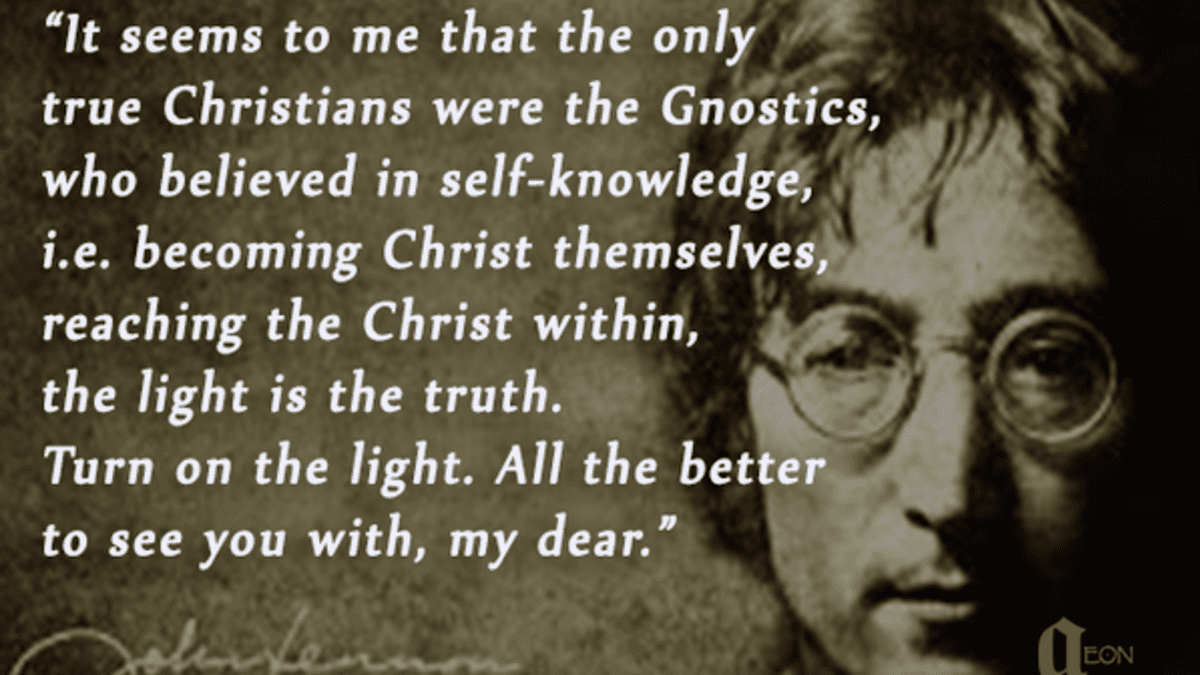
Always Gnosticism. . .

The grave threat against Christianity has always been and still is Gnosticism.  It is that unwholesome belief that the flesh and bodily things are somehow unworthy, common, and in the way of the true wisdom of the spiritual.  It is also the pursuit of things hidden and the disdain for the things plain.  It is this that progressive and liberal Christianity has come to define as truth.  In this view, Christianity has less to do with us as mortals and everything to do with the spiritual.  The pursuit of our mortal lives lies in the understanding of unbodily things, of secret mysteries, hidden behind the obvious for those who will pass through event, fact, and truth toward something greater.  So this Christianity is not interested in the redemption of the body, in the resurrection of the body, and the life everlasting as embodied people.  Instead, it looks at the body for what it is not instead of for what it is.  This is what St. Paul warns against in 1 Corinthians 15.  It ought to be the warning that arises from orthodox Christianity today.

Nowhere is this more true than when it comes to the current preoccupation with discerning and deciding for gender -- as if it had nothing to do with the body itself!  What is obvious (male or female) is set aside in favor of what is hidden in feelings and desires.  This is not simply a decision that one makes in adulthood but the burden thrust upon our children from the youngest age -- they must discern who they are and decide who that is -- not in terms of vocation or occupation but gender.  Medicine's foremost warning to do no harm is set aside in treating the body as a canvas for the self-expression of feeling and desire.  This can mean treating puberty as if it were a disease and the reproductive organs as if they were a prison.  And we have not even begun to talk about sin yet.

It is also true in many other areas of life.  The pursuit of happiness, once a freedom enshrined in rights guaranteed, has become the sole pursuit of life.  It is a happiness that is not a blessing to the happy but the burden and duty of life that offers a constantly changing target that will prevent the focus ever from being taken off self and placed on another.  Marriage gets in its way.  Children are roadblocks to this personal and solitary journey toward happiness.  Medicine is a tool for happiness (the way pain reduction has displaced healing as its purpose and even required the people who serve medicine to provide a painless exit when someone arrives at the conclusion that it is time).

The celebration of life that so quickly replaced the funeral and the focus on the past instead of any real future is another aspect of this Gnosticism.  The life is lauded for its self-centered focus upon happiness and the greatest accomplishment is such a life well lived.  In the end, the spirit is released from the body to a better place that is not defined and to an existence vague enough to be just about anything.  Think how this contrasts with the preaching of the Savior who dies to kill death and rises to bestow the life death cannot overcome.  Think how disappointing it is to the purveyors of this Gnosticism that Jesus can be touched, eats, walks, and has a real, fleshly body (though glorious).

It was, in my view, the beginning of what ended up the great Battle for the Bible -- the idea that the factual or historical reality of something is either unnecessary or even an impediment to the spiritual truth represented there.  It is not that Adam and Eve are not real people but that their existence as people is irrelevent to Genesis and the unfolding story of sin and redemption.  It is not that Jonah and the whale are not real and the event of the prophet's amazing attempt at escape historical but this does not matter and its historicity may even impede its spiritual meaning and appreciation.  So it is for Jesus' resurrection.  It does not need to be said that Jesus did not rise and His bones might still be found in a cave in Palestine but that the historical truth of that event is somehow unnecessary and even detracts from the spiritual meaning of the resurrection.  It does not need to be said that marriage is the divinely instituted order for church and society but marriage is optional and even an enemy of personal fulfillment -- a fulfillment that is spiritual and not physical in nature.  I could go on.  Once you unleash this genie from the bottle, Gnosticism is free to rob Christianity of the truth of all truths and to leave us with a hidden gem to find, a secret path to follow, and a spiritual future that looks back at flesh and blood as if it were youthful foolishness.

This can have nothing to do with the Jesus who comes in flesh and blood in the womb of the Virgin, who suffers, dies, and sheds His blood upon the cruel instrument of death on the cross, and who rises to rescue not the idea of a person but their body from its chains as well.  It does not take long then to gut the sacraments from their reality and to make the Word a code book to be broken instead of the Word of Life to be believed.  Imagine that.

Sunday, May 15, 2022

The Scriptures are. . .

One of the curious things is also one of the most obvious -- that Scripture is not primarily words but a voice speaking.  I fear that in our context of a published book, we have forgotten that God's Word is a living Word, a living voice, that speaks.  We think of printed words on a page and of an individual reading those words, interpreting them for him or herself, and applying those words personally and individually.  That is not the context of Scripture from the beginning but a very recent aberration and one that is fraught with tensions and problems. 

Scripture was primarily a worship and catechetical book in the Old Testament.  It was found in the community of Temple and synagogue and not on a bookshelf in a home.  People assembled together to hear the Word, just as they did in Luke 4 when Jesus got the scroll, opened to the text appointed for the day, and preached not only by Jesus' speaking but by His very presence as the Word Incarnate.  In the assembly is where the Scriptures were heard by most folks -- at least until more modern times.

In this respect Scripture is ecclesiological -- it is the Church's book, addressed to the Church, received by the Church, and taken up by the Church as her voice to the world.  In contrast, we have come to think of the Bible as the people's book, to make of it what they will, and therefore devoid of meaning and purpose except those assigned to it by the reader.  It is no wonder that people are all over the page when it comes to what the Word of God says.  In fact, the soft underbelly of Protestantism is that private interpretation has not only become the norm but the ideal.  We may come together to share our individual insights but we do not think of God's Word as being addressed to the Church and not to us as individuals.

Furthermore, Scripture is liturgical.  Its context is liturgical -- not simply by virtue of its history of use within the assembly of the Old and New Testament communities but because it is an efficacious or sacramental Word that does what it says as well as mean what it says.  The whole purpose of Scripture is not to inform but to bring the sinner into the presence of a gracious God so that the forgiven sinner might worship the Lord in spirit and in truth (a clear reference here to the means of grace!).  Scripture is a living Word and speaks life -- and the Holy Spirit is the breath and power that not only prepares the hearer but enables the hearer to hear in faith and thus enter into the Body of Christ as that Body is gathered around His Word and Sacraments.  All Scriptural is liturgical because it testifies to Christ and Christ brings us into communion with the Father -- worship.

In a tragic sense, the Church has surrendered too much of this.  We have surrendered the Word to the Biblical scholars to tell us what we do not know -- as if there is a hidden meaning or a hidden reality about the text that must be unpacked by an academic or intellectual pursuit.  The Biblical scholar no longer sees their work in service to the Church but often in opposition to what the Church has believed, confessed, and taught -- as if we naive or ignorant and must be taught.  In a strange sense, most of modern Biblical scholarship begins with presuppositions that either undermine or exist in opposition to the basic tenets of faith.

Further in this vein, the Church has allowed Scripture to be ripped from its liturgical context and so its goal is no longer Christ but the satisfaction of our curiosity or the explanation of our problems in a way that makes us feel better.  Has the work of Biblical scholars aided in the proclamation of this living Word or distracted from it?  Have the individual interpretations that flow from the personal reading of Scripture aided in our worship or impeded that liturgical assembly?  Is Christ the goal and the end of Scripture or is there another goal or end?  The goal here is the edification not simply of the individual but the building up of the Body of Christ.  

Liturgically we address this.  The lectionary volume in our parish is encased in a silver book cover.  It signals in a visual way that this is not simply a book nor is Scripture like other books.  It is the Word of God.  When we carry this book, we honor it because it belongs first to Christ and exists to accomplish His purpose.  Its words are not ours and the voice that reads it is its voice -- it remains God's Word to accomplish His purpose and His voice even though the mouth of the reader.  So the reader finishes the text by saying:  The Word of the Lord!  And the people respond Thanks be to God!  When the Gospel is read in the midst of the assembly, accompanied in procession with the processional crucifix and candles, it gives even more profound notice that this is God's Word, that it speaks Christs and Him crucified, and that this Christ is our Light and our Life.  We turn to meet this Word and we remain standing until it is placed upon the lectern, acknowledging its unique and special place.  I hope that we learn to address this, within the congregation, to be sure, and especially within the formation of pastors in the seminaries. 


Saturday, May 14, 2022

Curious. . .

I received an email the other day from someone who reported to me how someone (name was not listed) suggested that those who like liturgical worship are, in fact, merely reflecting upon worship their own rather affluent lifestyles.  A curious statement to be sure.  Since American affluence is hardly reflected in anything formal or orderly but the chaos of anything goes -- from behavior to vulgarity to dress!  Americans are certainly not in great danger of a more formal or ceremonial anything.  Instead, it is the opposite affliction that is common to America -- a deliberate casual attitude toward nearly everything except desire (which must be honored and respected above all!).

The reality is actually quite the opposite.  Liturgical and ceremonial Lutheran worship has survived and even thrived where there was little affluence.  Think historically of the parish served by the Rev. Berthold von Schenk or look at where the Rev. Richard John Neuhaus began his ministry.  Far from being large or affluent, these parishes were small and had meager resources.  What was true in the past, is also very true of today.  Sure, there are those congregations which are blessed with an abundance of resources and people and who still endeavor to reflect the fullness of our evangelical and catholic tradition rather than its minimum, but the vast majority are on the small side and do not have any fat wallets.  Think here of parishes like Zion in Detroit or St. Pauls in Kewanee.  It would be nice if the more liturgical parishes of the LCMS could claim an abundance of both money and people but the reality is that these parishes typically are on the small side all the way around.

On the other hand, the most affluent parishes of the LCMS tend to be on the casual side of things -- from the style of worship to the typical wardrobe of those on either side of the rail (as if there was an actual altar rail).  Part of the reality here is that it costs the big bucks to pay for the technology rich style of worship that requires screens and big bands and one of those expensive cups of designer coffee.   If there is any congregation that reflects the American mood today, it is not the confessional or liturgical parish.  It might, on the other hand, be the evangelical style Lutheran who likes theater style seating, lighting, and entertainment as well as the option of watching it all on his personal screen while wearing sleep pants and munching on the breakfast Uber Eats just delivered.

Affluence has little to do with support for liturgical worship with confessional integrity.  In fact, despite what the critics say, liturgical worship with confessional integrity has always been rather out of step with culture and this is even more true today.  It is counter culture to kneel, cross yourself, chant, genuflect, use incense, or use a chalice.  If you want to stick out like a sore thumb in Lutheranism today, advocate for a more elaborate ceremonial within the historic parameters of our confession.  That is true not just for Lutherans, it is true for nearly ever Christian tradition.  Pope Francis has admitted as much in his dogged pursuit of the Latin Mass enthusiasts.  If Francis is afraid of a small group of zealots for a dead language, perhaps that tells you as much about the power of ceremony as it does the insecurities of a particular Pope.  It is no different within Lutheranism.  There are those who are confident that the undoing of Luther's legacy is threatened more by those who add in a ceremony or two or a few words to the ordinary liturgy of the hymnal than it is by those who long ago ditched the book, the liturgy, the lectionary, and the Sacrament for a swell pair of khakis and a nice polo in a warehouse outfitted with the latest techno toys.

Lets be real, folks!  Individualism, casual to the extreme, the priority of preference, and whatever makes us feel good is the encroaching fog that threatens to dim the Church's light before the world.  Anything that challenges these and turns the focus on the efficacy of a Word that does what it says and water, bread, and wine that are what they sign is the most radical thing of all.   

Friday, May 13, 2022

Setting the record straight. . .

Now that Roe might be overturned, it is time to rebut some of the myths that have been posited about abortion.

  • Overturning Roe will not stop abortions.  It merely turns the decision back to the states to decide where we all know some will allow and some will restrict abortion.  Even now state laws differ.  In at least one state you can abort right up until the moment of delivery -- even though that is not what Roe decided either.  So leave it up to the states like most laws are and should be.
  • Overturning Roe simply admits the obvious -- the Constitution did not envision, did not foresee, and does not include any right to abortion.  There is no such thing as a civil right for abortion so all the comparisons to the legitimate and laudable Civil Rights Movement are foolish comparisons.  FWIW, nearly all of the leaders of that important and impressive movement were against abortion.
  • Overturning Roe will not restrict doctors from the ordinary pursuit of their duties and medical responsibilities -- not even for those suffering miscarriage or the mothers whose lives are medically threatened by the continuation of the pregnancy.  This is not about inserting police into a doctor's office or testing legitimate medical advice with attorneys present.
  • Overturning Roe will not immediately end the death of these innocent ones.  People will travel to places where abortion is legal and the changing of a law does not change people's minds -- we have witnessed that too often for anyone to question that truth.
  • Overturning Roe will not make bring back the back alley abortionists.  There are abundant alternatives available to a practice just as immoral as the abortions themselves.  As I said above, people can travel and will even, as it might seem, on somebody else's dime.

And while I am at it, some foolish things people say about those who are pro-life and the churches who advocate for the rights of the unborn (along with others society is not so sure it wants or values).

  • Those who are think that pro-life folks are only interested in preventing the killing of the child should remember that the pro-life are also, by and large, the same folks who are volunteering at food pantries, giving money to all sorts and kinds of relief agencies, rounding up their total at stores for good causes, and a thousand other things that improve the lives of those in need.  It is foolish, stupid, and wrong to suggest that people want the babies but refuse to invest in the lives of their moms or families or the children.
  • Those who think that abortion is health care need to remember that we do not reward doctors for killing their patients.  Every OB doctor has two patients -- the child in the womb deserves every consideration as much as the mother.  Health care is supposed to mean protecting life.  It is about time that we saw through the lie that killing the child in the womb is good medicine.
  • Those who think every child has a right to be wanted should look at the high statistics for infertility and the monies being spent every year in reproductive technology -- in large measure because abortion has eliminated the babies available for adoption.  If every child aborted in a given year were suddenly available to adopt, everyone of them would be.  If you are GLBTQ+, you might want to think twice about being pro-choice since this means babies would be available for you to adopt as well -- what with laws against discrimination and all.
  • Those who think my body, my choice -- where were you when this business of Covid vaccinations and mask wearing and such were being mandated?  That phrase works only when it conveniently fits your prejudice.  Further, it is not your body.  The baby in the womb is not merely another organ in the mother's body but has separate DNA and a life distinct enough from the mother so that not every disease the mother has is passed on to the child.  Furthermore, wasn't it your choice to have sex or not?  Wasn't that the choice you should be concerned about?  
  • Those who try to compare abortion to other things might recall that in abortion there is only one party consenting -- the one seeks to end the life of the other.  The choice to abort, unlike the choice to have intercourse, is not mutual but completely one-sided -- not altogether unlike the kind of violence that would take away the choice and consent from the woman by rape or incest. 
  • Those who were wearing masks and social distancing for the past two years should have realized that if these things work, so does contraception.  While contraception is not necessarily the best choice, it will at least protect us from having to kill the life of another because somebody did not think ahead or prepare for that choice to have sex.
  • Those who think that the government has no right to force this on you might do well to remember all the things the government does force on us -- things that are supposed to save lives -- like a seat belt, for example.  If saving lives is an important function of our government, how does legalized killing of the life in the womb square with that cause?
  • Those who suggest that the child in the womb isn't a real child because they have not been invited to funerals for miscarried babies -- well, that is about the rudest thing I have ever heard.  As a pastor I can tell you first hand of the loss, pain, sorrow, and suffering of those who endure a miscarriage.  Some of them would be happy to have had the opportunity to have a funeral for their beloved child who did not live long enough to be held in their arms.  If it were a customary practice, I know many who would have appreciated their loss being treated as a real loss with real grief.  Instead they are subjected to uncaring comments like the child must have been damaged or it is natures way of fixing a mistake or there is always a next time.  You are right, maybe we ought to honor the dignity of the grieving parents, grandparents, and siblings by holding a funeral for the miscarried babies and I will invite all those who think that the child in the womb is not real to come and find out how it hurts.

You know what is strange?  We live at a time when a war is going on in Europe and people are dying over real estate and yet some folks think the world is coming to an end because they might have their access to a free abortion restricted in some way.  Are our values so skewed by the demand for rights that we no longer pay attention to the cost of those rights or those who must suffer for us to have those rights?  

I will admit that I am radically pro-life.  I do not even understand why an innocent child should have to suffer in case of rape or incest.  Why not punish the perpetrator of these crimes instead of the baby?  Why not allow that child of your pain to bring joy to a family unable to conceive?  Life is made cheap by the way we treat those least able to care for themselves.  It is high time we acknowledged our error and try to make amends.  From the baby in the womb to the aged in a nursing home, every life is sacred, precious, and the duty and responsibility of a compassionate society to protect and care for -- even when the cost is great!  The mark of our nobility as people is shown not by the rights we demand but by the cost we bear so that those who require our sacrifice may live.  

If you were looking for theological statements, I was aiming at another audience today -- one that does not listen to the Word of God but should see how unreasonable the arguments are which are enlisted to make the murder of the child int he womb a legal and moral right and choice.  Abortion is the most illogical and irrational practice of our modern world -- even without arguments from the Word of God.

Thursday, May 12, 2022

The undoing of Christianity. . .

A while ago one of the princes of the Roman Catholic Church, a fellow Jesuit, and an outspoken ally of the pope, openly and bluntly cast aside the voice of Scripture, centuries of Christian teachings, and the very tenets of the Catechism of his own church to give a nod toward the sexual liberation of homosexuality, gender identity, and divorce.  His is a most prominent and unwavering voice for this view but he is not alone. 

“The Church’s positions on homosexual relationships as sinful are wrong,” said Cardinal Jean-Claude Hollerich of Luxembourg, speaking with a German Catholic news agency. “I believe that the sociological and scientific foundation of this doctrine is no longer correct. It is time for a fundamental revision of Church teaching, and the way in which Pope Francis has spoken of homosexuality could lead to a change in doctrine."

Well, there you have it.  Science and sociology tell me that Scripture, tradition, and his own church's catechism is simply wrong and has been wrong for a very long time.  Is this how that vaunted Synodal Way is supposed to work?  There does not seem to be a conversation here.  Only a conclusion.  His church and previous popes have believed and taught in error.  Now, lest you think all the problems of the Christian Church are related to sex, let us take this out of the context of GLBTQ++ and divorce and cohabitation and ask what other things have been wrong that need to be righted?

The undoing of Christianity has not come and will not come from the press of a secular world at odds with Christian teaching and Scripture's words but has and will always come from doubts and fears that maybe we had it wrong and perhaps we need to say so.  If Christianity could get it wrong on sex, what else have we gotten wrong?  Here liberal Protestantism and liberal Roman Catholicism are on exactly the same page.  Scripture is not the first or the last or the decisive word.  Neither is tradition (or Tradition).  Science and sociology (and, I might add, pop psychology) are the trump cards that take pot.  That is what liberal Protestantism has been saying for a very long time and liberal Roman Catholics have come out of their prayer closets to join them.

Surely it is clear that this is what happens when Scripture is no longer the infallible voice of God and the witness of faithful tradition no longer counts!  It is but the first of many pillars of doctrine to fall.  How far and how fast they fall is anyone's guess but it won't take long to decide that it is not simply that the veracity of Scripture is suspect but its central truth is as well.  The enemies of the faith are most often within the House of God and not on the outside throwing stones.  By dismantling the timbers of God's House, you make it cave in upon itself.  And that is what is happening to a liberal and progressive Christianity -- be it Lutheran or Roman Catholic or Protestant.  It is collapsing under the weight of its own angst and doubt -- not to mention the weight of whatever prevails as a scientific theory, sociological idea, or psychological presupposition in the present moment.

Wednesday, May 11, 2022

Who is dead and who lives?

It has become the rage to insist that tradition is dead and that to pay attention to tradition is to give to the dead veto power over the present -- which is alive.  The presumption is that religion which is hopelessly wedding to the past is equally dead and that religion which lives fully in the present moment is the only religion that is truly alive.  

Once I watched a series in which one of the characters struggled to feel alive.  He had rejected any past or any comfort from what was and tried to create anew the moments of terror and risk that would make him feel alive.  Several times during the series, the main character spent moments on a precipice -- literally -- waiting for a push to step off to his death.  But that is surely a euphemism for the state of affairs today.  Modernists insist upon living in the moment but they are ultimately dead.  Only those who live as present heirs of the legacy of their fathers are truly alive and know who they are and what they are here to do.

That is so true of the state affairs of the Church.  Modernists and imprisoned in the moment -- struggling to make that moment relevant and current.  And that is the curse.  The moment gives no comfort for it daily surrenders what was edgy and current to dunghill of the yesterday -- leaving the present without comfort, consolation, or courage.  It is like the thrill junkie constantly in search of something new, different, and better.  As soon as you find it, it is replaced by something newer and you have pinned yourself to what does not last.  How terrible this prison is!  The latest technology, contemporary praise song, sermon series, and gimmick makes what we have pale in comparison and so we are always striving but never reaching or grasping that which we seek.

On the other hand, the traditionalist knows exactly the what the present is and is not -- and what the past is and is not.  We are not inventors but guardians, not creators but preservers, not visionaries to what could be but heralds of what was and still is.  That is the tension in which we live.  The liturgy does not live because we reinvent it for the modern moment but because it preserves and conserves the living voice of Christ whose speaking and acting are tied eternally together.  The sacraments do not deliver to us what they sign because the sign is culturally relevant but because the Spirit is at work attaching the Word to the element so that our hearing becomes feeling in baptismal water and tasting in the Eucharist.

Think about the famous quotes:  “Tradition means giving votes to the most obscure of all classes, our ancestors. It is the democracy of the dead. Tradition refuses to submit to the small and arrogant oligarchy of those who merely happen to be walking about.”   (G.K. Chesterton, Orthodoxy)   “Tradition is not the worship of ashes, but the preservation of fire.” (Gustav Mahler)  “Tradition is the living faith of the dead, traditionalism is the dead faith of the living. And, I suppose I should add, it is traditionalism that gives tradition such a bad name.” (Jaroslav Pelikan, The Vindication of Tradition: The 1983 Jefferson Lecture in the Humanities).  They beg us not to worship the past but to listen to it, not to a prison of what was but to the wisdom of those who went before, and not to a temple of what was but to the enduring character of what remains.

We live at a time in which yesterday is like the parlor of the old homes of the past -- it is a room shut off from the heartbeat of our present life and is opened up only to acknowledge death.  We live in an open concept life in which we live and work and play in the same place and at the same time.  Ours is a home without walls and therefore without an escape from the moment.  Churches have become the same kind of spaces -- where the horizontal dominates the vertical and community is its own end (even digital community or virtual koinonia which is no longer really distinguished from personal).   Churches echo this confusion.  Without sacred or secular it is only me that is left and what I feel or judge in the moment.  

I read some tweets from a rapper who happened to say that he and his family had communion at home with some whole wheat bread and apple juice.  He thought it was real.  Many chimed in to suggest that is was real -- as were their Doritos and Code Red sacraments or their Arbys and grape juice box communions.  Soon some raised some questions about it all -- the haters who cannot let go of the past!  What everyone seemed to miss is that reality by definition has a past and a future as well as a present.  Holy Communion does come out of thin air to inhabit the moment but preserves the past while presuming the future -- all in the wonder of a moment filled with God's ripeness and mercy.  We eat the Passover fulfilled but also taste the Marriage Feast of the Lamb without end -- either both are fully in this Sacrament or neither is.  So when we live in the moment, we commune with no one at all, least of all God, and what we receive is captive to what we feel or think or prefer or judge.  How full of ourselves we are!

If you have to choose, choose the past because it comes with the hidden gift of the future.  However, if you choose the present you will have a fading moment that has only glance in the mirror of me before it must be replaced to remain current.  I will not be dissuaded from my anchor in God's past for it is the power of my present and the beginning of my future.  That is His gift.  The past does not get to cast its chains upon the present but neither can the present dismiss the past.  Here, rooted in time our God comes to us but He comes to fulfill all of yesterday and to plant the seed of tomorrow.  It is about time we began remembering this.

Tuesday, May 10, 2022

Knowing the Shepherd by His Voice...

Sermon for the Fourth Sunday of Easter (C) preached on Sunday, May 8, 2022, by the Rev. Daniel M. Ulrich.

Alleluia!  Christ is risen.  He is risen indeed.  Alleluia!

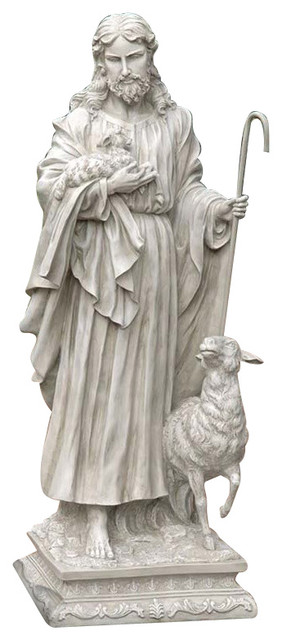
    Christ the Good Shepherd is a common image in the Church and that image has been the subject of church art throughout the centuries.  We have our own piece of Good Shepherd art in our sanctuary.  Right over there stands the Good Shepherd statue.  Jesus is there with His shepherd’s crook in one hand, a lamb in the other, and an adult sheep close by.  That statue not only reminds who Christ is, but who we are as well.  When we look at that statue, when we look at any Good Shepherd art, Jesus isn’t the only one pictured; we’re there too.  We’re the sheep.  We’re His sheep kept secure in His care.  We’re His sheep kept secure unto everlasting life.  That’s the promise Jesus gives to you. 
    In the Gospel reading today we heard an exchange between Jesus and some of the Jews who opposed Him.  It was at the Feast of Dedication, what we know as Hanukkah, a celebration of the rededication of the temple after a foreign ruler (Antiochus IV Epiphanes) desecrated it by sacrificing a pig on the altar to Zeus.  While Jesus was at the temple the Jews surrounded Him and they bluntly asked if He was the Messiah.  Apparently everything He had said before and all the miracles they saw and heard Him do wasn’t clear enough.  They wanted Him to tell them plainly.  They wanted to hear Jesus say the words, “I am the Christ.” 
    Their blunt question required a blunt answer.  Jesus plainly said, “I told you, and you do not believe” (Jn 16:25).  I told you that I am the Christ.  The works that I’ve done in the Father’s name witness to me.  It’s clear for your eyes to see and your ears to hear, but you don’t believe.  You refuse to believe, because you are not part of my flock.  Those who opposed Jesus did so because they refused to believe.  They weren’t part of His sheep; and therefore, they couldn’t know the Shepherd.  But you do.  You know your Shepherd.  You know Him because you’ve heard His voice and received the gift of faith in that hearing. 
    God clearly says in Paul’s letter to the Romans, “Faith comes from hearing, and hearing through the Word of Christ” (Rom 10:17).  You sheep have heard that Word of Christ.  You’ve heard the Good News of the Lamb of God who is your Shepherd.  You’ve heard how your Good Shepherd laid down His life for you; sacrificing Himself for you on that altar of the cross, dying to pay for your sin, dying to redeem you.   You’ve heard the Word of Christ, baptized in His name.  You’ve heard the voice of your Shepherd, speaking through His under-shepherd pastors, absolving your sins.  You’ve heard your Shepherd’s word of promised forgiveness, life, and salvation as you feast upon His very Body and Blood.  Your Shepherd speaks.  You hear His voice.  You know Him.  And He knows you; each and every one of you. 
    I grew up on a family farm.  We didn’t farm the land, we leased it out to some else, and he raised cattle.  I grew up literally seeing a bunch of cows across my front yard.  And even though I saw those animals almost every day, I couldn’t tell them apart.  They all looked the same.  They were all just cows.  But somehow, that farmer knew those cows as individuals.  He knew when one was sick or ill.  He could tell when things were a bit off.  And that’s how it is with Christ the Good Shepherd.  
    Jesus’ flock is so much larger than that herd of cattle, and yet He knows each and every one of His sheep as individuals.  He knows you.  He knows when things are a bit off.  He knows your illness and pain.  He knows what troubles you.  He knows your sin and guilt.  He knows your fears.  And He answers all of that with His forgiveness and the promise of everlasting life. 
    In that exchange at the temple, Jesus didn’t just respond to His opponents; He also made a promise to you His sheep.  “My sheep hear my voice, and I know them, and they follow me.  I give them eternal life, and they will never perish, and no one will snatch them out of my hand. … [N]o one is able to snatch them out of the Father’s hand” (Jn 10:27-29).  You are under the eternal care of your Good Shepherd.  You are that lamb in that statue held by your Lord, kept secure in the everlasting life He won for you.  You’re kept secure even though we live in a world filled with wolves. 
    As St. Paul met with the pastors from the Ephesian church (Ac 20:17-35), he warned them that wolves would come in and try to take God’s sheep.  They’d lead people away by speaking twisted things.  They wouldn’t rightly speak the Word of Christ.  Paul calls these false teachers wolves because wolves mean death for sheep; and false teaching means death for us, leading away from the life of our Good Shepherd. 
    We need to be alert to this.  We need to be aware of this, because we’re sheep.  Like sheep, we easily stray.  We easily wander off and go after things that appear pleasing to us; but in that wandering we walk away from the security of our Good Shepherd.  Yes, Christ promises that nothing or no one can snatch us from Him, and this promise is a comfort to be sure.  But we can’t forget that just because nothing can snatch us away, that doesn’t mean we can’t wander away ourselves.  Knowing there are wolves out there in sheep’s clothing we have test everything against the Word of Christ, making sure what we hear is the truth.  We seek out our Shepherd’s voice because that’s where our security and everlasting life is found.
    We usually think of sheep has being dumb and dirty animals.  We don’t usually like be associated with them; but there’s nothing better than being a sheep in God’s flock.  A good shepherd makes sure his flock is secure.  He makes sure they have everything they need: water, pasture, shelter, protection from predators.  That’s what our Good Shepherd gives to you: the water of Baptism, the pasture of His Body and Blood, the shelter of His Church, and His cross and resurrection that saves you from sin, death, and the devil.  There’s nothing better than these gifts, and so we thank our Good Shepherd for these things.  We join in that heavenly worship, clothed in robes of white washed in the blood of the Lamb.  We sing His praises so that others might hear His voice, know Him by faith, and receive His promise of life.   
    You know your Good Shepherd.  God has made Him known to you through His Word and deeds.  You know His voice as He speaks to you through His Word.  You’re kept secure in His arms, nourished unto everlasting life through His Sacrament.  No one and nothing can snatch you away.  With this security sing your Shepherd’s praise.  Praise Him for what He has done.  And with that praise, point others to the Good Shepherd so that they too can hear His voice and receive His life.  In Jesus’ name…Amen.
            Alleluia!  Christ is risen.  He is risen indeed.  Alleluia!
 

The two lies. . .

It would be humorous if it were not so sad that Rome lives with the lie that everything promulgated by Paul VI was mandated by Vatican II.  Ample research has gone into the Bugnini deception and how the work was a surprise even to the Pope in whose name the changes were established.  So it is more than curious that Vatican II would become the center of what is really a power play within the Roman Church.  It has become the dividing line of theology and, to some on both sides, orthodoxy.  To the Latinists the Novus Ordo is the Mass of Discontinuity that casts a shadow of doubt and uncertainty over the whole pale of the Roman Church.  To the progressives, the Novus Ordo represents the only legitimate expression of Roman piety and how you feel about it is the litmus test of godly obedience.  I suppose if I were Roman Catholic it would be harder to make a joke about this but, come on, is this the thing that ought to be consuming Rome's time?  Apparently the current Pope is threatened by those who prefer the Mass that ruled time for more than 400 years and the ridiculous sideshows that too often accompany the Novus Ordo have tainted it forever in the minds of his opponents.  Meanwhile, Rome withers in size and fights doctrinal wars over its very soul.  The preference of one form over another ought to be the least of Papa Frank's problems.  But it is not.  Perhaps it is convenient distraction from financial scandals, German liberals, the inculturation of pagan symbols, the faithful unsure if Christ is really present in the Sacrament, and the constant emptying of the pews.

It would be humorous if it were not so sad that Lutherans live with the lie that the Reformation were about the freedom to ditch vestments, lectionary, liturgy, reverence, ceremony, and the like.  Adiaphora has come to mean whatever and Lutherans now resist every impulse of what was once normal among us in worship and piety.  Ample research has gone into the deception that a conservative Reformation is really a radical one and that Luther's appeal to conscience therefore justifies everyone's preference for what is meaningful and speaks to their soul on Sunday morning.  In the end, like Rome's battle, this is not simply about things liturgical but a battle for the soul of the Churches of the Augsburg Confession.  Are we who our confession claim us to be or are we who we feel like at the moment?  To the progressives anything and everything that might be misunderstood or not appreciated by the outsider who enters our services for the first time could and should be discarded in the cause of Christ.  I have had it put to me that crassly:  would you keep chanting or vestments or reverence even if it meant somebody might reject the Gospel because of these things?  Really?  The confessionals among us spend too much time warring over page 15 in TLH or Setting 3 of LSB against the other two settings as if it were impossible to use the newer rites with any doctrinal integrity (along with conflicts over lectionaries, etc...).  Meanwhile Lutherans is in the battle for its soul -- with liberals on one side who love the forms (stripped of their masculine pronouns) but who don't bother believing the words and evangelicals on the other side who keep trying to turn the Divine Service into a holy variety show that entertains and saves.  In the end, we have our own pews emptied by age and the failure to catechize and our own crises of what is believed, practiced, and how it is paid for.

Let us be honest.  The biggest Roman Catholic Church in the world are those who used to be Roman Catholic but no longer go to confession or mass.  They claim a membership which is hidden even to them.  The biggest Lutheran Church in the world are those who used to be Lutheran but no longer attend the Divine Service or see any difference between Lutheranism and any other generic Christianity devoid of sacramental life and creedal integrity.  A pox on both houses!  This is the fruit of a failed catechesis that taught the faith as if it were imparting head knowledge instead of a baptismal vocation that can and must be fulfilled in our life together around the Word and Table of the Lord.  Lutherans are not Baptists in formal dress nor are we evangelical wannabes.  Both of those are false identities that betray the central Lutheran claim to be catholic in doctrine and practice -- the genuine catholics!  Rome is suffering because they built a house of cards created by the impression that they created Scripture and can invent things to bind men's consciences (from purgatory to the treasury of merits to the good works that contribute to your salvation).  The salvation of both is found in the same place -- the Word of the Lord that endures forever.  This was surely Luther's dying hope -- not that Rome would become Protestant but that it would be reborn the attention to the Word of God.  This was surely Luther's dying fear -- not that Lutherans would become Roman Catholic but they would fail to be catholic and in so doing would forget that their life is formed, shaped, and empowered by the Word of the Lord that endures forever.

I will admit to the pipe dream that perhaps the Reformation was ongoing and its work within Rome was not stalled and that its expression within Lutheranism was to live out fully our confessional claim of catholicity.  I am a dreamer.  I admit it.  But that is where I live. . . in the dreams of what could be if we all lived by the Word, font, and Table of the Lord.

Monday, May 9, 2022

5th Largest Pipe Organ

The Hazel Wright Organ has been cleaned, repaired, and restored and is back home in Garden Grove.  Fun fact:  then organist at the Crystal Cathedral Christopher Pardini was the guest artist at the dedication recital of the Grace Lutheran Church Organ (not small by any means but only 22% the size of the Wright Organ).  Anyway, this happened a while ago but I was otherwise occupied.  So take a look. . .  or read about it here....

Sunday, May 8, 2022

Hearing and believing. . .

Don't get me wrong.  It is our opportunity, our duty, and our delight to read God's Word every day.  Far be it from me to diminish or detract from this gift and blessing of accessibility and availability.  But nearly every time the Word of God is spoken of in Scripture, it is about a Word that is heard -- a Word spoken into our ears and not read with eyes and mind.  This is not because of the times and something that God would have said differently to us if the times had been different, if books had been as freely and cheaply available as they are today.  God has never been blind to the future and could have easily have said read a few more times to anticipate our situation today.  Instead, over and over again the focus is on hearing the Word.  That does not only or even primarily mean when the readings appointed for each Sunday are read, but to preaching itself.

The Word we hear is a Word spoken and preached.  Our Confession says this is the reason for the Office of Pastor.  The Augustana simply mirrors what St. Paul says.  Faith comes by hearing the Word.  Oh, sure.  You and I both know that God does work through the written Word but we must also admit that the primary way God has intended us to encounter His Word is in the ear.  From Genesis through to Revelation, God acts in His speaking.  In between He speaks and His Word makes baptismal water the womb of forgiveness and everlasting life.  He speaks and His Word is the power that absolves us of our sin and creates in us a desire, by the power of the Spirit, to amend our sinful lives.  He speaks and His Word is applied to us and to our lives by a preacher who lives among us as icon of Christ and the voice through which that Word is spoken.  He speaks and His Word gives to bread His flesh for the life of the world and to the cup His blood that cleanses us from all our sins.

The Word is not magic but it is a sacramental Word.  It does what it says and bestows what it promises.  It does not return to God empty no matter how much we long to see its results and do not.  It always and everywhere accomplishes His purpose in sending that Word.  That is a Word that comes from the outside into us, by the power of the Spirit.  By faith we grasp this Word and claim the gifts Christ has appointed for all who hear and believe.  God continually addresses us with a voice, a Word that is alive, a two edged sword, and a means of grace.  What we do with it surely affects its benefit and blessing to us but it is never a benign or symbolic or empty Word -- even when our stubborn wills fail to hear it, refuse to keep it by faith, or are too soon distracted by cares, joys, and the ways of the world.

There are those who wonder if preaching has a future (or, perhaps, even a present value).  But preaching will continue to live and thrive not because we are good at it but because this is how faith comes, faith is nourished, and faith is sustained.  God has said and so it will be just as it has been.  Preaching is profound not because the preacher is stilled at the craft (though this is an art every preacher should work on) but because God is in the speaking and God is in the hearing.  If our people are not listening, it could be due more to the fact that they no longer know or believe that God is speaker and God comes into the ear.  If our people are judging the craft of the preacher instead of the content, it could be because we have focused too much on the person and too little on the Word spoken and the Word that comes into the ear and the faith wrought by the Spirit.

Read the Scriptures.  Know the Scriptures.  Reading and knowing the Word of God will only help you hear the Word spoken and preached into your ear.  But reading and knowing does not replace hearing.

Saturday, May 7, 2022

Stress, burn out, and resignation. . .

It is no secret that pastors are finding their vocation more stress filled and conflict laden than any expected.  The numbers of clergy diagnosing as or self-diagnosing as suffering burn out began its increase long before the pandemic.  Resignations are now common among those in high profile plum positions and parishes as well as those in the trenches.  Only a fool would deny that this is at least epidemic for clergy in this day and at this time.  For every pastor who is vocal about his feelings and admits to considering resignation, there are more whose thoughts are known only to them and to their families.  But the sheer number of conflicts and quarrels in a typical parish today, multiplied by the pandemic, should open our eyes to the cost of this office for those on whom this office has been conferred.

Of course, there are obvious reasons.  Two years of a pandemic that basically declared the Church and all that a pastor does as mostly non-essential are surely influential on the angst that afflict clergy today.  The shrinking dollar in many congregations and the fear that many pastors may find themselves priced out of their jobs is and has been a reality for many small and medium sized parishes.  The ordinary struggles of life -- upon marriage and family -- are only multiplied in a marriage and family lived within the glass house of the pastor amid a congregation of people.  Student debt and middling or small salaries created a battle between the pastor as husband and father and as pastor of the congregation.

But there is another reason and this one is less the subject of articles and blog posts and the news.  This is true primarily of Lutherans and those pastors serving within the LCMS (those whom I know better than any other pastors).  That is the fact that pastors are neither universally or usually respected as highly as they once were.  In other words, the very office the pastor holds is not held in the high esteem it was in previous times -- by those whom he has been called to serve.  Too often, the pastor is treated as a hireling or employee -- someone who works for the people and does what they people think he ought to be doing.  Though we continue to speak the language of call and calling, the people in the pews are less aware of what that calling is and of the duties to which they have called their pastor.  This is in part because we no longer speak in the language of the call documents.  Instead, we have taken up the language of the world and other communions and we now hold the pastor responsible for things that the pastor is not responsible (at least by call).

All of this contributes to a confusion of who the pastor is and what the pastor is called to do -- at a time in which that calling is under great pressure from within the from the outside.  Most of the struggles a pastor faces could be dealt with more easily if he knew his people understood who he was a pastor and what he was there to do -- and they appreciated that service.  Even if they do know and hold his service in high esteem, it is often much less verbalized or obvious to clergy today than it was in the past.  As an example, where I vicared and in my home parish, when their pastor retired, they bought him a house.  That probably would not happen today.  Money is neither the primary nor sole means of expressing appreciation but it is also a tangible sign of esteem.

I would argue that much of clergy stress and burnout and many thoughts of resignation might be allayed by strong and strongly communicated support and encouragement from the pew.  If you esteem what your pastor does as pastor and value his service to you, tell him.  Tell his family.  Encourage him even when financial rewards are not possible.  As a pastor for 42 years I can tell you that the storms of my ministry were weathered easier by knowing my people were praying for me, by their verbal encouragements to me and my family, and by their support as best they were able.

The second thing people can do is to minimize the unnecessary conflicts in the parish.  Yes, too many upsets are completely unrelated to the pastor or the parish and simply the fruit of our discontent with our lives, families, and occupations that come home to roost in the church.  But, good parish leaders and a well organized parish can minimize such things and prevent meetings from becoming complaint sessions.  

To the pastor I say bluntly, preach faithfully, teach faithfully, preside faithfully, and faithfully provide pastoral care to your people.  Make sure they know that doctrine is not up for grabs nor is the Scripture a book defined by interpretation or opinion.  Make them friends with their Small Catechism, especially with the Table of Duties.  They will appreciate it.  Furthermore, stay a while.  The longer you are in a parish, the deeper and broader your support system and the people will show it.


Friday, May 6, 2022

Words about words. . .

Some have challenged my assertion that retirement is a word not found in Scripture.  They would point to Numbers 4 in which the numbers of those appointed to do the heavy lifting of the Tent of Meeting were aged 30-50.  Aha!  Retirement at age 50!  Or is it that the service of those age 50 and older, like those not yet 30, is different.  That for the specific 20 years mentioned, the service is as directed toward the Tent of Meeting but at other stages of life, the service is elsewhere directed.  I see no statement directing that after age 50 the seniors are free to spend their children's inheritance on a life of self-centeredness and bucket lists.  Unless I have missed that verse.  Or they would point to Leviticus 8:24-36 wherein the Levites are directed to work from 25 to 30 as apprentices and then from 30-50 carrying the full burden of their service until age 50 when they assist but allow the younger both to learn and perfect their service under the oversight of the elders.  Why?  Well, if we think pastoral duties are heavy today, think of the stamina needed for all-day, every day moving large livestock (sheep, goats, cattle) as part of their sacrificial roles. If you allow for the shorter lifespan of men of that time, the age of 50 was probably a reasonable limit for full-time service of these labor intensive duties. Their service did not end but it did change.  Then there is that pesky verse from Leviticus 27:7 in which it might appear that a man over 60 is worth but half a younger man.  Except that this verse is about their value before God and not their value as a man or woman.  Even then, such a senior discount says nothing about them stopping work, going on cruises, spending down their IRAs, and hitting the golf course.

While we are at it, someone challenged my assertion that depression is not in Scripture either.  How awkward it is to go from retirement to depression as if they were inexorably linked.  There is no Hebrew word for depression or being depressed.  What there is in Hebrew is a word that we generally translate as sorrow or sighing.  Isaiah says it.  The redeemed of the Lord shall return to Zion from their exile and sorrow and sighing shall flee away.  Jeremiah holds the promise that God will turning their mourning into joy, comfort them, and make them rejoice from their sorrow.  Both of these might apply.  Yes, the Septuagint has the word a time or two but usually translated discouraged.  In any case, that does not say that God is oblivious to or unconcerned about the sorrow of our hearts and our depression.  In fact, just the opposite.  Our Lord Jesus is the answer to all our sorrows, sighings, and discouragements and what we here must bear, we will not endure in eternity.

I must admit that I am almost giddy at the next one.  The byword of our intolerant age is the word tolerance but every time anything close to that occurs in Scripture, it is bad news.  Jesus insist that it will be more tolerable for Sodom on Judgment Day than for those who heard Him and rejected Him.  The Psalmist warned that God would have closed His ears to his need if God had looked upon and tolerated or condoned the sin in his heart (66:18).  But the clincher is in Revelation 2:20 when Jesus criticizes tolerance and accuses Thyatira for tolerating Jezebel that fornicating and idol meat offering woman!  So much for the virtue of our age and Scripture!

Just a little fun with words. . .  oooh, now there is a word to look up.  Is fun in the Bible????

Thursday, May 5, 2022

Religion is not to influence, except...

Now that the make up of the Supreme Court is seven Roman Catholics with two Jews, concern is voiced that the religious affiliation of the judges should not exert undo influence upon the decisions of the court.  However, that is exactly what under girded the original decision in Roe v Wade.  Then, however, in January of 1973, there was one Catholic on the bench, three Episcopalians, three Presbyterians, one Methodist, and one Lutheran (at the time LCA).  That is to say, all but one of the judges were mainline Protestants.  Oddly enough, the Lutheran (Rehnquist) and an Episcopalian (White) dissented but all the rest, including the Roman Catholic concurred in the majority opinion establishing abortion as a right.  While these jurists are loathe to admit it, it was exactly the liberal Protestant views that predominated in the minds of the majority -- so much so that it was surprising and shocking to them that anyone disagreed!  They had presumed that their own religious ethos was the mirror of the nation and it had not even occurred to them that they were not reflecting a commonly held ethical and moral position.

So what has changed?  In part the denominations represented by those jurists in 1973 have become a toothless tiger of a mainline Protestantism with a past but not much of a future.  The United Methodists are disuniting, the Presbyterians have divided many times already, the Episcopalians are a shell of their former self, and Rehnquist would not even recognize the Lutheran denomination that was once his home.  The most vibrant forms of Christianity in America are in the fundamentalists, the evangelicals, and, most surprisingly, in Roman Catholicism.  They are the voices who have arisen to challenge the once vaunted moral consensus that produced a Roe in the first place.  Furthermore, even the nones who claim no formal affiliation are not quite fully on board the whole idea that the life in the womb is neither a life nor worthy of any guarantees.

Of course, abortion will continue to be debated and will keep on dividing Americans no matter whether the Court reverses itself or it does not.  That is because the debate is not simply about what ought to be legal but whether it is moral.  And the reality is that in America today, there is no larger moral consensus.  Situation ethics predominate -- informed by feelings and desires more than facts or rights or wrongs.  Even if it could be proved beyond the shadow of a doubt that the fetus is prescient, feels pain, and is fully human that would not alter the position of those whose drumbeat is my body, my choice.  It is no longer about a commonly held consensus of right and wrong or even about facts.  It is not even about religion and religious convictions.  How can you debate something when the only arbiter of truth or virtue is how one feels about something?  How can you expect to find consensus on abortion when we cannot even decide what it means to be a man or a woman?

So religion is not to influence the ethical values of the law except where they fit with the progressive viewpoint and liberal agenda that seems more than ever in control of our institutions and our opinions.  We cannot even see the conflict between my body, my choice when it comes to abortion or when it comes to a vaccine mandate so how will we see past the limits of reason to forge a new consensus of virtue and evil?  In the end that is our dilemma.  We do not know how to argue for or promote a common sense of values and truths greater than ourselves.  That is what was behind Roe and what will make the future of abortion less about resolution than about division still and more to come.  The mainline denominations were heralding the way for a Roe decision in 1973 but they proved to be unreliable and are fading fast from the scene.  The downside is that we have no idea what might or will replace them.  As the road sign warns, danger ahead.

Wednesday, May 4, 2022

The Lord is near. . .

Like Santa, the Lord is watching out to see if you are naughty or nice.  Or so the child views the comparison between the red fat man who comes once a year to divvy out presents and the mighty One who comes at the end of time as King and Judge of all.  At first, it might seem an understandable comparison.  But that is because we have presumed the nearness of the Lord is tied to one purpose -- judgment.  How odd that we would do that?  Could it be inner guilt that moves our perception of God's immediacy instead of the promise of Emmanuel?  Whatever, the Christian presumes God is closer to every day life and to the person more than farther.  Those who believe in some sort of God but could hardly be called Christian tend to think of God in more distant terms.  And why not?  It fits the idea of a Santa God who is there when you want him and absent when you don't and it goes with the idea that such a God is more interested in your behavior than in you.

For the Christian, the nearness of the Lord is not something tied to a watchful eye looking over our shoulders at our misdeeds.  It is not a fearful thing that concerns us -- it is of great comfort to us to know that God is present.  Bidden or not, God is present.  That presence is itself part of His beneficence.  We are greatly relieved that God is near and His nearness is not simply due to His watchful concern over our errors and screw ups.  No, God is near as an agent and instrument of blessing to us -- undeserved though we are.  That makes His presence even more comforting.  The presence of the Lord is not some warning shot across our bow (except to those who do not know Him by faith) but the assurance that no matter how we feel or how things look, He is with us -- full of grace and truth.

One of the hallmarks of faith is how you perceive God's immediate presence.  Those who are not religious tend to think of God on a shelf, there when you need Him and not there when you don't. The key here is you decide when you need Him and You make Him present.  He is the God of crises and longing when nothing else works to fix or answer the need.  But this is hardly faith.  Nobody has to believe in a fire extinguisher in order to reach for one when you cannot put out the fire any other way.  For the religious God is near and He is the mover who comes to us (incarnation) and makes His home with us (Church and means of grace).  We awaken to that presence when faith, prompted by the Spirit, opens up eyes we did not have before and hearts that were closed to the working of God.  The God who is near, whether bidden or not, is the God whose will is good and gracious, whose mercy trumps His justice, and whose Fatherly compassion is not simply our rescue but our very ground of being.

The practice of such an immediate God means prayer -- a conversation with God which always ends with the statement only faith can make -- Thy will be done.  It means being conversant with His Word -- not as a rule book or an encyclopedia of knowledge or a how to guide but as the place where the child hears the voice of His heavenly Father, the lamb hears the call of His Good Shepherd, and bride hears the beckoning love of her bridegroom.  It means a flowering of new life not as duty to a set of ideals but as the prompting of the Spirit to practice the things of God here and now -- sort of a rehearsal for the eternity when the prompting will be be replaced by an innate knowledge and desire for God.

Coming now well after the first announcement of Emmanuel, we have seen it put into place in water become wine, strangers become disciples, the sick healed, the lame restored, and the demon possessed set free.  We will trek with the inner circle to the transfiguration mount where the glory will be revealed but now, as we approach Lent, we discover that the greater glory is the love that was willing to die that we might live.  It is this nearness of the Lord that drives and compels the Christian.  It is this perfect love that casts out fear of His presence and a nearness too close for comfort.


Tuesday, May 3, 2022

Modesty is not shame. . .

The world loves to gloat over what they deemed the prudish shame over nudity, vulgarity, and sex acts.  The presumption is that Christians are ashamed of God's creation of people as male and female and the call to be fruitful, multiply, and fill the earth.  It is an easy but false charge.  The constant barrage of naked images, of the basest and crudest of language, and the flaunting of sex acts (otherwise known as pornography) has done nothing to elevate us as people and everything to diminish us and cause us shame.  Modesty is not shame.  Modesty honors what God has made.

It is no wonder that the times in which our language has devolved into the most vulgar words we can invent and nudity has become the standard fare of media and sex acts between actors that leave nothing at all to the imagination, the self is suffering.  We no longer know what it means to be a man or a woman and so we entertain this uncertainty as evidence that the body and soul are at odds in some people.  We no longer know what it means to be husband or wife or married and so the young have chosen to remain single even while their loneliness contributes toward a pandemic of depression.  We no longer value children or view the child as anything more than a choice and so young people choosing not to marry are already choosing to sterilize themselves to prevent them from changing their minds.

Sexual liberation has become a curse that will destroy any notion of nobility, beauty, and goodness left in our secular world.  Our failure to master language has left us with little choice except to substitute crudity for erudition and vulgarity for eloquence.  Our fascination with sex acts has not taught our hears to love but to fear any intimacy except that which is staged for our amusement.  This is our shame.  Christians who laud God's creative grace in making us male and female are not prudes but they have learned that excess is not the path of respect, self-respect, and self-esteem but a detour to destruction.  Christians who love words because they confess the Word made flesh and the Savior who works among us still by His efficacious Word are not trying to shut up anyone.  Instead they are trying to let the voice speak that can do something about what ails us.  

With our loss of modesty has come a casualness about our live and a loss of shame that do nothing to help and everything to hurt.  We do not cover our nakedness because it is ugly but because sin has taken God's goodness away from us and left us with lust.  We are not against vulgarity because of the way it sounds but because of what it does to us as people and how it deprives us from the Word that is our rescue and hope.  We do not turn away from the portrayal of sexual acts because the acts are corrupt but because our corruption of God's gift have soured us on the context and blessing of sexual intimacy -- children!

We have sexualized our children and made them part of our fantasy of lust -- in the process stealing away their childhood and leaving them with adult sized pain, problems, and psychological disorders.  Look around our world today.  Our kids are wrestling with challenges that are beyond their maturity and should be beyond their experience.  This is child abuse as well as the physical and sexual abuse that ordinarily fall under that definition.  The end result is that they are broken, fragile, fearful, and filled with despair.  If all of our libertine efforts were benefiting our children, why are our children having such deep seated and serious problems?  Why is suicide so much on their minds?  Could it be that the liberation of adults has become the prison of children?

We have stolen from marriage anything and everything that would make marriage anything more than cohabitation for convenience.  In the end, working so hard to make sure that there is no difference between those who shack up and those who order their lives together in vow and promise (especially before God), has done nothing to help those cohabiting and everything to destroy marriage, family, and the home.  Our young people are not rejecting marriage so much as they are rejecting the idea that they need a God or a marriage license to sanction a relationship of convenience, little more than friends with benefits.  Their rejection of the false image of marriage prevents them from learning that this is neither real nor true but only a fake characterization of the treasure created for us and that we were created for...

The vulgarity that passes for humor and communication does nothing to ennoble us and everything to demean us.  Even worse, it deprives us of the real use of words to speak hope in the midst of despair, life in the face of death, and peace that passes understanding.  Absent the gifts that the Word incarnate has come to speak into us, our corruption of the language can only shock, offend, and divide us.  Worst of all, we have become so accustomed to this base and crude form of language that we end up working harder than ever to shock and offend because we think this is what leads us to understanding and appreciation.

Christians know better.  But too many Christians have surrendered their hearts and minds to the reality of the world around them.  We dare not.  We cannot ignore these excesses any more than we can join them.  We must take up the cause of modesty not because of fear but for the sake of love.

Monday, May 2, 2022

Thoughts while fishing. . .

Sermon for the Third Sunday in Easter (C) preached on Sunday, May 1, 2022.

A lot had happened.  Jesus was betrayed into the hands of His enemies right before their eyes.  He was taken to courtrooms in which the verdict was fixed and put before Pontius Pilate.  He was condemned to death and Rome’s cruelest instrument was used to fulfill the verdict.  They had run to the tomb only to find it empty and hidden behind locked doors but still Jesus found them.  It was all too much.  Their plate was full, their hearts choked up, and their minds reeling.  Lets go fishing.

As they had in the past, sometimes as Jesus’ own bidding, they pushed the boat out into the water and cast down their nets.  When life becomes too much to handle, you go back to the things you have always done to find consolation in the past.  The last time this had happened, the full net about sank the boat.  Peter jumped into the water to try and steady things.  Then he saw Jesus and in fear urged the Lord to leave him alone for he was a sinful man.  This time they caught nothing but frustration until Jesus urged them to cast their net on the other side.  As if they had not thought of this already, they relented and did as they were told.  Now the boat was again laboring under a mighty catch and Peter was again in the water.  This time, now post-resurrection, Peter did not protest but they all stood in awe of the Lord.  This was now the third time Jesus had revealed Himself to them and they had nothing to say.

Most of us do not cry out in fear to the Lord as Peter once did.  We do not say “Depart from me, Lord, for I am a sinner.”  Instead, we plead to God to just leave us alone to enjoy our sin, to make our peace with death, and to live as we desire.  It is not that we do not like what Jesus did for us as much as we take it for granted. It is God’s job to forgive sin and it is our job to give Him something to forgive.  There is no fear in our hearts to enter into the holy ground of God’s presence.  We have tamed our God and turned him into kindly granddaddy who cannot but give us what we want if only we ask rightly.  It is not that we do not think there is sin, just that our sin is not as bad as the big sins of the big sinners who need mercy.

Because of this, we do not live in the shadow of the cross but wherever we think our sins can be well hidden.  We do not live in the light of Christ but where the darkness will keep all our wrongs safely out of view.  We live day to day, in pursuit of the moment, confident that we have God covered, and well practiced in the fine art of apology, excuse, and self-justification.

I wish I could say that our age had a healthy fear of God but we don’t.  We fear not getting what we want most of all and we think we have learned how to live with one foot in God’s Kingdom and one foot here on earth to make sure we both – the pie in the sky when you die and the early life well-lived and long-lived.  How foolish we are.

Peter may have cried out “Depart from me, Lord, for I am a sinner” in the Gospel reading for today but all the disciples knew enough to stay silent before the Lord rather than to open the mouth and prove themselves the fools they were.  What about you and me?  If we are not compelled by the guilt and shame of our sins and the fear of death, what is that does compel us?  If we are not moved even more by Christ’s might act of deliverance, what will move us?

That we might dwell with God, God became man.  To pay for the high cost of our sins, God ransomed His own most precious treasure – His Son.  To deliver us from death, our Lord died.  To raise us up from death, our Lord is risen.  My friends, the Lord will tell you where to fish.  Your boat will not sink.  Your net will not break.  God is determined to overflow you with the riches of His grace.  The things of our old lives no longer count but the number of God’s treasures are counted daily as we confess our sins and are forgiven, remember our baptism into Christ, hear the voice of absolution and are given a clear conscience, and taste and see the goodness of the Lord in His flesh that we eat and His blood that we drink.

Our lives are precarious, our boats are fragile, our sins are many, our death is always near.  But God is mighty and powerful.  Because He holds our lives in His hand, we are secure.  Because His strength is made perfect in our weakness, we will endure.  Because He has vanquished death and announced His victory to hell, we will not die.  Yet we have this treasure in earthen vessels and our nets are daily stretched to the limit.  As long as we are in Christ, we have nothing to fear.  The Lord is ever at work in us to guard us as His most precious treasure.  He does not grow tired of us or of our constant need to be rescued, forgiven, and restored.

Our fishing days are over.  The big ones that got away are safe.  But the world for whom Christ died is now our focus.  We live not for ourselves but for Him who loves us.  We are safe and secure in the holy ark of the Christian Church and we are about our Father’s business, fishing for men with mercy and feeding lambs with the bread of heaven and the cup of salvation.  

This life is now prelude to the most real life of all – the one for whom Christ died and rose.  Our baptismal vocation is now to live in Christ the new life He has given, doing the good works of Him who called us from darkness into His marvelous light.  Our comfort lies in that He has declared us worthy, given our lives purpose and meaning, and given us work to do so that our labors will endure forever.  

It does not matter if you are old or young, the day of the Lord is always morning.  We depart from the boat of our fears and worries to stand upon the beach of God.  And there He is.  The Lord is waiting.  He has prepared us an eternal meal.  He delivers us into His presence until there no longer a past to fear or a present in which to struggle but only the unlimited future of His abundant grace.

He has made all things right and all things new.  Do you love Him?  Then love the things of God and seek after these things with all your heart, body, mind, and soul.  Fish where He has bidden for the catch He has prepared.  And nothing will steal from you the God who loves you and nothing will come between you and His salvation.  

When you were young, you woke up and dressed yourself  to go where you wanted and to do what you desired and you thought it would always be like that.  Youth refuses to depend on anyone.  When you get old, you will depend upon the outstretched hand of another to rise from your bed and dress you and they will take you where you do not want to do.  Age teaches us that we must depend upon others but we resent it. Sin makes us full of ourselves and we think we are our own masters.  Faith places us in the hands of God where we depend only on grace sufficient for each day.  From our lives in His hands we wait for a death that Christ has already answered and for a life we cannot imagine.  In Jesus name.  Amen.