Friday, April 19, 2019

The Passion. . .


John 18-19 (ESV)

Betrayal and Arrest of Jesus

18 When Jesus had spoken these words, he went out with his disciples across the brook Kidron, where there was a garden, which he and his disciples entered. 2 Now Judas, who betrayed him, also knew the place, for Jesus often met there with his disciples. 3 So Judas, having procured a band of soldiers and some officers from the chief priests and the Pharisees, went there with lanterns and torches and weapons. 4 Then Jesus, knowing all that would happen to him, came forward and said to them, “Whom do you seek?” 5 They answered him, “Jesus of Nazareth.” Jesus said to them, “I am he.”[a] Judas, who betrayed him, was standing with them. 6 When Jesus[b] said to them, “I am he,” they drew back and fell to the ground. 7 So he asked them again, “Whom do you seek?” And they said, “Jesus of Nazareth.” 8 Jesus answered, “I told you that I am he. So, if you seek me, let these men go.” 9 This was to fulfill the word that he had spoken: “Of those whom you gave me I have lost not one.” 10 Then Simon Peter, having a sword, drew it and struck the high priest's servant[c] and cut off his right ear. (The servant's name was Malchus.) 11 So Jesus said to Peter, “Put your sword into its sheath; shall I not drink the cup that the Father has given me?”

Jesus Faces Annas and Caiaphas

12 So the band of soldiers and their captain and the officers of the Jews[d] arrested Jesus and bound him. 13 First they led him to Annas, for he was the father-in-law of Caiaphas, who was high priest that year. 14 It was Caiaphas who had advised the Jews that it would be expedient that one man should die for the people.

Peter Denies Jesus

15 Simon Peter followed Jesus, and so did another disciple. Since that disciple was known to the high priest, he entered with Jesus into the courtyard of the high priest, 16 but Peter stood outside at the door. So the other disciple, who was known to the high priest, went out and spoke to the servant girl who kept watch at the door, and brought Peter in. 17 The servant girl at the door said to Peter, “You also are not one of this man's disciples, are you?” He said, “I am not.” 18 Now the servants[e] and officers had made a charcoal fire, because it was cold, and they were standing and warming themselves. Peter also was with them, standing and warming himself.

The High Priest Questions Jesus

19 The high priest then questioned Jesus about his disciples and his teaching. 20 Jesus answered him, “I have spoken openly to the world. I have always taught in synagogues and in the temple, where all Jews come together. I have said nothing in secret. 21 Why do you ask me? Ask those who have heard me what I said to them; they know what I said.” 22 When he had said these things, one of the officers standing by struck Jesus with his hand, saying, “Is that how you answer the high priest?” 23 Jesus answered him, “If what I said is wrong, bear witness about the wrong; but if what I said is right, why do you strike me?” 24 Annas then sent him bound to Caiaphas the high priest.

Peter Denies Jesus Again

25 Now Simon Peter was standing and warming himself. So they said to him, “You also are not one of his disciples, are you?” He denied it and said, “I am not.” 26 One of the servants of the high priest, a relative of the man whose ear Peter had cut off, asked, “Did I not see you in the garden with him?” 27 Peter again denied it, and at once a rooster crowed.

Jesus Before Pilate

28 Then they led Jesus from the house of Caiaphas to the governor's headquarters.[f] It was early morning. They themselves did not enter the governor's headquarters, so that they would not be defiled, but could eat the Passover. 29 So Pilate went outside to them and said, “What accusation do you bring against this man?” 30 They answered him, “If this man were not doing evil, we would not have delivered him over to you.” 31 Pilate said to them, “Take him yourselves and judge him by your own law.” The Jews said to him, “It is not lawful for us to put anyone to death.” 32 This was to fulfill the word that Jesus had spoken to show by what kind of death he was going to die.

My Kingdom Is Not of This World

33 So Pilate entered his headquarters again and called Jesus and said to him, “Are you the King of the Jews?” 34 Jesus answered, “Do you say this of your own accord, or did others say it to you about me?” 35 Pilate answered, “Am I a Jew? Your own nation and the chief priests have delivered you over to me. What have you done?” 36 Jesus answered, “My kingdom is not of this world. If my kingdom were of this world, my servants would have been fighting, that I might not be delivered over to the Jews. But my kingdom is not from the world.” 37 Then Pilate said to him, “So you are a king?” Jesus answered, “You say that I am a king. For this purpose I was born and for this purpose I have come into the world—to bear witness to the truth. Everyone who is of the truth listens to my voice.” 38 Pilate said to him, “What is truth?”
After he had said this, he went back outside to the Jews and told them, “I find no guilt in him. 39 But you have a custom that I should release one man for you at the Passover. So do you want me to release to you the King of the Jews?” 40 They cried out again, “Not this man, but Barabbas!” Now Barabbas was a robber.[g]

Jesus Delivered to Be Crucified

19 Then Pilate took Jesus and flogged him. 2 And the soldiers twisted together a crown of thorns and put it on his head and arrayed him in a purple robe. 3 They came up to him, saying, “Hail, King of the Jews!” and struck him with their hands. 4 Pilate went out again and said to them, “See, I am bringing him out to you that you may know that I find no guilt in him.” 5 So Jesus came out, wearing the crown of thorns and the purple robe. Pilate said to them, “Behold the man!” 6 When the chief priests and the officers saw him, they cried out, “Crucify him, crucify him!” Pilate said to them, “Take him yourselves and crucify him, for I find no guilt in him.” 7 The Jews[h] answered him, “We have a law, and according to that law he ought to die because he has made himself the Son of God.” 8 When Pilate heard this statement, he was even more afraid. 9 He entered his headquarters again and said to Jesus, “Where are you from?” But Jesus gave him no answer. 10 So Pilate said to him, “You will not speak to me? Do you not know that I have authority to release you and authority to crucify you?” 11 Jesus answered him, “You would have no authority over me at all unless it had been given you from above. Therefore he who delivered me over to you has the greater sin.”
12 From then on Pilate sought to release him, but the Jews cried out, “If you release this man, you are not Caesar's friend. Everyone who makes himself a king opposes Caesar.” 13 So when Pilate heard these words, he brought Jesus out and sat down on the judgment seat at a place called The Stone Pavement, and in Aramaic[i] Gabbatha. 14 Now it was the day of Preparation of the Passover. It was about the sixth hour.[j] He said to the Jews, “Behold your King!” 15 They cried out, “Away with him, away with him, crucify him!” Pilate said to them, “Shall I crucify your King?” The chief priests answered, “We have no king but Caesar.” 16 So he delivered him over to them to be crucified.

The Crucifixion

So they took Jesus, 17 and he went out, bearing his own cross, to the place called The Place of a Skull, which in Aramaic is called Golgotha. 18 There they crucified him, and with him two others, one on either side, and Jesus between them. 19 Pilate also wrote an inscription and put it on the cross. It read, “Jesus of Nazareth, the King of the Jews.” 20 Many of the Jews read this inscription, for the place where Jesus was crucified was near the city, and it was written in Aramaic, in Latin, and in Greek. 21 So the chief priests of the Jews said to Pilate, “Do not write, ‘The King of the Jews,’ but rather, ‘This man said, I am King of the Jews.’” 22 Pilate answered, “What I have written I have written.”
23 When the soldiers had crucified Jesus, they took his garments and divided them into four parts, one part for each soldier; also his tunic.[k] But the tunic was seamless, woven in one piece from top to bottom, 24 so they said to one another, “Let us not tear it, but cast lots for it to see whose it shall be.” This was to fulfill the Scripture which says,
“They divided my garments among them,
    and for my clothing they cast lots.”
So the soldiers did these things, 25 but standing by the cross of Jesus were his mother and his mother's sister, Mary the wife of Clopas, and Mary Magdalene. 26 When Jesus saw his mother and the disciple whom he loved standing nearby, he said to his mother, “Woman, behold, your son!” 27 Then he said to the disciple, “Behold, your mother!” And from that hour the disciple took her to his own home.

The Death of Jesus

28 After this, Jesus, knowing that all was now finished, said (to fulfill the Scripture), “I thirst.” 29 A jar full of sour wine stood there, so they put a sponge full of the sour wine on a hyssop branch and held it to his mouth. 30 When Jesus had received the sour wine, he said, “It is finished,” and he bowed his head and gave up his spirit.

Jesus' Side Is Pierced

31 Since it was the day of Preparation, and so that the bodies would not remain on the cross on the Sabbath (for that Sabbath was a high day), the Jews asked Pilate that their legs might be broken and that they might be taken away. 32 So the soldiers came and broke the legs of the first, and of the other who had been crucified with him. 33 But when they came to Jesus and saw that he was already dead, they did not break his legs. 34 But one of the soldiers pierced his side with a spear, and at once there came out blood and water. 35 He who saw it has borne witness—his testimony is true, and he knows that he is telling the truth—that you also may believe. 36 For these things took place that the Scripture might be fulfilled: “Not one of his bones will be broken.” 37 And again another Scripture says, “They will look on him whom they have pierced.”

Jesus Is Buried

38 After these things Joseph of Arimathea, who was a disciple of Jesus, but secretly for fear of the Jews, asked Pilate that he might take away the body of Jesus, and Pilate gave him permission. So he came and took away his body. 39 Nicodemus also, who earlier had come to Jesus[l] by night, came bringing a mixture of myrrh and aloes, about seventy-five pounds[m] in weight. 40 So they took the body of Jesus and bound it in linen cloths with the spices, as is the burial custom of the Jews. 41 Now in the place where he was crucified there was a garden, and in the garden a new tomb in which no one had yet been laid. 42 So because of the Jewish day of Preparation, since the tomb was close at hand, they laid Jesus there.


Thursday, April 18, 2019

The goal of the Lutheran liturgical movement is still unrealized. . .

Though others have told the history in detail, the Lutheran liturgical movement had its roots not in the monastery (Rome) or in the university (other liturgical traditions and even some Protestants) but in the parish.  It was not primarily a movement to recover some pristine moment in liturgical history or to resurrection a liturgy from a particular time or place and make it normative or even a desire to see the recovery of Eucharistic vestments, chanting, or the customary ceremonial Lutherans once knew and had no qualms about (like they do today).  It was born of a pastoral perspective to recover the Eucharist as the source and summit of our faith and piety and the Divine Service as the order in which that Eucharistic piety might take shape in our lives as the baptized people of God.  It was not a purist ideal but a pastoral need and urgency when we read our Symbols and looked at what had passed as faithful Lutheran practice in the day.

No longer could the norm be page 5 and the Ante Communion with its abrupt end right where the Supper should be.  No more could four times a year be both minimum and maximum.  No more could we be faithful in the pulpit while the altar sat as ornament to what was missing and still feel like we were honoring our history and being true to our Lutheran Symbols.  No one should be content to understand the Sacrament of the Lord's Body and Blood as mere added extra to an otherwise complete Service of the Word.  No more could we look at rubrics and the Divine Service and say that we were being Lutheran in practice not to have the Sacrament on the Lord's Day and whenever else there were people who desired to receive it.

With this came also a renewal of baptismal identity, the re-discovery of baptismal vocation, the renewal of the Word as the efficacious Word that does what it says and delivers that of which it speaks, the revival of private confession, and the restoration of the ministry as seelsorge and not simply preacher.  It all became part of the one move to recover and re-establish within the people of God a fully Eucharistic piety, prayer life, and life of mercy and service.

Now here on Maundy Thursday (or Holy Thursday), we find ourselves face to face with what the Lord did on the night when He was betrayed and we must once again survey how we have kept what He has instituted.  It is not enough to preserve in theory the Real Presence or to have proper and faithful awe of the gift.  It is required of us that we must keep the gift, that this Holy Sacrament must be the beating heart and center of our life together as a people of Word AND Sacrament. 
O Lord, in this wondrous Sacrament You have left us a remembrance of Your passion.
Grant that we may so receive the sacred mystery of Your body and blood that the fruits of Your redemption may continually be manifest in us; for You live and reign with the Father and the Holy Spirit, one God, now and forever.  Amen.
If we would keep this wondrous Sacrament, then we must be prepared to have it continually manifest among us so that we may bear its fruits in our lives.  In the end, it may well be that we have recovered more the easy part of this renewal -- you see more chasubles, hear more chanting, witness more frequent communion, etc...  But we still have much work ahead of us to preach and teach the Sacrament as the beating heart of our common life as the baptized people of God, the source and summit of our spiritual lives, and the body of Christ receiving His Body to be that body.  If for this reason only, the Lutheran liturgical movement continues and will not pause. 

If we fail, we will have only restored ceremonies empty of meaning and still left our people with the suspicion that Lutherans are simply Evangelicals or others who happen to have a checkered liturgical history.  Our Symbols insist that is not true but if we fail in our efforts to keep up the good work once begun in restoring a Eucharistic piety to our people, those words will testify only to what was and not to what is.  In this we pray the Lord not to let us fail.

Wednesday, April 17, 2019

The Passion compels faith not admiration. . .

Sermon for Passion Sunday, April 14, 2019.

    Pilate often seems like a unwitting righteous man, somebody who stumbled upon the truth and tried to get it right.  After all, three time Pilate pleads with the crowd:  I find no guilt in this man.  Three times he tells the crowd Jesus does not deserve the death they are clambering for.  Three times he attempts to distance himself from the guilt of what they seek – the death of Jesus, the King of the Jews.  Even at the end, it seems like Pilate is still trying to  be on Jesus’ side when he puts the truth above Jesus on the cross:  Jesus of Nazareth, King of the Jews.

    To a people who find themselves in Pilate’s place, trying to do the right thing among a people who will not let you do the right thing, it may seem that Pilate is a kind of hero in a story seemingly devoid of heroes.  But Pilate is NO hero.  What kind of hero is bullied into the murder of a just and good man?  What kind of hero understands the jealousy that accuses Jesus and acquiesces to that jealousy and cooperates with death?  What kind of her tries to do the right thing and then steps back to preserve himself at the cost of an innocent victim?

    Pilate is no hero nor is he an innocent bystander in a bigger story.  Pilate does not simply look the other way but allows the injustice of Jesus’ death to go forward and offers as the agency of that death the full faith and credit of the Roman government.  He may not want any blood on his hands but the blood and the guilt is there whether he admits it or not.  For it is not enough simply to admit that Jesus is innocent, that Jesus is righteous, and the Jesus does not deserve the death He dies.  Even Satan knows and admits that, with a giggle.  Everyone who has heard the Gospel knows this – whether they believe it or not.  Jesus’ innocense is not the big truth.  There is bigger.

    The big truth is our guilt.  He died for us.  Not because we were worth dying for but because by His death He would redeem the guilty and forgive the sinner their sins, and declare holy the one who is clearly unclean.  It is not enough to admire Jesus or even to be sympathetic to Him.  What Jesus has come for is faith.  He has come to draw faith from the hearts of the fearful, shameful, guilty, and evil sinner.  He has come to cleanse us not with words but with His blood.  For that to happen, you cannot stand and admire Jesus from afar but you have to come near to be sprinkled with His blood.

    This story is not a tragedy that compels our sympathy or our admiration for the innocent victim.  No, this is the story of God’s writing, unfolding before us what it meant to promise redemption to Adam and Eve in the garden, to issue the Law to Moses, to build the Tabernacle and then Temple of His presence among His people, to speak hope through the prophets, and to fulfill the promise delivered down through the ages.  The response God seeks is not sympathy or admiration but faith.  This Holy Week we will hear again every detail of what took place.  We will hear of plotting and betrayal, of pain and suffering, of death and the grave.  But this is a story of hope – at least for those willing to get close enough to Jesus and the story of His love for sinners.

    Now you have heard the whole story today but over the course of the next week you will hear it in different ways.  You may not think you need to be here, that one hearing is enough.  But I implore you to think otherwise.  What we do over the next week is not simply a history lesson making sure you get the details right.  What we will do over the next week is not to re-enact the events but to re-live them – to relive them as a people inside the story.  You already know the story, the beginning and how it ends.  There is no surprise here.  That story is at the heart and core of every Sunday when we gather for worship and every sermon preached from this pulpit and every bread we break and cup we drink.  It is the truth that every word of the liturgy and every ceremony of the Divine Service fleshes out from week to week to week.

    That Jesus lives is the reason why we place a baby in the manger and bow our heads to the altar and light candles when we already have electric lights and mark ashes on our foreheads and process behind palms and meet as the Upper Room for the Body and Blood of Jesus and strip the chancel bare except for the cross and fill it with Easter lilies.  There is no surprise ending in the story.  But there is a need to relive it year after year and week after week.  For in the reliving of the death of Christ, we are raised to forgiveness and life; in the reliving of the resurrection we are directed to and celebrate the gift of the life that death cannot undo.  It is not so that we get the details right, that Jesus was not guilty, but that He died for you and for me, the innocent for the guilty, so that hearing we might believe and believing we might live.

    Come back on Monday and Tuesday and Wednesday and you will hear the story again from another Gospel eye.  And Thursday come and see the miracle of the Upper Room made present among us again that with apostles of old and saints who went before we may eat upon Christ’s flesh and drink His blood.  And Friday come and hear the story read clear and plain with only the cross before you to remind you that all that Jesus said and all that Jesus did was for you, for you to come to faith, for you to be forgiven, and to redeem your lost lives from death and the grave.  Come on Saturday and see how deliverance was provided by God as type and promise of the one all sufficient death of Christ and how His time in the tomb sanctifies our own death and grave.  Come on Easter Sunday and sing with the faithful who went before the new song of Christ risen and we who rise in Him and through Him.  The story is long but what makes it both hard and hopeful is that we see ourselves in it as those for whom He suffered and by whom we are redeemed.  It is not enough to find Jesus not guilty;  what we need to find in these words is the hope and promise that in Christ we are saved.  Amen.

An angry God is a drag. . .

Hell was never a popular idea -- except as a juicy reward for those whom we love to hate.  Even when everyone thought there was a hell, nobody wanted to go there.  But the fear of God's wrath was real -- just as real as the wrath itself.  At least for a while.  Now it seems that a loving God presumes no hell and no wrath.  An angry God is a drag on the church, on evangelism, and on a winsome face before the world.  So what is to be done?

To be sure, some churches have long ago quietly stopped talking about hell -- except, of course, for those sinners so depraved and their sins so egregious that redemption does not seem possible.  For most folk that means hell is a distant idea, far removed from daily life and far removed from any ideas of God and the Church.  But the whole premise of redemption seems to require a God who is angry over sin and a cost to be borne to make that redemption possible.  If sin is so bad that it requires a Savior to redeem us, part of its evil must be some sort of eternal judgment.  Maybe that is why so many have decided to ditch the whole idea of the cross and focus instead upon the moral imperative of love.

As we make our way through Holy Week, we take each solemn step in the realization that sin is not just bad in and of itself but its consequences for our relationship with God have forced us not only to admit judgment and hell but also to speak about it.  The day is coming when sin can no more be ignored and when divine judgment must be faced.  To stand apart from the cleansing blood of Christ will leave the sinner without any refuge.

A loving God is still a God of justice and without Christ to satisfy that wrath, the sinner stands alone to face the full consequences of God's anger over sin.  It may not be popular but it is Biblical.  Once nearly every church body knew that.  Now some of them are not so sure.  At best some are not sure there is a hell and most hope that if there is one, it is empty.  All of this is rather foolish banter since none of us needs to believe in it for it to be real or for its consequences to be suffered by those who think they can handle the weight of their sins on their own terms.

Holy Week is, if anything, the most profound testament not simply to the reality of God's anger over sin but the depths of the mercy that would suffer for us to relieve us of this judgment.  Yet it remains that without God's wrath over sin and the reality of hell, the cross is at best confusing and at worst just plain cruel.  So unless you are ready to ditch the Biblical witness in favor of 'A God without wrath brought men without sin into a Kingdom without judgment through the ministrations of a Christ without a Cross,' we will be forced to deal with the reality of hell and of God's anger over sin.

Tuesday, April 16, 2019

Notre Dame is burning. . .

Notre Dame burning is not simply shocking but tragic.  A cathedral which stood for more than 800 years ends up being tinder and in a few hours the iconic steeple has fallen and the roof has caved in to leave it a shell of its former self.  There is no way to speak of this profound loss to Roman Catholicism, to Christianity, and to France.  That said, what Notre Dame stands for was long ago lost to France and it's fire burned image only highlights the sad state of affairs for the Christian faith there.

I am confident that my words will be echoed by those who grieve not simply for the loss of a building but for the faith in a nation where history had woven together the fate of the people with a Christian identity.  Europe has been on a deliberate march toward a post-Christian society that has been remarkably successful according to research that has shown a majority of young people in a dozen countries have no religion.  Majorities of the young do not attend religious services or pray or even identify as religious and France is among the top 8 most secular nations according to recent surveys.

Though there is some anecdotal evidence of a religious revival in France, 53 percent of citizens identify as Catholic, less than 5 percent regularly attend Mass, according to a recent poll conducted by Ipsos and reported by the Catholic newspaper La Croix.  Priestly vocations are pathetic though some would suggest that they are not declining like they once were -- hardly much of an encouragement in a nation in which many priests are still actively serving even into their late 70s.  How will renewal happen without priests to lead?  Even with those who identify as Roman Catholics (culturally, at least), the distance between these and their Church on Sunday morning does not encourage the idea of renewal.  Christian identity remains stronger outside of France (in Italy, as one example, where nearly a third of the population believes the faith is very important to their national identity).

The most interest in religion is France was sparked by politics more than theology.  Since 1905, the government is supposedly neutral toward religion.  Since 1912, Islam has been legally recognized though no one would dare to suggest that Islam has received a warm welcome or instant acceptance among the French, whether they are religious French or not.  Only 120 some priests were ordained across the whole of France last year and about a fifth of them ordained belong to traditionalist communities.  Half of the dioceses did not ordain even one priest in 2018.

So if you grieve a building, you must first of all grieve the loss of Christianity and if you are sad to see such an icon be destroyed then you must also grieve the loss of what was iconed -- orthodox Christianity.  It will be a monumental task to rebuild Notre Dame but the restoration of a building is still easier than recovering the faith and restoring a deep and profound Christian character to the nation.  So if we pray for a building today, let us pray even more fervently for the renewal of orthodox and catholic Christianity or we will be left with a monument to what was -- instead of a voice and a community in testimony of what is and will be. . .

Monday, April 15, 2019

You could be wrong. . .

In the seemingly never ending discussion of the ordination of women (or substitute other issues), the complaint is often made against those who do not ordain women (or approve of other modern practices), you could be wrong.  Well, yes, I suppose in a theoretical way those who do not deviate from the historic practice of the Church could be wrong.  Of course, we do not think we are wrong -- but neither do they think they are wrong who have decided to break with tradition and make the change.  So while it might be interesting to know what we think about what passages of Scripture say or whether the historic practice of the Church on issues such as the ordination of women has been, that counts for little.  What we think as individuals or what we think as a group in a certain moment of time does not matter much in comparison to the catholic principle of what has always and everywhere been believed.  The issue then is not whether we think we could be wrong but whether we think God could be wrong.

You see the Church does not have authority nor do her ministers possess the freedom to impose what they think upon the Word of the Lord that endures forever nor do they possess the right to deviate from the sacred deposit.  Though this might seem curious coming from a son of the Reformation, that battle was not over a change in the teaching of the Church but over the changes that did not have the authority of Scripture nor the uniform witness of the ancient Church.  Such things as purgatory and the treasury of merits or indulgences were challenged precisely because they did not have standing in Scripture and developed over time more from reason than any revelation.  Surely Lutherans have imperfectly practiced this but we have faithfully confessed this in our Symbols.  So it is especially egregious to Lutherans when some of those who claim to be heirs of this conservative reform back to sources insist that it is a proper conclusion to the Reformation to ordain women or change the definition of family or accept as normal any sexuality except that ordered by God in creation.  We are not only betraying the Word of God but even the legacy of Luther and the Reformers bequeathed to us.  This remains our biggest issue with Rome and yet it is an issue without substance when people who claim to wear the name Lutheran do what Rome has done and invent practices.

Yes, I suppose it is possible we could be wrong but if that were a possibility, how better to be wrong?  Deviating from the catholic doctrine and practice or maintaining it?  Who better to betray?  The times in which we live and to stand apart from them or the God who has given us His Word and bond and disown that?  This seems to be one of the most pivotal issues in all of Christianity and it is where orthodoxy is being most tested today.  Will we risk being misunderstood or rejected or even persecuted to stand with the Lord and with those who went before us OR will we cave in out of fear to go with the flow of modernity-- wherever that might lead?  It would seem to me that those who insist the Church must change to survive have already given up on the Word and promise of God that His Church will continue to exist and hell shall not prevail against her.  So they may think themselves the saviors who will rescue the Church from being judged out of step or irrelevant but in reality they are the ones who are killing what God has made and doing this from within.  While it is true we might have much to fear from forces against Christianity, it is also clear from history that we have much to fear from those who insist that we must depart from Scripture and the catholic doctrine and practice that have accompanied that Word in order to make sure that the Church survives. 

Some might think that if you depart and die God will simply say "what were you thinking?" and shrug His shoulders and tell them to come on it and take their seat at the table of eternity.  Maybe so.  That is God's domain and not mine.  But it also could be true that God will say "I know you not because you knew Me not; depart from me."  We do not maintain faithfulness and continuity with Scripture because we are afraid of God but because we trust Him.  We do not keep to the Word and its catholic teaching and practice because we fear change but because we fear and love God.  We do not put much stock in thinking when that thinking leads us away from God and our fathers in the faith or when it attempts to reason us to depart from this sacred deposit because it is possible we could be wrong.  Jesus Christ yesterday, today, and forever.  The Word of God that endures forever.  These are the pillars that hold up God's house.  Without them we build on shifting sand.

Sunday, April 14, 2019

Palms and Hosannas. . . Rejection and Crucifixion. . .

Growing up LCMS, Palm Sunday was less about Jesus than me.  It was Confirmation Day.  I never had palms and never paid much attention to the lessons or even wondered why it was called Palm Sunday.  It was about boys in their first man suits and girls dressed in white dresses, about examinations in front of the whole congregation, solemn promises, and a professional photographer to capture the moment.

Not all of that is bad, of course.  Confirmation is still a worthy practice though the suits and white lacy dresses have long since departed.  I live with a certain amount of nostalgia for old practices that have been lost and not replaced with something equally as study.  Catechism students today hardly know the catechism with the precision and memory I had to learn it and that is not good though they may get a rounder and deeper introduction to other things I never learned about (from church history to liturgy).

Palm Sunday was probably chosen because it usually falls before field work and planting -- something vitally important in an agrarian economy.  I really don't know much more than this.  But Palm Sunday was there long before it was my confirmation day and long before it became common timing for this rite among Lutherans.  And that is where we ought to focus.

Palms and hosannas were not ends in and of themselves but the prelude to rejection and cries to crucify the Son of David.  Jesus did not enter Jerusalem for the heady atmosphere of a crowd but for the cross.  He was set like flint for this purpose and kept it before the disciples over and over again until Peter insisted Jesus put such talk away.  We love palms but we do not like crosses.

When the lectionary was revised, Palm Sunday became part of the Sunday of the Passion, remembering what the hosannas gave way to and how the palms turned into a cross.  Again, I have mixed feelings about this but over all it is very important not to leave it at palms or hosannas but to connect why He came to the destiny He embraced for us and for our salvation.

Here we make our procession (from out doors, weather permitting) and shout hosannas and wave our palms but it always ends up in the same place.  Where veiled crosses draw our attention to what we know is hidden and where alleluias long to be sung but for another week are foregone.  It is where the passion that counts is not impetuous infatuation or lust but the drive to love sacrificially that did not shrink from the cross, bearing its pain for us, and paying for sin's awful price that we might be ransomed, redeemed, and restored.  It is not what I grew up with, not the glory days of palms that had their own full Sunday, but it fits better the Biblical progression of a welcome that was less about the crowd than the cross that stood awaiting.

Ride on, King Jesus.

Saturday, April 13, 2019

Honor your father and mother. . .

Honor your father and your mother.

How sad it is that this has become a shell of a commandment.  For most it means flowers and candy or taking Mom out on Mother's Day or watching Dad unwrap his customary tie or BBQ tool while he grills lunch for the family.  It has become a word directed simply to people, to the two people who raised you -- whether they are two moms or two dads or what ever form of parentage happens to pass for mother and father.  It is as if God were simply paving the way for Hallmark and American Greetings and the sentimental industry known for producing greeting cards that are long on flowery words to make up for empty actions or forgotten relationships.

The Ten Commandments are never easy to keep and certainly never as easy as looking for a gift at the last minute on the days set aside for moms and dads on the secular calendar.  There is, as they say, more here than meets the eye.  While the commandment to honor your Father and Mother does certainly refer to your Mom and Dad, it is not simply about them.  It is first and foremost the acknowledgement of the order which God has appointed for this thing we call family.  It is honoring the family as well as Mom and Dad.  It is a call to know God's gracious purpose and saving will through the institution of the family.  The commandment proceeds first from this and then to the individuals.

To keep the commandment is not simply about honoring the specific relationship you have with your parents but upholding and preserving the shape of what God has established in the home, of the marriage that is for one man and one woman and endowed with the creative grace of a child, a life long union born not of passion or lust but of sacrificial love and fidelity. This is not about convenience or even about desire but of holiness sustained not by will but by the grace of forgiveness.  God has built creation as male and female and the creation of man and woman and the institution of marriage and family were the crown of His creative work.  It was not a human choice but the creative work of God from the very beginning.  The commandment reaches back into Genesis, male and female He created them, in the image of God he created them, to be fruitful and multiply, to fill the earth and have dominion over all that God had made.

When we dishonor our parents, we are certainly breaking the commandment but when dishonor what God has made and the order of His creation, we dishonor Him.  You cannot isolate moms and dads from the context of the whole.  You cannot interchange the parts and presume that you are preserving what God has made and honoring that creation.  You cannot honor the institution while despising the people whom God has placed within it.  It all goes together.  Perhaps someday we will remember this again but for now even churches seem to have forgotten that this is not a Hallmark moment but a call to see, esteem, and honor what God has done -- on the grand scheme of things and in the home where you dwell.

Friday, April 12, 2019

In relation to her Son. . .

A Melkite author quoted by a Latin Rite Roman Catholic blogger put it this way:
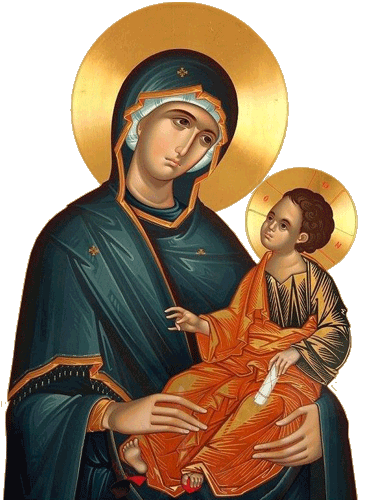
I recently read an account of the importance of Mary’s title “Theotokos” in a book called Steward of the Mysteries, by Bishop Nicholas Samra of the Melkite Church. He pointed out that in Eastern iconography, as a rule, Mary is portrayed with her Son. Her importance is in relation to Him. Just as She gave flesh to Christ, we are called to give flesh to the mystical body of Christ, the Church, when we go out into the world. (emphasis added)

The title “Theotokos”, the use of which was dogmatically ratified by the Council of Ephesus in 431, is very often translated as “God-bearer” or “Mother of God.” She was both, but this word means something distinct, I have been told - one who “bore and gave birth to God.” Any saint might be referred to as a God-bearer too, “theophoros”, as each of us is called to bear God in a spiritual, moral and virtuous sense, and by this, our flesh is informed and transformed by Christ. Mary is a “theophoros” too, but only she is Theotokos. She bore God in a physical sense, and gave birth to Him; Her flesh formed Christ’s.
I think this is not only a good rule but one that is in keeping with the very words of the Blessed Virgin in the Magnificat.  The direction of her words we so often sing accords with this rubric of iconography.  Her importance is in relation to Him.  That ought to be something any Lutheran (except an inconoclast) would joyfully affirm. My soul rejoices in God my Savior.  Would that we learned from her this important truth.  In an age of individualism when so many insist upon drawing all attention to themselves, Mary, the Mother of our Lord, does just the opposite.  She points us to Him who is the fruit of her womb.  Elizabeth recognized this as well and rejoiced that the mother of her Lord would come to visit her!

Even those who get all nervous and upset when the name of Blessed Mary is mentioned ought to be comforted that we look upon her in relation to her Son.  In this we are not imposing anything upon her that she does not impose upon herself.  Of course, art that depicts the Annunciation may appear to violate this rule but look at the context -- it is not an image of Blessed Mary alone but the Virgin to whom the Archangel announces her role and place in the salvation history of God's people.


Thursday, April 11, 2019

Receive the Son & Receive His Inheritance

[Jesus] looked directly at them and said, “What then is this that is written: ‘The stone that the builders rejected has become the cornerstone’?” (Lk 20:17). 

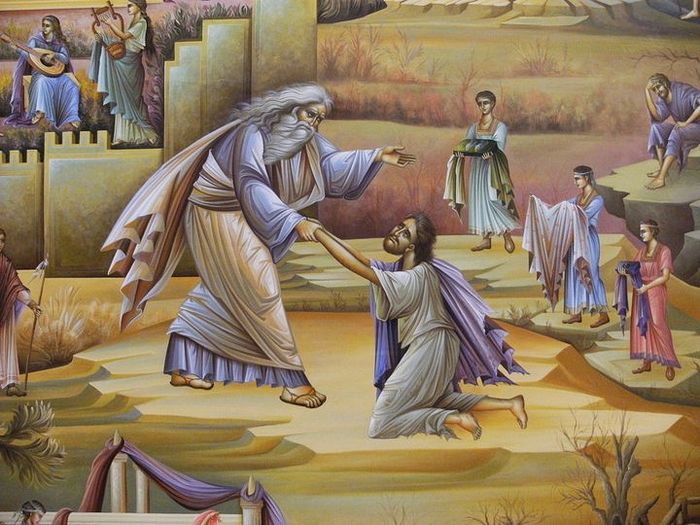
    Last week we heard the parable of parables, the story of the Prodigal Son.  This son asked for his share of the inheritance before his father’s death.  This request wasn’t just for money.  Ultimately, it was a rejection of the father; a wishing that his dad was dead. 

Today we hear another parable from Jesus, and again, rejection and inheritance plays a part.  A man planted a vineyard and leased it out to tenant farmers, expecting his rightful share of the fruit.  So when harvest time came, he sent his servant to collect.  But the tenants rejected the man and his servant.  They refused to live up to their agreement.  They beat the servant and sent him away empty handed.  And so they did to the 2nd and 3rd servants that were sent.  Finally, the man sent his son, thinking the tenants would respect and honor him, but just like before, they didn’t.  In fact, they escalated their violence.  They said, “This is the heir.  Let us kill him, so that the inheritance may be ours” (Lk 20:14).  And so they did.  Thinking they could lay claim and take the inheritance, they rejected and murdered the son.   

What foolish thinking!  How could these men think they would keep the vineyard after killing the man’s son?  In what world do murderers get the inheritance of the one they’ve murder?  That’s not how it works.  These tenants were fools, rejecting the man and his son. 
At the end of the parable, Jesus explained exactly what would happen to those foolish tenants: “[The man would] come and destroy those tenants and give the vineyard to others” (Lk 20:16).  And therein lies the meaning of this parable, reject the Son and be destroyed...but receive the Son and be given his inheritance.

We easily see how the tenants were foolish, but there’s someone else in the parable who was even more foolish, at least by our standards, and that was the man.  How foolish did he have to be to send his son?  In no way had those tenant farmers exhibited any trustworthiness.  I no way had their actions said they would honor the son.  In every way they showed themselves to be scoundrels capable of murder; and yet, the father still sent his son to them.  He gave his son into the hands of killers!  Why?  Because that’s what our Heavenly Father does.  God gives.  He continually gives.  He gave His Son because of His love for you.

This parable is nothing else than a retelling of the story of salvation.  The man of the parable is God the Father.  The tenant farmers are the people of Israel and its religious leaders.  The servants sent were all the prophets of old whom God sent to call His people back from their sin.  This call to repentance was continually rejected, over and over again.  Finally, God sent His beloved Son, and He too was rejected.  The religious leaders refused to receive Christ.  They refused to listen to His call of repentance; and with jealous anger, they delivered Him over to be murdered on a cross. 

It seems foolish that God would do such a thing.  Why give His Son up to be killed for sinners, for people who continually rejected Him?  Because of His love.  Our heavenly Father gave His Son into the hands of murderers so that He could have you, so that He could save you from sin and death and give you the inheritance of everlasting life. 

Just like the tenant farmers, we reject God over and over again.  We’ve been rejecting Him and sinning ever since our first parents.  Instead of recognizing that our life is a gift from Him, we live as if we’re in charge.  We reject any claim God has on us as our Creator.  Instead of living according to His Word and commands, producing fruits of obedience, performing the good works expected of us in service to Him and our neighbors, we do what we want, we take what we want.  We sin and sin.  And then, when God sends one of His servants to call us back from our sin, a pastor or one of our brothers and sisters in Christ, we refuse and reject them.  We may not physically beat them or kill them like the tenants in the parable, but we become angry with them, which our Lord has said is the same thing as murder (Matt 5:21-22).  And for this, we deserve nothing less than to be treated like the tenant farmers.  We deserve to be destroyed.  And yet, because of God’s unexplainable mercy, He sent His Son to be destroyed in your place.  

God gave His beloved Son to die on the cross, to receive the just punishment of your sin.  God sent His Son to be the cornerstone and foundation of our salvation so that you could receive forgiveness and everlasting life.  God promises this to all who receive His beloved Son with faith.  God wants to give this inheritance to you. 

    St. Paul says, “You have received the Spirit of adoption as sons, by whom we cry, ‘Abba! Father!’  The Spirit himself bears witness with our spirit that we are children of God, and if children, then heirs--heirs of God and fellow heirs with Christ” (Rm 8:15b-17b).  Baptized in Christ, you receive the Son for your salvation.  With the gift of faith, you know Christ your Lord.  You know Him as the cornerstone of your salvation.  And with this faith you receive His inheritance.  You receive the forgiveness of sins.  You receive everlasting life.  You receive salvation.

The tenants were foolish thinking they would get the inheritance after killing his son.  If they would’ve received the son and honored him, everything would’ve been good.  But because of their rejection, they threw it all away.  Don’t be like these tenants.  Don’t give up the gift for the dead-

end of demand or works.  Rejoice in Christ and rejoice in His inheritance.  Repent of your sin.  Build upon Christ the cornerstone of your salvation, and live in Him now and live for His everlasting life to come.  In Jesus’ name...Amen. 

Worship and Life. . .

Pure doctrine has often been mistaken as a goal or end in and of itself.  Indeed, that is the charge laid against churches like the Lutheran Church Missouri Synod who still emphasize pure doctrine.  Pure doctrine has become some sort philosophical pursuit of right language, of precise terminology, and of rational explanation.  But pure doctrine lives first in the life of the Church before it is penned to paper in creed, confession, or symbol.  And that is something we tend to forget.  It is not simply the lex credendi that is our focus.

I was reading the words of another and found this point eloquently described:
Lex orandi, lex credendi. Long before the Orthodox Church gathered in council at Nicaea, she was living the Orthodox faith. Long before the Church dogmatically confessed that Jesus Christ is homoousios with the Father, she was preaching a trinitarian gospel. Long before there was a St Athanasius, she was worshipping Jesus Christ and praying to the Father through the Son in the Holy Spirit.
The apostolic faith is not a museum piece to be admired as if it were simply art but it is to be celebrated every every day within the Divine Service and the Daily Offices where this doctrine is prayed and confessed.  It is no some precious gem to be kept hidden and secure except for a few times when it is paraded before people to admire.  This is living truth to be lived.  This is what Lutherans heard so very well when this connection between worship and confession, praise and truth, prayer and belief were placed into the Introduction to the Lutheran Worship hymnal in 1982 through Norman Nagel.
"Our Lord speaks and we listen. His Word bestows what it says. Faith that is born from what is heard acknowledges the gifts received with eager thankfulness and praise. Music is drawn into this thankfulness and praise, enlarging and elevating the adoration of our gracious giver God. Saying back to him what he has said to us, we repeat what is most true and sure. Most true and sure is his name, which he put on us with the water of our Baptism. We are his. This we acknowledge at the beginning of the Divine Service. Where his name is, there is he. Before him we acknowledge that we are sinners, and we plead for forgiveness. His forgiveness is given us, and we, freed and forgiven, acclaim him as our great and gracious God as we apply to ourselves the words he has used to make himself known to us. The rhythm of our worship is from him to us, and then from us back to him. He gives his gifts, and together we receive and extol them. We build one another up as we speak to one another in psalms, hymns, and spiritual songs. Our Lord gives us his body to eat and his blood to drink. Finally his blessing moves us out into our calling, where his gifts have their fruition. How best to do this we may learn from his Word and from the way his Word has prompted his worship through the centuries. We are heirs of an astonishingly rich tradition. Each generation receives from those who went before and, in making that tradition of the Divine Service its own, adds what best may serve in its own day – the living heritage and something new."
I am not sure that it is possible to deduce our way or even think our way to the Trinity but I am fully convinced that we can worship our way to the Trinity for this is exactly what happens every Sunday.  In the Divine Service we participate in this eternal truth.

Wednesday, April 10, 2019

Symbolic Justice. . .

I am not sure what to think about all the investigations of Trump, the outrages over police shootings, the prosecution of Cardinal Pell in Australia, reparations for slavery and the poor treatment of those in the past, and the like.  It does not seem like justice is the goal but more symbolic justice.  In other words, the guilt or innocence of the specific individual seems not necessarily relevant but the quest for holding someone accountable or punishing someone for the presumed sins of the many.  When was our legal system about symbolic justice?  Is it not to be about the guilt or innocence of the accused?

It seems Congressman Nadler has decided that Trump is guilty of something and therefore is looking for evidence that will justify impeachment.  This is a political goal but it is not the pursuit of justice.  Trump is unpleasant by all accounts but we have already had years of searching for complicity or collusion with Russia and found instead largely individual crimes by flawed underlings.  That is apparently not enough for some.

The public and private affronts to police using reasonable but not entirely accurate judgments in split second decisions presumes guilt and implies that the law matters less than symbolic justice against the suffering minorities (even when the offender is a minority).  This is a social goal but it is hardly a legal goal or an accurate usage of the judicial system.  Some have decided that the outcomes were so egregious that the individual guilt or innocence of the accused officers is secondary to the need for public and symbolic justice.

I have never met or know much of anything about Cardinal Pell but I have read that he was exonerated of the charges of which he has now been found him guilty, that he did not have to return to face judicial review but voluntarily gave up his diplomatic immunity, and that his character seems uniformly admired.  Some of my friends have suggested that he was going to be found guilty no matter the facts because Australia needed a scapegoat for the sexual abuse crimes of many priests.  This makes for great headlines but it hardly constitutes a definition of real justice -- if his innocence is true.

Compensation for victims, in this case for the victims of slavery and oppression, is a noble thought but the real victims are long ago buried and the people who would receive such reparations for injustice did not suffer what their ancestors did -- nor would the people paying the bill for such compensation be the guilty ones of old.  It is a great idea on paper but where does it end?  Is this what passes for justice -- the heirs of the oppressed benefit from the heirs of some of those who oppressed them (my own ancestors came to the country around 1900 from Sweden and Germany -- not exactly the plantation owners typified in the slavery of the past).  It is symbolic justice but could it be that symbolic justice is not itself just?

Some have likened the suffering of Jesus as symbolic justice.  God was meeting out the punishment for the guilty on His own innocent Son.  Absent any substitutionary atonement, the best you can make out of the cross of Christ is similar to symbolic justice.  But the Church has maintained that there was nothing symbolic about the suffering of Christ on the cross nor about the fruits of His redeeming work.  This is not a theory of atonement but its fact, not about the idea of justice but the radical new justice of mercy.  Jesus is not some victim chosen by the guilty to satisfy their quest for symbolic justice but the willing victim, who determines the day and the hour of His glory, and who goes to the cross for the joy that is set before Him.

It would seem to me that the world may dabble in symbolic justice but it would be best if the Church did not.  We dare not define Jesus as a mere scapegoat nor can we afford to speak of the cross as anything but the satisfaction for our sins by the innocent victim who goes willingly into its pain and death in order to redeem the guilty and bestow upon them the gift of life.  The categories of symbolic justice are new and fragile and may not even endure the current debate but the divine justice of mercy that triumphs over justice endures forever.  Jesus is no symbolic Savior but a real Redeemer who bleeds and aches and sighs and dies and lays in the ground to rise with the scars of His wounds as the victory marks that beckon us to know Him and the life only He can give.

Tuesday, April 9, 2019

More important than many care to note. . .

Churches like the Lutheran Church Missouri Synod face a convention cycle every now and again, well, in this case every three years.  There are enough shenanigans and goofiness in this preconvention time to make even the most stoic among us nervous.  Truth be told, it is not simply about issues but about personalities, not simply about visions for the future but the sins of the past, and not simply about what is best for the church as it is who gets to decide what is best for this church.  I wish it were over.

There are tales of doom and gloom that make the end of the world look tame.  There are accusations of incompetence and incoherence that would suggest we have a habit of electing the most flawed leaders among us.  There is the great temptation to make mountains out of mole hills and mole hills out of mountains.  It is a messy experiment -- this democratic style institution -- and it seems to get messier with every passing triennium.

Although reading this blog you might get another idea, I am far removed from the halls of power.  I have opinions and sometimes people agree with them but I have little influence and little desire to be a king maker.  That said, I do have a stake in the outcomes -- as does everyone in this church body.  We have a stake in what happens.  That is why we owe it to ourselves to be well informed -- and not simply from the tabloids or slick marketing tools of the various camps.  We need to look deeper to find out what is really at stake.  This is not a referendum on praise bands or a popularity contest about who you like or who you don't.  These kinds of gatherings have a great deal to do with who we are and how we present ourselves to the world around us.

So if you happen to be a delegate, take that responsibility seriously.  Before you peruse the pages of a weekly newspaper or internet site to find out how you should vote, you need to know who we are as Lutherans.  Try reading the Augsburg Confession.  Review the Small and Large Catechisms of Luther.  Read the Apology.  Check out the Formula of Concord.  Make sure that you can discern the funny stuff from the serious, the truth from error, and reality from the sensational.

We are voting on substantial things but we cannot vote on God's Word.  Doctrine is not established by majority or plurality.  We need to make sure that we are students of the Word and students of the Book of Concord before we study up on what the old voices of discontent in our church body and the new voices of change are saying.  Perhaps we need an SAT or ACT exam on Lutheran teaching and practice before exercising the vote.  It is, perhaps a radical idea, but it could not hurt.  So if you will be headed to lovely Tampa in July of this year, do yourself and your church a favor and dig into the Word of God and our Lutheran Symbols.  Make sure you can spot a red herring or a straw man or a sensationalist position.  Give us all a break and take your role, responsibility, and purpose very seriously.  Just a few radical thoughts. . .

Monday, April 8, 2019

Where go the Methodists?

A historic vote but to what end?  When the Methodists voted to agree to the most conservative of the options presented for what to do about GLBTQ marriage question, some rejoiced while others lamented even as most wondered about the shape of the future for this denomination.  Do we stay or do we go?  That is the question some congregations and clergy are facing in the wake of a surprising decision to retain their historic position on the issue.  Yet what kind of victory is it?

If Methodists split, the fracture will surely leave the denomination weaker than ever but it would at least offer some measure of homogeneity to each group.  The vote was significant but not resounding (438-384) and it probably signals the leanings of Methodists -- at least the ones in the US.  Though clergy who violate the ban could face loss of income or suspension, it seems unlikely that those committed to the GLBTQ agenda will stop what they are doing.  It also seems unlikely that they will fight all that hard to stay in a church body they cannot support.

Bishop Hee-Soo Jung of the Wisconsin United Methodist Conference said, "We are a wounded church. We are a divided church. We are a church in pain, and we are doing harm to each other."  That is certainly an understatement.  No one is entirely happy with the way things turned out.  Some believe that this vote will come up again and again and again until the progressive wing gains the upper hand.  Furthermore, it was another case of the leaders on one side of the issue and the folks in the pews on the other side.

The denomination’s bishops and many of its most influential clergy pushed hard for a choice that would have allowed local congregations, conferences, and clergy to make their own decisions about conducting same-sex marriages and ordaining LGBTQ pastors. This proposal was called the “One Church Plan” and it had, as one of its goals, the hope that the denomination might be kept together. In the end, Methodist delegates rejected its recommendations and chose the "Traditional Plan," which affirmed the denomination’s current teachings against homosexuality -- a stance already flagrantly and defiantly ignored by many within the denomination.

Underneath this all is another issue.  That is the fact that, in essence, this church body had a referendum on the teachings of Scripture and the teachings of Scripture lost.  More than 40% decided that the Bible was wrong and they did not want to be on the wrong side of a culturally defining issue.  We always say we cannot vote on what the Scriptures say and yet that is exactly what we do too often.  Since it is by vote, a vote can just as easily say that the Bible's position is either no longer relevant or tenable OR that this was not the correct reading of the Scriptures in the first place.  It is a tenuous victory, not that we should ignore it but neither should we be too comforted by it.  Stay tuned for more. . .

Sunday, April 7, 2019

Got an email again. . .

Okay.  I got another email.  From those telling me what I need to do to revitalize my parish and the larger church.  And me.  In that email I was told:
Ten or 15 years from now, there won’t be much left in most of today's churches...or in most church bodies.

  • Look at what’s unraveled in the last 5 years.
  • The believers coming behind us don’t want to inherit much of what we want to give them. (Ask them!)
  • Look at your own denomination…do you sense positive, forward momentum coming from the HQ?
  • The wonderful 70 and above crowd? It becomes a few.
  • Most church bodies, mine included, are mostly white…in an increasingly racially diverse future (43% of millennials are not white!).
Okay.  We all know that the statistics are not good.  But. . . before we act to abandon those now in the pews by alienating them with a worship form (I believe) is antithetical to our Confessions, perhaps we ought to take a good look at those who have.  In other words, I would like to see the statistics themselves unpacked to determine if the congregations losing the highest proportion of membership (or better attendance) are those who have also lost the liturgy and any functional Lutheran identity on Sunday morning.  It is my suspicion that the congregations using the liturgy have a rate of decline that is less than those congregations that have decided to bundle themselves as non-denominational evangelical wannabes on Sunday morning.  It is my suspicion that remaking a confessional Lutheran congregation to look, act, smell, and sound like the non-denominational evangelical congregation down the street will do little to slow or reverse the decline.  In fact, there are many statistics that would suggest that millenials in particular are more in tune with historic liturgy and ceremonial than with the fun church entertainment style so often promoted by those who think they can fix what is wrong with Lutherans.

One thing I can tell you is that even if the pews remain more full, the people in those pews are generally not Lutheran in identity or faith (not their fault since they are not taught to be Lutherans).  Furthermore, the people filling the pews tend to be (and statistics support this) not unchurched who are seeking church for the first time or even those who are coming back to church but the church shoppers who look for new churches like they would the latest and greatest new restaurant -- and they are gone to visit the next best newest church when it opens its doors.  

So, though I do believe their motivation is on target, I do also believe their guidance will not help us be faithful as Lutherans to our Symbols OR help us reach out to those burned out and turned off or who do not see themselves as people of faith at all.  What I do believe will help is a congregation serious about what is believed and taught, sober and reverent in worship, and using music as a servant of the Word instead of personal preference.  Furthermore, I remain unconvinced that Lutherans are failing because they are Lutheran but are failing more because they are failing to be Lutheran.  And if you have read this blog before, you will not be surprised by that statement. 

Saturday, April 6, 2019

The Survival of the Tannenberg Pipe Organs. . .


Throughout his career, David Tannenberg was well-regarded as an organ builder and was in high demand throughout the German-speaking communities to provide organs for their churches. His instruments were the largest and most complete in all of America at the time, and by 1830, many Moravian, Lutheran, and German Reformed churches housed organs made by Tannenberg or one of the other Pennsylvania-German organ builders. This resulted in the first German organ culture unique in the New World. Today, Tannenberg is widely regarded as one of America's greatest organ builders, and indeed, his work could be considered to be comparable to some of the greatest organ builders of that time in Europe. Although only nine of his organs survive today, his special lieblich style has survived in these instruments for us to enjoy. Today, eight of these nine organs either remained in or were restored to their original condition, and the remaining instrument in York has been partially restored, and will be completed in the next few years. 

READ ON HERE with photos and musical files to hear these amazing instruments from this amazing builder!

Friday, April 5, 2019

Code words. . .

Those who seek to bring about radical change seldom speak in radical terms.  Mostly they speak as a people who desire to conserve and who believe that in order to survive or flourish, the conservation must be stewarded by careful change.  But, as a great line put it, Progressive is usually code for departing from the teachings of Scripture and Tradition.  Something has to go.  Since the most important thing for many is the fact that the Church is judged by those outside her as relevant and authoritative, what has to go to preserve the Church's image and credibility are the distinctive things of the Church -- what Scripture says and how that faith has been preserved through time and space.

Strangely, those who are usually labeled radical are those who are not only trying to preserve and conserve but restore what has been lost.  A case in point.  My parish is celebrating our 60th birthday this year and, though we generally use Divine Service 1 or 2 from Lutheran Service Book, we have been using Divine Service 3.  It preserves the form in use when this congregation was founded and it has been conserved in our liturgical tradition since it was framed in 1941 in The Lutheran Hymnal -- itself a preservation of forms much earlier and most uniformly shaped in the Common Service of 1888.  All well and good, right?  Maybe not.

Since this order preserves the chanting of the Words of Institution -- not something usually done in the first two Divine Services, that chanting stands out like a sore thumb as something new -- a departure from the past.  In reality it is the restoration of the past (and something restored not simply locally but by rubric and setting in Lutheran Service Book).  Yet to Lutheran ears in Tennessee, it is radical, new, an innovation, and, worse, katholische.  This is, of course, rather goofy since Rome did not even speak these words loudly for the hearing of the people, much less chanted the Words of Institution, in so long I cannot even document it.  In other words, this is a distinctly Lutheran practice, innovated by Martin Luther, who directed that they be chanted in the Gospel tone.  So, to some, I am a progressive because they think I have innovated.  To others, I am a medievalist since I am preserving something unworthy or not essential to be preserved.

And therein lies the problem.  When we fail to know our history, we confuse what is progressive with what preserves and what preserves or restores with what is radical.  This is no small thing because it means that we are ripe for the plucking by those who seek to steal from us not some small liturgical practice like the chanting of the Words of Institution but the big things of Scripture and its clear teaching of the Gospel and Tradition and its preservation of that truth in every place and every time.  That is the big danger.  It is no big deal that a Lutheran pastor has to explain himself for something as small as the chanting of the Verba but it is a big deal when we have to restore what has been lost because we no longer know the difference between the sacred deposit once delivered to the saints and that which has been invented to make the faith more palatable or accessible to those outside the faith and more reasonable to those within who find believing a stretch.

By the way, the greater danger is not that Lutherans will come off looking like Roman Catholics to those who do not know better but that Lutherans will themselves presume that they are more like the big box evangelicals all around them than they are the people of the Augustana, the Catechism, and the faith they confess.  In essence, what we have today are Lutherans who know so little of their faith and history that they find it more reasonable to think of themselves as Methodists with a liturgy or vested Baptists when it comes to the Bible or friendly evangelicals when it comes to styling their church before the world than the people and faith the Symbols insist we are.  Sacraments are not some residual Catholic thing we can ditch but the essence of who Lutherans are.  The efficacious Word is not simply an inerrant Word but one that works -- that does what it says because the Spirit is at work in it and through it.  The liturgy is not adiaphora so be tinkered with or abandoned because we do not like it or we like other things better but the other side of the confession coin.  To lose it is to lose what we believe and not simply a format.  And all of this is hastened and encouraged by people who confuse conservers with progressives and progressives with conservers to the the point where it actually becomes reasonable to abandon the faith in order to save it.  Then, Toto, we are not in Kansas anymore.

Thursday, April 4, 2019

The limits of infallibility. . .

Papal infallibility is something Rome counts on as the cornerstone holding up their house and Lutheran blood boils at the prospect while most of the world laughs.  A while back a Roman Catholic blogger put out a one sentence post that I found rather interesting.

"Certainly the Pope is not infallible beyond the Deposit of Faith originally given."
It sounds profound and it is certainly true but it is not true in any way that it is not also true of anyone who holds to the Deposit of Faith originally given.  This is not a controversial statement at all but one Lutherans not only hold but hold joyfully.  This is what we confess in our Symbols.  The issue here is not infallibility regarding the Deposit of Faith but what is the Deposit of Faith.
Rome would insist that this statement does not equate with Scripture and that there is revelation beyond Scripture which must be held as part of the Sacred Deposit.  Here is where we part waters.  For Lutherans, the norming norm is Scripture alone.  That we all know.  But that the Word of God is also source and norm.  In other words, there is no binding revelation beyond that Word of God that is yesterday, today, and forever the same.  It is this Word that IS the Deposit of Faith.  It is not that we can believe that which does not conflict with Scripture but we cannot bind the conscience to anything about which Scripture is silent.  That is our issue with infallibility and with the definition of Deposit of Faith as defined by Rome.
The Creeds do not supplement the Word but summarize its teaching.  The Symbols do not add to the Word but confess that Word before the world.  The Liturgy does not compete with the Word but is that Word prayed.  When we begin to get this again, we will find unity among the traditions and renewal for a faith that seems strained under the weight of opinion and the conflict over what was always and everywhere believed, confessed, and taught.  
Larry Peters is not infallible beyond the Deposit of Faith originally given.  Go ahead and insert your name.  This is not a trivial statement but a profound one and one that points us right back to the Word of God that endures forever. 

Wednesday, April 3, 2019

The evolution of sin . .

While watching Rome try and figure out what to do with the priest abuse scandal, I read where one commentator lamented that there are those currently in power who tend to view the whole thing as a matter of structural failure (the sin of clericalism) as opposed to individual sin (homosexual behavior).  As true as this observation is with regard to Rome's soap opera, it is true in a larger sense for the way the world sees sin and wrong -- and the way Christians have become accustomed to defining sin.

The sins are seen more in terms of social justice than personal sin or failure.  So instead of blaming priests who violate the celibate order (whether homosexual behavior or heterosexual behavior), the issue is clericalism (abuse of power) or order (no one in their right mind should ever expect anyone to deny the basic sexual desire).  Now translate this into the world and the approach to everything from cohabitation to homosexuality to transgender to everything else under the sun is to make it the world's problem and not the problem of the person.  It becomes inconceivable that anyone can or should ever be asked to deny desire and, therefore, it is the job of secular institutions and religious institutions is to find a way to justify that desire and the fulfillment of it.  The sinner presents himself to God and to the Church not for correction or absolution but for affirmation and approval.  In the end, about the only role left for the Church in all of this is to encourage people to be true to themselves and their wants.  Any other approach to sin would require shifting the responsibility back onto the person and their desires.  In the end, such a view is lawless.  There can be no truth whatsoever and no morality that flows from truth.  It is situational ethics at its best and at its worst.

Rome's treatment of the priest sexual scandal is a textbook definition of the landmines and pitfalls that lie before the Church (any Christian who wishes to be orthodox).  There are many in Rome who are working as hard as they can to shift the whole scandal away from the personal sin of the priest (violating his own agreed upon celibacy or denying his homosexual desire) and onto the structures (a hierarchical church, priestly power, the abuse of that power, and, of course, clericalism.  The impetus for this has less to do with trying to figure out what to do about the scandal than it does a desire to radically remake that Roman Catholic Church.  They are promoting not simply an answer to the priest problem but an opening for Rome to give approval to gay, lesbian, bi-sexual, transgender, queer and whatever else they want to approve.  In addition, they want to remake the priesthood by opening the door to women and to married men (what becomes, in essence, the approval of relationships as equal to marriage).  The resistance understands this even though the current pope does not.

Lutherans should be paying attention to this -- especially Lutherans who do have not given into the prevailing pressure to normalize GLBTQ behaviors.  We are not contending for single issues but for a larger issue and not against individuals who have such desires but for the Biblical morality in which desire is not the ultimate truth but every Word that proceeds from the mouth of the Lord.  Wisdom.  Attend.  The burden is moved from finding passages that give actual approval to the passages that prohibit such and the exegetical task begins with a determination that there has to be a way to explain away the prohibition.  Then if God has not prohibited, He must have approved it.  And if God approves everything that is not prohibited, then the Church's job is to advocate for it.  So the exegete turns it away from the personal sin and behavior to the abuse -- Scripture is not talking about homosexual relationship but rape or the abuse that comes from the powerful dominating the weak.  If that sounds familiar, it is because it worked with the decision to ordain women and it is the process that is being used now for a host of other issues.

Tuesday, April 2, 2019

the Parable of Parables

Sermon for Lent 4C, preached on Sunday, March 31, 2019.

   Twitter and bumper stickers do not make for good theological answers.  What we want made short and easy, God makes long and complicated.  Jesus loves you sounds great until you face the threat of cancer or lose your job or mourn the death of a child.  Then the easy answer is not so easy and faith becomes complicated and messy.  Most of the time we tend to reduce the parables of Jesus into easy lessons with easy answers but in doing so we miss much of what Jesus is saying. 

    We tend to think we are the prodigals whose repentance ought to count for something, who deserve something of the grace shown to us.  But we just might be the resentful brother who wonders why his father forgave so quickly his good for nothing sibling and so foolishly gave him what he neither earned nor merited.  The romance in the parable lies with the prodigal son who did what we all wish we could do – spend ourselves into happiness and live out all that we want.  Even if he is a good for nothing, we all secretly wish we were him.  So it is so profoundly comforting that when the money runs out and the guilt sets in, we know God forgives us and will gives us back all that we lost.  At least that is how we read the parable.

    Nobody likes the older son, moody and jealous and who does what is right by his father but only because he wants the same things his younger brother wants.  The only difference is that the older son bides his wait for time, age, illness, and death because he knows he will have it all to do with as he pleases without having to face his father’s rebuke or disappointment.  So nuts to the older brother and his selfishness.  It is no wonder the younger brother wanted to cash in his chips and run away.  Who wouldn’t?

    The problem is that neither son is a good example.  We are both sons – those who do what must be done to get what we want and those who blow it foolishly because we think we deserve some self-indulgence every now and then.  So who should we focus upon?  If not the son who meets life with a champaign taste and a beer budget or the son of who says the right words but burns with jealousy in his heart – then who?  Who is the hero of this parable of parables?  It should be obvious.  It is the waiting father, the compassionate father, the forgiving father – the heavenly Father.  He is the hero.

    Jesus does not need to tell us a story to get us to think about ourselves.  We do that all the time already.  We cannot stop thinking about ourselves.  We are so conscious of our wants, needs, desires, and dreams that it is pretty darn hard to pay attention to a boring preacher on Sunday morning or sing hymns that have too many stanzas or pray for too many words.  We watch the clock because we are thinking about ourselves.
We come to church because we know we should and we think of everything except church while we are here and we leave as soon as we can – and then we think we ought to get a little more credit for having shown up in the first place.  We are sinners.

    But who is God?  God is the Father who wants to give us all things and daily and richly bestows upon us too much for our own good.  God is the Father who carries the wounds of a rejected Dad by a people who would rather live on their own terms and die on their own terms.  We stop loving God every time something does not go our way but but God is the Father who never stops loving us.  We resent the good we know we should do but God still loves us.  We run away to indulge ourselves but God still loves us.  God loves the good we do as His children and God forgives the evil we should not do as His children.  Even when we insist that it is all about me, God still loves us.

    His love is not some theoretical love that inhabits feelings and hearts or lives in words or ideas.  The love of the Father is concrete and unmistakable.  He sends forth His Son for sinners like you and me.  He accepts the righteousness of Christ to count us righteous.  He gives to those marked with death the everlasting life of Easter morning.  He does this out of pure grace and mercy and not because we can or do anything for Him.  He is the star of the story and this is what we miss in this and so many parables.  Jesus is not telling how we ought to live or what we should or should not do.  Jesus is confronting us with what the love of the Father that He is come to reveal by His cross, suffering, death, and resurrection.

    When God brings our dead brothers and sisters to life again through repentance we should rejoice as do the angels in heaven but instead we complain:  where these people were when we were out there alone trying to be good.  When we think ourselves good enough or better than most, the Lord calls us to look into the mirror of our souls and see that we are sinners as desperately in need of His redeeming grace as those whom we so quickly condemn.  When we want to cut and run because we think life is too hard, we are not getting the recognition we think we deserve, our marriage is costing us too much, children are harder than we thought, and all we really want is some time to and for ourselves, the waiting Father points us those who faithfully do His bidding as best they are able and asks us why we cannot do the same?  When we thrive on conflict and throwing gasoline soaked words into the small fires in our families and our nation, the Lord points us to the healing balm of His mercy and asks us to apply it to our world so filled with impatience and violence. 

Your brother was dead and now is alive, was lost and now is found.  You were dead and now are alive, were lost and now are found.  And this is the will of the Father, that all people might be saved and come to know Christ.

    God has thrown a party for sinners.  The best He has to offer has been slaughtered upon the cross and now is your food in this bread and cup.  He has clothed you in the royal robes of righteousness in your baptism.  He has washed you clean in His blood.  He has restored His family by the power of His grace and mercy.  You need to learn to rejoice in Him and not in what you think you have done or what you think you deserve or in what you think is fair.  You need to learn to rejoice in the mercy of the Father who has waited for you when you had no time for Him and who still waits upon you here in this blessed sacrament.  For until you learn to rejoice in the mercy of Your heavenly Father, life will seem to be all about pleasure at any cost or about duty that steals away all your pleasure.  Only when the focus is upon the waiting father can those waiting learn to rejoice.

How appropriate for the day when we have a 60th birthday party for our congregation.  A party for sinners.  That is today.  Not a pat on the back to a people who did good but a good God who loves sinners, redeems them, and works through them to build His church on earth.  That is our party.  It is not to tell tall tales of our heroism but of God’s mercy who lavishes upon the undeserving forgiveness, life, and salvation, and then sets free the forgiven to tell the world what He has done.  God has not given us a fatted calf but the flesh and blood of His Son, not a robe of our own but Christ’s own robe of righteousness to wear, and not a ring for a finger but the mark of the cross upon our hearts.  And not to us only but to countless thousands over 60 years in this place.  Today is not about us.  It is and always must be about God, if there is to be another anniversary.

    The waiting Father waits for the self-indulgent who give into whim and desire and He has provided a conscience to sound the call to repentance.  The waiting Father waits for the dutiful who do all the right things but with resentment in their hearts and He has provided a conscience to bring them to repentance.  To both the self-indulgent and the resentful the Lord speaks His Word, points to the salvation that comes not to the deserving but to sinners through Christ alone.  He gladly gives us all things in Him – things we do not deserve and never will and things    The waiting Father has given us all things in Christ.  That is the parable above all parables.  More than this, that is the story of our lives, redeemed, restored, and renewed in Christ our Savior.  Happy 60th Grace Lutheran Church.  Happy new birth day to a sinful world.  So great is God’s love for us, what can we do but say Thanks be to God!!

    In the name of the Father and of the Son and of the Holy Spirit.  Amen.

Who is the Church for?

Back to basics.  Sometimes the most basic thing is forgotten or ignored so long that it must be taught as if it were something new.  It is not new but the newness has become the familiar the old truth has become the stranger.  Surely this is exactly true when it comes to who the Church is and why she exists.

The internet, not always a good thing and certainly not neutral, has proliferated the confusion largely on the basis of anecdote.  Stories of people who feel that they Church has dishonored them or denied them or failed to appreciate them or ignored them or dismissed their feelings have created a clamor for a more responsive community of faith that will not dishonor the members (or even those outside) by denying them or their feelings or their desires.  Such us the case over and over again when one finds a story of the Church's injustice toward someone (note here that I am NOT talking about abuse or commenting upon that scandal).

While we find this in Roman Catholic circles, it is no less a problem in Lutheran ones or in the general sphere of Protestantism, either.  The Church is conceived as some mass movement, some democratic institution whose purpose is the happiness or satisfaction of her people and whose truth is adjustable to fit the feelings and movements of people and the times.  It is, of course, the idea of the Church as grand therapist, of worship as largely self-help therapy, and of the truth existing to support and give space for the free reign of feelings.  Therapeutic deism is not just the rage, it has become the truth so true that the reality has been erased from the memory of many.

Accordingly, the church exists for the sake of the people.  Fidelity to the Lord and to His Word is less important than responsiveness to the people, to their felt needs, to the affirmation of their whims and desires, and to the ultimate justification not of the sinner before a righteous God but of feelings and a sense of well-being above all things.  More specifically, the Church is to be a stage for us to perform what we want or to display who we are -- all within a perfectly free atmosphere in which judgment is withheld and everyone is as good as gold in their own eyes and in God's -- except of course when we are victims of the hate speech or control mechanisms of others who wish to restrain us and the free reign and dominance of our feelings more important that truth.

Because we believe the constituency of the Church (as opposed to her mission) are the people, who the Church is and for whom she exists is tilted away from God and His purpose to what we think we need.  Right now, we think we need affirmation, we need to feel good about ourselves, and we need the freedom to define ourselves without constraint or judgment.  In other words, the Church is, at least in the minds of many, a giant therapist whose role and purpose is to listen and encourage us in what us meaningful and true for me. No wonder sin and forgiveness do not enter the vocabulary of such a church and no wonder there is so much talk about our dignity.  The Church has become the divine vehicle of self-expression, a super canvas in which we paint ourselves and our reality the way we think it should be.  No wonder there is no talk of a constant and unchanging morality or ethical standard (other than to be true to self).  The Church is a heavenly arm of the social media in which we daily and even hourly spew forth what is on our mind or what we are thinking or feeling at the moment.

The problem is this.  We did not create the Church.  The Church exists not for our pleasure or self-expression or even for our happiness.  The Church exists because God established her and the Church exists to fulfill His saving purpose in the world.  His gift of freedom is not without limit or direction and He has set us free so that we might live in relationship to the God who made us and redeemed us -- a relationship defined by this same God toward a goal and purpose directed by this God.  This is the old idea that has become radical and new to a world which has slowly eased the Church from the hands and direction of God and made her into a human institution shaped for distinctly human purposes.  Until we get that right, a term like church does not speak clearly but has become a muddle to a world and to those who claim membership in her but who know her as something distinctly different that living organism God created her to be.

Monday, April 1, 2019

The ascent of man. . .

Even Christians have learned to see human history as an ascent, a rising path from meager beginnings to the triumph of man over limitations great and small.  Christian children are immersed in this idea from the earliest days of their lives -- from cartoons to school texts to the history of civilization.  So it is no wonder that it is hard going when they go to Sunday school or catechism class and are taught that God created all things and not simply as a deity who flips a switch to start the ball rolling.

As a child we read National Geographic and watched all the programs that detailed the plight of primitive man in a modern, educated, and scientific world.  The goal of civilization is to bring into the main thrust of life all those tribes left behind by accident or geography.  The ascent of man is presumed to be fact and truth unassailable by any real challenge and technology is considered the prime example of man's ascent, the triumph of intellect.

But what if man's technological ascent is not some rising tide over time?  What if the primitives that we have found were once superior and experienced dramatic decline?  How is it that great achievements like the pyramids could happen side by side such primitive societies?  Could it be that man's ascent is not some neat trajectory toward a peak but zig zags, ups and downs, or, worse, a decline?  Could it be that it is a descent instead of an ascent?  Could it be that an ascent of technological progress could be accompanied by a moral and cultural descent?  Take a look at the arts and the intricate refinement of music or painting and then listen to one note popular songs or vulgar rap or art that shows a crucifix in a vat of urine -- is this progress?  Can we compare the great fugues of Bach with the silly trivialities of modern music and say things are better now?  Or can we compare the complex tonalities of great music masters with the atonal inventions of modern composes and say these will have the same staying power?  Can we look at the Michelangelo's great work or Botticelli and look at a the random splash of color on a canvas and say that this is the shape of progress?  Can we look at the breakdown of the family, the vast numbers of children aborted, the preoccupation with sex and desire, the promotion of vulgarity in the media and say this is the triumph of man?

I hope I am asking a question that many others are also asking.  I hope that this challenge to the single rising line of progress is enough to challenge the idea that technological progress is enough to say we are improving as a race and a people.  In the Scriptures we read of a real Fall -- not a symbolic failure but the seeds of evil that have sown corruption to challenge the whole idea of progress and offer us another picture to describe what is going on in the world around us.  Science has become values neutral and has tried to teach us to see things in the same way but this is surely not a sign of our improvement but a mark of our decline.  Until we begin to challenge the whole idea of progress, we will be left trying to reconcile the idea of sin with a world that most folks have been conditioned to see as a line of ascent, a triumph of mind and will, and the improvement of what either squirmed out of the swamp or began at the command of God.  Evolution is not a nice and neat explanation to the question of beginnings but the propaganda of secular humanism that is so full of itself it has come to believe its own lies.  That, my friends, is no April Fool's joke.