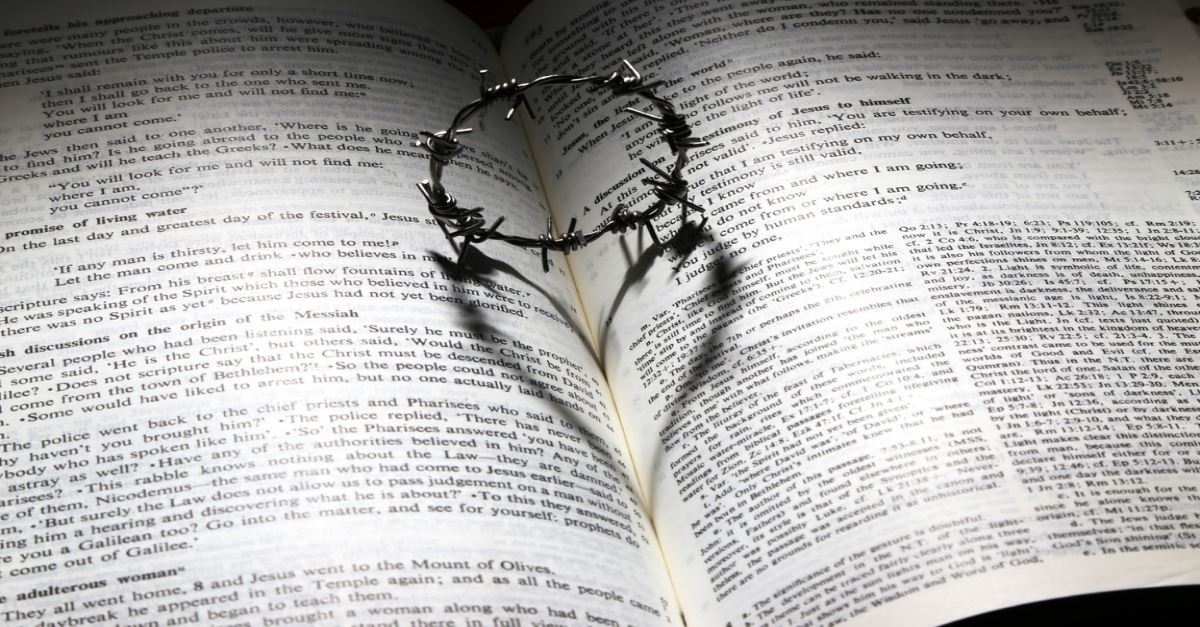
Tuesday, June 9, 2020

Living in the Triune Name. . .


Sermon for the Holy Trinity, Sunday, June 7, 2020, preached by the Rev. Daniel M. Ulrich.
[Jesus said]: “Go therefore and make disciples of all nations, baptizing them in the name of the Father and of the Son and of the Holy Spirit” (Matt 28:19). 
               Your name is a special thing.  It identifies you and your family.  But I’m not talking about your first, middle, and last name given to you at your birth.  I’m talking about the Triune name of God that He placed upon you in your baptism.  This name proclaims who you are.  This name proclaims whose you are.  You belong to the Lord, a baptized child of God.  YOU BEAR HIS TRIUNE NAME, AND YOU LIVE IN THAT NAME. 
               We too easily think about our baptisms as being a thing of the past.  Whether we were baptized decades ago or just last week, we think of it as history.  But your baptism isn’t history.  It’s a present reality.  It’s who you are right now, at this very moment, and it’s who you will be tomorrow and the day after that, and that day after that, all the way into eternity.  You’re the Father’s creation.  You’re the Son’s redeemed.  You’re the Spirit’s sanctified. 
               You’re the Father’s creation.  Contrary to the popular theory of evolution that you’ve been taught in school and read about in the natural history museums and see on the Discovery channel, you’re the purposeful creation of God.  Humanity isn’t an accident.  You’re not an accident.  The Lord has purposely given you life.  The Psalmist praises God saying, “You formed my inward parts; you knitted me together in my mother’s womb.  I praise you, for I am fearfully and wonderfully made” (Ps 139:13-14).  God knew exactly what He was doing when He made you.  He intimately put you together.  Nothing else in creation was made in this way. 
               God brought all things into existence by speaking.  He said “Let there be,” and there was.  But that’s not how God made humanity.  He made you and me by forming us out of the dust of the ground and breathing the breath of life into us.  He got His hands dirty and He created us in His own image.  This can’t be said about anything else in creation, only us.  We are the crown of His creation, created in His image.  And because of this life has value.  All life matters to God. 
This is something we need to constantly hear, because sinfully we don’t think all life matters.  We put qualifiers on life.  Society says the life of the unborn child is less valuable than the life of the mother.  And if the birth of that child puts too much of a burden on the, well then, kill it.  The same can be said about the elderly and those with disabilities.  With sin we view them as useless and a drain on resources and time. Our culture is a culture of death, thinking it’s better for people to die than for us to be “burdened” by them. 
We let superficial differences, like the color of our skin, the language we speak, the places we’re from, we let these things divide us.  Our sin makes these divisions grow, getting deeper and wider, leading to racism, hate, and disdain.  Our sin bursts forth and refuses to think of others.  We don’t love and care for others.  We only love and care for ourselves, our wants, our desires.  These are the things we value.  And if we have to trespass against someone’s life to get what we want, well so be it.  Our sinful Old Adam doesn’t want life, but death.  We need to be saved from this.  We need to be redeemed from this; and we are in Christ.
               After the Flood, God said to Noah, “Whoever sheds the blood of man, by man shall his blood be shed, for God made man in his own image” (Gen 9:6).  This is what we deserve.  We deserve to have our blood shed because of our sin.  We don’t value the life God created.  And yet, this blood punishment, this death sentence, it hasn’t been placed on you, but on God’s own Son. 
You’re the Son’s redeemed, purchased and won from all sin and death with His holy precious blood and innocent suffering and death on the cross.  Christ gave His life for yours.  He died so you’d live.  He died so that all would live.  God loves all the lives He’s created that He willingly sacrificed the life of His only begotten Son.  That’s what Peter and all the other apostles proclaimed in all those different languages on Pentecost.  Christ died not just for your sin and mine, but for the sin of the all world.  He desires all to be saved.  Christ sent out the apostles to baptize all nations, so that we all would be saved; so that we all would receive life, so that we all would receive His promised Spirit
               You’ve received His promised Spirit.  You’re the Spirit’s sanctified.  You’re God’s holy people, bearing the sign of the cross, bearing God’s name.  And with the help of the Spirit you live lives that honor His name. 
               You’re God’s holy people, and as such, you need to live like it.  Scripture and the Small Catechism tells us what our baptism means.  It means the Old Adam in us should by daily contrition and repentance be drowned and die with all sins and evil desires.  It means we need to repent of all the times we haven’t valued life.  It means the new man should daily emerge and live before God in righteousness and purity forever.  It means we show Christ’s righteousness as we love our neighbors, valuing their life, helping them in their needs.  It means we forgive as we’ve been forgiven.  We can’t let hate and disdain rule our lives.  We need to repent of it and forgive.  On our own we fail at this, but God has given you His Spirit, and He will enable you to do this.   
You are baptized in the name of the Father, and of the Son, and of the Holy Spirit.  You’re born again, born from above, born for everlasting life.  You’re a child of God.  Live as His creation, thanking Him for your life, and the life of all people.  Live as His redeemed, repenting of your sin, seeking His forgiveness and salvation in Christ.  And live as His sanctified, with holy lives that honor His name.  In Jesus’ name...Amen. 

Not literal nor juridical...

The implosion of Methodism has been long in coming.  Some have suggested that it was helped along by merger.  I find that most ironic.  There was a time when mergers were all in vogue and it was presumed that we were doing God a great favor by reducing faith to minimums that divergent traditions could accept and adding diversity to Scripture, apostolicity, and catholicity.  This was a time in which it was hoped every last Protestant division could be healed with a majority vote and the stroke of a pen.  History has not been so kind to mergers.  For every church merged, several were created who refused the proposal of marriage.  Worse, the merged churches found themselves in disagreement, distress, and decline in the wake of disasters over what Scripture said, the role of reason and experience, and the fruits of sexual liberation in the culture around them.

Methodism has been especially hard hit because some actually took their doctrinal statements and Book of Discipline seriously.  Most of them were not in America but in the missions once planted whose voices heralded caution to the way most American Methodists were ready to cast their history to the wind.  And now Methodists are no longer United and working out a divorce with the division of property being the inevitable major issue.

As others have chronicled, the 1972 Book of Discipline gave a preview of the present mess when it it proposed that four sources should guide Methodist theological reflection: Scripture, tradition, reason, and experience.  Now officially Methodism had elevated reason and experience to the equal of Scripture -- a place where tradition had not even been.  As if it could not be made worse, the same theological statement insisted that the doctrinal standards of the newly constituted church were “not to be construed literally and juridically.”  People began to take this at its face value.  United Methodist doctrine became unenforceable and so every crazy position was impossible to rebuke or reject.  Doctrine became a mere matter of individual opinion and Scripture was not normative to any of it.

Of course, Methodists are not alone.  The Episcopal Church had also relegated the 39 Articles to the category of historical statements and it has been in free fall even longer than the Methodists the Anglicans had once spawned.  It has also suffered its own heretics and as long as they were properly vested found it impossible to hold them accountable to anything -- anything, that is, except the sacred tenets of the GLBTQ+ agenda.  The curiously named Bishop Love of Albany has found himself in a mess that somehow escaped Bishops Pike and Spong.  Doctrinal standards may not have any teeth but the duty to fall in line with the sexual liberation agenda can be enforced.  And this was the trigger that finally undid the unity of the United Methodist Church.

And Lutherans have gone the same path.  The ELCA has become a loose confederation of individual synods united by a paper thin confessional subscription, a common hymnal, and the absolute loyalty to the GLBTQ+ agenda.  It spun off a couple of churches along the way -- one trying very hard to be the ELCA prior to 2009 and the other looking more like congregationalist cooperating in certain areas than a real church body.  The pressure is on Missouri to do the same.  There are many who believe that Districts are semi-autonomous entities able to dismiss or disregard the rules and theological statements of the whole.  There are congregationalists who act as if the Synod is incapable of anything more than a polite suggestion to the supreme domain of the parish.  And, of course, there are those who believe that doing what seems right in your own eyes is the key to revival and renewal.  Who is to say how this will end up for Missouri?

Of course, I have a vested interest in this.  The whole of my forty years as pastor have been within this church body and I entered the roster in the wake of a split that seemed for a time to be able to make us walk our separate ways instead of walking together.  The correct side won the battle for the Bible but they appear to have lost nearly every battle since.  Districts and their presidents seem intent upon going their own ways.  Ecclesiastical supervision sounds fine on paper but is a devil to enforce.  On social media large and influential parishes flaunt the theological commission of their own church to promote internet communion.  I am fairly confident that Missouri will shrink both in size and in influence from now through the end of my life.  Our mission work is about our only cause for hope.  The college system that once produced many dedicated church workers seems on the precipice of disaster (both financial and confessional).  Our national leaders have been reduced in numbers by a restructuring a decade or so ago and we have effectively turned them into beggars to keep the thing afloat.  I am not ready to give up but I am greatly concerned and I do not know anyone who isn't.

In the end what has undone us is the idea that Scripture must be informed by reason and experience and that tradition is even less reliable than reason and experience.  It is a cancer that has infected us all.  Rome is not immune and Orthodoxy is facing its own juridical tests.  If what we confess is not literal and it has not juridical stature, there is little to unite us except political opinions.  The emptiness of Protestantism is that it talks more about climate change, sexual liberation, and personal fulfillment than it does the Scriptural theme of sin and forgiveness through the death and resurrection of our Lord Jesus Christ.  The pandemic has proven that we will do everything to protect our mortal lives but may be willing to surrender just about anything of our spiritual lives in order to feel safe and be comfortable.  If I were God I would walk away and start over.  But everyone is relieved that I am not God and God is not yet ready to walk away.  He contends for those whom He has redeemed with the precious blood of His Son and He is determined to deliver us to the destiny He has prepared in everlasting life.  This is our faith and this is our hope.  It is the central message of Scripture, the unfailing witness of tradition, the one eternal thing worthy of our reasoned focus, and the fruit of experience guided and guarded by the Holy Spirit.

Monday, June 8, 2020

Faith and masculinity. . .

I opened the copy of The Living Lutheran that sat on top of the stack of mail in my office.  Wrong move.  First of all is the celebration of 50 years of the ordination of women, 40 years of the ordinary of women of color, and 10 years of the ordination of those with a gender of choice and all the other letters that go with it.  But I will pass on that for now.  This is the ELCA and it is predictable.  These are the things that are featured in their official periodicals now for some time.  If it is not normal, it is the normal that their sanctioned media choose to portray. 

Then there was an article that piqued my interest.  Generation to Generation: How a father and son see faith and masculinity.  Well, big mistake.  It is not so much about faith at all but greatly about masculinity -- though not quite what you would expect.  Where to begin?

Son celebrates that Dad taught him that God is not stagnant but that our conception about God and our relationship with God fluctuates.  It is a flexible faith for a flexible deity.  Father gushes about how much he has learned from his son on how we are intended to live as part of a harmonious creation.  Apparently the family did not spend much time in the Catechism.

Then to the masculinity.  First a definition:  a person who performs the male gender and also is born with male physiological characteristics. . .  Hmmmm.  Well, it is the ELCA and the ELCA is a parrot of the current thinking and jargon on gender stuff.  Apparently you are healthy if you  are untethered from the cultural norms (except, of course, the current cultural norms; the bad ones being the old ones reflected in, say, the Scriptures).  Dad insists that Genesis 1 and its binary creation is inherently false and that masculinity is defined by love for neighbors and creation (but not God?!?!?!).  Well, what do you expect from a cisgendered male?!?

Son says God has called for acceptance and love.  Apparently holiness and righteousness are not working words in the new vocabulary.  Then comes some sentimental stuff about men cooking and women earning more than men along with a complaint about the few times he was spanked growing up.  Dad hopes his son will not repeat his mistakes in parenting and promises to reflect upon why he did what he did as parent growing up.

Back to faith.  Dad is sure God exists despite his doubts but, after all, you don't have to be possess perfect faith in God to be perfectly faithful to God's creation.  Nothing there about Jesus, sin, death, or anything else of orthodox Christianity.  Son says his faith's evolution rarely strengthens my belief in God but does bolster his faith in humanity. He also warns against attributing too much to the Holy Spirit in your life.  But there was never much danger of that in this conversation.

Dad insists that good/bad is bad binary.  But since none of us can know the mind of God, naivete is not a bad thing and more naivetes are even better!  The Sufi mystic Rumi might be quoting Jesus (or not) and says beyond good and bad is a nice field where we can picnic and where we can explore the freedom to be wrong.

My snark was in high gear today.  Nevertheless, as goofy and ridiculous as this article was and is, the bigger questions behind all of this is what does the ELCA believe, confess, and teach?  In other words, is this stuff even remotely Christian.  And if it is not, then why does the ELCA promote such drivel and can the ELCA legitimately claim to be Christian anymore?  It gave up Lutheranism a long time ago.  By the way, lest you think that these are two normal pew sitters, the son is graduating from an ELCA college and the dad is an adjunct prof at an ELCA seminary.  Well, the son did say that the grace of God is the gift of making mistakes and being forgiven.  Perhaps they are Lutheran after all.  Since some Lutherans believe that since it is God's job to forgive, it is our job to give Him something to forgive.  And they gave God a lot to forgive in that brief article.

If you are a member of an ELCA congregation, you need to decide if this is reflective of who you are or not.  And if this is not who you are, you need to find an orthodox Lutheran congregation and join it.  Nobody who is uncomfortable with this kind of thing should remain in a church body that promotes this before their membership and the world. 

Sunday, June 7, 2020

Holy Trinity


It is truly meet, right, and salutary that we should at all times and in all places give thanks to You, holy Lord, almighty Father, everlasting God, who with Your only-begotten Son and the Holy Spirit are one God, one Lord. In the confession of the only true God, we worship the Trinity in person and the Unity in substance, of majesty coequal. Therefore with angels and archangels and with all the company of heaven we laud and magnify Your glorious name, evermore praising You and saying:


On this day we sing of the God who has revealed Himself in the mystery of the Holy Trinity.  The Trinity is not some ancillary dogma but the heart and core of our Christian identity.  To get this wrong, is to cease to be Christian.  To get it right is not to presume to unpack the mystery of the God who is one and one in three but to confess it faithfully before the world.  What better way to do this than with the ancient texts of the Gloria, the Te Deum, St. Patrick's Breastplate, and the Athanasian Creed.  So here they are below.


Athanasian Creed

       Whoever desires to be saved must, above all, hold the catholic faith.
Whoever does not keep it whole and undefiled will without doubt perish eternally.
And the catholic faith is this,
that we worship one God in Trinity and Trinity in Unity, 
   neither confusing the persons nor dividing the substance.
For the Father is one person, the Son is another, and the Holy Spirit is another.
But the Godhead of the Father and of the Son and of the Holy Spirit is one: 
   the glory equal, the majesty coeternal.
Such as the Father is, such is the Son, and such is the Holy Spirit:
the Father uncreated, the Son uncreated, the Holy Spirit uncreated;
the Father infinite, the Son infinite, the Holy Spirit infinite;
the Father eternal, the Son eternal, the Holy Spirit eternal.
And yet there are not three Eternals, but one Eternal,
just as there are not three Uncreated or three Infinites, but one Uncreated and one Infinite.
In the same way, the Father is almighty, the Son almighty, the Holy Spirit almighty;
and yet there are not three Almighties, but one Almighty.
So the Father is God, the Son is God, the Holy Spirit is God;
and yet there are not three Gods, but one God.
So the Father is Lord, the Son is Lord, the Holy Spirit is Lord;
and yet there are not three Lords, but one Lord.
Just as we are compelled by the Christian truth to acknowledge each distinct person as God and Lord, 
   so also are we prohibited by the catholic religion to say that there are three Gods or Lords.
The Father is not made nor created nor begotten by anyone.
The Son is neither made nor created, but begotten of the Father alone.
The Holy Spirit is of the Father and of the Son, neither made nor created nor begotten, but proceeding.
Thus, there is one Father, not three Fathers; one Son, not three Sons; one Holy Spirit, not three Holy Spirits.
And in this Trinity none is before or after another; none is greater or less than another;
but the whole three persons are coeternal with each other and coequal, so that in all things, as has been stated above, the Trinity in Unity and Unity in Trinity is to be worshiped.
Therefore, whoever desires to be saved must think thus about the Trinity.
But it is also necessary for everlasting salvation that one faithfully believe 
   the incarnation of our Lord Jesus Christ.
Therefore, it is the right faith that we believe and confess that our Lord Jesus Christ, 
   the Son of God, is at the same time both God and man.
He is God, begotten from the substance of the Father before all ages; and He is man, 
   born from the substance of His mother in this age:
perfect God and perfect man, composed of a rational soul and human flesh;
equal to the Father with respect to His divinity, less than the Father with respect to His humanity.
Although He is God and man, He is not two, but one Christ:
one, however, not by the conversion of the divinity into flesh, but by the assumption of the humanity into God;
one altogether, not by confusion of substance, but by unity of person.
For as the rational soul and flesh is one man, so God and man is one Christ,
who suffered for our salvation, descended into hell, 
   rose again the third day from the dead,
   ascended into heaven, and is seated at the right hand of the Father, God Almighty, 
   from whence He will come to judge the living and the dead.
At His coming all people will rise again with their bodies 
   and give an account concerning their own deeds.
And those who have done good will enter into eternal life, 
   and those who have done evil into eternal fire.
This is the catholic faith; whoever does not believe it faithfully and firmly cannot be saved.

Saturday, June 6, 2020

Because he is a dog. . .

It has been observed that dogs chase cars not because they expect to catch them but because that is what dogs do.  Others have put it this way.  Dogs bark at trains not because they expect the trains to stop but because that is what dogs do.  In any case, it is as obvious as it is obscure in its wisdom.

Sometimes I admit to feeling much like a dog barking or chasing and that is who I am.  Perhaps some folk would figure that it is useless activity to bark at things that are not as they should be since chances are not great that my barking gets noticed or will change anything.  But that is what dogs do.  That is what I do.

Some of you might grow tired of my barking.  Sometimes I grow tired of myself.  Some of you might complain that the barking is repetitive.  You have heard that bark before.  Well, I suppose you have.  I expect that I have repeated myself more than I know and more than you care to read.  I am not at all sure that this requires an apology on my part.  On the one hand, this is a blog and you are free not to read it just as you are free to disagree with the opinions of the author (who represents his own opinions and not those of his church, church body, wife, or family).  Being repetitive is not a crime.  In fact, it might be more typical than it is unusual.  All the great authors repeat themselves.  Even God says the same thing to us over and over again.  If the preacher is faithful, he will repeat himself (and not simply when preaching on the same text over and over again).  After all, if Jesus insists that He is not come to speak His own words but the words of the God who sent Him, then every preacher should at least plead guilty of doing the same.  Novelty often is the enemy of faithfulness.

Great writers and thinkers often return to recurring themes and messages.  I am not at all trying to say I am great but to suggest that my own meager efforts are in good company.  Dogs bark.  We can presume that somebody understands that bark -- at least the dog doing the barking.  To the rest of us it sounds rather repetitive and probably annoying. Maybe that is how you view this blog.  Maybe my words are not as clear to others as they seemed to me when I wrote them.  Maybe you fear you have heard my bark before.  It could be that my bark was not all that appealing when you first heard it and it has not improved by being heard over and over again.

Preachers repeat.  It is not accidental but intentional.  They should repeat.  Preaching is not necessarily the best venue for the creative.  It fits better those who are willing to borrow the words of another and make them their own.  That is the nature of preaching.  We speak not of what we know and done but of who we know and what He has done. That is how it should be.  Such should not discourage the wordsmith from his craft but at least teach him that it is not the power of his words that affects people but the faithfulness of those words to Christ, the Word made flesh.  From March through May I probably preached some 100-125 times.  I expect I was not alone.  They were strange times and are still not over.  But the times did not demand entertainment or novelty.  They required faithfulness.  I am not sure if any of those sermons will be remembered but the Word of the Lord was not and will not be forgotten.  It served as a rudder to the ship of the Church on uncertain waters.  It was hope to those despairing, comfort to those distressed, strength for those weak, and courage in the face of fear.  Sins were forgiven, hearts were consoled, and minds reassured.  God did the work but the pastor provides the mouth.  God's Words fill the mouth and if they fill the mouth, they will also fill the ear of the hearer and the mind and heart of the believer. So this dog will continue to bark. 

Friday, June 5, 2020

Life and Death and Life again. . .

At age 22 Johann Sebastian Bach put together this cantata for a funeral.  Whose funeral we do not know.  But it was a more than a mere compilation of texts matched to wonderful music.  This was a theological tome setting the life and death of God's people within the context of Christ's life, death, and resurrection.  The faithful join at last in Simeon's song of faith, not resigned to God's will but rejoicing in it.   "This extraordinary music," writes John Eliot Gardiner, "composed at such a young age, is never saccharine, self-indulgent or morbid; on the contrary, though deeply serious, it is consoling and full of optimism." But this is not optimism.  This is filled with hope, hope planted in Christ's redemption and confident that what God ordains is always good.


Cantata BWV 106
Gottes Zeit ist die allerbeste Zeit (Actus Tragicus)
English Translation in Interlinear Format
Cantata BWV 106 - God's time is the very best time
Text: Acts 17: 28 (Mvt. 2a); Psalm 90: 12 (Mvt. 2b); Isaiah 38: 1 (Mvt. 2c); Luke 23: 43 & Martin Luther (Mvt. 3b); Adam Reusner (Mvt. 4); Johann Leon (Mvt. 6)
Chorale Texts: Ich hab mein Sach Gott heimgestellt | In dich hab' ich gehoffet, Herr | Mit Fried und Freud
Biblical quotations are in green font, chorale quotations in purple font
1
Sonatina

Flauto I/II, Viola da gamba I/II, Continuo

2a
Chorus [S, A, T, B]

Flauto I/II, Viola da gamba I/II, Continuo

Gottes Zeit ist die allerbeste Zeit.
God's time is the very best time.
In ihm leben, weben und sind wir, solange er will.
(Acts 17:28)
In him we live , move and are, so long as he wills.
In ihm sterben wir zur rechten Zeit, wenn er will.
In him we die at the right time, when he wills.


2b
Arioso [Tenor]

Flauto I/II, Viola da gamba I/II, Continuo

Ach, Herr, lehre uns bedenken, (Psalm 90:12)
Ah Lord, teach us to think
daß wir sterben müssen,
that we must die
auf daß wir klug werden.
so that we become wise.


2c
Aria [Bass]

Flauto I/II, Viola da gamba I/II, Continuo

Bestelle dein Haus; (Isaiah 38:1)
Put your house in order
denn du wirst sterben
for you will die
und nicht lebendig bleiben.
and not remain living.


2d
Chorus

Flauto I/II, Viola da gamba I/II, Continuo

Es ist der alte Bund:
It is the old covenant:
Mensch, du mußt sterben!
Man, you must die!
Soprano:
Ja, komm, Herr Jesu, komm!
Yes, come, lord Jesus. come !

(Ecclesiasticus 14:17)
(Revelations 22:20)


3a
Aria [Alto]

Viola da gamba I/II, Continuo

In deine Hände befehl ich meinen Geist;
Into your hands I commit my spirit;
du hast mich erlöset, Herr, du getreuer Gott.
(Psalm 31:6)
you have redeemed me, Lord, you faithful God.


3b
3b. Arioso [Bass] and Chorale [Alto]

Viola da gamba I/II, Continuo

Heute wirst du mit mir im Paradies sein.
Today you will be with me in paradise.


(Luke 23:43)
Mit Fried und Freud ich fahr dahin
With peace and joy I travel there
In Gottes Willen,
in God's will,
Getrost ist mir mein Herz und Sinn,
my heart and mind are confident,
Sanft und stille.
peaceful and calm.
Wie Gott mir verheißen hat:
As God has promised me:
Der Tod ist mein Schlaf geworden.
death has become my sleep


4
Chorus [S, A, T, B]

Flauto I/II, Viola da gamba I/II, Continuo


Glorie, Lob, Ehr und Herrlichkeit
Glory, praise, honour and majesty
Sei dir, Gott Vater und Sohn bereit,
be given to you God father and son,
Dem heilgen Geist mit Namen!
to the holy spirit by name!
Die göttlich Kraft
God's strength
Mach uns sieghaft
make us victorious
Durch Jesum Christum, Amen.
through Jesus Christ. Amen.


Ton Koopman gives commentary.


Thursday, June 4, 2020

My Lord and My God. . .

While not exactly as I might have made it, a worthwhile look at what is happening in the Divine Service, seen by faith if not by eyes.  The Veil Removed. . . Indeed.


Wednesday, June 3, 2020

An anonymous hero. . .

Too often we presume that heroic figures are larger than life.  Like Marvel characters, they exhibit superhuman powers and accomplish unbelievable feats.  Most of my heroes are thoroughly ordinary and fairly anonymous.  Few of them realize the impact they have had on me or others and most of them are content to be anonymous.  They have excelled in being ordinary.  But that is not a bad thing.  In fact it is a good thing.  They have done their duty without fanfare and been faithful without expectation of great reward.  They have been selfless without drawing attention to their sacrifices and they have been good and decent people without being self-righteous.

Among those heroes is David Michael Ulm.  Hardly anybody will recognize his name.  David was my friend for 45 years.  We went to school together and began our ministries as pastors the same year.  From seminary David was called to St. John Lutheran Church in Au Gres, MI.  He served there for 3 1/2 years before accepting a call to Good Shepherd Lutheran Church in New Baltimore, MI, where he served for 35 years.  David never served a large congregation but each congregation he served was enlarged by his time there.  Few may ever recall one of his sermons but that was not because there was anything wrong with them.  It was because they were solid, faithful, and orthodox.  He was not flashy in the pulpit but he was faithful and faithfulness is underrated.  He preached solid and faithful sermons, carefully crafted and rehearsed.

David loved the liturgy.  He was careful and precise in the chancel.  He went over checklists for each Divine Service and practiced every word of the liturgy.  He handled the things of God for the sake of God's people.  He never forgot that.  His demeanor was reverent and respectful and he taught by example that the most precious things of this life are the things we find it hardest to value.  David was solidly Lutheran but understood that the best of Lutheranism was not anything sectarian but was in everything that was catholic and apostolic.
 

That does not mean David was perfect.  He had his guilty pleasures (Dark Shadows was among them).  He did not take very good care of himself and he died too young.  He did not pick up the phone when you called (even when you yelled at him in the answering machine or voicemail to just pick up the darn phone!).  But he did call you back.  We spent many hours and days together -- from being baked red on Long Beach Island in New Jersey to the Renaissance Festival in Michigan and from tourist stops around Detroit with obligatory church supply store visit to trips to Canada and stores specializing in all things British!  We went to Synod Conventions together and saved up our per diem money to splurge at the best restaurants on our time off.

When I got the call to Clarksville, I blamed David. After all, his dad had managed the Frosty Morn plant in Clarksville in the 1970s and his family lived on the corner of Memorial and Fairway in a house I pass by several times a day.  Who else would preach at my installation 27 years ago?  And he returned the favor.  I preached at his installation at Good Shepherd, using as the text Mark 10:35-45.  David retired from Good Shepherd and continued there as member, sacristan, and deacon for the Divine Service.  But he did not live to enjoy much of that retirement and died sometime in his sleep on Sunday, May 24.

David was the kind of friend you could not talk to for months and then pick up the phone and gab away as if you lived next door.  I loved him as a brother, respected him as a brother pastor, and loved the way he served so faithfully without expecting any notice or reward.  He was a hero, the kind of heroes that make for great friends and even greater pastors.  I hate that his death in this time of distancing, isolation, and restrictions means that his funeral will be small but I am confident that it would not bother him.  To his mother, sister, and brothers I can offer only my deepest sympathies and regrets that he left us too soon.  But he will receive the only accolades that count -- the well done, good and faithful servant that God says of those who have finished their course in faith and now rest from their labors.  Today I am in New Baltimore, Michigan doing the final duty of our friendship, preaching at his funeral. 


Requiescet in pace.

In order to save them, we might have to hasten their demise. . .

If I recall, a quote that goes back to the Viet Nam era said something like in order to save the village, we had to destroy it.  I am not at all sure whether this is accurate or whether the reporter who is credited with it (Peter Arnett) got it from some other source or if it was original to him.  But it could take on new life as we deal with the aftermath of the corona virus.

They said that all of the radical suspension of our liberties and the restriction of our lives was for the sake of protecting the hospitals from being overloaded with patients, protecting the general populace from infection, and protecting the vulnerable (read here aged and infirm) from death.  I am not at all sure that what was done has contributed toward any of these goals and I am not sure how you would measure such a thing.  But one thing I do know is that the vulnerable population (aged and infirm) has suffered more than most in this area of "safe at home" orders.

I have members of my congregation who were to be quarantined to their rooms in nursing homes and assisted living centers -- without visitors and with meals dropped off to their rooms.  The homes had already restricted outside access to their patients and residents so even family had a hard time getting in.  One such family elected to take the elderly resident home -- sure that the isolation would only hasten the memory loss, confusion, and degeneration already in progress.  For many of these, their trips to church, among other few weekly stops, were the lifelines of communication, stimulation, and support that kept them mentally and emotionally alive.  Shutting off these visits may have preserved them from the virus but the cost of that protection may have stolen away parts of their lives they will never recover.

A while ago my own nearly 90 year old mother made her first trip out of the house in three months -- to visit her sister-in-law and my son about forty miles away from where she lives.  The reunion and time out of the house was a godsend for her.  I called her almost daily but it did not take much empathy to hear the longing and loneliness in her voice and to see the cost of such isolation.  Her story could be repeated time and time again.  I wonder if this was considered when plans were made to isolate us for our own good?  For her this happened in a very rural area of the Midwest where the threat was already minimal.  This is a woman who has no access to online worship and who is alone most of the day already.  What little social contact she had was forbidden by the rules of the pandemic.

Pastors are repeatedly told to discourage the vulnerable population from attending worship or advised to segregate them far from the rest of those assembled.  It sounds good on paper but it may well condemn those who need to be safely around others from even a semblance of that fellowship (even though distancing remains).

I fear that we as a nation and those leading our response to this viral threat did not pause to give much consideration to the cost borne by those most vulnerable.  Even the simple matter of getting out and going to church was deemed non-essential social gatherings for folks like these when their family and church family knows better.  In order to save them, we may have ended up hastening dementia and other health ills (no eye doctor appointments, well visits, or non-essential medical treatments were allowed during the height of the viral threat).  Those who could have been seen in ERs but were not.  Those despondent may have taken their lives alone and in terror of the fear so well communicated.  How many more casualties of this virus never got COVID19 but suffered greatly because of it.

All the while, however, we made sure that those who desired to abort a child would have free and unfettered access to the essential right to kill the child in the womb.  How strange that we would work so hard to protect one life at the cost of the quality of that life only to kill another life whose future might be filled with promise!  Such is the inequity of it all.

This is but one story in many stories of how the cure may have been worse than the virus.  I certainly do not what to minimize the threat to us by the unknown of this virus but neither do I want us to forget who paid the higher cost in all of this.  Among those who lost jobs and income, some folks paid the price of a life hastened to the emptiness of dementia and the grave.  This should also be part of our larger conversation.

Tuesday, June 2, 2020

God's building. . .

Sermon for Pentecost, preached on Sunday, May 31, 2020.

    We love to tout what we have done.  Children rush to parents and peers, “Look, what I did!”  All around us we celebrate accomplishments from baby’s first words or steps to graduations from high school and college.  Adults are no different.  We want the world to know and acknowledge all that great things we have done.  How sad we are when we do something we think grand and nobody notices.  We crave recognition.

    The Scriptures are replete with accomplishments but if you look at them, the good ones are not ours but God’s.  He is the one with the grand plans and resources and He works through the flawed and failed servants we have come to call saints.  Some of you have traveled to the Creation Museum to see a replica of the ark.  Though it is named Noah’s Ark, it never was Noah’s.  God was the architect and Noah merely a day laborer in his grand plan.  When the ark was full and the rains were about to come, it was God who closed the door and sealed in Noah and his family, eight souls in all, with all the animals.  It is not all that much to see, really.  Not a yacht but a floating barge of giant proportions but not all that much for the eye except size.  Even worse, it had no means of propulsion.  It was not meant to get somewhere, merely to float and to protect those within.  From beginning to end, the whole thing was dependent upon the Lord’s grace.

    All of this stands in stark contrast to the things man decided to do.  From Nimrod’s Tower of Babel to the golden calf of the children of Israel, the things conceived in the mind of man did not fare so well.  In most cases, it was God who was left with all the broken pieces of man’s foolishness and God who had to fix what man had screwed up. That is the whole story of the Gospel but it is also the story of Pentecost.  The confusion of languages and cultures is resolved not in one mighty nation or one triumphant culture but in the voice of the Spirit speaking the universal language of Jesus Christ crucified and risen.  That is what we hear today from the apostles upon whom tongues as of fire burned and unlearned languages poured forth from their lips.  Jesus Christ our Savior.

    In one small child from the womb of Blessed Mary, in one obedient life among so many sinners, in one cry of pain amid so many desperate cries, in one last gasp in death amid so many dying and dead, the Lord comes to undo man’s prideful sin or arrogance.  In one grave lay all the dead who die in the Lord and in one resurrection are the hopes of all who will be raised.  This was St. Peter’s message to the Jews from so many places.  This was the hope God had planted upon the ruin of man’s plots and plans – even the plot and plan of those who thought they were in charge when they pronounced a sentence of death upon Jesus.  That is why we are here because God has built His new ark and His new people upon the ruins of the old.  This is the day the Lord has made.

    You can bet if we had built the Church it would have picked and chosen a culture and a people to be first and best.  You can bet that if we had built the Church, we would have lifted up one language and one identity to reign over all others.  But God those to embrace all of humanity in the flesh of His Son and to grant to Jew and Gentile the promise of redemption through the common blood of the uncommon Savior, through the common message spoken in uncommon tongues, by the power of the one Spirit who teaches the hearts of men to laud not their accomplishments but God’s doing to save us.

    The people around the undertakings of God are always rich with judgment against God’s plans.  That boat will not float and besides it is not even raining?  What good comes from Nazareth?  Are not these speaking ignorant Galileans?  Who are these a bunch of drunks?  Well, all of this is true from the vantage point of what we esteem to be great and the foolishness of the world in rejecting God’s wisdom.  But from the vantage point of faith, God is building.  A plan to reveal His salvation at the right time and day.  A people who are great because of the Son of Mary who will save all sinners. A cross that gives life from an instrument of death.  Nobodies through whom God speaks His mighty Gospel.  A Church created not from the brightest and smartest but from those who believe the Word of God and keep it.

    We focus on the spectacle.  But the greater mystery and miracle is in the plan of God from a foiled tower to a universal Gospel.  The tongues were reversed not by a common vocabulary but a common message for all tongues and all people and all places. From the first beginning in the Garden to the ark that rescued humanity from itself to the Tower of Babel that limited man’s pride to the Israelites wandering in the wilderness to the tribes and their kings to the remnant of a people governed by a Roman stooge, God was in the details unfolding His salvation.  And now it is here.  Not for the few or the exceptional or the worthy but for every sinner who confesses Jesus Christ.  And it shall come to pass that everyone who calls on the name of the Lord shall be saved.

    This is the reality of a Church spread over every continent and spoken by more people and languages than ever before.  This is the reality of this congregation whose reach is across the world through the missions of our Synod.  This is the reality of a congregation planted by people who built a house for God here some 61 years ago.  This is the reality of doors that open every Sunday to welcome new people into this house of God, of people who come here for the first time and of people who return because here the Word of the Lord is preached and here the Sacraments of Christ are administered.  This is the reality of parents who bring their children to baptism and of all ages gathered in Bible study to know Christ through His Word.  This is the reality for so many churches opening again from the prison of fear and the pandemic threat.

    Pentecost is not about an event or a day in history but God working to build His Church, to send forth the Gospel of Jesus Christ crucified and risen, to open the Kingdom to all who believe, and to rescue sinners by the blood of Christ.  It began in Jerusalem when the Holy Spirit descended upon the apostles, St. Peter preached, and 3,000 were baptized.  In Christ the chief cornerstone, God was building a living temple and the saints before us, there here now, and those who will come because of our preaching and teaching, are living stones with which God is still building His Church.

    None of this looks like some flashy business enterprise cooked up on Madison Avenue, financed by Wall Street, and shaped by marketing gurus.  No, it is nothing like that.  It is the work of God, not of man, not selling the Gospel but giving it away, and not out for profit but for the rescue of sinners, one soul at a time.  Like Noah of old, we are ridiculed.  Like the martyrs we are threatened, persecuted and marked for death.  Like the apostles we are just men and women whose only virtue is Christ and whose only power is His Word.  But nothing can separate us from God’s love in Christ and nothing can prevent the Lord from finishing His new creation, in this age and in all the days to come.

    Unlike those who tried to build a stairway to God, God has built a staircase down to us and come to us down that ladder laden with the gifts of forgiveness, life, and salvation.  Unlike those who left confused and divided, this Gospel makes clear what matters and what counts and unites the divided with one baptismal name and one future promised in heaven.  Unlike those who snickered at the apostles on Pentecost, people are being led by the Holy Spirit to faith and repentance, to rejoice in His mercy and to hope in His love.

    On this day as we recall what God did on that day to begin the building project known as the Christ’s Church, we rejoice that the building is still going on, the Word is still being preached, the Holy Spirit still dwells in us, sinners are still being forgiven, the weary are still be uplifted, and the dying still given life that death cannot overcome.  It happens right here where the Word is preached and the Sacraments administered.  It happens throughout the world where congregations like us gather.  It happens on the mission fields far and near where those in darkness are enlightened in Christ.  And it will continue to come to pass, that everyone who calls upon the name of the Lord shall be saved.  That is the Spirit’s work.  Then.  And now.  Amen.

Te Deum Laudamus

Of all the great hymns of the Church, none is as profound or as beloved as the Te Deum.  Te Deum laudamus, (Latin: “God, We Praise You” ), is a hymn to God the Father and to His son Jesus Christ.  It was for a very long time familiar through its place as the primary canticle of Matins.  It is a universal hymn well known to Roman Catholics, Episcopalians, and especially, Lutherans.   It has been attributed to various authors, perhaps St. Ambrose, St. Augustine (some have suggested on the occasion of his baptism), and Nicetas, early 5th century bishop of Remesiana.  It is not as random as some might think.  There are equal sections devoted to the Father and Son, a sentence  to the Holy Spirit, followed by a prayer.  It is not quite poetry ant not quite prose.  It is doctrinal (especially in response to the Arian controversy so close to the time of its composition.  And it is almost creedal in the way it confesses the Trinitarian faith.

Composers and hymn writers have found the Te Deum irresistible.  From Purcell to Charpantier to Vaughan Williams to Britten to Handel to Berlioz to Kodály to Bruckner, to Willan to Dvořák to Pärt, among others, these words have lent themselves to song and instrumental praise.  Sir William Walton's Coronation Te Deum was written for the coronation of Queen Elizabeth II in 1953, and it has been a favorite of British composers.  The 18th-century German hymn Großer Gott, wir loben dich is a somewhat free translation of the Te Deum, which we know in English as "Holy God, We Praise Thy Name." More recently, Lutherans have warmed to the paraphrase by Stephen Sarke published in Lutheran Service Book at "We Praise You and Acknowledge You, O God" and matched to the matchless tune by Holst, Thaxted.

I must admit I am still partial to the traditional words and much less so to the ICEL texts that seem rather banal and ordinary in comparison to the older words.

You can listen to them here.


Lutheran Service Book modernized them slightly.  


And the Starke Hymn:


We praise thee, O God: We acknowledge thee to be the Lord.
All the earth doth worship thee: The Father everlasting.
To thee all angels cry aloud: The heavens and all the powers therein.
To thee Cherubim and Seraphim continually do cry:
Holy, holy, holy: Lord God of Sabaoth.
Heaven and earth are full of the Majesty of thy glory.
The glorious company of the Apostles praise thee:
The goodly fellowship of the Prophets praise thee:
The noble army of Martyrs praise thee:
The holy Church throughout the world doth acknowledge thee:
The Father of an infinite Majesty,
Thine adorable true and only Son,
Also the Holy Ghost the Comforter.
Thou art the King of Glory O Christ:
Thou art the everlasting Son of the Father.
When thou tookest upon thee to deliver man:
Thou didst humble thyself to be born of a Virgin.
When thou hadst overcome the sharpness of death:
Thou didst open the kingdom of heaven to all believers.
Thou sittest at the right hand of God:
In the glory of the Father.
We believe that thou shalt come to be our Judge.
We therefore pray thee help thy servants
Whom thou hast redeemed with thy precious Blood.
Make them to be numbered with thy saints
In glory everlasting.
O Lord, save thy people and bless thy heritage.
Govern them and lift them up forever.
Day by day we magnify thee;
And we worship thy Name ever, world without end.
Vouchsafe, O Lord:
To keep us this day without sin.
O Lord, have mercy upon us:
Have mercy upon us.
O Lord, let thy mercy be upon us
As our trust is in thee.
O Lord, in thee have I trusted:
Let me never be confounded.

Monday, June 1, 2020

Living Water

Sermon for the Pentecost Vigil, preached on Saturday, May 30, 2020.

    Water figures large in the story of Scripture.  From the Spirit hovering over the face of the deep waters in the first lines of Genesis to the river of life in the last chapters of Revelation, water is not a minor detail.  This water is more often a good thing, a blessing, a gift.  But sometimes it is an agent of God’s judgment and wrath.  The flood comes to mind here.  But it is amazing how often water is the very image of God, the shape of His promise, and the fruit of His redeeming work.

    Zechariah the prophet speaks of those who have forsaken the fountain of living water, the Lord, and who are subject to His judgment until they repent of their sins.  It is a call to hope in the Lord.  And there is a promise hidden there in the prophet’s oracle:  In that day living waters will flow out of Jerusalem, in all the seasons of life, and the Lord will be their only God and His name the only name of salvation.

    Isaiah the mighty prophet speaks the invitation and promise of God.  “Come, all you who are thirsty, come to the living waters.”  The prophet speaks of the day when God will provide not just water but living water to quench the heart thirsty for righteousness and the desire for new and everlasting life.

    Jesus had this in mind when He met the Samaritan woman at the well and promised the water that will be come a well of water springing up to eternal life in all who drink of it.  Well, tonight we meet our Lord at the fountain of life, in the waters of Holy Baptism, where the Holy Spirit dwells and does His work.  And in the shadow of Pentecost, we gather to witness the promise given long ago and yet ever fresh:  If any is thirsty, let him come to Me and drink.  He who believes in Me, as the Scripture has said, from his heart will flow rivers of living water.

    We so often speak of things like this as if they were but symbols.  They are surely signs and symbols but they are so much more.  They convey the very reality of that which they speak.  In other words, living water is not an image for the mind but the feel of water splashed upon the head in the name of the Father and of the Son and of the Holy Spirit.  This is not a sentiment or a word picture but a place where the words are given life and that life flows to release the sinner from his sins and restore the lost to the family of God and fill the empty with the Spirit and faith.  That is what we are here for and what we have witnessed with our own eyes.
    Pentecost is usually thought of as a day of unique miracles – of tongues of fire on the heads of the apostles and languages that flow from the mouth without having been learned by the head and thousands brought to repentance by one single sermon.  And not to deny the uniqueness of that day, the works of Pentecost are not unique and continue in the Church just as they did on that first day.
   
    The fire of the Holy Spirit fills the minds and hearts of all who believe.  It burns with the brightness of Christ’s light in the once dead hearts and minds of those condemned by their sins to death.  This fire of the Holy Spirit cleanses the heart and mind and directs them to know and love God’s Word and to obey it with the obedience born of desire and not of fear.  This fire of the Holy Spirit burns so that the believer may shine with the brightness of Christ’s Light in words of witness and in good works to God’s glory.

    The mouth learns to speak a new language – the language of God’s Word and faith.  We might think that the worst that comes from our mouths are curse words or vulgarities but the worst that comes from our mouth is unbelief.  The rejection of God, of God’s Word, and of God’s saving work is the most vile thing that proceeds from the lips of mankind.  This is the unforgivable sin.  All our hearts were once condemned to speak from unbelief until the Holy Spirit came to teach us a new language not learned with the mind but taught by the Spirit.  This is the language of faith.  Every time someone comes to faith, the miracle of Pentecost is revealed among us again and again and again.  Every time baptismal water claims the lost for God’s family, the Pentecost miracle is revealed among us again and again and again.

    Though we live in a culture which presumes repentance to be what we must do in order to be approved by God, repentance is not a precondition placed upon God’s favor but the fruit of His love, work, and power in us.  Repentance happens every Sunday when God’s people confess their sin, own up to responsibility for all that they have thought, said, and done, and plead the mercy of Jesus Christ for forgiveness.  Repentance happens when the sinner is brought to the water of baptism and to the question “Do you wish to be baptized?” answers “I do.”  Repentance is what happens at the rail when people kneel before the Lord of life and receive into their mouths the body and blood of Christ.

    And just as living water brought you into God’s kingdom, living water flows through you to others.  Every Christian life is a life of witness.  Every one.  It is not a matter of choice but who you are and what you desire and what you say and what you do.  This is the living water flowing in you and now flowing out to all those around you.  Witness is not a matter of learning a speech or rehearsing a sales pitch or selling a product.  Witness is a matter of being who you are.  You are a child of God by baptism and faith.  The living water does not find a dam to keep it contained within you but lives and flows through you.  Imperfectly, yes.  Within the frailty of our lives still lived in the world where sin still afflicts us, yes.  But flow it does.  We cannot make it happen.  We can only impede its flow by refusing the prompting of the Spirit.  So tonight we pray not only for the living water that has claimed in us in baptism but that we may learn to cooperate with and live in obedience to the Spirit as He teaches us the new ways of life as a child of God.

    And when this is all done, where shall we be?  According to Revelation, we shall be with the saints, whose have been guided through tribulation, trouble, and trial to the water of life.  According to Revelation, God will give us thirsty the spring of living water whose price has already been paid by Christ and from which no temptation or doubt or fear will trouble us anymore.  According to Revelation, we shall gather at the river, just as the old Gospel song says, where God will guide us to the river of the water or life, clear as crystal, flowing from the throne of God and the Lamb, around which the fruits of all the promises of God shall be fulfilled forever more.

    That is what you saw tonight, in the promise of water fulfilled, in Pentecost sign kept again in the Word placed in water, and in the voices added to our own in confession of Christ.  And on that day the prophets will rejoice to see us living out their vision of living water, of springs that flow without end, of fresh water without impurity, and of pure water that satisfies our thirst forever.  God make it so.  Amen.

Real. . .

Doubtless it is a false characterization to say that the distinctions between Luther and the various Sacramentarians is whether or not Christ is present in the Eucharist.  Everyone believes He is there somewhere.  But it is clear that the concern for Luther and those with him was not that Christ was somewhere but where Christ was as Christ Himself has pledged and promised.  It is not necessarily that what are pitted against each other are a real presence and a real absence but the mode of that real presence.  While Luther and his partners were no supporters of Eucharistic adoration outside the Mass, those who spoke against the bodily presence when attacking the Rome's practice of veneration of the Eucharistic host were missing something in Luther that is connected to his insistence upon the real real presence. That is that Luther and his theological heirs have insisted that adoration of the host can and, indeed, should take place within the context of the Mass or Divine Service precisely because it is there in the host or bread that Christ is present -- the same crucified, risen, ascended, and glorified Lord.


It can all be seen in Luther's writing from April 1523 to the Bohemian Brethren.  There he defends himself from those who had misrepresented his view in The Babylonian Captivity of the Church and to deal with the Bohemian Brethren and their rejection of such adoration.  Typical Luther, he was hesitant to insist upon uniformity and yet he did insist that it was summarily wrong to reject such adoration.  Christians must be free to adore Christ present in the Sacrament as disposed by the heart and as they have opportunity.  When in a Waldensian catechism it is stated that Christ is not present substantially and naturally in the Sacrament and that He is not there to be adore, Luther cries not so fast.  So the two issues of adoration and the real presence at connected from the beginning in Luther and his heirs.


Now to come back to the sacrament: he who does not believe that Christ’s body and blood are present does well not to worship either with his spirit or with his body. But he who does believe, as sufficient demonstration has shown it ought to be believed, can surely not withhold his adoration of the body and blood of Christ without sinning. For I must always confess that Christ is present when his body and blood are present. His words do not lie to me, and he is not separated from his body and blood.  LW 36
What one believes or does not believe in the heart can wait for another time. One should put to him the straight question: “What is held here in hand and mouth?” (Martin Luther, An Open Letter to Those in Frankfurt on the Main [1533]
For Luther, the elevation and adoration were not necessarily attached to the idea of the Mass as a sacrificial offering but are affirmations that this bread is Christ's body and this cup is His blood and that what His Word says it is, it truly is, held in the hand of the pastor and distributed to the mouth of the communicant.  That is the intention for which Christ established this Sacrament and not for a use apart from the eating and drinking in faith.

Those who refused to adore or who refused the possibility of adoration could not, in Luther's mind, hold to the real presence of Christ in His Sacrament.  In the same way, the manner with which you deal with what remains after the Distribution (the reliquae) is also significant in the distinction between Luther and his conservative reformers and their insistence upon the real real presence and those who refused to connect that presence to the bread and cup, to the eating and drinking.

Luther's concern here is also the mixing of consecrated and unconsecrated -- something that has meaning and significance only if there is a change that Christ effects by His Word and promise -- and with the treatment of the consecrated as if it were nothing but bread and wine.  So Luther cautions the consumption of what remains not because he believes the real presence has some expiration date but to avoid abuse against Christ's body and blood.   The mixing of consecrated and unconsecrated is an abuse in the mind of Luther and in the practice of the reformers with him. 

Later Lutheran teachers took up this same concern for the real presence.  Martin Chemnitz put it this way:  ...the mind should be so elevated and faith should so meditate that it recognizes that on this sacred table has been placed the Lamb of God with his body and blood. On this table we see the bread and the cup placed and dealt with by the external action of the priests. And when we receive a little from the external bread and the cup in the Supper, then at the same time faith, on the basis of the Word, recognizes that we also truly receive the body and blood of Christ which are present on the table. Chemnitz, The Lord's Supper

Lutherans are too often lumped in with the Radical Reformers and their heirs who rejected the connection of any presence to the bread and cup.  In contrast, Luther retained the elevation and insisted upon the adoration being allowed because he insisted that Christ was not symbolically or simply spiritually present but in and with the bread and wine.